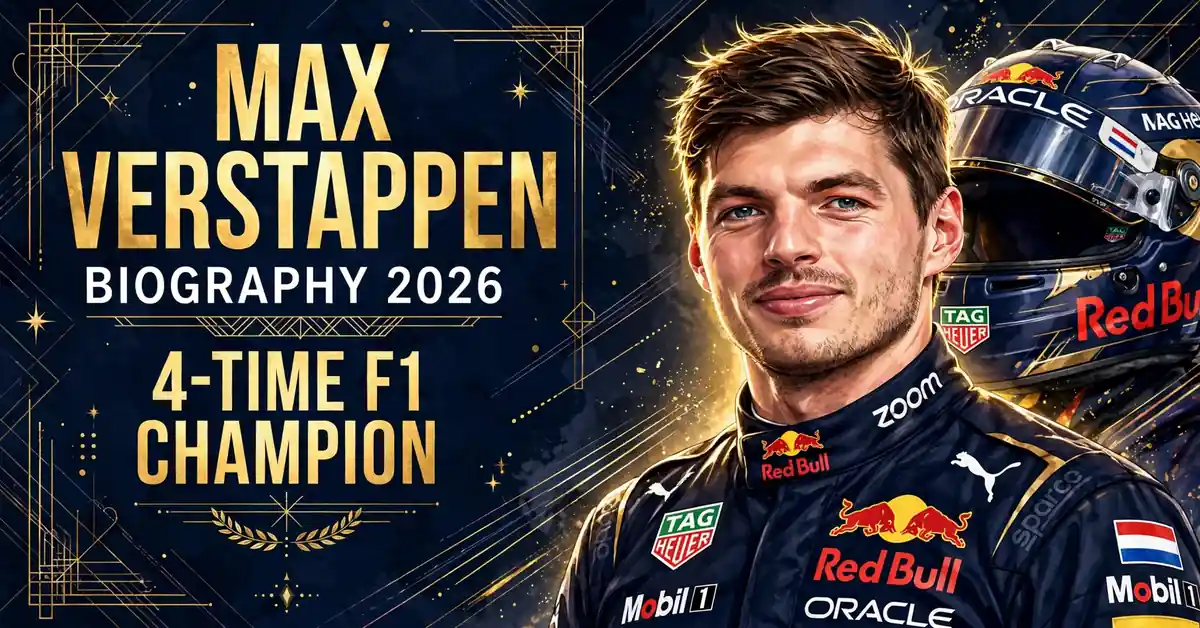
Max Verstappen biography 2026: born 30 September 1997, the Dutch driver won four straight F1 titles with Red Bull and 71 Grands Prix before turning 29.
Last updated: November 16, 2026 · By Nathan Cole
Max Verstappen biography 2026: the Dutch driver born on September 30, 1997, in Hasselt, Belgium, became the youngest driver ever to start a Formula 1 race at 17, the youngest winner ever at 18, and a four-time world champion by 27. He races for Red Bull Racing, holds 71 Grand Prix wins and four consecutive World Drivers’ Championships (2021–2024), and in 2025 he lost a fifth straight title to Lando Norris by two points. At 29, with a new car number and a new set of F1 rules for 2026, he is chasing the title back.
Verstappen’s life reads like a deliberate experiment in how fast a racing career can be compressed. He was karting at four, winning European titles before ten, racing single-seaters at 16, and standing on an F1 podium at 18. His father Jos raced 107 Grands Prix; his mother Sophie was a kart racer. The family business was speed, and the boy was put to work in it before he could read properly. What followed was a decade of records that rewrote the sport’s age limits, a rivalry with Lewis Hamilton that ended in the most disputed finale in F1 history, a 2023 season of near-total control, and a 2025 defeat by the smallest margin the championship allows.
This profile follows the life in order: the Hasselt birth and the strict karting childhood, the leap to Formula 3 at 16, the Toro Rosso debut, the instant Red Bull promotion, the four titles, the two-point loss in 2025, and the 2026 reset — a new car number, a new teammate, and new regulations. It also settles the money questions with named sources: an estimated net worth of $200–250 million in 2026 and a reported Red Bull base salary of around $65–70 million a year. Every figure is tied to the outlet that reported it, and every estimate is labelled as one.
Quick Facts
| Full Name | Max Emilian Verstappen |
| Born | September 30, 1997, Hasselt, Limburg, Belgium (age 29 in 2026) |
| Nationality | Dutch (born in Belgium to a Dutch father and Belgian mother; races under the Dutch flag) |
| Team | Red Bull Racing (since 2016; under contract through the end of 2028) |
| Car Number | #3 in 2026 (was #33, 2015–2021; #1, 2022–2025) |
| Titles | 4 Formula 1 World Drivers’ Championships (2021, 2022, 2023, 2024) |
| Career Stats | 71 wins, 48 pole positions, 127 podiums (as of the 2025 Abu Dhabi GP, per Wikipedia) |
| Height | 5 ft 11 in (181 cm), widely listed; 72 kg |
| Parents | Jos Verstappen (former F1 driver) and Sophie Kumpen (former kart racer) |
| Partner | Kelly Piquet (together since 2020, public since January 2021); daughter Lily, born May 2025 |
| Net Worth | Estimated $200–250 million in 2026 (estimate, not an audited figure) |
| Residence | Monaco (since shortly after turning 18) |
How This Biography Was Reported
Career facts come from the public record — Wikipedia’s career statistics, Britannica’s biography updated October 11, 2026, EBSCO’s research-starter profile, and Formula1.com’s own reporting. Money figures are estimates, and this profile says so each time: net worth and salary numbers come from trackers and business outlets (Celebrity Net Worth, Forbes via Athlon Sports and Crash.net, F1 Chronicle, European Business Magazine), never from Verstappen or Red Bull, who do not disclose driver pay. Where sources disagree, the profile publishes the range and names the outlets on each side. Contract terms reported in 2026 by single social-media sources are flagged as unconfirmed rather than stated as fact.
+
Born in Hasselt: A Racing Family, A Strict Childhood
Max Emilian Verstappen was born on September 30, 1997, in Hasselt, in the Belgian province of Limburg. His father was Dutch, his mother Belgian, and the household ran on motorsport. Jos Verstappen had raced in Formula 1 from 1994 to 2003, contesting 107 Grands Prix, including a debut season at Benetton as Michael Schumacher’s teammate. Sophie Kumpen had been a kart racer herself, quick enough that people who watched her race still talk about it. Max was the elder of two children; his younger sister Victoria grew up in the same paddock world.
The family lived in Maaseik and Bree, small towns in Belgian Limburg close to the Dutch border. Max’s first taste of motorsport came at two, riding a quad bike around the family home, according to Britannica. At four he moved to karting. At seven he won his first race. Within a few more years he was winning national and European karting championships, beating drivers years older than him. The pattern of his whole career was already visible: arrive early, win quickly, move up before anyone expects it.
His parents separated and later divorced while he was still a child, and Max lived mainly with his father. Jos took charge of the racing education, and his methods have drawn criticism for years. In the 2023 television documentary Max Verstappen: Anatomy of a Champion, Jos said he was strict and uncompromising because that was what reaching the top required. Max has defended his father in interviews since, saying the discipline made him. Readers can judge the method by the result, and the result is hard to argue with — but the cost of it is part of the story too, and it shaped the driver he became: self-reliant, unbothered by pressure, and famously hard to rattle.
The dual nationality question follows him everywhere. He holds claims to Belgian and Dutch citizenship through his parents, but he races under the Dutch flag with a Dutch licence. Britannica notes he chose the Dutch side because he spent more of his formative time with his father. He was raised in Belgium, speaks Dutch, English and German, and has lived in Monaco since shortly after his 18th birthday. For the full year-by-year account of his age at each milestone, see Max Verstappen’s age in 2026 — 29, with every record dated to the birthday.
Karting: Winning Before He Was Ten
Karting is where every F1 driver starts, but few start as early or win as fast as Verstappen did. He was four when he first sat in a kart. By seven he had his first race win. Before he turned ten he was collecting national and European championship titles across karting categories, the kind of record that makes team bosses in junior formulas start asking questions.
The karting years matter because they explain the driving style that later split opinion in F1. In karts, Verstappen learned to brake later than the driver ahead, to defend a position by putting his car exactly where the other driver wanted to be, and to treat every lap as a fight. He also learned to win from the front and from the back, in wet weather and dry, on tracks across Europe. By the time he left karts, he had spent more than a decade racing — and he was still only 15.
His father ran the programme with the same intensity he had applied to his own F1 career. Travel, testing, debriefs, more testing. The family poured its money and time into the karting years, betting that the boy would make it pay back. It was a gamble most racing families lose. The Verstappens won it, and the payoff started arriving in 2014, when Max was 16 and the junior single-seater world opened up to him.

Formula 3 in 2014: Ten Wins at Sixteen
In 2014, at 16, Verstappen stepped from karts into cars. He raced the Florida Winter Series first, then joined the FIA Formula 3 European Championship, the toughest junior single-seater series in the world at the time. He also joined the Red Bull Junior Team, the driver-development programme that had already produced Sebastian Vettel and Daniel Ricciardo.
The numbers from that F3 season still look strange. Verstappen won 10 races, more than any other driver in the series, including a run of six wins in a row in the middle of the season. He finished third in the championship, not first, largely because he failed to finish several races — the aggression that won him races also cost him points. That trade-off would follow him into F1: spectacular speed, paid for with the occasional crash.
One season of F3 was all it took. Red Bull had seen enough. In August 2014, before the F3 season had even finished, Toro Rosso — Red Bull’s junior F1 team — announced that Verstappen would race for them in 2015. He was 16 years old. The announcement made him the youngest driver ever signed to a Formula 1 race seat, and it forced the sport to ask a question it had never had to ask: how young is too young for F1?
F1 Debut in 2015: The Youngest Driver Ever
Max Verstappen made his Formula 1 debut at the 2015 Australian Grand Prix, driving for Scuderia Toro Rosso. He was 17 years and 166 days old, the youngest driver ever to start a Grand Prix. The record he broke had stood for decades, and the gap was not close — the previous youngest debutant had been 19.
His first race ended after 32 laps with an engine failure. The debut itself was a footnote; the season that followed was the story. Verstappen finished 12th in the drivers’ championship, scored points in his second race in Malaysia, and took a best result of fourth in Hungary and the United States. He collected the FIA’s Rookie of the Year, Personality of the Year and Action of the Year awards at the end-of-season prize giving, the last of those for a fearless overtake at the Belgian Grand Prix.
The debut also changed the rules. After the 2015 season, the FIA introduced a minimum age of 18 for a Formula 1 super licence, the credential a driver needs to race. Verstappen remains the only driver who ever started a Grand Prix at 17, because the sport moved the line after he crossed it. His 2015 season had done more than launch a career — it had forced the governing body to rewrite its own entry rules.
First Win in 2016: The Youngest Winner in History
Verstappen started 2016 with Toro Rosso and finished the season with Red Bull Racing. The promotion came after four races, when Red Bull dropped Daniil Kvyat back to Toro Rosso and moved Verstappen up. His first race for the senior team was the Spanish Grand Prix on May 15, 2016 — and he won it.
He was 18 years and 228 days old, the youngest race winner in Formula 1 history, and the first Dutch driver ever to win a Grand Prix. The win was not a gift. Both Mercedes cars had collided on the opening lap, but Verstappen still had to hold off Kimi Raikkonen’s Ferrari for the final laps on older tyres, defending with the same late-braking nerve he had shown in karts. He did it without a mistake.
The rest of 2016 confirmed it was no fluke. He finished fifth in the drivers’ championship, two places behind his new teammate Daniel Ricciardo, and produced a drive in the rain at the Brazilian Grand Prix — climbing from 16th to third in 15 laps — that veterans still cite as one of the great wet-weather performances. He was 19 years old. The sport had found its next star, and the star had arrived four years ahead of schedule.
The Learning Years: 2017–2020
The four seasons between the first win and the first title were a slow education in patience. Verstappen was fast enough to win races from 2016 onward, but the Red Bull car was not fast enough to win championships, and his own driving still carried the rough edges of a teenager.
In 2017 he failed to finish seven of his first 14 races, was involved in three first-lap collisions, and scored only one podium in that stretch. The second half of the season was better — wins in Malaysia and Mexico — and he finished sixth in the standings. In 2018 the aggression drew penalties from race officials and open criticism from other drivers and his own team. He won twice, finished fourth in the championship, and finished well ahead of Ricciardo, who left Red Bull at the end of the season. The message from inside the team was clear: the speed was never in doubt; the judgement had to catch up.
Red Bull switched engine suppliers for 2019, moving to Honda, and the change suited Verstappen. He won three races and finished third in the drivers’ championship, a career best at the time, while new teammate Alex Albon finished five places behind him. In 2020 he repeated the third-place finish behind the dominant Mercedes pair of Lewis Hamilton and Valtteri Bottas, winning twice and finishing second or third in nine other races. Across those two seasons he had established himself as Red Bull’s undisputed lead driver. All that was missing was a car that could fight Mercedes over a full season. That car arrived in 2021.
The First Title: 2021 and the Abu Dhabi Finale
The 2021 season was the most ferocious title fight Formula 1 had seen in years. Verstappen and Lewis Hamilton, chasing a record eighth world title with Mercedes, clashed on track more than once — major accidents at the British and Italian Grands Prix among them — and arrived at the final race in Abu Dhabi tied on championship points. The winner of that race would win the title.
Verstappen won 10 races in 2021. Hamilton had led much of the Abu Dhabi finale when a late safety car bunched the field, race officials made a contested decision about lapped cars, and Verstappen — on fresh soft tyres — overtook Hamilton on the final lap to take the race and the championship. It was his first world title, and he became the first Dutch driver ever to win one. He was 24 years old.
The finish remains disputed. Mercedes protested, the protests were rejected, and the FIA later changed its race-control procedures and replaced the race director. None of that changes the record books: Verstappen is a world champion from 2021. His own words after the race were simple — “it’s insane. It’s insane. I don’t know what to say.” The controversy has followed the title ever since, but so has the driving that earned it: ten wins against a seven-time champion in equal machinery, over 22 races.
Second Title: 2022 and a New Era of Control
New technical regulations took effect in 2022, forcing major changes to car design. Red Bull’s car proved fast; Mercedes’ car slumped. Verstappen won 15 races in 2022, a record for a single season at the time, and secured his second drivers’ championship with races to spare. Hamilton finished sixth. Alongside teammate Sergio Perez, Verstappen also helped Red Bull win the constructors’ championship, the team’s first since 2013.
Early in the season, the title fight looked real. Charles Leclerc won two of the first three races for Ferrari and led the championship into the spring. Then Red Bull found pace Ferrari could not match, and Verstappen won race after race through the summer and autumn. The 15-win tally broke a record set by Michael Schumacher and Sebastian Vettel, and it showed what Verstappen could do with the fastest car: win race after race through the summer and autumn without a slip.
The Record Season: 19 Wins in 2023
If 2022 was control, 2023 was domination on a scale Formula 1 had never seen. Verstappen won 19 of 22 races, broke the single-season wins record he had set the year before, and won his third consecutive drivers’ championship. He finished outside the top three just once all season. He finished every race. He more than doubled the points scored by his teammate Perez, who finished second in the standings.
He also set the record for the most wins in a row during a season: 10 consecutive victories. The Monaco Grand Prix in May showed the gap at its widest — Verstappen took pole and won, beating second-placed Fernando Alonso by more than 27 seconds. By mid-season, pundits were openly worrying that the predictability was hurting the sport. One Guardian headline put it plainly: “Max Verstappen and Red Bull are brilliant but their dominance is a problem for F1.”
The 2023 season is the strongest single-season performance in the sport’s history by the numbers: most wins, most consecutive wins, most points, biggest margin over a teammate. It also set the bar Verstappen himself would be measured against from then on. Every season since has been judged by whether he could do it again — and the answer, so far, is that nobody can do 2023 twice, including him.
Fourth Title: 2024 and the Win in the Rain
Verstappen won the first two races of 2024, then retired with a brake failure in Australia — his first failure to finish a race in almost two years. By Miami in May, Lando Norris had beaten him in a straight fight, and questions were spreading about whether the Red Bull advantage was gone. A sixth-place finish at Monaco added to the doubts.
The answer came over the next six races: two wins, a second place, and a championship lead that held through the summer break. After the break Norris kept the pressure on, but Verstappen’s drive in the rain at the Brazilian Grand Prix in November — from 17th on the grid to victory — put the title within reach. At the next race in Las Vegas, he finished ahead of Norris and sealed his fourth consecutive drivers’ championship. He was 27 years old.
Four straight titles put Verstappen in rare company. Only Juan Manuel Fangio, Michael Schumacher, Sebastian Vettel and Lewis Hamilton had won four or more consecutive drivers’ championships before him. The comparison with Vettel is the sharpest one: Vettel also won his four straight titles with Red Bull, from 2010 to 2013, in the team’s first great era. Verstappen’s four came in the team’s second. Between them, the two drivers account for eight of Red Bull’s titles. “To stand here as a four-time world champion is of course something that I never thought was possible,” Verstappen said after Las Vegas. “So yeah, at the moment, just feeling relieved in a way, but also very proud.”
Losing the Crown: 2025 and Two Points
Red Bull started 2025 behind McLaren, the 2024 constructors’ champions, and the gap showed early. McLaren secured a second consecutive constructors’ title with six races still left in the season. But Verstappen’s own performances improved sharply in the second half of the year, turning the drivers’ championship into a three-way fight between him and the two McLaren drivers, Lando Norris and Oscar Piastri.
Verstappen won 8 races in 2025, the most of any driver, and won five of the last eight races of the season, including the Abu Dhabi finale. It was not enough. Norris took third place at Abu Dhabi to secure his first world title, finishing on 423 points to Verstappen’s 421 — a margin of two points after 24 races. Piastri finished third in the standings.
Two points is the smallest honest margin in the sport: one position, in one race, anywhere in the season. Verstappen’s late-season run — the comeback that nearly stole a fifth straight title from a faster car — is now part of his reputation rather than a footnote. He lost the title, but he lost it by winning the final race and forcing Norris to earn the crown on the last day. The defeat also ended his run with the number 1 on his car, and that is where the 2026 story begins.
2026: Car Number 3 and a New Rules Era
For the 2026 season, Verstappen will race with the number 3 on his car. He confirmed the switch in December 2025, telling Dutch broadcaster Viaplay: “It won’t be number 33. My favourite number has always been 3, apart from number 1. We can now swap, so it’ll be number 3.”
The story behind the number is a small piece of F1 history. When Verstappen entered the sport in 2015, he wanted the number 3, but it belonged to Daniel Ricciardo, his future teammate. He chose 33 instead, calling it double the luck, and raced with it until he won his first title in 2021. Champions may use the number 1, and he did so for four seasons. After losing the 2025 title, the number 1 passed to Norris — who confirmed he would use it for McLaren in 2026. A recent FIA rule change now allows drivers to change their permanent numbers during their careers, something that was previously forbidden, and both the FIA and Ricciardo — who retired in 2024 — gave permission for Verstappen to take the 3.
The number is the least of the changes for 2026. Formula 1 enters a new regulations era, Red Bull runs its own Ford-backed power unit for the first time, and Verstappen has a new teammate: Isack Hadjar, promoted from Racing Bulls. The season starts on March 8, 2026, with the Australian Grand Prix. Verstappen is under contract with Red Bull through the end of 2028, a deal signed in March 2022. Some outlets reported in 2026 that a new deal running through 2030 had been signed, with figures near €92 million a year in base salary attached to the claim. Red Bull has never confirmed those terms, and this profile treats them as unconfirmed reports, not fact.
Records and Career Statistics
Verstappen’s record list is the biography in numbers. As of the 2025 Abu Dhabi Grand Prix, per Wikipedia, he has 71 wins, 48 pole positions, 36 fastest laps and 127 podiums across 11 seasons. He is one of only five drivers in F1 history to win four consecutive drivers’ championships, and the youngest driver ever to start a race and to win one.
| Season | Team | Wins | Championship |
|---|---|---|---|
| 2015 | Toro Rosso | 0 | 12th |
| 2016 | Toro Rosso / Red Bull | 1 | 5th |
| 2017 | Red Bull | 2 | 6th |
| 2018 | Red Bull | 2 | 4th |
| 2019 | Red Bull | 3 | 3rd |
| 2020 | Red Bull | 2 | 3rd |
| 2021 | Red Bull | 10 | 1st — champion |
| 2022 | Red Bull | 15 | 1st — champion |
| 2023 | Red Bull | 19 | 1st — champion |
| 2024 | Red Bull | 9 | 1st — champion |
| 2025 | Red Bull | 8 | 2nd (421 pts, Norris 423) |
The records that matter most: youngest driver to start a Grand Prix (17 years, 166 days); youngest winner (18 years, 228 days); most wins in a season (19, 2023); most consecutive wins (10, 2023); most wins in a season by a driver aged 26 or under — every age record in the book, in effect. He was made an Officer of the Order of Orange-Nassau in September 2022, a Dutch honour recognising his racing achievements. For more driver fortunes from the same grid, browse the Celebrity Net Worth archives, where his rivals’ profiles sit alongside his own.
Money: Salary, Net Worth and Endorsements
Verstappen is the highest-paid driver on the Formula 1 grid. Forbes, cited by Athlon Sports in July 2026, put his total 2026 earnings at roughly $86 million — about $78 million on track and $8 million off it. F1 Chronicle, working from the same contract reporting, puts his Red Bull base salary at $65–70 million a year, with performance bonuses of up to $11.5 million a season tied to wins, podiums and championship position, taking total on-track pay to around $76 million. The two accounts differ in the details, not the shape: a base near $70 million, bonuses on top, and nobody else on the grid close to him. The full breakdown, with the contract history and the deal figures behind it, is in Max Verstappen’s net worth in 2026 — the $538M deal context behind the $210M estimate.
His net worth is estimated at $200–250 million in 2026. Celebrity Net Worth lists about $200 million; RacingNews365 has cited around $210 million; the Dutch Quote 500 rich list put his wealth near €260 million; European Business Magazine’s August 2026 analysis put it at $250 million. The spread is wide because the inputs are private: Red Bull is privately held and discloses nothing, and endorsement values are reported by journalists rather than published by the parties. F1 Chronicle estimates his career F1 earnings at more than $245 million, and his personal endorsement income at $15–25 million a year — though Forbes’ off-track figure of $8 million shows how far apart even serious outlets sit on the sponsorship number. This profile publishes the range and names the sources rather than pretending the record is settled.
The Monaco question comes up with every Verstappen money story. He has lived in Monaco since shortly after turning 18, and Monaco charges no personal income tax. A 2023 investigation by the Dutch newspaper De Volkskrant estimated the arrangement could save him at least €200 million in taxes through 2028 compared with Dutch rates. That is the newspaper’s estimate, not a fact about his tax bill, and it is worth stating plainly: nobody outside his accountants knows what he pays. What is certain is that the Monaco move, made at 18, was the first serious financial decision of his adult life — and it was made with the same cold logic as his driving.
Personal Life: Kelly Piquet, Family and Life Away From the Track
Verstappen’s partner is Kelly Piquet, a Brazilian model and publicist and the daughter of three-time Formula 1 world champion Nelson Piquet. The couple confirmed their relationship publicly in January 2021, after being together since 2020. In May 2025 they welcomed a daughter, Lily. Verstappen was 27 when she was born, in the middle of the season in which he lost the title by two points — a year in which the private milestone and the professional defeat arrived together.
He is not reported as married. The Piquet connection makes the family story neatly circular: the son of one F1 driver partnered with the daughter of another, and their child is the grandchild of two men who raced at the top of the sport. Kelly’s father won his three titles in the 1980s; Verstappen’s father raced in the 1990s and 2000s. The paddock is small, and the Verstappen-Piquet family sits at its centre.
Away from racing, Verstappen is a serious sim racer, competing in online endurance events with his Team Redline outfit — a hobby that doubles as training, since the reaction times and racecraft transfer directly. He speaks Dutch, English and German, supports FC Barcelona and PSV Eindhoven, and keeps his private life out of the press as far as a four-time world champion can. He lives in Monaco, trains hard, and has said he does not expect to race into his forties the way Fernando Alonso has. The plan, as he has described it, is to win what he can while he is at his peak, then try other forms of racing — endurance events included — before the age of 40.
Driving Style and Influence on the Sport
Verstappen’s driving style is the most argued-over subject in modern Formula 1. His defenders point to the car control: the late braking, the wet-weather feel, the ability to keep a sliding car on the road at speeds where others would crash. His critics point to the collisions — the 2017 and 2018 incidents, the 2021 clashes with Hamilton — and call the style reckless. Both sides are describing the same driver. The aggression that caused penalties in 2018 is the aggression that won the 2021 title on the final lap.
His influence on the sport is measurable. The FIA’s minimum age of 18 for a super licence exists because he debuted at 17. The 2023 season forced a public debate about whether one driver’s dominance was hurting the sport’s appeal. And the 2025 season, in which McLaren’s two young drivers beat him by two points, showed the grid he helped shape: Carlos Sainz, who won races for Ferrari in 2024, George Russell, who leads Mercedes into the 2026 rules reset, and the McLaren pair all race in a sport whose competitive order Verstappen defined for four years. Britannica’s assessment is blunt: he is one of only five drivers ever to win four consecutive titles, and one of the most influential figures in contemporary Formula 1.
What Comes Next: The Fifth Title Chase
The 2026 season is the most open question of Verstappen’s career. New regulations reset the competitive order, Red Bull’s new Ford-backed power unit is unproven, and McLaren arrives as the defending champion team with Norris carrying the number 1. Verstappen has never started a season as the challenger since 2021. At 29, with four titles and 71 wins, he has nothing left to prove — and a fifth title would put him alongside only Fangio, Schumacher, Hamilton and Vettel in the sport’s history.
His contract runs through 2028, which gives Red Bull time to build around him, and his age gives him time too: champions have won titles into their late thirties, and Verstappen has said he wants to try endurance racing before 40 rather than chase F1 records into his forties. The realistic reading of 2026 is that it is a building year for Red Bull and a proving year for Verstappen — the first season in five in which the number on his car is not 1, and the first in which the sport will find out whether the fastest driver of his generation can win again without the fastest car.
If he does, the biography gets a fifth chapter at the top. If he does not, the four titles, the 71 wins and the records he set before turning 28 already place him among the greatest drivers the sport has produced. Either way, the story that began with a four-year-old in a kart in Limburg is not finished — it has simply reached the part where the outcome is uncertain again, which is where Verstappen has always been at his best.
Frequently Asked Questions
How old is Max Verstappen in 2026?
Max Verstappen is 29 years old in 2026. He was born on September 30, 1997, in Hasselt, Belgium, and he turned 29 on September 30, 2026. He won his first world title at 24 and his fourth at 27.
Where was Max Verstappen born?
Max Verstappen was born in Hasselt, Limburg, Belgium, on September 30, 1997, and raised in Maaseik and Bree. He is Dutch and Belgian by parentage — his father Jos is Dutch, his mother Sophie Kumpen is Belgian — but he races under the Dutch flag with a Dutch licence.
How many F1 championships has Max Verstappen won?
Max Verstappen has won four Formula 1 World Drivers’ Championships, consecutively in 2021, 2022, 2023 and 2024 with Red Bull Racing. He is one of only five drivers in F1 history to win four straight titles. He finished runner-up in 2025, two points behind Lando Norris.
When did Max Verstappen make his F1 debut?
Max Verstappen made his Formula 1 debut at the 2015 Australian Grand Prix for Toro Rosso, aged 17 years and 166 days — the youngest driver ever to start a Grand Prix. The FIA later set a minimum age of 18 for a super licence, so the record can never be broken.
Who is Max Verstappen’s partner?
Max Verstappen’s partner is Kelly Piquet, a Brazilian model and publicist and the daughter of three-time Formula 1 world champion Nelson Piquet. They confirmed their relationship publicly in January 2021, and their daughter Lily was born in May 2025. He is not reported as married.
What is Max Verstappen’s net worth in 2026?
Max Verstappen’s net worth in 2026 is estimated between $200 million and $250 million. Celebrity Net Worth lists about $200 million, RacingNews365 has cited around $210 million, and European Business Magazine’s August 2026 analysis put it at $250 million. No audited accounts exist, so every figure is an estimate.
What is Max Verstappen’s salary?
Max Verstappen’s Red Bull base salary is reported at around $65–70 million a year, with performance bonuses of up to $11.5 million a season, taking total on-track pay to roughly $76 million. Forbes, cited by Athlon Sports in July 2026, put his total 2026 earnings at about $86 million including endorsements. He is the highest-paid driver on the grid.
What car number will Max Verstappen use in 2026?
Max Verstappen will race with car number 3 in 2026. He previously used #33 from 2015 to 2021 and #1 as reigning champion from 2022 to 2025. The number 3 was his favourite and previously belonged to Daniel Ricciardo, who gave permission for the switch after an FIA rule change allowed mid-career number changes.
Sources & Reporting
This biography was reported from the public record between October and November 2026. Career facts and statistics come from Wikipedia’s Max Verstappen profile (career totals as of the 2025 Abu Dhabi Grand Prix: 71 wins, 48 poles, 127 podiums) and Britannica’s biography, updated October 11, 2026, by Laura Payne. Early-life and junior-career detail comes from EBSCO’s Research Starters profile and Formula Daily’s driver profile. The 2026 car-number change is reported from Formula1.com (December 18, 2025), Sky Sports, Autosport and RacingNews365. The 2025 championship margin (423–421) is reported from Formula1.com, Sky Sports and Bleacher Report.
Money figures are estimates from named outlets: Athlon Sports (July 15, 2026, citing Celebrity Net Worth and Forbes); F1 Chronicle (salary and net-worth estimates); European Business Magazine (August 22, 2026); PaddockIntel (net-worth range and contract reporting); BiographyDiary (audit of the unconfirmed 2030 contract figures); Crash.net, citing Forbes (2026 earnings split). The De Volkskrant tax-saving estimate is that newspaper’s 2023 investigation, cited via PaddockIntel. Height and weight are listed by Healthy Celeb (updated October 6, 2026). No figure in this profile comes from Verstappen or Red Bull Racing, who do not disclose driver pay. Corrections: if any fact here is wrong, contact us and we will correct it — see our corrections policy on the About page.
About the Author
Nathan Cole is the editor of Guide Net Worth, where he covers celebrity fortunes, contracts and careers with named sources and dated reporting. He researches every profile from live reporting and public records, and labels every estimate as one.
References & Sources
This article has been fact-checked and verified against multiple public sources, financial disclosures, SEC filings, Forbes reports, Celebrity Net Worth databases, and official records. All net worth estimates are based on publicly available information and financial analysis.