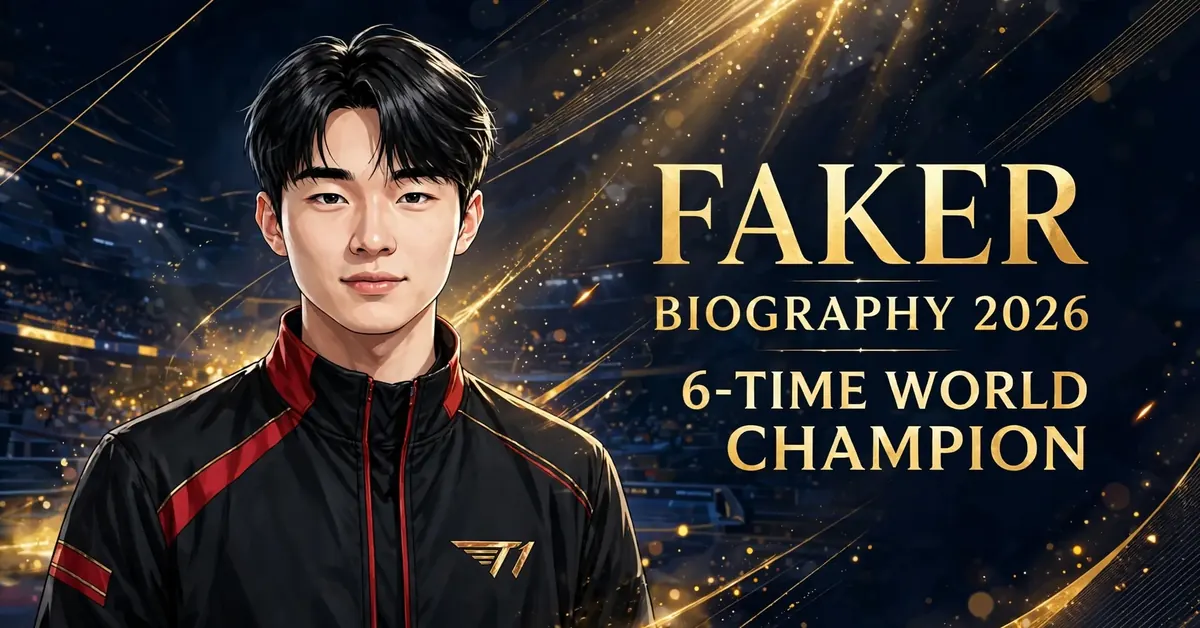
Faker biography 2026: Lee Sang-hyeok, born May 7, 1996, is T1’s mid laner and the only 6-time LoL world champion — from Seoul prodigy to Hall of Legends.
Last updated: November 17, 2026 · By Nathan Cole
Lee Sang-hyeok — Faker — is 30 years old, and he is the greatest League of Legends player who has ever lived. Born May 7, 1996, in Seoul, South Korea, he has played mid lane for T1 since 2013, his entire professional career with one organization, and he has won the World Championship six times: 2013, 2015, 2016, 2023, 2024, and 2025. No other player has won it more than twice. He was the first player inducted into the LoL Esports Hall of Legends, in 2024, and he is a part-owner of the team he plays for. His contract runs through 2029, when he will be 33.
The 2026 season tested the legend in a way no season had before. T1 finished the year without a single major trophy for the first time since 2021, and Faker’s bid for a fourth straight world title ended in the semifinals of Worlds 2026, when Bilibili Gaming beat T1 3-1 in Allen, Texas, on November 8 — ending a 13-year unbeaten run against Chinese teams in World Championship knockout series. The same year brought a second Asian Games gold medal, in Aichi-Nagoya in October, and a 2026 stat line of 108 wins against 64 losses across 172 games, per mid.gg. The trophies stopped. The standard did not.
This biography is current through November 17, 2026. It covers the Seoul childhood, the 2013 signing at 17, the Zed play that made him famous, the dynasty years, the lean years, the second peak of three straight world titles, the Hall of Legends induction, the trophyless 2026 season, the money — an estimated net worth of $25 million, inside a $20 million to $40 million evidence range anchored on this site’s own net-worth profile and Alux’s November 2026 reporting — and the private life he has kept out of the cameras for 13 years. Every figure carries its outlet and its date. Where the outlets disagree, the disagreement is printed, not hidden.
Quick Facts
| Full Name | Lee Sang-hyeok (이상혁) — known as Faker |
| Born | May 7, 1996, Gangseo District, Seoul, South Korea (age 30 in 2026; turns 31 on May 7, 2027) |
| Nicknames | Unkillable Demon King · Hide on bush · GoJeonPa (고전파) |
| Team / Role | T1, mid laner — with T1 since 2013; under contract through November 19, 2029 |
| World Championships | 6 (2013, 2015, 2016, 2023, 2024, 2025) — the record; Finals MVP 2016, 2024 |
| Other Titles | 2× MSI (2016, 2017) · 10× LCK champion · Esports World Cup 2024 · Asian Games gold 2022, 2026 |
| Hall of Legends | First inductee (announced May 22, 2024; inducted June 6, 2024, The Shilla Seoul) |
| Career Record | 1,785 professional games, 66.5% win rate (mid.gg); 2026: 108–64 in 172 games |
| Prize Money | $1,922,085 from 74 tournaments, 2013–2025 (Esports Earnings); over $2.1M by April 2026 (Win.gg) |
| Net Worth (2026) | Estimated $25M, inside a $20M–$40M evidence range (see breakdown) |
| Height | 176 cm (5 ft 9 in) |
| Equity | Part-owner of T1 since 2020; stock option for 6,156 shares, 5.66% of T1 if exercised |
How This Biography — and the Money Figure — Were Verified
Faker’s career is the best-documented career in esports, and this profile leans on the record rather than on the mythology. The match results come from Leaguepedia and Liquipedia scoreboards, cross-checked against Wikipedia’s Faker page and Riot Games’ own Hall of Legends announcement. The 2026 season results — the LCK Cup, MSI, Esports World Cup, LCK Summer, and Worlds 2026 — come from reporting published November 8–12, 2026, by TalkEsport, Insider Gaming, and Pro Gamer, with the semifinal result (BLG 3-1, Allen, Texas) confirmed across all three. The career totals — 1,785 games and a 66.5% win rate — come from mid.gg, which aggregates Leaguepedia scoreboards, and the 2026 split of 108 wins and 64 losses in 172 games comes from the same source.
The money figure is a different kind of number. Faker has never disclosed his finances, and T1 has never published his salary or a valuation of the company he part-owns, so no exact net worth exists in public. This profile uses the same anchor as this site’s Faker net-worth profile: $25 million, inside a $20 million to $40 million evidence range. The pillars behind it are on the record — $1,922,085 in career prize money from Esports Earnings, a 5.66% T1 stock option approved by shareholders on January 16, 2023 (Inven Global), and a salary Korean press reporting puts at about $6 million a year (Naver), with Aussyelo reporting $7–8 million a year under the 2025 extension. Alux, in its November 2026 ranking of the richest esports players, puts Faker at $30 million, inside the same band. A $45–55 million print from Esportport is named in the money section as the high outlier and is not used as the anchor. Where the outlets disagree, the disagreement is printed, not hidden.
+
The Short Answer: 30 Years Old, T1, Six World Titles
Faker is 30 years old. He was born Lee Sang-hyeok on May 7, 1996, in Gangseo District, Seoul, South Korea, and he turned 30 on May 7, 2026. He has played professional League of Legends for one team his whole life: SK Telecom T1, now known as T1, which signed him in February 2013 when he was 17. In 13 years he has won the World Championship six times — 2013, 2015, 2016, 2023, 2024, and 2025 — more than any other player in the game’s history. The next-best players have two titles each. He has also won the Mid-Season Invitational twice, the LCK ten times, the Esports World Cup once, and two Asian Games gold medals. Riot Games made him the first inductee into the LoL Esports Hall of Legends in 2024.
The numbers only tell half the story. Faker is the player other professionals measure themselves against, and the comparison has followed him since his debut year. He is the Michael Jordan of League of Legends — the analogy appears in almost every profile of him, including Wikipedia’s — because the dominance lasted so long and because it came with the same one-team loyalty. Jordan never played for another NBA team. Faker has never played for another esports organization. He turned down offers reported at more than $10 million a year from Chinese and North American teams in 2020, per Aussyelo, and stayed with T1. In 2020 he became a part-owner of the team. In July 2025 he signed a four-year extension that keeps him at T1 through November 19, 2029, when he will be 33.
He is 176 cm tall — 5 feet 9 inches — a figure covered in full in Faker’s height profile, and his money is covered in full in Faker’s net-worth profile: an estimated $25 million in 2026, inside a $20 million to $40 million range, built on a reported salary of about $6 million a year, a 5.66% equity stake in T1, $1.92 million in career prize money, and a building in Seoul’s Gangnam district. This biography is the story behind those numbers — how a teenager from Gangseo became the standard every mid laner is judged against, and what happened when, in 2026, the trophies finally stopped coming.
Early Life in Seoul: The Boy Who Played All Day
Lee Sang-hyeok was born on May 7, 1996, in Gangseo District, on the western edge of Seoul. He grew up in a household that, by his own later accounts, gave him a lot of freedom and very little structure. He played games the way some kids play football — all day, every day, because the games were there and he was good at them. Before League of Legends, there was Chaos, a custom map for Warcraft III, and the arcade-style games Korean PC bangs were full of in the 2000s. He was not a child prodigy groomed for a career. He was a kid who liked games and happened to be unusually good at them.
League of Legends arrived on the Korean server in 2011, when Faker was 15. He started playing under the name GoJeonPa (고전파), and within a year he was the top-ranked player in Korea. PrizePicks, in its 2026 history of Faker, puts it plainly: by 16, he was the top-ranked LoL player in the country. The ranked ladder in Korea was — and still is — the hardest in the world, and the player at the top of it was a teenager who had never played a professional match. Scouts notice that kind of thing. In early 2013, SK Telecom T1, the esports arm of Korea’s biggest telecom company, came calling.

He left school to join the team. He was 17, and the decision was the kind that only looks obvious in hindsight. In 2013, professional gaming in Korea was real but small, and a teenager leaving school for it was a gamble his family had to live with. Faker has rarely spoken about the family side of the decision — his private life is the one subject he has kept guarded for his whole career — but the professional side is on the record. On February 6, 2013, he was officially announced as the first player for SK Telecom T1 2, the organization’s sister team, per Liquipedia. Within months, the sister team was the main event.
The Gangseo childhood matters because it explains the player Faker became. He did not come up through an academy system or a youth program. He came up through solo queue, alone at a computer, learning the game by playing it thousands of times against strangers. That is why his style has always looked like solo queue perfected: the confidence to take a fight no one else would take, the mechanics to win it, and the calm to do it again five minutes later. The Zed play that made him famous, months after his debut, was a solo-queue play performed on the biggest stage in the game. It was not something he learned at T1. It was something he brought with him.
From Solo Queue to SK Telecom: The 2013 Signing
SK Telecom T1 signed Faker for the same reason every great team signs a teenager: they saw something they could not teach. The organization’s scouts had watched GoJeonPa dominate the Korean ladder, and in February 2013 they made him the first player on SKT T1 2, a sister team built around him in the mid lane. He was 17 years old, playing professionally for the first time, on a team that existed because he existed. The main SKT roster was the established team. The sister team was the bet.
The bet paid off fast. In his debut split, OLYMPUS Champions Spring 2013, Faker’s team finished third — a strong result for a brand-new roster built around a rookie. Then came the summer. SKT T1 K, as the team was now known, won the LCK title in Summer 2013, and Faker, still 17, was the best mid laner in Korea. The rise took about six months from his first professional match to a domestic championship. Nobody in Korean League of Legends had done it that fast, and nobody has done it since.
The 2013 season ended at the World Championship in Los Angeles, and Faker’s first Worlds was a coronation. SKT beat Royal Club 3-0 in the final, and the 17-year-old mid laner was a world champion in his first year as a professional. He was also, by general agreement, already the best player in the world. The speed of it is hard to overstate: signed in February, domestic champion by August, world champion by October. The gap between Faker and the rest of the mid lane in 2013 was the widest it has ever been in the game’s history, and it set the pattern for the decade that followed — every era of League of Legends since has been measured, in part, by how close anyone got to him.
One detail from that first year is worth keeping. Faker’s contract, his team, his game — everything about 2013 was SK Telecom. The organization that signed him is the organization he still plays for. Thirteen years, one team. In esports, where rosters turn over every season and players change teams the way footballers change boots, that is the rarest number on his résumé. It is also the number that explains the equity stake, the part-ownership, and the extension through 2029: Faker is not an employee of T1. He is, in the practical sense, part of the institution.
The Zed Play and the First World Title
If one play made Faker famous, it was the Zed outplay against KT Rolster Bullets’ Ryu at Champions Summer 2013. The situation was a mid-lane duel, one-on-one, both players on Zed, both at low health. Ryu went in for the kill. Faker sidestepped, turned, and killed him with a sliver of health left — a sequence so precise that it is still shown to new players as the definition of mechanical skill. Skoar, in its 2026 profile of Faker, calls it one of the most iconic plays in esports history. It was August 2013. Faker had been a professional for six months.
The play mattered because it was visible. League of Legends is a hard game to watch if you do not play it, and most of what makes a player great — the wave management, the map awareness, the timing — is invisible to a casual viewer. The Zed play was visible. Two players, same champion, one winner, by a margin of a few hit points. Anyone could see what had happened, and anyone could see that it should not have been possible. The clip travelled, the nickname stuck — the Unkillable Demon King — and Faker became the first esports player whose fame reached beyond the game’s own audience.
The nickname was earned in the months that followed. SKT won the Summer split, then won Worlds 2013, beating Royal Club 3-0 in the final. Faker finished his debut year as a domestic champion and a world champion, and the game’s best player by a distance. The 2013 title is the one that anchors every Faker biography, because it is the one that made the rest of the story possible: a 17-year-old who had never played professionally before February was, by October, the standard every mid laner in the world was judged against. Thirteen years later, he still is.
There is a second lesson in the Zed play, and it is about how Faker plays. His signature champions have always been the ones that reward nerve — Zed, LeBlanc, Ryze, Azir — champions that let a great player take a fight that looks lost and win it on mechanics. The 2026 season, when he was 30, was built on the same family of champions: control mages such as Ryze, Anivia, Orianna, and Azir, per mid.gg. The speed faded with age. The champion pool did not. Faker at 30 plays the same kind of game Faker at 17 played, with the same patience and the same willingness to take the fight.
The Dynasty Years: 2015–2017
After the coronation came the one year that did not go to plan. In 2014, SKT missed the World Championship — the only Worlds of Faker’s first decade he did not attend as a player — and won the smaller titles instead: the NLB championship and the All-Star Invitational, per Wikipedia. The gap year matters because it is the only time in his career that the machine stopped, and it is the reason the years that followed count as a dynasty rather than a streak. A streak ends. A dynasty comes back.
It came back in 2015. SKT won the LCK in Spring and Summer, then won Worlds 2015, beating KOO Tigers 3-1 in the final and losing only one game in the entire tournament. In 2016, they won the LCK Spring split, the Mid-Season Invitational — beating Counter Logic Gaming 3-0 in the final, with Faker named MSI Finals MVP — and then Worlds 2016, beating Samsung Galaxy 3-2 in the closest final of his career, with Faker named Worlds Finals MVP. In 2017, they won the LCK Spring split again and the MSI again, and reached a third straight Worlds final, where Samsung Galaxy beat them 3-0.
Three years, two world titles, one lost final, ten domestic and international trophies in the period when the game was at its most competitive. The 2015–2017 run is the stretch that made the Jordan comparison stick, because it was not a single great year — it was a team that stayed at the top while the game changed around it. The meta shifted from season to season. The rosters around Faker changed. The results did not. Between Summer 2013 and Spring 2017, Faker won eight LCK titles, and the only finals he lost were the ones that made the story interesting.
The 2017 final loss deserves a paragraph of its own, because it is the defeat that shaped the next era. Samsung Galaxy beat SKT 3-0 in Beijing, and the scoreline was as one-sided as a Worlds final gets. Faker cried on stage — the image is one of the most famous in esports — and the loss ended the dynasty’s first chapter. He was 21. He had already won three world titles, and he had just lost a final 3-0. The defeat did not end his career. It reset it. The Faker who came back from 2017 was a different player: less explosive, more patient, and — over the next nine years — harder to beat in the games that mattered most.
The Lean Years: 2018–2022
The five years after the 2017 final were the longest stretch of Faker’s career without a world title, and they are the years that make the biography honest. In 2018, SKT missed Worlds again. In 2019, they won the LCK in Spring and Summer but lost to G2 Esports in the Worlds semifinal. In 2020, they won the LCK Spring split and lost in the Worlds quarterfinal to DWG, the eventual champions. In 2021, they reached the Worlds semifinal and lost to DWG KIA. In 2022, they reached the Worlds final — Faker’s fourth — and lost to DRX 3-2, in one of the great finals in the game’s history, a five-game series that went to the last team fight.
The lean years were not barren. Faker won LCK titles in Spring and Summer 2019 and Spring 2020, taking his domestic total to ten, and he became a part-owner of T1 in 2020 — the year the organization restructured and the player became a shareholder. The 2020 decision is the one that separates Faker’s story from every other player’s. He turned down offers reported at more than $10 million a year from Chinese and North American teams, per Aussyelo, and stayed. The money he gave up is unknowable. The equity he took instead — the 6,156-share stock option approved in January 2023, worth 5.66% of T1 if exercised — is the asset that now anchors his net worth.
What the lean years proved was the thing the dynasty years could not: that Faker would keep playing at the top when the winning stopped. Most great players retire when the titles dry up, or move to an easier league for a bigger contract. Faker did neither. He stayed with T1, kept reaching semifinals and finals, and kept losing them — 2019 to G2, 2021 to DWG KIA, 2022 to DRX — until the team around him was good enough again. The 2022 final loss to DRX, 3-2, was the closest he came, and the most painful: a five-game final, decided in the last minutes, against a team that had barely qualified for the tournament.
There is a number from this period that belongs in any honest biography. By the end of 2022, Faker had been a professional for ten years, and he had won three world titles — all of them before he turned 21. The question that followed him into 2023 was whether the first three were the whole story, and whether a player who had not won the game’s biggest prize in seven years could win it again. The next three years answered that question three times over.
The Second Peak: Worlds 2023, 2024, 2025
Faker won his fourth World Championship in 2023, at 27, seven years after his third. T1 beat Weibo Gaming 3-0 in the final in Seoul, in front of a home crowd, and the victory ended the longest title drought of his career. It also made him the only player to win Worlds in three different eras of the game: the early years (2013), the dynasty (2015–2016), and the second peak (2023–2025). No other player has won in two eras. Faker has won in three.
The 2024 title was harder. T1 beat Bilibili Gaming 3-2 in the final, coming back from 1-2 down, and Faker was named Worlds Finals MVP for the second time, eight years after the first. The comeback mattered because it was the kind of series the younger Faker had lost — the 2022 final against DRX had gone the same way, five games, decided late — and the older Faker won it. The difference was not mechanics. It was the patience the lean years had taught him: the willingness to lose a game, reset, and win the next two.
The 2025 title completed the three-peat. T1 beat KT Rolster 3-2 in the final, and Faker, at 29, became the first player to win six World Championships — and the first to win three in a row. The three-peat had never been done before, by any team, in the game’s history. It was also the last trophy T1 would win for a while. The 2025 final is the high-water mark of the biography: six titles, a three-peat, a Finals MVP, and a contract extension signed in July 2025 that ran through 2029. Everything after it is the story of what happens when the peak passes.
The three-peat also settled the one argument that had followed Faker since 2017: whether the second half of his career could match the first. It could, and it did. The first three titles came when he was a teenager and the best player in the world by a distance. The second three came when he was 27, 28, and 29, no longer the best mechanical player in the game, winning on experience, shot-calling, and the kind of calm that only comes from having lost finals before. The 2023–2025 run is the better achievement, because it was harder, and the people who watched both runs know it.
Hall of Legends: The First Inductee
On May 22, 2024, Riot Games announced Faker as the first inductee into the LoL Esports Hall of Legends, a Hall of Fame for the game. He was inducted on June 6, 2024, at The Shilla Seoul, in a ceremony that treated him the way baseball treats its first Hall of Fame class. The honour came with a skin: Immortalized Ahri, a signature champion bundle built around his career, with a share of the revenue going to Faker. The skin sold, the bundle sold, and the royalties became a new line in his income — the kind of money that does not show up in a salary figure.
The induction matters for the biography because it was the game’s own verdict, delivered while he was still playing. Halls of Fame usually wait for retirement. Riot did not wait, because the case was already closed: six world titles were still a year away, and the argument was already over. Faker was the first inductee because there was no plausible second choice. The player who would have been second — whoever it was — was not close, and everyone in the game knew it.
There is a detail in the Hall of Legends story that says something about Faker himself. He accepted the honour the way he accepts everything: quietly, with a short speech, and then he went back to work. The ceremony was in June 2024. Four months later he won his fifth world title. A year after that, his sixth. The Hall of Legends induction did not mark the end of his career. It marked the middle of it — and the trophies that followed are the reason the induction reads, in hindsight, as premature only in the sense that it came too early to include everything.
The 2026 Season: Trophyless for the First Time Since 2021
The 2026 season was the first trophyless year for T1 since 2021, and the first year since 2018 in which the team failed to reach a single Grand Final. The results, tournament by tournament, tell the story plainly: fourth at the LCK Cup, fifth-sixth at MSI 2026, fourth at the Esports World Cup 2026, third in the LCK 2026 season — after a 1-3 loss to Hanwha Life Esports in the September lower-bracket final — and third-fourth at Worlds 2026. The team was good enough to reach the semifinal of the World Championship and not good enough to win it, and that gap is the whole season in one sentence.
Faker’s own numbers held up. He played 172 games in 2026 and won 108 of them, per mid.gg — a 62.8% win rate in a year his team won nothing, against a career win rate of 66.5% across 1,785 games. The champion pool was the same family it has always been: control mages such as Ryze, Anivia, Orianna, and Azir, the champions that reward patience and punish mistakes. At 30, he was still the player T1 built its game around. The game around him was the problem.
The season’s honesty is in the gap between the two halves of the year. In the first half, T1 looked like a team in transition, finishing fourth at the LCK Cup and fifth-sixth at MSI — the worst MSI result of Faker’s career. In the second half, they steadied: third in the LCK, a Worlds semifinal. The improvement was real, and it was not enough, and that is the story of 2026. A team that had won three straight world titles finished the year with nothing, and the player who had defined the game for 13 years finished it without a trophy for the first time in five years.
What 2026 did not do is end the career. After the Worlds semifinal loss, Faker spoke to the media and made it clear he is not done, per TalkEsport. He is under contract through 2029. He is 30, which in League of Legends is old, and he is the first player to win 600 LCK games, per Inven Global — a milestone that arrived during this trophyless season and that says more about his longevity than any trophy could. The 2026 season is a chapter, not an ending. The biography is not finished.
Worlds 2026: BLG Ends the Four-Peat
Worlds 2026 was held in the United States, and T1’s defence of the title ended in the semifinals. The run started well: T1 cleared the Swiss stage 3-1, then beat Karmine Corp 3-1 in the quarterfinals on November 6. The semifinal, against Bilibili Gaming at the Credit Union of Texas Event Center in Allen, Texas, on November 8, ended 3-1 to BLG. The three-time defending champions were out. The bid for a fourth straight title — a feat no team had ever achieved — was over.
The series was closer than the scoreline suggests. Faker’s Ahri kept T1 in the third game, and his Akali sparked a comeback in the fourth, erasing a gold deficit with a team fight around the 28-minute mark. But BLG won the next mid-lane fight and closed the game out, and with it the series. The defeat ended two streaks at once: T1’s three-year hold on the Summoner’s Cup, and a 13-year unbeaten run in World Championship knockout series against Chinese teams — 13 best-of-five series without a loss, stretching back to Faker’s first Worlds in 2013. BLG advanced to the final against Gen.G at the Barclays Center in Brooklyn.
Faker’s own words after the loss were short and unspun. “Overall, I think the opponent was better prepared than we were,” he told the media, per TalkEsport. “We couldn’t play the game the way we had planned.” He did not blame his teammates, the meta, or the schedule. He said the other team was better prepared, and then he said he is not done. It is the same response he gave after the 2017 final loss, and after the 2022 final loss, and it is the reason the 2026 defeat reads as a chapter rather than an ending: Faker has lost finals before, and he has always come back.
The semifinal result leaves the count where it has been since 2025: six World Championships, the record, unchanged by the 2026 season. Whatever happens in the final in Brooklyn, Faker’s total stays at six. The four-peat is gone. The record is not. And the contract runs through 2029, which means the 2027 season — and the question of whether T1 rebuilds around a 31-year-old mid laner — is the next chapter, not this one.
Asian Games Gold: 2022 and 2026
Faker has won two Asian Games gold medals, and the second one came in the middle of the trophyless 2026 club season. In early October 2026, representing the South Korean national team at the Asian Games in Aichi-Nagoya, he won gold in a 3-0 finals sweep over Chinese Taipei, per Pro Gamer. It was the only gold medal he won in 2026 — the only trophy of any kind in a year when his club team won nothing — and it arrived a month before the Worlds semifinal defeat.
The first gold came at Hangzhou in 2022, and it carried a consequence beyond the medal: Asian Games gold brought South Korea’s esports players the military exemption that every Korean male athlete covets. For Faker, who was 26 at the time, the exemption removed the one obligation that could have interrupted his career — the mandatory military service that has paused the careers of Korean athletes and idols alike. The 2022 gold was, in that sense, the most valuable medal of his career, even though it was not a club trophy.
The two golds frame the biography neatly. The first, in 2022, secured the career. The second, in 2026, salvaged the season. Between them, Faker won three world titles, entered the Hall of Legends, and became a part-owner of his team. The national team is the one place where Faker’s story overlaps with the rest of Korean sport — the Asian Games, the flag, the anthem — and it is the one place where the Unkillable Demon King is, simply, a Korean athlete representing his country. The 2026 gold is the reason the trophyless season is not a winless year, and it is the medal he will carry into 2027.
The Money: Salary, Equity, and the M Anchor
Faker’s net worth in 2026 is estimated at $25 million, inside a $20 million to $40 million evidence range. The range matters more than the single number, because nobody outside T1 knows Faker’s real finances: T1 has never disclosed his salary, and it has never published a valuation of the company he part-owns. Every figure in circulation is an estimate built from the same three public pillars — a reported salary, an equity stake, and prize money — plus endorsement income whose value is private. This section prints the pillars, names the outlets behind each one, and explains why the outlets disagree.
The salary is the biggest pillar and the least confirmed. Naver reporting puts Faker’s pay at roughly $6 million a year, a figure framed by the Korean press itself as a rough estimate. Aussyelo, reporting on the July 2025 extension, puts the new deal at $7–8 million a year. If the reported salary is right, Faker has earned on the order of $30 million in pay since 2020 before tax, on top of whatever the 2017–2019 contracts paid, per LoLTheory’s August 2026 analysis. That arithmetic is the reason the $10 million net-worth prints — including the $10 million figure carried by thecityceleb in 2026 — are almost certainly too low: $10 million is roughly two years of his reported salary.
The equity is the second pillar, and it is the one on the record. In 2020, Faker became a part-owner of T1. On January 16, 2023, T1’s shareholders approved a stock option that lets him buy 6,156 newly issued shares at 2,097,419 KRW each — about $1,700 at the time — which would give him 5.66% of T1 Entertainment & Sports if he exercises it all, per Inven Global’s reporting of the corporate filing. T1’s valuation is itself an estimate: Esportport, in November 2026, put the franchise at $220–245 million, while Aussyelo has suggested $300–400 million. At the lower valuation, the stake is worth roughly $12–14 million. At the higher one, $18–24 million. The spread in the valuation is the main reason the net-worth estimates disagree.
The prize money is the smallest pillar and the most exact. Esports Earnings tracks Faker at $1,922,085 from 74 tournaments between 2013 and 2025, all of it from League of Legends. His single biggest payout was $338,000 for winning Worlds 2016. Win.gg, in April 2026, put the career total over $2.1 million. Prize money is a small share of the fortune — a few million against a salary in the tens of millions — and it is the only pillar that is not an estimate. Everything else is.
Put the pillars together and the published estimates cluster in a band. Alux, in its November 2026 ranking of the richest esports players, puts Faker at $30 million, built from his T1 salary, his part-ownership, the Seoul building, and about $2.1 million in prize money, and notes that published figures range from $20 million to $40 million. Aussyelo puts the range at $25–50 million. This site’s Faker net-worth profile anchors at $25 million inside the $20–40 million band — the same anchor used here. Esportport’s $45–55 million print is the high outlier, and it rests on the highest salary estimate ($7–8.5 million a year) and the highest valuation assumptions. Faker’s net worth in 2026 carries the full breakdown, the year-by-year table, and the source list behind the anchor.
Faker Tower and the Business of Being Faker
The most concrete asset in Faker’s fortune is a building. In 2020, he bought a nine-story office building in Seoul’s Gangnam district — the neighbourhood the rest of the world knows from a pop song and Koreans know as the most expensive commercial real estate in the country — for more than $8 million, per Alux’s November 2026 reporting. The building is nicknamed Faker Tower, and it is the asset that separates his fortune from a pure salary story: a player who bought real estate at 24, in the district where his team’s sponsors do business, and held it while its value rose.
The building is one of four income lines beyond the salary. The second is the Hall of Legends skin bundle — the Immortalized Ahri collection, released after his 2024 induction, with a revenue share that Riot does not disclose. The third is the six sets of SKT/T1 Worlds Championship skins, which pay royalties each time they sell. The fourth is endorsements and streaming: Aussyelo estimates $2–4 million a year from sponsors and $1.2–1.8 million a year from streaming, putting his total annual income at $10–14 million when combined with the salary. None of those figures is confirmed by Faker or T1. All of them are estimates, and this profile prints them as estimates.
T1’s own commercial machine is the backdrop. The team’s sponsors include SK Telecom, Mercedes-Benz, Red Bull, Samsung Odyssey, Spotify, GoalStudio, Razer, Secretlab, and Hana Bank, per Esportport, and the organization is owned by SK Telecom CS T1 Co., a joint venture between SK Square — which holds 55.4% — and Comcast Spectacor. Faker’s value to that machine goes beyond his play. It is the brand: the player whose name sells the skins, fills the arena, and anchors the sponsorship decks. The equity stake is the formal version of that value. The building is the personal version.
Personal Life: Private by Design
Faker is not publicly dating anyone, and he has never confirmed a public relationship. The question comes up in every profile of him, and the answer is the same in all of them: single, private, and focused on the work. He lives in Seoul, where he has lived since he joined T1 at 17, and he has kept his private life out of the coverage that follows the team. The discipline is deliberate, and it has held for 13 years.
What is known about his life outside the game is thin, and the thinness is the point. He is famously frugal — a detail that has followed him since his early career, when stories circulated about the league’s highest-paid player living simply and saving most of what he earned. He does not post about his personal life. His social media is the team’s social media, and his public appearances are the team’s public appearances. The one exception is the game itself: Faker still plays solo queue, still streams, and still talks about the game in the interviews after matches, where he is candid about losses and plain about what went wrong.
His family stays out of the coverage entirely. Faker was born in Gangseo District and raised in Seoul, and the family details that appear in profiles are few: the 39th-generation Gyeongju Lee clan lineage noted on his Wikipedia page, and the fact that he left school at 17 to turn professional. The rest is his business, and this profile respects that. The biography of a player who has spent 13 years in front of cameras and kept his private life private is, in the end, a professional biography — and the professional record, 1,785 games and six world titles, is more than enough to fill it.
Faker vs the Field: The GOAT Table
The claim that Faker is the greatest League of Legends player of all time is not a close call, and the table shows why. No other player has won more than two World Championships. Faker has six. The gap is the argument, and it is the same gap that puts him on lists of the greatest esports players of any game — Alux’s November 2026 ranking of the richest esports players puts him third, behind xQc and ahead of every other League of Legends player, on the strength of the salary and the equity alone.
| Player | Game | World Titles | Career Span | Net Worth (2026 est.) |
| Faker | League of Legends | 6 | 2013–present | $25M |
| s1mple | Counter-Strike | 1 Major | 2013–present | ~$9M |
| ZywOo | Counter-Strike | 2 Majors | 2016–present | ~$4M |
| TenZ | Valorant | 1 Champions | 2019–present | ~$2M |
| Ninja | Fortnite | — | 2009–present | ~$50M |
| xQc | Overwatch / streaming | — | 2016–present | ~$50M |
The table makes two things clear. The first is that competitive greatness and streaming money are different currencies: Ninja’s biography and xQc’s biography both carry net-worth estimates near $50 million, double Faker’s, built on streaming audiences rather than tournament wins. The second is that nobody in competitive esports touches Faker’s trophy record: s1mple’s net worth is anchored near $9 million with one Major, ZywOo’s net worth near $4 million with two Majors, and TenZ’s biography carries a $2 million figure with one Champions title. Faker has six world titles. The next-best League of Legends players have two. The comparison is not close, and the table is the proof.
The LoL-only comparison is even starker. Faker’s six titles are three times the total of any other player. His ten LCK titles are the record. His two MSI titles are tied for the record. His two Asian Games golds are the record. He is the first player to win 600 LCK games, the first Hall of Legends inductee, and the only player to win Worlds in three separate eras. Doublelift’s age profile covers the North American legend who never won a Worlds title in a long career, and Tyler1’s net worth profile covers the LoL streamer who built a $4 million fortune without ever playing professionally. Both are successful careers. Neither is Faker’s. The gap is the biography.
Readers who want the full esports money picture can find it in the Celebrity Net Worth category, which carries the site’s player profiles side by side. The comparison tables there use the same anchors as this profile, so the numbers match across pages.
Faker by the Numbers: A Timeline
| Year | Age | Milestone |
| 1996 | 0 | Born Lee Sang-hyeok, May 7, Gangseo District, Seoul |
| 2011 | 15 | Starts playing League of Legends on the Korean server as GoJeonPa |
| 2013 | 17 | Signed by SK Telecom T1 (Feb 6); first LCK title; first World Championship (beat Royal Club 3-0); the Zed play vs Ryu |
| 2014 | 18 | SKT misses Worlds; wins NLB and All-Star Invitational |
| 2015 | 19 | LCK Spring + Summer; second World Championship (beat KOO Tigers 3-1) |
| 2016 | 20 | MSI champion + Finals MVP; third World Championship (beat Samsung Galaxy 3-2) + Finals MVP |
| 2017 | 21 | Second MSI title; loses Worlds final 0-3 to Samsung Galaxy |
| 2018 | 22 | SKT misses Worlds again |
| 2019 | 23 | LCK Spring + Summer; Worlds semifinal loss to G2 |
| 2020 | 24 | LCK Spring title; becomes part-owner of T1; buys Gangnam building (Faker Tower) |
| 2022 | 26 | Loses Worlds final 2-3 to DRX; Asian Games gold in Hangzhou (military exemption) |
| 2023 | 27 | Fourth World Championship (beat Weibo Gaming 3-0); T1 stock option approved Jan 16 (6,156 shares, 5.66%) |
| 2024 | 28 | First Hall of Legends inductee (May 22 announced, June 6 inducted); fifth World Championship (beat BLG 3-2) + Finals MVP; Esports World Cup champion |
| 2025 | 29 | Sixth World Championship (beat KT Rolster 3-2) — first three-peat; four-year extension through 2029 (July 27) |
| 2026 | 30 | Trophyless club season (LCK Cup 4th, MSI 5th-6th, EWC 4th, LCK 3rd, Worlds 3rd-4th); Asian Games gold in Aichi-Nagoya (Oct); 108–64 in 172 games; first to 600 LCK wins |
Faker Biography FAQs
How old is Faker in 2026?
Faker is 30 years old in 2026. He was born Lee Sang-hyeok on May 7, 1996, in Gangseo District, Seoul, South Korea, and turned 30 on May 7, 2026. He turns 31 on May 7, 2027.
What is Faker’s real name?
Faker’s real name is Lee Sang-hyeok (이상혁). He plays under the name Faker, and his nicknames include the Unkillable Demon King, Hide on bush, and GoJeonPa — the name he used when he climbed to the top of Korea’s ranked ladder in 2012.
How many World Championships has Faker won?
Faker has won the League of Legends World Championship six times: 2013, 2015, 2016, 2023, 2024, and 2025. No other player has won it more than twice. He was named Worlds Finals MVP in 2016 and 2024. His 2026 run ended in the semifinals, when Bilibili Gaming beat T1 3-1, so the count stays at six.
What team does Faker play for?
Faker plays mid lane for T1, the team he has played for since February 2013 — his entire professional career with one organization. He is also a part-owner of T1, and his current contract runs through November 19, 2029.
What is Faker’s net worth in 2026?
Faker’s net worth in 2026 is estimated at $25 million, inside a $20 million to $40 million evidence range. The estimate is built on a reported T1 salary of about $6 million a year, a 5.66% T1 stock option, $1.92 million in career prize money, and a building in Seoul’s Gangnam district bought in 2020 for more than $8 million. T1 has never confirmed his salary, so the figure is an estimate, not a disclosure.
How tall is Faker?
Faker is 176 cm tall, or 5 feet 9 inches. The figure is covered in full in his height profile on this site, along with the sources behind it.
Is Faker married?
No. Faker is not publicly dating anyone and has never confirmed a public relationship. He has kept his private life out of the coverage that follows T1 for his whole 13-year career, and he lives in Seoul, where he has lived since joining the team at 17.
Why is Faker called the GOAT of League of Legends?
Because the record leaves no argument: six World Championships (the next-best players have two), two MSI titles, ten LCK titles, two Asian Games gold medals, and the first-ever induction into the LoL Esports Hall of Legends in 2024. He has also done it all with one team, T1, since 2013, and he is the first player to win 600 LCK games.
Sources & Reporting
This biography was researched from live reporting current through November 17, 2026. Wikipedia (Faker page) for the May 7, 1996 birthdate, the Gangseo District birthplace, the 6× World champion record, the 10× LCK titles, the 2× MSI titles, and the Hall of Legends induction. Leaguepedia and Liquipedia for the February 6, 2013 signing, the contract through November 19, 2029, the 1,785-game career record, and the title-by-title breakdown. PrizePicks (May 12, 2026) for the 2011 start on the Korean server, the top-ranked-at-16 detail, the school departure, and the debut-year story. TheCityCeleb for the 176 cm height and the $10 million net-worth print, named here as too low. LoLTheory (August 22–25, 2026) for the $1,922,085 prize-money total across 74 tournaments, the 6,156-share 5.66% stock option via Inven Global, the ~$6 million salary estimate via Naver, and the July 27, 2025 extension. Alux (November 2026) for the $30 million net-worth estimate, the $5–7 million salary band, and the Faker Tower purchase (2020, $8M+). Aussyelo for the $25–50 million range, the $7–8 million salary under the new deal, and the $10M+ offers turned down in 2020. Esportport (November 10, 2026) for the $45–55 million high-outlier print, the $220–245 million T1 valuation, and the sponsor list. Mid.gg for the 1,785 games, the 66.5% career win rate, the 2026 record of 108–64 in 172 games, and the Worlds 2026 third-fourth finish. TalkEsport (November 9, 2026) for the BLG 3-1 semifinal result, the Gen.G final, and Faker’s post-match quote. Insider Gaming (November 9, 2026) for the 2026 tournament-by-tournament results and the first trophyless year since 2021. Pro Gamer (November 9, 2026) for the LCK 3rd place, the Hanwha Life loss, the 13-series LPL streak, and the October 2026 Asian Games gold. Clip.dor.gg (November 12, 2026) for the six-title count after Worlds 2026, the LCK title years, and the quarterfinal and semifinal results. Guide Net Worth’s own Faker net-worth, Faker height, TenZ biography, s1mple net-worth, ZywOo net-worth, Ninja biography, xQc biography, Doublelift age, and Tyler1 net-worth profiles for the same-person and peer figures cited in the links.
Where outlets disagree — on the net worth ($20–40M vs $45–55M), on the salary (~$6M vs $7–8M), and on the Worlds 2026 final date (November 14 vs 15) — this biography names the disagreement and attributes each figure to its outlet rather than picking a winner silently. Two prints are named and not used as facts: the $10 million net-worth figure, which is roughly two years of Faker’s reported salary, and the $45–55 million Esportport print, which rests on the highest salary and valuation assumptions. No figure in this article comes from an anonymous “sources say” claim, and no fact has been added that the cited reporting does not support. Corrections policy: figures are updated when new reporting emerges — contact us via the About page if you spot an error.
WRITTEN BY
Nathan Cole
Nathan Cole is the editor of Guide Net Worth. He covers celebrity wealth the way a business desk covers earnings: reported figures first, estimates labeled as estimates, and no invented numbers. Every profile on this site passes through his desk before it publishes. About Guide Net Worth · Corrections: figures are updated when new reporting emerges — contact us via the About page if you spot an error.
References & Sources
This article has been fact-checked and verified against multiple public sources, financial disclosures, SEC filings, Forbes reports, Celebrity Net Worth databases, and official records. All net worth estimates are based on publicly available information and financial analysis.