Usain Bolt’s net worth in 2026 is an estimated $90 million — the $70–100M range, Puma millions, the $12.7M SSL fraud loss, and the businesses keeping him rich.
Last updated: November 17, 2026 · By Nathan Cole
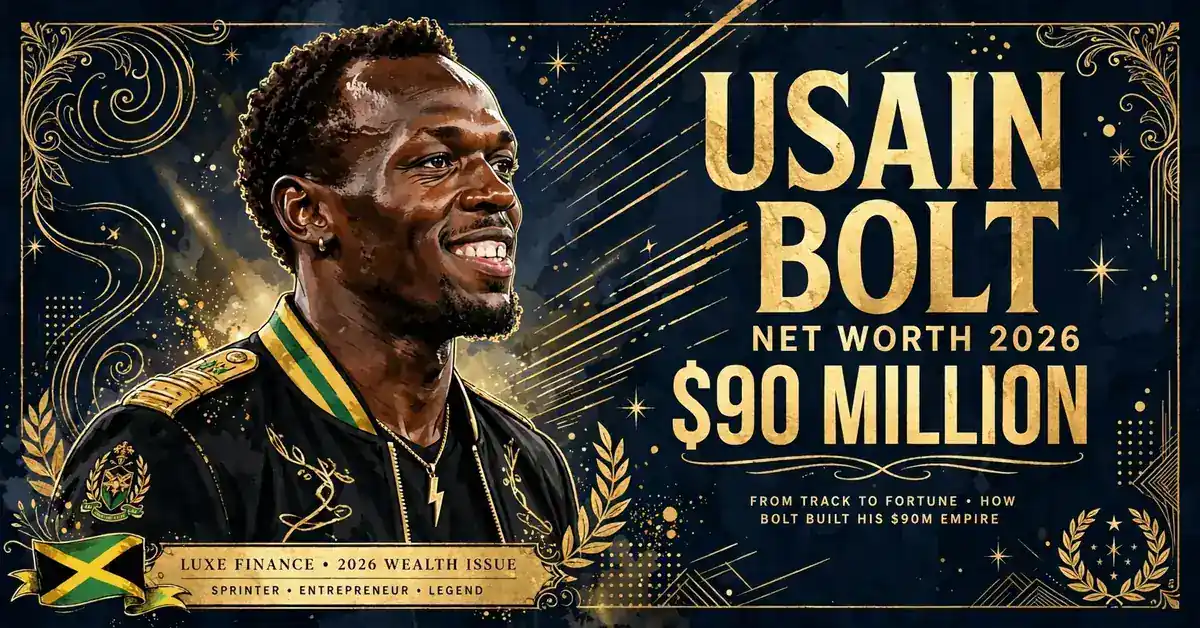
Usain Bolt’s net worth in 2026 is an estimated $90 million, inside a $70 million to $100 million range. Celebrity Net Worth updated its figure in August 2026, and AfroTech’s July 2026 profile and EssentiallySports’ September 2026 reporting agree on the $90 million anchor. The money came from speed: a Puma deal that ran from his teens into retirement, peak earnings of $20 million to $30 million a year almost entirely from endorsements, and a set of world records — 9.58 seconds for 100 metres, 19.19 for 200 metres — that no one has touched since 2009.
The headline number carries a twist no tracker can price cleanly. In January 2023, Bolt discovered that the investment account holding his retirement savings had been emptied by fraud: statements showed about $12.7 million in October 2022, and only about $12,000 remained. As of July 2026, the Jamaica Gleaner reported that his legal team said he had recovered none of it. The $90 million estimate describes what he earned, not necessarily what he kept. This article gives the full picture, kept current to November 17, 2026: the year-by-year earnings, the Puma deal in four eras, every named endorsement, the fraud money trail, the businesses he built after retiring in 2017, and the peer table that shows where $90 million puts him among retired greats.
Quick Facts
| Full Name | Usain St. Leo Bolt |
| Net Worth 2026 | Estimated $70–100 million, anchored at $90 million (Celebrity Net Worth, updated August 2026) |
| Peak Annual Earnings | $20–30 million a year at his peak, mostly endorsements (AfroTech, July 2026); Forbes put 2016 earnings at $32.5 million |
| Born | August 21, 1986, Sherwood Content, Jamaica; turned 40 on August 21, 2026 |
| Height | 6 feet 5 inches (1.95 m) |
| Records | 100m 9.58 seconds, 200m 19.19 seconds (both Berlin, 2009); 8 Olympic gold medals |
| Retired | 2017, after the World Championships in London |
| Main Sponsor | Puma (since 2002); about $9 million a year on the 2010 extension, over $10 million a year on the later deal |
| Other Endorsements | Gatorade, Visa, Hublot, Virgin Media, Nissan, Sprint, Advil |
| Businesses | Tracks & Records restaurants, Bolt Mobility e-scooters, Bolt Labs, RDM drink (in development); Champion Shave (2016, failed) |
| Fraud Loss | About $12.7 million statement balance (Oct 2022) at Stocks and Securities Limited; $6.2 million validated amount; none recovered as of July 2026; trial set for February 2027 |
| Family | Engaged to Kasi Bennett on August 21, 2026; father of three — daughter Olympia Lightning, 6, and twin sons Thunder and Saint Leo, 5 |
How This Estimate Was Made
No audited figure exists — Bolt has never published his finances — so this article treats the net worth as an estimate throughout and shows the work. The anchor is Celebrity Net Worth’s $90 million, updated in August 2026, cross-checked against AfroTech’s July 2026 profile and EssentiallySports’ September 2026 reporting, which both land on the same number. Pulse Sports supplies the $70 million to $100 million range. The earnings history comes from Forbes: $32.5 million in 2016 and $34.2 million for the twelve months ending June 2017, with the split between endorsements and winnings named. The Puma figures are reported contract values from Reuters and Forbes reporting, not confirmed contract terms — the exact amounts were never disclosed by Puma. The fraud figures come from Jamaica Gleaner reporting via AfroTech, with the $12.7 million statement balance and the $6.2 million validated amount kept separate because they describe different things. Where sources disagree — $90 million against a $110 million outlier, eight golds against the often-quoted nine — the article names the disagreement and explains the choice. A September 2026 review by net-worth.vip put the honest position well: the $90 million figure is plausible, but no current balance sheet exists to reproduce it.
+
The Million Answer: What Usain Bolt Is Worth in 2026
Usain Bolt’s net worth in 2026 is estimated at $90 million, on a range of $70 million to $100 million. Celebrity Net Worth updated its figure in August 2026. AfroTech’s profile of July 21, 2026, updated July 24, put it the same way: “As of 2026, Celebrity Net Worth estimates Usain Bolt’s net worth at around $90 million.” EssentiallySports agreed in September 2026. Three separate 2026 sources landing on one number is as solid as a celebrity net-worth estimate gets.
The range matters more than the anchor. Pulse Sports gives the $70 million to $100 million spread, and the spread is honest: nobody outside Bolt’s accountant sees the real numbers, and a retired athlete’s wealth is a mix of cash, property, business stakes and brand value that no public filing captures. A tracker that counts his business ventures generously lands near $100 million. One that counts only bankable career earnings lands near $70 million. The $90 million anchor sits in the middle, and it is the number this article uses.
One figure sits outside the range and needs naming. Some trackers circulate a $110 million estimate for Bolt. No 2026 reporting from a named outlet supports it, and it runs ahead of every documented earnings year. Treat it as the outlier it is: a tracker inflating the anchor without new evidence. The same caution applies to older, lower figures still floating around — a $55 million estimate from NetWorthBro and an old Forbes-derived $31 million figure — both of which predate the August 2026 update and the reporting behind it.
The $90 million also needs its biggest caveat stated plainly, because it changes what the number means. It does not reflect the SSL investment fraud. Bolt’s legal team told the Jamaica Gleaner in July 2026 that he had recovered none of the missing funds. The trackers build their estimates from career earnings and sponsorship income, not from an audit of his bank accounts. The $90 million describes what the fastest man in history earned. Whether he still holds it is a different question, and the fraud section below answers it in full.
The Puma Deal That Paid Like a Football Contract
The Puma deal is the spine of Usain Bolt’s fortune. He signed with Puma as a teenager in 2002, when he was 16, according to CNBC reporting cited by Money.com. The relationship ran for his entire career and beyond it — a single sponsor threading through every record, every Olympics, and into retirement. No other track athlete has ever had a deal like it.
The deal grew in four eras, and the reported figures climb with each one. In the early years, Puma paid him about $1.5 million a year, according to the Financial Times, as reported by Money.com. The 2010 extension, signed after his Beijing and Berlin triumphs, was reported at about $9 million a year. The 2013 renewal — the deal that took him through the Rio Olympics — was reported at about $10 million a year, with Reuters reporting that he would receive $10 million a year through the 2017 World Championships in London, and then $4 million a year as a Puma brand ambassador after retirement. Later reporting puts the final deal at more than $10 million a year.
Two warnings belong with those numbers. The exact contract amounts were never disclosed by Puma — the 2010 renewal reporting said so explicitly — so every dollar figure here is a reported estimate from press sources, not a confirmed term. And the $4 million ambassador figure after retirement is the part of the deal that keeps paying in 2026, nine years after he last raced. Puma bought more than a sprinter. It bought the lightning-bolt pose, the name, and the right to keep selling them long after the spikes came off.
The scale of the deal only makes sense against the sport around it. Track and field pays its stars a fraction of what football, basketball or golf pay theirs. Most sprinters patch together small deals and appearance fees. Bolt’s Puma contract paid him like a footballer — Reuters’ reporting at the 2013 signing put him 40th on Forbes’ list of the world’s best-paid sports stars, and the richest track and field athlete by a wide margin. The deal also explains why the fortune survived retirement: the ambassador payments, the licensing, and the brand work did not stop when the racing did.

Year by Year: How the Fortune Was Built
No one has published a year-by-year balance sheet for Bolt, and this article will not pretend one exists. What the record does give is a set of dated earnings reports, and they stack into a clear shape: a slow build through the 2000s, a sharp rise after Beijing 2008, and a peak in the Olympic years 2016 and 2017 when he was among the best-paid athletes on the planet.
| Year | Reported earnings | Source |
|---|---|---|
| 2002–2009 | About $1.5M a year from Puma in the early years; rising after Beijing 2008 | Financial Times via Money.com |
| 2010 | Puma extension reported at about $9M a year | Forbes / Reuters reporting |
| 2013 | Puma renewal reported at about $10M a year | Reuters via Sharpss / NetWorthBro |
| 2014 | $23M in endorsements; $200,000 in salary/winnings (Forbes) | Forbes via NetWorthBro |
| 2015–2016 | $32.5M in 2016 — $30M endorsements, rest winnings and appearance fees | Forbes, via Money.com and Guinness |
| 2016–2017 | $34.2M — $32M endorsements + $2.2M winnings and appearance fees; 23rd highest-paid athlete in the world | Forbes via Money.com / net-worth.vip |
| 2017–2026 | Retirement income: Puma ambassador payments (reported $4M a year), Hublot and other brand work, business ventures, appearances | Reuters; AfroTech July 2026 |
Read the table as a flow, not a balance. The Forbes years are pre-tax earnings, and the money that stayed after agents’ fees, taxes, training costs and living expenses was far less than the headline. A decade at roughly $20 million to $30 million a year at his peak, as AfroTech put it in July 2026, with the biggest years clustered around the Olympics, is how a $90 million net worth is built. The 2016 figure shows the shape of it: $32.5 million in a single Olympic year, $30 million of it from endorsements.
The retirement rows are the part most profiles skip, and they matter most for 2026. Bolt stopped racing in 2017, but the Puma ambassador payments were reported to continue at $4 million a year, and the brand work — Hublot, appearances, the Ultimate Championship ambassador role in September 2026 — kept paying. AfroTech’s July 2026 profile put his current income at about $20 million a year from endorsements and businesses, per SCMP reporting from 2021 that still frames the post-retirement picture. The fortune did not freeze in 2017. It changed shape, from race winnings to brand income.
The Endorsement Portfolio: More Than Puma
Puma was the anchor, but the portfolio around it is what pushed peak earnings past $30 million a year. The named brands in Bolt’s endorsement stable, across his career, are Gatorade, Visa, Hublot, Virgin Media, Nissan, Sprint and Advil. Each deal was smaller than Puma. Together they were worth millions a year, and they did something Puma alone could not: they put his face in front of audiences that never watch track.
The split inside the Forbes numbers shows the balance. For the twelve months ending June 2017, Forbes estimated $34.2 million in pre-tax earnings: $32 million from endorsements and $2.2 million from winnings and appearance fees. For 2016, Forbes put the total at $32.5 million, with $30 million from endorsements. In other words, about 93 cents of every dollar Bolt earned at his peak came from sponsors, not from running. The Jamaica Gleaner’s account of the Forbes figures, cited by net-worth.vip, adds that a single European meet appearance could command about $300,000 — the appearance fee being the one place where the running itself paid directly.
Hublot is the endorsement that best shows the post-retirement shift. Bolt is still a Hublot ambassador in 2026, and his newest watch — the Hublot Big Bang Reloaded Chronograph Usain Bolt Edition — contains sand from the running track back home in Jamaica, a detail he discussed in a 2026 interview with Boss Hunting. The watch is a collector’s object, not a mass-market product, and that is the point: the deals now trade on legacy, not on the next race. Gatorade and Visa paid for the athlete in his prime. Hublot pays for the legend.
The portfolio also included media licensing that most net-worth profiles miss. His name and likeness featured in the Temple Run mobile game franchise, which had passed a billion downloads by 2016, according to CEO NA magazine. In October 2021, Forbes reported that he had joined Autograph, the digital media and NFT platform co-founded by NFL quarterback Tom Brady. Neither deal has a public dollar figure attached, so neither is counted in the $90 million anchor with a number — but both show a fortune built on the name as much as on the legs.
Why Prize Money Barely Mattered
Here is the fact that surprises readers most: the running itself paid almost nothing. The Forbes split makes it plain — $2.2 million of $34.2 million in 2016–17 came from winnings and appearance fees, and even that figure mixes the two. The 2014 Forbes breakdown is starker still: $23 million in endorsements against $200,000 in salary and winnings. Track and field’s prize purses are small next to the purses in tennis, golf or boxing, and Bolt’s career proves it.
What the running did pay for was the platform. Three Olympic Games — Beijing 2008, London 2012, Rio 2016 — each delivered a global audience no advertising buy could match, and each one reset the endorsement market in his favour. The 2009 World Championships in Berlin, where he set both world records in the space of four days, did the same. The records were the product. The endorsements were the revenue.
That is why the fortune looks the way it does: heavily weighted to a few peak years, built on contracts signed when the whole world was watching, and then carried forward by ambassador deals and licensing after the racing stopped. A sprinter who wins the same medals without the charisma — the pose, the interviews, the showmanship — earns a fraction of it. Bolt’s earnings were never a prize-money story. They were a fame story, and the fame was earned on the track.
The Missing Millions: The SSL Fraud Case
Every profile of Bolt’s money has to reckon with January 2023. That month, Bolt’s holding company, Welljen Limited, discovered that its account at Stocks and Securities Limited (SSL), a Kingston investment brokerage where the account had been opened in 2012, held only about $12,000. Account statements from October 2022 had shown a balance of roughly J$2 billion — about $12.7 million. The money was gone, and the case became the biggest financial fraud scandal in Jamaican history, with the Jamaica Gleaner later putting total losses at roughly $30 million across more than 200 clients.
The discovery followed a tip from a former employee with ties to the scheme, and Bolt’s lawyer, Linton P. Gordon, told reporters the account held his client’s retirement and lifetime savings. Jamaica’s Financial Services Commission installed its own temporary manager at SSL, and the firm’s former client relationship manager, Jean-Ann Panton, was charged with offences including forgery and larceny as a servant, according to the Jamaica Star. Bolt’s attorneys gave SSL ten days to return the money or face civil and criminal proceedings. The money did not come back.
A year later, Bolt addressed the case himself in a video posted on social media on January 11, 2024: “Yow peeps, so it’s been one year. Just want unnu know seh mi still deh ya, still a fight the fight, still a hold on, always a go stay strong.” In February 2025, speaking on The Fix podcast, he said he had still not been reimbursed, and that rumours he had been paid back were wrong. His legal team told the Gleaner in July 2026 that he had recovered none of the missing funds. The case is not a footnote to the fortune. It is the largest single hole in it.
The Money Trail: .7 Million Against .2 Million
Two different figures circulate for the SSL loss, and confusing them has caused errors in other profiles, so this article keeps them separate. The $12.7 million is the statement balance — what the account showed on paper in October 2022, roughly J$2 billion, before the fraud surfaced. The $6.2 million is the amount investigators validated as actually deposited and lost, after separating genuine transactions from fabricated entries in the statements. Both numbers come from Gleaner reporting, and both are used here because each describes a different thing: what Bolt believed he had, and what the investigators could prove he had put in.
The gap between the two figures is the fraud itself. The statements were, in the words of Bolt’s manager reported by the Caribbean Council in January 2023, fraudulent — showing a portfolio intact while the money was gone. That is also why the $90 million net-worth estimate cannot simply be reduced by $12.7 million to give a “real” figure: the trackers never counted the SSL account as a verified asset in the first place, and the validated loss of $6.2 million is the firmer number for what vanished. Either way, the loss is large against a $90 million fortune — roughly 7 to 14 percent of it, depending on which figure is used.
Recovery has been slow and partial. A victims’ compensation fund, set up to facilitate payouts to victims of the alleged fraud and administered by trustee Caydion Campbell, began making partial payouts in 2025, with victims asked to submit proof of claims by April 30, 2025. The fund was never designed to make victims whole, and Bolt’s legal team confirmed in July 2026 that he had recovered none of the missing funds. A trial in the case is set for February 2027. Until it concludes, the honest statement is the one his legal team gave the Gleaner: nothing recovered, and no date for recovery.
The Businesses After Retirement: Restaurants, Scooters and One Failure
Bolt retired from athletics in 2017 and went into business — with mixed results, and the mix is worth reporting honestly, because the failures say as much about the fortune as the successes. The ventures divide into four groups: food, transport, health technology, and one outright failure.
Tracks & Records, his Jamaican restaurant, opened in Kingston in April 2011, while he was still racing. Bolt is a partner through the Jamaica-based franchise Franjam. In October 2018, a London branch opened in Shoreditch — the first of 15 planned UK restaurants under a deal with the Casual Dining Restaurants Group, making it the first Jamaican-owned restaurant franchise to open on an international scale, according to East London Lines. The menu runs on classic Jamaican dishes, jerk pork among them, alongside international plates. No revenue figure has been published for the chain, so this article counts it as an operating business, not a valued asset.
Bolt Mobility, the electric-scooter company, was founded in 2018 and launched nationally on March 12, 2019, in New York, with Bolt as global spokesperson and co-founder alongside Dr Sarah Haynes, the company’s co-founder, co-CEO and chairwoman. The scooters — swappable batteries, phone chargers, space for shopping bags — ran on the streets of Fort Lauderdale, Arlington and Alexandria, with Miami, Atlanta, Nashville and Los Angeles named as planned markets. Venture firm Rokk3r Fuel ExO and the Yucaipa Companies invested. The company aimed at the gap between public transport and car ownership, and it put Bolt’s name on a product far from the track.

The failure is Champion Shave. In 2016, Bolt launched a company making high-end, six-blade razors. It never took off: the web domain is now vacant and the social media accounts are deleted, as SportBible reported in November 2024. The grooming venture is a useful corrective to the idea that a famous name guarantees a business — the same name that sold Puma shoes by the million could not sell razors.
The newer ventures are smaller and more focused. Bolt Labs, powered by SprintRay, uses 3D printing to provide dental care across Jamaica. RDM, an energy and hydration drink, is in development — Bolt told Boss Hunting in a 2026 interview that he had always wanted to make an all-natural drink focused on athletes, and hoped to launch it by summer. And in February 2026, RacingNews365 reported that Bolt was holding talks about becoming an investor in a Formula E team, without naming the team. None of these carries a published valuation, so none is added to the $90 million with a number. Together they show the direction of the money after retirement: Jamaican businesses, health technology, and the brand itself.
The Records Behind the Money: 9.58, 19.19 and Eight Golds
The fortune rests on two numbers that have not moved in seventeen years. Bolt set the 100 metres world record of 9.58 seconds and the 200 metres world record of 19.19 seconds at the World Championships in Berlin in August 2009. Both still stand in November 2026. No sprinter since has come within a tenth of a second of the 100 metres mark in a championship final. The records are the asset that never depreciates: every anniversary, every “fastest man alive” segment, every comparison with the next generation starts from 9.58 and 19.19.
The Olympic count needs a correction that most quick profiles get wrong. Bolt is often described as a nine-time Olympic champion. The official count is eight. He won the 100 metres, 200 metres and 4×100 metres relay at Beijing 2008, London 2012 and Rio 2016 — nine golds on the track. The 2008 relay gold was later stripped after teammate Nesta Carter’s doping case, leaving eight. The full story of the career, from Sherwood Content to the 2017 retirement, is in Usain Bolt’s biography for 2026, which carries the same correction.
The record count beyond the Olympics is just as strong: eleven world championship titles, as Boss Hunting noted in its 2026 interview, and a third world record in the 4×100 metres relay — 36.84 seconds, set at London 2012 — that also still stands. Bolt retired after the 2017 World Championships in London, pulling up injured in the 4×100 metres final. He left with the records intact, and they have stayed intact through every season since, including the 2026 season. That durability is the commercial point: a record that falls loses its marketing value overnight, and his have not fallen.
Life at 40: Engagement, Three Children and a Sunday League Team
August 2026 was the biggest month of Bolt’s post-retirement life. He turned 40 on August 21, 2026, and at his 40th birthday celebration at One Belmont in Kingston, Jamaica, he proposed to his longtime partner Kasi Bennett, getting down on one knee with a microphone in front of family and friends while Bruno Mars’ “Marry You” played. The Jamaica Observer published photographs of the moment, and The Richest reported on August 25, 2026 that Bennett said yes. She later showed off the ring: a five-carat pear-shaped diamond set between smaller diamonds. The couple have been together since 2013 and went public at the Rio Olympics in 2016. Bolt told the crowd they had been together 14 years and that she had given him “three wonderful kids”. The full account of his age, and what each year of it held, is in how old Usain Bolt is in 2026 on our sister site CelebAmerica.
The three children are daughter Olympia Lightning Bolt, six years old in 2026, and twin sons Thunder Bolt and Saint Leo Bolt, both five. Bolt has said publicly that he and Bennett agreed not to have more children after the twins were born. The family lives in Jamaica, and the engagement — after thirteen years together — put an official seal on a relationship that had been private for most of its first four years.
The same month brought the strangest headline of his retirement: Bolt registered as a player for Wythenshawe Vets FC, a club in south Manchester that plays in the Premier Division of the Cheshire Veterans Football League, a Sunday league competition for players over 35. The registration, reported by the Jamaica Gleaner via the Football Association’s Full-Time website on August 23, 2026, put the 40-year-old on a veterans roster managed by former Manchester City midfielder Stephen Ireland, alongside former Premier League names including Emile Heskey, Antonio Valencia, Joleon Lescott and Papiss Cisse. The club made no formal announcement, Bolt was not on its 2026/27 squad list, and the registration does not guarantee he will play. It is a bit of fun rather than a comeback — but it fits a man who trained with Borussia Dortmund and trialled with the Central Coast Mariners in Australia in 2018 before giving up the football dream. He is 6 feet 5 inches tall, and the full breakdown of the height that shaped his stride is in Usain Bolt’s height profile for 2026.
What Bolt Still Earns in 2026
Nine years into retirement, Bolt still earns. The Puma ambassador payments were reported at $4 million a year after retirement, and the brand work has not stopped: the Hublot ambassadorship, the new watch edition, appearances, and the ambassador role for the inaugural World Athletics Ultimate Championship in Budapest, held September 11–13, 2026, where World Athletics named him its Ultimate Legend. SCMP reporting from 2021, still the best public guide to his post-retirement income, put his ongoing earnings at about $20 million a year from endorsements and businesses — a figure AfroTech’s July 2026 profile echoes in its $20 million to $30 million peak range.
The 2026 calendar shows how the income is earned now. February 2026 brought the Formula E investment talks. August brought the birthday, the engagement and the Wythenshawe registration. September brought Budapest and the Ultimate Championship. None of these is a race, and none pays like a race — but together they keep the name in the news, and the name is the product. A retired sprinter who disappears loses the endorsement market within a few years. Bolt has not disappeared.
The Usain Bolt Foundation, which supports education and cultural development in Jamaica, is the other side of the post-retirement ledger. It is a charity, not a business, and it does not add to the net worth — but it is where a visible share of the public work goes, and it is the part of the story that the endorsement cheques do not capture.
Bolt Against His Peers: Where Million Sits
Comparisons are the fastest way to read a sporting fortune, because the gaps between sports are larger than the gaps inside them. The table below puts Bolt beside the Olympic greats readers ask about most, with their 2026 estimated fortunes from this site’s own profiles.
| Athlete | Sport | Estimated net worth |
|---|---|---|
| Usain Bolt | Sprinting | $90M |
| Michael Phelps | Swimming | $100M |
| Coco Gauff | Tennis | $35M |
| Simone Biles | Gymnastics | $25M |
| Allyson Felix | Sprinting | See profile |
| Katie Ledecky | Swimming | $5M |
| Noah Lyles | Sprinting | $4M–$7M |
The table shows the real story of his standing. Michael Phelps’ biography puts the swimmer at $100 million — the only Olympic great on this site ahead of Bolt, built on 28 medals and a longer endorsement tail. Coco Gauff’s net worth of $35 million shows what tennis pays a young star still competing. Simone Biles’ net worth of $25 million, built on gymnastics dominance and a long endorsement list, sits well below Bolt’s — a measure of how much more the sprint market paid at its peak. The sprint comparison is the starkest: Noah Lyles’ biography puts the current sprint king at $4 million to $7 million, and Allyson Felix’s biography covers a career of 11 Olympic medals that earned a fraction of Bolt’s fortune. Katie Ledecky’s biography, at $5 million across 14 Olympic medals, makes the same point from swimming. Bolt earned more than Gauff, Biles, Ledecky and Lyles combined — and he earned it in a sport that pays its stars less than almost any other.
The peer table also carries a warning for the next generation. Lyles is the fastest sprinter alive and the face of the sport in 2026, and his fortune is roughly a tenth of Bolt’s. The difference is not the medals. It is the moment: Bolt arrived when a single charismatic sprinter could hold the world’s attention for a decade, and he signed the Puma deal that turned that attention into a football-sized contract. The market has not repeated the trick since.
Why the Estimates Differ — and Which One to Trust
Net-worth trackers disagree about Bolt because they are guessing from the same thin public record, and they weigh its pieces differently. A tracker that counts the Puma ambassador payments, the restaurant chain and the scooter company at full value lands near $100 million. One that counts only documented career earnings, minus taxes and fees, lands near $70 million. One that takes the Forbes earnings years at face value and adds a decade of compounding lands on $90 million. All three methods are defensible. None of them is an audit.
The $110 million outlier deserves a closer look, because it is the number most likely to mislead a reader. It appears in trackers that do not name a source or a date for the increase, and no 2026 reporting from a named outlet — not Celebrity Net Worth, not AfroTech, not EssentiallySports — supports it. The August 2026 Celebrity Net Worth update, the freshest named-source figure available, is $90 million. Until a named outlet reports a higher figure with evidence behind it, $110 million is a tracker inflating the anchor, not a new fact.
The honest answer, then, is the range with the anchor: $70 million to $100 million, anchored at $90 million, with the SSL loss sitting outside the estimate. A reader who wants a single number can use $90 million. A reader who wants the truth should keep the range, the caveat, and the fraud case in mind at the same time. The fortune is real, and so is the hole in it.
Frequently Asked Questions
What is Usain Bolt’s net worth in 2026?
Usain Bolt’s net worth in 2026 is estimated at $70 million to $100 million, anchored at $90 million according to Celebrity Net Worth, which updated its figure in August 2026. AfroTech (July 2026) and EssentiallySports (September 2026) agree on $90 million. The estimate does not reflect the $12.7 million lost in the 2023 SSL investment fraud, none of which had been recovered as of July 2026.
How much does Usain Bolt make per year?
At his peak, Bolt earned an estimated $20 million to $30 million a year, almost all of it from endorsements, according to AfroTech’s July 2026 profile. Forbes put his 2016 earnings at $32.5 million and his earnings for the twelve months ending June 2017 at $34.2 million — $32 million from endorsements and $2.2 million from winnings and appearance fees. In retirement he still earns from Puma ambassador payments, reported at $4 million a year, plus Hublot and other brand work.
How much did Puma pay Usain Bolt?
Puma paid Bolt about $1.5 million a year in his early years, about $9 million a year on the 2010 extension, and about $10 million a year on the 2013 renewal through the 2017 World Championships, with a reported $4 million a year as a brand ambassador after retirement. Later reporting puts the final deal at more than $10 million a year. The exact contract amounts were never disclosed by Puma, so every figure is a reported estimate.
Did Usain Bolt lose money in a scam?
Yes. In January 2023, Bolt’s holding company Welljen Limited discovered that its account at Stocks and Securities Limited in Kingston held only about $12,000, against statements showing about $12.7 million in October 2022. Investigators later validated about $6.2 million as actually deposited and lost. As of July 2026, the Jamaica Gleaner reported that Bolt had recovered none of the money, and a trial is set for February 2027.
How many Olympic gold medals does Usain Bolt have?
Usain Bolt has eight Olympic gold medals. He won the 100 metres, 200 metres and 4×100 metres relay at Beijing 2008, London 2012 and Rio 2016 — nine golds on the track — but the 2008 relay gold was stripped after teammate Nesta Carter’s doping case, leaving eight. He also holds the 100 metres world record of 9.58 seconds and the 200 metres world record of 19.19 seconds, both set in Berlin in 2009.
How old is Usain Bolt in 2026?
Usain Bolt is 40 years old in 2026. He was born on August 21, 1986, in Sherwood Content, Jamaica, and turned 40 on August 21, 2026. He is 6 feet 5 inches (1.95 m) tall and retired from athletics in 2017.
Is Usain Bolt married?
Not yet — he is engaged. Bolt proposed to his longtime partner Kasi Bennett on August 21, 2026, during his 40th birthday celebration at One Belmont in Kingston, Jamaica, and she said yes. They have been together since 2013 and have three children: daughter Olympia Lightning, six, and twin sons Thunder and Saint Leo, five. The ring is a five-carat pear-shaped diamond.
What does Usain Bolt do now?
At 40, Bolt runs businesses including the Tracks & Records restaurant chain and Bolt Mobility e-scooters, works on the Bolt Labs dental project and the RDM drink, and earns from Puma and Hublot brand work. In August 2026 he registered as a player for Wythenshawe Vets FC, a Manchester veterans football team, and in September 2026 he was an ambassador for the inaugural World Athletics Ultimate Championship in Budapest.
Sources & Reporting
This article was researched on 17 November 2026 from live reporting: Celebrity Net Worth (updated August 2026) for the $90 million anchor; AfroTech (July 21, 2026, updated July 24, 2026) for the $90 million agreement, the $20–30 million peak earnings, the Puma figures and the SSL case; EssentiallySports (September 2026) for the $90 million agreement and the Forbes earnings figures; Pulse Sports for the $70–100 million range; Forbes via Money.com for the $32.5 million 2016 earnings and the $34.2 million twelve-months-to-June-2017 figure, and via the Financial Times and CNBC for the early Puma terms; Reuters via Sharpss and NetWorthBro for the 2013 Puma deal terms and the $4 million ambassador payments; net-worth.vip (review checked September 22, 2026) for the sceptical take on the $90 million estimate, the $300,000 appearance fee, and the $6.2 million validated fraud amount; the Jamaica Gleaner via AfroTech and the Caribbean Council for the SSL case figures, the July 2026 no-recovery statement and the February 2027 trial date; the Jamaica Star for the charges against Jean-Ann Panton; Face2Face Africa and The Fix podcast for Bolt’s February 2025 statement that he had not been reimbursed; Britannica (updated October 23, 2026) and World Athletics for the birth date and place, records and career results; The Richest (August 25, 2026), Parade (August 22, 2026) and Female First (August 23, 2026) for the engagement, the five-carat ring and the children’s ages; the Jamaica Gleaner via the FA Full-Time website, ClutchPoints and JA Blogz (August 2026) for the Wythenshawe Vets FC registration; World Athletics via RacingNews365 reporting (February 2026) for the Ultimate Legend honour and the Formula E investment talks; Boss Hunting (2026) for the Hublot watch, the RDM drink and the eleven world titles; usainbolt.com (March 12, 2019) for the Bolt Mobility launch; SportBible (November 26, 2024) for Champion Shave and Bolt Labs; East London Lines (2018) for the Tracks & Records London opening; and this site’s own Usain Bolt biography (October 30, 2026) and height profile (November 6, 2026) for the cross-checked dates and figures. Where sources disagreed — the $90 million anchor against the $110 million outlier, eight golds against the often-quoted nine, and the $12.7 million statement balance against the $6.2 million validated amount — the article names the disagreement instead of picking a number silently. Corrections are welcome via the About page.
Nathan Cole
Nathan Cole is the editor of Guide Net Worth. He covers celebrity wealth the way a business desk covers earnings: reported figures first, estimates labeled as estimates, no invented numbers. Every profile passes through his desk before it publishes. About Guide Net Worth · Corrections: figures are updated when new reporting emerges — contact us via the About page if you spot an error.
References & Sources
This article has been fact-checked and verified against multiple public sources, financial disclosures, SEC filings, Forbes reports, Celebrity Net Worth databases, and official records. All net worth estimates are based on publicly available information and financial analysis.