Steve Smith is 37 in 2026 — born June 2, 1989, in Kogarah, Australia. The former captain passed 11,000 Test runs and retired from ODIs in March 2025.
Last updated: November 24, 2026 · By Nathan Cole
Steve Smith is 37 years old in 2026. He was born on June 2, 1989, in Kogarah, a suburb in Sydney’s south, and turned 37 on June 2, 2026. He is still an active Test cricketer — and that last fact is the one people keep getting wrong. Smith retired from one-day internationals in March 2025 and from T20 internationals in August 2024, but he has not retired from cricket. He captained Australia in the first Ashes Test of the 2025–26 series at Perth, played a Test series in South Africa in October 2026, and passed 11,000 Test runs along the way, at an average above 55.
The age matters because of what he has done with the years. Smith debuted as a leg-spinner who could bat a bit, became the best Test batter of his generation, lost the captaincy in the ball-tampering scandal of 2018, and came back to score 774 runs in the 2019 Ashes — one of the great comebacks in the sport’s history. His ICC Test batting rating of 947 is the second-highest of all time, behind only Don Bradman’s 961, and he was named the ICC Men’s Test Player of the Decade for 2011–2020. He reached 10,000 Test runs in Galle in January 2025, the fourth Australian to do it.
This profile answers the age question the way it should be answered — with the date, the sources, and the career that explains why millions of people are still asking: the Kogarah childhood, the debut as a spinner, the transformation into a run machine, the ban and the comeback, the 10,000-run milestone, the ODI retirement, and what he is doing in 2026 at 37, with a return Ashes tour of England in 2027 on the horizon.
Quick Facts: Steve Smith at a Glance
| Full name | Steven Peter Devereux Smith |
| Born | June 2, 1989, Kogarah, New South Wales, Australia |
| Age | 37 (turned 37 on June 2, 2026) |
| Height | 176 cm (5 ft 9 in) |
| Role | Right-handed top-order batter; occasional leg-spin bowler |
| Teams | Australia; New South Wales; Sydney Sixers; Washington Freedom |
| Test debut | July 13, 2010, vs Pakistan (as a leg-spinner) |
| Test record | 127 matches, 11,003 runs, average 55.29, 37 centuries, top score 239 (as of October 22, 2026) |
| ODI record | 170 matches, 5,800 runs, average 43.28, 12 centuries — retired March 5, 2025 |
| T20I record | 67 matches, 1,094 runs — retired August 2024 |
| World Cups | ODI World Cup 2015, 2023; T20 World Cup 2021; World Test Championship 2023 |
| Peak rating | 947 ICC Test batting rating — second-highest ever, behind Bradman’s 961 |
| Family | Married to Dani Willis (September 2018) |
| Net worth (2026) | Estimated $30M–$35M (CricToday, Yardbarker, CricScope) |
| 2026 status | Active in Tests only; captained the Perth Ashes Test; passed Steve Waugh as Australia’s third-highest Test run-scorer in October 2026 |
How This Age Figure Was Adjudicated
Smith’s age is one of the least disputed facts in cricket: the ICC’s own player profile, Wikipedia, myKhel, Sportradar and SofaScore all give the same date of birth — June 2, 1989 — and the same age, 37, as of 2026. There is no competing figure to adjudicate, so this profile spends its space on the question people actually argue about: whether he has retired. The answer is precise and sourced: he retired from ODIs on March 5, 2025 (Cricket Australia confirmed it the same day) and from T20Is in August 2024, but he remains an active Test player, with his last Test on October 18, 2026, against South Africa. Career statistics are from Cricinfo, as published on October 22, 2026; the 10,000-run milestone is dated to January 29, 2025, from ICC and Cricket Australia reporting. Net worth figures come from CricToday, Yardbarker and CricScope and are labelled estimates throughout — Smith has never disclosed his finances.
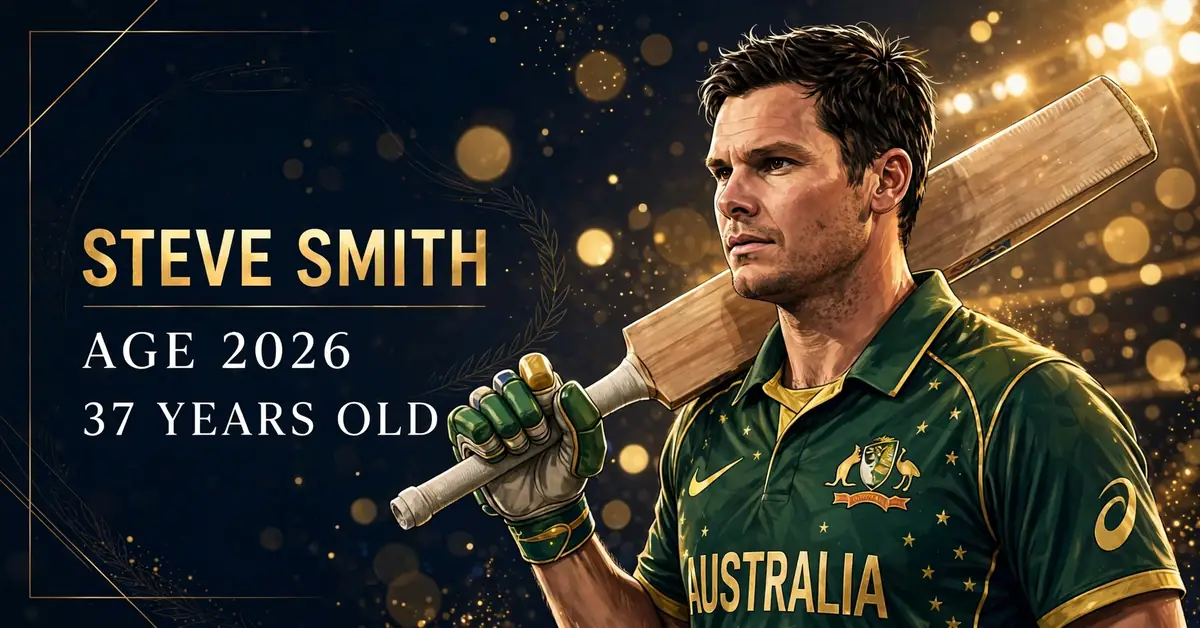
+
The Short Answer: 37 Years Old, Born June 2, 1989
Steve Smith is 37 years old. He was born on June 2, 1989, in Kogarah, New South Wales, and he turned 37 on June 2, 2026 — a birthday he spent, fittingly, in the middle of a cricket season. The ICC’s player profile lists his age as 37, Wikipedia gives the same date, and every major stats site agrees. There is no mystery here, and this article does not manufacture one.
What confuses people is not the number but the status. Search for Smith in 2026 and the first results mix three different facts: he retired from ODIs, he retired from T20Is, and he is still playing Tests. The retirement headlines are real — he announced his ODI retirement on March 5, 2025, the day after Australia’s Champions Trophy semi-final loss to India, and he had already stepped away from T20 internationals in August 2024. But neither announcement ended his career. He took his future “series by series” in Tests, and by October 2026 he had played a Test series in South Africa and passed Steve Waugh as Australia’s third-highest Test run-scorer.
At 37, Smith is old for a modern batter and young for a great one. Sachin Tendulkar played Tests until he was 40. Ricky Ponting retired at 37. Steve Waugh played until 38. Smith’s own numbers suggest he is not done: 11,003 Test runs at an average of 55.29, 37 centuries, and a 42-ball hundred for the Sydney Sixers in the Big Bash League in January 2026 — a format where 37-year-olds are supposed to slow down, not speed up.
He is 176 cm tall — 5 ft 9 in — a detail covered in Steve Smith’s height profile, and the height matters to his story in a way it does not for most batters. His technique is built on movement: a shuffle across the stumps, a trigger that starts before the bowler releases, and hands that work late. It looks restless. It has produced one of the great Test records of the modern era.
Early Life in Kogarah, Sydney
Steven Peter Devereux Smith was born on June 2, 1989, in Kogarah, a suburb in Sydney’s St George region. His father, Peter, is Australian and holds a degree in chemistry; his mother, Gillian, is English. The mixed heritage gave him something useful later in his career — a British passport and the right to play county cricket in England without counting as an overseas player — but as a boy in Kogarah it mostly meant a house where cricket was taken seriously and school was taken seriously too.
He attended Menai High School and left at seventeen to play cricket in England, a decision that tells you how far ahead he was planning. Most Australian teenagers with talent stay home and wait for the state system to find them. Smith went to the country where the game was invented, played club and county age-group cricket, and came back with a technique hardened by English conditions — the same conditions that would later define his Ashes career.
The detail that surprises people who only know him as a batter is that he arrived as a bowler. Smith was a leg-spinner first, in the mould of Shane Warne, and his early selection for New South Wales and Australia was built on the leg-break, the googly and a useful lower-order bat. He modelled his bowling on Warne and spent his teenage years trying to be the next great Australian wrist-spinner. The batting was the secondary skill, the thing he did while he waited to bowl. It did not stay secondary for long.
The Debut: A Leg-Spinner Who Could Bat
Smith’s international debut came in the white-ball formats first. He played his first ODI on February 19, 2010, against West Indies at the Melbourne Cricket Ground, wearing cap number 182. Five months later, on July 13, 2010, he made his Test debut against Pakistan at Lord’s, wearing baggy green cap number 415 — as a leg-spinner, batting at number eight.
The first two years were a slow education. He played Tests in fits and starts, in and out of the side, and the selectors were never quite sure what he was: a bowler who batted, or a batter who bowled. The answer arrived in the 2013–14 season, when he was picked as a specialist batter and scored his first Test century — 111 against England at Perth in the Ashes whitewash of 2013–14. The leg-spin, which had defined him, quietly became the occasional over he bowled to break a partnership. The batting, which had been the secondary skill, became the career.
By the 2014–15 home summer, the transformation was complete. Smith scored four centuries in four Tests against India, including 192 at the MCG, and finished the series with 769 runs at an average of 128. He was twenty-five years old, and he was suddenly the best batter in the world. The ICC rankings agreed: he reached the top of the Test batting rankings in 2015 and stayed near it for the better part of a decade.
Captaincy: The Youngest Leader of His Generation
Smith became Australia’s captain at twenty-six, younger than Ponting or Waugh when they took the job, and he held the role in all three formats. The first taste came in the 2014–15 tri-series, when George Bailey was suspended for a slow over-rate and Smith captained his first ODI against England on January 20, 2015. Three days later he scored his first ODI century — 102 off 95 balls — and Australia went on to win the series. The pattern was set: Smith led from the front, with runs.
The 2015 World Cup, played at home, was the first great triumph of his captaincy era — though the captain that tournament was Michael Clarke, and Smith’s contribution was with the bat: 105 in the semi-final against India at the SCG, then 56 not out in the final against New Zealand at the MCG as Australia won its fifth World Cup. He was twenty-five, and he had a World Cup winner’s medal before his first full year as a Test regular was done.
As full-time captain, Smith’s record was strong and his batting reached its peak. He scored 687 runs in the 2017–18 Ashes at home, including a double century at Perth, and his ICC rating climbed to 947 — the second-highest figure in the history of Test cricket, behind only Don Bradman’s 961. He was named the ICC Men’s Test Player of the Decade for 2011–2020, an award that covers a ten-year span in which he averaged more than 60 at his best and carried Australia’s batting almost alone for long stretches.
His stand-in captaincy, after the ban, was arguably more impressive than the original. He captained Australia in ten Tests, winning seven and drawing one, including the team’s only Test victory in India since 2017. When Pat Cummins withdrew from the 2025 Champions Trophy, Smith took the ODI captaincy again — thirteen ODIs in total across his later stints — and led Australia in his final ODI, the semi-final against India on March 4, 2025. He has now led Australia in every format, in both his twenties and his thirties, before and after the worst episode of his career.
The Ban: Sandpapergate and the Year Away
No honest profile of Steve Smith skips March 2018. During the third Test against South Africa at Cape Town, the Australian team was caught using sandpaper to alter the condition of the ball. Smith, as captain, admitted he knew about the plan and did nothing to stop it. Cricket Australia’s investigation banned him from cricket for twelve months, stripped him of the captaincy, and barred him from holding a leadership position for a further year after his return.
The ban cost him a year of his prime — he was twenty-eight, at the peak of his powers, and he missed the 2018–19 home summer entirely. It also cost him his reputation, in Australia and abroad, in a way that a poor run of form never could. The press conference where he apologised, in tears, became one of the defining images of Australian sport. He has never hidden from it since, and this article does not soften it: he was the captain, he knew, and he was punished for it.
What followed is the reason the story is still told. Smith returned to international cricket at the 2019 World Cup, then played the Ashes series in England that summer and produced one of the great individual performances in the history of the game: 774 runs in four Tests, at an average of 110.57, including twin centuries at Edgbaston in his first Test back. He missed the third Test at Headingley with concussion after being struck by a Jofra Archer bouncer — and Australia lost the match he missed, the only Test of the series they lost. The comeback did not erase the ban. It proved, to everyone watching, that the batter was still there.
The Comeback: 774 Runs in the 2019 Ashes
The 2019 Ashes deserves its own section because it is the series that defines Smith at 37. He arrived in England with the crowd against him, the press against him, and a year away from Test cricket behind him. In the first Test at Edgbaston he scored 144 and 142 — twin centuries in his first Test back, in front of a crowd that booed him to the crease and applauded him off it. He added 92 at Lord’s before the Archer blow ended his match, then returned to score 211 at Old Trafford and 80 and 23 at The Oval.
The final tally was 774 runs in seven innings, with three centuries and three fifties, at an average of 110.57. It was the most runs by a visiting batter in an Ashes series in the modern era, and it came against an England attack built to stop him. The series was drawn 2–2, and Australia retained the Ashes. Smith’s performance was the difference between retaining and losing, and every report of the series since has started with his name.
The innings also settled the argument about his technique. Smith’s method — the shuffle, the trigger movement, the bat coming down late and from an angle that looks wrong — had been mocked for years as something that could not last. After 2019, it was studied instead. Coaches now teach the late hands and the still head that Smith’s shuffle is built around, and the technique that looked like a quirk is taught as a system. He changed how the game is coached, which is a rarer achievement than any run tally.
10,000 Test Runs: Galle, January 2025
Smith’s 10,000th Test run arrived the way his career tends to arrive: one run short, then right on time. In the New Year Test at the SCG in January 2025, he needed one run to reach the milestone and fell short in his second innings, finishing the match on 9,999. Three weeks later, in the first Test of the Warne-Muralitharan Trophy in Sri Lanka, he pushed his first ball from Prabath Jayasuriya toward mid-on and ran a single. He was the fifteenth player in history to pass 10,000 Test runs, the fourth Australian after Ricky Ponting, Allan Border and Steve Waugh, and the fifth-fastest by innings to get there.
He finished that first day in Galle unbeaten on 104, bringing up his 35th Test century later in the day, and Australia won by an innings. The series was his as captain — Pat Cummins had stayed home for the birth of his second child — and Smith scored 141 off 251 balls in the first Test to set up the win. In the second Test he passed Ponting’s record for the most Test catches by an Australian, with 197, and became Australia’s leading Test run-scorer in Asia.
The milestone put his age in context. He was thirty-five when he reached 10,000 runs, and only Kumar Sangakkara, of the batters beyond the mark, had a better average at the time — Sangakkara’s 57.40 against Smith’s mid-50s. The 36th century followed in the Caribbean in July 2025, and the 37th came in the South Africa series of October 2026, when he passed Steve Waugh as Australia’s third-highest Test run-scorer. The numbers keep moving because he keeps batting.
The ODI Retirement: March 5, 2025
Smith announced his retirement from one-day internationals on March 5, 2025, the day after Australia lost the Champions Trophy semi-final to India by four wickets. He had captained the side in the tournament after Cummins withdrew, and he led Australia in his final ODI, the semi-final itself, on March 4, 2025. Cricket Australia confirmed the decision the same day. He was thirty-five.
His ODI record stands at 170 matches, 5,800 runs at an average of 43.28, with 12 centuries and a top score of 164. The two World Cup medals — 2015 and 2023 — sit at the centre of it, along with the 105 in the 2015 semi-final and the 56 not out in the final. The retirement was not a surprise to anyone who had watched his workload: he had already stepped away from T20 internationals in August 2024, last playing the format in February 2024, and his stated reason was to focus on Test cricket, the format he has always called his priority.
The decision also made financial sense, in the plain sense that it did not cost him much. His Cricket Australia central contract, reported at roughly AUD $1.3–1.5 million a year, is built around Tests, and his franchise earnings — the Sydney Sixers in the Big Bash, where he struck a 42-ball century in January 2026, and Washington Freedom in Major League Cricket — do not depend on ODI selection. His endorsement income, built over fifteen years, covers the rest. The ODI retirement trimmed his match fees. It did not trim his career.
Steve Smith in 2026: Still Batting, Still Captaining
Smith’s 2026 has been a working year, not a farewell tour. He started it with the 42-ball century for the Sydney Sixers in the Big Bash League in January — the kind of innings that silences talk of slowing down, from a 36-year-old in a format built for 22-year-olds. Then came the Ashes: in the first Test of the 2025–26 series at Perth, he led Australia out as captain in Cummins’ absence, the latest of his stand-in stints in the job.
October 2026 took him to South Africa for a Test series, his last Test coming on October 18, 2026, against the Proteas at Durban, where his career snapshot stood at more than 10,900 Test runs with 37 hundreds. During that series he passed Steve Waugh’s tally to become Australia’s third-highest Test run-scorer, behind only Ponting and Border. He has described his future as “series by series” — no retirement date, no farewell tour announced, and a return Ashes tour of England in 2027 on the horizon.
The age question, asked the way this article asks it, has a second answer now. Smith is 37, but he is not a veteran hanging on. He is the third-highest run-scorer in Australian Test history, still adding to the total, still captaining when his team needs him, and still scoring hundreds in franchise cricket between Test series. The readers who land here asking “how old is Steve Smith” usually want to know whether he is finished. The reporting says he is not.
The Numbers: A Career in Three Formats
| Format | Matches | Runs | Average | 100s / 50s | Top score |
|---|---|---|---|---|---|
| Tests (active) | 127 | 11,003 | 55.29 | 37 / 45 | 239 |
| ODIs (retired Mar 2025) | 170 | 5,800 | 43.28 | 12 / 35 | 164 |
| T20Is (retired Aug 2024) | 67 | 1,094 | 24.86 | 0 / 5 | 90 |
| First-class | 192 | 15,859 | 53.75 | 54 / 68 | 239 |
The Test line is the one that matters, and it rewards a closer look. An average of 55.29 across 127 Tests puts Smith in company that barely exists: among batters with more than 10,000 Test runs, only Sangakkara’s 57.40 sits above it, and Smith’s 37 centuries have come at a rate — roughly one every three and a half Tests — that matches Ponting’s. His 224 Test catches are a record for an Australian outfielder that will take years to approach, and his bowling, the skill he debuted with, still accounts for 19 Test wickets.
Two records frame the career better than the averages do. He was the fastest player to 8,000 Test runs, reaching the mark in his 151st innings in his 85th Test, against Pakistan at Lahore on March 21, 2022. And his ICC rating of 947, reached at his peak, is the second-highest batting rating ever recorded — behind Bradman’s 961 and ahead of every other batter who has played the game. Ratings are not trophies, but a gap of fourteen points to Bradman, across ninety years of cricket, is the closest anyone has come.
The Technique: Why the Shuffle Works
Smith’s batting looks wrong to anyone taught the game from a textbook, and it works for reasons the textbook does not cover. He starts with his feet moving — a shuffle across the stumps as the bowler runs in — and his bat comes down late, from behind his pads, at an angle that leaves his off stump exposed to the eye and covered in fact. His head stays still. His hands stay late. The ball is met under his eyes, not in front of them.
The method has a cost and a benefit, and both are visible in his record. The cost is the occasional dismissal that looks careless — an lbw to a ball he shuffled across to, a nick to one he left late. The benefit is time: by moving early and playing late, he gives himself longer to read the ball than a batter who plants his feet and commits. Against fast bowling, that extra fraction of a second is the difference between a block and a boundary, and it is why his record against pace — Archer, Anderson, Broad, Bumrah — is as strong as it is.
He is also, quietly, one of the best fielders of his generation. The 224 Test catches include the slip cordon work that wins matches in Australia, where the ball flies fast and low, and the record for most catches by an Australian — passing Ponting’s 197 in the second Test at Galle in January 2025 — is a fielding record, not a batting one. It sits in his profile because it belongs there: Smith’s value to Australia has always been larger than his runs.
Steve Smith’s Net Worth in 2026: M–M
Smith’s net worth in 2026 is estimated at $30 million to $35 million, the range the most recent cricket finance trackers agree on. CricToday and Yardbarker both put him at around $35 million in 2026. CricScope puts him at about $30 million as of early 2026, inside a wider published range of $25 million to $35 million, and TechnoSports agrees at $30 million to $35 million. AussieVibe stretches the top end to $40 million. The one low figure, SurpriseSports at $20 million, sits outside the consensus and is treated here as the floor, not the anchor.
The money is performance-based, not business-based, and that is the honest shape of it. His Cricket Australia central contract pays roughly AUD $1.3–1.5 million a year. His Big Bash deal with the Sydney Sixers is reported at around USD $400,000–420,000 a season. Franchise stints — the IPL with Rajasthan Royals, Rising Pune Supergiant and Delhi Capitals, and now Washington Freedom in Major League Cricket — added seven-figure fees across his career. Endorsements and property make up the rest. There is no Forbes or Bloomberg valuation for Smith, and he has never disclosed his finances, so every figure here is an estimate built from reported contracts, not an audited number.
Readers who want the full money breakdown — the year-by-year contracts, the franchise fees and the property deals — can read Steve Smith’s $30M–$35M net worth profile on CelebAmerica, which anchors the same range and lays out the sources behind it. The age story and the money story are different articles for a reason: one is a date, and the other is a range. Both are given here with the sources named.
One comparison puts the number in context. Virat Kohli, who is 38 in 2026, is worth many times Smith’s figure, because Kohli’s endorsement market is India-sized and Smith’s is Australia-sized. That gap is not a judgement on either player — it is a fact about the markets they play in. Smith’s $30–35 million is the fortune of a Test cricketer from a country of 27 million people, built almost entirely on runs.
Personal Life: Family and Dani Willis
Smith married Dani Willis in September 2018, in a ceremony in New South Wales attended by his Australian teammates. Willis, a law graduate who has kept her own career separate from cricket, has been a constant presence through the ban year and the comeback — the press conference apology in 2018, the Ashes summer of 2019, and the long stretches of touring since. She travels with the team on major tours and is one of the few partners the Australian setup treats as part of the group rather than an accessory to it.
His parents remain part of the story too. His father Peter, the chemistry graduate, and his mother Gillian, who is English, raised him in Kogarah and supported the decision to leave school at seventeen for England — a decision most parents would have resisted, and one that made the career possible. Smith has credited his family with keeping him grounded through the ban year, when the public attention was at its worst and the cricket was gone.
Off the field, Smith is known for the same intensity he shows on it: a net session that runs long, a fielding drill repeated until it is perfect, and a private life that stays private. He does not court attention away from cricket, and the coverage of his personal life reflects that — the facts are the marriage, the family, and the game. This profile does not invent more than that.
Smith vs His Generation: The Fab Four at 37
Smith belongs to the “Fab Four” — the four batters, born within eighteen months of each other, who defined Test cricket for a decade: Smith, Joe Root, Virat Kohli and Kane Williamson. At 37, Smith’s position in the group is the most interesting, because the others have moved on and he has not.
| Batter | Born | Age in 2026 | Test runs | Test average | Status |
|---|---|---|---|---|---|
| Steve Smith | June 2, 1989 | 37 | 11,003 | 55.29 | Active in Tests |
| Joe Root | December 30, 1990 | 35 | 13,000+ | ~51 | Active in Tests |
| Virat Kohli | November 5, 1988 | 38 | 9,230 | 46.85 | Retired from Tests, May 2025 |
| Kane Williamson | August 8, 1990 | 36 | 9,000+ | ~54 | Active in Tests |
Kohli retired from Tests in May 2025, a year older than Smith and with fewer runs at a lower average — but with a white-ball fortune and a fame that dwarfs the other three combined. Rohit Sharma, who is 39 in 2026, retired from Tests the same month. Babar Azam, 32 in 2026, is the next generation’s standard-bearer and still building his case. MS Dhoni, 45 in 2026, played his last international in 2019 and still plays the IPL. Smith sits between them all: older than Root and Williamson, younger than Kohli and Rohit, and the only one of the four still scoring Test hundreds at 37 while captaining his country when asked.
The comparison that matters most is with Root, the only other member of the four still active in Tests with a comparable workload. Root has more runs — over 13,000 — and the record for the most Test runs by an Englishman. Smith has the better average, 55.29 against Root’s low-50s, and the better peak, a rating of 947 that Root has never approached. Both men will be judged when they finish. Smith, at 37, is still writing his ending.
What Comes Next: The 2027 Ashes and Beyond
Smith has said he will take his future “series by series”, and the next date on the calendar is the one every Australian cricketer circles: a return Ashes tour of England in 2027. He will be thirty-eight by then, and the tour will be his fourth Ashes series in England — a place where he has scored more runs, at a better average, than almost any visiting batter in history. The 774 runs of 2019 will follow him there, in the best way: as the standard he set for himself.
The shorter horizon is the home summer and the Big Bash, where his 42-ball century for the Sixers in January 2026 showed that the white-ball game has not left him, even if the international version of it has. The longer horizon is the record book: Ponting’s 13,378 Test runs are a long way off, but Border’s 11,174 — the second-highest Australian total — is within a good series of Smith’s current 11,003. Passing Border would make him the second-highest run-scorer in Australian history, behind Ponting alone.
He has also left a door open that no one expected: the captaincy. He led Australia in the Perth Ashes Test of 2025–26 when Pat Cummins, who is 33 in 2026, was unavailable, and his stand-in record — seven wins and a draw in ten Tests — is the best of any Australian stand-in captain in the modern era. The full-time job is Cummins’, and Smith has never campaigned for it back. But the team keeps asking him to do it, and he keeps saying yes.
Sources & Reporting
This profile was researched from live reporting and public records in November 2026. Money figures are estimates from the named outlets below, not official disclosures — Smith has never published his personal finances.
Age and biographical spine: ICC player profile and rankings (age 37; date of birth June 2, 1989); Wikipedia — Steve Smith (cricketer) profile (born Kogarah, June 2, 1989; Menai High School; left at 17 for England; Test debut July 13, 2010; ODI debut February 19, 2010; career statistics as of October 22, 2026; ICC rating 947; ICC Men’s Test Player of the Decade 2011–2020; last Test October 18, 2026, vs South Africa); myKhel and Sportradar (age 37 in 2026); SofaScore (176 cm; Washington Freedom).
Milestones and 2025–26 reporting: ICC — Smith joins the 10,000 club in Sri Lanka (January 29, 2025; 15th player, 4th Australian, 5th fastest by innings); Cricket Australia — “10K and counting” (January 29, 2025); theScore — 10,000 runs at Galle (January 29, 2025); CricReads — ODI retirement (March 5, 2025; 170 ODIs, 5,800 runs, average 43.28); CREX — 2025 milestones (Galle 141, Ponting catch record 197, 36th century in the Caribbean, Champions Trophy captaincy); CricScope — age, height, net worth and career profile, updated October 2026 (10,900+ Test runs, 37 hundreds, passed Steve Waugh; 42-ball BBL century January 2026; “series by series” future; 2027 Ashes tour); SportsTiger — fastest to 8,000 Test runs (151st innings, 85th Test, Lahore, March 21, 2022).
Net worth: CricToday and Yardbarker — around $35 million in 2026; CricScope — about $30 million as of early 2026, range $25–35 million; TechnoSports — $30–35 million; AussieVibe — $30–40 million (AUD $45–55 million), central contract AUD $1.3–1.5 million, BBL USD $400,000–420,000; SurpriseSports — $20 million. Reporting window: November 2026. Corrections: figures are updated when new reporting emerges — contact us via the About page if you spot an error.
For more celebrity wealth profiles, browse the Celebrity Net Worth archive.
Frequently Asked Questions About Steve Smith
How old is Steve Smith in 2026?
Steve Smith is 37 years old in 2026. He was born on June 2, 1989, in Kogarah, New South Wales, Australia, and turned 37 on June 2, 2026. The ICC’s player profile, Wikipedia and every major stats site give the same date.
Has Steve Smith retired from cricket?
No — not from cricket. Steve Smith retired from ODI cricket on March 5, 2025, after the Champions Trophy semi-final loss to India, and from T20 internationals in August 2024. He remains an active Test cricketer, captained Australia in the first Ashes Test of 2025-26 at Perth, and played a Test series in South Africa in October 2026.
How many Test runs has Steve Smith scored?
Steve Smith has scored 11,003 Test runs in 127 matches at an average of 55.29, with 37 centuries and a top score of 239, as of October 22, 2026. He passed 10,000 Test runs at Galle in January 2025 and passed Steve Waugh as Australia’s third-highest Test run-scorer in October 2026.
What is Steve Smith’s net worth in 2026?
Steve Smith’s net worth in 2026 is estimated at $30 million to $35 million. CricToday and Yardbarker both put him at around $35 million, CricScope at about $30 million as of early 2026, and TechnoSports at $30 million to $35 million. His income comes from his Cricket Australia central contract, franchise fees and endorsements.
How tall is Steve Smith?
Steve Smith is 176 cm tall, which is 5 ft 9 in. His height and build are covered in detail in our Steve Smith height profile.
Who is Steve Smith’s wife?
Steve Smith is married to Dani Willis. The couple married in September 2018 in New South Wales. Willis, a law graduate, has been a constant presence through his career, including the ban year of 2018-19 and the 2019 Ashes comeback.
Why was Steve Smith banned?
Steve Smith was banned for 12 months in March 2018 after the ball-tampering scandal in Cape Town, South Africa, when the Australian team was caught using sandpaper on the ball. As captain, Smith admitted he knew about the plan and did nothing to stop it. He was stripped of the captaincy and barred from leadership for a further year after his return.
What is Steve Smith doing in 2026?
In 2026 Steve Smith is still an active Test cricketer. He struck a 42-ball century for the Sydney Sixers in the Big Bash League in January 2026, captained Australia in the first Ashes Test of 2025-26 at Perth, and played a Test series in South Africa in October 2026, passing Steve Waugh as Australia’s third-highest Test run-scorer. He says he is taking his future series by series, with a return Ashes tour of England in 2027 on the horizon.
WRITTEN BY
Nathan Cole
Nathan Cole is the editor of Guide Net Worth. He covers celebrity wealth the way a business desk covers earnings: reported figures first, estimates labeled as estimates, and no invented numbers. Every profile on this site passes through his desk before it publishes. About Guide Net Worth · Corrections: figures are updated when new reporting emerges — contact us via the About page if you spot an error.
References & Sources
This article has been fact-checked and verified against multiple public sources, financial disclosures, SEC filings, Forbes reports, Celebrity Net Worth databases, and official records. All net worth estimates are based on publicly available information and financial analysis.