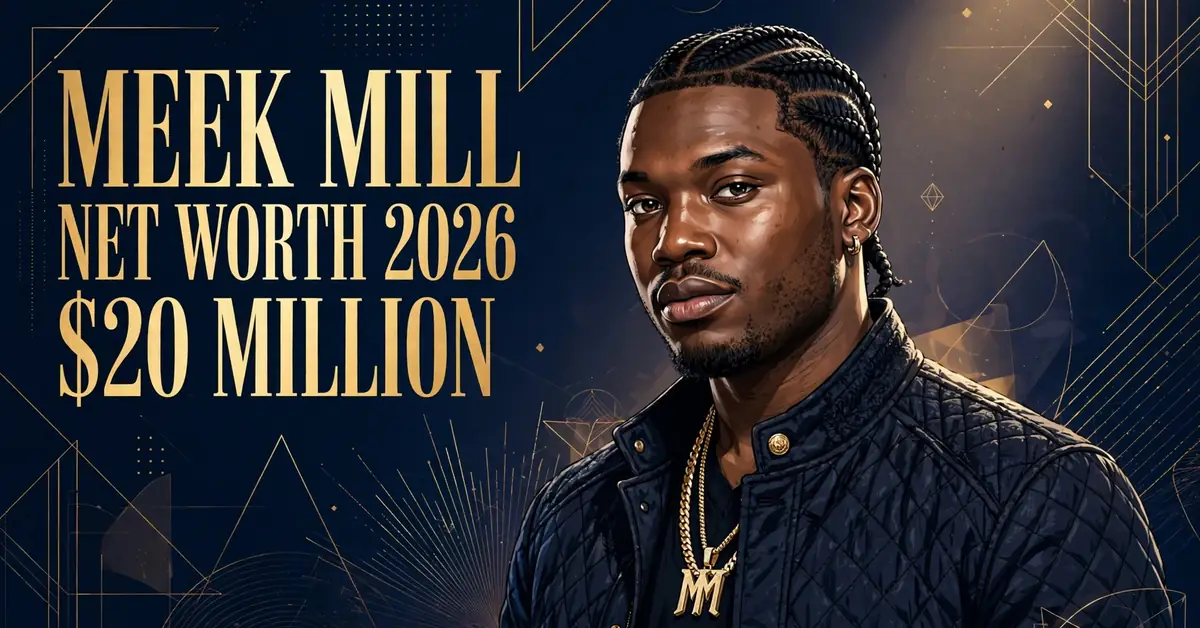
Meek Mill’s net worth is $20 million in 2026, anchored by Celebrity Net Worth in a $15M–$30M range. Mixtapes, Dream Chasers, prison, REFORM: how he built it.
Last updated: November 25, 2026 · By Nathan Cole
Meek Mill, born Robert Rihmeek Williams on May 6, 1987, in Philadelphia, Pennsylvania, is 39 years old in 2026 — and his net worth is estimated at $20 million, anchored by Celebrity Net Worth in its September 2026 update and seconded by AfroTech. The honest range is $15 million to $30 million, because the private pieces of his fortune — his Dream Chasers label equity, his stakes in Lids and Fanatics, the value of a catalog he now largely controls — have never been disclosed. What follows is the full accounting: the mixtapes, the two number-one albums, the prison sentence that turned into a reform movement, the label he built, and the 2026 singles that show he is still recording.
Meek’s money story splits into two halves. The first half is the classic rap climb: battle rapping on Philadelphia corners, a T.I. deal that went nowhere, a Rick Ross signing in 2011, a debut album whose opening track became a sports-stadium anthem, and a 2015 album that debuted at number one on the Billboard 200. The second half is stranger and more interesting: a probation violation that put him back in prison in 2017, a release that made him the face of criminal justice reform, a label joint venture with Jay-Z’s Roc Nation, and a slow, deliberate move toward independence — releasing his 2026 singles through his own Dream Chasers imprint, distributed by Stem, with no major-label middleman in the credits.
One claim needs handling up front, because it will confuse anyone who Googles him this year. In April 2026 Meek said on social media that he had made “like 80m off rap since drake beef.” That is his own claim about gross career rap earnings since 2015 — not a net worth figure, not audited, and not something any outlet has independently verified. It sits in this article exactly as it should: as Meek’s words, in the section about the feud, with the difference between gross earnings and net worth spelled out. The $20 million anchor stands on its own evidence, and the section on why sources disagree shows the work.
Quick Facts
| Net Worth (2026) | $20 million (estimated; honest range $15M–$30M) |
| Full Name | Robert Rihmeek Williams |
| Born | May 6, 1987, South Philadelphia, Pennsylvania (age 39) |
| Height | Listed at 6 ft 2 in (1.88 m) |
| Profession | Rapper, songwriter, entrepreneur, criminal justice reform advocate |
| Nationality | American |
| Partner | No confirmed relationship as of 2026 (never married) |
| Children | 3 sons |
| Wealth Sources | Music catalog, streaming, touring, Dream Chasers Records, Lids/Fanatics equity, endorsements |
| Last Updated | November 25, 2026 |
How This Estimate Was Made
This figure is an independent estimate — Meek Mill has never disclosed his finances publicly. Our process: gather every credibly reported salary, deal, and asset; cross-check them across reputable outlets; allow for taxes, representation fees, legal costs, and spending; and publish a range wherever sources disagree, with the reasoning shown in the article. Anything uncertain is labeled as an estimate, not a fact. A rapper’s own social-media earnings claim is reported as his claim, never as a verified figure.
+
The Twenty Million Dollar Answer
The number most outlets agree on is $20 million. Celebrity Net Worth carries it in its September 2026 update. AfroTech reaches the same figure. BounceMojo, in its September 2026 update, also lands on $20 million and adds a year-by-year table showing the estimate flat at $20 million since 2020, after $14 million in 2018. Three independent aggregators arriving at the same number in the same quarter is not proof — none of them has seen his bank statements — but it is the strongest consensus the public record offers.
The range around that anchor is where the honest reporting lives. LitNightzNews, in a careful August 4, 2026 analysis, argues that $15 million to $30 million is more defensible than any single figure, and explains why: published estimates are built by adding reported earnings, subtracting estimated expenses, and applying a rough multiplier to private assets. Meek’s private assets are the whole problem. Nobody outside his circle knows what his Dream Chasers equity is worth, what his Lids and Fanatics stakes are worth, or what his catalog — which he now largely controls — would fetch in a sale. A range admits that ignorance instead of hiding it.
Two outliers show what happens when the method breaks. NetWorthSpot, updated November 1, 2026, puts him at about $9.4 million, with a ceiling of $13.1 million. That is an advertising-revenue model: it estimates what a YouTube channel and streaming presence earn and treats that as the fortune. It misses the label, the equity, and the touring entirely, and its own page contradicts itself by also quoting $20 million in the text. At the other end, a $55 million figure circulated on a low-quality content farm in November 2026 with no methodology at all — no earnings, no assets, no sources. It was rejected outright. A $25 million figure also circulates, carried by Art Threat in its May 2026 birthday piece and by one table inside Scintillating Stars (whose own text says $20 million). It sits at the top of the honest range, not outside it, and it is the reason the range runs to $30 million rather than stopping at $20 million.
The shape of the estimate has barely moved in years, and that flatness tells its own story. BounceMojo’s table shows $14 million in 2018, $20 million in 2020, and $20 million ever since. Meek has not had a blockbuster album cycle since 2018, and his income now comes in steadier, smaller streams — catalog royalties, independent singles, label income, equity — rather than the big paydays that move an estimate. The fortune is durable, not growing fast. That is the first thing to understand about it.
Early Life in South Philadelphia (1987–2006)
Robert Rihmeek Williams was born on May 6, 1987, in South Philadelphia, the son of Kathy Williams. His father, Robert Parker, was killed when Meek was five years old, reportedly during an attempted robbery. Kathy raised Meek and his older sister Nasheema alone, and after her husband’s death she moved the family to North Philadelphia, into a three-bedroom apartment on Berks Street. Money was short for most of his childhood. The details matter because they explain the chip on his shoulder that never left his music: he has spent twenty years rapping about a childhood the industry usually prefers to file under “humble beginnings” and move past.
Music was the refuge. As a teenager he started battle rapping on street corners and in local clubs, building a reputation for speed, breath control, and a willingness to take on anyone. Family musicians and local Philadelphia figures — Will Smith, DJ Jazzy Jeff, and the city’s battle circuit — were early influences. He took the name Meek Millz, later shortened to Meek Mill, and by his late teens he was a known quantity in the city’s underground: not famous, but feared in a rap battle, which in Philadelphia counted for more.
Trouble arrived early and stayed. At 19, in January 2007, he was arrested outside his cousin’s house carrying a gun in his waistband. He was charged with 19 counts, including assault, gun charges, and drug possession, convicted on six, and sentenced to 11 to 23 months in prison. He served less than six months before the judge ordered his release and placed him on eight years of probation. That probation — eight years for a case that began when he was a teenager — would shape the next decade of his life more than any record deal. It was still hanging over him when he became famous, and it was the mechanism that sent him back to prison at the height of his career.
Battle Rap Roots and the Flamers Mixtapes (2006–2011)
Meek’s first solo mixtapes, The Real Me and its sequel, arrived in 2006. He followed them with the Bloodhoundz, a short-lived rap group formed with three friends, and then the series that made his name in the streets: Flamers in 2008 and Flamers 2: Hottest in tha City in 2009. The tapes were raw — recorded fast, mixed rough, built for Philly corners rather than radio — and they traveled. T.I. heard them, signed Meek to Grand Hustle Records in 2008, and offered him a path to Warner Bros. Within a week, both Warner Bros. and Grand Hustle had offered him deals.
The Grand Hustle years produced no album. Meek was derailed by the conviction and prison term, and when he came out he kept releasing mixtapes while the label situation drifted. He parted ways with Grand Hustle in February 2011 without ever releasing a record for the label. It reads like a failure in hindsight, but the tapes kept his name hot: Dreamchasers in 2011 and Dreamchasers 2 in 2012, the latter downloaded a reported 1.5 million times in six hours on DatPiff, and the series won Best Mixtape at the 2012 BET Hip-Hop Awards. By 2011 he was also named to XXL magazine’s Freshman Class, the annual list that marks a rapper as a commercial prospect. The industry was watching, even if no album existed yet.

Signing With Rick Ross and Maybach Music Group (2011–2012)
In February 2011, after leaving Grand Hustle, Meek signed with Rick Ross’s Maybach Music Group. It was the right label at the right moment. Ross was building MMG into the loudest crew in rap — Wale, Pill, and later Omarion — and Meek’s hunger fit the roster’s energy. His first appearances came on the label’s Self Made Vol. 1 compilation in May 2011, where “Tupac Back” and “Ima Boss,” both featuring Ross, became his calling cards. “Ima Boss” gave him his first entry on the Billboard Hot 100, and a remix of the track became his first gold certification from the RIAA.
The signing mattered financially as well as musically. A major-label deal meant advances, a marketing machine, and tour slots Meek could never have bought himself. It also meant the label took its cut of everything he made for years — a trade he would spend the next decade renegotiating, first through the Dream Chasers joint venture and eventually by going independent. Rick Ross’s $150 million empire was built on exactly this model: sign hungry artists, put the label’s weight behind them, and keep a share of the upside. Meek was the bet that paid off fastest, and the one who eventually outgrew the arrangement.
By the end of 2011 the groundwork was set: a label, a crew, a mixtape series with a real audience, and a debut album on the calendar. What nobody could have predicted was that the album’s opening track would outlive the album itself and become the most durable piece of music Meek ever made.
Dreams and Nightmares: The Debut That Became an Anthem (2012–2014)
Dreams and Nightmares arrived on October 30, 2012, released jointly by Maybach Music Group and Warner Bros. Records. It debuted at number two on the Billboard 200, selling more than 165,000 copies in its first week, and went on to earn a gold certification from the RIAA. The lead single, “Amen” featuring Drake, put Meek on radio. But the record’s real legacy is its first three minutes.
The title track’s intro — a piano-led slow build that erupts into a full-throated victory lap — became one of the defining rap records of the decade. Sports arenas adopted it as a hype song. Playoff crowds chant it. It has been licensed, memed, and quoted into the culture so thoroughly that many people who have never heard the rest of the album know the intro by heart. That kind of staying power is a financial asset in itself: a song that never leaves the public ear keeps generating publishing and licensing income year after year, long after the first-week sales are forgotten.
The same month the album dropped, Meek announced his own label imprint, Dream Chasers Records, named after his mixtape series. The first signees included Louie V. Gutta, Lee Mazin, and Goldie. It was an early sign of the instinct that would define his business career: own the infrastructure, not just the voice. In October 2012 he also appeared on Wale’s “Bag of Money,” which reached number 64 on the Hot 100 — one more brick in a catalog that was growing fast.
| Studio album | Released | Billboard 200 debut | Certification |
|---|---|---|---|
| Dreams and Nightmares | Oct 30, 2012 | No. 2 (165,000+ first week) | RIAA Gold |
| Dreams Worth More Than Money | June 29, 2015 | No. 1 (246,000 units) | RIAA Platinum |
| Wins & Losses | July 21, 2017 | No. 3 (87,000 units) | RIAA Gold |
| Championships | Nov 30, 2018 | No. 1 (229,000 units) | RIAA Platinum |
| Expensive Pain | Oct 1, 2021 | No. 3 | — |
| Too Good to Be True (with Rick Ross) | 2023 | No. 23 | — |
Dreams Worth More Than Money and the First Number One (2015)
Meek’s second album, Dreams Worth More Than Money, arrived on June 29, 2015, and it was the commercial peak of his early career. It debuted at number one on the Billboard 200 with 246,000 equivalent album units in its first week — 215,000 of them pure album sales — and spent a second week at the top. It went on to earn a platinum certification and won Top Rap Album at the 2016 Billboard Music Awards. By the end of 2015 it had sold 350,000 copies domestically.
The album’s biggest single was “All Eyes on You,” featuring Nicki Minaj and Chris Brown, which reached the top 25 of the Billboard Hot 100 and went double platinum. The collaboration was also personal: Meek and Minaj had begun dating in early 2015, and he opened her world tour that year. The song’s success tied his commercial fortunes to the most visible relationship in rap at the time, and the breakup two years later would play out just as publicly.
Financially, 2015 was the year the money started to match the fame. Touring, streaming, and the album’s sales put Meek on the map as an earner, not just a hitmaker. But the same summer the album topped the charts, he picked the fight that would define his public image for years — and, by his own later telling, cost him more than it gained him.
The Drake Feud of 2015 and the Eighty Million Dollar Claim
In July 2015, weeks after his album hit number one, Meek accused Drake of using a ghostwriter — Quentin Miller — on their collaboration “R.I.C.O.” The accusation detonated across hip-hop. Drake answered with “Charged Up” and then “Back to Back,” a diss track so effective it earned a Grammy nomination and became a hit in its own right. Meek’s reply, “Wanna Know,” landed flat. The consensus at the time was brutal: Meek had started a fight with the biggest rapper alive and lost it in public. Drake’s biography runs the other side of this story, from a Degrassi child actor to a $400 million empire, and it is worth reading to understand the scale of the opponent Meek chose.
For years the feud was treated as the moment Meek’s career stalled. He has spent the decade since arguing the opposite. The two men reconciled in 2018 with “Going Bad,” a collaboration that became his highest-charting song ever. And in April 2026, after Charlamagne Tha God said on his podcast that Meek never recovered from the beef, Meek fired back on social media with a number: “I made like 80m off rap since drake beef.” AllHipHop reported the claim on April 3, 2026; HotNewHipHop covered it again on April 29. In the same posts he listed his plaques since the feud — “Tap” three-times platinum, “Peta” double platinum, “Blue Notes” one and two platinum, “Uptown Vibes” platinum, “What’s Free” featuring Jay-Z platinum, “F*** on Me” featuring Cardi B platinum — and added that he was still selling out shows and had about $2 million on his schedule that month, “all rap money not counting other deals.”
Here is what that claim is, and what it is not. It is Meek’s own statement about his gross rap earnings over eleven years — album sales, streaming, touring, features — before taxes, before label splits, before management, before lawyers, before spending. Gross earnings are not net worth. If he earned $80 million in gross rap income since 2015 and kept, after every cut, somewhere near a quarter of it, the math lands in the same neighborhood as the $20 million estimate. That is illustrative arithmetic, not a verified audit, and it is presented here as exactly that. The claim’s real value is as a rebuttal to the narrative that the feud ended him: whatever the precise number, the catalog kept paying, the tours kept selling, and the career did not stop in 2015.
Wins and Losses and the Prison Sentence (2016–2018)
Between the feud and the prison sentence, Meek kept working. The DC4 mixtape arrived in October 2016, and Wins & Losses, his third studio album, followed on July 21, 2017. It debuted at number three on the Billboard 200 with 87,000 equivalent album units in its first week and went gold. The album’s title was prophetic in a way nobody wanted: the losses were about to arrive in a courtroom.
On November 6, 2017, Judge Genece Brinkley sentenced Meek to two to four years in prison for violating his probation — the same probation that dated back to his 2007 case, a decade earlier. The violations were an airport fight and popping wheelies on a motorcycle in New York City. No charges were ever filed in either incident, but the judge treated them as technical violations and handed down a sentence that shocked the music world. He served about five months at the State Correctional Institution in Chester, Pennsylvania.
The sentence set off the #FreeMeekMill movement. Jay-Z, Colin Kaepernick, and dozens of other artists and athletes spoke out. The Philadelphia District Attorney’s office itself supported vacating the original conviction. On April 24, 2018, the Pennsylvania Supreme Court ordered his release on bail, and he walked out of prison to a hero’s welcome — and straight to a Philadelphia 76ers playoff game the same night, sitting courtside with the team’s owner, Michael Rubin. The convictions were eventually overturned entirely, and the charges were dropped in August 2019, ending a twelve-year legal saga. In 2023, Governor Tom Wolf granted him a full pardon, wiping the conviction from his record before leaving office.
The prison sentence cost him directly — months of lost touring and recording income, legal fees that no estimate can price — and it also remade his public identity. He came out of Chester not just as a rapper who had been to prison, but as the most famous living example of how probation can trap a person for a decade over technicalities. That identity would become the second pillar of his career, and a real, if hard-to-price, part of his brand value.
Championships: The Comeback Album (2018–2019)
Seven months after his release, Meek delivered the album the moment demanded. Championships arrived on November 30, 2018, and debuted at number one on the Billboard 200 with 229,000 equivalent album units in its first week — only 42,000 of them pure sales, the rest streaming, including 235.4 million streams in seven days, the sixth-largest debut streaming week of the year for any album. It went platinum and earned Meek his first Grammy nomination, for Best Rap Album.
The album’s lead single, “Going Bad” featuring Drake, peaked at number six on the Billboard Hot 100 — still his highest-charting song — and the reunion carried a message the whole industry heard: the feud was over, and both men were bigger for ending it. The album also featured Jay-Z, Cardi B, and Rick Ross, and its title was literal. Meek had come home from prison and made the best album of his life, in his own words, and the charts agreed.
The Championships era was also his most lucrative touring period. A 2019 tour grossed a reported $20 million-plus, and the album’s streaming numbers kept paying long after the tour ended. In August 2019, Amazon Prime Video released Free Meek, a documentary series about his battle with the criminal justice system, with Jay-Z as executive producer. The series turned his legal fight into a prestige television product — and into another income stream, with Amazon as the partner.

REFORM Alliance and Criminal Justice Reform (2019–2023)
On January 23, 2019, at John Jay College of Criminal Justice in New York, Meek and Jay-Z launched the REFORM Alliance alongside Michael Rubin, New England Patriots owner Robert Kraft, Clara Wu Tsai, Vista Equity Partners founder Robert F. Smith, and other business and philanthropic leaders. The nonprofit’s mission was narrow and specific: change probation and parole laws so that technical violations — the kind that sent Meek back to prison — stop trapping people for years. The co-founders pledged to raise $50 million and set a goal of reducing the number of people on probation and parole by one million.
REFORM is a nonprofit, so it adds nothing to Meek’s net worth directly. Its value to his fortune is indirect and real: it made him a credible public figure beyond music, put him in rooms with billionaires and governors, and turned a prison sentence into a platform. That platform has produced paid speaking engagements, documentary work, and partnerships that a rapper with only hit songs does not get. It also gave his brand a durability that outlasts chart cycles. When people write about Meek in 2026, they write about the reform advocate as much as the rapper, and that is worth more than any single endorsement deal.
The work has continued into the 2020s. REFORM has pushed probation reform bills in multiple states, and Meek has stayed visible in the fight — testifying, lobbying, and using his social media reach to keep cases in the news. The pardon from Governor Wolf in 2023 closed his own case for good, but the organization he co-founded is still running, and his role in it is now a permanent line in his biography.
Dream Chasers Records: Owning the Label (2012–2026)
Dream Chasers started as a mixtape banner and became the center of Meek’s business life. He announced the imprint in October 2012, and in July 2019 he and Jay-Z formally launched Dream Chasers Records as a joint venture with Roc Nation, with Meek as president — responsible for building the staff, finding artists, and running talent development, marketing, creative strategy, and business affairs. The label signed artists including Yung Bleu and Vory, and its early roster included Lil Snupe, who was killed in 2013.
The Roc Nation chapter ended in July 2022, when Meek confirmed he had ended his management deal with the company, saying he and Jay-Z remained on good terms and would keep working together on REFORM. Dream Chasers then became the primary imprint for his independent releases — and that shift is the key to his recent economics. As a label owner, Meek now earns on both sides of his own deals: as the artist and as the label collecting a share of the revenue. His 2026 singles are released through Dream Chasers, distributed by Stem, with no major label in the credits at all.
Outside music, the equity story is the part of his fortune nobody can price. In 2019 he became a co-owner of Lids, the sports apparel retailer known for licensed hats, taking an active creative role and releasing Dream Chasers merchandise through the chain, with some collaborations directing proceeds to criminal justice reform. In 2022 he joined Rubin, Jay-Z, and Maverick Carter in buying the century-old Mitchell & Ness brand through Fanatics, giving him a second slice of the sports-merchandise business. The size and current value of his ownership stakes have not been publicly disclosed — Celebrity Net Worth says so plainly — and that silence is the single biggest reason the net worth estimate is a range rather than a number.
Expensive Pain and the Independent Era (2021–2025)
Expensive Pain, Meek’s fifth solo studio album, arrived on October 1, 2021, and debuted at number three on the Billboard 200 — his fifth consecutive top-five album. The title fit the moment: he was publicly frustrated with his label situation, and within weeks of the album’s release he was accusing Atlantic and Maybach Music Group of withholding money he believed he was owed. The album’s modest sales, by his own standards, became the argument for the next move: stop renting his career from a major label and own it outright.
The years that followed were quieter on the album front and louder everywhere else. In 2023 he reunited with Rick Ross for Too Good to Be True, a collaborative album that peaked at number 23 on the Billboard 200 — a respectable showing for a reunion record, and a reminder that the MMG relationship, whatever its tensions, still produced music. In 2024 he released the Heathenism EP, his first fully independent project, and began the slow rollout that would define 2026: singles, not albums, released on his own schedule through his own imprint.
The independent era also changed how he talks about money. His April 2026 posts about the $80 million in rap earnings since the Drake feud were, among other things, a statement about independence: he was making that money, he said, since going independent, and he was still counting. Whether the number is exact or rounded, the direction is clear. He spent the first decade of his career inside other people’s companies. He is spending the second decade building his own.
Meek Mill in 2026: New Singles and the Dream Chasers Return
Meek has not released a studio album in 2026, and as of November 13, 2026, none has been officially announced. What he has released is a steady run of singles through Dream Chasers — the clearest evidence yet of the independent model working. The year opened with “600 Racks” on April 3, 2026, his first confirmed single of the year. On July 24 he appeared on Philadelphia rapper Surf7’s “GOOSE COAT (Remix),” with an official music video. A week later, on July 31, he released “Nightmares to Dreams” through Dream Chasers Records, distributed by Stem — a deliberate sequel to his defining song, “Dreams and Nightmares,” that flips the title and looks back at the journey from North Philadelphia to the top of the charts.
“Nightmares to Dreams” peaked at number 82 on the Billboard Hot 100, a solid showing for an independent single with no album behind it, and its video, released August 3, 2026, included footage from a brief meeting with Pennsylvania Governor Josh Shapiro on July 4. The single’s production, by LOR, Different Money, and DeloMixedThis, echoes the original’s melody in a more restrained first half before growing frenetic and menacing — a veteran rapper revisiting his anthem without imitating it. On October 16, 2026, he reunited with G Herbo on “Wanna Be Free,” the year’s latest confirmed release. Two confirmed solo singles, a feature, a freestyle, and a collaboration: that is the 2026 catalog so far, and the speculation about a full album — five years after Expensive Pain — grows louder with every release.
The 2026 run matters for the net worth story because of how it is structured. Every stream of “Nightmares to Dreams” pays Dream Chasers, not a major label. Every ticket on a tour built around these singles pays Meek’s company first. Independence means smaller grosses than a major-label album cycle, but a larger share of what comes in — and for a 39-year-old artist with a catalog that already earns, the share matters more than the gross.
How the Twenty Million Dollar Fortune Breaks Down
The money comes from five places, and their order has changed over time. Music and streaming lead: five studio albums, two of them number one, two platinum, two gold, plus a catalog whose biggest song — the “Dreams and Nightmares” intro — earns publishing and licensing income every year it plays in a stadium. Touring follows: his peak years put him among the twenty highest-paid rappers in the world, and he still sells out shows in 2026, by his own account. Dream Chasers Records adds label income on his own releases and his signees. Equity — the Lids and Fanatics/Mitchell & Ness stakes — is the least visible and potentially the most valuable piece. Endorsements, including reported deals with Puma and Amazon, round out the picture.
The only hard earnings numbers in the public record are the Forbes windows, reported by Celebrity Net Worth. Between June 2017 and June 2018, Meek earned $15 million before taxes and expenses — enough to make him one of the twenty highest-paid rappers on the planet that year. Between June 2018 and June 2019, he earned $20 million. Forbes ranked him number 15 on its 2019 list of highest-paid hip-hop acts, attributing roughly $21 million in pre-tax earnings; Meek publicly pushed back on Twitter, saying Forbes had his accounts wrong. These are pretax income figures for a twelve-month window, not additions to net worth — the distinction matters, because taxes, management, lawyers, and living costs take a large share before anything is saved. A rapper who earns $20 million in a year does not keep $20 million.
| Earnings window | Pretax earnings | Source |
|---|---|---|
| June 2017 – June 2018 | $15 million | Celebrity Net Worth (Forbes data) |
| June 2018 – June 2019 | $20 million | Celebrity Net Worth (Forbes data) |
| 2019 Forbes highest-paid hip-hop list | ~$21 million (ranked No. 15) | Forbes via LitNightzNews; Meek disputed the figure |
| Apr 2026 (Meek’s own claim) | ~$80 million gross rap earnings since 2015 | Meek Mill on X/Instagram (AllHipHop, HotNewHipHop) — unverified claim |
Peer comparison puts the figure in context. Drake’s net worth sits around $400 million, and Nicki Minaj’s net worth around $150 million — both artists who turned rap fame into far larger business empires. Meek’s $20 million is a different kind of fortune: smaller, built later, and shaped by five months in prison and a decade of legal costs that his peers never paid. He is not in the billionaire conversation, and he is not pretending to be. What he has is a catalog that earns, a label he owns, equity in two sports-merchandise businesses, and a public platform that keeps him relevant without a hit album every year. Readers looking for more profiles in this lane will find them in our Celebrity Net Worth archive.
| Source | Figure | Why it reads this way |
|---|---|---|
| Celebrity Net Worth | $20M | Sept 2026 update; most-cited anchor |
| AfroTech | $20M | Agrees with anchor; original reporting on his business |
| BounceMojo | $20M | Sept 2026 update; flat since 2020 |
| LitNightzNews | $20M anchor; $15M–$30M range | Aug 4, 2026; best methodology — range adopted here |
| Art Threat | $25M | May 7, 2026 birthday piece; top of the honest range |
| NetWorthSpot | ~$9.4M (up to $13.1M) | Nov 1, 2026; ad-revenue model — misses label, equity, touring |
| Track LLC Cars | $55M | Content farm, no methodology — rejected |
Family, Relationships and Personal Life
Meek has three sons. His two eldest, Rihmeek and Murad, are with Fahimah Raheem, his partner from 2006 to 2012. His third son was born on May 6, 2020 — Meek’s 33rd birthday — to Milan Rouge Harris, his partner from 2017 to 2020. He has never married, and as of 2026 there is no confirmed relationship: Us Weekly lists him as single, and relationship trackers describe him as possibly single. The one relationship the public followed closely was with Nicki Minaj’s biography covers the other side of that story — the two dated from early 2015 to January 2017, he opened her world tour in 2015, and their split played out in songs and social media for years afterward.
His mother Kathy and his older sister Nasheema remain the family he talks about most. His father’s death when he was five is the wound at the center of his music — it appears in interviews, in lyrics, and in the way he talks about the neighborhood that raised him. He stands listed at 6 feet 2 inches tall (1.88 m), a figure carried by biography aggregators rather than a measurement he has confirmed himself. He lives between Philadelphia and his business interests, and he has kept his children largely out of the public eye, a choice that stands out in a career otherwise lived very publicly on social media.
The social media presence is part of the story, and part of the risk. Meek’s posts — the $80 million claim, the label disputes, the running commentary on the industry — keep him in the news between releases, and they also create the controversies that follow him. It is a trade he seems to have accepted: attention as a business strategy, with the occasional firestorm as the cost.
Sources & Reporting
Figures in this profile reflect reporting through November 2026. Key sources: Celebrity Net Worth (the $20M anchor, the Forbes $15M/$20M earnings windows, the Lids and Dream Chasers detail, updated September 2026); AfroTech (the $20M figure, the prison timeline, the REFORM launch, the Fanatics/Mitchell & Ness purchase); LitNightzNews (the $15M–$30M range argument and per-source adjudication, August 4, 2026); BounceMojo (the $20M figure and year-by-year table, September 2026); AllHipHop (the $80M earnings claim, April 3, 2026) and HotNewHipHop (April 29, 2026); Art Threat (the $25M figure and the 39th-birthday piece, May 7, 2026); NetWorthSpot (the $9.4M ad-model outlier, November 1, 2026); Wikipedia / Meek Mill discography (album dates, chart peaks, certifications, the 2026 singles including “Nightmares to Dreams” at No. 82); Apple Music and StupidDOPE (the July 31, 2026 single release and its Dream Chasers/Stem credits); AsWeHipHop (the 2026 release tracker, updated November 13, 2026); Prison Legal News (the REFORM Alliance launch, January 2019); Oxygen (the 2007 case, the 2017 sentence, the 2023 pardon); REVOLT (first-week sales for Dreams and Nightmares, Wins & Losses, and Championships); Headline Planet (the Dreams Worth More Than Money first-week numbers). Where outlets disagree on money, the article publishes a range and explains why. Where a figure rests on a single source — his listed height, the $25M figure — the article says so. No verified reporting was found on his current property holdings or 2026 touring gross, so no figures are given for either.
Frequently Asked Questions
What is Meek Mill’s net worth in 2026?
Meek Mill’s net worth is estimated at $20 million in 2026, anchored by Celebrity Net Worth (September 2026 update) and AfroTech, inside an honest range of $15 million to $30 million. His wealth comes from his music catalog, streaming, touring, Dream Chasers Records, equity stakes in Lids and Fanatics/Mitchell & Ness, and endorsements.
How old is Meek Mill?
Meek Mill is 39 years old. He was born Robert Rihmeek Williams on May 6, 1987, in South Philadelphia, Pennsylvania, and turned 39 on May 6, 2026.
How tall is Meek Mill?
Meek Mill is listed at 6 feet 2 inches tall (1.88 meters). The figure comes from biography aggregators rather than a confirmed measurement, so it is best treated as a listed height.
Who is Meek Mill’s wife or girlfriend?
Meek Mill has never been married and has no confirmed relationship as of 2026. His most high-profile relationship was with Nicki Minaj, whom he dated from early 2015 to January 2017. He was previously in long-term relationships with Fahimah Raheem (2006–2012) and Milan Rouge Harris (2017–2020).
How many children does Meek Mill have?
Meek Mill has three sons. His two eldest, Rihmeek and Murad, are with Fahimah Raheem, and his third son was born on May 6, 2020 — Meek’s 33rd birthday — to Milan Rouge Harris.
What happened between Meek Mill and Drake?
In July 2015 Meek Mill accused Drake of using ghostwriter Quentin Miller on their song “R.I.C.O.” Drake answered with “Charged Up” and “Back to Back,” and Meek’s reply “Wanna Know” landed flat. The two reconciled in 2018 with “Going Bad,” which peaked at No. 6 on the Billboard Hot 100. In April 2026 Meek claimed he had made about $80 million in rap earnings since the feud — his own claim, not a verified figure.
How much does Meek Mill make per year?
There is no fixed annual salary. The only hard earnings windows in the public record are Forbes figures reported by Celebrity Net Worth: $15 million pretax between June 2017 and June 2018, and $20 million pretax between June 2018 and June 2019. His income now comes from streaming, touring, his Dream Chasers label, and equity stakes, so it varies year to year.
What is Meek Mill doing in 2026?
Meek Mill released three singles in 2026 through his own Dream Chasers imprint: “600 Racks” on April 3, “Nightmares to Dreams” on July 31 (which peaked at No. 82 on the Billboard Hot 100), and “Wanna Be Free” featuring G Herbo on October 16. He has not released a studio album in 2026, and none has been officially announced; his latest solo album remains Expensive Pain from 2021.
WRITTEN BY
Nathan Cole
Nathan Cole is the editor of Guide Net Worth. He covers celebrity wealth the way a business desk covers earnings: reported figures first, estimates labeled as estimates, and no invented numbers. Every profile on this site passes through his desk before it publishes. About Guide Net Worth · Corrections: figures are updated when new reporting emerges — contact us via the About page if you spot an error.
References & Sources
This article has been fact-checked and verified against multiple public sources, financial disclosures, SEC filings, Forbes reports, Celebrity Net Worth databases, and official records. All net worth estimates are based on publicly available information and financial analysis.