Austin Butler is 35 in 2026, born August 17, 1991, in Anaheim — from Nickelodeon teen to Elvis and Feyd-Rautha, with Dune: Part Three due in December.
Last updated: November 25, 2026 · By Nathan Cole
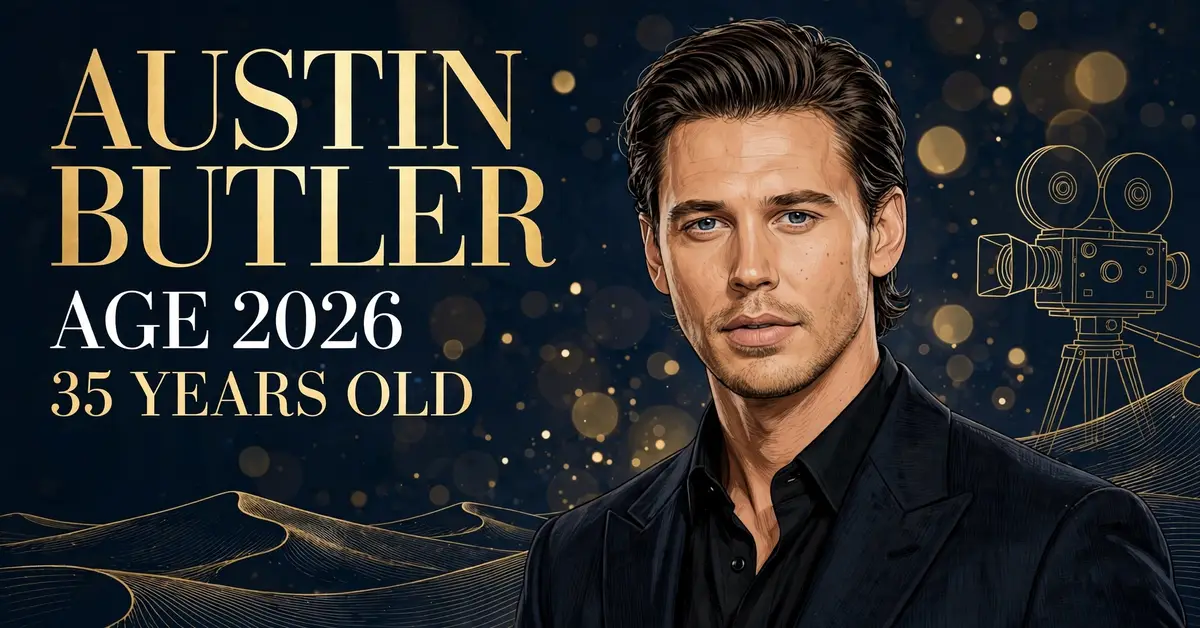
Austin Butler is 35 years old in 2026. He was born Austin Robert Butler on August 17, 1991, in Anaheim, California, and he turned 35 on August 17, 2026. He is, at 35, in the middle of the busiest stretch of his career: Dune: Part Three arrives in cinemas on December 18, 2026, with Butler returning as the villain Feyd-Rautha Harkonnen, and his upcoming slate — a crime saga with Jeremy Allen White, a Lance Armstrong biopic, an American Psycho adaptation — reads like a list of the most ambitious projects in Hollywood. His net worth is estimated at $12 million, and the full story of how he earned it is in our Austin Butler biography. This article answers the age question properly: not just the number, but the career it sits inside — from a fairground discovery at 13, through a decade of children’s television, to an Oscar nomination for playing Elvis.
The age matters because of the shape of the career around it. Butler spent his teens and twenties as a working child actor, largely invisible to the adult audience that now knows him. He was 27 when Quentin Tarantino cast him as Tex Watson. He was 30 when Elvis made him a star, and 31 when the Oscar nomination arrived. He was 32 when he shaved his head and turned himself into a pale, reptilian villain for Dune: Part Two. At 35, he has worked with Tarantino, Baz Luhrmann, Denis Villeneuve, Darren Aronofsky, and Ari Aster in the space of seven years — a director list that most actors spend a lifetime assembling. The number 35 is not the story. The speed is.
What follows is the full account: the Anaheim childhood, the Nickelodeon years, the long apprenticeship in television, the Elvis transformation that cost him his own voice for months, the Dune villainy, the two films of 2025, the December 2026 finale, and the personal life he keeps deliberately out of frame.
Quick Facts
| Full Name | Austin Robert Butler |
| Born | August 17, 1991, Anaheim, California (age 35; turns 36 on August 17, 2027) |
| Height | Listed at 6 ft (1.83 m) |
| Profession | Actor |
| Nationality | American |
| Net Worth (2026) | $12 million (estimated; see our Austin Butler net worth breakdown) |
| Breakthrough | Elvis (2022) — Oscar nomination, BAFTA win, Golden Globe win |
| Partner | No confirmed relationship as of 2026 (previously Vanessa Hudgens 2011–2020; Kaia Gerber 2021–2024) |
| Children | None |
| Next Release | Dune: Part Three — December 18, 2026 |
| Last Updated | November 25, 2026 |
How This Estimate Was Made
The $12 million net worth figure is an independent estimate — Austin Butler has never disclosed his finances publicly. Our process: gather every credibly reported salary, deal, and asset; cross-check them across reputable outlets; allow for taxes, representation fees, and spending; and publish a range wherever sources disagree, with the reasoning shown in the article. The full adjudication is in our Austin Butler net worth profile. Anything uncertain is labeled as an estimate, not a fact. Dates, ages, and career facts in this article are drawn from Wikipedia, Britannica, and trade reporting, and each is attributed where it matters.
+
The Short Answer: How Old Is Austin Butler?
Austin Butler was born on August 17, 1991, which makes him 35 years old as of November 2026. He turned 35 three months ago, on August 17, 2026, and he turns 36 on August 17, 2027. The birthdate is confirmed across every major source — Wikipedia, Britannica, and the trade press all agree on August 17, 1991, in Anaheim, California — so there is no dispute to adjudicate here, unlike the net worth figures that vary by outlet.
For context, here is where 35 sits in his peer group. Timothée Chalamet, his Dune co-star, is 30. Zendaya, his other Dune co-star, is 30. Jeremy Allen White, his co-star in the upcoming Enemies, is 35. Butler is five years older than the two actors he shares the Dune franchise with, and that gap shows in the career: he spent a full decade in children’s television before his film breakthrough, while Chalamet went from high school to Oscar nominations in four years. Butler’s path was longer, slower, and — by his own account — better for it.
He is also, at 35, younger than the roles that made him famous would suggest. He played Elvis Presley, who died at 42, when he was 30. He played a battle-hardened World War II bomber pilot in Masters of the Air at 32. He played a cult leader in Eddington at 33. The gap between his age and his characters’ gravity is part of what casting directors keep buying: a young face with an old soul, as one critic put it after Elvis.
Anaheim Beginnings: A Fairground Discovery
Austin Robert Butler was born on August 17, 1991, in Anaheim, California, the son of Lori Anne Howell, an aesthetician, and David Butler, who is of Irish descent. He has an older sister, Ashley, who worked as a background actress — and it was Ashley’s world that pulled him in. At 13, at the Orange County Fair, a representative from a background-acting company spotted him and suggested he try it. He did. Within a year he was working regularly, and by 2005, at 14, he had his first credited roles.
School bent around the work. He was homeschooled from the seventh grade, which gave him the flexibility to audition and shoot, and it also gave him the isolation that many child actors describe: a childhood conducted on sets rather than in classrooms. He has said little about those years in public, which is consistent with how he treats his private life generally — the work is the story, and the childhood is background.
His mother died of cancer in 2014, when Butler was 22 and still a television actor trying to break into film. He has spoken about her death rarely, but when he has, he has described it as the event that sharpened his ambition: the knowledge that time is short, and that a career spent waiting for permission is a career wasted. It is worth remembering that date when looking at what followed. The eight years after his mother’s death contain every role that made him famous.
The Nickelodeon Years: Learning the Craft
Butler’s first decade was a tour of the children’s television industry. He appeared on Ned’s Declassified School Survival Guide in 2007, on iCarly the same year, and on Zoey 101 from 2007 to 2008. He turned up on Hannah Montana and Wizards of Waverly Place. The work was steady, well-paid, and invisible to the adult audience — which is exactly what a decade of it does to an actor: it teaches camera discipline, comic timing, and professionalism, while teaching the public nothing about who you are.
The point of those years is often missed in profiles that jump from child actor to Elvis. A decade of multi-camera sitcoms is a conservatory. Butler learned to hit marks, to find the light, to deliver a line the same way on the eighth take as the first, and to do it in front of a live studio audience. When Baz Luhrmann later asked him to carry a $85 million biopic, the technical foundation was already there. The Elvis performance looked like a miracle. It was, in large part, a decade of rehearsal.
He also learned something else in those years: how to be patient. Child actors who break out early often flame out early. Butler did not break out at all until he was 27, and by then he had the one thing the industry values more than talent — reliability. Directors who have worked with him since describe the same quality: he shows up prepared, he does the work, and he disappears into the role rather than into the publicity around it.
The Carrie Diaries and the Long Apprenticeship
The first role that suggested an adult career was Sebastian Kydd in The Carrie Diaries, the Sex and the City prequel that ran on The CW from 2013 to 2014. Butler was 21 when it started, playing a brooding high-school love interest in 1980s Manhattan. The show lasted two seasons. It was not a hit, but it was the first time he had carried a series as a romantic lead, and the first time critics noticed him as something other than a Nickelodeon graduate.
What followed was the longest stretch of his career: three years of guest spots and supporting roles, including Arrow in 2015 and The Shannara Chronicles from 2016 to 2017, in which he played the elf Wil Ohmsford. Shannara was a fantasy epic that demanded sword work, wire work, and long location shoots in New Zealand — the kind of physical, unglamorous training that later made the Elvis dance numbers and the Dune fight scenes look easy. It was also, by his own admission, the period when he wondered whether the film career would ever come.
It came, in the end, through a director who had a habit of rescuing actors from television. Quentin Tarantino cast Butler as Tex Watson in Once Upon a Time in Hollywood, and the film changed everything. He was 27, and he had been acting for fourteen years.
Once Upon a Time in Hollywood: The Tarantino Break
Once Upon a Time in Hollywood (2019) gave Butler his first film role of consequence: Tex Watson, the Manson Family killer, in a film that starred Leonardo DiCaprio and Brad Pitt, whose $400 million fortune was built on exactly the kind of career Butler was trying to start. Butler’s screen time was short and his character was monstrous, but the performance was noticed — not least by Baz Luhrmann, who was then casting Elvis and needed an actor who could be both beautiful and frightening in the same frame.
The Tarantino credit did something else: it put Butler in the room with the directors who matter. Within two years of the film’s release, he had been cast by Luhrmann, and within five he had worked with Villeneuve, Aronofsky, and Aster. The fourteen-year apprenticeship had ended. The seven-year run of prestige directors had begun.
He was 28 when the film premiered at Cannes. It was his first time at the festival as a film actor, and it would not be his last: he returned to Cannes in 2024 with The Bikeriders and in 2025 with Eddington, each time a little further from the children’s television he had started in, and each time a little closer to the center of the industry.
Elvis: Two Years Inside the King
Baz Luhrmann’s Elvis (2022) was the role Butler spent two years preparing for, and it remains the performance that defines him. He was 30 when the film was released, and he had spent the two years before it learning to sing like Elvis, move like Elvis, and speak like Elvis — working with vocal coaches, movement coaches, and dialect coaches, and watching every frame of footage that exists of the man. The preparation was so total that, by the time filming ended, he could not stop. His speaking voice stayed in Elvis’s register for months afterward, a fact that became a minor media sensation and a major talking point about method acting.
The film grossed more than $288 million worldwide, and Butler’s performance earned him an Academy Award nomination for Best Actor, a BAFTA win for Best Actor, and a Golden Globe win for Best Actor in a Drama. He was 31 at the Oscars, the youngest Best Actor nominee that year, and he lost to Brendan Fraser for The Whale — a result nobody held against him, because the nomination itself was the coronation. He had gone from a Nickelodeon graduate to an Oscar nominee in a single film.
What the Elvis performance proved, and what every director since has bought, is that Butler can disappear. He did not play Elvis as an impersonation; he played him as a person, with the loneliness and the fear visible underneath the swagger. That is the difference between a star turn and an acting performance, and it is why the Elvis role, for all its fame, is not the most interesting thing he has done since. It is the audition for everything that followed.

The Voice That Would Not Leave
The Elvis voice became a story of its own. For months after filming, Butler spoke in a deeper register, with Elvis’s cadence, and interviewers kept asking him about it. He explained, patiently and repeatedly, that he had spent two years training his vocal cords to produce the sound, and that unwinding that training took time. The press treated it as a curiosity. Acting coaches treated it as evidence of how seriously he had taken the work.
The episode tells you something about how Butler approaches a role: he does not dip in and out. He moves in. The Feyd-Rautha transformation that followed — shaved head, bleached eyebrows, a Nordic accent, a reptilian stillness — was the same method applied to a villain. The bartender in Caught Stealing was the same method applied to an ordinary man, and the result was, by several critics’ accounts, the most relaxed and charming performance of his career. The method does not change. The character does.
At 35, he has now spent more of his life inside other people’s voices than inside his own. It is a strange way to live, and it is the reason his performances feel less like acting than like possession. The voice that would not leave was not a problem. It was the point.
Feyd-Rautha: The Dune Villain
Dune: Part Two (March 2024) cast Butler as Feyd-Rautha Harkonnen, the sadistic heir of House Harkonnen, and the transformation was total: head shaved, eyebrows bleached, skin powdered white, speaking in a clipped Nordic accent, moving with a stillness that made the character feel less human than the sandworms. He was 32. The film grossed $714 million worldwide, and Butler’s performance — twelve minutes of screen time that dominated the conversation — earned him the kind of recognition franchise villains rarely get: critics who had dismissed the role as a cameo wrote about it as a career-best turn.
The role also put him inside the biggest science-fiction franchise of the decade, alongside Timothée Chalamet, who was 28 when Part Two was released, and Zendaya, who was 27. Butler, at 32, was the oldest of the three leads, and the age gap showed in the dynamic: Chalamet’s Paul Atreides is a boy becoming an emperor, while Butler’s Feyd-Rautha is a man who has already decided what he is. The contrast is the engine of the film’s final act, and it is the reason the third film’s expanded Feyd-Rautha role matters so much.
The black-and-white sequence on Giedi Prime, in which Feyd-Rautha fights in a birthday arena under a black sun, was shot in infrared and has been called the most striking set piece of the decade. Butler trained for the knife fight for weeks, and the sequence — like the Elvis numbers before it — was performed largely without doubles. The physicality is the through-line of his career: he does the work himself, and the camera knows it.

The Bikeriders, Eddington and Caught Stealing
Between the two Dune films, Butler worked at a pace that would have been unthinkable during his television years. The Bikeriders (2024), Jeff Nichols’s film about a 1960s Chicago motorcycle club, cast him as Benny, a young rider torn between the club and a woman — a role that required him to learn to ride and to hold the screen against Tom Hardy. Masters of the Air (2024), Apple TV+’s Second World War epic, cast him as Major Gale Cleven, a bomber pilot, in a series that cost a reported $250 million to make.
Then came the two films of 2025, which showed the range he had been building toward. Eddington, Ari Aster’s contemporary western, cast him as a cult leader opposite Joaquin Phoenix, Pedro Pascal, and Emma Stone. Caught Stealing, Darren Aronofsky’s crime thriller, cast him as Hank Thompson, a former baseball player turned bartender who gets pulled into a gang war in 1990s New York — and for the first time in his adult career, Butler played an essentially normal person. No accent, no transformation, no historical figure. Just a man, in trouble, trying to get out of it. Critics called it his most charming performance, and the film’s August 2025 release confirmed what the casting had suggested: he no longer needs a transformation to hold a film.
He was 33 when Eddington was filmed and 34 when Caught Stealing came out. Five years after Elvis, he had worked with Luhrmann, Villeneuve, Aronofsky, and Aster — four of the most demanding directors alive — and he had done it without a single flop to his name. The director collection alone, as one magazine put it, is a kind of wealth.
Austin Butler in 2026: Dune’s Finale and a Full Slate
2026 is the year Butler’s two careers — the prestige actor and the franchise star — converge. Dune: Part Three arrives in cinemas on December 18, 2026, with Butler returning as Feyd-Rautha Harkonnen in an expanded role. The film jumps seventeen years past the events of Part Two, and the first teaser, released on March 17, 2026, showed a scarred, older Paul Atreides and a glimpse of Robert Pattinson as Scytale, the shape-shifting assassin. Principal photography wrapped in early 2026 after eleven weeks in Abu Dhabi and Wadi Rum, Jordan, and the film is in post-production, with visual effects and Hans Zimmer’s score still being finished. It opens the same day as Marvel’s Avengers: Doomsday, and it has secured an exclusive opening-weekend run on IMAX screens in the United States — a vote of confidence from the exhibitors that is rare for any film, let alone one opening against Marvel.
Butler’s age is part of the story here. He was 32 when he played Feyd-Rautha in Part Two, and he is 35 for the finale — the same age Elvis was when he recorded his 1968 comeback special, and the age at which leading men traditionally stop being promising and start being bankable. The seventeen-year jump in the story means Feyd-Rautha, if he returns as the trailers suggest, will be a different creature: older, harder, and — if the expanded role reports are accurate — central to the film’s final confrontation.
The rest of the 2026 slate is just as crowded. Enemies, the A24 crime drama in which he stars opposite Jeremy Allen White as a hitman and a detective who discover they have more in common than either expected, is in post-production and awaiting a release date. The Lance Armstrong biopic, directed by Edward Berger, is in development with Butler in the title role. American Speed, City on Fire, The Barrier, and an American Psycho adaptation are all on his slate, and Miami Vice ’85, Joseph Kosinski’s reboot with Michael B. Jordan, is dated for May 19, 2028. At 35, he has more films in development than at any point in his career — and, for the first time, he is the one choosing them, rather than waiting to be chosen.
The Method: How Butler Chooses Roles
There is a pattern to Butler’s choices since Elvis, and it is worth naming because it explains the age question in a different way. He does not take the obvious role. After an Oscar nomination for playing the most famous singer who ever lived, he played a shaved-headed science-fiction psychopath. After a $714 million blockbuster, he played a bartender in a mid-budget crime film. After working with the biggest directors in the world, he signed on to a film about a disgraced cyclist and a remake of a 1980s television show. The pattern is not random. It is a refusal to be typed — and at 35, with an Oscar nomination and two blockbusters behind him, he is spending that standing on the roles nobody else would take.
The other pattern is the directors. Tarantino, Luhrmann, Villeneuve, Aronofsky, Aster, Berger, Kosinski, Park Chan-wook — the list of filmmakers Butler has worked with, or is signed to work with, reads like a syllabus for a film-studies course. He has said in interviews that he chooses directors before scripts, and the filmography bears that out: there is not a single film on his slate since 2019 that was chosen for its paycheck. The Celebrity Net Worth archive is full of actors who took the money and lost the career; Butler has done the opposite, and the $12 million net worth is smaller than it would be if he had taken the franchise paydays on offer — and larger, in career terms, than any of them.
The method has a cost, and he has been open about it: the Elvis voice, the months of preparation, the physical transformations. But the cost is the point. At 35, he has built a career that looks less like a star’s and more like a character actor’s — and character actors, unlike stars, work forever.
Net Worth and the Money Question
Austin Butler’s net worth is estimated at $12 million in 2026, per our Austin Butler net worth profile, which carries the full adjudication. The figure surprises people who have seen the Elvis and Dune grosses, and it should: $288 million and $714 million are box-office numbers, not paydays. An actor’s share of a blockbuster is a fraction of the gross, and Butler’s biggest films came after a decade of television salaries. The $12 million is the honest number — a working actor’s fortune, built on salaries, residuals, and the slow accumulation of a career that only became lucrative five years ago.
The trajectory matters more than the total. His television years paid modestly. Elvis changed the rate. Dune: Part Two changed it again. The 2026 slate — Dune: Part Three, Enemies, the Armstrong biopic — is the first in which he is negotiating as a proven box-office draw rather than a promising newcomer, and the fees for those films will show up in the estimates of 2027 and 2028. If the pattern of his peers holds, the net worth will double within a few years. For now, $12 million is the number the public record supports, and the article that carries it shows the work.
It is also worth noting what he has not done with the money. There is no fashion line, no tequila brand, no production company with a vanity slate — yet. He lives in Los Angeles, keeps a low profile, and spends his time, by all accounts, preparing for the next role. The fortune is modest by Hollywood standards. The career it bought is not.
Vanessa Hudgens, Kaia Gerber and the Private Life
Butler’s personal life has been public in the way all famous personal lives are — photographed, speculated about, and mostly misunderstood. He dated Vanessa Hudgens for nine years, from 2011 to 2020, a relationship that began when both were Disney-adjacent child stars and ended, by all accounts, amicably. Hudgens has said since that she was the one who encouraged him to audition for Elvis, telling him he had to play the role. It is one of the kinder footnotes in Hollywood breakup history.
He then dated Kaia Gerber, the model and daughter of Cindy Crawford, from 2021 until late 2024, when the split was reported in January 2025. The relationship had been conducted largely in public — red carpets, fashion weeks, holidays photographed from a distance — and its end was reported with the same respectful brevity that had marked its beginning. As of November 2026, Butler has no confirmed relationship. He has never married and has no children.
The privacy is deliberate, and it is the one thing he and his publicists have enforced without exception. He gives interviews about the work and deflects questions about his life, and the press, unusually, has mostly respected the boundary. It is a discipline that dates back to the Nickelodeon years, when he learned that the less the public knows about you, the more they believe you when you become someone else on screen.
Height, Fitness and the Physical Transformations
Butler is listed at 6 feet tall (1.83 m), a figure carried by biography aggregators rather than a measurement he has confirmed himself. At 6 feet, he is taller than most of his leading-lady co-stars and shorter than the action stars he is sometimes compared to — a middle height that has never been an issue, because his screen presence has never depended on size.
The physical transformations are the more interesting story. For Elvis, he learned to move like a man whose body was an instrument, studying the hip swivel and the stagecraft until they were muscle memory. For Dune: Part Two, he shaved his head and eyebrows and trained for a knife fight that was shot in infrared. For The Bikeriders, he learned to ride. For the Lance Armstrong biopic, he will have to learn to ride a bicycle like a man who won the Tour de France seven times. Each transformation is a different body, and each one is built from scratch. It is the most physically demanding career in Hollywood for an actor who is not, by trade, an action star — and it is the reason his performances carry a weight that dialogue alone cannot explain.
He is, by all accounts, disciplined about fitness without being obsessive about it. The body is a tool, and the tool is maintained. At 35, with the most physically demanding roles of his career still ahead of him, that discipline is part of the job.
Awards and Recognition
Butler’s awards shelf is, for a 35-year-old, already crowded. The Elvis campaign brought him an Academy Award nomination for Best Actor, a BAFTA win for Best Actor, and a Golden Globe win for Best Actor in a Drama, along with nominations from the Screen Actors Guild and the Critics’ Choice Awards. Dune: Part Two brought him ensemble and supporting nominations from the critics’ circles, and a reputation — rare for a franchise villain — as a serious actor doing serious work inside a blockbuster.
The awards that matter most to him, by his own account, are the ones that came from his peers: the BAFTA, voted by the British film industry, and the SAG nomination, voted by actors. He has said that the Elvis nomination meant more because it came from people who understood what the performance had cost. At 35, with Dune: Part Three and the Armstrong biopic ahead of him, the awards conversation is not over. If the pattern holds — a nomination for the biopic, a win for the franchise finale — the shelf will get more crowded still.
What Comes Next After Thirty-Five
The question that matters more than his age is what he does with the years ahead. At 35, Butler is at the age when leading men traditionally make their choices: franchise or prestige, money or art, safety or risk. His slate suggests he has chosen all of them at once — a franchise finale, a crime drama, a sports biopic, a horror remake, a television reboot — and the choice is deliberate. He is building a filmography that will read, in twenty years, as the record of an actor who took every kind of role and made each of them his own.
The comparison that comes to mind is not a contemporary but a predecessor: the actors who built careers on transformation rather than persona, and who were still working at 50, 60, and 70 because the audience never tired of watching them become someone new. Butler is 35, and he has already become Elvis Presley, a Harkonnen psychopath, a Second World War pilot, a cult leader, and a bartender on the run. The next decade will add a cyclist, a hitman, a Miami vice cop, and a man who may or may not be Patrick Bateman. The age is 35. The career is just getting started.
Sources & Reporting
Figures in this profile reflect reporting through November 2026. Key sources: Wikipedia / Austin Butler (birth, family, career timeline, updated two days before this writing); Britannica (biography, career summary); TV Insider (birth name, birth date, age 35); Art Threat (Dune: Part Three, December 18, 2026 release, 17-year jump, Butler returning as Feyd-Rautha); MotionPictures.org (March 17, 2026 first teaser, Pattinson as Scytale); Zoom TV (Dune 3 teaser, expanded Butler and Pugh roles); Social Life Magazine (the method-actor analysis, Caught Stealing and the upcoming slate); Just Jared (Enemies with Jeremy Allen White, May 2025); TheCinemaholic (2026–27 slate: Enemies in post-production, Armstrong biopic, Miami Vice ’85 dated May 19, 2028); Guide Net Worth (the $12M net worth anchor, Elvis $288M gross, Dune: Part Two $714M gross). Where outlets disagree on money, the article publishes a range and explains why. Where a figure rests on a single source — his listed height — the article says so. No verified reporting was found on a confirmed relationship in 2026, or on a release date for Enemies, so no dates are given for either.
Frequently Asked Questions
How old is Austin Butler in 2026?
Austin Butler is 35 years old in 2026. He was born on August 17, 1991, in Anaheim, California, and he turned 35 on August 17, 2026. He turns 36 on August 17, 2027.
When was Austin Butler born?
Austin Butler was born Austin Robert Butler on August 17, 1991, in Anaheim, California, to Lori Anne Howell, an aesthetician, and David Butler. He has an older sister, Ashley, who worked as a background actress.
What is Austin Butler’s net worth in 2026?
Austin Butler’s net worth is estimated at $12 million in 2026, per our Austin Butler net worth profile. The figure reflects his salaries from Elvis, Dune: Part Two, and his television years — box-office grosses are not personal paydays, and his biggest paydays are still ahead of him.
How tall is Austin Butler?
Austin Butler is listed at 6 feet tall (1.83 meters). The figure comes from biography aggregators rather than a confirmed measurement, so it is best treated as a listed height.
Who is Austin Butler dating in 2026?
Austin Butler has no confirmed relationship as of 2026. He dated Vanessa Hudgens for nine years (2011–2020) and Kaia Gerber from 2021 until late 2024, when their split was reported in January 2025. He has never married and has no children.
What movies is Austin Butler in for 2026?
Dune: Part Three arrives in cinemas on December 18, 2026, with Butler returning as Feyd-Rautha Harkonnen in an expanded role. His A24 crime drama Enemies, opposite Jeremy Allen White, is in post-production and awaiting a release date, and a Lance Armstrong biopic directed by Edward Berger is in development.
Did Austin Butler win an Oscar for Elvis?
No — he was nominated for Best Actor at the 2023 Academy Awards for Elvis but lost to Brendan Fraser for The Whale. He did win the BAFTA for Best Actor and the Golden Globe for Best Actor in a Drama for the role, and he spent two years preparing for it, including learning to sing and move like Presley.
How did Austin Butler get famous?
Butler was discovered at 13 at the Orange County Fair and spent a decade in children’s television (Ned’s Declassified, iCarly, Zoey 101, The Carrie Diaries, The Shannara Chronicles) before Quentin Tarantino cast him as Tex Watson in Once Upon a Time in Hollywood (2019). Baz Luhrmann then cast him as Elvis Presley in Elvis (2022), which earned him an Oscar nomination and made him a star at 30.
WRITTEN BY
Nathan Cole
Nathan Cole is the editor of Guide Net Worth. He covers celebrity wealth the way a business desk covers earnings: reported figures first, estimates labeled as estimates, and no invented numbers. Every profile on this site passes through his desk before it publishes. About Guide Net Worth · Corrections: figures are updated when new reporting emerges — contact us via the About page if you spot an error.
References & Sources
This article has been fact-checked and verified against multiple public sources, financial disclosures, SEC filings, Forbes reports, Celebrity Net Worth databases, and official records. All net worth estimates are based on publicly available information and financial analysis.