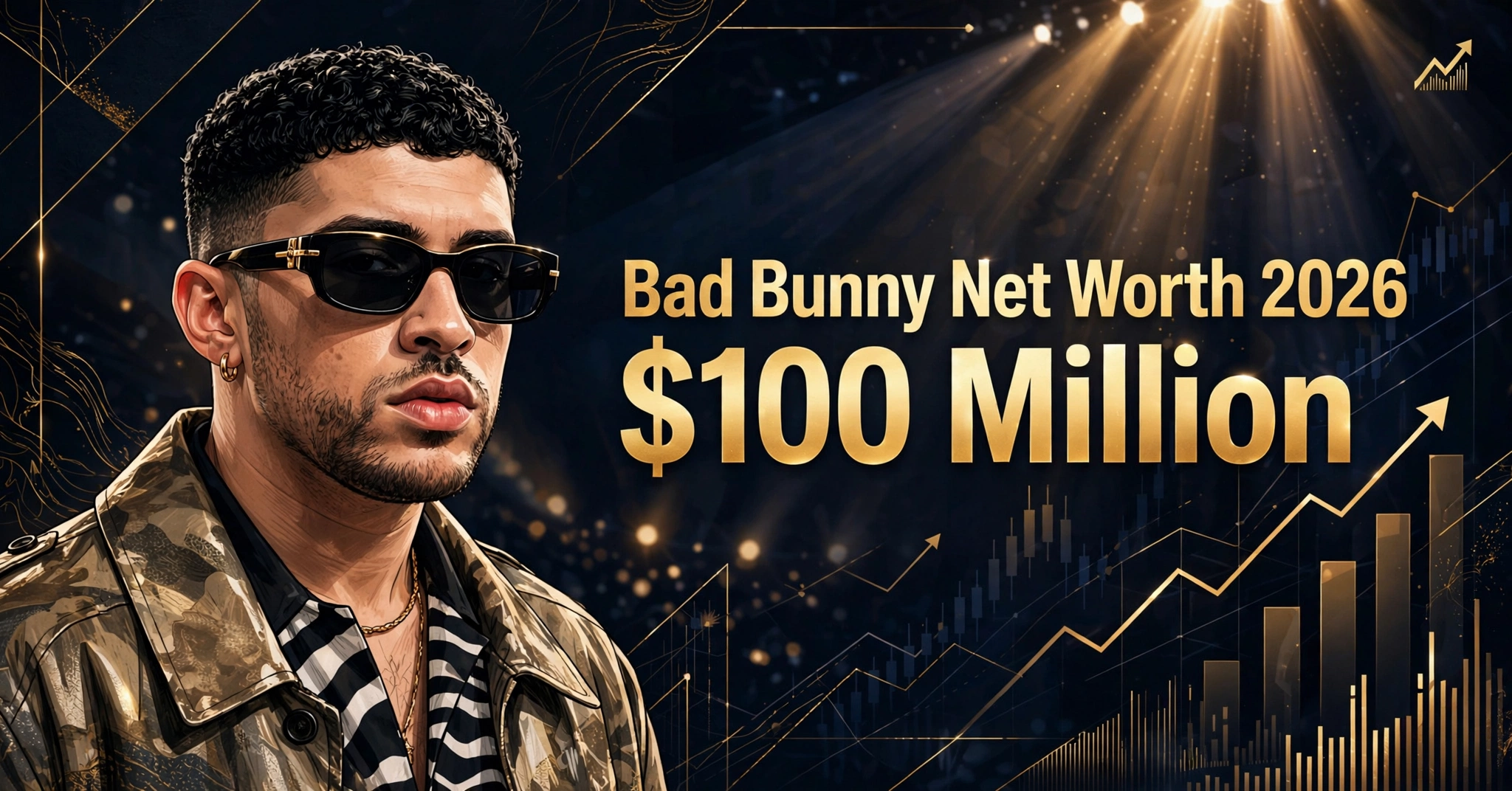
Bad Bunny’s net worth in 2026 is estimated at $100 million. We break down every revenue stream — $1B in career touring, 19.8B Spotify streams, the Super Bowl halftime show, Adidas, and his businesses — with estimates labeled honestly.
Last updated: September 30, 2026
By Nathan Cole
In 2016, Benito Antonio Martínez Ocasio was bagging groceries at an Econo supermarket in Vega Baja, Puerto Rico, uploading songs to SoundCloud between shifts. Ten years later, he is the first Latin artist in history to gross $1 billion on tour, the first musician to win the Grammy for Album of the Year with a fully Spanish-language record, and the owner of an estimated $100 million fortune.
This figure is an independent estimate — Bad Bunny has never disclosed his finances publicly. Our process: gather every credibly reported salary, deal, and asset; cross-check them across reputable outlets; allow for taxes, representation fees, and spending; and publish a range wherever sources disagree, with the reasoning shown in the article. Anything uncertain is labeled as an estimate, not a fact.
Estimated net worth, career earnings, and the business behind the number.
He did all of it without recording a single English-language hit.
That last fact is not trivia. It is the business story. Every net-worth profile of Bad Bunny lists the same ingredients — tours, streams, endorsements — but almost none of them explain the unusual economics underneath: why his money compounds differently than an English-language pop star’s, why a 30-show residency in Puerto Rico mattered more than a 30-show arena run in America, and why the most valuable performance of his career paid him essentially nothing.
This profile breaks down the full $100 million: every tour gross we could verify, what streaming actually pays at his scale, the endorsement portfolio, the businesses, the real estate, and the honest math on what “gross” becomes once everyone else takes their cut. Estimates are labeled as estimates throughout. Nothing here is invented.
Bad Bunny at a glance
Detail
Fact
Full name
Benito Antonio Martínez Ocasio
Born
March 10, 1994, Vega Baja, Puerto Rico
Estimated net worth (2026)
$100 million
Net worth (2025)
~$50 million (Cosmopolitan) — roughly doubled in a year
Biggest income source
Touring (over $1 billion career gross, per Billboard Boxscore)
Co-owner, Los Cangrejeros de Santurce (basketball); co-owner, Gekkō steakhouse (Miami); equity in Rimas Sports
Historic firsts
First Latin artist to headline the Super Bowl halftime show solo; first Spanish-language Album of the Year Grammy; first Latin artist past $1B in touring
Bad Bunny’s net worth in 2026 is estimated at $100 million, according to Celebrity Net Worth and a consensus of major outlets reporting this year. That figure is roughly double the ~$50 million valuation Cosmopolitan and others attached to him in 2025, making his one of the fastest-growing fortunes in music.
One caveat before going further: a Parade profile published this year put the number at $140 million while attributing it to Celebrity Net Worth — but every other outlet citing that same source reports $100 million. Treat $100 million as the anchored consensus and $140 million as an unverified outlier. Net-worth figures for private individuals are always estimates, never audited totals, and this profile treats them that way.
The doubling itself is the interesting part. Fortunes do not double in twelve months by accident. Three things converged in 2025–2026: a $66 million earnings year documented by Forbes, a Grammy milestone that permanently raised his booking and endorsement value, and a Super Bowl halftime show that converted thirteen unpaid minutes into a 470% streaming surge. Each is worth examining on its own, because each reveals a different gear in his money machine.
The style=”border-bottom:2px solid #c9a227;padding-bottom:10px;margin-top:2.2em;scroll-margin-top:90px;” Billion Touring Machine: Where Most of the Money Comes From
If you take one number away from this profile, make it this one: $1.08 billion. That is Bad Bunny’s reported career touring gross — 6.4 million tickets across 260 reported shows — according to figures reported to Billboard Boxscore. He is the first Latin artist and the first non-English-language performer ever to cross the ten-figure touring mark.
Here is how that billion was built, tour by tour, using the verified Boxscore figures rather than the inflated numbers that circulate on social media:
El Último Tour del Mundo (2022):$120.1 million in box-office revenue, per Pollstar. This was the arena run that proved a Spanish-only setlist could fill buildings across the United States.
World’s Hottest Tour (2022):$314.1 million from 1.9 million tickets, per Billboard Boxscore — his first full stadium run and, at the time, one of the highest-grossing tours ever by a Latin artist. (Some outlets cite $435 million; the Boxscore figure is the verified reported gross, and this profile uses it.)
Most Wanted Tour (2024): $211 million from 753,000 tickets, per Billboard. An arena-scale run that kept him at the top of the touring economy between stadium cycles.
Debí Tirar Más Fotos World Tour (2025–2026): $360 million and counting, with 2.4 million tickets sold in its first 41 shows. The European leg alone tells the story of his global pricing power: ten shows in Madrid grossed $96.1 million from 623,000 tickets, and the combined Spain-Portugal run delivered $129.6 million — making it the highest-grossing Boxscore tour in history to play zero shows in the United States. The trek launched November 21, 2025, in Santo Domingo and closed July 22, 2026, in Brussels.
Now the honest part — the part most net-worth profiles skip. Gross is not net. A $314 million tour gross does not mean $314 million lands in the artist’s account. Out of every touring dollar come venue fees, the promoter’s cut, production costs (staging, crew, transport for a stadium show runs into the millions per night), management and agency commissions, taxes across multiple jurisdictions, and the salaries of the dozens or hundreds of people who make the show happen.
So what does the artist actually keep? Industry analysts generally estimate that a headliner at Bad Bunny’s level retains roughly 20 to 35 percent of gross touring revenue as personal profit, depending on the deal structure. Apply that illustratively — and this is illustrative math, not a reported figure — to the $1.08 billion career gross, and you get lifetime touring profit somewhere in the $215–380 million range before taxes, spread over eight years. After taxes, reinvestment, and lifestyle costs, a nine-figure net worth is exactly what you would expect the remainder to look like. The $100 million estimate is not mysterious once you run the haircut; if anything, it is conservative.
Per-show economics sharpen the picture further. Pollstar has estimated his earnings at up to $4.1 million per performance, and industry reporting puts his private-event fee between $2 million and $5 million for a single concert or festival headline slot. When one night’s work commands seven figures, a 30-date run is a wealth event, not just a tour.
The $1.08 billion touring machine: where most of the money comes from.
The 30-Show Residency That Moved an Island’s Economy
In 2025, Bad Bunny did something almost no global superstar does at the peak of their touring power: he stayed home. His 30-show Puerto Rican residency, No Me Quiero Ir de Aquí (“I Don’t Want to Leave Here”), played entirely on the island — and its economic footprint was staggering. Estimates put the boost to Puerto Rico’s economy at $176.6 million to $733 million, a range that reflects different methodologies for counting tourism, hospitality, and secondary spending.
Why does a residency matter for net worth, rather than just headlines? Three reasons. First, residency economics are structurally better than touring economics: no intercontinental freight, no nightly venue negotiations in foreign markets, one production build amortized across 30 shows. The margin per show is higher even if the gross per show is lower. Second, it converted cultural capital into political and brand capital — the residency was a statement of Puerto Rican identity that deepened the loyalty premium his endorsements trade on. Third, Forbes attributed the bulk of his $66 million 2025 earnings year to the residency, which means it was likely his single most profitable twelve-month stretch on a per-night basis.
There is also the decision it represented. In September 2025, Bad Bunny publicly vowed he would not tour the United States, citing fears of ICE raids targeting his predominantly Hispanic fanbase at shows. He then headlined the Super Bowl — in the United States — five months later. The tension between those two facts tells you how deliberately he manages where his body, and his brand, appears. Scarcity is a pricing strategy, and he practices it.
Streaming Royalties: What 19.8 Billion Plays Actually Pay
Bad Bunny was Spotify’s most-streamed artist in the world in 2020, 2021, 2022, and again in 2025, when he amassed 19.8 billion streams in a single year. He was already at 17 billion streams in 2026 by the time of mid-year reporting. Lifetime, estimates range from 85.5 billion (Parade) to over 102 billion (RouteNote) — the variance reflects different counting dates and methodologies, so treat the range as the honest answer.
What does that pay? Spotify pays rights holders roughly $0.003 to $0.005 per stream. Multiply 19.8 billion by that range and you get $59–99 million in generated royalties — but that money does not go to Bad Bunny. It is split among the label, publishers, songwriters, and featured artists before the performer sees a cent. Forbes’ reporting gives us the ground truth: of his $66 million in 2025 earnings, nearly $30 million came from Spotify streams. That implies an effective per-stream take-home, after all splits, of roughly $0.0015 — a useful rule of thumb for what superstardom actually yields per play.
Two things make his streaming economics unusual. First, catalog depth: with 85–102 billion lifetime streams, his older albums (YHLQMDLG, Un Verano Sin Ti) generate a perpetual royalty base that compounds as new fans discover them — Un Verano Sin Ti alone moved over 16 million units worldwide and was IFPI’s Global Album of the Year for 2022. Second, ownership: reporting has suggested he retains ownership interests in portions of his catalog through his Rimas Entertainment relationship, which would give him long-term royalty upside beyond a standard artist deal. That claim is unverified — it comes from a single secondary outlet — but the structure of his Rimas partnership makes it plausible, and it is worth flagging as an upside factor rather than a confirmed asset.
The Super Bowl Halftime Show:
The Super Bowl Halftime Show: $0 Salary, 470% Streaming Spike
Salary, 470% Streaming Spike
On February 8, 2026, Bad Bunny headlined the Super Bowl LX halftime show at Levi’s Stadium — the first Latin artist to headline solo — in front of 128.2 million viewers (Nielsen’s Big Data + Panel rating), a Telemundo viewership record, and a record for the most social-media views in any 24-hour stretch. The performance later won seven Emmy Awards.
Here is what the NFL paid him for it: essentially nothing. The league does not compensate halftime performers beyond a union-scale fee and expense reimbursement. For context, Newsweek reported Jennifer Lopez and Shakira received $1,030 apiece for their 2020 show; Sports Illustrated reported Usher made $671 for 2024, plus about $1,800 for rehearsals. Bad Bunny’s thirteen minutes were, financially speaking, a donation.
It was also one of the best investments of his career. His Spotify streams surged 470% in the aftermath, and the exposure — to 128 million viewers, including older and non-Latino households outside his core audience — is the kind of audience acquisition that money cannot efficiently buy. One outlet’s “industry experts” estimated a $3–5 million net-worth lift within a single week; that figure is unattributed and should be treated skeptically, but the direction is not in doubt. The halftime show is a loss leader that pays in catalog streams for years.
The booking was controversial. President Donald Trump called the selection “absolutely ridiculous,” and some commentators demanded a boycott. The NFL’s calculus was demographic: Latino viewership had risen 11% and Spanish-language broadcasts 34% in recent years, and Bad Bunny is the single most efficient vehicle for reaching that audience. He had history with the event, too — he appeared alongside Lopez and Shakira at the 2020 halftime show. As he put it when the booking was announced in September 2025: “What I’m feeling goes beyond myself. It’s for those who came before me and ran countless yards so I could come in and score a touchdown… this is for my people, my culture and our history.”
$0 salary, 470% streaming spike: the Super Bowl halftime math.
Endorsements: The Adidas Empire and the “Second Release Calendar”
Bad Bunny’s endorsement portfolio reads like a shortlist of brands competing for the under-35, bicultural consumer: Adidas, Corona, Cheetos, Calvin Klein, Gucci, Pepsi, Crocs, and Spotify. Adweek has called him America’s most desirable brand endorser, and his own philosophy explains the selectivity: “It’s about how much I love the brand and how much they’re going to respect my creativity.” He does not lend his name widely; when he does, the deals are structured as creative partnerships, which command premium fees.
Adidas is the anchor — a long-term partnership signed in March 2021 that has become one of the most productive artist-brand collaborations in the industry. The details show how hands-on it is: his first shoe, the Forum Low “First Café,” was designed around the café con leche he drinks every morning; the “Paso Fino” Response CL featured suede trim evoking Puerto Rico’s Cordillera Central mountains; the Gazelle Indoor “El Yunque” was named for the island’s rainforest. In March 2026, Adidas announced his first true signature silhouette, the BadBo 1.0 — the culmination of five years of partnership, with a star logo drawn from the Puerto Rican flag. By then he was on his 14th shoe with the brand.
Here is the angle competitors miss: Bad Bunny’s team has effectively built a second release calendar that runs parallel to his music. Sneaker drops generate their own hype cycles, sell out instantly, and keep his name commercially active in years without an album — the same playbook Jay-Z ran with Rocawear in the 2000s, except Bad Bunny contributes only the cultural signal while Adidas handles manufacturing, distribution, and marketing. It is a more efficient leverage of fame than almost anything else in music, and it is a meaningful, recurring income stream that never appears in a tour gross.
Corona came aboard in 2019, sponsoring his X100PRE tour through the Corona Estéreo Beach concert series, then signing him as the face of the 2020 “La Vida Más Fina” campaign — a deliberate play on Corona’s Hispanic heritage and the growing Hispanic population in the United States. Cheetos partnered with him on “Deja Tu Huella” (“Leave Your Mark”), a philanthropic initiative run with his Good Bunny Foundation and the PepsiCo Foundation. Calvin Klein put him in its Icon Cotton Stretch campaign, shot in Puerto Rico and scored with his song “EoO.” Gucci cast him in a campaign alongside Kendall Jenner during their much-publicized relationship. Each deal is reported to be worth seven figures annually; in aggregate, endorsements likely contribute $8–12 million per year, though the exact terms are private.
Businesses: A Basketball Team, a Steakhouse, and a Sports Agency
Beyond endorsements, Bad Bunny owns pieces of actual enterprises — the stage of wealth-building where touring income converts into equity:
Los Cangrejeros de Santurce — he is a co-owner of the Puerto Rican professional basketball team, a hometown asset that doubles as a cultural statement.
Gekkō — a Japanese steakhouse in Miami’s Brickell neighborhood, which he co-owns. Hospitality is a classic celebrity-equity move: the brand drives the door, the operating partner runs the room.
Rimas Sports — he holds equity in the sports agency arm of the Rimas empire, positioning him on the representation side of the athlete economy, not just the talent side.
The Rimas relationship deserves emphasis because it is the closest thing Bad Bunny has to a corporate holding structure. Signed to Rimas Entertainment (the independent label that bet on him early), with equity extending into Rimas Sports, he sits inside a 360-degree ecosystem where his music, his brand deals, and his sports investments compound under one roof. It is the modern independent-artist equivalent of the old major-label machine — except he owns a piece of the machine.
Acting and WWE: The Side Hustles That Pay Like Main Hustles
Bad Bunny’s acting résumé has grown into a genuine second career: Bullet Train (2022) opposite Brad Pitt, Narcos: Mexico, Darren Aronofsky’s Caught Stealing (2025), and Adam Sandler’s Happy Gilmore 2 (2025), plus hosting and performing on Saturday Night Live. Film salaries at his level of fame typically run from the high six figures into the low seven figures per role — solid money, but a fraction of a tour gross. The strategic value is different: each role puts him in front of audiences who do not stream reggaeton, widening the top of his fan funnel.
Then there is wrestling — and this one is pure passion converted into profit. A lifelong WWE fan, Bad Bunny won the WWE 24/7 Championship in 2021, headlined WrestleMania 37 in a tag-team match (earning genuine respect from wrestling critics for his in-ring work), and became a playable character in WWE 2K23. One secondary outlet estimated a $100,000 fee for a Royal Rumble appearance — treat that as unverified, but directionally it shows even his hobbies pay. The WWE relationship matters financially because it is authentic: fans can tell the difference between a paid crossover and a genuine obsession, and authenticity is what his endorsement premium is built on.
Real Estate: Hollywood Hills, Bird Street, and San Juan
Bad Bunny’s property portfolio reflects the classic superstar pattern — a home base plus American footholds — with one eye-catching detail:
San Juan, Puerto Rico — his primary residence, keeping him close to family and roots. Details are scarce, which is typical; Puerto Rican property records for celebrities are rarely publicized.
Hollywood Hills, Los Angeles — an $8.8 million estate, described by Architectural Digest as built for entertaining, with modern design and expansive views.
Bird Street, Los Angeles — a $8.4 million hideaway purchased from Ariana Grande, per Architectural Digest. Buying from a fellow pop star is a small-world detail that tells you which tax bracket of the housing market he shops in.
Manhattan — a high-profile West Chelsea penthouse rental during his U.S. market ascent.
And then there is the most Bad Bunny real-estate story ever told: fans could spend the night in the 53-foot matte-black semi-truck from the cover of his 2021 album El Último Tour Del Mundo, listed on Airbnb for $91 a night — a nod to his 9.1 billion Spotify streams that year. It was marketing disguised as hospitality, and it worked.
In total, his known real-estate holdings likely represent $20–30 million in asset value — a meaningful but not dominant slice of the $100 million estimate, and consistent with someone whose wealth is still primarily in motion (touring, deals) rather than parked in property.
Bad Bunny’s Net Worth Over Time
Year
Estimated net worth
What changed
2018–2019
$5–10 million
X 100PRE debut; “Mía” with Drake; Forbes 30 Under 30
2020–2021
$18–25 million
Most-streamed artist on Spotify worldwide; YHLQMDLG; WWE debut
2022
$30–40 million
Un Verano Sin Ti (IFPI Global Album of the Year); World’s Hottest Tour ($314.1M)
2023–2024
$50–60 million
Most Wanted Tour ($211M); Forbes top-10 earner trajectory
2025
~$50 million
30-show Puerto Rico residency; $66M Forbes earnings year
2026
$100 million
Grammy Album of the Year; Super Bowl LX halftime; $1B touring milestone
The figures above are estimates compiled from publicly reported valuations and career milestones — the trajectory matters more than any single cell.
The Spanish-Only Moat: Why His Economics Are Different
Every profile notes that Bad Bunny sings in Spanish. Almost none treat it as the financial strategy it is. Consider what refusing English crossover actually buys him:
Zero translation discount. English-language pop stars split their creative energy chasing global ubiquity; Bad Bunny concentrated it. The result is total ownership of the largest underserved audience in music — the global Spanish-speaking market plus the U.S. Latino market — with no direct competitor at his scale.
Pricing power through scarcity. By rarely giving English-language interviews, rarely appearing on English-language television outside event moments (SNL, the Super Bowl), and touring the U.S. selectively, he keeps supply of “Bad Bunny the American celebrity” artificially low while demand compounds. That is why his per-show fees and endorsement rates clear the market.
A catalog that never ages out of its market. English-language hits decay as tastes shift; a Spanish-language catalog anchored in reggaeton, trap, bachata, and rock serves a demographic whose growth — in the U.S. and globally — is structural, not cyclical. His 85–102 billion lifetime streams are an annuity on a growing population.
Cultural authority that converts to equity. Brands do not hire Bad Bunny for impressions; they hire him for permission — permission to speak to an audience that distrusts corporate messaging. That is why his deals are structured as creative partnerships (design the shoe, score the campaign, co-own the narrative) rather than face-on-a-poster endorsements. Creative-partnership deals pay more and last longer.
Spotify’s head of music, Jeremy Erlich, put it this way to Forbes: “He has a finger on the pulse of culture like no one else. He’s dictating what culture becomes.” When you dictate culture, you do not negotiate rates. You set them.
How His Wealth Compares
Context matters more than rankings, but the milestones speak for themselves. Bad Bunny is the first Puerto Rican artist to reach a nine-figure net worth (per GreyJournal’s 2026 analysis) — a sentence that would have been unthinkable when he was uploading tracks to SoundCloud in 2016. He crossed $1 billion in career touring faster than any artist in Boxscore history, a pace that took most legacy stadium acts two to three decades. And he did it as a non-English-language performer, a category the industry treated as a commercial ceiling until he turned it into a floor.
The honest comparison is not “who is richer” — it is structural. English-language pop fortunes (Taylor Swift, Beyoncé) are built on album cycles plus touring plus catalog sales. Bad Bunny’s fortune is built on touring plus streaming plus cultural-equity deals, with no English crossover and no catalog sale. It is a different machine producing a comparable result, which is precisely why the industry studies him.
The speed record may be the most underappreciated number in this entire profile. Most legacy stadium acts needed twenty to thirty years to approach $1 billion in career touring grosses. Bad Bunny did it in under eight years from his first major tour — the fastest ascent to ten figures in Boxscore history. Speed matters for net worth because it compresses a career’s worth of compounding into a window where the artist is still young enough to reinvest aggressively rather than coast.
Philanthropy: The Good Bunny Foundation
Wealth profiles often treat charity as decoration; in Bad Bunny’s case the numbers are concrete enough to include. Through his Good Bunny Foundation, he has distributed over 25,000 gifts to children’s hospitals and supported autism research and cancer patients. After Hurricane Fiona devastated Puerto Rico in 2022, he organized benefit efforts and donated supplies to affected communities. The Cheetos “Deja Tu Huella” partnership channeled corporate money through the foundation into Hispanic community initiatives. In 2023, GLAAD honored him with its Vanguard Award for allyship. None of this directly builds net worth — but it builds the trust asset that his endorsement premium runs on, which does.
The Million Year, Line by Line
Forbes’ 2025 accounting gives us the rare gift of a documented earnings year: $66 million, good for #10 among the world’s highest-paid musicians. Reconstructing it from Forbes’ own reporting shows exactly how the machine fits together:
Revenue stream
Estimated contribution
Basis
Spotify streaming (19.8B plays)
~$30 million
Reported by Forbes via TheStreet
No Me Quiero Ir de Aquí residency (30 shows)
Bulk of the remainder (~$25–30M)
Forbes: “the bulk of his earnings came from” the residency
Endorsements, appearances, acting
Single-digit millions
Industry estimates; exact splits private
Total
~$66 million
Forbes
Two things stand out. First, the residency — 30 shows on one island — out-earned everything else, which validates the residency-economics argument from earlier: fewer moving parts, higher margin per night. Second, streaming at his scale is a $30 million-a-year annuity before he plays a single show. Most artists would kill for either line item; he has both, every year, before endorsements even enter the picture.
And remember: $66 million in earnings is not $66 million added to net worth. Taxes (Puerto Rico’s Act 22 incentives may shelter some income, though his specific tax structure is private), team commissions, and reinvestment all take their share. The net-worth doubling from ~$50M to ~$100M across 2025–2026 reflects retained earnings plus asset appreciation plus the forward value the Grammy and Super Bowl added to his future booking rates — not a simple addition of one year’s pay.
Controversy and the Bottom Line
No honest 2026 profile can skip the controversies, because they tested the commercial thesis in real time — and the thesis held.
In September 2025, Bad Bunny vowed not to tour the United States, citing fears that ICE raids could target his predominantly Hispanic audiences. When the NFL then announced him as the Super Bowl LX halftime headliner, the backlash was loud: President Donald Trump called the selection “absolutely ridiculous,” conservative commentators called for a boycott of the game, and critics labeled him a hypocrite for playing the country’s biggest stage after refusing its tour circuit.
Here is what happened to the business: nothing bad. The halftime show drew 128.2 million viewers — a record for the Spanish-language broadcast and one of the largest audiences in the game’s history. Streams spiked 470%. The world tour grossed $360 million. The Emmys gave the performance seven trophies. If the boycott had teeth, they left no mark on any number that matters.
The financial read is instructive. Bad Bunny’s brand was never built on universal approval; it was built on intense loyalty from a specific, growing demographic. Controversy that alienates casual critics while deepening core-audience devotion is, perversely, good for his pricing power — it reinforces the authenticity premium his endorsement deals are priced on. Brands pay him to reach an audience that trusts him more than it trusts them; a boycott that fails publicly only proves the audience is really his. That is not a moral judgment. It is an observation about how cultural-equity assets behave under stress: they appreciate.
Personal Life
Bad Bunny guards his private life closely, and this profile will not speculate beyond what is publicly reported. He was linked to jewelry designer Gabriela Berlingeri from approximately 2017 to 2022, and to model Kendall Jenner from late 2023 into 2024 (the pair appeared together in a Gucci campaign). As of early 2026, he has not confirmed a current relationship, and he has no children. He remains based in Puerto Rico and speaks openly about his identity — telling the Los Angeles Times: “At the end of the day, I don’t know if in 20 years I will like a man. One never knows in life. But at the moment I am heterosexual, and I like women.”
Sources & Reporting
Figures in this profile reflect reporting through September 2026. Key sources: Forbes (highest-paid musicians coverage and the $100 million estimate); Billboard Boxscore (tour grosses, including the Most Wanted Tour figures that anchor the live-income math). Streaming-era income is estimated from public per-stream economics, labeled as illustrative wherever exact splits are undisclosed.
Frequently Asked Questions
What is Bad Bunny’s net worth in 2026?
Bad Bunny’s net worth in 2026 is estimated at $100 million, according to Celebrity Net Worth and a consensus of major outlets. The figure roughly doubled from ~$50 million in 2025, driven by a $66 million Forbes earnings year, the Grammy for Album of the Year, and the Super Bowl LX halftime show.
How did Bad Bunny make his money?
Primarily touring — over $1 billion in career grosses per Billboard Boxscore, the first Latin artist to reach that mark. Streaming royalties (19.8 billion Spotify streams in 2025), endorsements (Adidas, Corona, Cheetos, Calvin Klein, Gucci), acting roles, and business equity (a basketball team, a Miami steakhouse, Rimas Sports) make up the rest.
How much does Bad Bunny make per concert?
Pollstar has estimated up to $4.1 million per performance, and industry reporting puts private-event and festival headline fees between $2 million and $5 million. Keep in mind gross per-show figures are split among venues, promoters, crew, and management before the artist’s cut.
Was Bad Bunny paid for the Super Bowl halftime show?
Essentially no. The NFL pays halftime performers only a union-scale fee (prior headliners received roughly $670–$1,030) plus expenses. The real payoff is exposure: his Spotify streams surged 470% after the show, which converts into lasting royalty income.
What businesses does Bad Bunny own?
He is a co-owner of the Puerto Rican basketball team Los Cangrejeros de Santurce and the Miami steakhouse Gekkō, and he holds equity in Rimas Sports. His longest commercial partnership is with Adidas, which released his first signature silhouette, the BadBo 1.0, in 2026.
How many Grammys does Bad Bunny have?
He won three Grammys in 2026 — including Album of the Year for DeBÍ TiRAR MáS FOToS, the first Spanish-language album ever to win the award — bringing his career total to six. His Super Bowl halftime performance also won seven Emmy Awards.
Where does Bad Bunny live?
His primary residence is in San Juan, Puerto Rico. He also owns an $8.8 million Hollywood Hills estate and a $8.4 million Bird Street home in Los Angeles purchased from Ariana Grande, per Architectural Digest.
Is Bad Bunny married?
No. He has not confirmed a current relationship as of early 2026 and has no children. He was previously linked to Gabriela Berlingeri (~2017–2022) and Kendall Jenner (late 2023–2024).
WRITTEN BY
Nathan Cole
Nathan Cole is the editor of Guide Net Worth. He covers celebrity wealth the way a business desk covers earnings: reported figures first, estimates labeled as estimates, and no invented numbers. Every profile on this site passes through his desk before it publishes. About Guide Net Worth · Corrections: figures are updated when new reporting emerges — contact us via the About page if you spot an error.
References & Sources
This article has been fact-checked and verified against multiple public sources, financial disclosures, SEC filings, Forbes reports, Celebrity Net Worth databases, and official records. All net worth estimates are based on publicly available information and financial analysis.
Last Updated:September 30, 2026
Fact Checked:✓ Verified
Research Method:Public Records & Financial Analysis
Celebrity Net Worth Researcher & Biography Analyst
Nathan Cole is the editor of Guide Net Worth. He covers celebrity wealth the way a business desk covers earnings: reported figures first, estimates labeled as estimates, and no invented numbers.