Mike Tyson is 5 ft 10 in (178 cm) tall with a 71-inch reach. How the shortest heavyweight champ beat 6’5″ giants — plus his full bio and 2026 net worth.
Last updated: October 2, 2026 · By Nathan Cole
Mike Tyson stands 5 feet 10 inches tall — 178 centimeters, measured barefoot — with a 71-inch reach. ESPN’s listings carried the same numbers into the Jake Paul fight week in November 2024. He is 60 years old, born June 30, 1966, in Brooklyn, New York, and he retired from professional boxing with a 50-6 record and 44 knockouts.
That measurement is the strangest fact in heavyweight history. The average American man is 5’9″, which makes Iron Mike only an inch above average — and one of the shortest men ever to rule the heavyweight division, a weight class where champions usually run 6’1″ to 6’7″. He beat men half a foot taller anyway, lost the crown to a 6’3½” jab, and in November 2024 climbed back in against a 6’1″ opponent at age 58. His net worth sits at an estimated $20–30 million in 2026, rebuilt largely on the back of a reported $20 million purse from that fight and a cannabis company he co-founded in 2021.
Quick Facts
| Height (2026) | 5 ft 10 in (178 cm) (reported) |
| Reach | 71 in (180 cm) (reported) |
| Full Name | Michael Gerard Tyson |
| Born | June 30, 1966, Brooklyn, New York City (age 60) |
| Profession | Former professional boxer; cannabis entrepreneur |
| Nationality | American |
| Spouse | Lakiha Spicer (married June 6, 2009) |
| Net Worth (2026) | $20–30 million (estimated) |
| Last Updated | October 2, 2026 |
How This Profile Was Built
The height and reach figures are reported measurements — 5 ft 10 in (178 cm) and 71 in (180 cm) — carried across boxing record books, Wikipedia’s cited sources, and ESPN’s fight-week listings. The net worth figure is an independent estimate: gather every credibly reported purse, deal, and business venture; cross-check them across reputable outlets; allow for taxes, representation fees, and spending; and publish a range wherever sources disagree, with the reasoning shown in the article.

+
The Short Answer: 5 Feet 10 Inches (178 cm)
Mike Tyson is 5’10” (178 cm) tall. That number has held steady across his entire career — from the 1980s tale-of-the-tape cards to Wikipedia’s cited infobox to ESPN’s listings ahead of the Jake Paul fight in November 2024. Height-listing sites like TallerThan call it one of the most stable measurements in celebrity data: no inflation, no controversy about the number itself.
There is one wrinkle worth naming. A small number of retrospectives — including a CompuBox retrospective of the Buster Douglas fight — list Tyson at 5’11”. A half-inch drift like that is normal in boxing listings, where heights get rounded between sources. The official figure, the one the record books use, is 5’10”.
For context: the average American man stands about 5’9″. Tyson is one inch above that. Among heavyweight champions of the modern era, that makes him an outlier — most of the men who held his belts stood between 6’1″ and 6’7″. He is widely described as one of the shortest heavyweight champions in the sport’s history, and the shortest to dominate the division the way he did.
How Tall Is Mike Tyson Compared to Heavyweight Champions?
Numbers mean more side by side. Here is Tyson against the men who defined his career — the giants he beat, the one who took his crown, and the one he faced in 2024.
| Fighter | Height | Reach | Result vs Tyson |
|---|---|---|---|
| Mike Tyson | 5’10” (178 cm) | 71″ (180 cm) | — |
| Tony Tucker | 6’5″ (196 cm) | — | Lost to Tyson, Aug 1987 |
| Buster Douglas | 6’3½” (192 cm) | 83″ (211 cm) | Beat Tyson, Feb 1990 |
| Lennox Lewis | 6’5″ (196 cm) | 84″ (213 cm) | Beat Tyson, 2002 |
| Jake Paul | 6’1″ (185 cm) | 76″ (193 cm) | Beat Tyson, Nov 2024 |
The pattern is plain: nearly every defining opponent stood taller. Tony Tucker had seven inches on him. Douglas had five and a half inches plus a 12-inch reach advantage. Lennox Lewis had seven inches and a 13-inch reach edge. Even Jake Paul, 31 years younger, gave up nothing in size — 6’1″ with a 76″ reach, per ESPN.
Tyson’s prime fighting weight ran about 215–220 lbs of dense muscle on that short frame. At the November 2024 weigh-in he checked in at 228.4 lbs, nearly identical to Paul’s 227.2 lbs. Same weight class, very different geometry.
The 71-Inch Reach: A Shorter Weapon, Sharper
Reach is where Tyson’s size story gets interesting. His 71-inch reach is short for a heavyweight — Douglas had 83 inches, Lewis 84. In most divisions, a 12- or 13-inch reach deficit is a death sentence. Tyson turned it into a non-factor for four years.
The mechanism was the peekaboo style taught by Cus D’Amato: constant head movement, slipping under the jab instead of blocking it, and stepping inside where a tall man’s arms become a liability. A jab that misses leaves the taller fighter overextended for a split second. Prime Tyson lived in that split second, closing distance and throwing hooks and uppercuts from angles taller men couldn’t see.
It worked because of what the short frame carried. Observers at the time described his hand speed as the fastest the heavyweight division had seen, and his punching power as comparable to men 40 pounds heavier. His neck reportedly measured around 20 inches — the build of a man engineered, almost literally, to punch upward.
The Peekaboo Engine: Built to Beat Bigger Men
Tyson did not stumble into a style that neutralized height. He was built for it, deliberately, by Cus D’Amato — the veteran trainer who took the teenager in after spotting him at the Tryon School for Boys in upstate New York and eventually became his legal guardian.
D’Amato’s Catskill gym ran on a simple thesis: a short heavyweight must never fight at long range. Training drilled bobbing, weaving, and slipping punches by inches, then exploding inside. Kevin Rooney, D’Amato’s protégé, carried the system forward after D’Amato’s death in 1985 and through the championship years.
The proof came against the division’s tallest. Watch the August 1987 unification fight against the 6’5″ Tucker: Tyson out-jabbed a man with far longer arms, slipping Tucker’s jab and working underneath it all night. It is the clearest filmed evidence that his system was designed, from the ground up, to dismantle exactly the kind of fighter who should have beaten him.
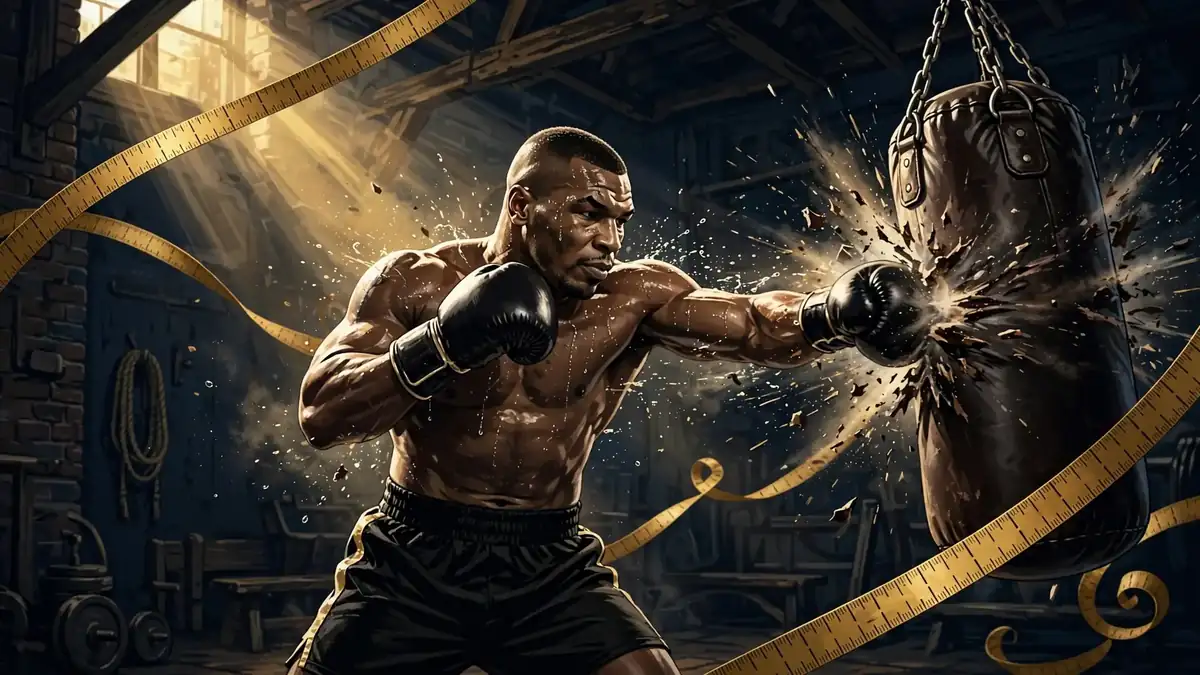
Early Life: The Short Heavyweight From Brownsville
Michael Gerard Tyson was born June 30, 1966, in Brooklyn, New York, and grew up in the Brownsville neighborhood — one of the roughest corners of the city. By age 13 he had reportedly been arrested dozens of times. His mother died when he was 16. Nothing about the start suggested a future champion of anything.
The turn came at Tryon, the juvenile facility upstate, where his fighting ability caught the eye of a counselor who connected him with D’Amato. The old trainer saw a 13-year-old heavyweight with freakish power and rebuilt him: the peekaboo defense, the discipline, the ring IQ. Tyson won Junior Olympic gold in 1981 and 1982, then turned professional on March 6, 1985, in Albany — stopping Hector Mercedes in the first round.
He won his first 19 professional fights by knockout, 12 of them in the first round. The division had never seen a 5’10” heavyweight move like that.
The Championship Run: Winning Big at 5’10”
In November 1986, at age 20, Tyson stopped Trevor Berbick in two rounds to become the youngest heavyweight champion in history — a record that still stands. The following year he added the WBA and IBF belts, unifying the division: the first heavyweight to hold all three major titles at once, and the only one to unify them in succession.
He reigned as the undisputed champion from 1987 to 1990. The signature night came in June 1988, when he knocked out Michael Spinks in 91 seconds to become the lineal champion. Spinks had never lost. The fight lasted less time than a coffee break.
During the run, the height gap kept not mattering. Larry Holmes, Tony Tubbs, Frank Bruno, Carl Williams — bigger men, all stopped. The aura did half the work: opponents looked beaten walking to the ring. The other half was the shortest path in boxing — straight through the middle, under the jab, where none of them could reach him in time.
The Night the Height Gap Won: Buster Douglas
On February 11, 1990, at the Tokyo Dome, the geometry finally caught up. James “Buster” Douglas — a 42-to-1 underdog, 29-4-1, fighting for his recently deceased mother — stood 6’3½” with an 83-inch reach. That is a 12-inch reach advantage and roughly five inches of height over Tyson, and for ten rounds Douglas used every inch of it.
He worked behind a snapping left jab — the Los Angeles Times later compared it to Larry Holmes’s — kept Tyson at the end of it, and moved. Tyson’s left eye swelled shut. In the tenth round, Douglas knocked the undisputed champion out. It remains one of the biggest upsets in sports history, and the blueprint every tall fighter has studied since: don’t fear him, jab him, make the short man travel the long distance all night.
Context matters, and honest coverage says so: the Tyson who walked into Tokyo was not the 1988 machine. His training had slipped, his corner was in disarray after the split with Rooney, and his personal life was unraveling. Douglas fought the fight of his life against a champion having the worst night of his. Both things are true.

Later Years: Lennox Lewis and the Reach Problem
The Douglas loss ended the aura, but the size problem kept showing up. In June 1997, Evander Holyfield — taller, longer, and utterly unafraid — goaded Tyson into the most infamous moment in boxing history: Tyson bit Holyfield’s ear twice in the third round at the MGM Grand and was disqualified.
Then came Lennox Lewis in 2002 in Memphis: 6’5″, an 84-inch reach, a ramrod jab from a man who knew exactly how to use it. Lewis knocked Tyson out. It was the Douglas blueprint executed by a bigger, better version — proof that once opponents stopped being terrified, the inches started counting.
Tyson’s last professional victory came in February 2002. His final pro fight — a sixth-round TKO loss to Kevin McBride in June 2005 — closed a 59-fight career: 50 wins, 44 by knockout, 7 losses, 2 no-contests. He was 38, broke, and done with boxing. Or so everyone thought.
Jake Paul 2024: Size Measured Again
On November 15, 2024, at AT&T Stadium in Arlington, Texas, a 58-year-old Tyson walked into a sanctioned professional bout — 8 rounds, two minutes each, 14-ounce gloves — against Jake Paul, live on Netflix. It was his first pro fight in 19 years.
The tale of the tape told the old story with the ages reversed. Paul, 27, stood 6’1″ with a 76-inch reach per ESPN — three inches taller and five inches longer than Tyson. The weigh-in was nearly even: Tyson 228.4 lbs, Paul 227.2 lbs. But youth did what height used to do to Tyson’s opponents. Paul won a unanimous decision, 80-72 and 79-73 twice, landing 78 of 278 punches to Tyson’s 18 of 97.
| Mike Tyson | Jake Paul | |
|---|---|---|
| Age | 58 | 27 |
| Height | 5’10” (178 cm) | 6’1″ (185 cm) |
| Reach | 71″ (180 cm) | 76″ (193 cm) |
| Weigh-in | 228.4 lbs | 227.2 lbs |
| Result | Paul by unanimous decision (80-72, 79-73, 79-73) | |
The fight itself underwhelmed. The business didn’t. Netflix drew a reported 108 million global viewers with 65 million concurrent streams — the most-streamed sporting event ever at the time — and the gate hit $18.1 million, a Texas combat-sports record. The reported purses: $40 million for Paul, $20 million for Tyson. Neither figure was officially confirmed — Paul himself later said his was in the low 30s — but the $20 million number is the one every outlet carried for Tyson, and it changed his finances overnight.
Net Worth Snapshot: What Iron Mike Is Worth in 2026
Mike Tyson’s net worth in 2026 is estimated at $20–30 million, with Celebrity Net Worth’s widely cited figure sitting at about $30 million. The Street’s 2026 reporting lands in the same band, noting that the most common estimate before the Paul fight was around $10 million — the $20 million reported purse roughly tripled it.
| Era | Figure | Source |
|---|---|---|
| Career earnings (reported) | $430M+ (~$700M adjusted) | mrfinancialadvisor, 2026 |
| Peak net worth | ~$300M (Forbes once floated $685M) | Parade via Celebrity Net Worth, Jan 2026 |
| Bankruptcy | $23M in debt, filed 2003 | Parade; mrfinancialadvisor |
| Pre-Paul-fight estimate | ~$10M | The Street, 2026 |
| 2026 estimate | $20–30M (~$30M) | Celebrity Net Worth; The Street |
The arc is the most dramatic in sports finance: over $430 million earned from fights and endorsements — including a $27 million HBO deal in 1987 and a $120 million Showtime contract — then lost to spending, management, promoters, taxes, and lawsuits. He filed for bankruptcy in 2003 owing $23 million. For years he talked openly about being broke.
The rebuild came from unlikely places: exhibition bouts, the Hotboxin’ podcast, appearances — and the cannabis business (below). The Paul fight’s reported $20 million purse did the rest. Thirty million is a fraction of the peak, but it is real money, and it is his.
Personal Life: Lakiha Spicer and Family
Tyson married Lakiha “Kiki” Spicer on June 6, 2009, in a private ceremony at the La Bella Wedding Chapel in Las Vegas — eleven days after the death of his four-year-old daughter Exodus in a treadmill accident. Clark County Clerk records confirm the date. The couple had dated on and off since the mid-1990s.
They have two children together: daughter Milan and son Morocco Elijah, born January 25, 2011, in Henderson, Nevada, where the family lives. Tyson has seven children in total. He credits Spicer, openly and often, with saving his life — pulling him out of addiction and chaos and into the stable third act he is living now. They renewed their vows in Las Vegas in 2011.
Tyson 2.0 and the Business of Being Iron Mike
In October 2021, Tyson co-founded Tyson 2.0, a cannabis company, with entrepreneur Chad Bronstein as chairman and Adam Wilks as CEO, under the parent company Carma Holdings. It was his second run at the industry — the earlier Tyson Ranch, a 40-acre California operation, dated to 2018.
Tyson 2.0 moved fast: products across dozens of US states and international markets within its first year, per industry reporting, and a viral hit in March 2022 with “Mike Bites” — gummies shaped like an ear with a bite taken out, a wink at the Holyfield fight. He also acquired a majority stake in Ric Flair’s cannabis line that same month. Alongside it, the Hotboxin’ with Mike Tyson podcast, launched in 2019, pulled tens of millions of listeners with its mix of athletes, comedians, and celebrities.
The throughline of the business career is the same as the boxing one: take the thing everyone said was a disadvantage — the past, the chaos, the bite — and sell it back as the brand. At 5’10”, he was never supposed to rule the heavyweights either.
Sources & Reporting
Figures in this profile reflect reporting through September 2026. Key sources: Wikipedia (the cited 5’10″/178 cm height and 71″/180 cm reach, birthdate, career record, championship reign 1987–1990, Junior Olympic golds); ESPN via NBC Sports (the 5-foot-10/71-inch listing, Paul’s 6’1″/76″ listing, and both November 2024 weigh-in weights); Bleacher Report (the November 15, 2024 fight result, scores, and reported $20M/$40M purses); BoxingScene’s CompuBox retrospective and Bad Left Hook (Douglas’s 6’3½” height, 83″ reach, and the February 11, 1990 Tokyo details); Celebrity Net Worth via Parade (the ~$30M 2026 estimate, $300M peak, 2003 bankruptcy); The Street (the $20–30M range and the pre-fight ~$10M figure); Fandomwire via The New York Times and Clark County Clerk records (the June 6, 2009 wedding); PRNewswire/company reporting via cannabis trade press (Tyson 2.0’s October 2021 launch, founders, and executives). Where outlets disagree — the stray 5’11” listings, the $10M vs $30M net worth band — the article says so and publishes the range rather than picking a side.
Frequently Asked Questions
How tall is Mike Tyson?
Mike Tyson is 5 feet 10 inches tall (178 cm), measured barefoot. The figure is consistent across boxing record books, Wikipedia’s cited sources, and ESPN’s listings. A few retrospectives round him to 5’11”, but 5’10” is the official, most-cited number.
What is Mike Tyson’s reach?
Tyson’s reach is 71 inches (180 cm). It is short for a heavyweight — Buster Douglas had an 83-inch reach and Lennox Lewis 84 inches — which is why his peekaboo style was built around slipping inside longer arms rather than boxing at range.
How much does Mike Tyson weigh?
In his prime, Tyson fought at around 215–220 lbs of dense muscle on his 5’10” frame. At the November 2024 weigh-in for the Jake Paul fight, he checked in at 228.4 lbs — nearly identical to Paul’s 227.2 lbs.
How old is Mike Tyson in 2026?
Mike Tyson was born on June 30, 1966, in Brooklyn, New York, which makes him 60 years old in 2026. He was 58 when he fought Jake Paul in November 2024 — 31 years older than his opponent.
Is Mike Tyson the shortest heavyweight champion ever?
He is among the shortest heavyweight champions of the modern era. Most heavyweight titleholders stand between 6’1″ and 6’7″, and at 5’10” Tyson gave up half a foot or more to opponents like Tony Tucker (6’5″) and Lennox Lewis (6’5″) — and beat most of them anyway.
How did Tyson beat taller boxers?
Through the peekaboo style taught by Cus D’Amato: constant head movement, slipping under the jab instead of blocking it, then exploding inside where a tall fighter’s reach becomes a liability. Against the 6’5″ Tony Tucker in 1987, he out-jabbed a much longer-armed man all night.
Who is taller: Jake Paul or Mike Tyson?
Jake Paul is taller. Paul stands 6’1″ (185 cm) with a 76-inch reach, per ESPN, compared to Tyson’s 5’10” (178 cm) and 71-inch reach. Paul won their November 15, 2024 fight by unanimous decision.
What is Mike Tyson’s net worth in 2026?
Mike Tyson’s net worth is estimated at $20–30 million in 2026, with Celebrity Net Worth’s widely cited figure around $30 million. That is up from roughly $10 million before the Jake Paul fight, whose reported $20 million purse — plus his Tyson 2.0 cannabis business — rebuilt his fortune after his 2003 bankruptcy.
WRITTEN BY
Nathan Cole
Nathan Cole is the editor of Guide Net Worth. He covers celebrity wealth the way a business desk covers earnings: reported figures first, estimates labeled as estimates, and no invented numbers. Every profile on this site passes through his desk before it publishes. About Guide Net Worth · Corrections: figures are updated when new reporting emerges — contact us via the About page if you spot an error.
References & Sources
This article has been fact-checked and verified against multiple public sources, financial disclosures, SEC filings, Forbes reports, Celebrity Net Worth databases, and official records. All net worth estimates are based on publicly available information and financial analysis.