Burna Boy biography 2026: Damini Ogulu, born July 2, 1991, rose from Port Harcourt to a Grammy and the World Cup stage. Age, family, albums, fortune, explained.
Last updated: October 31, 2026 · By Nathan Cole
Burna Boy is 35 years old in 2026. Born Damini Ebunoluwa Ogulu on July 2, 1991, in Port Harcourt, Nigeria, he is the Grammy-winning Afrobeats star who went from making beats on a classmate’s software at age 10 to performing at the 2026 FIFA World Cup final. His story is unusual even by pop-star standards: the grandson of Fela Kuti’s manager, the son of a welding-company manager and a translator who became his own manager, a university dropout who built his own record label before signing to a major, and the first African artist to headline a UK stadium.
The career arc runs from “Like to Party” in 2012 through eight studio albums, a Grammy win for Twice as Tall in 2021, and a 2026 calendar that put him on the world’s biggest stages twice in two months — the World Cup opening ceremony in Mexico City on June 11 and the first-ever World Cup final halftime show on July 19. His net worth is estimated at around $40 million inside a published range of $22 million to $50 million, a spread this profile explains rather than hides, because Burna Boy himself has publicly dismissed the low end of it.
This biography is current through October 31, 2026. It covers the family, the schooling in England he walked away from, every album in order, the business moves behind the music, the relationships he has confirmed and the ones he has not, and the 2026 run that made him, by one July 2026 report’s count, Africa’s best-selling artist of all time at 14.46 million equivalent album sales.
Quick Facts
| Full Name | Damini Ebunoluwa Ogulu |
| Born | July 2, 1991, Port Harcourt, Rivers State, Nigeria (age 35 in 2026) |
| Also Known As | African Giant, ODG, Big 7 |
| Height | Listed at 6 ft 1 in (185 cm) |
| Parents | Samuel Ogulu (welding-company manager) and Bose Ogulu, “Mama Burna” (translator turned manager, founder of Spaceship Collective) |
| Grandfather | Benson Idonije, radio broadcaster and former manager of Fela Kuti |
| Siblings | Nissi Ogulu (singer) and Ronami Ogulu |
| Education | Corona Secondary School, Agbara; Media Technology at the University of Sussex (2008–2009); Media Communications and Culture at Oxford Brookes University (2009–2010) — left without completing a degree |
| Occupation | Singer, songwriter, record producer; founder of Spaceship Records |
| Years Active | 2010–present |
| Labels | Spaceship, Atlantic, Warner Music Group (deal signed 2017) |
| Breakthrough | “Like to Party” (2012); debut album L.I.F.E (2013); “Ye” (2018); African Giant (2019) |
| Grammy | Best Global Music Album for Twice as Tall (March 2021) — first Nigerian solo artist to win a Grammy |
| Net Worth (2026) | Estimated $22 million–$50 million; anchor figure ~$40 million; no audited figure exists — see the money section |
| Partner | Not publicly married; dated British rapper Stefflon Don (2018–2022); current relationships kept private |
How This Biography Was Checked
Dates, family details, and the album sequence in this profile come from the public record as reported by Wikipedia, AllMusic, and Nigerian and international music press, cross-checked against each other where they overlap. Where outlets disagree — most visibly on net worth, and on a few heritage details — this profile names the disagreement and attributes each version to its outlet instead of picking one silently.
Three cautions apply throughout. First, Burna Boy has never published a balance sheet, so every net-worth figure here is an estimate built from touring, streaming, endorsements, and label ownership, and the honest answer is a range ($22 million–$50 million), not a point figure. Second, touring grosses are gross box-office receipts before venues, promoters, crews, taxes, and management take their cuts; the $30.46 million figure for the I Told Them tour is cited as a gross, never as take-home pay. Third, relationship reporting after his 2022 split from Stefflon Don is treated as reported, not confirmed, because Burna Boy has not confirmed a current partner publicly.
Figures are updated when new reporting emerges — contact us via the About page if you spot an error.
+
The Short Version: Who Burna Boy Is
Damini Ebunoluwa Ogulu, known to the world as Burna Boy, is a Nigerian singer, songwriter, and record producer whose sound he calls Afro-fusion: Afrobeats and Afrobeat roots blended with dancehall, reggae, hip-hop, R&B, and pop. He has released eight studio albums between 2013 and 2025, won a Grammy, won multiple BET Awards for Best International Act, and headlined stadiums on three continents. By 2026 he had become the rare African artist whose name appears on World Cup songs, Apple Music venue openings, and stadium announcements in the same year.
The nickname “African Giant” started as an album title in 2019 and stuck as an identity. It fits the scale of the touring business he built: London Stadium in June 2023 made him the first African artist to headline a UK stadium, and his I Told Them tour grossed $30.46 million from 22 reported shows between 2023 and 2025, according to Touring Data figures cited by multiple outlets. That touring record is the backbone of his fortune, and it is also the reason the low-end net-worth estimates look shaky to anyone who follows the boxscores.
He is also one of the most deliberate image-builders in Afrobeats. The braids, the designer fits, the Pan-African rhetoric, the Fela Kuti lineage claimed through his grandfather — all of it is part of a persona constructed over fifteen years, and all of it is documented in the sections below, in order, with the receipts attached.
Early Life in Port Harcourt: The Fela Kuti Connection
Burna Boy was born on July 2, 1991, in Port Harcourt, the capital of Rivers State in southern Nigeria, and raised there. His father, Samuel Ogulu, managed a welding company. His mother, Bose Ogulu — now known to fans worldwide as “Mama Burna” — worked as a language translator before becoming her son’s manager and later founding her own entertainment company, Spaceship Collective. He is the family’s middle story in a household where music was not a hobby but a lineage: his maternal grandfather, Benson Idonije, was a radio broadcaster, music critic, and onetime manager of Fela Kuti, the Afrobeat pioneer whose shadow falls across Burna Boy’s entire career.
That lineage is often repeated without its detail, so here is the detail. Idonije managed Fela Kuti during a formative period of the Afrobeat movement, and the Kuti catalogue was part of the household soundtrack as Burna Boy grew up. When Burna Boy later sampled Fela, invoked him in interviews, and built his stagecraft around live bands and long, politically charged songs, he was drawing on a tradition he inherited at home, not one he discovered as a marketing angle. His younger sister Nissi Ogulu became a singer in her own right, and his other sister, Ronami, works in design and engineering — a family in which creative work was normal, not exceptional.
One correction that belongs in any careful biography: Burna Boy is frequently described online as Yoruba. The reporting that traces his parentage says otherwise — his father is Ogoni, from Rivers State, and his mother is Edo, from Otuo town in Edo State. The Yoruba label appears to be a lazy inference from his Lagos base and his Yoruba-language lyrics, not from his family background.
He attended Corona Secondary School in Agbara, Ogun State. It was there, at age 10, that a classmate handed him a copy of FruityLoops, the production software now known as FL Studio, and he started making his own beats. The detail matters because it dates his production career a full decade before his fame: by the time “Like to Party” arrived in 2012, he had been producing for roughly half his life.
London, University, and the Decision to Drop Out
At 16, Burna Boy moved to London to continue his education, following a path familiar to many middle-class Nigerian families. He studied Media Technology at the University of Sussex from 2008 to 2009, then Media Communications and Culture at Oxford Brookes University from 2009 to 2010. He did not finish a degree at either institution. The dropout is now part of the legend, but the sequence matters: he left formal education twice, in two different cities, before committing to music full time.
London gave him something the classroom did not. He absorbed the UK’s dancehall, grime, and garage scenes, and the reggae and dancehall influences that later defined Afro-fusion were shaped as much by London sound systems as by Lagos street pop. After returning to Nigeria, he interned at a radio station in Port Harcourt, a stint that put him inside the broadcasting business his grandfather had worked in and gave him a practical education in how songs reach audiences.
The decision to leave university was a gamble his family did not immediately celebrate, but the timeline vindicates it. Within two years of his return to Nigeria he had a record deal and a breakout single, and within five he had his own label. The education he did complete was practical rather than academic: the radio internship, the years of self-taught production, and the London years spent absorbing dancehall, grime, and garage firsthand.
“Like to Party” and L.I.F.E: The 2012 Breakthrough
Burna Boy’s professional career began in 2010, but the record that changed it arrived in 2012. “Like to Party,” produced by LeriQ, was the lead single from his debut studio album and the first song that made him a national name in Nigeria. The track’s easy dancehall swing was a deliberate break from the harder street-pop sound dominating Lagos at the time, and it announced a singer who could carry a melody across genres rather than a rapper who sang hooks.
The debut album, L.I.F.E (an acronym for “Leaving an Impact for Eternity”), followed in 2013 on Aristokrat Records, and it peaked at number seven on the Billboard Reggae Albums chart — an early sign that his audience was already forming outside Nigeria. The album’s singles included “Run My Race” and “Tonight,” and its guest list — 2Baba and Wizkid among them — placed the newcomer alongside the two biggest names in Nigerian pop. The Aristokrat deal gave him distribution and a platform; it also gave him his first lesson in label politics, and his time there ended as he moved toward building his own operation.
The 2012 Headies award for Next Rated, which he won that year, is the kind of early-career marker that looks minor in retrospect and mattered enormously at the time. In Nigerian music, the Next Rated prize is a formal anointing: it tells promoters, brands, and radio that the industry has picked its next star. Burna Boy’s win put him on the same conveyor belt that had carried Wizkid and Davido, and it set up the rivalry narrative — Burna Boy versus the Lagos pop machine — that would define his next five years.
On a Spaceship and the Spaceship Label
In 2015, Burna Boy founded Spaceship Entertainment and released his second studio album, On a Spaceship, on it. The move looks obvious now — every major Afrobeats star eventually owns a label — but in 2015 it was a statement of intent from an artist who had spent three years inside someone else’s system. Spaceship gave him control of his masters, his signings, and his release schedule, and it became the vehicle for everything that followed, from the Atlantic deal to the stadium tours.
On a Spaceship itself was a transitional record: less immediate than L.I.F.E, more experimental in its production, and a sign that Burna Boy was thinking about albums as statements rather than collections of singles. The following year brought the Redemption EP in 2016, a shorter project that kept him in circulation while the bigger move — a major-label deal — was negotiated. The EP’s title was not accidental. Burna Boy had spent 2014 and 2015 rebuilding his reputation after a period in which his public image, including a well-publicized legal incident, threatened to outrun his music. Redemption was the reset, and it worked: by the end of 2016, the conversation was about the music again.
Spaceship’s later evolution matters for the money story. The label became Spaceship Records, and his mother Bose Ogulu’s Spaceship Collective grew alongside it as a management and entertainment company. Keeping the business inside the family is the single most important structural fact about Burna Boy’s fortune: where other artists split touring, recording, and management revenue across separate companies, Burna Boy’s circle kept a larger share of each stream in-house.
Atlantic Records and Outside: “Ye” Changes Everything
In 2017, Burna Boy signed with Atlantic Records and its parent company, Warner Music Group — the deal that took him from Nigerian star to global artist. His third studio album and major-label debut, Outside, arrived in January 2018 and reached number three on the Billboard Reggae Albums chart, winning Album of the Year at the Nigeria Entertainment Awards. The album’s centerpiece was “Ye,” a track that started as an album cut and became a phenomenon: it spread through African diaspora communities, then through European clubs, then into the global streaming charts, and it remains his signature song.
“Ye” deserves its own paragraph because it changed the economics of his career. Before “Ye,” Burna Boy was a Nigerian star with international potential. After “Ye,” he was a festival headliner with a song that promoters in London, Paris, and New York could book on. The track’s rise coincided with the global Afrobeats wave of 2018–2019, but it was not a wave-rider: its production, built around a warm, mid-tempo groove and a hook that worked in any language, was designed to travel, and it did.
Outside also clarified the Afro-fusion formula. The album moves between dancehall, reggae, R&B, and Afrobeat without announcing the shifts, and its guest list — including British artists — signaled that Burna Boy was building a UK base as deliberately as a Nigerian one. The London years were paying off: he understood the British market as an insider, not an export, and Atlantic’s deal gave him the machinery to exploit that understanding.
African Giant: The Album That Made Him Undeniable
If Outside opened the door, African Giant (July 2019) kicked it off its hinges. The fourth studio album won Album of the Year at the 2019 All Africa Music Awards, earned a nomination for Best World Music Album at the 62nd Annual Grammy Awards, and delivered the BET Award for Best International Act in 2019 — the first of his multiple wins in that category. The album’s title became his permanent nickname, and its politics — Pan-African, anti-colonial, confrontational in a way Nigerian pop rarely attempted at that scale — gave him an identity beyond hit singles.
The album’s timing was perfect and accidental at once. Released in the summer of 2019, it landed as Afrobeats crossed into the American mainstream, and its songs — “Anybody,” “On the Low,” “Gbona,” “Killin Dem” with Zlatan — gave the movement a flagship record that was both commercially successful and critically serious. The Grammy nomination, even without a win, changed how American media covered him: he was no longer “Nigerian singer Burna Boy” in the novelty sense, but a Grammy-nominated album artist.
The same year brought the Apple Music Up Next artist selection, a program that put his face in front of the platform’s global audience, and a Coachella performance that placed him on the festival circuit’s biggest stage. By the end of 2019, the arc was complete: the Port Harcourt kid who made beats at 10 was a continental spokesman with a Grammy nomination, a BET award, and an album title that had become a job description.
Twice as Tall and the Grammy Win
Twice as Tall, released in August 2020 and executive-produced by Sean “Diddy” Combs, won Best Global Music Album at the 63rd Annual Grammy Awards on March 14, 2021. The win made Burna Boy the first Nigerian solo artist to win a Grammy — Wizkid’s earlier Grammy had come as a featured artist on Beyoncé’s “Brown Skin Girl,” so Burna Boy’s was the first won as a lead artist carrying his own album. The distinction is routinely blurred in short biographies, and it matters: a lead-artist Grammy is a different credential from a featured-artist one, and it is the credential that anchors his claim to have taken Afrobeats further than anyone before him.
The album itself was a pandemic record in the best sense: recorded across continents while touring was impossible, it leaned into live instrumentation and the Fela-inspired band sound that his grandfather’s generation had pioneered. Songs like “Monsters You Made” with Chris Martin and “Way Too Big” showed an artist confident enough to let the music breathe, and the Grammy voters rewarded exactly that confidence. The win also settled the Nigerian debate that had run since 2019: whatever the arguments about Wizkid, Davido, and Burna Boy, only one of the three had a Grammy on his own album.

Love, Damini and I Told Them…: The Stadium Years
Love, Damini arrived in July 2022 and became, at the time, the highest-debuting Nigerian album on the Billboard 200 chart. Its lead single “Last Last,” built around a sample of Toni Braxton’s “He Wasn’t Man Enough,” became one of his biggest global hits, and its title — his first name, plainly stated — signaled an album about the man rather than the persona. The record’s commercial performance confirmed that the Grammy had not been a peak but a platform: Burna Boy was now releasing albums that debuted at heights no Nigerian artist had reached.
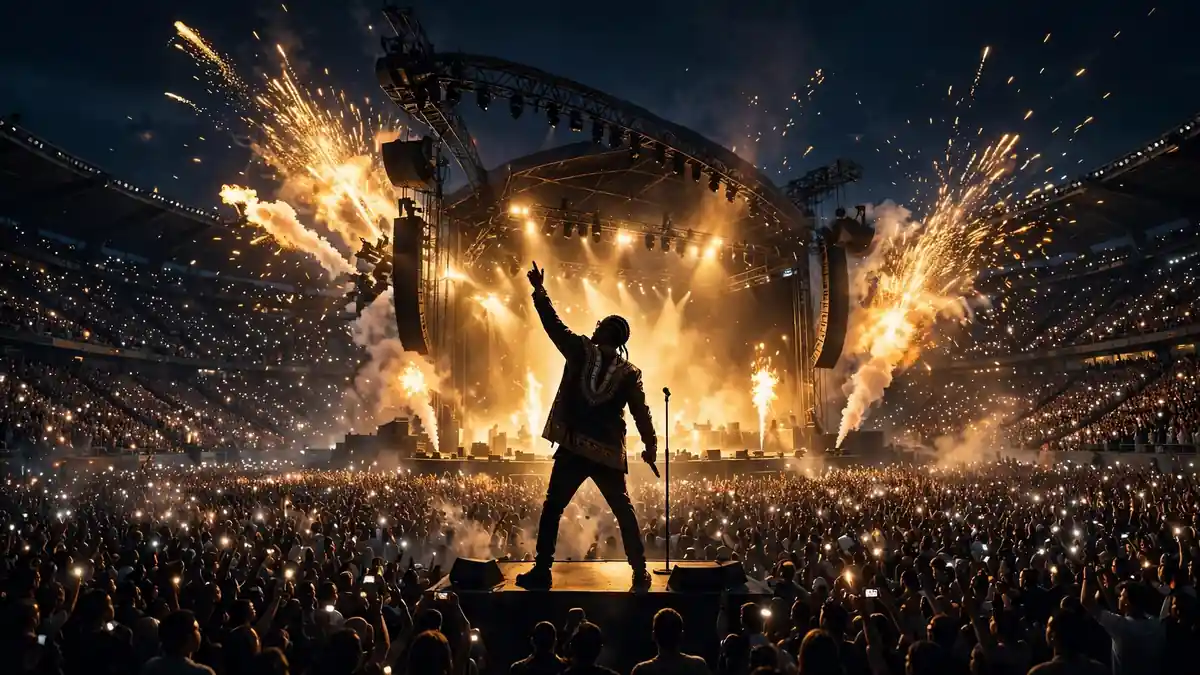
The stadium years followed immediately. In June 2023 he headlined London Stadium, becoming the first African artist to headline a UK stadium — an 80,000-capacity milestone that the British press covered as a historic moment for African music. He went on to sell out Citi Field in New York and the Stade de France in Paris, completing a run of stadium headlines across three countries that no African artist had previously achieved. The I Told Them… album (August 2023), with its “Sittin’ on Top of the World” single featuring 21 Savage, supplied the soundtrack, and its tour produced the hard number that anchors his fortune: $30.46 million gross from 22 reported shows, per Touring Data.
That gross figure needs its context in the same breath. Thirty million dollars in reported box-office is not thirty million dollars in Burna Boy’s bank account: venues, promoters, production, crew, travel, management, and taxes all take their share before the artist is paid. But as a measure of demand it is unmatched among his peers, and it explains why the touring-heavy estimates of his wealth run far higher than the catalogue-only ones. When ThrillNG’s October 2026 ranking of Nigeria’s richest musicians noted that “no African act sells more tickets,” it was pointing at exactly this record.
No Sign of Weakness and the 2025–2026 Run
No Sign of Weakness, his eighth studio album, arrived in July 2025 with the confidence its title suggests. By then Burna Boy was operating at a level where an album release was a formality between tours: the records sustained the brand, the tours paid for it, and the brand deals — including the multi-year partnership with Swiss sportswear company On that EssentiallySports reported in 2026, making him the face of its Clubhouse Nights campaign and tennis initiatives — stacked on top. Reports in 2026 also indicated a $15 million investment alongside music executive L.A. Reid in Texas-based consumer electronics company MOON Ultra, though the financial details and any returns remain private, so this profile records the report without adding it to his wealth as a lump sum.
The 2025–2026 run also extended his presence as a collaborator rather than just a headliner. Apple Music lists him on J. Cole’s 2026 album The Fall-Off, and in August 2026 reports circulated that he would return to London Stadium for a third headline show in 2027 — a record-breaking return to the 80,000-capacity venue that first made him a stadium artist. A July 2026 report credited him with 14.46 million equivalent album sales worldwide, describing him as Africa’s best-selling artist of all time; the figure comes from a single report rather than an industry body, so this profile attributes it rather than stating it as settled fact.
The through-line of this period is scale without dilution. Where many artists at his level chase pop features to stay relevant, Burna Boy’s 2025–2026 moves — a stadium return, a World Cup song, a sportswear ambassadorship, a tech investment — all extended the same identity he built in 2019: the African Giant as a business in its own right.
2026: The World Cup, Apple Music Hall, and Rolling Loud India
Burna Boy’s 2026 began at the center of the world’s biggest sporting event. In May 2026 he joined Colombian superstar Shakira on “Dai Dai,” the official song of the 2026 FIFA World Cup. FIFA then announced both artists as performers of the song at the tournament’s opening ceremony in Mexico City on June 11, 2026 — and Burna Boy returned to the World Cup stage for the tournament’s historic final halftime show on July 19, 2026, at MetLife Stadium in New Jersey, the first halftime show ever attached to a World Cup final. “Dai Dai” also placed him on the official FIFA World Cup 2026 album alongside Future, Tyla, 21 Savage, Stormzy, Davido, Rema, and Ayra Starr.
Two performances in two months at that scale would be a career year for most artists. Burna Boy’s autumn matched it. On October 17, 2026, he joined British rapper Dave on stage in Lagos for “Location,” their 2019 collaboration from Dave’s debut album Psychodrama, during the closing night of Dave’s The Boy Who Played the Harp tour at the Wole Soyinka Centre for Culture and Creative Arts — a guest spot that revisited shared history rather than announcing new material. Then, on October 29, 2026, he was set to become the first African artist announced to perform at Apple Music Hall, Apple’s new 600-capacity live venue inside London’s Battersea Power Station, joining an inaugural lineup alongside Elton John, Charli XCX, Baby Keem, Troye Sivan, Arlo Parks, and Chase & Status, with the performance livestreamed globally on Apple Music.
The year was scheduled to close with a first. Rolling Loud India 2026, set for December 12–13, announced Burna Boy as a Day 1 headliner alongside Metro Boomin, marking his debut performance in India — a new continent-scale audience for an artist who had already conquered Europe, North America, and South America. The arc from Port Harcourt to Mumbai, via Mexico City and Battersea, is the cleanest summary of what the previous fourteen years built: a Nigerian artist who no longer needs to break into a market, because the markets now book him first.
Afro-Fusion: What His Sound Actually Is
Burna Boy calls his sound Afro-fusion, and the term is precise rather than evasive. Afrobeat, the genre Fela Kuti built, is built on long songs, live bands, horns, and political lyrics. Afrobeats, the 2010s pop movement, is built on short songs, digital production, and dancefloor hooks. Burna Boy’s music sits in the overlap: he uses Afrobeat’s band arrangements and political directness inside Afrobeats’ song lengths and streaming economy, then adds dancehall’s vocal cadence and reggae’s bass weight. The result is music that reads as African to African audiences and as pop to everyone else, without either audience feeling pandered to.
The Fela influence is audible in the music itself. Horns, call-and-response backing vocals, and songs that run past four minutes all come from the Afrobeat template, and Burna Boy has sampled Fela directly and invoked him in interviews throughout his career. But the dancehall side is equally structural: his phrasing, his patois inflections, and his comfort on reggae rhythms all trace back to the London years and to a Jamaican influence that Nigerian pop rarely foregrounded before him. Afro-fusion, as a label, is his way of claiming both inheritances at once.
That dual inheritance is also why his collaborations travel. Chris Martin on “Monsters You Made,” 21 Savage on “Sittin’ on Top of the World,” Ed Sheeran on “For My Hand,” Shakira on “Dai Dai” — each pairing works because Burna Boy’s sound has a slot for a pop, rap, or Latin guest without changing its center. The 2026 World Cup song is the logical endpoint: a Colombian pop star and a Nigerian Afro-fusion star on the same official tournament track, with neither sounding like a guest in the other’s genre.
Money: The Million– Million Estimate, Tested
Burna Boy’s net worth in 2026 is best stated as a range: $22 million to $50 million, anchored at around $40 million. The floor comes from Celebrity Net Worth at $22 million, corroborated on the low side by ThrillNG’s October 2026 ranking at $19–25 million. The ceiling comes from Pulse Nigeria’s November 2025 profile at $45–50 million, with annual earnings estimated at around $20 million, and from self.name.ng’s October 2026 Nigeria ranking at $40–60 million. Inside the range sit EssentiallySports at roughly $28 million (derived from Celebrity Net Worth), worth.ng at roughly $35 million, and researchroom.com.ng at $40 million — the figure this profile anchors on, because it sits near the middle of the credible spread and matches the high camp’s floor.
Two facts argue against the low end, and both come from outside the estimate industry. First, Touring Data’s reported gross of $30.46 million from 22 shows on the I Told Them tour (2023–2025) is a single tour’s gross box-office, and it already exceeds the entire $22 million net-worth figure before a single stream, endorsement, or catalogue payment is counted. Gross is not net — the cuts described in the stadium section are real — but a one-tour gross above the total net-worth estimate is a sign the estimate is stale, not that the tour lost money. Second, Burna Boy himself has said so twice: asked in 2023 whether $22 million was accurate, he laughed and said, “Let’s not talk about that one,” adding, “Well, I prefer them to think that. That’s cool,” as The Nation reported; and in a December 2025 interview on Complex’s 360 With Speedy, he called the $22 million figure “way off,” without offering an alternative.
The income streams behind the range are straightforward. Touring is the largest: stadium and arena headlines across Europe, North America, and Africa, plus festival fees that, for an artist of his tier, run into seven figures per appearance. Streaming and recording royalties follow, built on eight albums and a catalogue that includes “Ye,” “Last Last,” and “On the Low” — songs with multi-year streaming tails. Endorsements add a third stream, most recently the 2026 On sportswear partnership. Label ownership adds a fourth: Spaceship Records means he keeps a share of his own releases and of his signees’ work that a purely signed artist never sees. Real estate and luxury assets — houses in Lagos and abroad, a car collection, and jewelry reported at close to $5 million — are visible but illiquid, and this profile does not convert them into cash in the anchor figure.
One outlier is excluded deliberately. A separate self.name.ng list of Africa’s richest musicians in 2026 put Burna Boy at $180 million — three times the same publisher’s own Nigeria-list figure of $40–60 million, published in the same month. When a publisher contradicts itself by a factor of three, the outlier is not averaged in; it is discarded, and the discard is disclosed here so readers can judge for themselves.
The honest summary: Burna Boy is a multi-millionaire many times over, almost certainly worth more than the $22 million figure that still circulates, and probably worth somewhere near $40 million once touring, catalogue, endorsements, and label ownership are all counted and taxes and costs are allowed for. Anyone printing a single number without that range is selling certainty the record does not contain.
Personal Life: Family, Stefflon Don, and Privacy
Burna Boy’s family is also his business, and that fact shapes his personal life more than any relationship headline. His mother, Bose Ogulu, manages his career and runs Spaceship Collective; his sister Nissi is a singer; his grandfather’s Fela Kuti connection is the family legend he performs from. The result is a personal life that is unusually well-documented in its family dimension and unusually guarded in its romantic dimension.
The one relationship he has publicly confirmed at length is with British rapper Stefflon Don, whom he dated from 2018 to 2022. The pair collaborated, appeared together publicly, and spoke about each other in interviews; their split in 2022 was announced rather than leaked, which is itself a sign of how controlled his public narrative is. Since then, he has not confirmed a partner publicly. Reports in December 2024 linked him to American R&B singer Chloe Bailey, and further reports in early 2025 described the relationship as confirmed — but Burna Boy himself has not confirmed it in the way he confirmed the Stefflon Don relationship, so this profile records the reports as reports and leaves the status as unconfirmed.
He has not publicly confirmed having children, and he is not publicly married. Those two sentences are stated plainly because biography searchers ask both questions constantly, and the careful answer to each is the same: no public confirmation exists. What is confirmed is the family structure that actually runs his life — a mother-manager, a musical sister, a grandfather whose legacy he carries on stage — and that structure, more than any romance rumor, explains how he has stayed at the top for fourteen years without the management chaos that has derailed many of his peers.
Frequently Asked Questions
How old is Burna Boy in 2026?
Burna Boy is 35 years old in 2026. He was born Damini Ebunoluwa Ogulu on July 2, 1991, in Port Harcourt, Rivers State, Nigeria, and he turned 35 on July 2, 2026 — two weeks before his World Cup final halftime performance on July 19.
What is Burna Boy’s real name?
Burna Boy’s real name is Damini Ebunoluwa Ogulu. He was born in Port Harcourt, Nigeria, to Samuel Ogulu, who managed a welding company, and Bose Ogulu, a former translator who became his manager and is known as “Mama Burna.”
Where is Burna Boy from?
Burna Boy is from Port Harcourt, the capital of Rivers State in southern Nigeria, where he was born and raised. His father is Ogoni and his mother is Edo, from Otuo town in Edo State. He later lived in London, where he studied at the University of Sussex and Oxford Brookes University before leaving without a degree to pursue music.
How did Burna Boy become famous?
Burna Boy broke through in 2012 with “Like to Party,” the lead single from his debut album L.I.F.E (2013). His international breakthrough came with “Ye” in 2018, followed by the African Giant album in 2019, which earned a Grammy nomination and a BET Award for Best International Act. The Grammy win for Twice as Tall in 2021 made him the first Nigerian solo artist to win the award.
Has Burna Boy won a Grammy?
Yes. Burna Boy won Best Global Music Album at the 63rd Annual Grammy Awards on March 14, 2021, for Twice as Tall, which was executive-produced by Sean “Diddy” Combs. He is the first Nigerian solo artist to win a Grammy as a lead artist; his album African Giant had been nominated the previous year for Best World Music Album.
What is Burna Boy’s net worth in 2026?
Burna Boy’s net worth in 2026 is estimated at $22 million to $50 million, anchored at around $40 million. Celebrity Net Worth puts him at $22 million, while Pulse Nigeria’s November 2025 profile estimated $45–50 million. No audited figure exists, and Burna Boy himself called the $22 million figure “way off” in a December 2025 interview, so the range — not a single number — is the honest answer.
Who is Burna Boy dating? Is he married?
Burna Boy is not publicly married. He dated British rapper Stefflon Don from 2018 to 2022. Since their split he has kept his relationships private; reports in late 2024 and early 2025 linked him to American singer Chloe Bailey, but he has not publicly confirmed a current partner, and he has not publicly confirmed having children.
What is Burna Boy doing in 2026?
In 2026 Burna Boy recorded “Dai Dai” with Shakira, the official song of the 2026 FIFA World Cup, performed it at the opening ceremony in Mexico City on June 11 and at the first-ever World Cup final halftime show on July 19 at MetLife Stadium, joined Dave on stage in Lagos on October 17, performed at Apple Music Hall in London on October 29 as the first African artist announced for the venue, and is scheduled to headline Rolling Loud India on December 12 as his debut performance in India.
Sources & Reporting
This profile was researched on October 31, 2026, from live search results and the outlets named throughout: Wikipedia and AllMusic for the birth date (July 2, 1991, Port Harcourt), family details, education history, and album sequence; the All Africa Music Awards and Grammy records for the African Giant nomination and the Twice as Tall win (March 14, 2021); Billboard chart reporting for the L.I.F.E, Outside, and Love, Damini chart positions; Touring Data, via CelebrityFees and ThrillNG, for the $30.46 million gross from 22 reported shows on the I Told Them tour; Celebrity Net Worth for the $22 million estimate; Pulse Nigeria (November 2025) for the $45–50 million estimate and ~$20 million annual earnings figure; EssentiallySports for the $28 million figure, the 2026 On sportswear partnership, and the reported $15 million MOON Ultra investment; The Nation (2023) and Complex’s 360 With Speedy (December 2025) for Burna Boy’s own dismissals of the $22 million figure; NotJustOk and Ghana News Online for the Rolling Loud India December 12–13, 2026 headline booking; The Nollywood Reporter for the Apple Music Hall October 29, 2026 performance and the World Cup song and ceremony details; and 24Hip-Hop for the October 17, 2026 Dave Lagos guest performance.
Where outlets disagree — on net worth, on the $180 million outlier, and on the status of reported relationships after 2022 — this profile names the disagreement and attributes each figure to its outlet rather than picking a winner silently. No figure in this article comes from an anonymous “sources say” claim, and no fact has been added that the cited reporting does not support. Corrections policy: figures are updated when new reporting emerges — contact us via the About page if you spot an error.
WRITTEN BY
Nathan Cole
Nathan Cole is the editor of Guide Net Worth. He covers celebrity wealth the way a business desk covers earnings: reported figures first, estimates labeled as estimates, and no invented numbers. Every profile on this site passes through his desk before it publishes. About Guide Net Worth · Corrections: figures are updated when new reporting emerges — contact us via the About page if you spot an error.
References & Sources
This article has been fact-checked and verified against multiple public sources, financial disclosures, SEC filings, Forbes reports, Celebrity Net Worth databases, and official records. All net worth estimates are based on publicly available information and financial analysis.