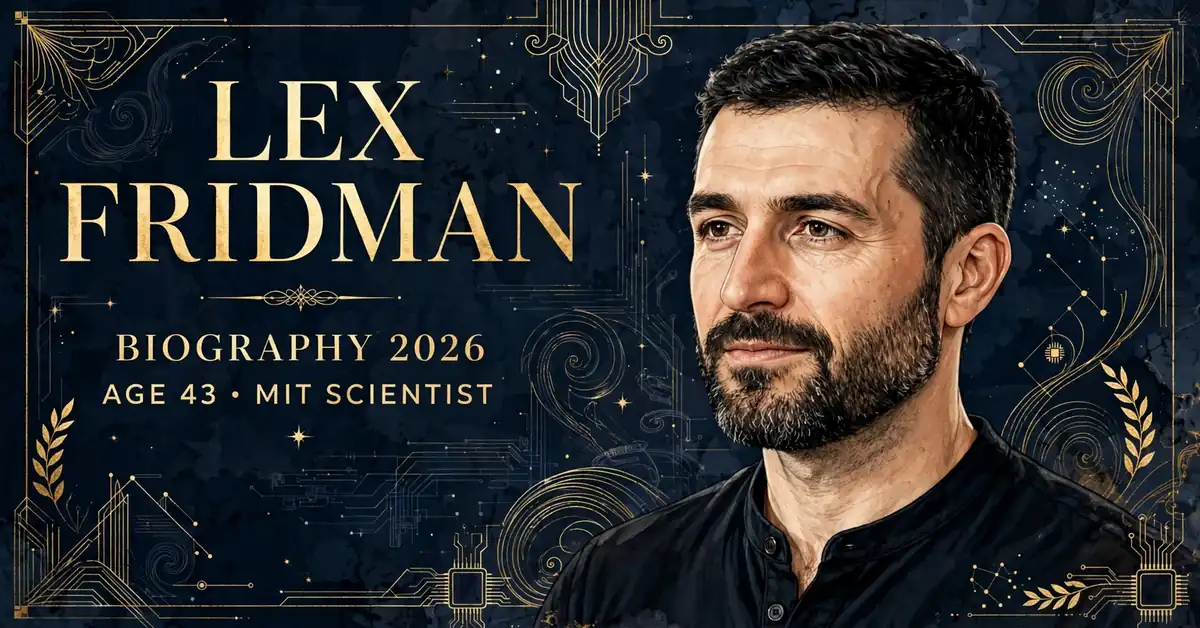
Lex Fridman biography 2026: age 43, MIT scientist and podcast host — from a Soviet childhood to 5.07 million subscribers and interviews with world leaders.
Last updated: October 31, 2026 · By Nathan Cole
Lex Fridman is 43 years old in 2026. He was born Alexei Alexandrovich Fridman on 15 August 1983 in Chkalovsk, in what was then the Tajik Soviet Socialist Republic, and he turned 43 on 15 August 2026. That single correction matters, because much of the internet still gets it wrong: one popular profile lists him at 42, another prints 1986 as his birth year, and both errors keep circulating from site to site. The verified date comes from his own public posts and the biographical record built on them, and it anchors everything that follows.
The short version of the life is this. A boy born in the Soviet Union, raised in Moscow, and moved to Illinois at about 11 grows up in a house of physicists, earns a PhD from Drexel, spends six months at Google, then joins MIT to study how humans behave around semi-autonomous cars. In 2018 he starts a podcast in his spare time. Eight years later that podcast has 5.07 million YouTube subscribers and 935 million views, and its guest chair has held Elon Musk, Mark Zuckerberg, Donald Trump, Volodymyr Zelenskyy, and Narendra Modi. He is still a research scientist at MIT, still living in Texas, and still — by every serious account — an unusually private man for someone who talks to the most famous people on earth for three hours at a time.
Quick Facts
| Full Name | Alexei Alexandrovich Fridman, known as Lex Fridman |
| Born | 15 August 1983, Chkalovsk, Tajik SSR, Soviet Union (age 43 in 2026) |
| Occupation | Computer scientist, MIT research scientist, podcast host, writer |
| Podcast | The Lex Fridman Podcast — begun 2018 as The Artificial Intelligence Podcast, renamed 2020 |
| YouTube (Oct 31, 2026) | 5.07 million subscribers, 935.2 million views, 870 videos (vidIQ) |
| Education | Drexel University — BS and MS in computer science (2010), PhD in electrical and computer engineering (2014) |
| MIT Role | Research scientist, Laboratory for Information and Decision Systems (LIDS), since 2022 |
| Height | Listed at 5 ft 9 in (175 cm) in competitor profiles; no primary-source confirmation |
| Estimated Net Worth | About $10 million, inside an $8–12 million full-profile estimate range (see breakdown) |
| Family | Father Alexander Fridman, plasma physicist and Drexel professor; brother Gregory Fridman, also a Drexel professor |
| Last Updated | October 31, 2026 |
How This Profile Was Put Together
This biography is built from the documented record, not from profile-site copies: Wikipedia’s sourced biography (crawled October 13, 2026), Business Insider’s April 2023 investigation, the Boston Globe’s February 2024 profile, MIT’s own staff and lab listings, and vidIQ’s channel statistics last updated October 31, 2026. Where sources disagree — his age, his net worth, his height — the disagreement is shown and the stronger source is named. Where no reliable source exists, as with his private relationships, this article says so instead of filling the gap. Net worth figures are estimates from third-party outlets, never bank balances, and they are labeled as estimates throughout.
+
Early Life: Born in Tajikistan, Raised in Moscow, Schooled in Illinois
Lex Fridman was born in Chkalovsk, a city in the Tajik Soviet Socialist Republic, on 15 August 1983. He grew up in Moscow, in a Jewish family, during the last years of the Soviet Union. He was about 11 when the family left Russia for the Chicago area, soon after the Soviet collapse — a move that meant a new language, a new school system, and a childhood split across two worlds before he was a teenager.
He attended Neuqua Valley High School in Naperville, Illinois. The detail is worth pausing on, because it explains something about the adult interviewer: Fridman is not a man who grew up inside American tech culture and then reported on it from the outside. He arrived in it, learned English as a second language alongside Russian, and spent his school years catching up in a suburb of Chicago while his father built an academic career at Drexel University in Philadelphia. The outsider’s patience that listeners hear in his long interviews — the willingness to let a guest finish, to ask the basic question, to sit with an answer — has roots in that move.
Family: A House Full of Physicists
Fridman’s father, Alexander Fridman, is a plasma physicist and a professor at Drexel University. His brother, Gregory Fridman, also became a professor at Drexel, working in plasma physics as well. It is a family in which a PhD is not an unusual outcome but the expected one, and in which dinner-table conversation runs toward science by default.
That background cuts two ways in Fridman’s story. It gave him an early fluency in scientific thinking and a direct line into academic life. It also set the bar he would spend his twenties trying to clear on his own terms: his father and brother stayed inside the university system, while Lex built a second career outside it, in public, on YouTube, that neither of them could have predicted. He has spoken warmly about his father in interviews and on social media, and the respect runs in both directions — Alexander Fridman’s field, plasma physics, is about containing extreme energy, which is a fair description of what his son later tried to do with three-hour conversations about artificial intelligence.
Education: Drexel, From BS to PhD
Fridman followed his family to Drexel University, where he earned both a bachelor’s and a master’s degree in computer science in 2010. He stayed on for a doctorate in electrical and computer engineering, completing his PhD in 2014 under the advisement of engineering educators Moshe Kam and Steven Weber. His dissertation was titled “Learning of Identity from Behavioral Biometrics for Active Authentication,” and its question was practical: can a computer tell who is using it, continuously, from how that person behaves — typing rhythm, mouse movement, interaction patterns — rather than from a password typed once?
The work mattered for two reasons. First, it gave him a genuine research credential before he ever recorded a podcast episode; he was not a commentator who learned AI from press releases, but a researcher who had done the unglamorous work of building authentication systems. Second, it set the theme of his whole career: human-centered AI, machines that understand people rather than replace them. His later MIT research on drivers, his podcast’s focus on consciousness and human nature, and even his interview style all trace back to that question of how machines read humans.
Google: Six Months That Shaped the Thesis
In 2014, the year he finished his PhD, Fridman spent six months at Google, continuing his dissertation work on AI for identity authentication and taking part in deep-learning efforts for large-scale behavior-based authentication. Six months is a short stay, and it is sometimes written up as a footnote. It deserves more weight than that.
Google in 2014 was where academic machine learning met industrial scale, and Fridman’s project sat exactly on that boundary: behavior-based authentication only works if it can run for millions of users without annoying them. The stint gave him industry experience to pair with his academic record, and it confirmed the direction he would take next — back to a university, but to applied problems with real users, not pure theory. He left Google after six months, and he has never gone back to a full-time industry job since.
MIT and the Tesla Autopilot Study That Changed Everything
In 2015, Fridman moved to MIT’s AgeLab as a research scientist, working on psychology and big-data analytics to understand driver behavior. At AgeLab he led a team of computer engineers building learning algorithms for semi-autonomous vehicles, in collaboration with Toyota. A paper he co-authored won a Best Paper award at the 2017 Conference on Human Factors in Computing Systems, one of the top venues in human-computer interaction, and another co-authored paper earned an honorable mention in 2018. He also guest lectured at Drexel, his alma mater. By any normal academic measure, this was a solid, respectable, low-profile career.
Then came 2019, and the study that made him famous and controversial in the same week. Fridman published a preprint on Tesla Autopilot concluding that drivers using semi-autonomous vehicles stayed focused — a finding that ran against established research on how humans interact with automated systems, which generally finds attention drifts as automation takes over. Elon Musk praised the study publicly. Fridman was flown to Tesla’s offices for an interview with Musk. Viewings of his podcast episodes rose sharply afterward.

The criticism arrived just as fast, and a fair biography has to carry it in full. Missy Cummings, a professor at Duke University and an advisor to the National Highway Traffic Safety Administration, described the study as “deeply flawed,” pointing to its methodology and small sample size. AI researcher Anima Anandkumar argued Fridman should have submitted the study for peer review before seeking press coverage. The study was later removed from MIT’s website. Fridman left AgeLab and took up an unpaid role in MIT’s Department of Aeronautics and Astronautics that same year.
What happened next is the part most profiles skip. Fridman did not leave MIT. Since 2022 he has worked as a research scientist at the MIT Laboratory for Information and Decision Systems (LIDS), and until December 2025 he also conducted research for the Center for Complex Engineering Systems, a collaboration between MIT and King Abdulaziz City for Science and Technology. The Boston Globe reported in February 2024 that he lives in Texas but remains employed by MIT and is on campus regularly. The unpaid chapter, in other words, was a transition, not an exit — and the podcast income that made the transition survivable came directly from the fame the Tesla study produced.
The Podcast Begins: 2018 and the 2020 Rename
Fridman began his podcast in 2018. It was originally titled The Artificial Intelligence Podcast, a name that matched his day job and his first guest pool of researchers and engineers. In 2020 he renamed it The Lex Fridman Podcast, a change that looks small on paper and was large in practice: the show stopped being a niche AI program and became a general long-form conversation show, with scientists sitting alongside fighters, musicians, philosophers, and politicians.
The format barely changed across that rename, and that stability is the show’s signature. Episodes run long — ThoughtLeaders puts the average video at more than three hours — and Fridman publishes about two a month, far slower than daily podcasters. He prepares deeply, asks plainly, and rarely interrupts. MIT professor Manolis Kellis described the effect in the Boston Globe’s 2024 profile: “He’s a listener. He’s there to learn. He invites you as a fly on the wall to learn along with him. He’s not pushing an agenda or trying to seem smart.” Whether you admire that style or find it too soft depends on what you want from an interviewer, and the criticism section below gives the other side its full say.

The Guest List: Musk, Zuckerberg, Trump, Zelenskyy, Modi
No biography of Fridman works without the guest list, because the guest list is the career. Elon Musk has appeared multiple times, starting with the Tesla interview that followed the 2019 study. Mark Zuckerberg sat for a conversation conducted as photorealistic avatars inside the metaverse, a technical stunt that doubled as a genuine interview. Jeff Bezos, Sam Altman, Joe Rogan, Jordan Peterson, MrBeast, and Andrew Huberman have all taken the chair, along with scientists, historians, and fighters whose names mean less to a general audience but everything to their fields.
The political interviews are where the show’s reach became impossible to ignore. Fridman interviewed Donald Trump in September 2024, during the presidential campaign. He interviewed Volodymyr Zelenskyy in January 2025, after the Ukrainian president agreed to record a podcast with him. He interviewed Narendra Modi, the prime minister of India, in 2025. He also interviewed Benjamin Netanyahu, an appearance that drew a July 2023 Haaretz piece arguing he failed to challenge the prime minister’s claims, and Kanye West in October 2022, an interview the Los Angeles Times covered for West’s remarks about Jews and abortion. The pattern is consistent: Fridman invites figures other interviewers cannot get, or cannot get to sit for three hours, and then lets them talk.
2026 on the Show: AI, Psychiatry, and the Math Crisis
The 2026 episode list shows a host who has not drifted from his first subject. Episode 490, “State of AI in 2026,” brought together Fridman, Sebastian Raschka, and Nathan Lambert to argue about large language models, coding, scaling laws, China, agents, GPUs, and AGI. Episode 501, released August 26, 2026, featured David Heinemeier Hansson — DHH, creator of Ruby on Rails — on the future of programming, agentic engineering, and Linux. Episode 502, released September 17, 2026, was a long conversation with historian Andrew Scull on psychiatry, asylums, mental illness, ECT, lobotomies, Freud, and Jung.
Then came episode 503, released October 26, 2026, the most talked-about episode of his year. Fridman gathered three mathematicians — MIT’s Ankur Moitra, the University of Washington’s Steven Brunton, and Rutgers’ Alex Kontorovich — for an emergency episode on what he called the AI crisis in math. The trigger was an OpenAI release from October 6, 2026, sharing roughly 700 AI-generated results, including a claimed proof about the zeta function (a quasi-Riemann hypothesis), a blowup counterexample for a version of the Navier-Stokes problem, and a claimed proof of the Unique Games Conjecture, with formalizations in Lean, the language computers use to check proofs. The episode’s own framing, and the reporting around it, is careful on one point that matters: these are AI-generated claims, not settled proofs, and the conversation is about what it means for mathematics if machines start producing results humans cannot easily verify. It is the 2019 Tesla story in a new form — Fridman standing at the exact point where a new technology meets human judgment, asking questions instead of delivering verdicts.
How Big Is the Podcast? Subscribers, Views, and the Long-Form Math
The Boston Globe reported in 2024 that the podcast had attracted 3.6 million subscribers. By October 31, 2026, vidIQ puts the Lex Fridman YouTube channel at 5.07 million subscribers and 935.2 million total views across 870 videos. September 2026 alone added 10,000 subscribers and 6.54 million views. Those numbers put him far below the biggest entertainment YouTubers and far above nearly every other interview show built on three-hour science conversations — which is the point. His audience is not the largest on the platform. It is one of the most patient.
| Andrew Bustamante, episode 310 (2022) | 20.02 million views — the channel’s most-viewed episode per vidIQ |
| Tucker Carlson, episode 414 (2024) | 16.99 million views |
| Jordan Peterson, episode 313 (2022) | 16.82 million views |
| Elon Musk, episode 400 (2023) | 14.34 million views |
| Paul Rosolie, episode 369 (2023) | 13.06 million views |
The table carries its own lesson about the show’s economics. A channel publishing two long videos a month cannot live on ad revenue alone at the scale of daily creators, which is why sponsorships read at the top of each episode and listed on his sponsors pages matter so much to his income — and why any net-worth model built on YouTube ads alone will come out far too low, as the next section shows.
Net Worth: Why Estimates Run From Million to Million
Search for Lex Fridman’s net worth and the spread is almost comical: Net Worth Spot, updated October 1, 2026, puts him at about $2.1 million, with upside to $3 million. Finty estimates $4 million. Growth Hackers estimates around $8 million. Starinfozone gives $8–12 million. Guestcollab gives $10–12 million. They cannot all be right, but they can all be explained, and the explanation is the model behind each number.
Net Worth Spot’s figure is a YouTube-ad model: it counts channel views, applies a per-thousand-views rate, and projects from there. Its own page admits channels can earn more than $7 per thousand views, which would push its annual estimate toward $952,500. What that model leaves out is everything that makes Fridman’s business work: per-episode sponsorships from brands that pay to be read at the top of a three-hour show, speaking engagements, and his MIT research salary. A model that counts only ads will always understate a creator whose real product is attention from an audience that advertisers cannot reach elsewhere.
The full-profile estimates, which try to count sponsorships, speaking, MIT pay, and YouTube together, cluster at $8 million to $12 million, and the midpoint of that cluster — about $10 million — is the fairest single figure to carry. It is an estimate, built by outlets that have never seen his accounts, and it should be read that way. Nobody has published a sponsor rate, a speaking fee, or an MIT salary figure for Fridman, and this article invents none of them. What can be said with confidence is narrower: he is a millionaire many times over, he is nowhere near billionaire territory, and the $2 million ad-only figure tells you more about the limits of ad-only models than about his bank account.
Height, Fitness, and the Jiu-Jitsu Black Belt
Competitor profiles list Fridman at 5 ft 9 in (175 cm). That figure comes from profile sites, not from a primary source such as a team roster or an official biography, so it is reported here as “listed at” rather than verified. It fits the man viewers see on screen: lean, athletic, usually in a dark shirt, with the posture of someone who trains.
The training is real and well documented. Fridman holds a black belt in Brazilian jiu-jitsu, a discipline he has practiced for years and talked about on the show, including in conversations about training with Musk. The fitness thread runs through his public life in other ways too: he plays guitar and piano, he reads widely and posts about books, and his social media mixes science, training clips, and music in proportions that would look scattered from anyone else and coherent from him. The through-line is discipline as a daily practice — the same quality his podcast format demands from its listeners.
Personal Life: What He Keeps Private, and What He Shares
Here the honest answer is short, and its shortness is the point. No marriage, partner, or children are confirmed in reliable public reporting about Lex Fridman, and he does not discuss romantic relationships publicly. Profile sites that print a wife’s name or a relationship status for him are filling a gap with a guess, and this article will not repeat one. What is public is his family of origin — his father and brother, both Drexel professors — his friendships, and his work.
The friendships are unusually public for a private man. He has described spending Thanksgiving 2023 at the home of Ivanka Trump and Jared Kushner, watching The Godfather with them, a detail that surfaced in The Atlantic’s 2024 profile and that Fridman himself posted about on LinkedIn. His birthday posts thank friends including Musk, Rogan, and Huberman by name. He lives in Texas, works for MIT, and records conversations that the rest of the world watches. Beyond that, the private life stays private, and any biography that claims more is selling certainty it does not have.
The Criticism, Fairly Stated
Fridman’s success has drawn sustained criticism from inside the worlds he bridges, and a biography that only praised him would be incomplete. Business Insider’s April 2023 investigation reported that some scientists and academics fear he is contributing to a “cacophony of misinformation,” and quoted an anonymous AI researcher who thought he may have “abandoned academic rigor in pursuit of fame.” The Verge, in December 2023, called his podcast a show with “a following among the tech elite” built on softball interviewing. The Atlantic, in September 2024, wrote that he “does not maintain even a thin veneer of journalistic detachment” from interviewees who are also personal friends, and noted that his 2024 Trump interview allowed false claims about the Arlington National Cemetery incident to pass unchallenged. Current Affairs, in January 2023, argued that his posture of neutrality fails to adequately challenge falsehoods, and that his guest list leans far more right than left. Bloomberg, in March 2024, reported that tech CEOs see his show as a friendlier alternative to adversarial interviews with traditional journalists.
The defense, from people who know his work rather than his fame, is also on the record. Nobel laureate Frank Wilczek called him an effective science communicator who is “helping people understand science” at a higher intellectual level than many journalists covering the field. MIT LIDS director Sertac Karaman praised his ideas and research accomplishments. Gary Gensler, the MIT Sloan professor, described his online machine-learning courses as “online before online became such the vogue.” The fair summary is not that one side is right and the other wrong. It is that Fridman built a show on listening, and listening has a cost: guests who want a friendly room get one, and viewers who want a cross-examination do not. His audience, now past five million subscribers, has decided that trade is worth making. His critics have decided it is not. Both judgments are visible in the same episode list.
What Comes Next for Lex Fridman
At 43, Fridman sits in an unusual position: a working MIT research scientist whose side project became one of the most influential interview shows on earth, with a guest book that now includes sitting and former heads of state. The October 2026 math episode suggests where the show goes next — toward the questions AI is forcing on every field, asked slowly, at length, with the people doing the work in the room. His MIT role gives those conversations a credibility that pure media hosts cannot borrow, and his Texas base puts him in the middle of the tech migration his guests keep describing.
What would change the story? A book, which he has not published. A return to full-time academia, which his podcast income makes unnecessary. A political turn, which his neutrality posture has so far resisted even as his guest list invites the question. Or simply more of the same: two long conversations a month, a growing archive past 500 episodes, and an audience that keeps proving that patience is a format. The biography, as of October 31, 2026, is still being written in public, three hours at a time.
Sources & Reporting
This profile draws on Wikipedia’s sourced Lex Fridman biography (page crawled October 13, 2026), Business Insider’s investigation “Peace, love, and Hitler: How Lex Fridman’s podcast became a safe space for the anti-woke tech elite” (April 12, 2023), the Boston Globe’s “How podcaster Lex Fridman became MIT’s highest-profile science ambassador” (February 14, 2024), The Atlantic’s “Trump’s Red-Pill Podcast Tour” (September 2024), The Verge (December 2023), Bloomberg (March 2024), Haaretz (July 2023), Current Affairs (January 2023), and the Los Angeles Times (October 2022). Channel statistics come from vidIQ’s Lex Fridman channel page, last updated October 31, 2026, and episode details for episodes 490, 501, 502, and 503 come from their published episode listings. Net worth figures are third-party estimates from Net Worth Spot (October 1, 2026), Starinfozone, Guestcollab, Growth Hackers, and Finty, and are labeled as estimates. Corrections: figures are updated when new reporting emerges — contact us via the About page if you spot an error.
Frequently Asked Questions
How old is Lex Fridman in 2026?
Lex Fridman is 43 years old in 2026. He was born on 15 August 1983 in Chkalovsk, in what was then the Tajik Soviet Socialist Republic, and he turned 43 on 15 August 2026. Some profiles still list him at 42 or print 1986 as his birth year; both are stale or wrong against the verified date.
Where was Lex Fridman born?
Lex Fridman was born in Chkalovsk, Tajik SSR, Soviet Union, and grew up in Moscow. His family moved from Russia to the Chicago area when he was about 11, soon after the collapse of the Soviet Union, and he attended Neuqua Valley High School in Naperville, Illinois.
What is Lex Fridman’s net worth in 2026?
Lex Fridman’s net worth is estimated at about $10 million, inside an $8–12 million range from full-profile outlets. YouTube-ad-only models such as Net Worth Spot put him far lower, at about $2.1 million, because they leave out per-episode sponsorships, speaking engagements, and his MIT pay. No outlet has seen his accounts, so every figure is an estimate.
Is Lex Fridman still at MIT?
Yes. Since 2022 Lex Fridman has worked as a research scientist at MIT’s Laboratory for Information and Decision Systems (LIDS). He left MIT’s AgeLab in 2019 after the Tesla Autopilot study controversy and took an unpaid role in Aeronautics and Astronautics, but he did not leave MIT, and the Boston Globe reported in February 2024 that he lives in Texas while remaining employed by MIT.
When did Lex Fridman start his podcast?
Lex Fridman started his podcast in 2018, originally titled The Artificial Intelligence Podcast. He renamed it The Lex Fridman Podcast in 2020. By October 31, 2026, the channel had 5.07 million YouTube subscribers and 935.2 million total views across 870 videos.
Who are Lex Fridman’s most famous podcast guests?
His most famous guests include Elon Musk, Mark Zuckerberg, Jeff Bezos, Sam Altman, Joe Rogan, Jordan Peterson, and MrBeast, plus political leaders Donald Trump (September 2024), Volodymyr Zelenskyy (January 2025), and Narendra Modi (2025). His most-viewed episode is Andrew Bustamante’s 2022 appearance, at 20.02 million views.
How tall is Lex Fridman?
Competitor profiles list Lex Fridman at 5 ft 9 in (175 cm). That figure comes from profile sites rather than a primary source, so it is best read as a listed height rather than a verified measurement.
Is Lex Fridman married?
No marriage or partner is confirmed in reliable public reporting about Lex Fridman. He keeps his romantic and family life private beyond his parents and brother, and he does not discuss relationships publicly, so any site naming a wife for him is guessing.
Nathan Cole
Nathan Cole is the editor of Guide Net Worth. He covers celebrity wealth the way a business desk covers earnings: reported figures first, estimates labeled as estimates, and no invented numbers. Every profile on this site passes through his desk before it publishes. About Guide Net Worth · Corrections: figures are updated when new reporting emerges — contact us via the About page if you spot an error.
References & Sources
This article has been fact-checked and verified against multiple public sources, financial disclosures, SEC filings, Forbes reports, Celebrity Net Worth databases, and official records. All net worth estimates are based on publicly available information and financial analysis.