Khabib Nurmagomedov is 5 ft 10 in (178 cm) tall, per the UFC — with a 70-inch reach, an undefeated 29-0 record, and a net worth estimated at $25M–$40M in 2026.
Last updated: November 7, 2026 · By Nathan Cole
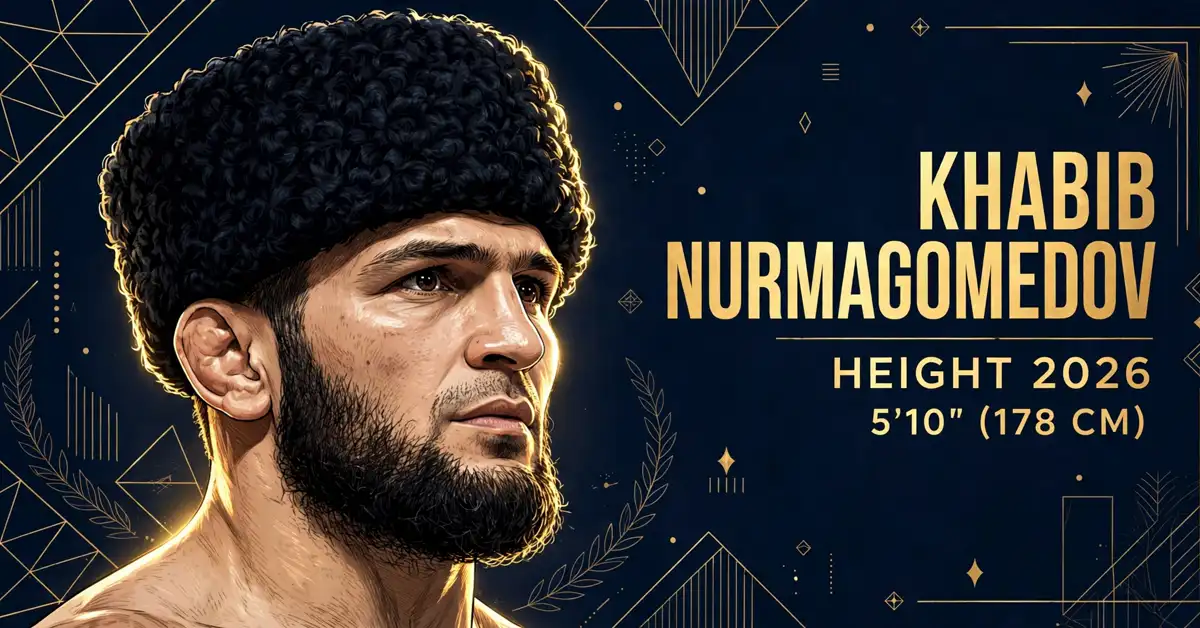
Khabib Nurmagomedov is 5 feet 10 inches tall (178 cm). That is the figure on his official UFC athlete profile, and it stayed the same from his octagon debut in January 2012 to his retirement as undefeated lightweight champion in October 2020. His reach is listed at 70 inches — exactly the same as his height — and his leg reach at 40 inches. Some smaller profile sites print 177 cm instead of 178 cm. That one-centimetre gap comes from rounding: 5 ft 10 in converts to 177.8 cm, so some outlets round down and the UFC rounds up. The honest answer is 5 ft 10 in — 177 to 178 cm depending on rounding, and this article anchors on the UFC’s 178 cm.
The number is the least interesting thing about it. The interesting part is what 5 ft 10 in did inside the octagon. Khabib retired 29-0, the only undefeated champion in UFC history to walk away with the belt and never come back, and he did it as a pressure wrestler in a division where most of his rivals were either taller or longer. Conor McGregor stood an inch shorter but carried a 74-inch reach — four inches longer than Khabib’s. Justin Gaethje stood an inch taller. Tony Ferguson stood an inch taller with a 76-inch reach. Khabib beat them all anyway, because his height gave him a low centre of gravity, a short powerful frame built for takedowns, and a style that turned a measurement into a weapon.
This page answers the height question first, then earns the rest of your time: the tale of the tape in full, the mountain-village childhood in Dagestan where a boy wrestled bears before he wrestled men, the road from a 2008 professional debut to the UFC title in 2018, the three defences that made him a star, the weight cuts that nearly broke him, the promise to his mother that ended his career at 29-0, and the coaching and promotion empire he has built since — with a net worth estimated at $25 million to $40 million in 2026.
Quick Facts
| Full Name | Khabib Abdulmanapovich Nurmagomedov |
| Height | 5 ft 10 in (178 cm) — official UFC listing; 177 cm on some sites (rounding) |
| Reach | 70 in (178 cm) — exactly equal to his height |
| Leg Reach | 40 in (102 cm) |
| Weight Class | Lightweight — 155 lb (70 kg) fighting weight |
| Stance | Orthodox |
| Born | September 20, 1988, Sildi village, Dagestan, Russia |
| Age in November 2026 | 38 |
| Nickname | “The Eagle” |
| Professional Record | 29-0 (8 knockouts, 11 submissions, 10 decisions); UFC record 13-0 |
| UFC Debut | January 21, 2012 |
| UFC Title | Lightweight champion, April 2018 – March 2021; 3 successful defences |
| Retired | October 24, 2020 (UFC 254), undefeated at 29-0 |
| Net Worth 2026 | Estimated $25–40 million (Celebrity Net Worth $25M; Wealthy Gorilla and Surprise Sports $40M) |
| Today | Coach and promoter — Eagle FC founder; coaches Islam Makhachev |
How This Height Was Verified
This profile is built from live reporting checked on November 7, 2026. The height — 5 ft 10 in (178 cm) — comes from the UFC’s own athlete profile, which lists height 70.00, reach 70.00 and leg reach 40.00 alongside a 155 lb fighting weight and a January 21, 2012 octagon debut. The same figure appears in every major reference source: Wikipedia, Tapology, William Hill News and Radio Times all print 5 ft 10 in (178 cm), and the tale of the tape published for his biggest fights — UFC 229 and UFC 254 — lists the same numbers. The 177 cm variant found on a handful of smaller profile sites is a rounding artefact, not a disagreement: 5 ft 10 in is 177.8 cm. The career record, title dates and retirement details come from the UFC profile, William Hill’s career record piece (updated August 6, 2025) and the fight-by-fight record on Tapology. The net worth figure is settled by adjudication, not by picking one outlet: Celebrity Net Worth prints $25 million in its May 21, 2026 update, while Wealthy Gorilla (November 7, 2026) and Surprise Sports (October 10, 2026) print $40 million — this article anchors on $40 million and prints the range beside it. No figure here is invented.
+
The Answer: 5 ft 10 in (178 cm) — and Why One Centimetre Causes Arguments
Khabib Nurmagomedov is 5 feet 10 inches tall (178 cm). The UFC’s athlete profile says so. Wikipedia says so. Tapology, William Hill, Radio Times and TheSportsDB all say so. The tale of the tape printed before every one of his UFC fights said so. Across a 12-year professional career, the number never changed — not after the move from Russia to the UFC, not after the title win, not after retirement.
So why do some sites say 177 cm? It is arithmetic, not a dispute. Five feet ten inches is exactly 177.8 centimetres. The UFC rounds that to 178. A few profile sites round it down to 177, and a few more copy the 177 from each other. The mykhel tale of the tape for UFC 254 lists Khabib at 5′ 10″ (177 cm) and Gaethje at 5′ 11″, which shows the same rounding habit on the same page. Neither side is wrong about the inches. The inches are the measurement that matters, and every source agrees on them.
The argument that never dies online — that Khabib is really 5 ft 8 in — has no support in the official record. It comes from face-off photos, where camera angles and footwear make a mockery of the eye, and from the fact that Khabib looks compact next to the rangy strikers he fought. He is compact. That is the point. At 5 ft 10 in and 155 lb, he carried the build of a wrestler who could drive through a taller man’s hips and hold him there. The height was never the story. What he did with it was.
Khabib Nurmagomedov’s Tale of the Tape: The Full Measurements
Height is one line on a fighter’s tale of the tape. The rest of the lines explain how Khabib fought. The table below is the official UFC listing, the same numbers that appeared on the broadcast graphic before every one of his 13 UFC fights.
| Measurement | Value | What It Meant |
| Height | 5 ft 10 in (178 cm) | Right at the lightweight average |
| Reach | 70 in (178 cm) | Exactly equal to his height — no reach edge |
| Leg reach | 40 in (102 cm) | Short, powerful base for wrestling shots |
| Fighting weight | 155 lb (70 kg) | Lightweight limit — a brutal cut for him |
| Walking weight | Reported 180–190 lb between camps | Closer to a natural middleweight |
| Stance | Orthodox | Standard lead-left stance |
| Record | 29-0 (8 KO, 11 SUB, 10 DEC) | Undefeated across 12 years |
The reach number is the one that should stop a reader. Most elite fighters have a reach several inches longer than their height — Conor McGregor is 5 ft 9 in with a 74-inch reach, five inches longer than he is tall. Khabib’s reach is 70 inches, the same as his height. His ape index is 1.00, dead even. In a striking exchange, that is a handicap. Khabib never won striking exchanges by out-reaching anyone. He won them by refusing to have them: closing the distance, grabbing a leg or a body lock, and taking the fight to the floor, where reach stops mattering and leverage starts.
The walking weight matters too. Between camps, Khabib has been reported at 180 to 190 lb — 25 to 35 lb above the lightweight limit. Cutting to 155 lb was the hardest part of his job, harder than any opponent, and it nearly ended his career once, at UFC 209 in 2017, when the cut put him in hospital and cancelled an interim title fight. A 5 ft 10 in frame carrying close to 190 lb is a thick, powerful frame. That thickness was the point. It was the frame that made 21 takedowns in one fight possible.
Growing Up in Sildi: A Mountain Village That Built a Wrestler
Khabib Nurmagomedov was born on September 20, 1988, in Sildi, a village in the Tsumadinsky District of Dagestan, in the mountains of Russia’s North Caucasus. Sildi sits high in the mountains, a place of stone houses, steep roads and thin air. It is not the kind of place that produces athletes by accident. Dagestan has produced more combat-sports champions per head than almost anywhere on earth, and the reason is not a mystery: wrestling is woven into daily life there, children start young, and the mountains make strong legs.
His father, Abdulmanap Nurmagomedov, was a decorated wrestling and sambo coach and a former Soviet army veteran. He moved the family to the Dagestani capital, Makhachkala, when Khabib was still a boy, and the training started early — not in a polished gym with air conditioning, but on mats in a room where the lessons were physical and the standards were absolute. Khabib began wrestling as a small child, moved into judo as a teenager, and then into combat sambo, where he became a two-time world champion before he ever fought a professional MMA bout.
The Dagestan wrestling system is built on volume and toughness. Young wrestlers drill takedowns thousands of times, run mountain roads, and wrestle partners who are older and heavier. The system produces fighters with deep gas tanks and a tolerance for discomfort that looks unnatural to outsiders. Khabib’s whole career was a product of it. The cardio that let him wrestle for 25 minutes without fading, the grip strength that let him hold a man down for entire rounds, the calm under pressure — all of it was installed in those early years, on those mats, under his father’s eye.
The Bear Story: Wrestling Before He Wrestled Men
The most famous story from Khabib’s childhood is the one that sounds made up and is not. As a boy, his father had him wrestle a bear cub as part of his training. Footage of the young Khabib grappling with the animal in a yard in Dagestan still circulates today, and Khabib has spoken about it openly in interviews, including on his first visit to the United States as a UFC fighter. The bear was a cub, kept by a local man, and the exercise was about grip, balance and fearlessness — the same qualities his father drilled on the mats every day.
The story gets retold so often that it has become a kind of shorthand for Khabib’s whole career, and the shorthand is fair. A child who learns to stay calm with a bear’s paws on his shoulders does not panic when a world champion has him in a bad position. The bear story is not the reason Khabib went 29-0. The thousands of hours of wrestling that surrounded it are. But the story survives because it captures something real about the way he was raised: fear was treated as a skill to be trained, not a feeling to be obeyed.
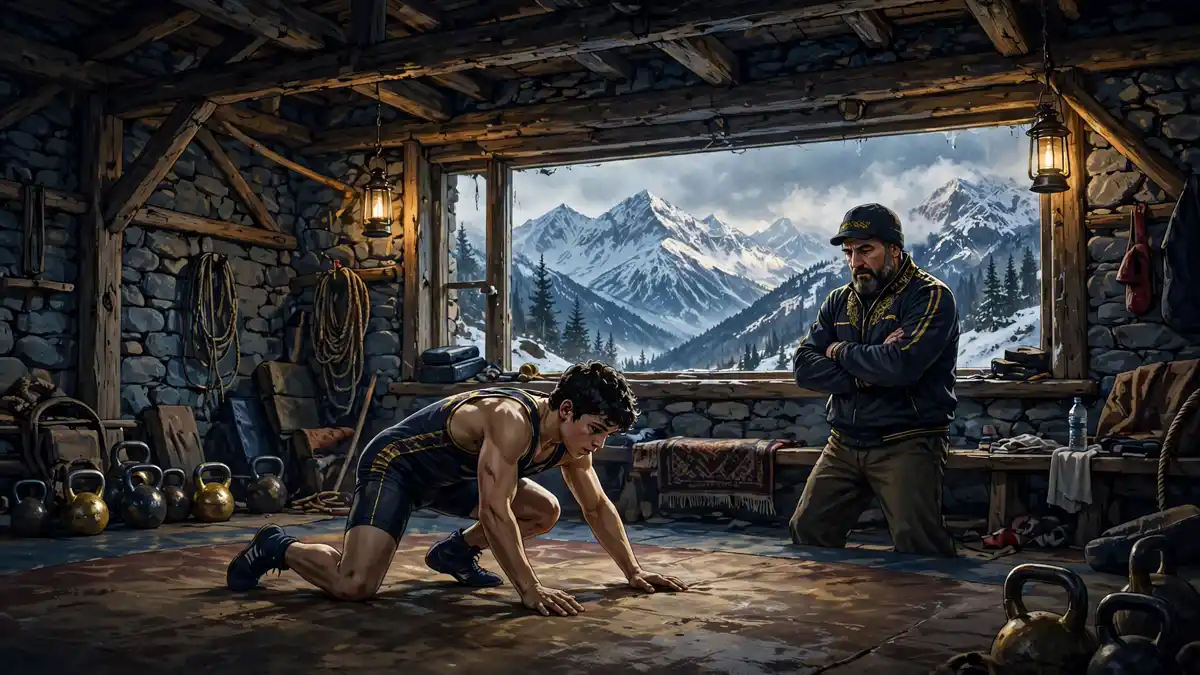
Abdulmanap’s role in the story cannot be overstated. He was Khabib’s first coach, his cornerman, and the architect of the style that went 29-0. The famous line from Khabib’s later career — that his father taught him to wrestle before he taught him to fight — is literal. The sambo titles came first. The striking came later, and only as much as was needed to set up the takedown. When Abdulmanap died in July 2020, Khabib lost the man who had built him, and three months later he fought for the last time.
From Dagestan to the UFC: The Road to 29-0
Khabib turned professional in 2008, fighting in small promotions across Russia and Ukraine. He won his first 16 fights before the UFC came calling — a run built the same way everything else in his career was built, on takedowns and control. He was not a knockout artist. Eight of his 29 wins came by knockout, and the early record was heavy on decisions and submissions, the mark of a grappler who broke opponents down rather than switching them off.
He made his UFC debut on January 21, 2012, submitting Kamal Shalorus in the third round. The UFC profile still lists that date as his octagon debut, and it is the starting point for the number that defines him: 13 wins, no losses, inside the promotion. The early UFC years were a slow climb. Khabib fought once or twice a year, beat solid opposition, and built a reputation as the man nobody wanted to fight — not because he was famous, but because he was miserable to share a cage with. Opponents knew what was coming. They knew they could not stop it.
The fight that announced him came in January 2013, against Abel Trujillo. Khabib took Trujillo down 21 times across three rounds, a UFC record that still stands. Twenty-one takedowns in 15 minutes is a number that reads like a misprint. It is not. Trujillo kept getting up, and Khabib kept putting him back down, and by the end of the fight the point was made in a way no interview ever could: you could know exactly what Khabib was going to do, prepare for it for months, and still spend the whole fight on your back.
Winning the Title: UFC 223 and the Belt That Took Six Years
Khabib won the vacant UFC lightweight championship on April 7, 2018, beating Al Iaquinta by unanimous decision at UFC 223 in Brooklyn. The fight itself was not his hardest — Iaquinta was a late replacement, stepping in on a day’s notice after Tony Ferguson pulled out injured and Max Holloway was pulled by doctors over a bad weight cut. Khabib dominated all five rounds, and the belt was his after six years in the promotion and ten years as a professional.
The belt mattered for a second reason. It made Khabib the first Russian-born fighter to win a UFC title, and it put a Dagestani wrestler at the top of the sport’s deepest division. The lightweight division has always been the UFC’s shark tank — the weight class with the most talent and the least room for error — and Khabib sat on top of it for the next three years. His reign, from April 2018 to March 2021, is the longest lightweight title reign in UFC history.
For the full story of his life and career beyond the measurements, see our Khabib Nurmagomedov biography, which covers his early years in Dagestan, his family, and the road to the title in detail.
UFC 229: McGregor, the Neck Crank, and the Biggest Night in UFC History
The first defence came against Conor McGregor at UFC 229 on October 6, 2018, in Las Vegas. It was the biggest fight in UFC history, reported at 2.4 million pay-per-view buys, and it was personal in a way few title fights are. McGregor had attacked Khabib’s bus in Brooklyn six months earlier, throwing a metal dolly through a window and injuring fighters inside. Khabib had spent the summer answering questions about revenge. He answered them in the cage.
The fight went four rounds. Khabib dropped McGregor with an overhand right in the second — the first time he had ever knocked an opponent down in the UFC — then took him down, mauled him on the ground, and finished him with a neck crank in the fourth round. The tale of the tape said McGregor was an inch shorter at 5 ft 9 in but carried a 74-inch reach, four inches longer than Khabib’s. The reach did not save him. Khabib closed the distance in the first minute and never let the fight become a striking contest.
What happened after the finish became its own story. Khabib jumped the fence and went after McGregor’s corner, a brawl broke out inside and outside the cage, and both men were fined and suspended by the Nevada commission. Khabib has said since that he does not regret defending his honour, and the UFC has never had a night like it before or since. The result, though, was never in doubt. The champion at 5 ft 10 in had beaten the biggest star in the sport’s history, and the height column on the tale of the tape had nothing to do with it.
Poirier and Gaethje: The Final Two Defences
The second defence came in Abu Dhabi on September 7, 2019, against Dustin Poirier. Poirier, also listed at 5 ft 9 in, had won the interim title while Khabib was suspended and arrived as a legitimate threat — a sharp boxer with a dangerous guillotine choke who had briefly caught Khabib in one during the fight. Khabib escaped, took Poirier down, and finished him with a rear-naked choke in the third round. After the fight, the two men swapped shirts in a show of respect, and Khabib sold Poirier’s shirt for charity. It was the most gracious night of his title reign.
The third and final defence came on October 24, 2020, against Justin Gaethje at UFC 254, also in Abu Dhabi. Gaethje, listed at 5 ft 11 in, was the taller man by an inch and the most dangerous striker Khabib had ever faced — a former wrestling standout with heavy leg kicks and genuine knockout power. The fight lasted less than two rounds. Khabib took Gaethje down, survived the early danger, and finished him with a triangle choke in the second round. Then he took off his gloves, laid them in the centre of the octagon, and announced his retirement.
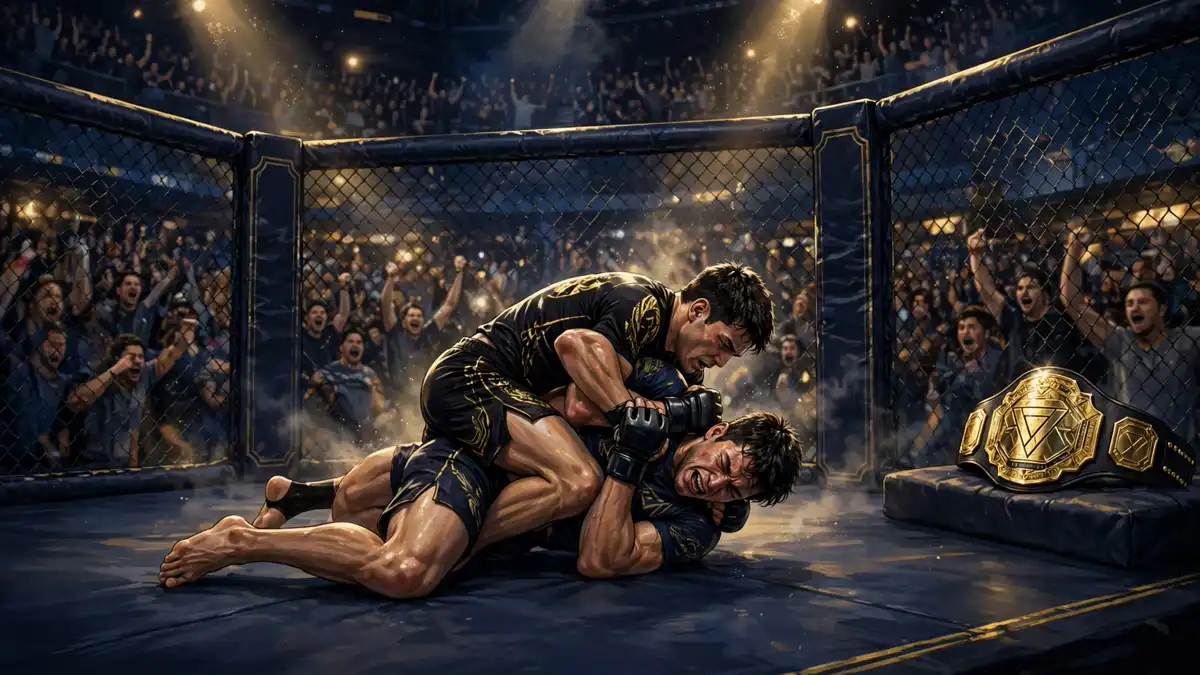
He was 32 years old, 29-0, and the reigning lightweight champion. Fighters do not retire in that position. They chase the next payday, the next record, the next legacy fight. Khabib walked away because he had promised his mother he would fight no more without his father in his corner, and because he believed he had nothing left to prove. The gloves stayed on the canvas.
How 5 ft 10 in Shaped the Most Feared Style in MMA
Khabib’s height was not an accident of his style. It was the foundation of it. At 5 ft 10 in with a short, thick build, his centre of gravity sat low. A low centre of gravity is a wrestler’s best friend: it makes the shot harder to sprawl on, the body lock harder to break, and the top position harder to escape. Taller fighters have longer levers, which help them strike from distance, but those same levers give a wrestler more to grab.
The style had a name among fans and analysts: “smesh.” It was not a single technique. It was a system. Close the distance without taking clean damage. Grab a leg, a body lock, or a wrist. Take the opponent down. Pass the guard. Trap a leg or an arm. Land short ground strikes until the opponent gives up his back or his neck, then finish. The system worked because Khabib’s body was built for it — short enough to get under a taller man’s hips, strong enough to hold him there, and conditioned enough to do it for 25 minutes.
The reach deficit forced the style, too. A fighter with a 70-inch reach cannot win a jabbing contest against a man with a 74-inch or 76-inch reach, so Khabib never tried. He accepted that he would take a shot or two closing the distance, because he knew what waited on the other side of it. His chin held up across 29 fights — he was never knocked down in his professional career — and his wrestling made the trade worth it. One clean punch against 21 takedowns was a bargain he took every time.
The 40-inch leg reach is the least discussed number on his tale of the tape, and it may be the most telling. Short legs mean a low base and short, powerful steps. Khabib did not need long legs. He needed to be under his opponent, not over him. The whole system — the pressure, the takedowns, the control — was built around a 5 ft 10 in frame doing exactly what a 5 ft 10 in frame does best.
Khabib vs His Rivals: Height Comparison
Height alone never decided a Khabib fight, but the comparisons show how little it mattered. The table below sets him against the four men who defined his title reign and the protégé he coaches today. Every height is the official UFC listing.
| Fighter | Height | Reach | Result vs Khabib |
| Justin Gaethje | 5 ft 11 in (180 cm) | 70 in | Lost by triangle choke, UFC 254 (2020) |
| Khabib Nurmagomedov | 5 ft 10 in (178 cm) | 70 in | 29-0, retired champion |
| Islam Makhachev | 5 ft 10 in (178 cm) | 70.5 in | Protégé — coached by Khabib |
| Tony Ferguson | 5 ft 11 in (180 cm) | 76 in | Fight booked five times, never happened |
| Conor McGregor | 5 ft 9 in (175 cm) | 74 in | Lost by neck crank, UFC 229 (2018) |
| Dustin Poirier | 5 ft 9 in (175 cm) | 72 in | Lost by rear-naked choke, UFC 242 (2019) |
The Ferguson line is the great what-if of Khabib’s career. The fight was booked five times between 2015 and 2020 and fell apart every time — injuries, weight-cut failures, and finally the pandemic. Ferguson, at 5 ft 11 in with a 76-inch reach, was the one rival whose length and unorthodox style might have tested Khabib’s system. The fight never happened, and both men have said since that they regret it. The table shows what Khabib was up against in theory. The record shows what happened in practice.
The Makhachev line is the most telling of all. Islam Makhachev, the man Khabib coaches today, is listed at exactly the same height — 5 ft 10 in — with a half-inch longer reach. Makhachev won the lightweight title in October 2022 and has held it since, fighting the same pressure-wrestling style, from the same Dagestani base, under the same coach. Khabib’s height did not just shape his own career. It shaped the next champion’s.
The Weight Cut: 155 lb and the Night It Nearly Ended Everything
For a man who walked around at 180 to 190 lb, making 155 lb was a war before the war. Khabib cut 25 to 35 lb for every fight, draining water, starving, and sitting in saunas until his body gave up what it had to give up. Most fighters cut weight. Khabib’s cuts were famous for how hard they were, and for how close they came to breaking him.
The worst of them came in March 2017, at UFC 209 in Las Vegas. Khabib was scheduled to fight Tony Ferguson for the interim lightweight title, the fourth attempt at a fight the fans had wanted for years. During fight week, the weight cut went wrong. Khabib was taken to hospital, the fight was cancelled, and the UFC lost its co-main event two days before the show. It was the only time in his career he missed weight, and it was the closest he ever came to a loss that had nothing to do with fighting.
The UFC 209 failure changed how Khabib handled his weight. He brought in a nutritionist, tightened his diet between camps, and never missed weight again. The three title defences that followed — McGregor, Poirier, Gaethje — all came in on weight without incident. The cut was still brutal. It was no longer reckless. That is the difference between a young fighter who thinks his body is invincible and a champion who has seen it fail.
Retirement: His Father, His Mother, and a Promise Kept
Abdulmanap Nurmagomedov died on July 3, 2020, at 57, after complications from COVID-19. He had been Khabib’s coach since childhood, his cornerman for every professional fight, and the man who designed the style that went 29-0. Khabib had already lost his father before he fought Gaethje. He fought anyway, because the fight was signed and his father would have wanted him to, and because his mother asked him to finish what he started — and then to stop.
The promise was simple. Khabib told his mother he would fight once more without his father, and never again. After the triangle choke ended Gaethje’s night at UFC 254, Khabib broke down in tears in the centre of the octagon, laid his gloves down, and told the interviewer he was done. “I promised my mother this would be my last fight,” he said. He was 32, undefeated, and holding the belt. The UFC spent months trying to talk him back — Dana White met him, offered him fights, waited for him to change his mind. In March 2021, the promotion confirmed what Khabib had said from the start: he was retired, and the lightweight title was vacant.
The retirement is what separates Khabib from every other great champion in the sport’s history. Fighters almost always come back. The money, the attention, the unfinished business — something pulls them back, and the comeback usually ends badly. Khabib never came back. Six years on, in November 2026, he has not fought again, and every rumour of a return has died the same way: with Khabib saying no.
Life After Fighting: Coach, Promoter, and Khabib in 2026
Retirement did not mean leaving the sport. It meant changing sides of the cage. Khabib became the head coach of the team his father built, cornering Islam Makhachev — the same 5 ft 10 in frame, the same Dagestani wrestling base — as Makhachev won the UFC lightweight title in October 2022 and defended it through the years that followed. He also corners Usman Nurmagomedov, his cousin, who holds the Bellator lightweight title. The system his father built now runs through him.
He also became a promoter. In 2020, Khabib bought the Gorilla Fighting Championship and relaunched it as Eagle FC, a promotion that runs events across Russia, the Middle East and the United States and gives young Dagestani fighters the same path he took — from regional shows to the big stage. Eagle FC is the business side of his retirement, and it is growing. Alongside it, he runs gyms, makes public appearances, and takes speaking engagements around the world.
As of November 2026, Khabib is 38, retired, and firmly out of the fighting business as a competitor. The rumours still surface — a superfight here, a comeback there — and they still end the same way. In October 2026, Dana White named Khabib among four fighters he puts in a class of their own, alongside Conor McGregor, Chuck Liddell and Ronda Rousey. The class is a small one. It is also a closed one. Khabib’s fighting career is finished, and his second career — as the coach and promoter who decides who the next champion is — is the one that now defines him.
Family: Patimat and a Private Life Away From the Cameras
Khabib married Patimat Nurmagomedova in 2013, and the couple have three children. He has kept his family almost entirely out of public view — no social media presence for his wife, no children in the spotlight, no family interviews. It is a deliberate choice, and it is consistent with everything else about him. The man who never trash-talked, never chased the camera, and never sold a fight with insults treats his private life the same way he treated his career: on his own terms.
That privacy is part of why the retirement promise carried so much weight. The promise was to his mother, made in the weeks after his father’s death, and it was about family before it was about fighting. Khabib has spoken about his mother rarely and with obvious respect, and the decision to retire at 29-0 was, in his own telling, a family decision first and a sporting one second. The record books remember the 29-0. The family remembers the promise.
Money: What 5 ft 10 in Earned — Net Worth M–M in 2026
Khabib Nurmagomedov’s net worth in 2026 is estimated at $25 million to $40 million. Celebrity Net Worth, which updated its Khabib profile on May 21, 2026, prints $25 million. Wealthy Gorilla, updated November 7, 2026, and Surprise Sports, updated October 10, 2026, both print $40 million. This article anchors on $40 million — the figure most 2026 profiles print — and prints the range beside it, because the gap between the two numbers is a disagreement about method, not about facts.
The earnings behind the figure are documented in unusual detail. Celebrity Net Worth’s own reporting puts Khabib’s disclosed UFC purses at roughly $14.7 million, but says his true fight income — once pay-per-view shares and discretionary bonuses are counted — was around $22 million to $25 million. Endorsements and speaking fees added roughly $20 million more, and total gross career revenue is estimated at $47 million to $55 million. The UFC 229 fight against McGregor, at a reported 2.4 million pay-per-view buys, was the richest night of his career by a wide margin.
The money kept growing after retirement. Eagle FC, the gyms, the speaking circuit and the coaching work all pay, and Khabib’s brand — the undefeated champion who walked away on his own terms — has proved durable in a sport where most stars fade fast. He is not the richest fighter in UFC history. McGregor, at a reported $200 million, sits far ahead of him. But Khabib never chased the richest-fighter title. He chased 29-0, and he got it, and the money followed.
Sources & Reporting
UFC athlete profile (ufc.com/athlete/khabib-nurmagomedov: height 70.00, reach 70.00, leg reach 40.00, weight 155 lbs, octagon debut January 21, 2012, retired status); William Hill News (Khabib Nurmagomedov professional record, updated August 6, 2025: 29-0-0, 5′ 10″, 155 lbs, 70″ reach, born 20/09/88, 21 takedowns vs Abel Trujillo); Radio Times (Khabib record, stats, height and weight ahead of UFC 254, October 23, 2020: 5 ft 10 in / 178 cm, 70 in reach); Tapology (fighter page: 5’10”, 178 cm, reach 70.0″, 29-0-0); TheSportsDB (1.78 m / 5 ft 10 in; born 20 September 1988); mykhel (UFC 254 tale of the tape, October 22, 2020: Khabib 5′ 10″ / 177 cm, Gaethje 5′ 11″); Diffsense (How Tall is Khabib Nurmagomedov, official UFC stats vs reality); Waged War (Khabib UFC bio and FAQs, September 2026: title won April 7, 2018 vs Al Iaquinta, defences vs McGregor, Poirier and Gaethje, retirement confirmed March 2021); Celebrity Net Worth (updated May 21, 2026: $25 million net worth, $47–55 million gross career revenue, ~$14.7 million disclosed purses, $22–25 million true fight income); Wealthy Gorilla (updated November 7, 2026: $40 million); Surprise Sports (updated October 10, 2026: $40 million); SportsBazaar (updated November 6, 2026: $40–50 million); Zoomboola and National Today (born September 20, 1988, Sildi village, Dagestan). Reporting window: November 7, 2026. All net worth figures are estimates built from reported earnings and public estimates, not audited financial statements. Where outlets disagreed, this article prints the range and the reason for it. If new reporting emerges, this article will be updated and the change noted here.
Frequently Asked Questions
How tall is Khabib Nurmagomedov?
Khabib Nurmagomedov is 5 feet 10 inches tall (178 cm), according to his official UFC athlete profile. The figure stayed the same across his whole career, from his UFC debut in 2012 to his retirement in 2020, and it is corroborated by Wikipedia, Tapology, William Hill and Radio Times. A few smaller sites list 177 cm instead, because 5 ft 10 in converts to 177.8 cm and some outlets round down while the UFC rounds up.
What is Khabib Nurmagomedov’s reach?
Khabib Nurmagomedov’s reach is 70 inches (178 cm), exactly the same as his height, per the UFC’s official athlete profile. His leg reach is listed at 40 inches (102 cm). A reach that matches height exactly is unusual for a UFC champion — Conor McGregor, who is an inch shorter at 5 ft 9 in, has a 74-inch reach — and it is one reason Khabib built his game around closing distance and wrestling rather than striking from range.
How old is Khabib Nurmagomedov?
Khabib Nurmagomedov is 38 years old in November 2026. He was born on September 20, 1988, in Sildi village, Dagestan, Russia. He turned professional in 2008 at 19, made his UFC debut on January 21, 2012, at 23, won the lightweight title at 29, and retired at 32 in October 2020.
What is Khabib Nurmagomedov’s record?
Khabib Nurmagomedov retired undefeated with a professional record of 29 wins and 0 losses: 8 knockouts, 11 submissions and 10 decisions. Inside the UFC he went 13-0, won the vacant lightweight title against Al Iaquinta in April 2018, and defended it three times — against Conor McGregor, Dustin Poirier and Justin Gaethje — before retiring in October 2020.
Why did Khabib Nurmagomedov retire?
Khabib retired because he promised his mother he would not fight again without his father in his corner. His father and coach, Abdulmanap Nurmagomedov, died on July 3, 2020, from COVID-19 complications. Khabib fought once more, beating Justin Gaethje at UFC 254 on October 24, 2020, then announced his retirement in the octagon. The UFC confirmed the retirement in March 2021.
How tall is Khabib compared to McGregor, Gaethje and Makhachev?
Khabib, at 5 ft 10 in (178 cm), stood one inch taller than Conor McGregor and Dustin Poirier, who are both listed at 5 ft 9 in (175 cm), and one inch shorter than Justin Gaethje and Tony Ferguson, both listed at 5 ft 11 in (180 cm). His protégé Islam Makhachev is listed at exactly the same height: 5 ft 10 in (178 cm). The reach picture was less kind to Khabib — McGregor’s 74-inch reach and Ferguson’s 76-inch reach both beat his 70 inches — but he beat McGregor, Poirier and Gaethje anyway.
What is Khabib Nurmagomedov’s net worth in 2026?
Khabib Nurmagomedov’s net worth in 2026 is estimated at $25 million to $40 million. Celebrity Net Worth, updated May 21, 2026, prints $25 million, while Wealthy Gorilla (updated November 7, 2026) and Surprise Sports (updated October 10, 2026) print $40 million. Celebrity Net Worth’s own reporting puts his gross career revenue at $47 million to $55 million, with disclosed UFC purses of about $14.7 million and true fight income of $22 million to $25 million once pay-per-view shares and bonuses are counted.
What does Khabib Nurmagomedov do now in 2026?
As of November 2026, Khabib Nurmagomedov is retired from fighting and works as a coach and promoter. He coaches Islam Makhachev, the UFC lightweight champion, and his cousin Usman Nurmagomedov, the Bellator lightweight champion, and he runs Eagle FC, the promotion he relaunched in 2020 after buying the Gorilla Fighting Championship. He has not fought since UFC 254 in October 2020 and has repeatedly said he will not return.
Nathan Cole
Nathan Cole is the editor of Guide Net Worth. He covers celebrity wealth the way a business desk covers earnings: reported figures first, estimates labeled as estimates, and no invented numbers. Every profile on this site passes through his desk before it publishes. About Guide Net Worth · Corrections: figures are updated when new reporting emerges — contact us via the About page if you spot an error.
References & Sources
This article has been fact-checked and verified against multiple public sources, financial disclosures, SEC filings, Forbes reports, Celebrity Net Worth databases, and official records. All net worth estimates are based on publicly available information and financial analysis.