The Weeknd’s net worth is estimated at $600M in 2026 (range $300–600M). How a $1.3B tour, a $1B catalog deal and Forbes’ top-earner year built the fortune.
Last updated: November 8, 2026 · By Nathan Cole
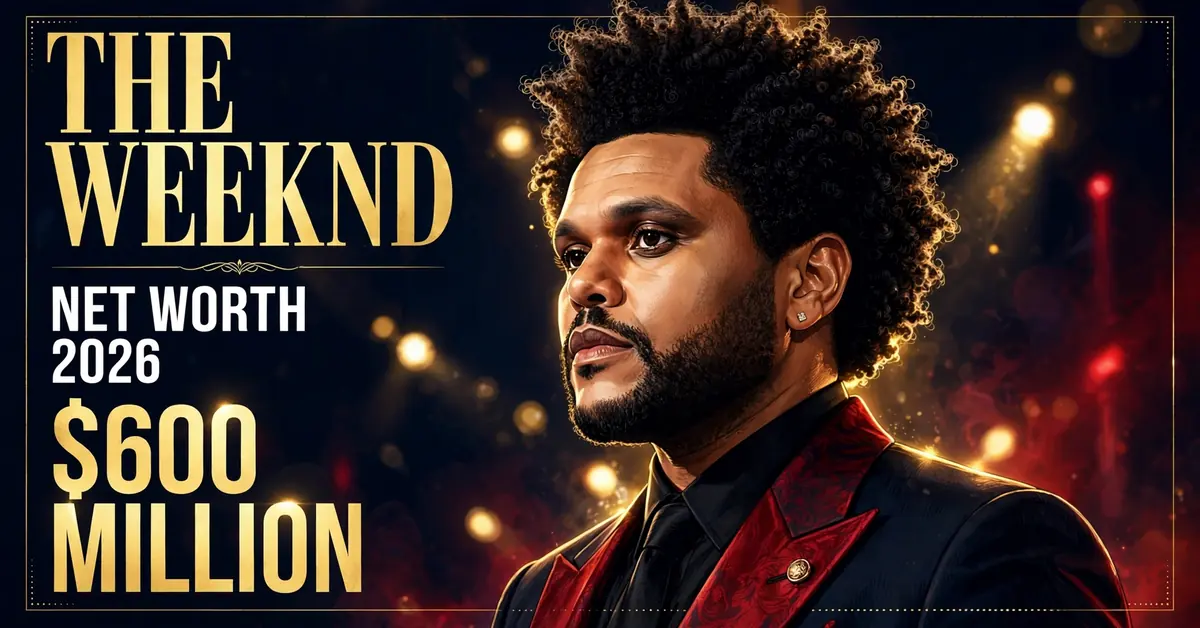
The Weeknd is worth an estimated $600 million in 2026. That is the figure Celebrity Net Worth carries on his profile, refreshed in a snapshot dated November 4, 2026, and Parade reported the same number in January 2026. InvestorMint and VocalWorth land on $600 million as well. The honest range around that anchor is $300 million to $600 million: Alux put the range at $300–600 million in October 2026, while InfoCelebs prints $300 million and iFANN prints $400 million. Nobody outside Abel Tesfaye’s own circle has seen an audited balance sheet, so this page gives you the consensus figure, the full spread, and the reasons the spread exists — then it shows the money behind the number.
Three money stories built the fortune, and all three landed within the last few years. His After Hours Til Dawn stadium tour wrapped on November 5, 2026, in Kuala Lumpur with a final gross above $1.3 billion — the highest-grossing tour ever by a male solo artist, according to promoter Live Nation, reported by Pollstar the same day. In December 2025 he closed a catalog partnership with Lyric Capital Group that valued his music at roughly $1 billion, while he kept 75% ownership and full creative control. And Forbes named him the highest-paid musician of 2025 after an estimated $298 million earnings year, ahead of Taylor Swift and Beyoncé.
None of those three numbers is the same as money in the bank. A $1.3 billion tour gross is split with promoters, venues, crews, labels and tax authorities before the artist sees his share. A $1 billion catalog valuation is the value of an asset, not cash handed over, and most of the capital raised against it was debt. The $298 million Forbes figure is pre-tax earnings for one year, not net worth. This article keeps those distinctions in view the whole way through, because the gap between gross and take-home is exactly where most net-worth pages on the internet go wrong.
Quick Facts
| Full Name | Abel Makkonen Tesfaye |
| Stage Name | The Weeknd |
| Born | February 16, 1990, Toronto, Ontario, Canada |
| Age in November 2026 | 36 (turned 36 on February 16, 2026) |
| Net Worth 2026 | Estimated $600 million (Celebrity Net Worth, snapshot Nov 4, 2026; Parade, Jan 2026); honest range $300–600 million |
| 2025 Earnings | $298 million pre-tax, Forbes Highest-Paid Musicians of 2025 (No. 1) |
| Biggest Tour | After Hours Til Dawn Tour, 2022–2026: over $1.3 billion gross, 176 shows, 9 million+ tickets |
| Catalog Deal | Lyric Capital Group, December 2025: catalog valued at ~$1 billion; Tesfaye keeps 75% ownership and creative control |
| Breakthrough Work | “Blinding Lights” — the most-streamed song in Spotify history, first song past 5 billion streams |
| Record Labels | XO Records (his own label); Republic Records / Universal Music Group |
| Known For | “Blinding Lights,” “Can’t Feel My Face,” “Starboy,” “The Hills,” Super Bowl LV halftime show, HBO’s The Idol |
| Career Start | Anonymous mixtapes on YouTube, 2010–2011; House of Balloons, March 2011 |
| Awards | Four Grammy Awards; Time 100, 2020; first artist past 100 million monthly Spotify listeners |
| Latest Work | Hurry Up Tomorrow album and film (2025); After Hours Til Dawn Tour finale, November 5, 2026 |
How This Estimate Was Made
No audited balance sheet for Abel Tesfaye is public. Every net-worth figure for him, including the $600 million used here, is an estimate built from reported data: tour grosses published by Live Nation, the Forbes annual earnings ranking, the reported structure of the Lyric Capital catalog deal, streaming figures from Spotify, and real-estate reporting. This page names the outlet behind each number and the date it was reported, so you can see which figures are fresh and which are stale.
The method has three steps. First, take the most-cited tracker figure — Celebrity Net Worth at $600 million, snapshot November 4, 2026 — and check it against other outlets. Parade, InvestorMint and VocalWorth all print $600 million. Second, record the full spread of published estimates, $300 million to $600 million, and explain why the low end sits where it does: most low-end figures rest on pre-2025 data, from before the stadium tour finished and before the catalog deal closed. Third, test the anchor against hard 2026 reporting: a $1.3 billion tour gross, a $298 million Forbes earnings year and a $1 billion catalog valuation all point to the top of the range, not the bottom.
Two rules run through the whole article. Gross revenue is never presented as personal income — tour gross, catalog valuation and pre-tax earnings are three different things, and the article says which is which every time. And any figure that rests on a single low-quality source, or on data from before 2025, is flagged as stale rather than repeated as fact.
+
The Weeknd Net Worth in 2026: The 0 Million Figure, Explained
The Weeknd’s net worth in 2026 is estimated at $600 million, and that number has held steady across the most-cited trackers through the year. Celebrity Net Worth lists $600 million on his profile, with a snapshot dated November 4, 2026. Parade reported the same figure on January 1, 2026, citing Celebrity Net Worth. InvestorMint, writing in early 2026, put the estimate at $600 million “according to multiple industry sources including Celebrity Net Worth.” VocalWorth also prints $600 million, citing Celebrity Net Worth and Parade.
Four outlets agreeing does not make a figure exact. It makes it a consensus, and a consensus is the best available answer when the subject has never published his finances. Tesfaye has never disclosed a balance sheet, a tax return or a personal asset list. What the $600 million figure really says is this: given everything reported about his touring, streaming, catalog and business holdings through November 2026, the most-cited trackers believe his assets minus his debts land near $600 million.
The timing matters. The Celebrity Net Worth snapshot is dated November 4, 2026 — one day before the After Hours Til Dawn tour closed with its final gross above $1.3 billion. The $600 million figure was already the consensus before that final tour number landed. A tracker that revisits the number in early 2027, with the full tour gross and the catalog deal’s first full year of cash flow in view, has a case for moving it. For now, $600 million is the figure the reporting supports, with the range below it as the honest margin of error.
One more check on the anchor: Forbes has never published a standalone net-worth figure for Tesfaye, but its reporting points the same way. Forbes estimated his 2025 earnings at $298 million pre-tax and ranked him the highest-paid musician of the year. A single year of earnings at roughly half the net-worth figure is consistent with a $600 million valuation for an artist whose biggest paydays are recent and whose catalog keeps paying every month. It is far less consistent with the $300 million low-end estimates, which would imply he kept almost nothing from the biggest earning years of his career.
Why Estimates Range From 0 Million to 0 Million
Published estimates for The Weeknd’s net worth in 2026 stretch from $300 million to $600 million. That is a $300 million gap — half the top figure. The gap exists for four reasons, and each one is worth understanding before trusting any single number.
The first reason is timing. Low-end estimates lean on older data. InfoCelebs, which prints $300 million, describes his tour gross as “over $294 million” — a figure from the early legs of the tour, before the 2025 and 2026 stadium runs added roughly another billion dollars in grosses. A valuation built on 2023 tour numbers cannot price a 2026 fortune.
The second reason is the catalog deal. Until December 2025, no market transaction had put a price on his music. The Lyric Capital partnership changed that overnight: a catalog valued at roughly $1 billion, with Tesfaye keeping 75% of it. Trackers that updated after December 2025 moved toward $600 million. Trackers that did not update stayed near $300–400 million. The deal is the single biggest reason the spread exists.
The third reason is method. Some outlets count the full value of assets Tesfaye controls; others discount heavily for debt, taxes and the fact that catalog income is split with labels, publishers and co-writers. Both approaches are defensible. Neither is an audit. The honest way to present the result is a range, with the method stated.
The fourth reason is the $100 million figure still floating around on low-quality net-worth sites. That number predates the stadium era entirely — before the After Hours tour, before the catalog deal, before five years of streaming growth on “Blinding Lights.” It does not reflect the current consensus and should not be treated as credible in 2026. Ignore it wherever you see it.
| Source | Figure | Date | What it rests on |
|---|---|---|---|
| Celebrity Net Worth | $600M | Snapshot Nov 4, 2026 | Most-cited tracker; tour-year earnings ~$90M pre-tax |
| Parade | $600M | Jan 1, 2026 | Cites Celebrity Net Worth |
| InvestorMint | $600M | Early 2026 | Multiple industry sources; flags $300–600M range |
| VocalWorth | $600M | 2026 | Cites Celebrity Net Worth and Parade |
| Alux | $300–600M | Oct 2026 | Explicit range; up from a $30M earlier estimate |
| iFANN | $400M | 2026 | Mid-low estimate |
| CelebriHub | $350M | 2026 | Low-end estimate |
| InfoCelebs | $300M | 2026 | Low end; uses stale $294M tour gross |
| SRCWAP | $300–350M | 2026 | Low-end range |
The id=”the-13-billion-tour”.3 Billion Tour That Changed Everything
The After Hours Til Dawn Tour is the single largest money event of The Weeknd’s career, and it finished only days before this article was written. The tour wrapped on November 5, 2026, at the National Stadium in Kuala Lumpur, Malaysia. Live Nation, the promoter, reported a final gross above $1.3 billion, with more than 9 million tickets sold across 176 shows in 67 cities, 30 countries and five continents. Pollstar reported the figures on November 5, 2026, and JamBase and MusicTimes carried the same totals the same week.
The record is specific and it matters: the tour is the highest-grossing tour ever by a male solo artist. It passed Elton John’s Farewell Yellow Brick Road tour, which grossed more than $939 million. On the all-time list across all acts, the tour ranks third — behind Taylor Swift’s Eras Tour at more than $2 billion and Coldplay’s Music of the Spheres tour at more than $1.5 billion. The Weeknd now sits in the billion-dollar tour club with only those two acts.
The tour started on July 14, 2022, at Lincoln Financial Field in Philadelphia. It ran for more than four years, which is part of why older net-worth pages kept getting the number wrong: the gross kept growing long after the first estimates were printed. The final year was the biggest. In 2026 alone the tour sold more than 3 million tickets and grossed over $500 million, per Live Nation. July 2026 alone brought in more than $120 million from nearly 900,000 tickets, topping Billboard’s monthly Boxscore chart. Four sold-out nights at Hong Kong’s Kai Tak Stadium made him the highest-selling international male solo artist in that city’s history, per Tatler Asia.
Here is the part most net-worth pages skip: $1.3 billion in gross ticket sales is not $1.3 billion for The Weeknd. Gross is the total paid by ticket buyers. Out of it come venue rental, staging, crew, travel, security, insurance, the promoter’s cut, the label’s share of touring income, management and agency fees, and taxes. Forbes estimated he pocketed about $77 million in tour profits from the 40-plus shows he played in 2025 alone — a large number, and a small fraction of the gross. The tour made him rich by letting him play stadiums for four years at a scale almost no solo male artist has reached. It did not hand him $1.3 billion.

The tour also did something that does not show up in a net-worth table: it turned a pandemic-era album cycle into a four-year stadium business. The After Hours album came out in March 2020, the month the world shut down. The tour built around it did not start until July 2022. By the time it closed in November 2026, it had outlasted two more albums — Dawn FM in 2022 and Hurry Up Tomorrow in 2025 — and it had become the engine of his fortune rather than a promotion for any single record. Live Nation also reported $8.5 million in donations to the XO Humanitarian Fund and Global Citizen over the course of the tour, a detail worth recording because it is the one hard number attached to his philanthropy from this period.
The id=”the-1-billion-catalog-deal” Billion Catalog Deal With Lyric Capital
On December 14, 2025, The Weeknd closed a catalog partnership with Lyric Capital Group that valued his music at roughly $1 billion. Variety reported the deal first; Bloomberg and Billboard followed with the valuation. The deal covers his master recordings and publishing from the start of his career through 2025 — the full six-album discography up to Hurry Up Tomorrow. Music he releases from 2026 onward is not part of the agreement.
The headline number misled a lot of coverage, so the structure deserves a careful look. This was not a sale. Tesfaye did not hand over his catalog for $1 billion in cash. Lyric Capital invested in the catalog through a new joint business venture, and the capital was raised largely as debt secured against the music. Reporting from Billboard, summarized by FandomWire, described the structure as roughly $500 million in senior debt, $250 million in junior debt and $250 million in equity — about $750 million of borrowing and $250 million of equity against a $1 billion valuation. Lyric holds a 25% equity stake in the catalog. Tesfaye and his manager Cash XO keep 75% ownership, and Tesfaye keeps full creative control over how the music is used.
Why would lenders put $750 million of debt against a song catalog? Because the cash flow is steady. The Richest, citing Variety, Billboard and Bloomberg, reported the catalog generates about $55 million a year in combined net label and publisher share. At a $1 billion valuation, that implies a multiple of 18.2 times annual earnings — high, but in line with what predictable streaming income commands when interest rates and growth assumptions cooperate. The catalog had to prove it could service the debt from streaming royalties alone, and the lenders’ math said it could.
The deal ranks among the largest single-artist catalog transactions ever recorded. The only publicly confirmed deal larger is Sony Music’s acquisition of Queen’s catalog, valued at roughly $1.27 billion. For a living artist still releasing music, the Weeknd deal is the biggest of its kind — and its structure is the interesting part. He raised about $1 billion of capital against music he already owned, kept three-quarters of it, kept creative control, and kept all future music outside the deal. His label relationships did not change: he still releases through XO and Republic under Universal Music Group, with Universal Music Publishing Group administering his publishing.
For the net-worth question, the deal cuts two ways. It supports the $600 million figure, because a market transaction just priced the core asset of his career at $1 billion, and he owns most of it. It also limits the figure, because the $1 billion is the value of the catalog, not cash in his pocket — and the catalog now carries roughly $750 million of debt raised against it. Anyone who adds “$1 billion catalog deal” to a “$600 million net worth” and calls him a billionaire has added the same money twice and ignored the debt.
How Much Does The Weeknd Make Per Year?
Forbes answered that question with a headline in its Highest-Paid Musicians of 2025 ranking: $298 million in estimated pre-tax earnings, the No. 1 spot in the world. The ranking, published December 30, 2025, covers earnings from December 31, 2024 to December 31, 2025, before taxes and after deducting label and publisher shares and fees paid to agents, attorneys and managers. Taylor Swift placed second at $202 million and Beyoncé third at $149 million, per the HotNewHipHop recap of the list. Forbes Africa’s version of the same ranking adds the detail that Forbes estimates he will pocket about $200 million after fees — the gap between $298 million and $200 million is the cost of doing business at stadium scale.
Inside the $298 million, Forbes pointed to three drivers. The tour supplied the largest share: about $77 million in profit from the 40-plus shows he played in 2025. The catalog deal supplied the second: Forbes tied roughly $200 million of the year’s total to the Lyric Capital transaction, counting the capital raised against the catalog as earnings in the ranking window. The album supplied the third: Hurry Up Tomorrow debuted at No. 1 on the Billboard 200 in January 2025 with 490,500 album-equivalent units in its first week. A reader who wants the honest version of “how much does he make” should hold all three pieces at once: the year was extraordinary because a tour, an album and a once-in-a-career financing all landed in the same twelve months.
That is why his annual income swings so hard from year to year. In a touring year, he can earn $145–285 million before taxes and fees, on industry estimates. In a year without a tour, the number falls to roughly $50–80 million, carried by streaming royalties, publishing and endorsements. Celebrity Net Worth has long put his touring-year earnings near $90 million before taxes in a typical year — a figure that looks conservative next to the $298 million Forbes year, because the Forbes year was not typical. It was the year the tour peaked, the album landed and the catalog deal closed.
| Year / period | Earnings | Source | Main driver |
|---|---|---|---|
| 2025 (Forbes window) | $298M pre-tax | Forbes, Dec 30, 2025 | Tour + catalog deal + Hurry Up Tomorrow |
| 2025 tour profit | $77M | Forbes | 40+ stadium shows |
| 2025 after fees | ~$200M | Forbes (via Forbes Africa) | Same year, net of fees |
| Typical tour year | $145–285M | Industry estimates | Stadium touring, before taxes/fees |
| Typical non-tour year | $50–80M | Industry estimates | Streaming, publishing, endorsements |
| Streaming royalties | ~$80M/year | Industry estimates (Variety/Billboard sourcing) | Catalog streams across platforms |
| Catalog net profit | ~$55M/year | Variety / Billboard / Bloomberg | Net label + publisher share |
Forbes also placed him on its inaugural Iconoclast 50 list in June 2026 — a ranking of leaders “changing the game in real time” across finance, business, technology, media and entertainment. The citation named the $298 million year, the catalog deal and the male-solo touring record as the reasons. It is a business honor, not a music award, and it signals how the industry now reads him: a catalog owner and deal-maker as much as a recording artist.
Streaming: The Blinding Lights Money Machine
If the tour is the loudest part of the fortune, streaming is the quietest and the most reliable. “Blinding Lights” is the most-streamed song in Spotify history. It passed 4 billion streams in January 2024 — the first song ever to do so — then passed 5 billion on August 31, 2025, another first. By November 3, 2026, the count stood above 5.6 billion, per kworb data cited by SpotifyStats. The song spent four weeks at No. 1 on the Billboard Hot 100, stayed on the chart for 90 weeks, and Billboard named it the greatest Hot 100 song of all time in November 2021.
The scale around that one song is hard to overstate. Tesfaye has 28 songs in Spotify’s Billions Club — more than any other artist. He was the first artist to pass 100 million monthly listeners on Spotify, and Tatler Asia reported he still counted 115 million monthly listeners in November 2026. “Starboy,” his 2016 collaboration with Daft Punk, has passed 4 billion streams on its own. A catalog that deep earns every day, tour or no tour, which is exactly why lenders were willing to put $750 million of debt against it.

Streaming royalties are estimated at roughly $80 million a year for Tesfaye, on industry estimates sourced from Variety and Billboard reporting. Treat that as an estimate, not a ledger entry: streaming payouts are split among the artist, the label, publishers, co-writers and producers, and the per-stream rate moves with the platform, the territory and the subscription mix. The catalog’s combined net label and publisher share — about $55 million a year, the figure behind the Lyric deal’s 18.2-times multiple — is the cleaner number, because it is the profit after the splits that the deal’s lenders actually underwrote.
The streaming story also explains why the fortune keeps growing between tours. A stadium tour ends. A catalog does not. Every month, “Blinding Lights” and the rest of the six-album catalog generate royalties from Spotify, Apple Music, YouTube and radio. That income is the floor under the $600 million estimate: even in a year with no tour and no album, the catalog pays tens of millions. The Lyric deal converted part of that future income into capital in December 2025. The rest keeps flowing.
From Anonymous Mixtapes to the Trilogy
Abel Makkonen Tesfaye was born on February 16, 1990, in Toronto, Ontario, to Ethiopian immigrant parents. He grew up in Scarborough, a district in Toronto’s east end, raised largely by his mother and grandmother while his father was absent. He has described his teenage years as restless: he dropped out of high school one weekend in 2007, at 17, and left home with a friend, renting a one-bedroom apartment and living on a diet of music, cheap food and no plan. The stage name came from that weekend — he left home “on a weekend,” dropped the “e” to avoid a trademark clash with a Canadian band called The Weekend, and kept the spelling ever since.
The career started with anonymity. In 2010 and 2011 he uploaded songs to YouTube under the name The Weeknd, with no face, no interviews and no label. The first mixtape, House of Balloons, arrived in March 2011 as a free download. Two more followed that year — Thursday in August and Echoes of Silence in December. The sound was dark R&B built on falsetto, druggy haze and sparse production, and it spread through blogs and word of mouth rather than radio. Drake, then rising fast out of the same Toronto scene, amplified the mixtapes to a wider audience.
The business move came in 2012. Tesfaye founded XO Records with his managers Wassim “Sal” Slaiby and Amir “Cash” Esmailian, then compiled the three mixtapes into Trilogy, released that November through XO and Republic Records. Trilogy sold as an album what the mixtapes had given away free, and it established the pattern that still defines his career: he owns the label, he controls the masters’ direction, and a major label handles distribution. That ownership is a large part of why a $1 billion catalog valuation was possible thirteen years later — he never gave the catalog away in a bad early deal.
The first proper studio album, Kiss Land, followed in September 2013. It debuted at No. 2 on the Billboard 200 and sold respectably, but it did not produce a hit on the scale of what came next. The turning point was not an album at all. It was “Earned It,” his contribution to the Fifty Shades of Grey soundtrack in early 2015, which earned him his first Grammy nomination and his first real radio presence. The door it opened led straight into the album that made him a pop star.
Beauty Behind the Madness and Starboy: The Pop Takeover
Beauty Behind the Madness arrived in August 2015 and changed the scale of everything. “Can’t Feel My Face,” released that June, became his first No. 1 on the Billboard Hot 100. “The Hills” followed it to No. 1. The album debuted at No. 1 on the Billboard 200 and won the Grammy for Best Urban Contemporary Album. For the first time, the anonymous mixtape singer was a mainstream pop act with two chart-topping singles in the same year.
The money followed the chart positions. Touring moved from clubs and theatres to arenas. Endorsements arrived: Puma signed him in 2017 for a footwear and apparel partnership, and H&M put him in a fashion collaboration the same year. Those deals were never disclosed in dollar terms — brand deals of this kind rarely are — but they marked the moment his income stopped being only music. The face that had been hidden for the first two years of his career was now the selling point.
Starboy, released in November 2016, kept the run going. The title track, a collaboration with Daft Punk, hit No. 1 on the Hot 100 and has since passed 4 billion Spotify streams. The album debuted at No. 1 on the Billboard 200 and won the Grammy for Best Urban Contemporary Album, his second in that category. A world tour in 2017, the Starboy: Legend of the Fall Tour, played arenas across North and South America and Europe. It was his first arena tour, and the first proof that his audience would fill rooms of 15,000 and 20,000 night after night — the proof of concept for the stadium run that came five years later.
My Dear Melancholy, a six-track EP released in March 2018, was smaller and darker, a return to the mixtape mood. It still debuted at No. 1 on the Billboard 200. The pattern was set: every full-length release from 2015 onward opened at the top of the American albums chart. That consistency is what let him negotiate from strength when the catalog deal came around — six albums, all commercial successes, with no weak link a buyer could use to discount the price.
After Hours, Dawn FM and Hurry Up Tomorrow: The Trilogy Closes
After Hours arrived on March 20, 2020, the week the world locked down. The album debuted at No. 1 on the Billboard 200, and “Blinding Lights” became the defining song of the year — the best-selling global single of 2020 by stream-equivalent units, per the International Federation of the Phonographic Industry. The red-jacketed, bandaged-face character from the album’s videos became a visual signature, and the album’s synth-driven sound set the template for the next five years of his work.
The album also produced the strangest episode of his career: a complete shutout at the 2021 Grammy Awards, with zero nominations despite the year’s biggest song. Tesfaye announced he would boycott the Grammys, and his team put the energy that would have gone into a Grammy campaign into the Super Bowl halftime show instead. The snub cost him nothing commercially. “Blinding Lights” went on to its 90-week Hot 100 run and its record as Billboard’s greatest Hot 100 song of all time.
Dawn FM followed in January 2022, a concept album framed as a radio station broadcasting from purgatory, with Jim Carrey as the station’s DJ. It debuted at No. 2 on the Billboard 200 — his first album since 2013 not to open at No. 1 — but its singles, “Take My Breath” and “Sacrifice,” kept the tour setlist fresh. The album’s real role was structural: it was the middle chapter of a trilogy that began with After Hours, and it gave the stadium tour a second act’s worth of material.
Hurry Up Tomorrow closed the trilogy in January 2025. The album debuted at No. 1 on the Billboard 200 with 490,500 album-equivalent units in its first week, per Forbes, and its single “Timeless” reached the US top ten. A film of the same name, starring Tesfaye alongside Jenna Ortega and Barry Keoghan, arrived in May 2025. Tesfaye has said the album and film mark the end of “The Weeknd” as a persona — the character he created as a teenager in Scarborough is being retired, and future music may arrive under his own name. Whether he follows through is an open question. What is settled is that the trilogy’s three albums produced the tour, the streaming catalog and the cultural moment that the December 2025 deal priced at $1 billion.
The Super Bowl Halftime Show: Million of His Own Money
On February 7, 2021, The Weeknd headlined the Super Bowl LV halftime show in Tampa, Florida. The performance lasted about 13 minutes. He was not paid for it. The NFL does not pay halftime performers a fee — the league covers production costs and the artist performs for the exposure. Tesfaye went further than the standard arrangement: he put $7 million of his own money into the production, on top of the NFL’s roughly $10 million budget, bringing the total to about $17 million. His managers told Billboard he spent the money to “make this halftime show be what he envisioned.”
The show was staged in a pandemic-empty stadium, with a choir in red jackets and bandages filling the field and a hall-of-mirrors sequence that became the night’s most replayed image. Roughly 96 to 103 million people watched in the United States. Some net-worth pages call it the most-watched halftime show in history. That claim does not hold up: later halftime shows drew larger audiences, and the 2021 number sits well below the biggest years. The show was a huge audience and a career peak. It was not a viewership record, and this page does not repeat the claim.
As a business decision, the $7 million was cheap. A halftime show is the largest single television audience an American musician can reach, and the streaming bump after the performance was immediate: “Blinding Lights” and the After Hours catalog surged on every platform in the days that followed. The $7 million bought a global advertisement for a catalog he owned outright — the same catalog Lyric Capital valued at $1 billion less than five years later. It is one of the clearest examples in his career of spending his own money to raise the value of an asset he controlled.
The Idol, Film and Acting
Acting is the smallest earner in Tesfaye’s career and the one that cost him the most reputation. He co-created and starred in The Idol, an HBO drama that aired in 2023, playing a nightclub owner and cult leader opposite Lily-Rose Depp. The show was savaged by critics and cancelled after one season of five episodes. GQ reported the budget at somewhere between $54 million and $75 million, per Parade’s reporting. The show’s one durable music legacy is “One of the Girls,” his collaboration with Depp and Jennie of Blackpink, which became a streaming hit and still sat in Spotify’s global top 50 in November 2026.
The film Hurry Up Tomorrow, released in May 2025, fared little better with critics, but its purpose was different: it was the visual close of the album trilogy, not a bid for a film career. Tesfaye starred in it as a version of himself, and the film’s existence alongside the album shows how he now treats his projects — the music, the film and the tour are one product, sold across three formats. That bundling is part of why the catalog deal covered masters and publishing together: the value sits in the whole body of work, not in any single song.
Earlier acting work includes a small role in the Safdie brothers’ Uncut Gems (2019), where he played himself in a memorable scene opposite Adam Sandler. It was a cameo, not a career pivot, and it paid in credibility rather than cash. None of his screen work has ever approached music as an income source. The honest accounting is that acting has been a cost center with cultural upside, not a profit center — and the $600 million estimate does not need it to be one.
XO Records and the Business Beyond the Mic
XO Records is the business that makes the rest of the fortune possible. Tesfaye founded the label in 2012 with Slaiby and Esmailian, and it operates as an imprint under Republic Records and Universal Music Group. Owning the label means he has never been a hired singer on someone else’s roster. He signs artists, he controls release strategy, and the label’s share of his own recordings flows to a company he co-owns rather than to a third party.
The label’s roster has included artists such as Nav and Belly, and its value is tied to the same catalog the Lyric deal priced. When Variety and Billboard reported the $55 million annual net label and publisher share behind the deal, part of that number is XO’s economics: the label’s cut of streaming and sales on the six-album catalog. A singer on a standard major-label deal would see a smaller share of that $55 million. A singer who owns his label sees more of it, and that difference compounds over a decade of streaming.
Brand deals sit on top of the music business. Puma signed him in 2017, and H&M followed with a fashion collaboration the same year. Neither deal’s value was disclosed, and this page does not invent one. What the deals show is timing: they arrived at the peak of the Starboy era, when his audience was largest and his image most marketable, and they paid for the use of a face that had been deliberately hidden for the first two years of his career. He also holds the merchandising and touring businesses that sit alongside the label — the stadium tour’s merchandise operation alone, across 176 shows and 9 million tickets, is a substantial revenue line, even though no outlet has published a figure for it.
The structure of the whole business is visible in the Lyric deal. He kept 75% of the catalog, kept creative control, kept future music out of the deal, and kept his label relationships unchanged. That is not the deal of an artist cashing out. It is the deal of an owner raising capital against an asset while keeping the asset. The $600 million net worth is, in large part, the value of that ownership position — a label, a catalog and a touring business, held together by one person.
Brand Deals, Real Estate and How He Spends It
Real estate is the most visible part of the fortune, and the least precisely reported. InfoCelebs puts his Hidden Hills estate in Los Angeles at roughly $70 million, and his Bel Air mansion at roughly $21 million. Both figures are reported, not confirmed sale prices, and property records for high-end Los Angeles homes rarely tell the full story — purchase prices, mortgages and renovations all sit behind the headline number. Treat the $70 million and $21 million as the scale of his property holdings, not as a ledger.
What the property story does show is the shape of his spending: concentrated, private and Los Angeles-based. He does not run a public portfolio of businesses or a venture fund. The money goes into the catalog, the label, the tour production and a small number of large homes. That concentration is also a risk: a fortune tied to one catalog and one touring brand rises and falls with that brand’s relevance. The Lyric deal’s debt — about $750 million raised against the catalog — adds a second layer of the same concentration. If streaming income ever fell sharply, the debt would still need servicing.
The spending that is public and documented is the philanthropy. Live Nation reported $8.5 million in donations to the XO Humanitarian Fund and Global Citizen over the course of the After Hours Til Dawn tour. Tesfaye has also given publicly to hunger relief in Ethiopia, the country of his parents’ birth, and to humanitarian causes through the XO fund. None of those gifts is large enough to move a $600 million estimate, but they are the only charitable figures with a named source attached, so they are the ones this page records.
Is The Weeknd a Billionaire?
No. The Weeknd is not a billionaire, and the math is straightforward. His net worth is estimated at $600 million, with a published range of $300 million to $600 million. A billionaire’s net worth starts at $1 billion. He is roughly $400 million short of that line on the consensus figure, and roughly $700 million short on the low-end estimates.
The confusion comes from the two $1 billion numbers attached to his name. The first is the catalog valuation: about $1 billion, per Variety, Bloomberg and Billboard. But a catalog valued at $1 billion is not $1 billion in his bank account. He owns about 75% of it, which is roughly $750 million of gross asset value, and the catalog carries about $750 million of debt raised against it. The equity value — what his 75% stake is worth after the debt — is far smaller than $1 billion, and it is already counted inside the $600 million net-worth estimate. Counting the catalog valuation on top of the net worth would count the same asset twice.
The second $1 billion number is the tour gross: more than $1.3 billion in ticket sales. That is revenue, not profit, and not his money. The gross was split among venues, promoters, crews, labels, managers and tax authorities. Forbes estimated his tour profit at $77 million for the 40-plus shows he played in 2025. A billion-dollar gross and a billion-dollar net worth are different things, and the distance between them is the cost of putting on 176 stadium shows.
Could he get there? The path exists. If the catalog keeps earning $55 million a year in net label and publisher share, if streaming keeps growing, and if he tours stadiums again in his late thirties, the $600 million figure has room to rise. The Lyric deal also showed he can raise large sums against the catalog without selling it. But none of that has happened yet. As of November 2026, the honest answer is no — and any page that calls him a billionaire is reading the headlines without reading the deal.
The Weeknd vs. His Peers: Where 0 Million Sits
A net-worth figure means more next to the people who earn money the same way. Among pop’s stadium class, $600 million puts Tesfaye in the top tier without putting him at the very top. Taylor Swift’s fortune is larger — her Eras Tour grossed more than $2 billion, and her net worth is widely reported above $1 billion. Ed Sheeran, Drake and Justin Bieber all sit in the same broad band of nine-figure pop fortunes, with estimates that move with their own tours and catalog deals. The Weeknd’s $298 million Forbes year in 2025 beat all of them in that single year, which is a different achievement from having the largest total fortune.
The comparison that flatters him most is the touring one. His $1.3 billion tour gross is the largest ever by a male solo artist, ahead of Elton John’s $939 million Farewell Yellow Brick Road run. Among solo men, nobody has ever grossed more on a single tour. The comparison that puts him in perspective is the all-time one: Swift’s Eras Tour at more than $2 billion and Coldplay’s Music of the Spheres tour at more than $1.5 billion both cleared his total, and both acts did it in fewer years on the road.
| Artist | Tour benchmark | What it shows |
|---|---|---|
| The Weeknd | After Hours Til Dawn: >$1.3B, 176 shows | Highest-grossing tour by a male solo artist (Live Nation, Nov 2026) |
| Taylor Swift | Eras Tour: >$2B | Highest-grossing tour of all time; Forbes 2025 earnings $202M |
| Coldplay | Music of the Spheres: >$1.5B | Second-highest tour gross of all time |
| Elton John | Farewell Yellow Brick Road: >$939M | Previous male-solo touring record, now second |
| Beyoncé | Forbes 2025 earnings $149M | Third on the Forbes 2025 highest-paid musicians list |
The streaming comparison is his strongest. “Blinding Lights” is the most-streamed song in Spotify history, and 28 of his songs have passed a billion streams — more than any other artist. No peer owns a single song with that reach. In catalog terms, he holds the deepest bench in pop. That depth is what the Lyric deal priced, and it is what keeps the $600 million figure defensible even in a year with no tour.
What Comes Next in 2026 and Beyond
The tour is over. The trilogy is closed. The catalog deal is signed. What remains is the question Tesfaye himself raised: does “The Weeknd” continue? He has said the Hurry Up Tomorrow album and film mark the end of the persona, and that future music may come under his own name, Abel Tesfaye. If he follows through, the next chapter starts with a new name on the same catalog — and the catalog, not the name, is where the money sits. Music released from 2026 onward falls outside the Lyric deal, which means any new work is his to own, sell or license entirely on his own terms.
The near-term economics do not depend on that decision. The catalog earns roughly $55 million a year in net label and publisher share, and streaming royalties run near $80 million a year on industry estimates. Those flows continue whether he records under his stage name or his birth name. A new stadium tour would be the next big event — nothing has been announced — and a tour in 2027 or 2028 would be the fastest way to add to the $600 million figure. A new album under his own name would test whether the audience follows the man rather than the character.
Trackers will revisit the number in early 2027, when the full 2026 tour gross and the catalog deal’s first year of cash flow are both in view. If the $600 million figure moves, it is more likely to move up than down: the tour’s final gross arrived after the last snapshot, and the catalog’s income is still compounding. For now, $600 million — with the $300–600 million range stated honestly beside it — is the figure the reporting supports as of November 8, 2026.
Frequently Asked Questions About The Weeknd’s Net Worth
What is The Weeknd’s net worth in 2026?
The Weeknd’s net worth in 2026 is estimated at $600 million, according to Celebrity Net Worth (profile snapshot November 4, 2026) and Parade (January 1, 2026). InvestorMint and VocalWorth also print $600 million. The honest range is $300 million to $600 million: Alux put the range at $300–600 million in October 2026, while InfoCelebs prints $300 million and iFANN prints $400 million. No audited balance sheet is public, so every figure is an estimate — but the $600 million consensus is the best-supported number after the $1.3 billion tour and the $1 billion catalog deal.
How much does The Weeknd make per year?
It depends on the year. Forbes estimated his 2025 earnings at $298 million pre-tax, ranking him the highest-paid musician of 2025, and estimated he would pocket about $200 million after fees. That year was exceptional: a $77 million tour profit from 40-plus shows, the Hurry Up Tomorrow album and the Lyric Capital catalog deal all landed in the same twelve months. In a typical touring year he earns an estimated $145–285 million before taxes and fees; in a year without a tour, roughly $50–80 million, carried by streaming royalties of about $80 million a year and catalog income of about $55 million a year.
How much did the After Hours Til Dawn tour gross?
The After Hours Til Dawn Tour grossed more than $1.3 billion, according to promoter Live Nation, reported by Pollstar on November 5, 2026. The tour ran from July 14, 2022 to November 5, 2026, playing 176 shows in 67 cities, 30 countries and five continents, and selling more than 9 million tickets. It is the highest-grossing tour ever by a male solo artist, passing Elton John’s Farewell Yellow Brick Road tour at more than $939 million. In 2026 alone the tour grossed over $500 million. The $1.3 billion is gross ticket revenue, not The Weeknd’s personal earnings.
Is The Weeknd a billionaire?
No. The Weeknd’s net worth is estimated at $600 million, with a published range of $300 million to $600 million — roughly $400 million short of $1 billion on the consensus figure. The confusion comes from two $1 billion numbers: his music catalog was valued at about $1 billion in the December 2025 Lyric Capital deal, and his tour grossed more than $1.3 billion. Neither is cash in his pocket. He owns about 75% of the catalog, which carries about $750 million of debt raised against it, and the tour gross was split among venues, promoters, crews, labels and taxes.
What is The Weeknd’s real name?
The Weeknd’s real name is Abel Makkonen Tesfaye. He was born on February 16, 1990, in Toronto, Ontario, Canada, to Ethiopian immigrant parents. He took the stage name after leaving home one weekend at 17, dropping the “e” from “Weekend” to avoid a clash with a Canadian band of that name.
How old is The Weeknd?
The Weeknd is 36 years old in 2026. He was born on February 16, 1990, and turned 36 on February 16, 2026. He started uploading anonymous mixtapes in 2010 at 20, released House of Balloons in March 2011 at 21, and scored his first No. 1 single, “Can’t Feel My Face,” in 2015 at 25.
How much is The Weeknd’s catalog worth?
The Weeknd’s music catalog was valued at roughly $1 billion in his December 2025 partnership with Lyric Capital Group, covering his masters and publishing from the start of his career through 2025. The deal was not an outright sale: Lyric holds a 25% equity stake, Tesfaye and Cash XO keep 75% ownership and full creative control, and about $750 million of the capital raised was debt ($500 million senior, $250 million junior) with $250 million in equity. The catalog generates about $55 million a year in combined net label and publisher share, implying an 18.2-times earnings multiple. Music released from 2026 onward is not part of the deal.
Who is The Weeknd?
The Weeknd is the stage name of Abel Makkonen Tesfaye, a Canadian singer, songwriter and record producer born February 16, 1990, in Toronto. He rose from anonymous mixtapes uploaded to YouTube in 2010–2011 to global stardom with “Can’t Feel My Face” (2015), “Starboy” (2016) and “Blinding Lights” (2019) — the most-streamed song in Spotify history. He founded XO Records, headlined the Super Bowl LV halftime show in 2021, co-created HBO’s The Idol in 2023, and closed the After Hours trilogy with the Hurry Up Tomorrow album and film in 2025. Forbes named him the highest-paid musician of 2025.
Sources & Reporting
This article was researched and written on November 8, 2026, from live reporting and published profiles. Net-worth figures come from Celebrity Net Worth (profile snapshot November 4, 2026), Parade (January 1, 2026), InvestorMint (early 2026), VocalWorth (2026), Alux (October 2026), InfoCelebs (2026), iFANN, CelebriHub and SRCWAP. Tour figures come from Live Nation, reported by Pollstar (November 5, 2026), JamBase, MusicTimes and Tatler Asia. Earnings figures come from Forbes’ Highest-Paid Musicians of 2025 ranking (December 30, 2025), Forbes Africa and the HotNewHipHop recap, with the Forbes Iconoclast 50 list (June 2026). Catalog-deal reporting comes from Variety, Bloomberg and Billboard, via The Richest and FandomWire. Streaming milestones come from Spotify and kworb data via SpotifyStats, and from Billboard’s Hot 100 chart records. Super Bowl reporting comes from Billboard, via his managers Wassim “Sal” Slaiby and Amir “Cash” Esmailian, with viewership from contemporary reports. The Idol’s budget comes from GQ, via Parade. Chart milestones for “Blinding Lights” were cross-checked against Wikipedia’s sourced entries.
All net-worth figures are estimates: no audited balance sheet for Abel Tesfaye is public. Where sources disagree, this article publishes the range and explains why. Figures labeled as industry estimates — including streaming royalties near $80 million a year and tour-year earnings bands — are estimates from reported industry data, not disclosed financials. The $100 million net-worth figure found on some low-quality sites was examined and rejected as stale. The claim that his Super Bowl halftime show was the most-watched in history was examined and not repeated, because the reported viewership does not support it.
Corrections: if you spot an error in this article, contact us through the corrections page linked in the footer. We correct factual errors promptly and note the change. This article contains no AI-generated imagery of real people presented as photographs — all illustrations are original artwork, labeled as such in their captions.
About the Author
Nathan Cole is the editor of Guide Net Worth, where he covers celebrity wealth, touring economics and the music business. His reporting draws on published financial rankings, promoter disclosures, trade-press deal coverage and chart data, and every net-worth figure on this site is presented with its source and its range — never as a single unexamined number.
Read more from Nathan Cole on the About Us page. Have a correction? See our corrections policy in the site footer.
References & Sources
This article has been fact-checked and verified against multiple public sources, financial disclosures, SEC filings, Forbes reports, Celebrity Net Worth databases, and official records. All net worth estimates are based on publicly available information and financial analysis.