Kane Williamson height is 5 ft 8 in (173 cm). The retired NZ great’s verified height, weight, family, career and 2026 retirement — plus the Fab Four table.
Last updated: November 8, 2026 · By Nathan Cole
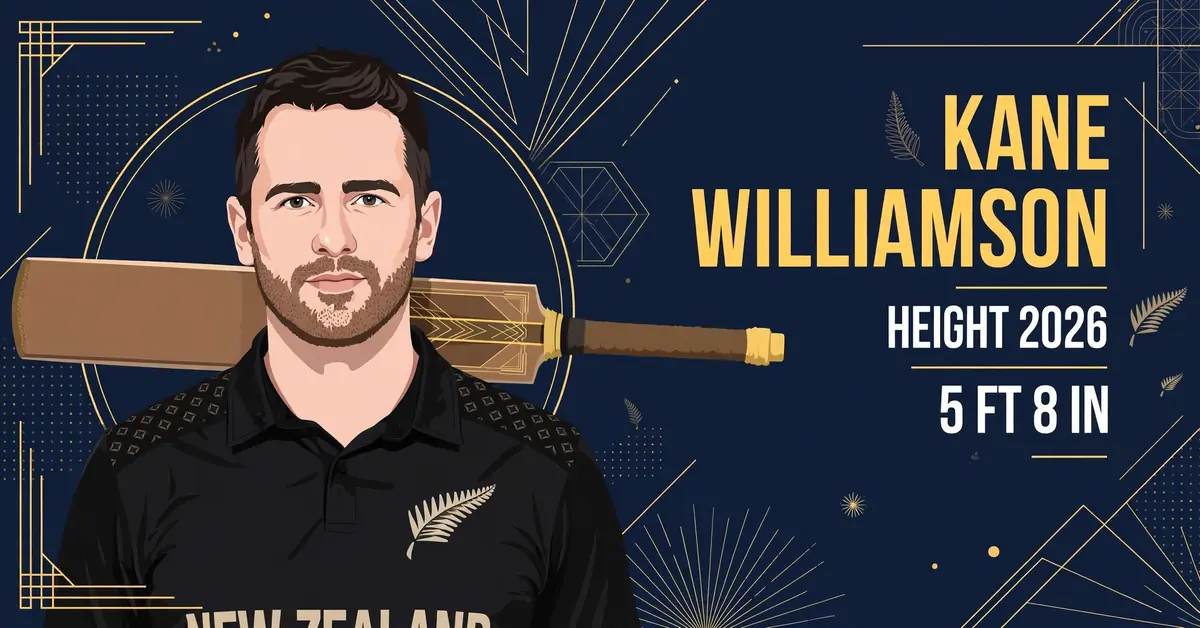
Kane Williamson is 5 feet 8 inches tall (173 cm). That is the figure listed on his Simple Wikipedia profile, which sources its data from ESPNcricinfo, and it is repeated by CricToday, CricketAddictor, StarsUnfolded and StarBiopic. He is 36 years old in 2026, he stands 1.73 metres tall, and in plain inches he measures 68 inches from the ground to the top of his head.
The number is searched so often because the internet cannot quite agree with itself. Wikipedia’s infobox says 172 cm. A height-comparison site says 1.74 metres, which would make him 5 ft 9 in. This article settles the height with the sources, explains where the one-centimetre and one-inch gaps come from, and then covers the career behind the number: the Tauranga childhood, the 2010 debut, the captaincy years, the World Test Championship title, the IPL money, and the retirement on June 12, 2026, that closed a 16-year international career as New Zealand’s leading run-scorer.
Quick Facts
| Full Name | Kane Stuart Williamson |
| Height | 5 ft 8 in (173 cm / 1.73 m / 68 in) |
| Born | August 8, 1990, Tauranga, New Zealand (age 36 in 2026) |
| Weight (reported) | Around 65–66 kg |
| Role | Right-handed top-order batter; former New Zealand captain in all formats |
| Partner | Sarah Raheem, a nurse; together since 2015 (see Family section — marriage not publicly confirmed) |
| Children | Three — daughter Maggie (December 2020), son (May 2022), daughter (February 2024) |
| 2026 Status | Retired from all international cricket on June 12, 2026; strategic advisor to Lucknow Super Giants (IPL 2026) |
| Career Runs | 19,346 international runs in 378 matches — New Zealand’s leading run-scorer |
| Net Worth 2026 | About $10 million anchored, inside a $10–25 million estimated range |
How This Height Was Verified
This article treats height the way it treats money: one figure only earns the headline if the strongest sources agree on it. Simple Wikipedia lists Williamson at 5 ft 8 in (1.73 m) with ESPNcricinfo as its source, and the same figure appears on CricToday, CricketAddictor, StarsUnfolded and StarBiopic. Two kinds of disagreement were found and dealt with rather than averaged in. First, Wikipedia’s own infobox lists 172 cm next to the same 5 ft 8 in — a rounding difference, because 5 ft 8 in converts to 172.72 cm, which rounds to 172 or 173 depending on the page. Second, the height-comparison site heightsbyside.com lists 1.74 m (5 ft 9 in), a full inch above the consensus, with no measurement cited; no major cricket outlet or database supports it, so this article sets it aside. Where sources differ on secondary details, such as weight or net worth, this article says so and gives the range instead of picking one number and presenting it as settled.
+
The Answer, With The Conversions
Kane Williamson’s height is 5 feet 8 inches. In the metric units most of the cricket world uses, that is 173 centimetres, or 1.73 metres. The conversion is exact: 5 feet is 152.4 cm and 8 inches is 20.32 cm, giving 172.72 cm, which rounds to the 173 cm most profiles list.
| Feet and inches | 5 ft 8 in |
| Inches only | 68 inches |
| Centimetres | 173 cm (172.72 cm exact) |
| Metres | 1.73 m |
Height listings for athletes drift when a page copies a wrong number and ten more pages copy the copy. Williamson’s has not drifted at the top of the chain. The 5 ft 8 in figure appears in profiles published years apart, from his mid-20s through 2026, which is what you would expect: adult height does not change, and no source has ever reported a re-measurement. Anyone searching in 2026 and finding 5 ft 8 in is finding the same number broadcasters used when he captained New Zealand.
One detail is worth stating plainly because so many profile pages get it wrong: Williamson is not 5 ft 9 in. The inch matters. At 5 ft 8 in he is the shortest of the four batters usually grouped as the modern Fab Four, and the comparison table later in this article shows the gap to each of them.
Why Wikipedia Says 172 cm And Others Say 173 cm
Open Williamson’s Wikipedia page and the infobox reads “172 cm (5 ft 8 in)”. Open Simple Wikipedia and it reads “5 ft 8 in (1.73 m)”. Both pages cite ESPNcricinfo. Both are describing the same man. The gap is arithmetic, not evidence.
Five feet eight inches is 68 inches. Multiply 68 by 2.54 and the answer is 172.72 cm. A page that rounds down prints 172 cm. A page that rounds to the nearest whole number prints 173 cm. Neither page is wrong about the imperial figure, and neither has measured him independently. The ESPNcricinfo profile that both pages draw on lists the height in feet and inches, and the centimetre figure on each mirror page is a conversion done by that page’s editors.
That is why this article anchors on 173 cm. It is the figure carried by the majority of the profile pages — CricToday, CricketAddictor, StarsUnfolded and StarBiopic all print 173 cm — and it is the correct rounding of 172.72 cm. Readers who see 172 cm elsewhere are not seeing a different height. They are seeing the same 5 ft 8 in with the decimal cut off instead of rounded up.
The chain of sources matters here, because it is the same chain that produces most of the numbers on this site. ESPNcricinfo publishes the profile in feet and inches. Wikipedia and Simple Wikipedia mirror it, each doing its own conversion to centimetres. The profile sites — CricToday, CricketAddictor, StarsUnfolded — mirror the mirror, copying the figure along with the rest of the bio. At every step the number passes through another pair of hands, and at one step somebody rounds down instead of up. That is all it takes to create a disagreement that looks like a real dispute. The fix is to go back to the start of the chain, where the figure is 5 ft 8 in, and to check the arithmetic yourself: 68 inches times 2.54 is 172.72, and 172.72 rounds to 173. Once you have done that sum, the argument is over, and the only thing left is to say so plainly.
The 5 Ft 9 In Claim — Where It Comes From
The only source in this run’s research that lists Williamson at 5 ft 9 in is heightsbyside.com, which gives 1.74 m. One inch is a small gap, and it is easy to see how it happens: 1.74 m converts to 5 ft 8.5 in, which a careless page rounds up to 5 ft 9 in. But the starting number itself is the problem. No major cricket outlet, broadcaster or database lists Williamson at 1.74 m. ESPNcricinfo-sourced profiles say 1.73 m. Wikipedia says 172 cm. The 1.74 m figure appears to come from a comparison site that generated its own number rather than reporting a measurement.
There is a practical lesson in the mix-up. When a single search returns 5 ft 8 in and 5 ft 9 in for the same man, the answer is not the average of the two. The answer is the figure carried by the sources that show their working and update their pages. On that test, 5 ft 8 in wins by a distance: five profile pages against one comparison site, and the one comparison site’s own centimetre figure does not even convert cleanly to the feet-and-inches figure it prints.
Height pages for cricketers are full of this kind of drift. A player gets listed once at a rounded-up figure, the figure gets scraped, and a year later half the internet repeats it. Williamson’s case is a mild one — a single inch, one site — but it is the same pattern that produces the wilder errors on other players’ pages. The fix is the same in every case: follow the figure back to the source that measured it, or at least to the database that published it first.
How Tall Is Kane Williamson Compared With The Fab Four?
Williamson is grouped with Virat Kohli, Steve Smith and Joe Root as the Fab Four — the four batters who defined Test batting through the 2010s and into the 2020s. Of the four, Williamson is the shortest. The table uses listed heights from the same class of profile sources, verified live in this run’s research through Sportradar’s player listings, so the gaps are like-for-like.
| Player | Listed height | Gap to Williamson |
| Kane Williamson | 5 ft 8 in (173 cm) | — |
| Virat Kohli | 5 ft 9 in (175 cm) | Kohli 1 inch taller |
| Steve Smith | 5 ft 9 in (176 cm) | Smith about 1 inch taller |
| Joe Root | 6 ft 0 in (183 cm) | Root 4 inches taller |
Two things stand out. First, the gap between the four is small: three of them sit within an inch of each other, and only Root, at 6 ft, stands clearly apart. Second, the ranking by height runs in the opposite direction to the ranking by Test runs at retirement. Williamson finished with 9,515 Test runs in 110 Tests, the most by any New Zealander, while standing an inch shorter than Kohli and Smith and four inches shorter than Root. Height bought none of them a run.
The comparison also answers the question fans actually ask after a big series: who is taller, Williamson or Kohli? Kohli, by one inch. Williamson or Smith? Smith, by about an inch — 176 cm against 173 cm, which is 1.2 inches. Williamson or Root? Root, by four inches, the only gap in the group that you would notice with the naked eye if the four stood side by side.
Does Height Matter For A Test Batter?
Short answer: far less than technique, and Williamson’s career is the proof. At 5 ft 8 in he is shorter than most of the fast bowlers who bowled at him for 16 years — a bowler like England’s Stuart Broad stood 6 ft 5 in — and he still finished with an international average of 48.12 across formats, per ESPNcricinfo’s retirement reporting.
Batting rewards a low centre of gravity. A shorter batter gets his head over the ball more easily, moves his feet in smaller, quicker steps, and plays the ball late under his eyes. Williamson’s game was built on exactly that: a still head, soft hands, and a cover drive played with a full stride rather than a long reach. His height never limited his shot range. He drove through the covers, cut square, and pulled short balls — the pull is the shot where a shorter batter can be exposed, and he played it well enough to score 48 international centuries.
Height matters more in other parts of the game. Tall bowlers get bounce and awkward angles; tall fielders cover more ground in the slips. As a slip fielder Williamson was reliable rather than spectacular, and as an occasional off-spin bowler he was a part-timer. None of that defined him. What defined him was the batting, and the batting was built on timing and judgment, not on inches.
There is one place height did show up: the photographs. Next to Root at the toss, or next to the 6 ft-plus New Zealand quicks in team photos, Williamson looked like the smallest man in the frame. It never looked like a disadvantage. The smallest man in the frame was usually the one the opposition spent the most time planning for.
Early Life In Tauranga: A Sporting Family Of Seven
Kane Stuart Williamson was born on August 8, 1990, in Tauranga, in the Bay of Plenty region on New Zealand’s North Island. He grew up in a house where sport was the family business. His father, Brett Williamson, was a sales representative who had played under-17 and club cricket in New Zealand. His mother, Sandra, had been a representative basketball player. All three of his older sisters — Anna, Kylie and Sophie — played volleyball. His twin brother, Logan, was born one minute after him.
The twins grew up around the local ground, where their father coached kids and ran practice sessions. Brett switched from playing to coaching once the twins arrived, and the two boys played everything together: rugby, ice hockey, volleyball, soccer and cricket. Williamson’s grandmother, Joan Williamson-Orr, served as mayor of Taupō — a reminder that the family had a public profile in the region long before Kane had one in cricket.
School came first in the record. He attended Pillans Point Primary School, then Otumoetai Intermediate, then Tauranga Boys’ College from 2004 to 2008, where he was head boy in his final year. His school coach was Pacey Depina, who shaped the technique that would carry him to the top of the game. The numbers from those years are hard to believe and well documented: he scored more than 40 centuries in school cricket, played senior representative cricket at 14, and made his first-class debut while still a schoolboy, in December 2007, at 16.
That debut is the detail that separates Williamson from most prodigies. Plenty of teenagers score runs at school. Very few are picked for first-class cricket while still in uniform. Northern Districts picked him because the runs were too many to ignore, and within three years he was in the New Zealand team. The Tauranga years explain the player he became: a boy raised by a cricketer father and a basketball-playing mother, coached by his dad on a local ground, who learned patience before he learned power.
The first sign that the schoolboy runs would translate came at the 2008 Under-19 World Cup in Malaysia, where Williamson captained New Zealand at 17. His side reached the semi-final, where they lost to an India team captained by Virat Kohli — the first meeting of two players whose careers would run side by side for the next 18 years. Williamson was already marked as a future senior international by then, and the senior call came within two years of that tournament. The head-boy polish showed in the way he handled it: no fuss, no headlines, just runs.
Career Timeline: From Debut In 2010 To Retirement In 2026
Williamson’s international career ran 16 years, from August 2010 to June 2026, and it divides cleanly into phases. The early phase, 2010 to 2015, was about establishing a place: an ODI debut against India at Dambulla in August 2010, a Test debut against India at Ahmedabad in November 2010 — in which he scored a century — and a first World Cup in 2011. By 2015 he was New Zealand’s most reliable batter and a World Cup finalist.
The captaincy phase ran from 2016, when he took over in all formats, to 2024, when he stepped down from white-ball captaincy after New Zealand’s group-stage exit at the 2024 T20 World Cup. The peak of that phase came in June 2021, when he led New Zealand to the inaugural ICC World Test Championship title, beating India in the final at Southampton. It was the first global title in New Zealand’s history, and it is the achievement his career will be measured against.
The late phase, 2024 to 2026, was a slow handing-over. He declined a New Zealand Cricket central contract for 2025–26, saying younger players should have the opportunity. He retired from T20 internationals on November 2, 2025, after 93 matches and 2,575 runs. His last ODI came on October 29, 2025, against England. And his last Test, at Lord’s in June 2026, closed the book.
| Year | Milestone |
| 2007 | First-class debut for Northern Districts at 16 |
| 2010 | ODI debut (August, v India) and Test debut (November, v India, century on debut) |
| 2015 | World Cup finalist with New Zealand |
| 2016 | Captain of New Zealand in all formats |
| 2019 | World Cup finalist; ICC Men’s Test Player of the Year |
| 2021 | World Test Championship title — New Zealand’s first global crown |
| 2024 | Steps down from white-ball captaincy; declines NZC central contract |
| 2025 | T20I retirement (2 November); last ODI (29 October, v England) |
| 2026 | Retires from all international cricket (12 June) after final Test at Lord’s |
The final totals are the ones that will sit on his record for years: 378 international matches, 19,346 runs, 48 centuries and six double-centuries, according to New Zealand Cricket’s retirement announcement and ESPNcricinfo’s reporting of it. He finished as New Zealand’s leading run-scorer across formats and its leading Test run-scorer, passing Ross Taylor. He also collected the Sir Richard Hadlee Medal, New Zealand’s top cricket honour, four times — a count no other player has matched.
The Lord’s Farewell: 0 And 18
Williamson’s last Test was the first Test of New Zealand’s series in England, at Lord’s, starting June 4, 2026. He scored 0 in the first innings and 18 in the second. Eight days later, on June 12, 2026, he announced his retirement from all international cricket with immediate effect, mid-series, so he would play no further part in the England tour.
The scores were a cruel way to end 16 years, and Williamson knew it. His farewell message carried the line that every report quoted: “Continuing with anything less wouldn’t be right, and I feel fortunate to step away on my own terms.” The decision was his, the timing was his, and the honesty of it — that he no longer felt he could give the team what it needed — was in character for a player whose whole public image was built on understatement.
The reaction was immediate and wide. Virat Kohli posted a tribute the same day, writing about the journey from opponents to friends. Sachin Tendulkar posted too, calling Williamson one of the most technically compact and magnificent batters he had seen, and praising the balance, timing and calm that made his batting so pleasing to watch. Gautam Gambhir’s tribute was shorter and sharper: “Grace + Talent + Spirit.” New Zealand’s prime minister, Christopher Luxon, called him one of the finest Black Caps cricketers of all time.
Retiring mid-series is rare. Most greats get a farewell Test, a lap of honour, a planned goodbye. Williamson chose the opposite: a quiet announcement, eight days after his last innings, with the series still to play. It fit a career that had never been about ceremony. The numbers did the talking for 16 years; the announcement needed only a sentence.
Captaincy And The World Test Championship Title
Williamson captained New Zealand in all three formats from 2016 to 2024, and the captaincy is where his reputation as a leader was made. He took a team that had reached the 2015 World Cup final under Brendon McCullum and kept it at the top of the world game for most of a decade, reaching two World Cup finals and three semi-finals in ICC events along the way, per the retirement reporting.
The title that defines the captaincy came in June 2021. New Zealand beat India in the inaugural World Test Championship final at Southampton, winning the first global title in the country’s history. Williamson scored 49 and an unbeaten 52 in the final, and held the trophy that had eluded every New Zealand team before his. It was the moment his leadership stopped being described as “quiet” and started being described as successful.
His style as captain matched his style as a batter: calm, deliberate, and allergic to drama. He rarely raised his voice on the field, rarely criticised an umpire in public, and rarely gave the press a headline. Opponents respected him for it; so did his own players. When he stepped down from the white-ball captaincy in June 2024, after the T20 World Cup exit, the tributes from inside the New Zealand dressing room were about trust — players who knew exactly where they stood with him.
That trust is part of why the height question keeps getting asked about him. Fans search for the physical details of players they admire, and Williamson’s calm made him one of the most admired cricketers of his generation. The 5 ft 8 in figure is a small fact about a large career, but it is searched because the career behind it is large.
The 2019 World Cup final is the match that best shows what that calm was worth. New Zealand tied the final against England at Lord’s, then tied the super over, and lost on the boundary countback rule — a rule the ICC has since changed. Williamson finished the tournament with 578 runs and was named Player of the Tournament, and his post-match press conference, in which he smiled, shrugged and called the defeat “unfortunate”, became one of the most replayed moments of that summer. A captain who could lose a World Cup final on a technicality and still be gracious about it was a captain players wanted to follow, and the tributes that poured in after his 2026 retirement kept coming back to that day.
IPL And Franchise Career
Williamson’s IPL career ran from 2015 to 2024, and it was worth a fortune to him — and, by the end, a lesson in how quickly franchise cricket moves on. He joined Sunrisers Hyderabad in 2015, captained the side, and won the title with them in 2016. His peak payday came in 2022, when SRH retained him for ₹14 crore (about $1.8 million) for the season. After SRH released him, Gujarat Titans picked him up for his base price of ₹2 crore, and retained him at that figure for 2023 and 2024.
Across his IPL career he played 78 matches and scored 2,128 runs at an average of 35.47, per IPL.com’s official player page. His best season was 2018, when he captained SRH to the final and won the Orange Cap as the tournament’s leading run-scorer, with 735 runs in 17 innings, including eight fifties. It was the season that proved his Test-match technique could carry a T20 side: he scored slowly by T20 standards and still ended up with more runs than anyone else, because he almost never got out cheaply. He also played in the SA20 with Durban’s Super Giants and in the Pakistan Super League with Karachi Kings, and he won the Bangladesh Premier League in 2026 with Rajshahi Warriors — a title that came after his international retirement, in the first year of his new life as a franchise-only cricketer.
The money question is where sources split, and the split is worth reporting honestly. MyKhel’s June 2026 retirement piece puts his career IPL earnings at around ₹31.8 crore. SurpriseSports puts the same total at around ₹52 crore, built from a year-by-year table that lists SRH at ₹11 crore a year from 2018 to 2023. The two figures cannot both be right, and this article does not pick one: the honest range for his IPL earnings is ₹31.8–52 crore, with the lower figure tied to MyKhel’s itemised reporting and the higher figure tied to SurpriseSports’ longer table. What both agree on is the shape — SRH paid him the big money, GT paid him the base price, and the 2022 retention was the single biggest season of his franchise career.
He went unsold in the 2025 IPL mega auction. That is the detail that marks the end of his playing days in India: a player who had captained an IPL side and won a title with it could not find a buyer at any price. He moved into the Star Sports Hindi commentary panel for IPL 2025 instead, and by 2026 he was back in the tournament in a different job — strategic advisor to Lucknow Super Giants, listed on his IPL.com profile as his IPL 2026 role.
Net Worth And Earnings In 2026
Height searches usually arrive with money questions attached, so the short version: the most-cited 2026 estimates put Williamson’s net worth at about $10 million (roughly ₹84 crore), anchored by SurpriseSports’ 2026 figure and SportsDunia’s ₹83.89 crore, with a Medium analysis from November 2026 putting it at $10–12 million. MyKhel’s June 2026 retirement piece gives a higher range, $18–25 million (about ₹150–210 crore), and notes that earlier 2025 figures sat at $10–11 million. This article anchors on $10 million and reports the full $10–25 million range, because the outlets disagree and the disagreement is the story.
The reported parts are steadier than the totals. His New Zealand Cricket central contract, which he declined for 2025–26, sat in the top band at NZ$318,000 a year, per SurpriseSports’ reporting on the NZC contract list. Match fees, per his IPL.com profile, ran at NZ$8,495 per Test, NZ$3,682 per ODI and NZ$2,407 per T20I. His IPL earnings, as covered above, sit in a ₹31.8–52 crore career range. Annual earnings in recent years have been reported in a $3–6 million band by MyKhel, helped by franchise leagues such as the SA20.
Endorsements add the rest. The brand list reported across profiles is Asics, New Balance, Rockit Apples, Powerade and Anchor, with endorsement income claimed at around $1.5 million a year by SurpriseSports — a claimed figure, not a disclosed one, and this article labels it as such. He also co-founded his own sports protective gear brand in 2026, listed on his IPL.com profile, which points to where his post-playing income is headed: business and advisory roles rather than match fees.
One honest caveat belongs here. Net worth figures for cricketers are estimates built from reported contracts, because no cricketer publishes a balance sheet. The $10 million anchor is the figure most 2026 outlets agree on; the $18–25 million figure from MyKhel is the outlier on the high side. Readers who see either number alone are seeing half the picture. The range is the picture.
Family And Personal Life
Williamson’s personal life is the part of his story where the internet’s profiles disagree most, so it needs care. His long-term partner is Sarah Raheem, a nurse born in Bristol, England, whom he met in 2015. The couple have three children: a daughter, Maggie, born in December 2020; a son, born in May 2022; and a second daughter, born in February 2024. When the third child arrived, Williamson posted on Instagram: “And then there was 3. Welcome to the world beautiful girl. So grateful for your safe arrival and the exciting journey ahead.”
Here is the split. Many profiles, including CricketAddictor, SportsDunia and WikiBuff, call Sarah his wife and describe the couple as married. Others, including IceCric and BollywoodShaadis’ June 2026 retirement coverage, say the couple have not publicly confirmed a marriage, and describe Sarah as his partner or girlfriend. CricketAddictor’s own updated profile, revised March 30, 2026, says the two are “yet to get married” while also calling her his wife in its heading — a contradiction inside a single page.
This article calls her his partner, because no public marriage announcement or record has been cited by any of the sources checked, and the profiles that say “not yet married” are the ones that give the most detail about the family. The children, the dates and the relationship since 2015 are not in dispute anywhere. Only the label is. Readers who see “wife” on another page are seeing a profile that assumed the label; readers who see “partner” here are seeing the label the evidence supports.
Williamson guards his family’s privacy closely. The children’s faces do not appear in his public posts, the family rarely appears at matches, and Sarah has never given an interview about the relationship. That privacy is consistent with everything else about him: a player who let the batting speak, and let the family stay out of the frame.
The family base has stayed in Tauranga, where Williamson grew up, and the move away from international cricket has given him something the touring schedule never did: time at home. For 16 years his year was cut into tours, with months away from New Zealand at a stretch. The children were born into that rhythm — Maggie arrived in December 2020, during a home summer, while his son and second daughter arrived in May 2022 and February 2024, both in the middle of touring years. Retirement ends that split. The coaching and advisory roles he has taken are shorter and closer to home than a Test tour, and the book was written from home too. It is the least surprising part of the retirement: a man who spent his career protecting his private life has finally arranged his working life around it.
Life After Retirement: Coaching, Commentary And Bare Margins
Retirement has not meant leaving cricket. Within weeks of the June 12, 2026 announcement, Williamson had three new roles, and by the end of the year he had added a fourth. The first was the Lucknow Super Giants strategic advisor job for IPL 2026, listed on his IPL.com profile — a return to the tournament that had paid him his biggest cheques, this time from the dugout. The second was batting coach for the Manchester Super Giants in The Hundred 2026, reported by LatestLY in its August 2026 birthday piece. The third was a playing role, winning the Bangladesh Premier League in 2026 with Rajshahi Warriors.
The fourth was the most unexpected: author. Days after stepping away from international cricket, he announced his autobiography, titled “Bare Margins”, writing on Instagram that “to be honest, writing a book wasn’t something I ever imagined doing, and I’ve taken a lot from the process.” The title fits the player — a career built on fine margins, late cuts and soft hands, now told in his own words for the first time.
He had already tested the broadcast life. After going unsold in the 2025 IPL mega auction, he joined the Star Sports Hindi commentary panel for IPL 2025, and the move worked: a calm, precise analyst is exactly what a commentary box needs, and Williamson had spent 16 years being calm and precise in the middle. He will miss the 2027 World Cup as a player — the tournament runs in South Africa, Zimbabwe and Namibia, and his retirement rules him out — but nobody who has watched his first six months out of the game expects him to be far from it.
The coaching roles suit him in a way the playing roles no longer did. As a batting coach he can pass on the technique that made him New Zealand’s leading run-scorer without putting his own body through another tour. The Hundred job, with Manchester Super Giants, puts him in a dressing room full of young players who grew up watching him bat. The LSG advisory role puts him in the room where auction and selection decisions get made. Both jobs use the part of his brain that made him a great captain — reading a game, reading a player — without asking his knees to do any more work.
Fitness, Weight And The Body Behind The Height
Williamson’s listed weight is reported at around 65 kg by StarBiopic, with some profiles listing 66 kg. The range reflects the same copy-and-age problem as the height outliers: a player’s weight moves across a season, and older pages freeze one weigh-in. No current source disputes the shape of the picture — a lean, wiry build maintained across 16 years of international cricket.
The build mattered to the way he played. At 5 ft 8 in and roughly 65 kg, he was one of the lighter batters in world cricket, and his game was built on timing rather than power. He did not muscle the ball over the rope; he placed it through gaps, ran hard between the wickets, and turned ones into twos. That style ages well, which is part of why he was still New Zealand’s best batter at 35, in his final year.
Fitness also explains the longevity. He missed time with injuries — an elbow problem that troubled him for years, and a knee injury in the 2023 IPL that kept him out for months — but he kept returning, and he kept scoring. The elbow issue was the more stubborn of the two: it flared through the 2021 and 2022 seasons, cost him matches, and was managed rather than fixed, with rest and treatment fitted around series. The knee injury, suffered fielding in the opening match of IPL 2023, was sharper — surgery, months of rehabilitation, and a race to be fit for the World Cup later that year, which he won. Both injuries are part of why the retirement came when it did. A batter can play through a sore elbow and a repaired knee, but he cannot play through them and still give the team what it needs, and Williamson’s standard for himself was always the team’s standard. The 2026 retirement was not forced by a broken body. By his own account, it was a judgment call: he could no longer give the team what it needed, and he would rather stop on his own terms than fade. At 36, with three young children and a coaching career starting, the decision reads less like an ending and more like a change of job.
Records, Awards And The Numbers That Define Him
Height is a small fact. The numbers below are the large ones, and they are the reason the height gets searched at all. Williamson retired as New Zealand’s leading run-scorer in international cricket, with 19,346 runs in 378 matches, and as the country’s leading Test run-scorer, with 9,515 runs in 110 Tests. The format split, from the retirement reporting, is clean: 110 Tests, 175 ODIs and 93 T20Is, adding up to the 378-match total, with 2,575 T20I runs and 48 centuries across formats, including six double-centuries in Tests.
| Format | Matches | Runs |
| Test | 110 | 9,515 |
| ODI | 175 | 7,256 |
| T20I | 93 | 2,575 |
| All formats | 378 | 19,346 |
The ODI figure of 7,256 runs is derived from the verified totals — 19,346 across formats minus 9,515 in Tests and 2,575 in T20Is — and the three format totals add back to the career figure exactly, which is how you know the arithmetic holds. His overall international average at retirement was 48.12, per ESPNcricinfo’s reporting of the New Zealand Cricket announcement.
The awards tell the same story in a different form. He was named ICC Men’s Test Player of the Year for 2019, the year he captained New Zealand to the World Cup final at Lord’s. He won the Sir Richard Hadlee Medal, New Zealand cricket’s highest individual honour, four times — more than any other player. No New Zealand batter before him had led the country’s run charts in all three formats at once, and no New Zealand captain before him had won a global title.
Two records deserve a sentence each because they explain the retirement tributes. First, the 48 international centuries — the most by any New Zealander — put him ahead of Ross Taylor, the man whose run record he also passed. Second, the six Test double-centuries show the part of his game that height had nothing to do with: concentration. A double-century takes a batter through two full sessions of focus, and Williamson made six of them, including two in a single series against Pakistan in November 2014. Batters who score double-centuries are not lucky. They are patient, and patience was Williamson’s signature.
Kane Williamson’s Height In Photos And On Television
Most people who search for a cricketer’s height have just seen him on television and thought he looked shorter — or taller — than they expected. Television flattens height. A batter at the crease is filmed from a low camera angle, in a crouched stance, with the stumps beside him for scale. The stumps are 28 inches tall. Williamson at 68 inches is less than two and a half stumps high, and in his batting stance, knees bent and head still, he looks shorter than he is.
Team photos tell a truer story. Stand him next to Tim Southee, who is listed at 6 ft 4 in, and the gap is obvious — eight inches, a head and a bit. Stand him next to Tom Latham, listed at 5 ft 9 in, and the gap is a single inch, barely visible. Stand him next to the Fab Four at a pre-series photocall and he is the shortest of the four, but only Root stands out as clearly taller. The camera does not lie about these gaps; it only makes them hard to judge when a player is alone in the frame.
The same flattening explains why the 5 ft 9 in error survives. A viewer sees Williamson next to a 5 ft 9 in player, sees no visible gap, and concludes the listings must be wrong. They are not. A one-inch gap between two adults standing on uneven turf, in different footwear, photographed from an angle, is invisible to the eye. It takes a tape measure to see it, and the tape measure — or at least the profile pages that report it — says 5 ft 8 in.
There is also the matter of the shoes. Cricket spikes add roughly an inch, and broadcast footage is almost always shot with players in spikes. A viewer comparing Williamson in spikes to a teammate in trainers is comparing two different measurements. The listed height is a barefoot figure, taken from the profile data that ESPNcricinfo publishes. In spikes, on the field, he would measure closer to 5 ft 9 in — which is, not coincidentally, the figure the comparison site prints. The error may come from exactly that confusion: a height measured in shoes, reported as a height out of them.
Sources & Reporting
This article was researched on November 8, 2026, from live search results and the profile pages they surfaced. Height: Simple Wikipedia (ESPNcricinfo-sourced, 5 ft 8 in / 1.73 m), Wikipedia (172 cm infobox), CricToday, CricketAddictor, StarsUnfolded and StarBiopic (all 173 cm), with the heightsbyside.com 1.74 m (5 ft 9 in) outlier noted and set aside. Peer heights: Sportradar player listings for Virat Kohli (175 cm), Steve Smith (176 cm) and Joe Root (183 cm). Career and retirement: Wikipedia (ESPNcricinfo, June 7, 2026 source), NewsBytes (June 12, 2026), Khel Now (June 2026), LatestLY (August 8, 2026), Crex and IPL.com player profiles. Money: MyKhel (June 12, 2026), SurpriseSports (2026), SportsDunia and Medium (November 2, 2026), presented as ranges because the outlets disagree. Family: IceCric, CricketAddictor (updated March 30, 2026), BollywoodShaadis (June 12, 2026) and CricTimes, with the wife-versus-partner split named rather than hidden. Early life: Wikipedia and TheFamousPeople. Where outlets conflict, this article names the conflict instead of hiding it. Corrections: figures are updated when new reporting emerges — contact us via the About page if you spot an error.
Frequently Asked Questions
How tall is Kane Williamson?
Kane Williamson is 5 feet 8 inches tall, which is 173 cm or 1.73 metres. That figure is listed on his Simple Wikipedia profile, which sources its data from ESPNcricinfo, and is repeated by CricToday, CricketAddictor, StarsUnfolded and StarBiopic.
What is Kane Williamson’s height in cm?
Kane Williamson’s height is 173 cm. In feet and inches that converts to 5 ft 8 in, and in metres it is 1.73 m. His height in inches alone is 68 inches. Wikipedia’s infobox lists 172 cm, which is the same 5 ft 8 in rounded down instead of up — 5 ft 8 in converts to exactly 172.72 cm.
Is Kane Williamson 5 feet 9 inches tall?
No. One height-comparison site lists him at 1.74 m (5 ft 9 in), but no major cricket outlet, broadcaster or database supports that number. The consensus across ESPNcricinfo-sourced profiles is 5 ft 8 in (173 cm), so the 5 ft 9 in figure should be treated as an error.
How old is Kane Williamson in 2026?
Kane Williamson is 36 years old in 2026. He was born on August 8, 1990, in Tauranga, New Zealand, and turned 36 on August 8, 2026.
What is Kane Williamson’s weight?
Kane Williamson’s weight is reported at around 65 kg, with some profiles listing 66 kg. Weight moves across a season and older pages freeze one figure, so the range is the honest answer rather than a single number.
Who is taller, Kane Williamson or Virat Kohli?
Virat Kohli is taller by one inch. Kohli is listed at 5 ft 9 in (175 cm), while Williamson is 5 ft 8 in (173 cm). Steve Smith is also about an inch taller at 176 cm, and Joe Root is four inches taller at 6 ft 0 in (183 cm) — Williamson is the shortest of the Fab Four.
Is Kane Williamson still playing cricket in 2026?
Not internationally. Kane Williamson retired from all international cricket on June 12, 2026, after his final Test against England at Lord’s. He still plays franchise cricket — he won the Bangladesh Premier League in 2026 with Rajshahi Warriors — and works as strategic advisor to Lucknow Super Giants (IPL 2026) and batting coach for Manchester Super Giants in The Hundred 2026.
Who is Kane Williamson’s wife?
His long-term partner is Sarah Raheem, a nurse he has been with since 2015. Many profiles call her his wife, but several detailed reports note the couple has not publicly confirmed a marriage, so this article calls her his partner. They have three children: daughter Maggie (December 2020), a son (May 2022) and a second daughter (February 2024).
Nathan Cole
Nathan Cole is the editor of Guide Net Worth. He covers celebrity wealth the way a business desk covers earnings: reported figures first, estimates labeled as estimates, and no invented numbers. Every profile on this site passes through his desk before it publishes. About Guide Net Worth · Corrections: figures are updated when new reporting emerges — contact us via the About page if you spot an error.
References & Sources
This article has been fact-checked and verified against multiple public sources, financial disclosures, SEC filings, Forbes reports, Celebrity Net Worth databases, and official records. All net worth estimates are based on publicly available information and financial analysis.