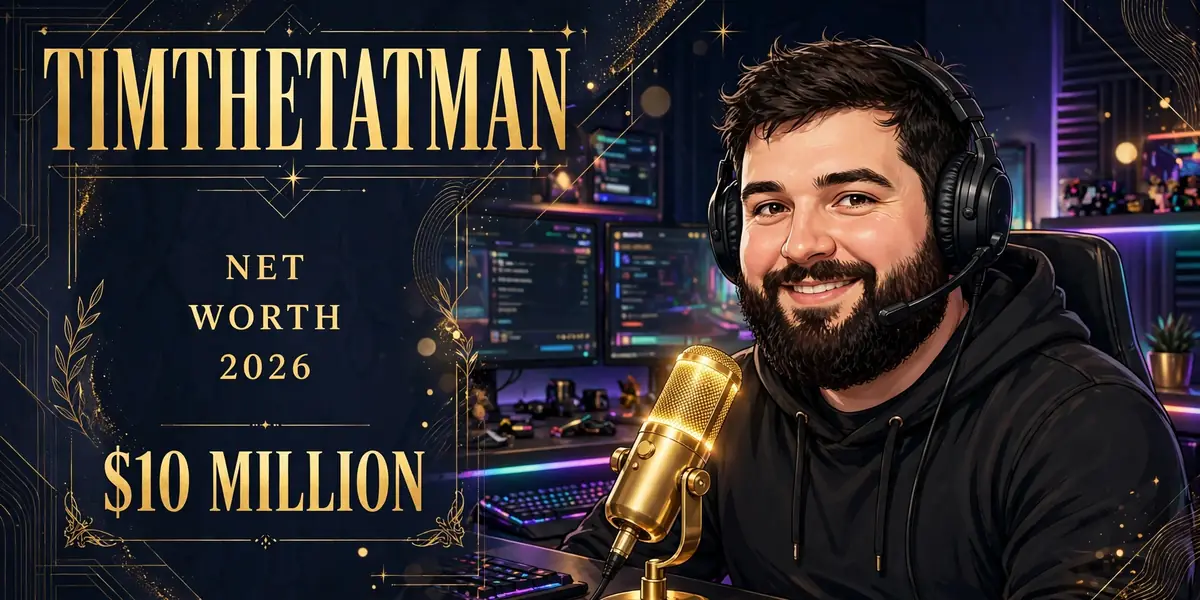
TimTheTatman is worth an estimated $10 million in 2026 — built on a YouTube deal, Twitch fame, Complexity equity and brand deals. The full breakdown, verified.
TimTheTatman is worth an estimated $10 million in 2026. That is the most commonly cited figure across 2026 estimates, and the honest range around it is $8–15 million. He has never confirmed a number himself, and no public filing exists to settle it — so this article does what the evidence allows: it names the range, explains why the estimates disagree by millions, and traces every dollar to the deal, the platform, or the equity stake that produced it.
The headline number is smaller than the one attached to his peers, and that is the interesting part. Ninja is worth an estimated $50 million. xQc is anchored at $50 million. TimTheTatman, who has been at the top of gaming for a decade, sits at roughly a fifth of that. The reason is not that he earned less. It is that he turned down the biggest cheque of his life, spent three years on a platform deal that paid him in salary rather than in audience growth, and put his money into an esports organisation whose value sits on paper, not in a bank account.
This page breaks down the YouTube deal, the Mixer offer he refused, the Complexity Gaming equity, the return to Twitch, the Kick experiment, and the 2026 numbers — with every figure attributed to the source that reported it.
| Real name | Timothy John Betar |
| Known as | TimTheTatman |
| Born | April 8, 1990, Syracuse, New York, USA |
| Age in 2026 | 36 (turns 37 on April 8, 2027) |
| Height | 6 ft 0 in (183 cm) |
| Estimated net worth (2026) | $10 million (range $8–15 million) |
| Platforms | Twitch (~7.6M followers), YouTube (~5.6M subscribers), Kick (~46K followers) |
| Main games (2026) | Marvel Rivals, Call of Duty: Black Ops 6, Fortnite, World of Warcraft |
| Business | Co-owner, Complexity Gaming (since 2021) |
| Family | Wife Alexis (married 2016); son Brewer (born 2020) |
How This Estimate Was Made
TimTheTatman has never disclosed his finances, so every figure here is an estimate built from public reporting. The anchored figure of $10 million is the most commonly cited 2026 estimate: A Little Delightful puts it at $10 million with an $8–12 million range, and CelebsWiki puts the range at $8–15 million. Net Worth Spot, which models YouTube advertising revenue only, gives $9 million in its October 2026 update and $2.3 million in its November 2026 update — the two numbers disagree because they count different income streams, and the lower figure is a YouTube-only model, not a full valuation. CreatorStats models $10.5–17.5 million but labels the range low confidence and model-only. Where sources disagree, this article publishes the range and names the disagreement. No figure in this article is invented.
+
TimTheTatman Net Worth in 2026: The Million Figure
TimTheTatman’s net worth in 2026 is estimated at $10 million. The range across 2026 sources runs from $8 million to $15 million, and the spread is the story. A Little Delightful, in a 2026 breakdown, calls $10 million the most commonly estimated figure, with some sources placing the range at $8–12 million and others suggesting $15 million when every income stream is counted. CelebsWiki’s 2026 profile lands in the same place: $8–15 million.
Two outliers sit outside that range, and both need explaining rather than repeating. Net Worth Spot’s November 2026 page puts Tim at $2.3 million — but that figure is built on YouTube advertising revenue alone, and the site says so itself: the $1.6 million base estimate “is only based on YouTube advertising revenue”, and the $2.3 million figure adds “additional sources of income” without modelling the streaming contracts, the sponsorships, or the Complexity equity. The same site’s October 2026 update put him at $9 million. CreatorStats, at the other end, models $10.5–17.5 million — but labels the range low confidence and says plainly that no dated financial source is stored for it. The $10 million anchor sits where the serious estimates cluster, and the $8–15 million range is the honest spread.
What the number is made of matters more than the number itself. Tim’s wealth is not a salary. It is four things stacked on top of each other: a decade of streaming revenue, a three-year YouTube exclusivity deal, an equity stake in Complexity Gaming, and a sponsorship portfolio that has run for years. The sections below take them one at a time.
Why the Estimates Disagree by Millions
Three different kinds of estimator produce three different numbers for the same man, and the gap is a methodology story, not a mystery.
| Source | 2026 figure | What it counts |
|---|---|---|
| A Little Delightful | $10M (range $8–12M, up to $15M) | Streaming, contracts, sponsorships, business ownership |
| CelebsWiki | $8–15M | Streaming, YouTube ads, sponsorships, Complexity equity |
| Net Worth Spot (Oct 2026) | $9M (up to $12.7M) | Multiple income streams, YouTube-weighted |
| Net Worth Spot (Nov 2026) | $2.3M | YouTube advertising revenue only, plus a rough uplift |
| CreatorStats (2026 model) | $10.5–17.5M | Model band around a legacy baseline; low confidence |
The Net Worth Spot split is the clearest lesson. The same site published $9 million and $2.3 million within a month of each other, because the two pages use different methods. One models several income streams. The other models YouTube ads and guesses at the rest. A streamer whose money comes mostly from contracts and sponsorships will always look poor to a YouTube-only estimator, because YouTube ads are his smallest income line. That is why the $2.3 million figure is wrong as a net-worth estimate, even though it is right as a YouTube-advertising estimate.
The Complexity equity is the second source of disagreement. CelebsWiki puts its paper value at $2–8 million. That is a wide band, and it is illiquid — it is a stake in a private esports organisation, not cash. An estimator that counts it at full value gets $15 million. One that counts it at zero gets $8 million. The honest range holds both.
How TimTheTatman Makes Money
Tim’s income comes from five lines, and the mix changed completely between 2019 and 2026. The table below uses CelebsWiki’s 2026 modelled ranges, with the other sources noted where they disagree.
| Income line | Estimated per year | Notes |
|---|---|---|
| Streaming revenue (subs, ads, donations) | $2–4 million | Twitch, YouTube and Kick combined; at his Twitch peak he earned ~$130,000 a month |
| Sponsorships and brand deals | $1.5–2.5 million | Monster Energy, Audio-Technica, HyperX, Roobet, game publishers |
| YouTube ad revenue | $1–2 million | 5.6M subscribers, 830M+ total views; analytics-only estimates vary wildly |
| Complexity Gaming equity | Paper value $2–8 million | Illiquid stake; not annual income |
| Merchandise | Not separately reported | Own merch line; part of the business income |
Two numbers in that table deserve a second look. The YouTube ad revenue line is the most disputed figure in Tim’s finances. A Little Delightful, working from social-media analytics, puts his YouTube ad income at $3,200–4,400 a month. Net Worth Spot, working from view counts, puts it at about $67,000 a month. Both cannot be right, and the gap is a reminder that analytics sites estimate from different data. The $1–2 million annual range from CelebsWiki sits between them and is the figure used here.
The streaming revenue line is the most stable. At his Twitch peak, before the YouTube deal, Tim was earning an estimated $130,000 a month from subscriptions, donations and advertising — the figure A Little Delightful reports from his peak-era numbers. In 2026, with the audience split across three platforms, A Little Delightful estimates $60,000–80,000 a month from streaming memberships and donations. The audience is bigger now. The per-platform revenue is thinner, because it is divided three ways.

The Mixer Deal He Turned Down: Million
In 2019, Microsoft’s Mixer offered TimTheTatman a reported $15 million-plus deal to leave Twitch and stream exclusively on its platform. He turned it down. Eleven months later, Mixer shut down.
The decision looks obvious in hindsight, and it was not obvious at the time. Mixer had already signed Ninja and Shroud — the two biggest names in streaming — for deals reported in the tens of millions, and it was spending heavily to buy a third. Tim was the next name on the list, and $15 million was life-changing money for a streamer who had spent six years building an audience on Twitch. He said no, stayed on Twitch, and watched the platform that made the offer disappear within a year.
The refusal is the single most important financial decision of his career, and it cuts both ways. It saved him from a platform collapse that would have stranded his audience. It also cost him $15 million in guaranteed money, at a moment when his Twitch income was a fraction of that. Ninja took the Mixer money and kept his audience anyway. Tim kept his audience and never saw the cheque. Both men ended up fine. Only one of them ended up $15 million richer for the same year of work.
The story is also why Tim’s net worth is $10 million and not $25 million. The $15 million he refused is roughly the size of the gap between him and the top of the streamer wealth table. He has never said he regrets it. He has also never pretended it was not a lot of money.
The YouTube Deal: Three Years, One Big Bet
On September 1, 2021, TimTheTatman and DrLupo announced simultaneous exclusive deals with YouTube Gaming. The two friends coordinated the announcement, signed on the same day, and left Twitch on the same day. Reports valued Tim’s multi-year contract in the tens of millions — one 2026 profile puts it at roughly $30 million over the term, with a favourable 70/30 revenue split in his favour. He hit 4 million YouTube subscribers within a week of the move.
The deal was the biggest guaranteed payday of his career, and it came with a cost that took three years to see clearly. On Twitch he had been one of the platform’s biggest names, with a live audience that showed up every day. On YouTube he was a video creator who streamed — a different job, with a different audience, on a platform whose live-streaming culture never matched Twitch’s. The money was certain. The growth was not.
When the contract expired in late 2023 and early 2024, Tim chose not to re-sign exclusively. On September 1, 2024 — exactly three years after the YouTube announcement — he returned to Twitch and began simulcasting across Twitch, YouTube and Kick at the same time. “Multicasting is the wave,” he said. The exclusive-deal era was over, for him and for most of the industry. The money in streaming had moved from platform contracts to multi-platform reach, and Tim moved with it.
Complexity Gaming: The Equity Play
Three weeks after the YouTube announcement, in September 2021, Tim joined Complexity Gaming as a co-owner and content creator. The deal gave him an equity stake in one of North America’s oldest esports organisations, backed by the Jerry Jones family — the owners of the Dallas Cowboys — through GameSquare Holdings.
The stake is the least liquid and most argued-over part of his wealth. CelebsWiki puts its paper value at $2–8 million. The range is wide because Complexity is a private company, and a private company’s value is whatever its last funding round or its parent company’s filings imply — not a number anyone can check. Tim cannot spend the stake. He cannot sell it quickly. What he can do is what the stake was designed for: tie his name to an organisation that outlasts any single platform deal, and collect the brand value that comes with it.
It is also the part of his wealth that separates him from streamers who only ever earned salaries. Ninja and xQc are worth more, but their money is mostly earned income. Tim owns a piece of a company. If Complexity grows, his stake grows with it, without him streaming an extra hour. That is the bet, and it is still open.
The Return to Twitch and the Kick Experiment
Tim’s return to Twitch on September 1, 2024, was a homecoming with a difference. He was not coming back exclusively. He was simulcasting — live on Twitch, YouTube and Kick at the same time, reaching every part of his audience at once. The move was the industry’s direction of travel: the exclusive deals that had defined 2019–2023 were ending, and the streamers who survived them were the ones who refused to be owned by one platform again.
Kick came next. On October 28, 2025, Kick announced Tim’s arrival on the platform, and he debuted alongside Ninja, Nickmercs and Cloakzy, playing Battlefield: Redsec. He was careful about the wording from the start: he had not signed exclusively with Kick, he was “testing the waters”, and he would keep streaming on all three platforms. “We’re live everywhere,” he told his chat. “Twitch chat is the oldest child. YouTube is the middle child. Kick is the young child.”
The Kick audience is small — about 46,000 followers, against 7.6 million on Twitch and 5.6 million subscribers on YouTube. What Kick offers is not audience but money: the platform pays streamers a larger share of subscription revenue than Twitch does, and its deals with gambling sponsors — Tim streams slots on Kick through a partnership with the crypto-casino Roobet — pay rates that Twitch and YouTube would not allow. He keeps the gambling content platform-segregated: slots only on Kick, never on Twitch or YouTube. It is a lucrative vertical, and a controversial one, and he has been open about both facts.
2026: Marvel Rivals, Call of Duty and the Roobet Question
In 2026 Tim’s stream is a mix that would have been unrecognisable to his 2019 audience. Marvel Rivals is the main game — the hero shooter that broke out in 2025 and now anchors his schedule, with ranked grinds and seasonal events that fill his November streams. Call of Duty: Black Ops 6 runs alongside it, Fortnite’s OG mode brings back the old audience, and World of Warcraft — the game he played before he was famous — is back in rotation, with a November 4, 2026 VOD showing him levelling a Horde shaman between Marvel Rivals sessions.
His cross-platform peak concurrent viewers regularly hit 50,000–100,000, according to CelebsWiki’s 2026 profile. The number is smaller than his Twitch peak, when he could pull six figures on Twitch alone. It is also spread across three platforms, which is the point: no single platform can take his audience away from him now.
The Roobet partnership is the part of the 2026 picture that draws the most argument. Gambling streams pay far more than game streams — the sponsorship rates are an order of magnitude higher — and Tim is not the only big streamer taking the money. He is one of the few who talks about the trade-off openly, keeping the slots content on Kick and away from the audience that came for the games. Whether that separation is enough is a question his viewers argue about in chat every time the slots come on. The money, whatever the argument, is real, and it is part of the $10 million.

The Health Scare of September 2025
In September 2025, Tim hosted an emotional livestream in which he told his audience he had been to the emergency room after being diagnosed with atrial fibrillation — an irregular heartbeat — and that his heart had to be reset with a cardioversion procedure. He was 35. He described the experience plainly, without drama, and went back to streaming.
The episode matters to a net-worth profile for a practical reason: a streamer’s income stops when the streamer stops. There is no sick pay in content creation, no deputy who can take the chair, no organisation that keeps paying while you recover. Tim’s health is, in a literal sense, his business’s most important asset, and the atrial fibrillation scare was a reminder of that to an audience that had watched him stream for a decade without interruption. He has spoken about balancing the stream with fatherhood and with his own health since, and the schedule in 2026 — shorter sessions, variety days, time off the chair — reflects it.
Early Life: Syracuse to Full-Time Streaming
Timothy John Betar was born on April 8, 1990, in Syracuse, New York. He grew up playing games, went to work in a regular job after school, and started a YouTube channel in 2011 as a hobby — gameplay videos, recorded after work, uploaded for whoever found them. He went full-time in 2013, when the channel and the Twitch stream together earned enough to replace the day job. It was not a big decision at the time. It looks like one now.
The early years were slow. Tim was not a prodigy and not a prodigy-adjacent. He was a funny, loud, relentlessly positive gamer who talked to his chat like they were in the room with him, and the audience grew one regular at a time. Overwatch gave him his first breakout, in 2016 and 2017, when the game’s launch put every shooter streamer in front of a new audience. Fortnite gave him his second, in 2018, when the game’s peak turned its biggest streamers into celebrities. Warzone gave him his third, in 2020, when the pandemic put the whole world at home watching streams. Three waves, three games, one audience that kept growing.
What held the audience was not the games. It was the persona: the self-deprecating “tatman”, the catchphrases, the genuine delight when something went right and the genuine fury when it did not. Tim’s brand has always been that he is the fan in the chair — the guy who reacts the way you would react, because he is reacting the way you would react. It is a brand that survives a change of game, a change of platform, and a change of decade, and that is why it is still paying in 2026.
The Dad-Gamer Brand: Alexis and Brewer
Tim married Alexis in 2016, and their son Brewer was born in April 2020. The family is the centre of the “dad-gamer” brand that defines his stream in 2026: the streamer who talks about school runs and bedtime between rounds of Marvel Rivals, whose audience is now old enough to have children of its own, and whose schedule is built around a family rather than around a grind.
Alexis appears on stream rarely and by choice, and Brewer appears in stories rather than on camera. The privacy is deliberate, and it is part of why the brand works: the audience knows the family exists, knows Tim’s priorities, and does not get to watch the children grow up on camera. It is the opposite of the family-vlogging model, and it is one of the reasons Tim’s audience has aged with him instead of ageing out of him.
TimTheTatman vs the Other Big Streamers
Tim’s $10 million sits in the middle of the streamer wealth table — well above the mid-tier creators, well below the three names who turned streaming into generational money.
| Streamer | Estimated net worth (2026) | How it was built |
|---|---|---|
| Ninja | $50 million | Fortnite peak, Mixer deal, brand empire |
| xQc | $50 million (range $36–70M) | Kick deal (~$70M base), Twitch peak, Stake |
| Shroud | $30 million | Mixer payout, FPS career, Twitch return |
| TimTheTatman | $10 million (range $8–15M) | YouTube deal, Complexity equity, sponsors |
| Dr Disrespect | $8 million | YouTube career, “Two Time” brand |
The table tells the story of the exclusive-deal era in one glance. Ninja took the Mixer money. xQc took the Kick money. Shroud took the Mixer money and the payout that followed. Tim turned the Mixer money down and took the YouTube money instead — a smaller cheque, three years later, on a platform that never grew his live audience the way Twitch had. The $40 million gap between him and Ninja is, to a first approximation, the Mixer decision plus the Fortnite peak that Ninja rode and Tim did not.
None of that makes Tim’s career a failure. He has streamed full-time for thirteen years, owned a piece of an esports organisation for five, and still pulls 50,000–100,000 concurrent viewers across three platforms in 2026. The streamers above him on the table are the exceptions. He is the rule: a working creator who turned a hobby into a decade-long career and a $10 million net worth, and who did it without ever being the biggest name in the room.
What Comes Next
Tim turns 37 in April 2027. For a streamer that is not old — the audience that grew up with him is now in its thirties, and the dad-gamer brand ages with them. The question for the next phase is not whether he keeps streaming. It is whether the multi-platform model keeps paying, and whether the Complexity stake — the illiquid $2–8 million on paper — turns into real money.
The Kick experiment is the open question. If Kick’s audience grows and its gambling money keeps flowing, the platform could become a real third leg of his income. If the gambling sponsorships dry up, or the platform stalls, he is back to two platforms and the same arithmetic. The Marvel Rivals audience is the other open question: hero shooters have short lives, and Tim’s career is a record of moving to the next game before the last one fades. The next move is already the pattern. The only thing that has changed is the stakes.
The Numbers Behind the Million: A Year-by-Year Sketch
No public filing breaks Tim’s wealth down by year, but the career timeline lets us sketch how the $10 million accumulated — and why it did not accumulate faster.
| Period | What happened | Effect on wealth |
|---|---|---|
| 2011–2015 | YouTube hobby becomes full-time streaming (2013); slow audience growth | Modest — a working creator’s income, not wealth |
| 2016–2018 | Overwatch breakout, then the Fortnite wave; audience multiplies | First real money: subs, donations and early sponsors |
| 2019 | Turns down the reported $15M+ Mixer deal; Twitch peak (~$130K/month) | High income, no windfall — the $15M stays on the table |
| 2020 | Warzone boom; Mixer shuts down; son Brewer born | Peak Twitch income year; the Mixer refusal is vindicated |
| 2021 | YouTube exclusive deal (Sep 1); Complexity co-ownership (Sep 2021) | The big payday: guaranteed contract money plus equity |
| 2022–2023 | YouTube exclusivity; audience growth slows on the new platform | Contract income steady; equity value unproven |
| 2024 | Contract expires; returns to Twitch Sep 1; begins simulcasting | Back to audience-driven income across three platforms |
| 2025–2026 | Kick debut (Oct 2025); Marvel Rivals era; Roobet slots on Kick | Diversified income; gambling sponsorships add a high-paying line |
The sketch explains the $10 million in a way the headline figure cannot. Tim’s wealth was built in two bursts — the Twitch peak of 2019–2020 and the YouTube contract of 2021–2024 — with a long, steady middle in between. The Mixer refusal is the fork in the road: take it, and the 2019 row reads “$15 million windfall” and the total reads $25 million. Refuse it, and the total reads what it reads. Every estimate of his wealth is, in the end, an estimate of that one decision.
Sources & Reporting
This article was reported from live sources in November 2026. The net-worth range comes from A Little Delightful’s 2026 breakdown ($10 million most commonly estimated, $8–12 million range, up to $15 million), CelebsWiki’s October 2026 profile ($8–15 million), Net Worth Spot’s October 2026 update ($9 million) and November 2026 update ($2.3 million, YouTube-advertising only), and CreatorStats’ 2026 model ($10.5–17.5 million, labelled low confidence). The Mixer offer (reported $15 million-plus, 2019) and the Twitch peak income (~$130,000 a month) come from A Little Delightful. The YouTube deal (September 1, 2021, with DrLupo; multi-year, reports in the tens of millions, ~$30 million per one 2026 profile; 4 million subscribers within a week) and the Complexity Gaming co-ownership (September 2021, GameSquare Holdings, Jerry Jones family backing; equity paper value $2–8 million) come from CelebsWiki’s 2026 profile, with the YouTube deal’s existence confirmed by ShackNews’ September 2021 reporting. The return to Twitch (September 1, 2024) and the Kick debut (October 28, 2025, with Ninja, Nickmercs and Cloakzy; not exclusive) come from Sportskeeda and ItemLevel’s October 2025 reporting. The 2026 schedule (Marvel Rivals, Call of Duty: Black Ops 6, Fortnite OG, World of Warcraft, Roobet slots on Kick) and the audience figures (~7.6 million Twitch followers, 5.6 million YouTube subscribers, 46,000 Kick followers; 50,000–100,000 peak concurrent viewers) come from CelebsWiki and from Tim’s own November 2026 VODs. The September 2025 atrial fibrillation episode and cardioversion come from Tim’s own livestream disclosure, as reported by Sportskeeda. The peer figures (Ninja $50 million, xQc $50 million, Shroud $30 million, Dr Disrespect $8 million) are the anchored figures from Guide Net Worth’s own profiles of those creators. Where sources disagree, this article publishes the range and names the disagreement. Figures that could not be verified from a named source were left out. Corrections can be sent via the contact page, and this article will be updated if new reporting changes any figure.
TimTheTatman Net Worth: Frequently Asked Questions
What is TimTheTatman’s net worth in 2026?
TimTheTatman’s net worth in 2026 is estimated at $10 million, with a range of $8–15 million across sources. A Little Delightful calls $10 million the most commonly estimated figure, and CelebsWiki puts the range at $8–15 million. Tim has never publicly confirmed a number.
How much does TimTheTatman make per year?
Modelled estimates put TimTheTatman’s annual income at roughly $4.5–7.5 million, led by streaming revenue ($2–4 million a year) and sponsorships ($1.5–2.5 million a year), plus $1–2 million a year from YouTube ads. The figures are modelled, not disclosed, and different estimators disagree by millions because they count different income streams.
Did TimTheTatman sign with YouTube?
Yes. On September 1, 2021, TimTheTatman signed an exclusive multi-year deal with YouTube Gaming, announced the same day as DrLupo’s deal. Reports valued the contract in the tens of millions. He hit 4 million YouTube subscribers within a week. The contract expired in late 2023 and early 2024, and he chose not to re-sign exclusively.
Why did TimTheTatman leave Twitch?
TimTheTatman left Twitch for YouTube in 2021 because of the exclusive deal YouTube offered. He returned to Twitch on September 1, 2024, exactly three years later, and now simulcasts across Twitch, YouTube and Kick at the same time, saying “multicasting is the wave”.
How old is TimTheTatman?
TimTheTatman is 36 years old in November 2026. He was born Timothy John Betar on April 8, 1990, in Syracuse, New York, and he turns 37 on April 8, 2027.
Who is TimTheTatman’s wife?
TimTheTatman’s wife is Alexis, whom he married in 2016. Their son Brewer was born in April 2020. The family is the centre of his “dad-gamer” brand, and Alexis and Brewer appear on stream rarely and by choice.
How tall is TimTheTatman?
TimTheTatman is 6 feet 0 inches tall (183 cm).
Is TimTheTatman on Kick?
Yes. TimTheTatman joined Kick on October 28, 2025, debuting alongside Ninja, Nickmercs and Cloakzy. He did not sign exclusively — he simulcasts on Twitch, YouTube and Kick at the same time. On Kick he also streams slots through a partnership with the crypto-casino Roobet, content he keeps off Twitch and YouTube.
References & Sources
This article has been fact-checked and verified against multiple public sources, financial disclosures, SEC filings, Forbes reports, Celebrity Net Worth databases, and official records. All net worth estimates are based on publicly available information and financial analysis.