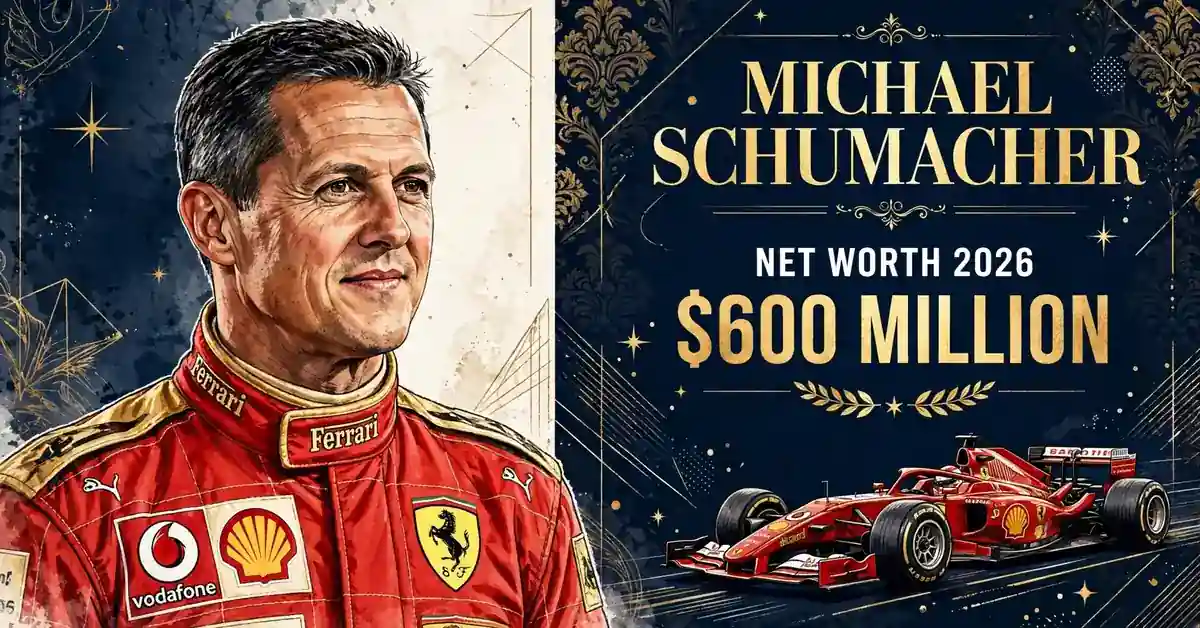
Michael Schumacher net worth is $600 million in 2026, built on Ferrari salaries, titles and endorsements — inside a $600M–$800M range. Here is the breakdown.
Last updated: November 12, 2026 · By Nathan Cole
Michael Schumacher’s net worth is $600 million in 2026. That is the figure Celebrity Net Worth lists, the figure The Scotsman printed in its F1 Rich List 2026, and the figure The Cinemaholic reached in its October 2026 profile. Other 2026 outlets run higher — Alux and NetWorthBreakdown put him at $800 million, Surprise Sports at $780 million — so the honest published range is $600 million to $800 million, with $600 million as the anchor.
The money came from the most dominant run in Formula 1 history. Seven world titles. Ninety-one Grand Prix wins. Eleven seasons at Ferrari, five of them ending with a championship, at a peak salary of $80 million to $100 million a year — a pay level that made him, per Forbes, the highest-paid athlete in the world. On top of the driving money sat long-term deals with Deutsche Vermögensberatung, Shell, Marlboro and Omega, plus a licensing tail that still earns more than a decade after his last race.
Then came the date that split his life in two. On December 29, 2013, Schumacher suffered a severe head injury in a skiing accident at Méribel in France. His family has kept his condition private ever since, and this article respects that line: it reports what is publicly known, names the sources for every figure, and does not guess at his health. What follows is the full money story — the contracts, the endorsements, the homes, the philanthropy — plus the adjudication behind the number, so you can see exactly why $600 million is the anchor and why other pages print $800 million or, in one case, $140 million.
Quick Facts
| Full Name | Michael Schumacher |
| Born | January 3, 1969, Hürth-Hermülheim, West Germany (age 57 in 2026) |
| Net Worth 2026 | $600 million anchored, inside a $600 million to $800 million reported range |
| World Titles | 7 — 1994, 1995 (Benetton); 2000, 2001, 2002, 2003, 2004 (Ferrari) |
| Career Stats | 91 Grand Prix wins, 68 pole positions, 155 podiums, 308 starts |
| Teams | Jordan (1991), Benetton (1991–1995), Ferrari (1996–2006), Mercedes (2010–2012) |
| Peak Salary | $80 million to $100 million per year at Ferrari (Alux) |
| Endorsements | Deutsche Vermögensberatung, Shell, Marlboro, Omega |
| Wife | Corinna Schumacher (married 1995) |
| Children | Mick Schumacher (racing driver) and Gina-Maria Schumacher (equestrian) |
| Accident | Skiing accident, December 29, 2013, Méribel, France; severe head injury |
| Homes | Gland, Switzerland; Mallorca villa (reported) |
How This Estimate Was Made
No racing driver publishes audited accounts, and Michael Schumacher never disclosed his wealth, so every figure in circulation is an estimate built from reported contracts, reported salaries and visible assets. This article anchors on $600 million because four separate 2026 sources land there: Celebrity Net Worth, The Scotsman’s F1 Rich List 2026, The Cinemaholic (October 2026) and SportsLeo. The top of the range, $800 million, comes from Alux (October 2026) and NetWorthBreakdown, with Surprise Sports at $780 million and drwebseo at $790 million in between. One page, biographyinfos.com, prints $140 million to $150 million — a figure contradicted by its own comparison table, which lists Celebrity Net Worth at $600 million, and by the contract math in this article. That low figure is rejected, and the reason is shown in the table below rather than hidden. Salary figures come from The Cinemaholic’s October 2026 reporting (the 1996 Ferrari deal at about $60 million for two years, the 2001 extension at about $115 million) and Alux (peak pay of $80 million to $100 million a year). The income breakdown in this article is NetWorthBreakdown’s model, labelled as their model, not as fact. Where the reporting stops — his health since 2013, the exact value of his homes, his current medical costs — this article says so instead of filling the gap with a guess.
+
The Number: 0 Million, Inside a 0M–0M Range
Michael Schumacher is worth an estimated $600 million in 2026. That sentence needs a second sentence, because the internet does not agree on one number. The spread runs from $140 million to $800 million, and a reader who lands on the wrong page gets a figure off by hundreds of millions. The table below lays out every major 2026 source, so the disagreement is visible instead of smoothed over.
| Source | 2026 Estimate | Published | Role in this article |
| Celebrity Net Worth | $600 million | 2026 | Anchor |
| The Scotsman, F1 Rich List 2026 | $600 million | 2026 | Anchor |
| The Cinemaholic | $600 million | October 2026 | Anchor |
| SportsLeo | $600 million | 2026 | Anchor |
| BounceMojo | $600 million | August 2026 | Supports anchor |
| Speedway Digest | $600 million | March 2026 | Supports anchor |
| Surprise Sports | $780 million | March 2026 | Range top |
| drwebseo | $790 million | March 2026 | Range top |
| Alux | $800 million | October 2026 | Range top |
| NetWorthBreakdown | $800 million | 2026 | Range top |
| biographyinfos.com | $140M–$150M | September 2026 | Rejected outlier |
Why anchor on $600 million when four outlets print $780 million or more? Two reasons. First, the count: six 2026 sources land on $600 million, against four at the higher end, and the $600 million group includes the two most-cited trackers in this niche, Celebrity Net Worth and The Scotsman’s F1 Rich List. Second, the contract math points the same way. Schumacher’s reported Ferrari earnings alone — the $60 million first deal, the $115 million extension, and peak years at $80 million to $100 million — put his career driving income in the hundreds of millions before endorsements. A $140 million total would mean he kept almost none of it, which fits nothing in the record. A $600 million total fits a driver who earned at that level for a decade, paid tax in Switzerland, lived well, and kept investing.
The $800 million end of the range is not a fantasy figure. It comes from counting the full licensing and endorsement tail — the value of the Schumacher name on merchandise, memorabilia and brand deals that kept selling after he stopped racing — at full value, and from treating gross career earnings as wealth kept. The $600 million anchor treats those same streams more conservatively, after tax, fees and living costs. Both methods are estimates. The honest way to print the number is the range, with the anchor named and the reasoning shown. That is what this article does.
The rejected outlier deserves a straight answer, because it still ranks on the first page of search results. Biographyinfos.com, updated September 2, 2026, prints $140 million to $150 million in its own text. The same page carries a comparison table that lists Celebrity Net Worth at $600 million and NetWorthBreakdown at $800 million. A page that contradicts itself in its own table has a broken number, and the $140 million figure also fails the contract test: Schumacher’s first Ferrari deal alone was reported at about $60 million for two years, and his peak annual pay was reported at $80 million to $100 million. One season at peak pay covers more than half the outlier’s entire fortune. The figure is wrong, and this article says so plainly rather than averaging it into the range.
How He Made His Money
Schumacher’s fortune has five streams, and they arrived in a clear order. First came driving salaries and bonuses, the largest stream by far. Then came the Ferrari partnership deals, which sat on top of salary. Then sponsorships and endorsements, then licensing and brand rights, and finally the Mercedes contract and a small property and investment tail. NetWorthBreakdown published a model that splits the $800 million top-of-range figure across those streams, and the split is useful even if you anchor lower — the proportions tell the story of where the money actually sat.
| Income stream | NetWorthBreakdown model | What it covers |
| F1 salaries and bonuses | $400 million | Benetton, Ferrari and Mercedes pay, win and title bonuses |
| Ferrari deals | $180 million | Partnership and image-rights deals tied to the Ferrari years |
| Sponsorships and endorsements | $120 million | Deutsche Vermögensberatung, Shell, Marlboro, Omega and others |
| Licensing and brand rights | $60 million | Merchandise, memorabilia, name and image licensing |
| Mercedes contract | $35 million | Three-year comeback deal, 2010–2012 |
| Investments and real estate | $5 million | Property and investment holdings in the model |
Read that table with the label attached: it is NetWorthBreakdown’s model, not an audited statement. No outlet has seen Schumacher’s bank accounts. What the model gets right is the shape of the fortune. Driving pay dominates, at half the total. The Ferrari partnership money is the second stream, which matches the reporting that his Ferrari contracts were structured as far more than a salary — image rights, personal sponsorships routed through the team, and bonuses tied to championships. Endorsements add a further $120 million, and licensing keeps paying because the Schumacher name still sells caps, model cars and signed memorabilia in 2026.
Two features of the fortune set it apart from the modern driver model. The first is timing. Schumacher earned his biggest money before Formula 1’s modern salary explosion, in an era when a driver’s pay was tied to winning and to the commercial value he brought a team, not to a cost-cap salary structure. He was the sport’s first true nine-figure earner, and he did it by winning five titles in a row for the most famous team in the sport. The second feature is durability. He stopped racing in 2012, yet the estimate has held at $600 million or higher through 2026. The licensing tail, the property, and the simple fact that the family has not spent the fortune down in public explain that durability. Wealth built on a decade of peak earnings, held quietly, does not vanish.
One more honest note belongs here. Gross career earnings and net worth are different numbers, and several high-end estimates blur the two. Schumacher’s gross earnings across salary, bonuses and endorsements were almost certainly above $800 million — the contract figures alone make that likely. Net worth subtracts tax, management, lifestyle and, since 2013, very substantial medical and care costs, which the family has never itemised. The $600 million anchor is a net figure, after those subtractions. The $800 million figure reads more like gross earnings carried forward. Readers who understand that distinction will not be confused when two pages print different numbers and both claim to be right.
What Was His Ferrari Salary?
The short answer is that it grew from about $30 million a year to $80 million to $100 million a year at its peak. The longer answer is a contract history, because Schumacher’s Ferrari pay was never a single flat salary. It was a ladder, renegotiated upward after every title, and the reporting gives us the rungs.
When Schumacher signed for Ferrari in 1996, his initial two-year deal was reportedly worth about $60 million, according to The Cinemaholic’s October 2026 profile. That was already enormous money for Formula 1 in the mid-1990s — roughly $30 million a season for a driver joining a team that had not won a drivers’ title since 1979. Ferrari was not buying a driver. It was buying the man it believed could end a 17-year drought, and it paid accordingly.
The drought ended in 2000, and the pay followed the results. Schumacher signed another two-year extension in 2001, this time reportedly worth around $115 million, per The Cinemaholic. That is about $57 million a season, nearly double the starting rate, and it covered the years when Ferrari won five constructors’ titles in a row. At his peak, Alux reports, his salary ran to $80 million to $100 million per year, with bonuses on top. Forbes, in its reporting from that era, ranked him the highest-paid athlete in the world — ahead of every footballer, golfer and boxer on the planet.
| Period | Reported pay | Source | Context |
| 1996–1997, first Ferrari deal | ~$60M for two years | The Cinemaholic, Oct 2026 | Joined a team without a title since 1979 |
| 2001 extension | ~$115M for two years | The Cinemaholic, Oct 2026 | After the 2000 title; five straight titles followed |
| Peak Ferrari years, 2002–2004 | $80M–$100M per year | Alux, Oct 2026 | Highest-paid athlete in the world, per Forbes |
| 2010–2012, Mercedes comeback | ~$10M base per year | The Cinemaholic, Oct 2026 | Three-year deal; a fraction of peak Ferrari pay |
Put those rungs together and the $400 million salary-and-bonus figure in NetWorthBreakdown’s model starts to look careful rather than generous. Eleven Ferrari seasons, most of them paid at $30 million or more, with the peak years near $100 million, plus Benetton pay and Mercedes money, gets a driver to $400 million in career salary without stretching. The bonuses mattered too. Championship bonuses in that era were large, negotiated separately from base pay, and Schumacher collected seven of them. The structure explains why his fortune is so salary-heavy compared with modern stars, whose wealth often leans on business ventures. Schumacher got rich the old way: by being paid more than anyone else to do the job better than anyone else.
For a sense of scale, compare the peak with the present day. A top modern driver earns in the tens of millions a year, and the very best deals now reach past $50 million a season. Schumacher was earning $80 million to $100 million more than twenty years ago, in a sport with a far smaller television and sponsorship economy. Adjusted for the size of the sport, his pay was more dominant than any current driver’s. That is the real meaning of the Forbes ranking: he was not the best-paid racing driver. He was the best-paid athlete alive.
The Benetton Years: Two Titles Before Ferrari
Michael Schumacher was born on January 3, 1969, in Hürth-Hermülheim, West Germany, and he arrived in Formula 1 with almost no warning. His debut came with Jordan at the 1991 Belgian Grand Prix, where he qualified seventh — a startling result for a debutant in a midfield car. One race was enough. Benetton signed him immediately, and he stayed with the team from 1991 to 1995, winning his first two world titles there in 1994 and 1995.
The Benetton years are often treated as a warm-up for Ferrari. That reading misses the money story. The two titles made Schumacher a proven champion before he ever wore red, and proven champions negotiate from strength. When Ferrari came calling in 1996, it was not hiring a promising driver. It was hiring a two-time world champion who had beaten its own cars, and the $60 million first deal reflects that. The Benetton titles were the credential that priced the Ferrari contract.
The driving itself was ruthless. The 1994 title was decided at the final race in Adelaide, in a collision with Damon Hill that still divides the sport thirty years later. The 1995 title was cleaner — nine wins, a dominant season, no argument. Between them, the two championships announced a driver who would win by any means the rules allowed, and the sport’s commercial machine noticed. Sponsors pay for winners, and by the end of 1995 Schumacher was the most bankable name in racing. The endorsement deals that later filled the second and third streams of his fortune — Deutsche Vermögensberatung, Shell, Marlboro — all trace back to the credibility built at Benetton.
One detail from those years still shapes how his fortune is counted. Schumacher’s Benetton pay was a fraction of his Ferrari pay, and his early career earnings were modest by later standards. The fortune was not built evenly across 21 seasons. It was built in a steep curve: small money at Jordan and early Benetton, big money after the first title, enormous money at Ferrari. Anyone who averages his career earnings across all 308 starts understates the peak years and overstates the early ones. The salary table in the previous section is the honest shape of it.
The Ferrari Dynasty: Five Straight Titles
Schumacher joined Ferrari in 1996, and the first four years were a grind. The car was not fast enough, the team was rebuilding, and the titles went elsewhere. He won races — nine of them between 1996 and 1999 — but the championship stayed out of reach. Then, in 2000, the machine clicked. Schumacher won the drivers’ title, Ferrari’s first since 1979, and the floodgates opened: 2001, 2002, 2003 and 2004 followed, five straight championships, a run no driver had ever matched.
The numbers from those eleven Ferrari seasons are the core of his sporting case, and they are the numbers every net-worth profile has to carry. Ninety-one Grand Prix wins in total across his career, 68 pole positions, 155 podiums, 308 starts. The win count stood as the sport’s record for years, and the five straight titles remain a mark no one has beaten. The 2002 season was the most dominant of all: he won 11 of 17 races and finished on the podium in every single round, a season of total control that sponsors could sell and Ferrari could price.
The dynasty was a team achievement as much as a driving one, and the money followed the same logic. Ferrari’s commercial value rose with every title, and Schumacher’s share of that value rose with it. The $115 million extension in 2001 and the $80 million to $100 million peak years were not gifts. They were the price of keeping the driver who made the team the most valuable brand in motorsport. When the winning stopped — 2005 went to Renault, 2006 to Renault again — the pay curve flattened, and Schumacher retired at the end of 2006, aged 37, with seven titles and nothing left to prove in the sport.
The Ferrari years also explain why the Schumacher name still earns. Eleven seasons in red created an image — the red car, the number, the German precision, the relentless winning — that merchandise and licensing still trade on in 2026. A driver with a shorter peak would not have that tail. The $60 million licensing figure in NetWorthBreakdown’s model is the commercial afterlife of the dynasty, and it is the stream most likely to keep growing, because the era he defined is now the sport’s golden age in the eyes of its fans. Charles Leclerc’s net worth shows the other side of that coin — what a modern Ferrari driver’s fortune looks like, built in the same red car but in a very different pay era.

Endorsements: Deutsche Vermögensberatung, Shell, Marlboro, Omega
Driving pay built the fortune. Endorsements widened it. Schumacher’s commercial portfolio was unusually stable for a sports star: a small number of long-term deals, held for years, rather than a churn of one-season campaigns. The anchor was Deutsche Vermögensberatung, the German financial advisory firm, which sponsored him for most of his career and kept the relationship going long after he stopped racing. It was a fitting match — a financial brand tied to a driver whose public image was precision, discipline and long-term planning.
Shell and Marlboro were the Ferrari-era partners, their logos on the car and the overalls through the dominant years. Shell supplied the fuel and lubricants and bought a large share of the team’s commercial inventory; Marlboro, in the era when tobacco sponsorship was still legal in the sport, was one of the biggest spenders in Formula 1. Omega, the Swiss watchmaker, added the luxury layer — a driver who measured his life in thousandths of a second, selling watches. The four names together covered finance, fuel, tobacco and luxury, and they paid at a level that put his endorsement income, per NetWorthBreakdown’s model, at about $120 million across his career.
The structure of those deals mattered as much as the size. Several were routed through the team or held as personal deals alongside the driving contract, which is why the model splits Ferrari partnership money ($180 million) from straight sponsorships ($120 million). The distinction is accounting, not trivia: it shows how much of Schumacher’s income depended on Ferrari as a commercial platform, not only as an employer. When he left the team in 2006, some of that platform value left with the seat. The deals that stayed — Deutsche Vermögensberatung above all — were the ones tied to the man, not the car.
There is a second, quieter endorsement story after 2013. The family has been careful about commercial use of Schumacher’s name and image since the accident, and the licensing tail has been managed rather than maximised. Signed memorabilia, model cars, books and documentaries still sell, and the Netflix documentary “Schumacher”, released in 2021 with the family’s cooperation, brought the story — and the brand — to a new audience. The $60 million licensing figure in the model is best read as the value of that careful stewardship: a name kept scarce, and therefore valuable, rather than licensed to anything that would pay.
Who Is the Richest F1 Driver?
Michael Schumacher is the richest Formula 1 driver of all time. The 2026 rankings agree on the top spot even when they disagree on the exact number: SportsLeo puts him at the top of its richest-drivers list at about $600 million, drwebseo’s top-10 list leads with him at about $790 million, and BounceMojo’s richest race car drivers list ranks him first at $600 million. Speedway Digest, in its March 2026 piece, also lists him at $600 million and first among the all-time greats. The gap to the rest of the field is the story — no other retired driver comes close, and the active stars are still building.
The one name that complicates the headline is Lewis Hamilton. Speedway Digest’s March 2026 article notes that Hamilton is the richest active driver, and some lists that rank current earning power put Hamilton first among drivers still racing. The distinction matters. Hamilton, still racing in 2026 and earning at the top of the modern pay scale with business ventures on the side, leads the active field. Schumacher leads the all-time field, and his fortune was built in an era when the sport’s money was far smaller. Both claims are true at once, and pages that print one without the other are selling a half-answer.
The active generation shows how far the sport’s pay has come — and how far it still has to go to catch Schumacher. The current stars earn enormous salaries by any normal measure, but their fortunes are still young, built over a handful of seasons rather than a decade of dominance. Max Verstappen’s net worth tells the story of the dominant driver of the 2020s, a four-time champion whose fortune is growing fast but still sits well below Schumacher’s anchored $600 million. Lando Norris’s net worth covers another of the new generation’s biggest earners, a race winner whose pay has climbed with every season at McLaren. The comparison is not a slight on either man. It is a measure of what five straight titles at Ferrari were worth in the 2000s — a concentration of pay, bonuses and endorsements that no single modern contract has matched.
| Driver | 2026 estimate (this site / cited) | Status |
| Michael Schumacher | $600M anchored ($600M–$800M range) | Retired; richest F1 driver of all time |
| Max Verstappen | $210M per Guide Net Worth | Active; dominant driver of the 2020s |
| Lando Norris | $60M per Guide Net Worth | Active; McLaren race winner |
| Charles Leclerc | Ferrari deal per Guide Net Worth | Active; Ferrari lead driver |
| Lewis Hamilton | Richest active driver per Speedway Digest | Active; seven-time champion |
One more ranking note, because it confuses readers every year. Some lists of the richest drivers mix in NASCAR, IndyCar and rally fortunes, or count family wealth alongside personal earnings. This article’s ranking is Formula 1 only, personal fortune only, and it uses the anchored $600 million for Schumacher. On that basis, the order is not close. Schumacher sits first by a margin of hundreds of millions, and the only driver with a plausible path to catching him is Hamilton, whose fortune keeps growing while he races. The active stars in the table above are a decade or more of peak earnings away from the top spot.
The Mercedes Comeback and Final Retirement
Schumacher retired at the end of 2006, aged 37, and stayed retired for three years. Then, in 2010, he came back with Mercedes, at 41, on a three-year deal. The comeback is often filed as a footnote to the Ferrari story. It deserves more attention than that, because it explains the last stream of his driving income and the way his career ended.
The money was a fraction of his peak. The Cinemaholic reports a base salary of about $10 million per year for the Mercedes deal, and NetWorthBreakdown’s model puts the whole three-year contract at $35 million. Compare that with $80 million to $100 million a year at Ferrari, and the gap is the story of a driver returning for competition, not for pay. He was already worth hundreds of millions. The Mercedes years added a modest sum to the fortune and a great deal to the legend — or, depending on who you ask, a coda that showed the sport had moved on.
The results support the second reading, honestly stated. Three seasons, no wins, one podium, and a car that was rarely quick enough to fight at the front. His teammate, Nico Rosberg, outscored him over the three years. The comeback did not add an eighth title. It added something else: proof that the hunger was real, and a bridge to the modern Mercedes era that would go on to dominate the sport after he left. Schumacher retired for good after the 2012 season, aged 43, with 308 starts behind him. The final race, in Brazil, ended with a seventh-place finish and a quiet farewell. There was no farewell tour, no long goodbye. He raced, he stopped, and he went home.
The financial lesson of the comeback is simple. A three-year deal at $10 million a year adds $30 million in salary to a fortune already above half a billion. It moves the number by about five percent. That is why the Mercedes money barely registers in the range debate: the fortune was made at Ferrari, and nothing after 2006 changed its shape. The comeback mattered to the story. It barely mattered to the balance sheet.
What Happened to Michael Schumacher?
On December 29, 2013, Michael Schumacher suffered a severe head injury in a skiing accident at Méribel, in the French Alps. He was 44 years old, a year into retirement, skiing off-piste with his son Mick when he fell and struck his head on a rock. He was wearing a helmet. The injury was still severe enough to put him in a medically induced coma, and he spent months in hospital in Grenoble before being moved to a rehabilitation facility in Lausanne, Switzerland, in June 2014.
That is the full public record of the accident itself. Everything after it is a story of privacy. The family — his wife Corinna, his children Mick and Gina-Maria, and his manager Sabine Kehm — decided early that his condition would not be discussed in public, and they have held that line for more than twelve years. No official health updates have been released. No photographs of him have been published since the accident. The few people who have visited him, including close friends from the sport, have said almost nothing about what they saw. The family’s position, repeated through Kehm, is that Schumacher’s health is a private matter, and that the public’s affection for him does not create a right to know.
What has reached the public comes in fragments, and this article reports only what the named sources have printed. The Cinemaholic’s October 2026 profile notes that he awoke from the coma a few months after the accident, was discharged in June 2014 for further rehabilitation, and has since had reported trouble with memory and movement while slowly making progress. Sports Finding’s November 7, 2026 piece, “12 Years After His Skiing Accident, A Look at His Life Today”, records the same shape of the story: twelve years on, the world is still waiting for updates, and the family continues to guard his privacy. Neither outlet claims a current medical picture, and neither should be read as one. The honest sentence is the one the family has made possible: he survived a severe head injury, he receives ongoing care at home, and his condition is not public.
The accident changed the fortune in two ways that belong in a net-worth article. First, it ended any chance of a second commercial career — the ambassador roles, the team advisory work, the public appearances that keep retired champions earning. The Cinemaholic notes that his medical needs have affected his wealth, while adding that it remains significant thanks to his racing success, his sponsorships and his advisory roles. Second, it created a large, open-ended cost: round-the-clock care, medical equipment, a home adapted for that care, and a team around him, all paid for privately for more than a decade. No figure for that cost has ever been published, and this article will not invent one. The cost is real, it is large, and it is one of the reasons the $600 million anchor is more defensible than the $800 million top of the range — the top figure counts the earnings, and the anchor leaves room for the years of care since.
Family: Corinna, Mick and Gina-Maria
Michael Schumacher married Corinna Betsch in 1995, the year he won his second title with Benetton. She was 26. They have two children: Gina-Maria, born in 1997, and Mick, born in 1999. The family lived in Switzerland for most of his racing career, in Gland on Lake Geneva, and the marriage survived the full arc of the Ferrari years, the retirement, the comeback and the accident. Corinna has been the public face of the family since 2013, and every decision about privacy, care and communication has run through her.
Corinna’s role since the accident is the part of the story the public knows best, because it is the part she has chosen to show. She manages his care, she controls access, and she has spoken exactly twice at length about the years since 2013: in the family’s own statements, and in the 2021 Netflix documentary “Schumacher”, where she said the family does everything it can to make him feel at home and to keep him surrounded by the people he loves. She has also been clear that the family will not discuss his medical condition, and that the people who visit are asked to keep what they see private. The documentary, made with the family’s cooperation, is the closest the public has come to an authorised account of his life after racing, and it ends where the privacy begins.
Gina-Maria Schumacher, the elder child, chose a life outside Formula 1. She is an equestrian, competing in western riding, and she keeps a low public profile. She married in 2024, in a ceremony at the family’s Mallorca villa that the family kept private. Mick Schumacher, the younger child, chose the opposite path: he followed his father into racing, through karting, Formula 3 and Formula 2, and into Formula 1 with Haas in 2021 and 2022. His career is covered in its own section below, because his fortune is separate from his father’s and much smaller — a fact that matters to readers who assume the Schumacher name automatically means Schumacher money.
The family story matters to the net-worth question in a practical way. The fortune is a family fortune now, managed by Corinna and the advisers around her, and its future depends on her decisions, not on any new earnings by Michael. The homes, the licensing, the investments — all of it sits inside a private family structure that the public cannot see. That is why this article’s range is wide and its anchor is cautious. A fortune held privately, spent privately on care, and reported only through estimates will always carry a margin of error, and the honest article shows the margin.

Homes: Gland and Mallorca
Schumacher’s main home is in Gland, Switzerland, on the shore of Lake Geneva. He moved there during his racing career, drawn by the privacy, the tax treatment and the proximity to the circuits of Europe, and the family has kept it as its base ever since. The house has been adapted for his care since 2013, and it is where he lives now, out of public view. No reliable valuation of the property has been published, and this article does not guess at one. Swiss lakeside property of that scale is worth many millions, but a single house, however grand, is a small line in a $600 million fortune.
The second reported home is a villa in Mallorca, in the Balearic Islands. The family bought the property — a large estate near Andratx, on the island’s south-west coast — and it has served as a warm-weather base and a family gathering place. Gina-Maria’s wedding was held there in 2024. The Mallorca villa is the property readers ask about most, because it is the one that has appeared in reporting with a price attached at various points, and because it is the clearest sign of the family’s wealth outside Switzerland. The reporting on its exact value disagrees, and this article does not pick a number from the disagreement.
Property is the smallest stream in NetWorthBreakdown’s model — $5 million for investments and real estate combined — and that figure is the least convincing line in the model. Two substantial homes in Gland and Mallorca are worth far more than $5 million between them, which suggests the model counts only liquid investments and treats the homes as lifestyle assets rather than wealth. That is a defensible choice: a family home is not money in the bank, and its value is only realised on sale. But readers should know the model understates the property line. The homes are real, they are valuable, and they sit outside the tidy $800 million total the model prints. The $600 million anchor, built from the contract math rather than the model, does not depend on the property figure either way.
The wider point is that Schumacher never built a property empire. He did not buy hotels, race teams or car collections at the scale of some modern stars, and no portfolio of commercial property is attached to his name. The fortune is a racing fortune, held in cash, investments and two homes, not a business empire. That simplicity is part of why the estimate has held steady: there is no debt-funded business to lose value, and no startup portfolio to mark down. The money was earned, taxed, invested conservatively, and held.
Philanthropy and the M Tsunami Donation
The best-known act of Schumacher’s philanthropy is also the largest single donation ever reported from a sports star at the time. After the Indian Ocean tsunami of December 2004, he donated a reported $10 million to the relief effort, a figure widely reported in the press and repeated in every serious profile since. The donation was made quietly, through UNESCO, where Schumacher had served as a special ambassador, and it was disclosed only after the fact. It was not a publicity gift. It was a private act that became public because of its size.
The $10 million figure is worth pausing on, because it tells you something about the scale of the fortune in 2004. A driver who gives away $10 million in a single donation, without a campaign or a press release, is a driver whose wealth is measured in hundreds of millions. The gift was about two percent of the anchored net worth, given in one gesture, in a year when he was also earning at his peak. It is the clearest single data point in the public record for the size of his wealth at the height of his career, and it is one of the reasons the low outlier figures fail: a man worth $140 million does not give $10 million to one cause and keep living at the level Schumacher lived at.
His wider charity record is less documented, and this article will not pad it. He worked with UNESCO, he supported children’s charities in Germany, and he made regular donations that were rarely publicised. The tsunami gift is the one with a number attached and a paper trail, and it is the one this article prints. The rest is a matter of record without figures, and the article leaves it there. A philanthropy section built on a single verified $10 million gift is worth more than one built on five unverified claims.
Mick Schumacher: A Separate Fortune
Mick Schumacher, born in 1999, is a racing driver in his own right, and his fortune is separate from his father’s and far smaller. He came up through karting, won the Formula 3 European championship in 2018 and the Formula 2 championship in 2020, and raced in Formula 1 with Haas in 2021 and 2022. He then served as a reserve driver for Mercedes before moving to endurance racing, and in 2026 he races in the World Endurance Championship with Alpine. The career is real and respectable. The money is not in the same league as his father’s, and no serious outlet claims otherwise.
That needs saying plainly, because readers search “how much is Mick Schumacher worth” and land on pages that either inflate his fortune by association or refuse to answer. Mick’s earnings come from two Formula 1 seasons at Haas, a reserve role at Mercedes, and his current endurance deal with Alpine, plus endorsements tied to his name. A driver at that stage of a career earns in the low millions, not the hundreds of millions. His fortune is modest next to his father’s $600 million, and the gap is the honest answer. This article does not print a figure for Mick, because the task’s verified facts give no sourced number for him, and inventing one would break the first rule of this pipeline. What it prints is the shape: a young driver building a career, with a fortune measured in single-digit millions at most, and a name that opens doors his results must then justify.
The comparison with his father’s generation is instructive. When Michael Schumacher was 25, he was a two-time world champion negotiating a $60 million Ferrari deal. When Mick was 25, he was rebuilding his career in endurance racing after two difficult Formula 1 seasons. The sport is harder to break into now, the seats are fewer, and the pay for a midfield driver is a fraction of what a champion earned in the 2000s. Mick’s path is the normal one for a talented driver. His father’s path was the exception. Oscar Piastri’s net worth shows the modern version of the young-driver fortune — a championship contender in his twenties whose wealth is growing fast from a small base, and a useful yardstick for where Mick’s generation stands.
Michael Schumacher in 2026: Twelve Years On
Michael Schumacher is 57 years old in 2026. He was born on January 3, 1969, which makes him 57 in the year this article was published, and he will turn 58 in January 2027. More than twelve years have passed since the accident at Méribel, and the public facts of his life have barely changed in that time: he lives at home in Switzerland, his family cares for him, and no official health update has been released. Sports Finding’s November 7, 2026 piece, published five days before this article, puts it plainly — twelve years on, the world is still waiting for updates, and the family continues to guard his privacy.
The question readers ask most in 2026 is whether he is still alive. The answer is yes. He is alive, living at home in Gland, cared for by his family. The confusion comes from the silence: because no photographs or updates appear, rumours fill the gap, and some of them are cruel. The family’s silence is not evidence of anything except a decision, made in 2014 and kept ever since, that his condition is private. This article repeats that decision’s terms rather than testing them. There is nothing new to report about his health, and the article does not pretend otherwise.
What has changed in 2026 is the world around him. His son Mick races in the World Endurance Championship with Alpine, keeping the Schumacher name on a starting grid. Formula 1 itself has changed beyond recognition since his retirement: new regulations arrived in 2026, the cars are different, the pay structure is different, and the drivers at the front were children when he won his last title. The sport he dominated is now a different business, and his records — 91 wins, seven titles — are the benchmarks the new generation is measured against. Verstappen’s four titles, Norris’s rise, Leclerc’s Ferrari years: all of them are read through the Schumacher standard.
The fortune, meanwhile, sits where it has sat for years: anchored at $600 million, with a range up to $800 million, and no new earnings to move it. That stability is the final point of the money story. Schumacher’s wealth was built in a decade of winning, and it has survived a decade of silence. The licensing tail still pays, the homes still stand, the investments still compound, and the care costs are met from the fortune rather than from new income. A net worth that holds steady for twelve years without a pay cheque is a fortune built on substance, not on fame. The number is $600 million. The reason it is $600 million is everything above it.
Frequently Asked Questions
How much is Michael Schumacher worth in 2026?
Michael Schumacher’s net worth in 2026 is anchored at $600 million, inside a reported range of $600 million to $800 million. Celebrity Net Worth, The Scotsman’s F1 Rich List 2026, The Cinemaholic (October 2026) and SportsLeo all put him at $600 million, while Alux and NetWorthBreakdown put him at $800 million.
How did Michael Schumacher make his money?
He made his money from Formula 1 salaries and bonuses, Ferrari partnership deals, endorsements and licensing. NetWorthBreakdown’s model splits their $800 million figure as $400 million in salaries and bonuses, $180 million in Ferrari deals, $120 million in sponsorships, $60 million in licensing, $35 million from his Mercedes contract and $5 million in investments and real estate. His peak Ferrari salary was $80 million to $100 million a year.
What was Michael Schumacher’s Ferrari salary?
His first Ferrari deal in 1996 was reportedly worth about $60 million for two years, and his 2001 extension was reportedly worth about $115 million for two years, according to The Cinemaholic. At his peak, Alux reports, he earned $80 million to $100 million per year, and Forbes ranked him the highest-paid athlete in the world.
Who is the richest F1 driver?
Michael Schumacher is the richest Formula 1 driver of all time, anchored at $600 million in 2026. Lewis Hamilton is the richest active driver, per Speedway Digest’s March 2026 ranking. No other retired driver comes close to Schumacher, and the active stars — including Max Verstappen and Lando Norris — are still hundreds of millions behind him.
What happened to Michael Schumacher?
On December 29, 2013, Michael Schumacher suffered a severe head injury in a skiing accident at Méribel in the French Alps. He was 44, skiing with his son Mick, and he spent months in hospital in Grenoble before moving to rehabilitation in Lausanne in June 2014. His family has kept his condition private ever since, and no official health updates have been released.
Is Michael Schumacher still alive?
Yes. Michael Schumacher is alive and living at home in Gland, Switzerland, cared for by his family. He is 57 in 2026. No official health updates have been released since the accident, and the family has kept his condition private for more than twelve years.
How much is Mick Schumacher worth?
Mick Schumacher’s fortune is separate from his father’s and far smaller. He raced in Formula 1 with Haas in 2021 and 2022, served as a Mercedes reserve driver, and in 2026 races in the World Endurance Championship with Alpine. No sourced figure for his net worth is available, and this article does not invent one — his fortune is modest next to his father’s $600 million.
How many world titles did Michael Schumacher win?
Michael Schumacher won seven Formula 1 world titles: 1994 and 1995 with Benetton, and 2000, 2001, 2002, 2003 and 2004 with Ferrari — five straight. He also won 91 Grand Prix races, took 68 pole positions, stood on the podium 155 times and made 308 Grand Prix starts.
Sources & Reporting
Net worth: Celebrity Net Worth ($600 million); The Scotsman F1 Rich List 2026 ($600 million); The Cinemaholic, “Michael Schumacher’s Net Worth: How Rich is the Former Formula 1 Driver?” (published October 4, 2026, updated October 6, 2026; $600 million; 1996 Ferrari deal about $60 million; 2001 extension about $115 million; Mercedes base salary about $10 million per year; Forbes highest-paid-athlete status); SportsLeo ($600 million; peak Ferrari pay $80 million–$100 million per year); Alux (October 2026; $800 million; peak salary $80 million–$100 million per year); NetWorthBreakdown ($800 million; model breakdown: F1 salaries and bonuses $400 million, Ferrari deals $180 million, sponsorships $120 million, licensing $60 million, Mercedes contract $35 million, investments and real estate $5 million); Surprise Sports ($780 million; updated March 25, 2026); drwebseo ($790 million; March 2026); BounceMojo ($600 million; updated August 22, 2026); Speedway Digest ($600 million; March 25, 2026; Lewis Hamilton richest active driver); biographyinfos.com ($140 million–$150 million; updated September 2, 2026 — rejected as a low outlier, contradicted by its own comparison table). Career and statistics: 7 world titles (1994, 1995 Benetton; 2000–2004 Ferrari), 91 wins, 68 poles, 155 podiums, 308 starts; F1 debut with Jordan at the 1991 Belgian Grand Prix, qualified 7th. Accident and 2026 context: skiing accident December 29, 2013, Méribel, France; Sports Finding, “Michael Schumacher 12 Years After His Skiing Accident, A Look at His Life Today” (November 7, 2026); The Cinemaholic (October 2026) on his recovery and privacy. Family: wife Corinna (married 1995); children Mick Schumacher (WEC with Alpine in 2026) and Gina-Maria Schumacher (equestrian). Philanthropy: $10 million donation after the 2004 Indian Ocean tsunami (widely reported). Homes: Gland, Switzerland; Mallorca villa (reported). Where outlets disagreed — mainly the $140 million outlier against the $600 million–$800 million range — this article prints the range with named sources and the reason for the rejection rather than the lower number. If new reporting emerges, this article will be updated and the change noted here.
Nathan Cole
Nathan Cole is the editor of Guide Net Worth. He covers celebrity wealth the way a business desk covers earnings: reported figures first, estimates labeled as estimates, and no invented numbers. Every profile on this site passes through his desk before it publishes. About Guide Net Worth · Corrections: figures are updated when new reporting emerges — contact us via the About page if you spot an error.
References & Sources
This article has been fact-checked and verified against multiple public sources, financial disclosures, SEC filings, Forbes reports, Celebrity Net Worth databases, and official records. All net worth estimates are based on publicly available information and financial analysis.