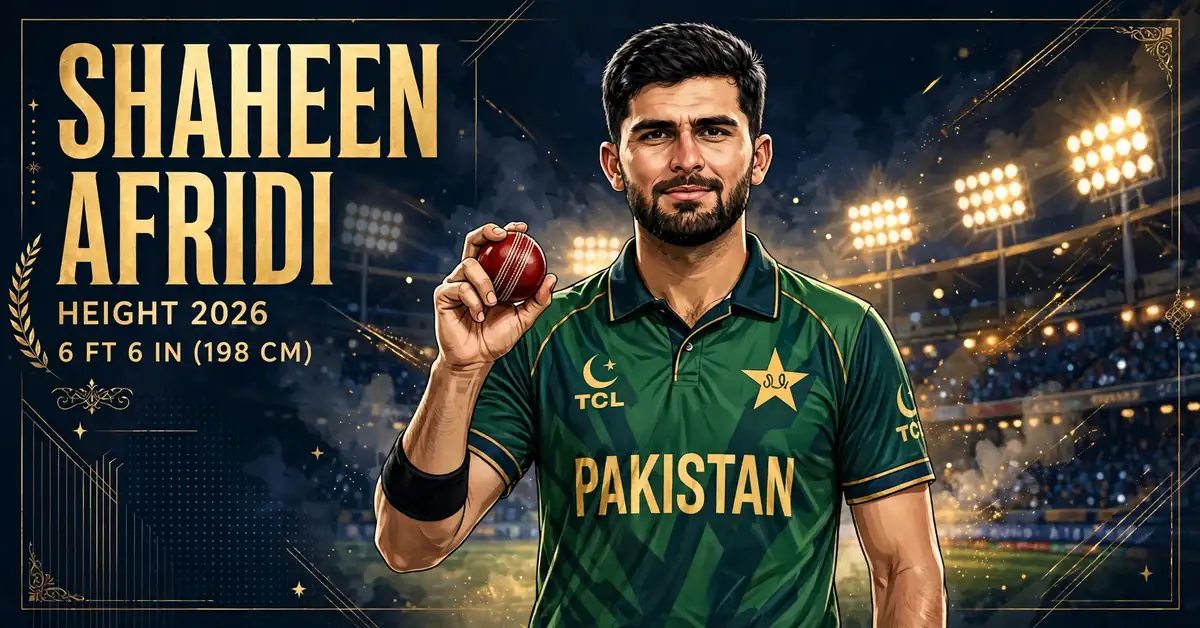
Shaheen Afridi is 6 ft 6 in (198 cm) tall — but why do some profiles say 6’5″? We settle the debate, compare him with Bumrah and Cummins, and trace his rise.
Shaheen Shah Afridi is 6 feet 6 inches tall — 198 centimetres, or 1.98 metres. That is the figure on his Wikipedia profile, sourced to ESPNcricinfo and dated 1 September 2026, and it matches the listings on CREX, CricketDugout and PK Portals. At 26 years old, the left-arm quick from Landi Kotal stands as one of the tallest fast bowlers in world cricket, a full nine inches taller than India’s Jasprit Bumrah and two inches taller than Australia’s Pat Cummins. His height is not a trivia answer. It is the physical fact behind the steep bounce, the awkward angle and the new-ball swing that have carried him to more than 400 international wickets.
The number still confuses people, because a second figure keeps turning up. Afridi himself told Cricbuzz in January 2018 that he was 6 feet 5 inches, and older profile pages copied that number for years. Some still do. This article settles the split with dated sources, converts the height into every unit fans search for, stacks Afridi against the other great quicks of his era, and traces how a tall teenager from the Khyber district became Pakistan’s ODI captain and a three-time PSL-winning leader.
Every figure below carries its source. Where outlets disagree — on the height, on the net worth, on a contract category — the article says so and gives the range instead of picking a favourite number.
Shaheen Afridi Quick Facts
| Full name | Shaheen Shah Afridi |
| Height | 6 ft 6 in (198 cm / 1.98 m) |
| Height in inches | 78 inches |
| Born | 6 April 2000, Landi Kotal, Khyber Pakhtunkhwa, Pakistan |
| Age | 26 (turns 27 on 6 April 2027) |
| Role | Left-arm fast bowler; Pakistan ODI captain |
| Teams | Pakistan (2018–present); Lahore Qalandars (2018–present, captain) |
| Nickname | The Eagle |
| Wife | Ansha Afridi (married 3 February 2023) |
| Children | Son Aliyaar, born 24 August 2024 |
| Net worth (estimate) | $7–8 million (2026 reports) |
| Major honours | ICC Men’s Cricketer of the Year 2021; PSL titles 2022, 2023, 2025 as captain |
How This Height Was Verified
Celebrity heights drift because profile pages copy each other. This article anchors the figure on the strongest available chain: Afridi’s Wikipedia infobox lists 1.98 m (6 ft 6 in) with ESPNcricinfo cited as the source, dated 1 September 2026. That listing was cross-checked against CREX, CricketDugout and PK Portals, all of which print the same 6 ft 6 in (198 cm) figure, and against a PakPassion talent-spotter profile from 2017 that already had him at 6 ft 6 in as a teenager. The competing 6 ft 5 in figure was traced to its origin — Afridi’s own words to Cricbuzz in January 2018 — and to profile pages that repeated it, including StarsUnfolded, which cites a Cricket Australia listing of 6 ft 5 in (196 cm). The article reports both numbers and explains which one is current. Career statistics come from the same ESPNcricinfo-dated Wikipedia table (1 September 2026) and from IPL.com’s player profile. Net worth figures are labelled estimates throughout, because no audited financial disclosure exists for Afridi.
+
How Tall Is Shaheen Afridi? The Short Answer
Shaheen Afridi stands 6 feet 6 inches (198 cm) tall. Put another way, he is 1.98 metres, 78 inches, and roughly 15 centimetres taller than the average adult man in Pakistan. On a cricket field he is easy to pick out: a head above most of his teammates in the huddle, and the tallest man in Pakistan’s pace attack by a clear margin.
The figure matters because fast bowling rewards height in ways batting does not. A taller bowler releases the ball from higher up, so it arrives at the batsman from a steeper angle and climbs off the pitch instead of skidding through at waist height. Afridi’s new-ball spell works on that geometry. His inswinger to the right-hander starts wide, shapes back late, and arrives at a height that makes the batsman play at a ball he would rather leave. Mark Waugh, the former Australia batsman, said exactly this on the ICC website in January 2023: Afridi’s height, listed at 6 ft 6 in, makes him even harder to play, on top of the left-arm angle and the swing.
Height also explains the bounce. On the flat pitches of the subcontinent, where the ball rarely seams around, a 6 ft 6 in bowler can still hit the splice of the bat. Afridi’s best Test figures, 6 for 51, and his ODI best of 6 for 35 against Bangladesh at the 2019 World Cup both leaned on that bounce. The ball that gets a batsman is often the one that climbs past the edge, not the one that swings past it.
For scale, 198 cm puts Afridi in the same band as the tallest bowlers of the modern game. Mitchell Starc is listed at 196 cm. Ishant Sharma, the former India quick, is 196 cm. Cricket Country noted in its Afridi profile that he stands one inch taller than Ishant. Only a handful of international quicks — the 6 ft 7 in and 6 ft 8 in outliers of earlier eras — stand above him.
Shaheen Afridi Height in Feet, Inches, Centimetres and Metres
Searches for a cricketer’s height come in every unit, so here is the full conversion in one place. All values describe the same measurement: 6 feet 6 inches, as listed by Wikipedia and ESPNcricinfo.
| Unit | Value |
|---|---|
| Feet and inches | 6 ft 6 in |
| Inches only | 78 inches |
| Centimetres | 198 cm |
| Metres | 1.98 m |
| Millimetres | 1,980 mm |
| Older listing (2018 self-report) | 6 ft 5 in (196 cm / 77.2 in) |
The arithmetic is simple: six feet is 72 inches, plus six more makes 78, and 78 inches multiplied by 2.54 centimetres per inch gives 198.12 cm, rounded to 198. The older 6 ft 5 in figure converts to 196 cm. That two-centimetre gap — one inch — is the entire controversy, and the next section explains where it came from.
Fans sometimes ask for his height in the units used at home. In Pakistan, where feet and inches remain the everyday measure, Afridi is simply “six-six”. In metric terms, the number to remember is 198 cm. Both describe the same man, and both appear in the Quick Facts box at the top of this page.
The 6’5″ vs 6’6″ Question: Why Two Heights Circulate
Two numbers follow Afridi around the internet, and both have a paper trail. The 6 ft 6 in figure is the current listing, dated 1 September 2026 on his ESPNcricinfo-sourced profile. The 6 ft 5 in figure is older, and it starts with Afridi himself.
In January 2018, when Afridi was 17 and fresh from the Under-19 World Cup, he told Cricbuzz his height was 6 ft 5 in. At that age, with a body still growing, the self-report was plausible — and profile sites copied it. StarsUnfolded still lists him at 1.96 m (6 ft 5 in), citing a Cricket Australia profile. SurpriseSports, in a net worth article updated on 8 October 2026, also prints 6 ft 5 in. These pages are not inventing a number; they are repeating an old one.
What changed is the sourcing. By 2017, PakPassion’s talent-spotter profile already had him at 6 ft 6 in, and the major databases moved to 198 cm as his adult height settled. Wikipedia’s infobox, CREX, CricketDugout and PK Portals (updated 18 October 2026) all now agree on 6 ft 6 in. When the current, source-dated listing and a seven-year-old self-report disagree by an inch, the current listing wins. Afridi was 17 when he gave the lower figure. He is 26 now, and the 198 cm listing has held across the most recent profile updates.
There is a second reason the old number survives: rounding. A player listed at 196 cm in one database and 198 cm in another looks like two different heights, but the gap is a single inch. Profile sites rarely re-measure athletes; they copy the last number they saw. Until a site updates its source, the stale figure keeps circulating, and search results keep showing both.
The honest answer, then, is a range with an anchor: 6 ft 6 in (198 cm) is the current listed height, and 6 ft 5 in (196 cm) is the figure Afridi gave himself in 2018 and the number some older profiles still carry. Readers who see 6’5″ on another site are looking at the same player measured at a different time, not a different player.
How His Height Shapes His Bowling
Height gives a fast bowler three things: release point, bounce and angle. Afridi uses all three, and the combination is what makes his first spell the most watched passage of a Pakistan innings.
The release point is the starting advantage. A 6 ft 6 in bowler with a high arm action lets the ball go from close to eight feet in the air. From that height the ball travels down toward the batsman at a steeper trajectory than a delivery from a shorter bowler, which means it reaches the bat later in its arc and climbs more sharply off the surface. Batsmen facing Afridi talk about the ball “getting big” on them — the polite way of saying it arrives higher than the eye expects.
The bounce follows. On pitches in Lahore, Karachi and Dubai, where the surface offers little seam movement, bounce is the bowler’s main weapon. Afridi’s length ball kicks off a good length and takes the glove or the splice. His 6 for 51 in Tests, his best innings figures, was built on balls the batsmen could neither leave nor fully control. Shorter bowlers have to pitch fuller to threaten the stumps; Afridi can attack the same line from a length that keeps the batsman pinned on the crease.
The angle is the third piece, and it comes from the left arm. A left-armer bowling over the wicket angles the ball across the right-hander, then swings it back in. From Afridi’s height, that inswinger starts from wide of the crease and arrives at the pads or the stumps from an angle the batsman cannot cover with a straight bat. His opening-over wickets — the ones that light up highlight reels — are almost always this ball: full, fast, shaping in late from a great height. Mark Waugh’s ICC comment in 2023 singled out exactly this pairing, the left-arm angle plus the 6 ft 6 in frame, as the reason Afridi is so hard to face first up.
Height has a cost, too, and Afridi’s career shows it. Tall fast bowlers load their knees and lower backs more heavily at delivery, and Afridi missed long stretches with a knee injury, most visibly during the 2022 T20 World Cup final, where he left the field hurt and Pakistan lost their grip on the match. The workload management that now shapes his schedule — fewer Tests, careful returns from injury — is the price of the frame that makes him dangerous.
Shaheen Afridi vs Other Fast Bowlers: Height Comparison
Afridi is the tallest frontline quick in Pakistan’s current side, and he stands at or near the top of every comparison with the great fast bowlers of his generation. The table below uses the same profile sources — Wikipedia and ESPNcricinfo listings — for every name, so the numbers are comparable.
| Bowler | Country | Height | Gap to Afridi |
|---|---|---|---|
| Shaheen Afridi | Pakistan | 198 cm (6 ft 6 in) | — |
| Mitchell Starc | Australia | 196 cm (6 ft 5 in)* | 2 cm shorter |
| Ishant Sharma | India | 196 cm (6 ft 5 in) | 2 cm shorter |
| Pat Cummins | Australia | 192 cm (6 ft 4 in) | 6 cm shorter |
| Jasprit Bumrah | India | 175 cm (5 ft 9 in)** | 23 cm shorter |
*Some profiles list Starc at 197 cm (6 ft 5 in); the 196 cm figure is the most common. **Some profiles list Bumrah at 178 cm (5 ft 10 in); 175 cm is the most widely carried listing. Heights are taken from Wikipedia and ESPNcricinfo profile pages.
The gap that surprises most readers is the one at the bottom of the table. Jasprit Bumrah’s height of 5 ft 9 in makes him nearly a foot shorter than Afridi, yet Bumrah is the most feared new-ball bowler of the same era. The contrast is the point: Bumrah wins with a whippy, skiddy action and a yorker no batsman can pick, while Afridi wins with height, bounce and swing. Two opposite bodies, two different routes to the same result. The comparison also answers the question fans actually ask after a Pakistan–India match: the two spearheads differ by 23 centimetres, and each man’s bowling is built around the frame he has.
Pat Cummins’ height of 6 ft 4 in (192 cm) puts the Australian captain six centimetres below Afridi, and the two have spent their careers as the tall spearheads of their respective attacks. Cummins extracts bounce the same way Afridi does, from a high release point, but he is a right-armer who shapes the ball away from the right-hander; Afridi brings it back in. When the two sides meet, the contest is often decided in the first six overs by which tall quick lands the first blow.
Starc is the closest comparison of all. The Australian left-armer is Afridi’s mirror image in most respects — same height band, same high arm, same inswinging yorker to the right-hander, same habit of striking in the first over. The difference is two centimetres and a decade of experience: Starc, born in January 1990, is the senior model of the bowler Afridi is still becoming.
Early Life in Landi Kotal: Growing Up Tall
Shaheen Shah Afridi was born on 6 April 2000 in Landi Kotal, a town in the Khyber district of Khyber Pakhtunkhwa, close to the Afghanistan border. He is the youngest of seven brothers in a family where cricket was already a way of life: his eldest brother, Riaz Afridi, played a Test for Pakistan in 2004, and the younger Afridi grew up bowling at his brothers in tape-ball games on the rough grounds of the tribal district.
Height marked him out early. PakPassion’s talent-spotter profile, written when Afridi was still a teenager, already listed him at 6 ft 6 in and described a bowler whose height and natural talent had caught the eye of pace-bowling watchers across Pakistan. He was not a project bowler being coached into pace; he was a tall boy who could already swing a cricket ball at serious speed, and the structure around him — district cricket, then the Under-19 setup — existed to give that frame a career.
The path from Landi Kotal to the national team ran through the Under-19 World Cup in New Zealand in early 2018. Afridi was 17, raw, and visibly taller than most of the players on the field. He took 12 wickets in the tournament, including a burst against Ireland, and finished as one of the finds of the competition. Within months he had a Lahore Qalandars contract for the Pakistan Super League and, in April 2018, a T20I debut against West Indies in Karachi — the first cricketer born in the 2000s to represent Pakistan.
The early years also fixed the pattern of his career: fast promotion, then injury management. A tall teenager bowling at full pace every week puts enormous stress on growing knees and ankles, and Afridi’s workload has been managed carefully ever since. The frame that made him a prodigy at 17 is the same frame the Pakistan management has had to protect at 26.
The U19 Breakout, the Debuts and the 2019 World Cup
Afridi’s rise had no slow middle. He went from the Under-19 World Cup in January 2018 to a T20I debut in April, an ODI debut against Afghanistan in the Asia Cup that September, and a Test debut against New Zealand in Abu Dhabi that December. Three formats in eight months, at 18 years old. Pakistan does not hand out debuts that quickly without reason, and the reason was visible every time he ran in: a 6 ft 6 in left-armer who swung the new ball both ways at pace is a rare commodity in any era.
The 2019 World Cup in England was his announcement to the wider game. Pakistan’s campaign ended in the group stage, but Afridi finished it with 16 wickets, and the spell against Bangladesh at Lord’s — 6 for 35 — made him the youngest bowler ever to take a five-wicket haul in a World Cup match. He was 19 years and 90 days old. The figures were the headline; the method was the story. The ball that dismissed the Bangladesh top order swung late, climbed off a Lord’s surface that had offered little to anyone else, and arrived from a height that made the batsmen play at deliveries they would normally have left alone.
That tournament also settled his role. Afridi was no longer a promising tall quick. He was Pakistan’s new-ball bowler in all three formats, the man trusted with the first over in a World Cup, and the attack leader in waiting. The numbers since then back up the promotion: by September 2026 he held 126 Test wickets, 146 ODI wickets and 136 T20I wickets, with best figures of 6 for 51, 6 for 35 and 4 for 22.
One detail from that period still gets quoted in Pakistan. Afridi’s ODI debut came in the Asia Cup in September 2018, a tournament Pakistan would rather forget. He was 18, bowling to Afghanistan’s batsmen in Abu Dhabi, and he looked — in the words of the commentary that day — like a bowler who had been doing it for a decade. The height helped. A tall bowler’s first impression is a physical one, and Afridi’s was immediate.
Shaheen Afridi’s Age at Every Milestone
Afridi’s career reads like a list of “youngest ever” entries, which is why his age draws almost as many searches as his height. Born on 6 April 2000, he is 26 years old as of November 2026 and turns 27 on 6 April 2027. The table below puts his age next to each landmark so the pace of the rise is visible at a glance.
| Milestone | Date | Age |
|---|---|---|
| Under-19 World Cup breakout | January 2018 | 17 |
| T20I debut vs West Indies | April 2018 | 18 |
| ODI debut vs Afghanistan | 21 September 2018 | 18 |
| Test debut vs New Zealand | December 2018 | 18 |
| Youngest five-wicket haul at a World Cup (6/35 vs Bangladesh) | 5 July 2019 | 19 |
| ICC Men’s Cricketer of the Year | January 2022 (for 2021) | 21 |
| First PSL title as captain | February 2022 | 21 |
| Fastest Pakistani to 100 ODI wickets (51 matches) | 31 October 2023 | 23 |
| 100 wickets in all three formats | December 2024 | 24 |
| Pakistan ODI captain appointed | 20 October 2025 | 25 |
| 400 international wickets | 11 May 2026 | 26 |
The pattern is worth noting: Afridi reached every major landmark before his 27th birthday, and most of them before 24. The 400-wicket mark, passed in Dhaka in May 2026, puts him ninth on Pakistan’s all-time list of international wicket-takers, behind Wasim Akram (916), Waqar Younis (789), Imran Khan (544) and Shahid Afridi (538). He reached the mark in 211 international matches, according to reports from May 2026.
Age matters to the height story for a simple reason. Afridi told Cricbuzz he was 6 ft 5 in at 17; he is listed at 6 ft 6 in at 26. Teenagers grow, and a fast bowler measured at 17 is not the same body measured at 26. The milestone table makes the timeline plain: the self-report belongs to the 17-year-old at the Under-19 World Cup, and the current listing belongs to the 26-year-old ODI captain.
The 2021 T20 World Cup and ICC Cricketer of the Year
If one year made Afridi, it was 2021. The T20 World Cup in the UAE that October and November gave him the stage, and he used the first over of Pakistan’s opening match — against India in Dubai — to produce the most replayed spell of his career. KL Rahul bowled, Rohit Sharma trapped lbw, and Virat Kohli’s India beaten by ten wickets. Two of the three dismissals came in Afridi’s first two overs, both to the inswinger that starts wide and comes back from his height. Pakistan went on to the semi-finals, where Australia ended the run, but the opening night had already changed Afridi’s standing in the game.
The year ended with the highest individual honour in cricket. In January 2022 the ICC named Afridi its Men’s Cricketer of the Year for 2021, the Sir Garfield Sobers Trophy, making him the first Pakistani ever to win it. The award covered all three formats: 78 wickets in the calendar year, including 47 in Tests at an average under 18, and the match-winning spells that had carried Pakistan through the World Cup. No Pakistani — not Wasim Akram, not Waqar Younis, not Imran Khan — had won the award before him.
The 2021 season also showed how his height works in white-ball cricket. In T20s, where batsmen attack from the first ball, a tall bowler’s bounce is a defensive weapon as much as an attacking one. Batsmen cannot simply stand and hit through the line when the ball climbs past the bat shoulder. Afridi’s T20I record — 136 wickets in 103 matches, the most by any Pakistan bowler — rests on that awkwardness as much as on the swing.
There is a quieter detail from 2021 that explains his durability in the years since. Afridi bowled more overs that year than any Pakistan quick, across formats and leagues, and his body held. The injuries that later cost him months came after that workload, not during it, and the management of his schedule since then has been built around the lesson of 2021: he is most dangerous when fresh, and freshness has to be planned.
Lahore Qalandars Captain: Three PSL Titles
Afridi has played for Lahore Qalandars since the 2018 Pakistan Super League, and in December 2021 the franchise made him captain — a move Imran Khan, the former Pakistan captain, had suggested. The Qalandars had never won the PSL. They had finished last more often than they had made the playoffs, and the captaincy looked like a gamble on a 21-year-old. It was the best decision the franchise ever made.
The first title came in February 2022. Afridi led the Qalandars to the trophy and finished the tournament as its leading wicket-taker, becoming the youngest captain ever to win a T20 league. The second title followed in 2023, when Lahore became the first team to defend the PSL championship. The third arrived in 2025, when Afridi’s side beat Quetta Gladiators in the final; he took 19 wickets in the tournament and was named Player of the Tournament. No captain in PSL history has lifted the trophy three times.
The Qalandars captaincy changed Afridi as a bowler, too. Franchise cricket rewards a captain who can bowl the hard overs himself, and Afridi’s PSL record — more than 95 wickets in the competition — comes from bowling at the death as well as with the new ball. His lower-order hitting, 27 sixes in PSL matches, made him a genuine all-round presence in the tournament, and the leadership experience fed directly into the national captaincy that followed.
Three titles in four seasons also explain why his name carries weight in Lahore beyond the national team. The Qalandars are Pakistan’s most popular franchise, and their captain is a civic figure in the city. When Afridi lifts a trophy at Gaddafi Stadium, the crowd is not only celebrating a cricketer. It is celebrating the local boy who turned a losing franchise into a dynasty.

Captaincy, Injuries and the Comeback
Afridi’s first taste of national captaincy came in November 2023, when he was handed the T20I side after Babar Azam stepped down. The stint lasted one series — a 4–1 defeat in New Zealand in January 2024 — and in March 2024 the PCB restored Babar to the role. Babar Azam’s height of 5 ft 11 in is a footnote to that story; the point is that the two men, the tall quick and the compact batsman, have swapped the leadership of Pakistan’s white-ball teams twice now, and the dressing room has followed both.
The knee injury is the other thread of these years. Afridi hurt his knee in the 2022 T20 World Cup final at the MCG, landing awkwardly while taking a catch, and the injury cost him months. He returned for the 2023 ODI World Cup, where his 6 for 35 against Bangladesh was the high point of a difficult campaign, then passed 100 ODI wickets in a record 51 matches in October 2023. The comeback was complete when, in December 2024, he became the first Pakistani — and the youngest bowler anywhere — to take 100 wickets in each of the three international formats.
October 2025 brought the role that fits him best. The PCB appointed Afridi captain of the ODI team on 20 October 2025, and he responded by leading Pakistan to a home ODI series win over South Africa, the first Pakistan skipper to do so. The T20I captaincy had been a brief experiment; the ODI job is a long-term appointment, built on the PSL record and on the respect he commands in the dressing room as the attack leader.
Through all of it, the height has been a constant and a complication. The bounce that wins matches also loads the knee at delivery, and the workload choices — resting from Tests, spacing out franchise commitments — are made with that frame in mind. Afridi at 26 is managing his body the way a veteran does, because a tall fast bowler who wants to bowl until 33 has to.
400 International Wickets and the 2025-26 Season
The 2025-26 season gave Afridi the two landmarks that define his current standing. First came the World Test Championship milestone: on the opening day of the first Test against Bangladesh in Dhaka in May 2026, he became the first Pakistani bowler to reach 100 wickets in the ICC World Test Championship. Three days later, on 11 May 2026 at the same ground, he passed 400 international wickets, joining a list of nine Pakistanis to reach the mark. Gulf News reported the milestone that week, and the Wikipedia career table dated 1 September 2026 puts his totals at 126 Test wickets, 146 ODI wickets and 136 T20I wickets — 408 in all.
The numbers place him in the company he grew up watching. Wasim Akram leads Pakistan’s list with 916 international wickets, followed by Waqar Younis on 789, Imran Khan on 544 and Shahid Afridi on 538. Afridi, at 26, is the youngest man on that list by a distance, and the only one of the nine still adding to his tally at a fast rate. If he stays fit, 500 international wickets before his 30th birthday is a realistic target, and the 600-wicket band — reached by only Wasim and Waqar among Pakistanis — is the long-term horizon.
The same season added a franchise chapter. Afridi was signed by Brisbane Heat for the 2025-26 Big Bash League, taking his left-arm pace to Australian conditions for a full tournament. The move followed the pattern of his career: PSL captaincy at home, county and league stints abroad, and a national contract that keeps him central to Pakistan’s plans. His T20I wicket tally of 136 remains the highest by any Pakistan bowler, a record he extended through the 2025 Asia Cup, where he was spotted in the stands with his wife Ansha and son Aliyaar during the match against Oman in Dubai.
As ODI captain, Afridi now leads the side into the next World Cup cycle with the new ball in his own hands — the position every great Pakistan quick has occupied, from Imran to Wasim to Waqar. The height that made him a prodigy at 17 is now the height of a captain at 26, and the attack is built around it.
Shaheen Afridi’s Age, Family and Life Off the Field
Afridi is 26 years old, born on 6 April 2000, and he turns 27 on 6 April 2027. He is the youngest of seven brothers, and the family connection runs deep in Pakistan cricket: his eldest brother Riaz played one Test for Pakistan in 2004, and Afridi has spoken about learning the game by bowling at his brothers in Landi Kotal before any coach ever saw him.
His marriage joined two of Pakistan’s best-known cricket families. On 3 February 2023 he married Ansha Afridi, the second daughter of former Pakistan captain Shahid Afridi, in a nikah ceremony at Zakaria Mosque in Karachi. Ansha was born on 6 December 2002, which makes her 23. The wedding was a private ceremony; the public celebrations, including the rukhsati, followed in September 2023. The couple’s first child, a son named Aliyaar, was born on 24 August 2024, while Afridi was playing a Test against Bangladesh in Rawalpindi. Shahid Afridi became a grandfather for the first time that day.
Off the field, Afridi keeps a low profile. His wife has no public social media presence — Shahid Afridi has said publicly that fake accounts claiming to be his daughters should be ignored — and the family appears in public mainly at matches, as during the Asia Cup in Dubai in September 2025. Afridi’s own social media is mostly cricket: training clips, match posts, and the announcement of his son’s birth, which he shared with the words “24/08/2024 will always be special to us.”
The family story matters to the height question in one small way. Shahid Afridi, his father-in-law, stood 6 ft 0 in as a player; Afridi is six inches taller. The next generation — Aliyaar, born in August 2024 — has two tall cricketing bloodlines behind him, and Pakistani fans have already started the joke that the boy will be a fast bowler before he can walk.
Shaheen Afridi Net Worth in 2026
Afridi’s net worth is estimated at $7–8 million as of 2026. The figure comes from the specialist estimation sites that track cricketer wealth — SurpriseSports put it at $8 million in an article updated on 8 October 2026, while a Medium ranking of Pakistan’s richest cricketers from May 2026 gave a $7–8 million range and Cricket Track offered $7–10 million. No audited disclosure exists, so the honest figure is a range, not a point estimate, and this article uses $7–8 million because two independent 2026 sources converge on it.
The money comes from three streams. The first is the PCB central contract: Afridi was placed in Category B of the board’s central contracts for the 2025-26 season, with a reported monthly retainer of around PKR 3–4.5 million plus match fees and bonuses, working out to roughly PKR 5–6 crore a year. (One source, SurpriseSports, lists him in Category A; the PCB’s announced list says Category B, and this article follows the board’s announcement.) The second stream is the PSL, where he is a Platinum-category player and captain of Lahore Qalandars on a reported salary of around PKR 7 crore per season — roughly $170,000 to $250,000 depending on the exchange rate used, which is why sources quote different dollar figures for the same contract.
The third stream is franchise cricket abroad and endorsements. Afridi has played in the BBL for Brisbane Heat in the 2025-26 season, has had county and league stints in England and the Caribbean, and carries brand deals across telecom, energy drinks and apparel in Pakistan. None of the endorsement values are public, which is the main reason the net worth range is as wide as it is. For context, he sits third on the 2026 ranking of Pakistan’s richest cricketers, behind Shahid Afridi at $47–50 million and Babar Azam, and ahead of most of his teammates — a remarkable position for a 26-year-old fast bowler whose career is barely past its midpoint.
That career still has its best earning years ahead of it. Fast bowlers peak late, franchise leagues pay their premiums to proven wicket-takers, and an ODI captain with three PSL titles is a marketable figure in Pakistan’s cricket economy. If Afridi stays fit through the next World Cup cycle, the $7–8 million estimate will look conservative within a few years.
Frequently Asked Questions About Shaheen Afridi’s Height
How tall is Shaheen Afridi?
Shaheen Afridi is 6 feet 6 inches tall (198 cm / 1.98 m). The figure is listed on his Wikipedia profile, sourced to ESPNcricinfo and dated 1 September 2026, and matches the listings on CREX, CricketDugout and PK Portals.
Is Shaheen Afridi 6’5″ or 6’6″?
His current listed height is 6 ft 6 in (198 cm). The 6 ft 5 in figure comes from Afridi’s own words to Cricbuzz in January 2018, when he was 17, and from older profile pages that copied it — including StarsUnfolded, which cites a Cricket Australia listing of 6 ft 5 in (196 cm). The 6 ft 6 in listing is the current, source-dated figure.
How tall is Shaheen Afridi in cm?
Shaheen Afridi is 198 cm tall. That is 1.98 metres, or 78 inches. The older 6 ft 5 in figure converts to 196 cm, which is where the two-centimetre confusion comes from.
Who is taller, Shaheen Afridi or Mitchell Starc?
Shaheen Afridi is taller. Afridi is listed at 198 cm (6 ft 6 in) and Starc at 196 cm (6 ft 5 in), a difference of two centimetres. Some profiles list Starc at 197 cm, which would narrow the gap to one centimetre, but Afridi is taller on every listing.
How old is Shaheen Afridi?
Shaheen Afridi is 26 years old. He was born on 6 April 2000 in Landi Kotal, Pakistan, and turns 27 on 6 April 2027.
What is Shaheen Afridi’s net worth?
Shaheen Afridi’s net worth is estimated at $7–8 million as of 2026, according to SurpriseSports (updated 8 October 2026) and a Medium ranking from May 2026. The figure is an estimate based on his PCB central contract, PSL salary as Lahore Qalandars captain, franchise league fees and endorsements.
Who is Shaheen Afridi’s wife?
Shaheen Afridi’s wife is Ansha Afridi, the second daughter of former Pakistan captain Shahid Afridi. They married in a nikah ceremony on 3 February 2023 at Zakaria Mosque in Karachi. Their son, Aliyaar, was born on 24 August 2024.
How many wickets has Shaheen Afridi taken?
Shaheen Afridi passed 400 international wickets on 11 May 2026 in Dhaka. As of 1 September 2026 he held 126 Test wickets, 146 ODI wickets and 136 T20I wickets — 408 in total — with best figures of 6/51, 6/35 and 4/22. His 136 T20I wickets are the most by any Pakistan bowler.
Sources & Reporting
This article was researched from live sources on 13 November 2026. The height figure is anchored on Afridi’s Wikipedia profile (1.98 m, sourced to ESPNcricinfo, 1 September 2026), cross-checked against CREX, CricketDugout, PK Portals (updated 18 October 2026), Grassroots Cricket and PakPassion. The 6 ft 5 in self-report comes from Afridi’s January 2018 interview with Cricbuzz, as reflected in the StarsUnfolded profile citing Cricket Australia. Career statistics use the ESPNcricinfo-dated Wikipedia table (1 September 2026) and IPL.com’s player profile. Captaincy and PSL title details come from PK Portals, SportsCafe and IPL.com; the 400-wicket milestone from Gulf News reporting in May 2026. Net worth estimates come from SurpriseSports (updated 8 October 2026), Cricket Winner (30 August 2026) and Tapmad (9 March 2026), with contract details from the PCB’s announced 2025-26 central contract list as reported by Medium (22 October 2026). Family details come from Geo Super, CricTracker and MyKhel reporting of August 2024, and TheCityCeleb’s profile of Shahid Afridi’s family. Peer heights were verified against Wikipedia and ESPNcricinfo listings, with the Pat Cummins figure cross-checked against the CelebAmerica height profile of 8 November 2026. Figures are reported as published by those outlets; where outlets disagree, the article gives the range and names the conflict. Corrections can be sent via the contact page, and the article will be updated if any source revises its listing.
References & Sources
This article has been fact-checked and verified against multiple public sources, financial disclosures, SEC filings, Forbes reports, Celebrity Net Worth databases, and official records. All net worth estimates are based on publicly available information and financial analysis.