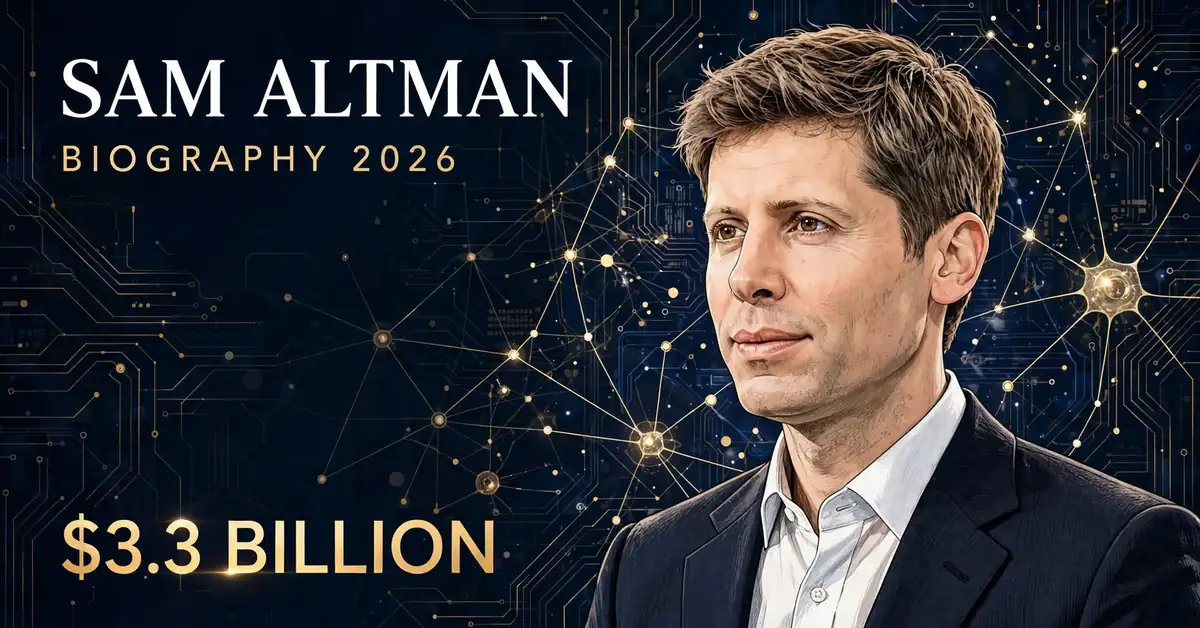
Sam Altman biography 2026: born April 22, 1985, the OpenAI CEO built a $3.3B fortune without owning OpenAI stock — from Loopt to Y Combinator to ChatGPT.
Last updated: November 13, 2026 · By Nathan Cole
Sam Altman is 41 years old in 2026, the chief executive of OpenAI, and a billionaire who owns none of the company that made him famous. Born Samuel Harris Altman on April 22, 1985, in Chicago and raised in St. Louis, he dropped out of Stanford at 19, sold his first startup for $43.4 million, ran Y Combinator at 28, co-founded OpenAI in 2015, and watched ChatGPT become the fastest-adopted product in history in 2022. Forbes puts his net worth at $3.3 billion in 2026 — a fortune built entirely outside OpenAI, from more than 400 startup investments made over twenty years.
The contradiction is the story. Altman runs a company valued at $852 billion as of March 2026, a company that filed confidential IPO papers in June 2026 and is discussed by bankers in the $850 billion to $1 trillion range. He takes a $65,000 salary and holds no direct equity in it. His wealth sits instead in a nuclear fusion startup, an early bet on Stripe, and an 8.7 percent slice of Reddit. In September 2026, his own president, Greg Brockman, debuted on the Forbes 400 with $25.5 billion. Altman missed the list entirely. The richest man at OpenAI is not its chief executive, and that fact explains more about Sam Altman than any single number on his balance sheet.
This biography covers the whole arc: the St. Louis childhood and the first Macintosh at eight, the Stanford dropout and the Loopt sale, the Y Combinator presidency, the founding of OpenAI, the ChatGPT explosion, the four-day firing in November 2023, the $500 billion Stargate bet, and the 2026 version of Altman — 41, married, a father, running the most closely watched company on earth while his own fortune quietly compounds somewhere else.
Quick Facts
| Full name | Samuel Harris Altman |
| Age (2026) | 41 — born April 22, 1985, Chicago, Illinois; raised in St. Louis, Missouri |
| Height | 5 feet 10 inches (178 cm) |
| Estimated net worth (2026) | $3.3 billion (Forbes; published range $3.2–4.0 billion) |
| Occupation | Entrepreneur, investor; CEO of OpenAI; Chairman of Helion Energy |
| Education | Stanford University, computer science (2003–2005, dropped out, no degree) |
| First company | Loopt, co-founded 2005; sold to Green Dot for $43.4 million (March 2012) |
| Y Combinator | Part-time partner 2011; president February 2014 – 2019 |
| OpenAI | Co-founder December 2015; CEO since 2019; fired and reinstated November 2023 |
| Biggest investments | Helion Energy (~$1.7B stake), Stripe ($633M), Reddit (8.7%), Retro Biosciences ($258M) |
| Salary | $65,000 per year as OpenAI CEO; no direct OpenAI equity |
| Spouse | Oliver Mulherin (married January 2024); son born via surrogacy, February 2025 |
| Honours | Time 100 (2023) |
How This Estimate Was Made
Sam Altman’s net worth is estimated at $3.3 billion in 2026, with a published range of $3.2–4.0 billion. The anchor is Forbes: $3.3 billion in its March/April 2026 estimate, $3.2 billion on its real-time tracker on October 15, 2026, and $3.3 billion again when the Forbes 400 list was published in September 2026 — Altman missed that list because the cut-off was $4.4 billion. One 2026 profile cites a Forbes revision above $4 billion after May 2026 court disclosures, which sets the top of the range. Aggregator figures of $5–6.5 billion are excluded: no audited filing supports them. The composition is unusually solid for a private fortune because the 2026 Musk v. OpenAI trial put court-document valuations on the record (Reuters, May 2026, values dated December 31, 2025): Helion Energy about $1.7 billion, Stripe $633 million, Retro Biosciences $258 million. Altman’s Reddit stake of 8.7 percent comes from its 2024 IPO filing. Almost every holding is private and illiquid, so the total moves with each revaluation — the range, not a single figure, is the honest answer.
+
Sam Altman Biography 2026: The Short Answer
Sam Altman is an American entrepreneur and investor, 41 years old in 2026, best known as the co-founder and chief executive of OpenAI, the company behind ChatGPT. He was born in Chicago on April 22, 1985, grew up in the suburbs of St. Louis, dropped out of Stanford University in 2005 to build a location-sharing app called Loopt, sold it for $43.4 million, became president of the startup accelerator Y Combinator at 28, and co-founded OpenAI in December 2015. He has run OpenAI as chief executive since 2019, apart from four days in November 2023 when the board fired him and then, under pressure from staff, investors and Microsoft, brought him back.
His money is the odd part. Forbes estimates his net worth at $3.3 billion in 2026, yet he owns no shares in OpenAI — the company now valued at $852 billion. The fortune comes from two decades of early-stage investing: stakes in more than 400 companies, including a roughly one-third holding in the nuclear fusion startup Helion Energy, an early bet on the payments company Stripe, and 8.7 percent of Reddit. His salary as OpenAI’s chief executive is $65,000 a year, less than many of his own engineers earn in a month. The table below settles the figure source by source.
| Source | Figure | Date |
|---|---|---|
| Forbes (billionaire estimate) | $3.3 billion | March–April 2026 |
| Forbes (real-time tracker) | $3.2 billion | October 15, 2026 |
| Forbes 400 list | $3.3 billion (missed the $4.4B cut-off) | September 2026 |
| Forbes (revised, per 2026 profile) | $4 billion+ | May 2026 |
| Reuters (court documents) | Helion $1.7B, Stripe $633M, Retro $258M | May 2026 (values Dec 31, 2025) |
| Aggregators (excluded) | $5–6.5 billion | 2026 (unaudited) |
Three Forbes readings cluster at $3.2–3.3 billion, one revision pushes past $4 billion after private stakes were disclosed in court, and the aggregators run higher on no filing at all. The honest figure is $3.3 billion, with the range noted. What follows is how a Stanford dropout who never finished a degree ended up running the most important technology company of the decade — and why his fortune is parked everywhere except inside it.
Chicago to St. Louis: The Early Years
Samuel Harris Altman was born on April 22, 1985, in Chicago, Illinois, into a Jewish American family, and moved as a young boy to the suburbs of St. Louis, Missouri, where he grew up the eldest of four children. His mother, Connie Gibstine, is a dermatologist. His father, Jerry Altman, worked as a real-estate broker. The household was comfortable and bookish rather than wealthy, and the detail that keeps recurring in every profile of Altman is the computer: he got his first Apple Macintosh at eight years old, took it apart, learned to write code, and never really stopped.
He attended John Burroughs School, an elite private school in St. Louis, where he did something unusual for a teenager in the late 1990s — he came out as gay before a school assembly, and argued for it openly. The confidence matters because it shows up again and again in his career: Altman has always been willing to take a public position early and absorb the reaction. At Burroughs he was known as the computer kid, the one who already understood the internet better than the adults around him. He left St. Louis in 2003 for Stanford University, where he enrolled to study computer science, one of the strongest programs in the world for a teenager who wanted to build things.
St. Louis shaped him in a quieter way, too. He has described himself as a product of the American Midwest rather than Silicon Valley, and the distinction shows in his public manner: plain-spoken, unflashy, allergic to the showmanship of the typical founder. He still speaks about the city as home. But the two years at Stanford were the break. He arrived in 2003, spent two years in the computer science program, and left in 2005 without a degree — a decision that looks inevitable in hindsight and reckless at the time, and the first of several bets in which Altman walked away from the safe path before anyone could see where the new one led.
Stanford, the Dropout and Loopt
Altman left Stanford in the spring of 2005, at 19, to co-found Loopt with several classmates — a location-based social app that let smartphone users share where they were with friends. The timing was early, almost too early: the iPhone did not exist yet, and Loopt ran on the flip phones and early smartphones of 2005. It was accepted into the very first batch of Y Combinator, the startup accelerator Paul Graham had just founded, and that placement turned out to matter more than the app itself. Loopt raised more than $30 million in venture capital over its life, burned through most of it, and was acquired by Green Dot Corporation for $43.4 million in cash in March 2012.

The Loopt years taught Altman two lessons that shaped everything after. The first was about timing: a good idea in the wrong year is a bad business, and Loopt’s location-sharing concept only became valuable years later, when the hardware caught up. The second was about the accelerator itself. Y Combinator had funded Loopt, advised it, and introduced Altman to the network of founders and investors that would define his twenties. He stayed close to the organisation after the sale, and in 2011 he joined Y Combinator as a part-time partner — a move that put him on the other side of the table, picking winners instead of being one.
Loopt also made him his first real money. The $43.4 million sale price was split among founders, investors and employees, so Altman’s personal share was a fraction of it — but it was enough to make him an investor rather than an employee for the rest of his career. He began writing small cheques to startups almost immediately, and one of the earliest, a $15,000 bet on a payments startup called Stripe in 2009, would become one of the most valuable holdings in his portfolio. The pattern was set: Altman would keep making small, early bets, and a few of them would compound into billions.
Y Combinator: The President at 28
In February 2014, Paul Graham announced on the Y Combinator blog that Sam Altman would become the accelerator’s next president. Altman was 28. The job made him one of the most powerful gatekeepers in Silicon Valley: Y Combinator funds hundreds of startups a year, and its alumni include Airbnb, DoorDash, Instacart, Reddit and Twitch. Over his five years as president, from 2014 to 2019, the accelerator funded more than 1,900 companies, and Altman’s own reputation grew with every batch — the young president who had dropped out of Stanford, sold a company, and now decided which founders got their first cheque.
The presidency paid in a currency more valuable than salary: deal flow. As president, Altman saw every promising startup before almost anyone else, and he invested personally alongside the accelerator. That is how a portfolio of more than 400 companies accumulated — not through a single fund, but through twenty years of small cheques written from the front row. Reddit, Airbnb, Stripe, Instacart, Helion Energy: the names in his portfolio read like a list of the companies Y Combinator itself is proudest of, because in many cases Altman backed them twice — once as the accelerator’s president, once with his own money.
He left Y Combinator in 2019 to run OpenAI full-time, and the timing was deliberate. The accelerator had grown into an institution, and Altman had grown into something else: a founder who wanted to build one company rather than fund a thousand. He kept the investing habit, though, and kept the network. When OpenAI needed money, talent or political cover in the years that followed, the people Altman called were, in many cases, the founders he had funded and the investors he had sat beside at Y Combinator. The presidency was not a detour from his career. It was the career, in compressed form: pick the future early, back it small, and wait.
OpenAI: The One Billion Dollar Bet
On December 11, 2015, Altman co-announced OpenAI with Elon Musk, Ilya Sutskever, Greg Brockman and others: a non-profit research lab dedicated to building artificial general intelligence for the benefit of humanity, backed by $1 billion in pledged commitments. The premise was unusual — a research organisation, not a company, funded by billionaires, with no product and no revenue — and the roster was the strongest in the field. Musk brought money and attention. Sutskever, formerly of Google Brain, brought the research credibility. Altman brought the network and the operator’s instinct. The lab was set up as a non-profit precisely so that it would not have to chase quarterly revenue, a structure that would cause enormous trouble later.
For the first three years, OpenAI was a research lab with a small public profile. That changed in 2019, when Altman became chief executive and restructured the organisation into a “capped-profit” company — a hybrid that could raise outside capital while keeping the non-profit in control. Microsoft put in the first $1 billion that year, and the money began to flow in the other direction: from the lab’s research into products. GPT-2 arrived in 2019, GPT-3 in 2020, and the models kept getting larger, more capable and more expensive to train. The compute bills grew into the billions, and Altman’s job shifted from research patron to fundraiser-in-chief, a role he has played ever since.
The structure he built in 2019 is the key to understanding both his power and his wealth. Altman owns no equity in OpenAI — a fact he has stated under oath and repeated in interviews, including a Vanity Fair conversation in October 2026 in which he acknowledged only a small indirect exposure through an old Y Combinator investment, and said he sometimes wishes he had accepted stock. The decision was deliberate at the time, a statement that the mission mattered more than the money. By 2026, with the company valued at $852 billion, it looks like the most expensive statement in the history of technology. It is also the reason his net worth is measured in his outside investments rather than in the company he runs.
ChatGPT: Five Days to a Million Users
On November 30, 2022, OpenAI released ChatGPT, a chatbot built on its GPT-3.5 model, and the world changed in a week. The product reached one million users in five days — faster than Instagram, faster than TikTok, faster than anything that had come before it. People used it to write essays, debug code, draft emails and argue with it about philosophy, and they posted the results everywhere. Altman, who had spent seven years telling anyone who would listen that AI was about to reshape the economy, was suddenly the most famous executive in technology. Time named him one of the 100 most influential people in the world in 2023.
The launch turned OpenAI from a research lab into a company with a product, a revenue line and a target on its back. Microsoft deepened its partnership with a multi-billion-dollar investment in January 2023, and the two companies’ fates fused: OpenAI supplied the models, Microsoft supplied the cloud and the distribution. By early 2026, ChatGPT was reported to have around 900 million weekly active users and OpenAI was running at roughly a $25 billion annual revenue run-rate — figures that make it, by revenue velocity, one of the fastest-growing technology companies ever built. The models kept coming: GPT-4 in March 2023, GPT-4o in May 2024, GPT-5 in August 2025, and GPT-5.4 and GPT-5.5 in the spring of 2026.
Success brought scrutiny of a different kind. Regulators in Washington and Brussels began asking whether one company should control the most capable AI systems on earth. Competitors — Google, Anthropic, Meta — raced to catch up. And inside OpenAI, the old tension between the non-profit mission and the for-profit reality sharpened into a fight. Altman had built the company to move fast and raise vast sums; the board that governed it had been chosen to move carefully and protect the mission. In November 2023, that tension snapped.
The Firing: Four Days That Shook Silicon Valley
On November 17, 2023, OpenAI’s board of directors fired Sam Altman as chief executive without warning, saying in a brief statement that he had “not been consistently candid in his communications with the board.” The announcement landed like a bomb. Within hours, OpenAI’s president Greg Brockman resigned in protest. Microsoft’s chief executive Satya Nadella, whose company had invested more than $10 billion in OpenAI, said he had learned of the firing minutes before the public did. Employees began posting on social media that they would quit unless Altman returned. Microsoft offered Altman a job leading a new AI research division, and most of OpenAI’s staff signed a letter saying they would follow him there.
The revolt lasted four days. On November 21, 2023, the board agreed to reinstate Altman as chief executive under a new board chaired by Bret Taylor, the former co-chief executive of Salesforce, with Larry Summers and Adam D’Angelo joining. The old board was gone. The precise reasons for the firing have never been fully disclosed — the board cited communication, Altman cited a governance failure, and the truth sits somewhere between a clash of personalities and a genuine disagreement about how fast AI should be deployed. What is certain is the outcome: Altman returned more powerful than before, the non-profit board’s authority was weakened, and the company accelerated.
The firing is the defining episode of Altman’s biography because it revealed both his power and his vulnerability. He had no equity, no voting control, and no legal claim on the job — yet the company could not function without him. Employees, investors and Microsoft all chose Altman over the board, and the board folded in four days. It also set the pattern for everything that followed: the 2025 recapitalisation that turned OpenAI’s for-profit arm into a public benefit corporation controlled by the non-profit OpenAI Foundation, with Microsoft holding roughly 27 percent; and the steady concentration of authority in the chief executive’s office. Altman survived the only serious attempt to remove him, and he has not been seriously challenged since.
The 3.3 Billion Dollar Fortune That Is Not OpenAI
Forbes puts Sam Altman’s net worth at $3.3 billion in 2026. The figure is remarkable for what it excludes: not one dollar of it comes from OpenAI, the company he runs and the company valued at $852 billion in March 2026. Altman owns no direct equity in OpenAI, a fact he has confirmed under oath, and his salary is $65,000 a year — a number so low that it reads like a rounding error against his fortune. The wealth comes from investing, and the investing started before OpenAI existed: small cheques, written early, into companies that grew up around him.
The portfolio is large and deliberately spread out. As of June 2024, it covered stakes in more than 400 companies, valued at around $2.8 billion. The 2026 court disclosures in Musk’s lawsuit against OpenAI gave the public its first hard look inside it, and the numbers were larger than Forbes had previously counted: a stake in Helion Energy worth about $1.7 billion, a Stripe holding worth $633 million, and a position in the longevity startup Retro Biosciences worth $258 million, all valued as of December 31, 2025. Add the Reddit stake — 8.7 percent at the 2024 IPO — plus Airbnb, Instacart, and hundreds of smaller positions, and the $3.3 billion figure is, if anything, conservative. The composition below is drawn from those disclosures, not from guesswork.
| Holding | Reported value | Basis |
|---|---|---|
| Helion Energy (nuclear fusion) | ~$1.7 billion (about one-third of the company) | Court documents, Reuters, May 2026 (values Dec 31, 2025) |
| Stripe (payments) | $633 million | Court documents, Reuters, May 2026 |
| Retro Biosciences (longevity) | $258 million | Court documents, Reuters, May 2026 |
| 8.7% stake | 2024 IPO filing | |
| 400+ other companies | Balance of the portfolio | Forbes; WSJ (venture book of 400+ companies) |
| OpenAI equity | $0 direct | Altman, under oath; Vanity Fair, Oct 2026 |
| OpenAI salary | $65,000 per year | Reported, multiple outlets |
The range around the figure is wide — $3.2 billion on Forbes’ real-time tracker in October 2026, more than $4 billion in one May 2026 revision after the court disclosures — because almost everything Altman owns is private and illiquid. A private stake is worth whatever the last funding round says it is worth, and a single down-round can move the total by hundreds of millions. That is why this article anchors on $3.3 billion and shows the range: the honest answer about a venture fortune is a band, not a point.
Helion, Stripe and Reddit: Where the Money Sits
Helion Energy is the largest single position in Altman’s portfolio, and the strangest. It is a nuclear fusion startup — a company trying to do what governments have spent seventy years failing to do — and Altman owns roughly a third of it, a stake the 2026 court filings valued at about $1.65–1.7 billion. He is also the company’s chairman. The bet fits his pattern: a technology with an enormous payoff if it works, a long timeline, and almost no one else willing to fund it early. Helion has raised hundreds of millions and signed a power-purchase agreement with Microsoft, but fusion power remains unproven at commercial scale. If Helion works, Altman’s stake is worth many billions. If it does not, the largest line in his fortune shrinks toward zero. That is the nature of a venture portfolio: the biggest holding is also the biggest risk.
Stripe is the opposite kind of bet — the safe one, made early and left alone. Altman put $15,000 into the payments startup in 2009, when it was two brothers in a small office, and the position was valued at $633 million in the December 2025 court disclosures. It is the single best illustration of his method: a small cheque, written before anyone else was paying attention, compounded over seventeen years. Reddit is the same story at a different scale: an early investment, held through the company’s long private life, now an 8.7 percent stake in a public company. Airbnb, Instacart, and the hundreds of smaller names in the portfolio follow the same shape — early, small, patient.
The portfolio also explains why Altman missed the Forbes 400 in September 2026 while his own president made it. Greg Brockman, OpenAI’s co-founder and president, debuted on the list at $25.5 billion — nearly eight times Altman’s $3.3 billion — because Brockman holds equity in OpenAI and Altman does not. The cut-off for the list was $4.4 billion, and Altman fell short by $1.1 billion. The comparison is the cleanest measure of what his no-equity decision has cost him on paper: the man who runs the company is worth a fraction of the man who co-founded it beside him. Altman has said he sometimes wishes he had accepted stock. The numbers say why.
Stargate and the 500 Billion Dollar Compute Bet
On January 21, 2025, Altman stood at the White House beside SoftBank’s Masayoshi Son and Oracle’s Larry Ellison as President Trump announced the Stargate Project: an initial $100 billion, rising to as much as $500 billion over four years, to build data centers across the United States for OpenAI’s models. The first site, in Abilene, Texas, was running by 2026. The logic was simple and, by Altman’s own account, unavoidable: the models he wants to build need more computing power than any company has ever assembled, and the only way to get it is to spend at a scale that rivals national infrastructure programs.
The spending did not stop at Stargate. In May 2025, OpenAI agreed to buy io, the hardware startup of former Apple designer Jony Ive, for just under $6.5 billion in stock — a bet that the next computing device after the smartphone will be built by OpenAI. In September 2025, Nvidia signed a letter of intent to invest up to $100 billion in OpenAI as the company deployed at least 10 gigawatts of Nvidia systems, roughly four to five million GPUs. One analysis put OpenAI’s total committed infrastructure spending above $1.4 trillion, including a 30-gigawatt buildout that Altman has described as an “infrastructure factory” capable of producing about a gigawatt of compute per week. Jensen Huang, whose company supplies the chips, has become one of Altman’s most important partners — and, like Altman, one of the richest men in technology.
The scale invites a question Altman has been asked repeatedly in 2026: whether the spending is sustainable. OpenAI’s revenue is growing fast, but the compute bill grows faster, and the company has leaned increasingly on leasing and partnerships rather than owning every data center outright. In February 2026, speaking at the India AI Impact Summit in New Delhi, Altman defended the industry’s energy use directly, arguing that training a human over twenty years consumes far more energy than training a model, and dismissing claims about water usage as untrue. The defence tells you where he stands: the buildout is the strategy, and the criticism is a cost of doing it first.
2026: The 852 Billion Dollar Valuation and the IPO Question
The year 2026 has been, by the numbers, the biggest of Altman’s career. On March 31, 2026, OpenAI closed a funding round of $122 billion in committed capital at an $852 billion post-money valuation, according to CNBC — the largest private financing in history, and a figure that makes OpenAI the most valuable private company in the world. In May 2026, a jury in Oakland found the claims in Elon Musk’s lawsuit against Altman and OpenAI barred by the statute of limitations, ending — for now — the legal war with the man who co-founded the company with him. Musk has said he will appeal. And on June 8, 2026, OpenAI filed a confidential draft registration with the Securities and Exchange Commission, the first formal step toward a public listing that bankers have discussed in the $850 billion to $1 trillion range.
Altman himself has pumped the brakes on the listing. In September 2026 he confirmed that OpenAI will not go public in 2026, citing safety considerations — a position that sits awkwardly beside the S-1 filing, and one that the market reads as a delay rather than a cancellation. The recapitalisation completed in October 2025 already changed the company’s shape: the for-profit arm became OpenAI Group PBC, a public benefit corporation controlled by the renamed non-profit OpenAI Foundation, which holds a 26 percent stake worth roughly $130 billion, while Microsoft’s stake sits at about 27 percent, valued near $135 billion, with its rights extended through 2032. Whatever the listing timetable, the governance fight that the 2023 firing previewed is settled: the non-profit controls the company, Microsoft is the largest outside partner, and Altman runs it.
There is one open question that matters more than the IPO date, and it is the question hanging over Altman’s own fortune: whether the board will ever grant its chief executive a conventional equity stake. One 2026 profile put it plainly — the biggest open question over his net worth is whether the man who built the world’s most valuable private company will ever own a piece of it. The answer, so far, is no. And the longer the answer stays no, the wider the gap grows between the value Altman creates and the value he keeps.
Personal Life: Marriage, Fatherhood and Family
Altman married Oliver Mulherin, an Australian software engineer, in a private ceremony at their estate in Hawaii in January 2024. In February 2025, the couple welcomed their first child, a son, through surrogacy — news Altman shared himself, briefly and without fanfare, in the same plain style he brings to everything else. The family lives mostly out of the public eye, and Altman has said little about his son beyond the announcement. He is 5 feet 10 inches tall, according to our height profile of him, and he keeps a schedule that former colleagues describe as relentless: early mornings, back-to-back meetings, and a habit of answering messages at hours that suggest he does not sleep much.
His family history has a harder edge. His sister, Ann Altman, filed a lawsuit in January 2025 alleging sexual abuse. Altman has denied the allegations, and in October 2026 the court dismissed the lawsuit with prejudice after Ann failed to comply with discovery obligations, including repeatedly refusing to appear for a medical examination. The case is a matter of public record, and this article reports it as such: the allegation was made, it was denied, and the court dismissed it. It is the only serious public controversy in Altman’s personal life, and it sits in sharp contrast to the rest of his reputation — a founder known for being private, controlled and careful with his public image.
The rest of his personal life is quieter. He chairs Helion Energy, the fusion company in which he holds his largest investment. He co-founded Worldcoin, the digital identity project now known as Tools for Humanity, which scans irises to prove personhood — a venture that has drawn regulatory scrutiny in several countries. He collects McLaren sports cars and, in the older profiles, a house in San Francisco and a ranch in California. He has described his politics as broadly centrist and has donated to both parties. None of it is flamboyant, and that is the point: the most powerful man in AI lives like a man who would rather be reading a research paper than attending a party.
Sam Altman vs the AI Billionaires
The fastest way to understand Altman’s fortune is to put it next to the men he works with and competes against. The table below compares him with the other founders and executives of the AI era — and the contrast is the story of this article in one place.
| Person | Role | Estimated net worth (2026) | Source of wealth |
|---|---|---|---|
| Sam Altman | CEO, OpenAI | $3.3 billion | 400+ startup investments; no OpenAI equity |
| Greg Brockman | President, OpenAI | $25.5 billion | OpenAI equity (Forbes 400 debut, Sep 2026, #45) |
| Jensen Huang | CEO, Nvidia | ~$200 billion | Nvidia stock — the chips behind the AI boom |
| Mark Zuckerberg | CEO, Meta | ~$212 billion | Meta stock — and a rival AI lab |
| Elon Musk | CEO, Tesla / SpaceX / xAI | Hundreds of billions | Tesla, SpaceX, xAI — and the man who sued Altman |
The gap between Altman and the rest of the table is not a gap in influence. Altman runs the company that set the pace for the entire industry, and his decisions — what to build, what to ship, what to hold back — shape the market for everyone else on the list. The gap is a gap in ownership. Huang owns Nvidia. Zuckerberg owns Meta. Musk owns his companies. Brockman owns OpenAI. Altman owns the companies around OpenAI, and the difference between those two positions is, on paper, about $22 billion — the distance between his $3.3 billion and Brockman’s $25.5 billion, the two men who sit in the offices next door to each other. No other founder-chief executive in the history of technology has run a company this valuable while owning so little of it.
What Happens Next for Sam Altman
The next two years will answer the questions this biography leaves open. The first is the IPO: OpenAI has filed its confidential S-1, bankers talk about $850 billion to $1 trillion, and Altman has said not in 2026 — so the market’s attention turns to 2027, and to whether a listing finally forces the equity question. A public company with a chief executive who owns nothing is an oddity the market will not ignore forever. The second is the compute bill: Stargate’s $500 billion, the Nvidia partnership, the io device, the $1.4 trillion in total commitments — all of it has to be paid for, and the revenue has to catch up with the spending.
The third is the technology itself. GPT-5 shipped in August 2025 to a mixed reception, with Altman apologising publicly for the way the rollout was handled and promising verified adults more control over what their AI can say. GPT-5.4 and GPT-5.5 followed in the spring of 2026. Altman has said he believes models will begin making small scientific discoveries by 2026 and larger ones by 2028. If he is right, the company he runs becomes the most important research institution on earth. If he is wrong, the spending looks reckless in hindsight. Either way, the bet is his, and he has made it with other people’s money and his own reputation.
And then there is the fortune. Helion either delivers fusion power or it does not. Stripe either goes public at a higher valuation or it does not. Reddit either keeps climbing or it does not. Altman’s $3.3 billion is a portfolio of bets on the future, and the future he is betting on is, in large part, the one he is building at OpenAI. The strangest fact of his biography may turn out to be the most durable one: the man who did more than anyone to put artificial intelligence into every hand on earth owns none of the company that did it, and got rich anyway — one small cheque at a time, starting with $15,000 on a payments startup in 2009.
Sam Altman Biography: Frequently Asked Questions
How old is Sam Altman in 2026?
Sam Altman is 41 years old in 2026. He was born on April 22, 1985, in Chicago, Illinois, and turns 42 on April 22, 2027.
What is Sam Altman’s net worth in 2026?
Forbes estimates Sam Altman’s net worth at $3.3 billion in 2026, with a published range of $3.2–4.0 billion. Forbes’ real-time tracker put him at $3.2 billion on October 15, 2026, and one May 2026 revision pushed the figure above $4 billion after court disclosures revealed the value of his private stakes. None of it comes from OpenAI equity — he owns none.
How did Sam Altman make his money?
Sam Altman made his money from investing, not from OpenAI. He sold his first startup, Loopt, for $43.4 million in 2012, then spent twenty years writing early cheques to more than 400 startups. His biggest holdings are Helion Energy (about $1.7 billion), Stripe ($633 million), an 8.7 percent stake in Reddit, and Retro Biosciences ($258 million). His salary as OpenAI’s CEO is $65,000 a year.
Why doesn’t Sam Altman own any OpenAI stock?
Sam Altman has said he holds no direct equity in OpenAI, a fact he confirmed under oath. He took no shares when he became CEO in 2019, a deliberate choice made when OpenAI was still a non-profit research lab. In an October 2026 interview with Vanity Fair he acknowledged a small indirect exposure through an old Y Combinator investment and said he sometimes wishes he had accepted stock. The company’s 2025 recapitalisation into a public benefit corporation gave him no equity either.
What happened when Sam Altman was fired from OpenAI?
On November 17, 2023, OpenAI’s board fired Sam Altman as CEO, saying he had “not been consistently candid in his communications with the board.” President Greg Brockman resigned in protest, most of the staff threatened to quit, and Microsoft offered Altman a job. Four days later, on November 21, 2023, the board reinstated him under a new board chaired by Bret Taylor. The full reasons for the firing have never been publicly disclosed.
How much does Sam Altman earn as OpenAI CEO?
Sam Altman earns a salary of $65,000 a year as OpenAI’s chief executive, according to multiple reports. It is a deliberately low figure — less than many of his own engineers earn in a month — and it is his only direct pay from the company, since he holds no OpenAI equity. Some 2026 profiles cite a figure of $76,001; $65,000 is the long-reported number.
Is Sam Altman married?
Yes. Sam Altman married Oliver Mulherin, an Australian software engineer, in a private ceremony at their estate in Hawaii in January 2024. In February 2025, the couple welcomed their first child, a son, through surrogacy.
How tall is Sam Altman?
Sam Altman is 5 feet 10 inches tall (178 cm), according to our height profile of him, published November 10, 2026.
Sources & Reporting
This article was reported from public sources on November 13, 2026. Biography: Wikipedia, “Sam Altman” (born April 22, 1985, Chicago; Stanford 2003–2005; Loopt $43.4M sale March 2012; Y Combinator president 2014–2019; OpenAI co-founded December 2015; ChatGPT November 30, 2022; sister’s lawsuit dismissed October 2026); Britannica Money, “Sam Altman” (updated May 18, 2026); CEO.wiki, “Sam Altman: biography and career” (marriage January 2024; son February 2025). Net worth: Forbes via multiple 2026 profiles ($3.3B March/April 2026; $3.2B real-time October 15, 2026; Forbes 400 September 2026, $4.4B cut-off); Reuters, May 2026 (court documents: Helion ~$1.7B, Stripe $633M, Retro Biosciences $258M, values December 31, 2025); HTX, September 21, 2026 (Greg Brockman Forbes 400 debut, $25.5B, #45). OpenAI 2026: CNBC via FrontierMinds (funding round March 31, 2026, $122B at $852B valuation); History.itlibra (GPT-5 August 2025; GPT-5.4 March 2026; GPT-5.5 April 2026; S-1 filed June 8, 2026; Musk suit decided May 18, 2026); Datawallet (recapitalisation October 2025; Microsoft 27%, ~$135B, through 2032); Followin (Microsoft partnership extension; $1.4T infrastructure commitments). All figures are reported or estimated as labelled in the text; where sources disagree, the article shows the range and says why. Corrections: if any figure in this article is shown to be wrong, contact us and we will correct it with a dated note, per our corrections policy.
References & Sources
This article has been fact-checked and verified against multiple public sources, financial disclosures, SEC filings, Forbes reports, Celebrity Net Worth databases, and official records. All net worth estimates are based on publicly available information and financial analysis.