Kenny Chesney net worth 2026: an estimated $220M inside a $180M–$225M range — 30M albums, $1.3B in tour grosses, Sphere residency and the Blue Chair Bay sale.
Last updated: November 13, 2026 · By Nathan Cole
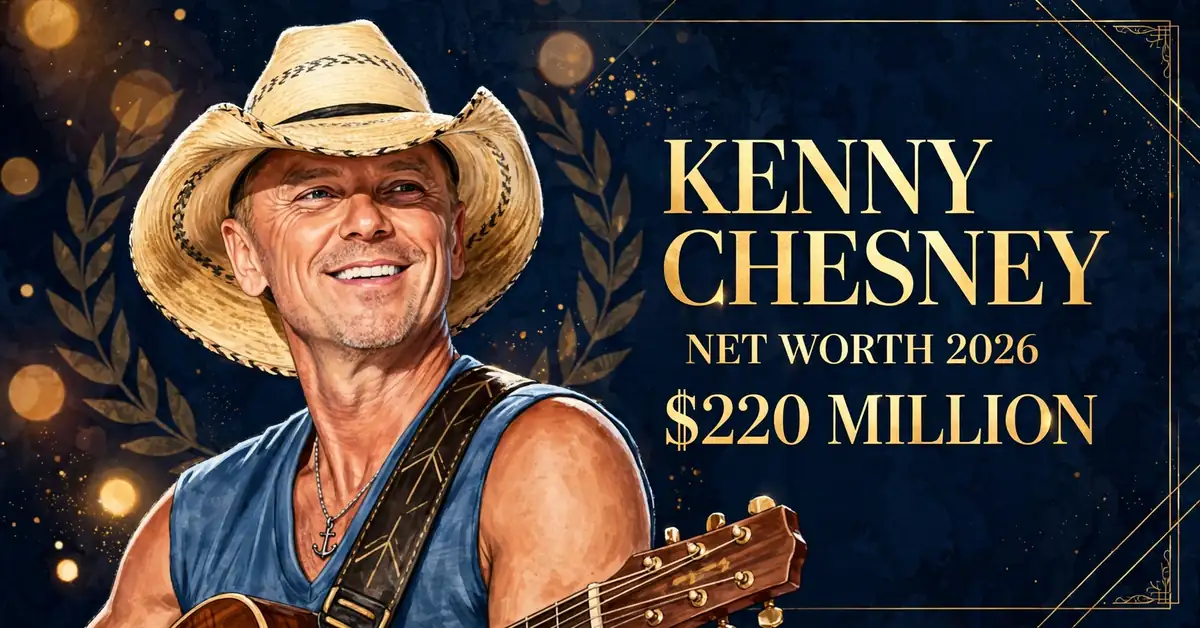
Kenny Chesney’s estimated net worth in 2026 is $220 million, inside a $180 million to $225 million range. The 58-year-old country star from Luttrell, Tennessee has spent three decades turning stadium shows into the biggest touring business country music has ever seen: Pollstar had tracked $1.3 billion in gross concert revenue across 957 headline shows by early 2025, with 18.7 million tickets sold. He has sold more than 30 million albums, collected 36 No. 1 songs on Billboard’s Country Airplay chart, launched a rum brand he owned outright for twelve years before selling it in 2025, and became the first country artist to headline a residency at Sphere in Las Vegas.
If you came for the essentials, you have them: $220 million, 58 years old, 21 studio albums, and a fortune built on touring first and everything else second. The rest of this profile traces how a kid who played football at Gibbs High School and sang in a bluegrass band at East Tennessee State University became the highest-grossing live country act of all time — the albums, the $135.3 million stadium tour of 2022, the Hipgnosis catalogue deal, the Blue Chair Bay sale, the 2025 Sphere residency and its 2026 return, the new Hey Now Records label, and the 21st album that arrived in September 2026.
Most pages about Chesney’s money print a single number and move on. Some still print $180 million, a figure that predates the Sphere residency and the rum sale. Others print $250 million or more with nothing behind it. This profile settles the figure with dates and sources, names the outlet behind every number, separates tour gross from take-home pay, and labels the estimate as an estimate throughout. Every claim below carries its source and its date.
Quick Facts
| Full Name | Kenneth Arnold Chesney |
| Born | March 26, 1968, Knoxville, Tennessee; raised in Luttrell (age 58 in 2026) |
| Height | 5 ft 7 in (170 cm), as commonly listed; no official measurement exists |
| Net Worth (2026) | Estimated $220 million, inside a $180M–$225M range (Celebrity Net Worth, updated 2026) |
| Known For | 21 studio albums; 36 No. 1 Country Airplay songs; the No Shoes Nation stadium tours; Sphere residency |
| Career Touring | $1.3 billion gross, 18.7 million tickets, 957 headline shows (Pollstar, by early 2025) |
| Businesses | Blue Chair Bay Rum (launched 2013, sold March 2025); Hey Now Records (launched 2026) |
| Wife & Family | Married actress Renée Zellweger in May 2005; annulled December 2005. No children. Not currently married. |
| Honours | Country Music Hall of Fame, inducted October 2025; 8 Entertainer of the Year awards (CMA + ACM) |
| Current Work | 21st album Silver Sands Marina (Sept 25, 2026); Sphere return, 11 shows in summer 2026; The Original Vibe Room Tour with Eric Church from April 2027 |
How This Estimate Was Made
Kenny Chesney has never disclosed his finances, so no published net worth figure is a fact — every one is an estimate built from public records. This profile weighed sources three ways: whether the outlet names its own data, whether the date is recent, and whether independent pages agree.
The anchor, $220 million, is the figure Celebrity Net Worth publishes on a page updated in 2026, and it is the only major tracker whose figure moved after the two events that changed Chesney’s balance sheet: the Sphere residency and the March 2025 sale of Blue Chair Bay Rum. The range, $180 million to $225 million, comes from TheCityCeleb, which prints that exact spread, and from kennychesney.net’s own FAQ section, which prints $180 million to $220 million. The $180 million figure that Cinapse and The Hollywood Gossip (September 17, 2026) still print is Celebrity Net Worth’s older number — a snapshot from before the Sphere grosses landed. The $100 million figure on NetWorthPost is older still: it cites The Big Revival, a 2014 album, as his “most recent”. The $250 million to $275 million figures on thinly sourced list pages carry no reporting behind them and sit above every dated source.
The honest statement, then: the touring grosses, the album sales, the catalogue deal and the rum sale are documented; the net worth is an estimate with a range. This profile labels it as such throughout, and it separates gross revenue from take-home pay wherever the two are confused.
+
Kenny Chesney at 58: The Short Answer
Kenny Chesney is 58 years old in 2026. He was born Kenneth Arnold Chesney on March 26, 1968, in Knoxville, Tennessee, grew up in the small town of Luttrell, and turned 58 on March 26, 2026. He has been a working country star for more than thirty years, and the last decade has been the richest stretch of his career — not the first. His estimated net worth in 2026 is $220 million, inside a $180 million to $225 million range, and the money arrives in four streams: stadium touring, recorded music and the catalogue sale, the rum business, and a new independent label he co-founded in 2026.
The touring numbers are the ones that set him apart. By early 2025, Pollstar had tracked 18.7 million tickets sold and $1.3 billion in gross concert revenue across 957 reported headline shows, per Celebrity Net Worth. No other country act has sold that many stadium tickets. His 2022 stadium tour alone grossed $135.3 million and sold nearly 1.3 million tickets. His 2018 Trip Around the Sun tour grossed $114.3 million on 1.289 million tickets and was, at the time, the biggest tour of his career, according to Billboard’s report of August 30, 2018. The 2024 Sun Goes Down tour kept the run going: $91.3 million from the first 21 shows alone by July 2024.
The second stream is the catalogue. In January 2022, Hipgnosis Song Management and Blackstone acquired 80 percent of Chesney’s recorded-music royalties, covering 22 albums from his 1994 debut through 2017’s Live in No Shoes Nation. The fee was never disclosed, and neither side has said a number since — but the deal turned thirty years of records into a lump sum, and it is the single biggest reason the estimates jumped in the 2020s. The third stream is Blue Chair Bay Rum, the brand he created in 2013, owned outright for more than a decade, and sold to Next Century Spirits in March 2025 for cash plus a significant ownership stake in the buyer. The fourth is Hey Now Records, the independent label he launched in 2026 with his longtime manager Clint Higham, former Warner Music Nashville chairman John Esposito and veteran executive Kris Lamb, with Chesney as its flagship artist.
How the Net Worth Figure Was Reached
Start with what is certain. Chesney has sold more than 30 million albums worldwide. He has nine No. 1 albums on the all-genre Billboard 200 and 17 No. 1 albums on Billboard’s Country Albums chart. He has 36 No. 1 songs on the Country Airplay chart and 23 on the Hot Country Songs chart. Those are chart facts, not estimates, and they are the foundation under every dollar figure that follows.
Forbes tracked his annual earnings through the peak stadium years: $56 million in 2016, $42.5 million in 2017, and $37 million between June 2017 and June 2018, per Celebrity Net Worth’s summary of the Forbes lists. Those are pre-tax earnings in single years, not net worth — but three years at that pace, stacked on two decades of touring before them, is how a fortune in the low hundreds of millions is built. Older reporting puts his 2011 earnings at $44 million and his 2013 earnings at $53 million, per NetWorthPost.
The range exists because the inputs are private. Nobody outside Chesney’s camp knows the Hipgnosis fee, the Blue Chair Bay sale price, his real-estate holdings, or his tax position. The $180 million low end is the figure that circulated before those two deals closed. The $220 million anchor is the figure the best-sourced tracker publishes after them. The $225 million top end is the top of the spread TheCityCeleb prints. Pages that print $250 million or $300 million offer no reporting to support the jump, and pages that still print $100 million are quoting a decade-old snapshot. The table below lays out the adjudication in full.
| Source | Figure | Date / Standing |
|---|---|---|
| Celebrity Net Worth | $220 million | Updated 2026 — ANCHOR; reflects Sphere + rum sale |
| TheCityCeleb | $180M–$225M | 2026 — sets the range |
| Cinapse / The Hollywood Gossip | $180 million | 2026 — older Celebrity Net Worth figure, pre-Sphere |
| kennychesney.net (FAQ) | $180M–$220M | 2026 — supports the range |
| themost10 | $250M–$275M | 2025 — thin sourcing, above every dated source |
| NetWorthPost | $100 million | Stale — cites a 2014 album as his most recent |
One more distinction matters, and most net-worth pages get it wrong: tour gross is not take-home pay. The $1.3 billion Pollstar figure is gross box-office revenue across Chesney’s career. Out of it come the promoter’s share, the venue’s share, production costs for a stadium-sized stage, the band and crew payroll, travel, and taxes. Forbes’ annual earnings figures — $56 million in 2016, for example — are the closer measure of what actually reached Chesney in a year. A reader who treats the gross as income will overstate his wealth by an order of magnitude, and this profile does not make that mistake.
From Luttrell to Nashville: Early Life and the Long Climb
Luttrell is a small community in Union County, Tennessee, and Chesney’s music has never really left it. He was born in nearby Knoxville on March 26, 1968, grew up in Luttrell, played football as one of the Gibbs High School Eagles in the mid-1980s, and went on to East Tennessee State University, where he played in the college bluegrass band and picked up a guitar in earnest. The Country Music Hall of Fame’s 2026 exhibition on his life, “Kenny Chesney: Living in Fast Forward,” opens with exactly that arc — the varsity jacket and jersey from Gibbs High, the college guitar, and the weathered wicker rocking chair that inspired “Old Blue Chair” after he woke on a St. John beach at sunrise.
He drove to Nashville in January 1991 — the Country Music Association’s Hall of Fame announcement notes he put his car on I-40 heading west on the day the Gulf War started — and spent the early 1990s playing the songwriter rounds. The first break came in 1993, when he signed with Capricorn Records and released his debut album, In My Wildest Dreams, in 1994. It sold modestly. The second break mattered more: a move to BNA Records in 1995, where he found a label willing to build him slowly, album by album, instead of chasing a single hit.
The climb was slow by modern standards. His first No. 1 single, “She’s Got It All,” arrived in 1997, three years after the debut. “How Forever Feels” followed in 1999. The albums kept coming — I Will Stand (1997), Everywhere We Go (1999), Greatest Hits (2000) — and the audience kept growing, but nothing in the 1990s suggested the stadium act he would become. That came later, and it came because Chesney understood something his peers did not: country fans would fill a football stadium for a singer they loved, if the show gave them a summer night worth remembering.
The Breakthrough Years: First Number Ones and the Stadium Idea
The turn came with No Shoes, No Shirt, No Problems in April 2002. The album topped the Billboard 200, its single “The Good Stuff” spent seven weeks at No. 1 and finished as Billboard’s No. 1 country song of the year, and Chesney’s image shifted from working Nashville singer to the barefoot, sun-bleached spokesman for a whole way of life. When the Sun Goes Down followed in February 2004, debuting at No. 1 on the Billboard 200, with “There Goes My Life” spending seven weeks at the top of the country chart and the title track — a duet with Uncle Kracker — also reaching No. 1. The album won the 2004 CMA Award for Album of the Year, and Chesney took Entertainer of the Year the same night.
The awards piled up fast after that. He won the CMA Entertainer of the Year award four times — 2004, 2006, 2007 and 2008 — and the ACM Entertainer of the Year award four consecutive times, 2005 through 2008. Eight Entertainer of the Year trophies across the two academies is a record of live-performance dominance, a radio record on its own would not explain it, and it tracks exactly with the touring story: Chesney was winning the awards that reward the stage at the same time he was building the biggest stage act in country music.
The stadium idea grew out of those years. In 2004, his tour grossed more than $64 million, selling 1,197,992 tickets, according to promoter Louis Messina — who called him “officially the biggest ticket seller in any kind of music” at the time, per a Top40-Charts report from September 2004. The 2007 Flip-Flop Summer Tour was the highest-grossing country road trip of its year. By the end of the decade, the pattern was set: one massive summer tour a year, mostly stadiums, mostly sold out, with the No Shoes Nation fan club — named for the 2002 album — turning up in matching gear and treating each show like a holiday.
The Touring Machine: A Billion in Grosses
The numbers behind the touring machine are the strongest part of the net-worth case, because they come from Pollstar’s box-office reporting rather than from guesswork. By January 2025, Pollstar had received reports from 957 Chesney headline performances. Those shows had sold 18.7 million tickets and grossed $1.3 billion. Ticketmaster’s artist bio, updated in 2026, repeats the same figures — more than $1.3 billion and 18 million tickets — and calls him one of the highest-grossing artists in live music, in any genre.
The tour-by-tour record shows how the grosses scaled. The Brothers of the Sun Tour with Tim McGraw in 2012 sold out 9 of its 23 stops, played to 1,085,382 fans, and grossed $96,458,890, according to Billboard’s 2012 year-end roundup — seventh among all touring acts that year, behind Madonna, Bruce Springsteen and Lady Gaga, all of whom played far more shows. The 2015 tour grossed $114.1 million. The 2018 Trip Around the Sun Tour passed it: $114.3 million on 1.289 million tickets across 42 concerts, per Billboard’s report of August 30, 2018, ending with two sold-out nights at Gillette Stadium in Foxborough, Massachusetts, where 121,714 fans paid $11.6 million across the two shows. The Ticketing Business, reporting the same figures in September 2018, noted that the 2018 grosses pushed his career total to $969 million with 15.3 million in attendance — and that his Gillette Stadium lifetime gross stood at $97.6 million with 1.09 million in attendance, the venue’s all-time high.
Then came the biggest single tour of his career. His 2022 stadium tour grossed $135.3 million and sold nearly 1.3 million tickets, per Celebrity Net Worth’s Pollstar summary. The per-show math is the part that explains the fortune: at that pace, a single stadium night grosses roughly $4 million to $5 million before costs. Chesney’s cut — after the promoter, the venue, production and payroll — is a fraction of the gross, but the fraction of a $135.3 million tour is still a very large number, and he has now run tours at that scale for the better part of two decades. Forbes’ earnings figures line up with the same story: $56 million in 2016, when he was the second-highest-paid country artist of the year, $42.5 million in 2017, and $37 million across the twelve months to June 2018.
Sun Goes Down and the 2024 Stadium Run
The 2024 Sun Goes Down tour — named for the 2004 album and its title track — showed the machine still running at full speed twenty years after the breakthrough. By July 2024, just 21 performances had already grossed $91.3 million, per Pollstar reporting summarized by Celebrity Net Worth. Three shows at Gillette Stadium outside Boston later sold 183,224 tickets and grossed $26.3 million. A single night at TQL Stadium in Cincinnati on June 29, 2024, sold 22,736 tickets and grossed $2.93 million, per Pollstar’s own report of July 25, 2024. The tour covered NFL stadiums, MLB parks and amphitheaters across North America, promoted by Messina Touring Group, and it set up the next two years: a residency in Las Vegas, a new album, and a new label.

The Sun Goes Down tour also carried the next generation with it. Megan Moroney opened the 2024 stadium run, and the pairing turned into a collaboration: the two recorded “You Had to Be There” together, a song that later appeared as a guest spot on Chesney’s 2026 album. It is a small detail, but it captures how the touring machine works as a business — the stadium run is a platform for the records, and the records feed the next stadium run.
Sphere: The First Country Residency in Las Vegas
In January 2025, Chesney announced something no country artist had done before: a residency at Sphere in Las Vegas, the 17,600-seat venue wrapped in a 160,000-square-foot screen with 171 million pixels and 167,000 speakers. He became the first country artist to headline the room, and the sixth artist of any kind to hold a residency there, joining U2, Dead & Company, the Eagles, Phish and Anyma. The run was announced as 12 dates from May 22 to June 14, 2025, presented by Blue Chair Bay Rum, with DJ Brandi Cyrus warming up the crowd. Demand was strong enough that three more dates were added on January 23, 2025, taking the run to 15 shows ending June 21.
The opening night, May 22, 2025, set the tone: a 23-song set with three encores, and a surprise guest in Kelsea Ballerini, the fellow East Tennessee singer who joined him on stage, per Parade’s report of May 23, 2025 and iHeart’s report the same day. The run closed with 239,070 tickets sold and $52.6 million grossed across the 15 shows, per Celebrity Net Worth — roughly $3.5 million a night in gross box office, in a room a third the size of the stadiums he usually plays. The residency worked because the venue did the work the stadium could not: the screen wrapped the island imagery around the audience, and the sound system let a quiet acoustic song land in the back row.
He went back. In the summer of 2026, Chesney returned to Sphere for 11 more shows, running June 19 through July 11, 2026, per the updated Celebrity Net Worth page and Parade’s June 2026 reporting. Across the two summers at Sphere, he sold close to 400,000 tickets. The residency also paid off in a second way: it gave him a Las Vegas base for the next phase of his career, and it proved that a country act could anchor the most technologically advanced room in live music — a claim no other country artist could make in 2025.
The Catalogue Sale: Hipgnosis and the 2022 Deal
On January 19, 2022, Hipgnosis Song Management announced that it had acquired 80 percent of Kenny Chesney’s recorded-music royalties, in the first deal struck under its new partnership with Blackstone, which had committed a billion dollars to music-rights acquisitions. The deal covered his discography from the 1994 debut In My Wildest Dreams through 2017’s Live in No Shoes Nation — 22 albums, 15 of them certified Platinum, five of those multi-Platinum, and 20 certified Gold, per the announcement carried by Music Business Worldwide and Music Connection. It also covered future greatest-hits, live and acoustic releases, plus SoundExchange and neighboring-rights royalties for every album in the catalogue, including the two Warner Music Nashville albums that followed the covered period, 2018’s Songs for the Saints and 2020’s Here and Now.
The fee was never disclosed, and that silence is itself informative: Hipgnosis and Blackstone do not publish per-deal prices, and Chesney’s camp has never hinted at one. What is public is the scale of the asset. The catalogue held nine No. 1 albums on the Billboard 200, 17 No. 1 albums on the Country Albums chart, and 18 Top 10 country albums, with more than 30 million albums sold worldwide. Chesney was represented by his longtime manager Clint Higham at Morris Higham Management and lawyer Jess Rosen at Greenberg Traurig, and the deal was Hipgnosis’s first with a country superstar.
For the net-worth picture, the sale matters in two ways. First, it converted thirty years of royalty income into a lump sum in 2022 — the kind of payment that lifts an estimate from the $180 million range into the $220 million range in a single year. Second, it left Chesney with 20 percent of the covered royalties, plus full rights to everything he has recorded since 2018, so the catalogue keeps paying him every month on top of the sale price. It is the cleanest example in his career of turning a lifetime of work into cash without stopping work: he sold most of the past and kept all of the future.
Blue Chair Bay Rum: From Beach Idea to a 2025 Sale
The most important business Chesney ever built outside music started with a chair. After waking on a St. John beach at sunrise and writing “Old Blue Chair” — the song that later gave its name to a Hall of Fame exhibition — he turned the island state of mind into a brand. Rather than sign a conventional endorsement deal with an established liquor company, he created Fishbowl Spirits and launched Blue Chair Bay Rum in 2013, working directly with master blender Mike Booth to develop the product, per Celebrity Net Worth. He owned the business outright, and he owned it for more than a decade.
The brand grew the way his tours did: slowly, then everywhere. Blue Chair Bay became the rum of the No Shoes Nation summers, the sponsor on the Sphere residency, and the presenter of the Hall of Fame exhibition that opened in July 2026. In March 2025, Next Century Spirits acquired Blue Chair Bay, per Celebrity Net Worth — and the structure of the deal tells its own story. Chesney took cash plus a significant ownership position in the acquiring company, which means he sold the brand and kept a stake in its future. The price was not disclosed, and no honest estimate can put a number on it — but a national spirits brand built over twelve years, sold to a consolidator, is a nine-figure-scale asset class, and the sale is the second of the two events that moved his published net worth from $180 million to $220 million.

The rum story also explains a habit that runs through Chesney’s whole career: he builds the thing himself instead of renting his name to someone else’s. The label, the rum, the touring operation — each one is a business he owns a piece of, not a cheque for lending his face. That is why the estimates cluster where they do. A singer who only earns touring fees and royalties is worth less than a singer who owns the rum brand, the label, and a fifth of his own catalogue.
The 2026 Chapter: Hey Now Records and Silver Sands Marina
2026 has been the busiest year of Chesney’s career in a decade, and it started with a business move. In March 2026, he joined longtime manager Clint Higham, former Warner Music Nashville chairman John Esposito and veteran record executive Kris Lamb in launching the independent Hey Now Records, with Chesney as its flagship artist, per Celebrity Net Worth. The label is distributed by Warner Records, and its first release is Chesney’s own 21st studio album — a structure that gives him the independence of an indie with the distribution muscle of a major.
The album, Silver Sands Marina, was announced on June 24, 2026, and released on September 25, 2026. It is an 11-track record produced by longtime collaborator Buddy Cannon, with guest appearances from Colbie Caillat, Lily Meola and Megan Moroney, and songwriting from Matraca Berg, Shane McAnally, Brett James, Jessie Jo Dillon, Tenille Townes and Adam Wright, per the track-list reporting of September 18, 2026. The lead single was “Carry On,” and the title track followed. It debuted at No. 7 on the Billboard 200 and No. 3 on the Top Country Albums chart, per Wikipedia’s chart record. It is also, unusually, the third album of his career on which he did not write or co-write a single track — the other two are 1996’s Me and You and 2007’s Just Who I Am: Poets & Pirates.
The same year brought the honour that closes the circle on a career. Chesney was elected to the Country Music Hall of Fame in 2025 as the year’s Modern Era Artist, announced by the Country Music Association on March 25, 2025, and formally inducted in October 2025 alongside record executive and producer Tony Brown and June Carter Cash. Billboard named him the No. 1 Country Artist of the 21st Century in May 2026, per Parade’s report of June 24, 2026. And on July 23, 2026, the Country Music Hall of Fame and Museum opened “Kenny Chesney: Living in Fast Forward,” an exhibition running through June 2027, presented by Blue Chair Bay Rum, with his Gibbs High School varsity jacket, his college guitar and the old blue chair itself on display, per the museum’s press release of June 16, 2026. He also appeared at the 2026 iHeartRadio Music Festival in September, and announced his return to stadiums: The Original Vibe Room Tour with Eric Church, Sheryl Crow and Greylan James, starting April 24, 2027, at Raymond James Stadium in Tampa, per iHeart’s report of September 17, 2026.
Albums, Singles and the Numbers Behind the Catalogue
Twenty-one studio albums in thirty-two years is a pace few artists sustain, and the chart record behind them is the reason the catalogue was worth buying. Chesney has nine No. 1 albums on the all-genre Billboard 200 — from No Shoes, No Shirt, No Problems in 2002 through Here and Now in 2020 — and 17 No. 1 albums on Billboard’s Country Albums chart. His singles run is longer still: 36 No. 1 songs on the Country Airplay chart and 23 on the Hot Country Songs chart, per the updated Celebrity Net Worth page, with more than 50 Top 10 hits across his career, per the Country Music Association’s Hall of Fame announcement.
The songs that built the fortune are the ones that still fill stadiums. “She’s Got It All” (1997) was the first No. 1. “How Forever Feels” (1999) and “The Good Stuff” (2002, seven weeks at No. 1) made him a radio fixture. “There Goes My Life” (2003, seven weeks at No. 1) and “When the Sun Goes Down” (2004, with Uncle Kracker) made him a star. “The Boys of Fall” (2010), “American Kids” (2014), “Save It for a Rainy Day” (2015) and “Get Along” (2018) kept the run going into the streaming era. “Take Her Home,” the single from his 20th album Born (2024), topped the chart again — a No. 1 single thirty years after the debut album.
Other writers supplied some of the biggest hits, and the credits show how deep Chesney’s Nashville ties run. Chris Stapleton, whose own net worth profile traces a $25 million fortune built on the same kind of touring, wrote “Never Wanted Nothing More,” Chesney’s 2007 chart-topper, and co-wrote “Whiskey and You,” the closing track of Hemingway’s Whiskey (2010). The point is not the trivia. It is that Chesney’s catalogue is a songwriter’s catalogue as much as a singer’s — a deep bench of songs that other artists’ fans know, which is why the records keep earning long after release week.
| Year | Album | What It Marked |
|---|---|---|
| 1994 | In My Wildest Dreams | Debut on Capricorn Records |
| 1997 | I Will Stand | First No. 1 single, “She’s Got It All” |
| 2002 | No Shoes, No Shirt, No Problems | First Billboard 200 No. 1; “The Good Stuff” 7 weeks at No. 1 |
| 2004 | When the Sun Goes Down | Billboard 200 No. 1; CMA Album of the Year |
| 2010 | Hemingway’s Whiskey | Billboard 200 No. 1; “The Boys of Fall” |
| 2018 | Songs for the Saints | Hurricane Irma relief album |
| 2020 | Here and Now | Ninth Billboard 200 No. 1 |
| 2024 | Born | 20th studio album; single “Take Her Home” |
| 2026 | Silver Sands Marina | 21st studio album; first release on Hey Now Records |
Wife, Family and the House on St. John
The most asked-about chapter of Chesney’s personal life lasted 128 days. He met actress Renée Zellweger on January 15, 2005, at NBC’s Concert of Hope, a tsunami relief telethon, where she was answering phones and he was performing. They started dating, and on April 29, 2005, she walked on stage at his concert in Jacksonville, handed him a margarita and kissed him in front of the crowd. Nine days later, on May 9, 2005, they married in a private sunset ceremony on St. John in the US Virgin Islands, at Chesney’s home in the gated Peter Bay community, with 35 close friends and family in attendance, per the reporting of the time.
Four months later, in September 2005, Zellweger filed for an annulment, listing “fraud” as the reason — a word that set off years of speculation. Both of them moved quickly to shut it down. Zellweger released a statement saying the term was “simply legal language and not a reflection of Kenny’s character,” and their joint statement said “the miscommunication of the objective of their marriage at the start is the only reason for this annulment.” The annulment was finalized in December 2005. Chesney addressed it directly in a 2007 interview on 60 Minutes, saying the only fraud was him thinking he knew what marriage would be like when he did not. He has never married again, and he has no children.
His private life since then has stayed private, which is how he prefers it. He is widely reported to have been in a long-term relationship with Mary Nolan since about 2012, though neither of them discusses it publicly. What is documented is the property. His St. John home is the place he returns to between tours, the site of the wedding, and the house that sheltered neighbours during Hurricane Irma. He is also reported to own a home in Franklin, Tennessee — the “Bella Luce” property, reported at around $10 million by thinner sources, so treat that price as reported rather than confirmed. The St. John house is the one that matters to the story: it is the island, the chair, the rum and the foundation, all in one place.
Giving Back: Love for Love City and the Irma Years
Hurricane Irma hit the US Virgin Islands in September 2017, and Chesney’s St. John home was in the middle of it. He opened the house to people weathering the storm, then set up the Love for Love City Foundation to help victims across the US and British Virgin Islands rebuild. The foundation’s name is a play on the island’s capital, Charlotte Amalie, and its work — rebuilding homes, restoring power, supporting displaced families — has continued long after the news cycle moved on.
The music followed the relief work. His 2018 album Songs for the Saints was tied directly to the Irma recovery, with its proceeds supporting the effort, and the record’s island sound — recorded with a band that included many of the musicians who had played with him for years — made the connection between the place and the music explicit. It is the album that explains why the Blue Chair Bay brand and the Hall of Fame exhibition both carry the island with them: St. John is not a holiday home for Chesney. It is the second hometown, the one that gave him the songs and then, in 2017, needed him back.
The philanthropy does not move the net-worth figure — giving money away reduces it, if anything — but it belongs in the profile because it is the part of the story the money pages usually skip. A fortune built on summer nights in stadiums, spent in part on rebuilding an island, is a different story from a fortune built and banked. Chesney has never publicized the foundation’s totals, and this profile does not invent them.
How Chesney Compares With Country’s Other Big Earners
Country music in 2026 has a new generation of stadium earners, and Chesney’s fortune sits above most of them — but the comparison is closer than it was five years ago. Zach Bryan’s net worth profile traces a $60 million fortune behind a $350 million deal, built on a streaming-first career that skipped the radio ladder Chesney climbed. Morgan Wallen’s net worth profile follows a $35 million fortune after a $33 million year, built on streaming numbers Chesney never had at the same age. Luke Combs’ net worth profile puts his fortune at $20 million behind an $11 million night, built on the same stadium model Chesney pioneered. Luke Bryan’s net worth profile traces a $160 million fortune behind a $12 million American Idol seat, built on touring and television together.
Chesney’s $220 million sits above all four, and the reason is time. Bryan, Wallen and Combs built their fortunes in the streaming era, where the money is fast but the catalogue is young. Chesney built his over thirty years, through the CD era, the download era and the streaming era, and he owns pieces of all three: the touring machine, the catalogue sale, the rum brand and now the label. Bryan’s $350 million deal is the number that could one day pass him, but it is a deal value, not a bank balance — the same distinction this profile draws between gross and take-home throughout.
| Artist | Estimated Net Worth (2026) | Main Engine |
|---|---|---|
| Kenny Chesney | $220 million ($180M–$225M range) | Stadium touring, catalogue sale, rum brand |
| Luke Bryan | $160 million | Touring + American Idol television |
| Zach Bryan | $60 million | Streaming + major label deal |
| Morgan Wallen | $35 million | Streaming + touring |
| Luke Combs | $20 million | Stadium touring, same model as Chesney |
The responsible summary: Kenny Chesney is 58 years old in 2026, the highest-grossing live country act of all time, a Country Music Hall of Fame inductee, and worth an estimated $220 million inside a $180 million to $225 million range. The birth date is documented, the tour grosses are Pollstar’s, the catalogue deal and the rum sale are on the record, and the money is labeled as an estimate. A reader who finishes this page should not need to Google the same questions again — and should know exactly which numbers are measured, which are estimated, and which remain private. For more country wealth profiles in this series, see the Celebrity Net Worth section on GuideNetWorth.
Frequently Asked Questions
What is Kenny Chesney’s net worth in 2026?
Kenny Chesney’s estimated net worth in 2026 is $220 million, inside a $180 million to $225 million range. The $220 million anchor is the figure Celebrity Net Worth publishes on a page updated in 2026, after his Sphere residency and the March 2025 sale of Blue Chair Bay Rum. The $180 million figure still printed by some pages is the older estimate from before those two deals.
How much does Kenny Chesney make per tour?
His tours gross tens of millions: the 2022 stadium tour grossed $135.3 million, the 2018 Trip Around the Sun tour grossed $114.3 million, and the 2024 Sun Goes Down tour grossed $91.3 million from its first 21 shows. That works out to roughly $4 million to $5 million in gross box office per stadium show — but gross is not take-home pay. After the promoter, venue, production, band and crew, and taxes, his personal earnings are far lower; Forbes put his annual earnings at $56 million in 2016, $42.5 million in 2017 and $37 million in the year to June 2018.
How old is Kenny Chesney in 2026?
Kenny Chesney is 58 years old in 2026. He was born Kenneth Arnold Chesney on March 26, 1968, in Knoxville, Tennessee, and raised in nearby Luttrell. He turned 58 on March 26, 2026, and will turn 59 on March 26, 2027.
Who is Kenny Chesney’s wife?
Kenny Chesney is not currently married. His only marriage was to actress Renée Zellweger: they married on May 9, 2005, on St. John in the US Virgin Islands, and the marriage was annulled in December 2005 after four months, with “fraud” listed as the legal ground — a term both of them said was simply legal language. He has no children and is widely reported to have been in a long-term relationship with Mary Nolan since about 2012.
How tall is Kenny Chesney?
Kenny Chesney is commonly listed at 5 ft 7 in (170 cm). There is no official measurement on the public record, so the figure should be read as the standard listing rather than a confirmed fact.
Did Kenny Chesney sell Blue Chair Bay Rum?
Yes. Chesney created Fishbowl Spirits and launched Blue Chair Bay Rum in 2013, working with master blender Mike Booth, and owned the brand outright for more than a decade. In March 2025, Next Century Spirits acquired Blue Chair Bay. Chesney took cash plus a significant ownership position in the acquiring company, so he sold the brand and kept a stake in its future. The price was not disclosed.
How many number one songs does Kenny Chesney have?
Kenny Chesney has 36 No. 1 songs on Billboard’s Country Airplay chart and 23 No. 1 songs on the Hot Country Songs chart, with more than 50 Top 10 hits across his career. He also has nine No. 1 albums on the all-genre Billboard 200 and 17 No. 1 albums on Billboard’s Country Albums chart, and has sold more than 30 million albums worldwide.
What is Kenny Chesney doing in 2026?
In 2026 Chesney returned to Sphere in Las Vegas for 11 shows from June 19 to July 11, after his 15-show residency there in 2025 made him the first country artist to headline the venue. He launched the independent Hey Now Records label in March 2026 and released his 21st studio album, Silver Sands Marina, on September 25, 2026. The Country Music Hall of Fame and Museum opened its exhibition “Kenny Chesney: Living in Fast Forward” on July 23, 2026, and he announced The Original Vibe Room Tour with Eric Church for April 2027.
Sources & Reporting
This profile was researched on November 13, 2026, from live search results and the outlets named throughout: Celebrity Net Worth (updated 2026) for the $220 million anchor, the Pollstar touring totals, the Forbes annual earnings, the Sphere grosses, the Blue Chair Bay sale, the Hey Now Records launch and the Hall of Fame induction; TheCityCeleb for the $180 million to $225 million range; Cinapse and The Hollywood Gossip (September 17, 2026) for the older $180 million figure; kennychesney.net for the $180 million to $220 million FAQ range; NetWorthPost for the stale $100 million figure and the 2011–2013 earnings; themost10 for the thin $250 million to $275 million figures and the 5 ft 7 in height listing; Billboard via Wikipedia’s Trip Around the Sun Tour page and The Ticketing Business (September 3, 2018) for the $114.3 million tour gross and the $969 million career total; Pollstar (July 25, 2024) for the TQL Stadium gross; Parade (May 23, 2025 and June 24, 2026) for the Sphere opening night and the Silver Sands Marina announcement; Country Now and The Music Universe (January 2025) for the Sphere residency dates; Music Business Worldwide and Taste of Country (January 2022) for the Hipgnosis catalogue deal; the Country Music Hall of Fame and Museum press release (June 16, 2026) for the exhibition; the Country Music Association (March 25, 2025) for the Hall of Fame class; iHeart (September 17, 2026) for the 2027 Vibe Room Tour; Entertainment Now and Wikipedia for the Silver Sands Marina release and chart positions; and the GuideNetWorth profiles for Chris Stapleton, Zach Bryan, Morgan Wallen, Luke Combs and Luke Bryan for the peer comparison figures.
Where outlets disagree — on the net worth, and on the height — this profile names the disagreement and attributes each figure to its outlet rather than picking a winner silently. No figure in this article comes from an anonymous “sources say” claim, and no fact has been added that the cited reporting does not support. Corrections policy: figures are updated when new reporting emerges — contact us via the About page if you spot an error.
WRITTEN BY
Nathan Cole
Nathan Cole is the editor of Guide Net Worth. He covers celebrity wealth the way a business desk covers earnings: reported figures first, estimates labeled as estimates, and no invented numbers. Every profile on this site passes through his desk before it publishes. About Guide Net Worth · Corrections: figures are updated when new reporting emerges — contact us via the About page if you spot an error.
References & Sources
This article has been fact-checked and verified against multiple public sources, financial disclosures, SEC filings, Forbes reports, Celebrity Net Worth databases, and official records. All net worth estimates are based on publicly available information and financial analysis.