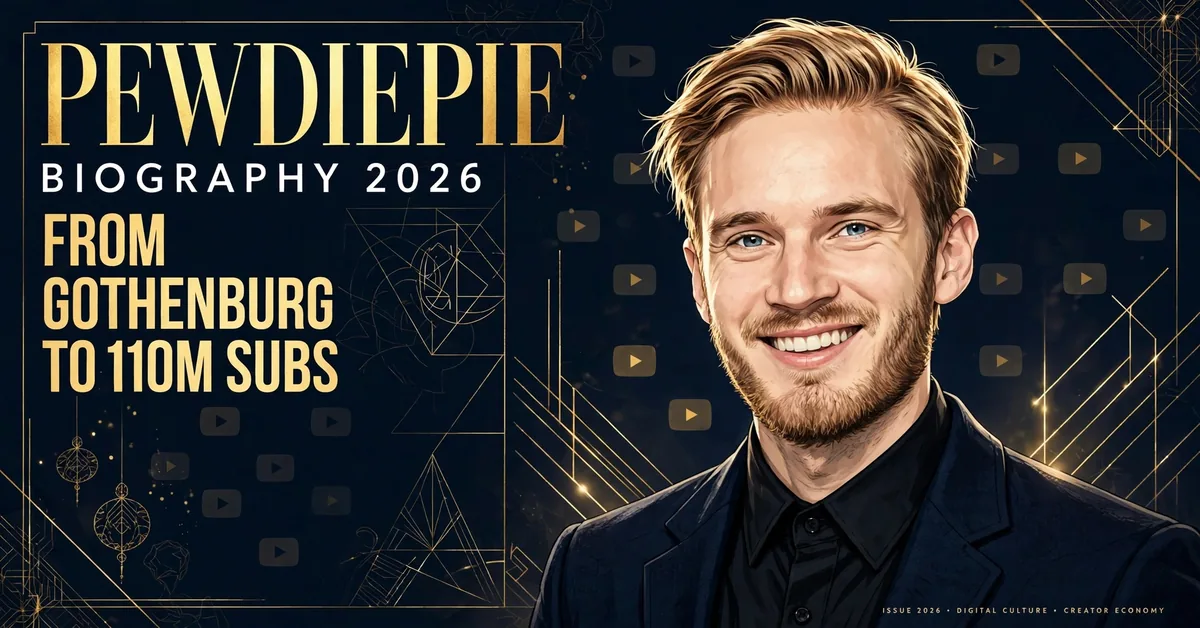
PewDiePie biography 2026: born 24 October 1989 in Gothenburg, age 37, 110M subscribers, $40–60M fortune, and a quiet life in Japan with Marzia and son Björn.
Last updated: 16 November 2026 · By Nathan Cole
Felix Arvid Ulf Kjellberg was born on 24 October 1989 in Gothenburg, Sweden, and he turned 37 on 24 October 2026. That date matters, because a surprising number of biography pages on the internet still call him 36 — they were written before his birthday, and nobody updated them. He is 37, his PewDiePie channel holds around 110 million subscribers, and he is, by the most recent dated estimates, worth somewhere between $40 million and $60 million. He lives in Tokyo with his wife Marzia and their son Björn, uploads when he feels like it, and in 2026 spent his energy building a free open-source AI workspace instead of chasing the algorithm that made him famous.
The career behind those numbers has no close parallel on YouTube. Kjellberg started filming himself playing horror games in a Gothenburg bedroom, became the most-subscribed channel on the platform in August 2013, and held that position — with brief interruptions — for six years. He was the first individual creator to reach 100 million subscribers. He also survived the two events that would have ended most careers: the 2017 controversies that cost him his Disney deal, and the 2018–2019 subscriber war with T-Series that turned his channel into a global news story. Then, at the height of his fame, he walked away from the treadmill and moved to Japan.
This biography works from dated sources and names them. Wikipedia, last updated 9 July 2026, supplies the spine; the competitor biographies published in October and November 2026 supply the 2026 freshness; Forbes supplies the peak-earnings years; and this site’s own net-worth profile supplies the money adjudication. Where the sources disagree — the exact size of the fortune, the subscriber count on any given day — the disagreement is printed, not smoothed over.
Quick Facts: PewDiePie at a Glance
| Full name | Felix Arvid Ulf Kjellberg |
| Born | 24 October 1989, Gothenburg, Sweden |
| Age | 37 (turned 37 on 24 October 2026) |
| Known as | PewDiePie, Pewds |
| Height | 5 ft 11 in (180 cm) |
| Occupations | YouTuber, content creator, author, game developer |
| Years active | 2010–present |
| Subscribers | Around 110 million (May 2026), ~29.5 billion views |
| Wife | Marzia Kjellberg (née Bisognin), married 19 August 2019 |
| Children | Son Björn, born 11 July 2023 |
| Net worth (2026) | Estimated $40–60 million; anchored at $40 million (Celebrity Net Worth, September 2026) |
| Biggest honours | First individual creator to 100 million subscribers (2019); most-subscribed channel 2013–2019 |
| Current residence | Tokyo, Japan (since May 2022) |
| Latest project | Odysseus, a free open-source AI workspace (launched 31 May 2026) |
How This Biography Was Researched
Kjellberg has never published a memoir, so this profile is built from reporting, not from access. The spine comes from Wikipedia, last updated 9 July 2026, checked against the competitor biographies published in October and November 2026 — alltechabout, ytshark, gamerbolt and CelebAmerica’s own biography of 11 November 2026. Family dates come from Famous Birthdays and the 2026 profile pages, which agree on the wedding date and the children’s birth date. Money figures come from Celebrity Net Worth’s September 2026 snapshot, cross-checked against its August 2026 richest-YouTubers list and this site’s own net-worth profile, which uses the same $40–60 million range.
Two rules run through the whole article. First, a reported figure is labeled as reported: the fortune is an outside estimate, not an audited account, and the range is printed alongside the anchor. Second, where sources disagree, the article says so and names the versions — the fortune’s top end and the subscriber count on a given day are both handled that way. Nothing in this article is invented, and no sentence is copied from a competitor.
+
Early Life in Gothenburg
Felix Arvid Ulf Kjellberg was born on 24 October 1989 in Gothenburg, Sweden’s second-largest city and a port town on the west coast. He grew up there with his parents, Lotta Kristine Johanna and Ulf Christian Kjellberg, and his older sister Fanny. Gothenburg in the 1990s was a long way from the internet fame that would follow: a working port city with a dry sense of humour, where a teenager’s main entertainments were video games and drawing.
The games came first. Kjellberg has described himself as a kid who spent hours on his computer, and the art came with it — he drew constantly, a habit that later showed up in the hand-drawn style of his early videos and in the book he published in 2015. School was unremarkable by his own account: he was bright enough to get into Chalmers University of Technology, one of Sweden’s most respected engineering schools, but never the student who loved the classroom. The Gothenburg years matter because they explain the two traits that define his public image: the Swedish deadpan that made his commentary funny, and the stubbornness of someone who left a safe degree for a gamble nobody around him understood.
There is a small detail from this period that fans still repeat, because it captures the whole story in miniature: before YouTube paid anything, Kjellberg sold hot dogs at a stand to support himself while he built the channel. It was not a hardship story — his family was comfortable — but it was a choice. He wanted the channel to pay for itself, and he was willing to stand in the cold to make that happen.
Family: Parents, Sister Fanny and the Gothenburg Household
Kjellberg’s parents, Lotta and Ulf, were both born in the late 1950s — Lotta in 1958, Ulf in 1957 — and the household was, by every account, stable and supportive. His mother worked in retail IT; his father worked in business. Neither had anything to do with entertainment, and neither pushed their son toward it. His older sister Fanny stayed out of the public eye entirely, a pattern the family has kept ever since: Felix became the most famous person on the internet, and the rest of the Kjellbergs stayed private.
The family dynamic shows up in the early career in one specific way. When Kjellberg dropped out of university in 2011 to do YouTube full time, his parents were not pleased — the decision reportedly caused real friction at home. It is the one part of the biography where the supportive-family story has a crack in it, and it is worth printing, because it is the decision the whole career turns on. A year later he had a million subscribers. A year after that he was the biggest channel on YouTube.
The privacy instinct he learned at home became his own. When his son Björn was born in July 2023, Kjellberg and Marzia filmed family vlogs for nearly three years — and then, in May 2026, announced they would end them in September 2026 so Björn could grow up outside the internet. The Gothenburg household’s rule, learned young, still runs the Tokyo household: the public gets the creator, not the family.
Education: Chalmers University and the Dropout Gamble
Kjellberg enrolled at Chalmers University of Technology in Gothenburg to study industrial economics and technology management — a serious degree at a serious school, the kind of choice that reassures parents. He lasted about a year. In 2011 he left the university to focus on YouTube, a decision that, as noted above, reportedly caused friction with his parents at the time.
The gamble looks obvious in hindsight and reckless at the time. In 2011 YouTube was not a career path in Sweden. There were no creator-economy jobs, no brand deals for gamers, no precedent for a 21-year-old making a living by shouting at horror games. Kjellberg’s channel was growing — he had started in April 2010 and was building an audience — but it was not yet paying a salary. The hot-dog stand filled the gap. He has never presented the dropout as a philosophy. It was a bet on a channel that was already moving, and the channel paid it back within a year.
The degree still shows up in the later career, in a quieter way than most people notice. When Kjellberg talks about his businesses — the book deal, the game, the Tsuki clothing brand, the 2026 AI workspace — he talks like someone who studied management: margins, ownership, control of the product. The year at Chalmers did not make him a YouTuber. It gave him the instincts of an owner, and the owner is the part of PewDiePie that survived when the YouTuber stepped back.

The First Channel and the Birth of PewDiePie
PewDiePie’s YouTube history starts earlier than most fans realise. Felix created his first channel, under the username “Pewdie”, on 19 December 2006. He forgot the password. Four years later, on 29 April 2010, he created the “PewDiePie” channel — “Pew” for the sound of a laser gun, “Die” for death in games, “Pie” because he liked the word — and started uploading Let’s Play videos.
The early videos were simple: Kjellberg playing horror games, mostly Amnesia: The Dark Descent, shouting, laughing and talking to the camera as if the viewer were sitting next to him. The format worked because it was the opposite of the polished gaming coverage of the time. There were no scripts, no edits that hid the fear, no pretence that he was good at the games. He was bad at them, loudly, and that was the point. By July 2012 the channel had passed a million subscribers.
The name itself is part of the story. Competitors with catchier brands came and went; “PewDiePie” was awkward, unpronounceable to non-gamers, and completely his. It became the most recognisable username on the platform, and when the channel hit its peak, the name was on merchandise, a book, a game and a clothing brand. The forgotten password on a 2006 account is the kind of accident that looks like destiny only after the fact — but the fact is that without it, there would be no PewDiePie.
The Rise: Let’s Plays and the Bro Army
The rise was fast by any measure. From the million-subscriber mark in July 2012, Kjellberg’s channel doubled and doubled again, and on 15 August 2013 it became the most-subscribed channel on YouTube. He was 23. The format had widened by then: horror games were still the core, but the channel had grown into vlogs, comedy sketches, commentary and satire, all delivered in the same unscripted voice. The audience called itself the Bro Army, and it behaved like one — loyal, loud, and everywhere in the comments of rival channels.
What the numbers miss is how the channel changed YouTube itself. Before PewDiePie, the platform’s biggest stars were mostly musicians and mainstream media. After him, the individual creator — one person, one camera, one personality — became the model every new YouTuber copied. The Let’s Play, which barely existed as a genre in 2010, became the platform’s default content. Kjellberg did not invent the form alone, but he was the one who proved it could be the biggest thing on the site.
The money followed the audience. Forbes named him the highest-paid YouTube star of 2016, with earnings of $15 million that year, and reported $12 million for 2017. Those were the peak years, and they matter to the biography because they explain the fortune: two years at the very top of the platform’s pay scale, with ad revenue, sponsorships and merchandise all running at once. The full adjudication, with the dated sources, is laid out in PewDiePie’s net worth profile on this site.
The Formats That Kept Him on Top
A channel does not stay the biggest on YouTube for six years on one format. Kjellberg kept inventing new ones. “Last Week I Asked You” (LWIAY) turned Reddit posts from his own community into a weekly show. “You Laugh You Lose” turned meme review into a competition. “Meme Review” became a fixture of internet culture in its own right, to the point where other creators’ careers were made or broken by a mention. The formats shared a rule: the audience supplied the material, and Kjellberg supplied the reaction.
The reaction was the product. His commentary was fast, self-deprecating and deliberately unpolished — a Swedish accent flattening American internet slang, jokes that landed because they were not rehearsed. Competitors with bigger budgets and better editing could not copy it, because the voice was the whole thing. When he tried more scripted work — the YouTube Red series Scare PewDiePie, which ran for one season — it worked, but it was never the core. The core was a man in a room, talking to a camera, reacting to something funny.
The formats also explain why the channel survived the controversies. A creator with one format loses everything when the format goes stale or the audience turns. Kjellberg had half a dozen formats, a community that generated its own content, and an audience that had grown up with him. When the algorithm changed, when the press turned hostile, when the subscriber war arrived, the channel bent and kept going.
The T-Series War: The Subscriber Battle of 2018–2019
The defining public drama of PewDiePie’s career came in 2018–2019, when the Indian music-label channel T-Series closed in on his subscriber count. For months the gap narrowed, and the internet turned the race into a campaign: “Subscribe to PewDiePie” became a slogan, a meme, a billboard, a Super Bowl ad bought by fans, and a chant at esports events. Kjellberg himself released a diss track, “Bitch Lasagna”, which became one of the most-viewed videos of his career.
T-Series passed him in early 2019, and the loss mattered less than the war itself. The campaign had turned a subscriber count into a global news story, and it had shown the scale of his audience: millions of people who would buy billboards for a YouTuber they had never met. It also showed the limit of that loyalty. T-Series was a corporation with a catalogue; PewDiePie was one person. A person can lose a numbers race to a company and still be the more famous of the two.
The war’s aftermath is the part of the biography that gets told least. In August 2019, a few months after losing the top spot, Kjellberg became the first individual creator to reach 100 million subscribers. The record mattered because it was his alone — no corporation, no label, no team. One person, one channel, a hundred million people. Nobody else has done it since, and the gap between him and the next individual creator has only grown.
Controversies and the Cost of the Spotlight
In January 2017, Kjellberg faced the worst backlash of his career after videos surfaced containing antisemitic jokes and imagery, including a paid stunt on Fiverr in which two men held up a sign reading “Death to all Jews”. The Wall Street Journal reported on the videos in February 2017, and the consequences arrived within days: Disney’s Maker Studios ended its deal with him, and YouTube cancelled the second season of Scare PewDiePie and removed him from its preferred-advertising programme.
Kjellberg apologised, called the jokes a mistake, and said he had not understood the weight of what he was playing with. The apology did not restore the deals, and it did not end the argument — critics said the jokes were not a one-off, supporters said the punishment was out of proportion. What is not in dispute is the cost: the two biggest corporate relationships of his career ended in the same week, and his income took a hit that the Forbes figures for 2017 reflect.
The second controversy came in March 2019, when the Christchurch attacker said “Subscribe to PewDiePie” during his livestream. Kjellberg called it “absolutely sickening” and asked his fans to end the meme, saying he did not want his name attached to a massacre. The episode is the darkest footnote in the biography, and it is also the moment his relationship with his own fame changed: the slogan that had been a joke became something he actively wanted buried. He stopped using it, and the Bro Army, for the most part, listened.
Marzia: The Partnership Behind the Channel
Kjellberg met Marzia Bisognin, an Italian internet personality, in 2011 — she had emailed him after watching his videos, and they met in person in Italy. She became a creator in her own right, built a large following of her own, and then retired from YouTube in 2018. The couple got engaged on 27 April 2018 and married on 19 August 2019 at Kew Gardens in London, in a ceremony that was small by celebrity standards and private by design.
Marzia matters to the biography because she is the one person who has been there for the whole arc. She was there for the hot-dog stand years, the rise, the Disney fallout, the T-Series war and the move to Japan. She also built her own businesses — the Tsuki clothing brand, launched with Felix in 2019, is a joint venture, and her design work and ceramics have their own following. The partnership is a genuine business partnership as well as a marriage, and it is one reason the fortune has survived the years when Felix stepped back from YouTube: the household kept earning while the channel slowed down.
The couple’s public life is deliberately narrow. They share what they choose — the Japan vlogs, the house, the son — and they keep the rest private. That discipline is the reason the biography of PewDiePie has so few tabloid chapters: there is almost nothing to report, because the two people at the centre of it decided, years ago, not to live in public.
The Move to Japan and a Quieter Life
In May 2022, Kjellberg and Marzia moved to Japan, settling in Tokyo. The move had been planned for years — they bought a house there in 2019 — and was delayed by the pandemic and Japan’s border rules. When it finally happened, it was a statement of intent: the biggest YouTuber in the world was leaving the world that made him, and choosing a country where he could walk down a street without being recognised every few steps.
Japan changed the channel. The videos became slower, more personal, and more domestic: vlogs about the house, the neighbourhood, the food, the language. The gaming content did not disappear, but it stopped being the point. The point became the life — a creator in his thirties, living in a foreign country, filming what he felt like filming. The audience followed, because the audience had grown up with him and was now in its thirties too.
The move also explains the subscriber count. At around 110 million subscribers and roughly 29.5 billion views as of May 2026, the channel is no longer growing the way it did in 2013. Some of that is YouTube removing inactive accounts — the count has drifted down from its peak — and some of it is the simple fact that a man who uploads when he feels like it does not grow the way a man chasing the algorithm does. Kjellberg has said, in effect, that he is fine with that. The channel is a record of his life now, not a race.

Fatherhood: Björn and the End of the Family Vlogs
On 11 July 2023, Kjellberg and Marzia’s son Björn was born in Japan. The announcement was made the way the couple makes announcements: in a video, on their own terms, with no press release and no magazine deal. For nearly three years the family vlogs followed — monthly videos about life in Tokyo with a small child, the kind of content that felt a long way from the horror-game screaming of 2010.
In May 2026, Kjellberg announced that the family vlogs would end in September 2026. The reason, given in the vlog itself, was privacy: Björn was turning three in July, and his parents wanted him to grow up outside the internet and enjoy life on his own terms. It was a decision in the same spirit as the move to Japan — the public gets the creator, not the family — and it was received, by the audience and the press, as the right call.
Fatherhood is the least-reported part of the biography, because the Kjellbergs report it themselves and on their own schedule. What the public record shows is a man who spent his twenties becoming the most famous creator on the planet, and his thirties building a life that the fame does not touch. The vlogs ending in September 2026 is not a retirement. It is a boundary, and the biography respects it: this article records the fact, not the child.
Beyond YouTube: Books, Games, Tsuki and the Brand
The fortune was never only ad revenue. In October 2015 Kjellberg published This Book Loves You, a collection of illustrated aphorisms that became a bestseller. In September 2015 he released PewDiePie: Legend of the Brofist, a mobile game built around his channel’s characters. In 2019 he and Marzia launched Tsuki Market, a clothing brand built on their shared design sense. Each venture was small by the standards of the channel, and each one added a revenue stream that did not depend on YouTube’s algorithm.
The brand deals of the peak years are the part of the money story that is hardest to pin down, because the figures were never published. What the record shows is the Forbes peak — $15 million in 2016, $12 million in 2017 — and the long tail after it: merchandise, the book, the game, Tsuki, and the catalogue of more than 4,600 videos that still earns ad revenue years after upload. A channel with 29.5 billion views does not need new uploads to earn. The back catalogue is an asset, and it is the asset that pays for the quiet life in Tokyo.
There is a comparison worth making here, because it explains why PewDiePie’s story is different from the other biographies in this series. MrBeast’s biography is the story of a creator who turned the channel into an empire and kept scaling. Ninja’s biography is the story of a streamer who cashed in a moment and built a brand around it. Pokimane’s biography and Valkyrae’s biography are stories of creators who diversified into companies. PewDiePie’s story is the opposite: a creator who reached the top, looked at what it cost, and chose less. The fortune is smaller than MrBeast’s, and the life is quieter — and by every account, including his own, that was the point.
Net Worth in 2026: The –60 Million Question
PewDiePie’s net worth in 2026 is estimated at $40 million to $60 million, and the anchor inside that range is Celebrity Net Worth’s September 2026 snapshot of $40 million. The other dated sources bracket it: Celebrity Net Worth’s own August 2026 ranking of the richest YouTube stars listed him at $45 million, and the 2026 profile pages put the range at $45–60 million. One profile even noted that Felix himself once said his actual net worth was “much much” higher than $20 million — an old remark, not a figure, and not used as an anchor.
The honest range is therefore $40–60 million, with $40 million as the most recent dated estimate. The full adjudication, with the three dated sources and the outlier figures, is laid out in PewDiePie’s net worth profile on this site — and the sister site NetWorthCraft reaches the same anchor, estimating the fortune at $40 million in its PewDiePie net worth profile. Where does the money sit? The reporting points to the YouTube catalogue, the peak-year earnings, the book and game, Tsuki, and the investments of a household that has lived well below its peak income for years. He is, at 5 ft 11 in (180 cm), also one of the taller creators in the field — the full height breakdown is on CelebAmerica’s PewDiePie height profile.
There is a reason the range is wide, and it is worth stating plainly: Kjellberg has never disclosed his finances, and creators at his level earn from sources that do not show up in public filings. The $40 million anchor is a reported estimate, not an audited account. What the sources agree on is the shape of the story — a fortune built at full throttle in 2016–2017, then preserved by a man who stopped spending at the same rate. The range is the honest version of the number, and this article prints the range.
Odysseus and the 2026 AI Pivot
On 31 May 2026, Kjellberg released Odysseus, a free, open-source, self-hosted AI workspace — a tool for running AI models on your own hardware, built after a year of documenting the process on his channel. It was the least PewDiePie-like product imaginable, and that was the point. The man who had spent fifteen years as the face of the attention economy built a tool for escaping it: run the models locally, keep your data, skip the feed.
The pivot had been building all year. In March 2026 he released a browser extension aimed at algorithmic feeds — a small tool that redirected users to their subscriptions page instead of the recommendation feed, addressing what he called “algo brain”. The extension was free, the workspace is free, and the code is open. None of it is a business in the ordinary sense. It is a creator using his audience to distribute an idea, the way he once used it to distribute a meme.
Odysseus is also the best evidence for what Kjellberg is now. He is not retired — he uploads, he builds, he experiments — but the experiments are his own, on his own schedule, for an audience that followed him from horror games to AI workspaces. The 2026 pivot is the biography’s final turn: the kid from Gothenburg who sold hot dogs to fund a channel is now giving away software, and the audience is still watching.
Legacy: What PewDiePie Changed About YouTube
PewDiePie’s legacy is the individual creator. Before him, the biggest channels on YouTube belonged to companies, labels and television networks. After him, the model was one person with a camera — and every creator in this series, from Kai Cenat’s biography to MrBeast’s, works in a world he helped create. The Let’s Play, the reaction video, the meme review, the community-generated show: all of them trace back, in one way or another, to a bedroom in Gothenburg in 2010.
The numbers will stand for a long time. Around 110 million subscribers. Roughly 29.5 billion views. Six years as the most-subscribed channel. The first individual to 100 million. A fortune of $40–60 million, built and then deliberately preserved. A marriage, a son, a house in Tokyo, and a free AI workspace released at 36 — the kind of second act that looks nothing like a retirement and everything like a choice.
He is 37 now, and the channel is fifteen years old. The biography’s final fact is the one the Quick Facts box prints first: born 24 October 1989, Gothenburg, Sweden, and still, after everything, the most famous individual creator YouTube has ever had. The full timeline — age, height, fortune — is spread across this site’s profiles, and the PewDiePie age profile carries the dated breakdown of the birthday that most of the internet got wrong this year.
Sources & Reporting
This biography was researched from public reporting in November 2026. The spine comes from Wikipedia’s PewDiePie profile, last updated 9 July 2026, checked against the competitor biographies published in October and November 2026 — alltechabout (updated 18 hours before this article’s research), ytshark (updated 31 October 2026), gamerbolt (updated 26 October 2026), CelebAmerica’s biography (11 November 2026) and Vedantu. The channel dates — the “Pewdie” account of 19 December 2006, the PewDiePie channel of 29 April 2010, the million-subscriber mark of July 2012, the most-subscribed date of 15 August 2013 — come from Wikipedia and ytshark, which agree on all of them.
Family dates — the 27 April 2018 engagement, the 19 August 2019 wedding at Kew Gardens, Björn’s birth on 11 July 2023 — come from Famous Birthdays and the 2026 profile pages, with the family-vlog ending (announced May 2026, effective September 2026) reported by SoapCentral. The fortune figures come from Celebrity Net Worth’s September 2026 snapshot ($40 million) and its August 2026 richest-YouTubers list ($45 million), cross-checked against gamerbolt ($45–60 million) and this site’s own net-worth profile, which uses the same $40–60 million range. The Forbes peak-earnings years ($15 million in 2016, $12 million in 2017) come from gamerbolt’s profile. The Odysseus launch date (31 May 2026) comes from gamerbolt and CelebAmerica’s biography, which agree on it. The height figure (5 ft 11 in / 180 cm) comes from Bored Panda’s 2026 profile. Figures are updated when new reporting emerges — contact us via the About page if you spot an error. No figure in this article is invented; where sources disagree, the disagreement is printed.
More profiles in this series: Celebrity Net Worth.
Frequently Asked Questions
How old is PewDiePie in 2026?
PewDiePie is 37 years old in November 2026. He was born Felix Arvid Ulf Kjellberg on 24 October 1989 in Gothenburg, Sweden, which means he turned 37 on 24 October 2026. Many biography pages still say 36 because they were written before his birthday and never updated.
What is PewDiePie’s real name?
PewDiePie’s real name is Felix Arvid Ulf Kjellberg. He was born in Gothenburg, Sweden, on 24 October 1989, to parents Lotta and Ulf Kjellberg, and grew up with his older sister Fanny. The name “PewDiePie” combines “Pew” (the sound of a laser gun), “Die” (death in games) and “Pie”.
When did PewDiePie start YouTube?
PewDiePie started YouTube in 2010. His first channel, under the username “Pewdie”, was created on 19 December 2006, but he forgot the password. He created the “PewDiePie” channel on 29 April 2010 and began uploading Let’s Play videos of horror games, notably Amnesia: The Dark Descent. The channel passed a million subscribers in July 2012 and became the most-subscribed channel on YouTube on 15 August 2013.
Who is PewDiePie’s wife?
PewDiePie’s wife is Marzia Kjellberg (née Bisognin), an Italian former content creator and entrepreneur. They met in 2011, got engaged on 27 April 2018, and married on 19 August 2019 at Kew Gardens in London. Marzia retired from YouTube in 2018, and the couple launched the Tsuki clothing brand together in 2019.
Does PewDiePie have children?
PewDiePie has one child, a son named Björn, born on 11 July 2023 in Japan. In May 2026, PewDiePie and Marzia announced that their family vlogs would end in September 2026 so that Björn could grow up outside the internet, with more privacy as he gets older.
What is PewDiePie’s net worth in 2026?
PewDiePie’s net worth in 2026 is estimated at $40 million to $60 million. The anchor is Celebrity Net Worth’s September 2026 snapshot of $40 million, while its August 2026 ranking of the richest YouTube stars listed him at $45 million. Forbes reported his peak annual earnings at $15 million in 2016 and $12 million in 2017. The fortune rests on YouTube ad revenue, the book and game, the Tsuki brand, and the back catalogue of more than 4,600 videos.
How tall is PewDiePie?
PewDiePie is 5 feet 11 inches tall (180 cm). Listings in circulation agree on the figure, and it is the adjudicated height used by this site’s sister profile on CelebAmerica. He is taller than most of the creators in his generation of YouTubers.
Where does PewDiePie live in 2026?
PewDiePie lives in Tokyo, Japan, with his wife Marzia and their son Björn. The couple bought a house in Japan in 2019 and moved there in May 2022, after pandemic border rules delayed the move. He uploads when he feels like it and in 2026 launched Odysseus, a free open-source AI workspace, on 31 May 2026.
WRITTEN BY
Nathan Cole
Nathan Cole is the editor of Guide Net Worth. He covers celebrity wealth the way a business desk covers earnings: reported figures first, estimates labeled as estimates, and no invented numbers. Every profile on this site passes through his desk before it publishes. About Guide Net Worth · Corrections: figures are updated when new reporting emerges — contact us via the About page if you spot an error.
References & Sources
This article has been fact-checked and verified against multiple public sources, financial disclosures, SEC filings, Forbes reports, Celebrity Net Worth databases, and official records. All net worth estimates are based on publicly available information and financial analysis.