Dream biography 2026: Clay, the masked Minecraft star, turned a 2014 channel into 34.8M subscribers and a $10M fortune — Manhunt, the Dream SMP and the mask.
Last updated November 19, 2026 · By Nathan Cole
Dream is 27 years old in 2026, and the masked Minecraft creator known online as Dream — real name Clay — has built an estimated $10 million fortune without ever becoming a public figure in the normal sense. He started a YouTube channel at 14, spent five years in near-total obscurity, then became the fastest-growing creator on the platform in 2019 and 2020. By 2021 he had more than 30 million subscribers, a roleplay server that drew over a million concurrent viewers, and a white smiley-face mask that sold as merch to millions of fans who had never seen his face.
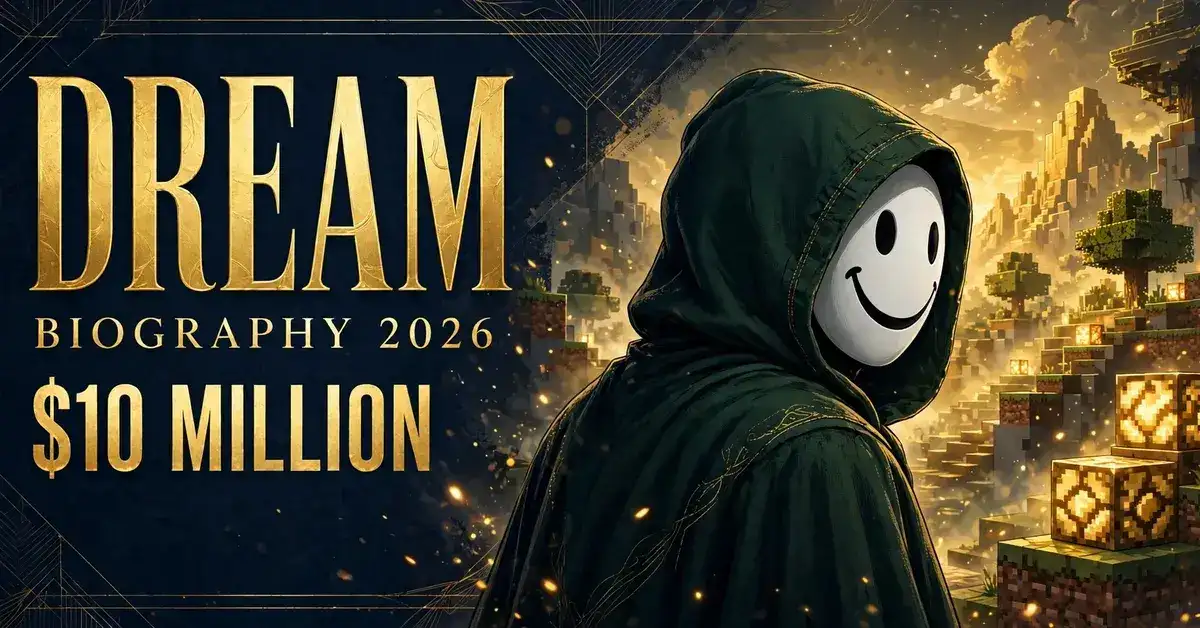
That mask is the whole story in one image. Dream hid behind it for three years, showed his face to the world in October 2022, and put the mask back on eight months later. In between came a speedrun cheating scandal that cost him his records, a music career with three 2021 singles, a Dream Team podcast, and a fortune built from YouTube ads, merch, music and sponsorships. In November 2025 he told his audience he had broken his wrist and might not be able to make the videos that made him famous. In 2026 he came back anyway, with a six-hunter Manhunt rematch that pulled 17 million views in its first months.
This biography lays out the full picture: the real-name mystery that no outlet has ever solved, the 2019 breakout, the Manhunt format and the Dream SMP server that defined an era of Minecraft, the cheating controversy told straight with both sides, the face reveal and the mask’s return, the money breakdown behind the $10 million estimate, and where Dream stands in November 2026 — 34.8 million subscribers, a healing wrist, and a second act still taking shape.
Quick Facts: Dream
- Real name: Clay (full surname unconfirmed — see the name section below)
- Online name: Dream / DreamWasTaken (formerly DreamTraps)
- Born: August 12, 1999, Orlando, Florida, USA (some profiles list Longwood)
- Age in 2026: 27 (turned 27 on August 12, 2026)
- Height: 6 ft 2 in (188 cm) per Guide Net Worth’s adjudication; listings vary from 6 ft to 6 ft 4 in
- Net worth (2026): $10 million estimated (range $6M–$15M)
- YouTube subscribers: 34.8 million (vidIQ, November 11, 2026); 4.5 billion total views
- Channel created: February 8, 2014, as DreamTraps; regular uploads from July 2019
- Known for: Minecraft Manhunt, Minecraft speedruns, the Dream SMP server
- Music: Singles “Mask”, “Roadtrip” and “Change My Clothes” (all 2021); labels Dream, Mercury, Republic
- Awards: Streamy Award for Gaming, 2020 and 2021
- Merch: dream.shop
- Family: Younger sister Drista (streamer), an older sister, a younger brother; cat Patches
How This Estimate Was Made
Dream has never published his finances, and no tax return, contract or bank statement has ever been seen by anyone outside his own circle. Every figure in this article is an estimate built from reported numbers.
- Ad-only floor: NetWorthSpot, which counts YouTube advertising alone, puts Dream at $4.4 million (updated October 1, 2026), with up to $6.2 million when other revenue is counted, and about $1.1 million a year in ad earnings.
- Whole-business range: StreamScheme, which counts ads, merch, music and sponsorships together, gives $6–15 million (January 2026). Uniforumtz gives $8–12 million (March 2026). Richradarz gives $10–20 million.
- Anchor: $10 million — the midpoint of the whole-business trackers, and the figure our own Dream net worth profile settles on after the same adjudication.
- Outlier rejected: one outlet claims $35–40 million without sourcing it. This article names that figure as the outlier it is and does not use it.
- What this is not: a bank statement. The honest answer is a range, $6M–$15M, with $10M as the best-supported single figure.
+
The Ten-Million-Dollar Question
The number that matters first: $10 million. That is where the weight of 2026 reporting lands, and it is the figure our Dream net worth profile settles on after weighing every tracker. StreamScheme put the range at $6–15 million in January 2026. Uniforumtz gave $8–12 million in March. NetWorthSpot, counting YouTube ads alone, put him at $4.4 million in its October 1, 2026 update — and then admitted the real number could reach $6.2 million once other revenue was counted. Richradarz lands at $10–20 million. Worthypedia lists $12 million. Zyntharo gives $5–10 million.
Readers who have seen a different number are not imagining things. The spread runs from $4.4 million to $20 million across the serious trackers, and one outlet claims $35–40 million. That gap is the story of this biography as much as the number itself. Dream’s income is private, his business is split across at least four streams — YouTube ads, merch, music and sponsorships — and the trackers count different combinations of those streams. An ad-only tracker and a whole-business tracker can look at the same channel and land $10 million apart, because they are measuring different things.
The $10 million anchor sits in the middle of the whole-business estimates and above the ad-only floor, which is exactly where it should sit for a creator whose merch line and music career are real businesses. A channel with 34.8 million subscribers and 4.5 billion views earns roughly $1.1 million a year from ads alone, per NetWorthSpot. Add a merch store that has sold the smiley-face mask to millions of fans, three music singles released through major-label distribution, and sponsorship money from the biggest years of the Dream SMP, and $10 million is the figure the evidence supports. The $35–40 million claim, by contrast, has no sourcing behind it and no math that survives a look at the ad numbers. This article leaves it where it belongs: in the outlier column.
Why the Estimates Disagree by Tens of Millions
Start with the low end. NetWorthSpot’s $4.4 million is the most careful number in circulation, and also the least complete. It counts YouTube advertising revenue and nothing else. It is a floor, not a fortune. The site says so itself: count the other revenue and the figure could reach $6.2 million. A creator who sells merch and releases music cannot be priced on ads alone, and anyone who quotes $4.4 million as Dream’s total wealth is quoting a partial figure as if it were the whole thing.
StreamScheme’s $6–15 million range takes the opposite approach. It counts the whole business — ads, merch, music, sponsorships — and then admits the uncertainty with a $9 million-wide range. That range is honest. Dream’s merch sales are not public. His music royalties are not public. His sponsorship rates are not public. A tracker that claims a single precise number for a private creator is guessing with a straight face. StreamScheme’s range says the quiet part out loud: the business is worth somewhere between $6 million and $15 million, and $10 million is the middle of that band.
The high end is where the numbers stop being estimates and start being wishes. Richradarz’s $10–20 million credits the merch and music scale generously but stays inside the plausible band. Press Farm’s $35–40 million does not. Nothing in the public record supports it. Dream has never appeared on a Forbes creator earnings list. He has no public brand empire, no venture portfolio, no reported nine-figure deal. A $35 million fortune would need roughly $5 million a year in after-tax income across seven years, and the ad math — $1.1 million a year from YouTube — does not get anywhere near that. The merch and music would have to be doing extraordinary numbers to close the gap, and no tracker has ever shown those numbers. Treat the $35–40 million figure as a traffic number, not a wealth number.
Clay, Not Clayton: The Name Nobody Can Confirm
Dream’s real first name is Clay. That much is confirmed, and it is almost the only thing about his identity that is. His surname has never been confirmed by Dream himself, and the outlets that print one are guessing — some of them loudly.
Kotaku reported the name Clayton Huff. Other profiles print Clayton Ray Huff. Polygon, in its October 4, 2022 explainer of the face reveal, said plainly that his last name was unknown. Chi-nese.com, updating its DreamWasTaken profile on October 22, 2026, noted that the full name is widely reported as Clayton Ray Huff while adding that he has never publicly verified it through an independently confirmed source. Fan wikis have printed yet another version, “Clay Lucas Bryce”, with no sourcing at all. Wikipedia, updated November 3, 2026, prints only “Clay” — and Wikipedia is right to do so.
The confusion is the point, not a footnote. Dream built the biggest Minecraft channel on the planet while keeping his surname private, and four years after his face reveal the surname is still not a settled fact. This article prints only “Clay” as confirmed and treats every reported surname as unconfirmed, because that is what the evidence supports. Any biography that states a surname as fact is repeating a rumour with a citation attached.
What is confirmed about the man behind the name fills in the rest of the picture. He was born on August 12, 1999, in Florida — most profiles list Orlando, some list the nearby city of Longwood. He has three siblings: a younger sister who streams as Drista, an older sister, and a younger brother. He once worked for AppleCare, the tech-support arm of Apple, before YouTube paid the bills. He has spoken publicly about an ADHD diagnosis, in a June 2021 interview with Anthony Padilla. He had a cat named Patches. None of that is glamorous. All of it is documented, and it is a better portrait of the person than any invented surname.
Florida, Fourteen, and a Channel Called DreamTraps
Dream created his YouTube channel on February 8, 2014, under the username DreamTraps. He was 14 years old. For five years, almost nobody watched. He uploaded Minecraft content in fits and starts, learned the game inside out, and built the technical skill that would later look like magic on camera. The channel sat in obscurity until July 2019, when he started uploading regularly — and then, in the space of a few months, everything changed.
The breakout video was a piece of detective work. In 2019 Dream published a video about finding PewDiePie’s Minecraft world seed — the string of numbers that generates a specific Minecraft world — and reverse-engineering the exact world the biggest YouTuber on the planet was playing in. It was the kind of video only a player with thousands of hours in the game could make, and it was the kind of video the Minecraft community had never seen. The seed video pulled in viewers who had never heard of Dream, and the speedrun videos that followed kept them.
The speed of the rise is hard to overstate. Dream went from a channel with a few thousand subscribers to one of the fastest-growing channels on YouTube in under two years. By the end of 2020 he had passed 10 million subscribers. By 2021 he had passed 20 million, then 30 million. YouTube named him a breakout gaming creator in 2020, and he won the Streamy Award for Gaming in 2020 and again in 2021. He did all of it without showing his face, without a camera on his desk, and without ever leaving Orlando. Our Dream age profile runs the full year-by-year timeline of that rise, from 14 to 27, for readers who want the dates in order.
The early years explain the later ones. Dream did not go viral by accident. He spent five quiet years learning Minecraft at a level few players reach, then arrived in 2019 with skills the audience could not look away from. The channel’s first five years look like failure from the outside. From the inside, they were practice.
The 2019 Breakout: A Seed, a Speedrun, and Overnight Fame
The seed video opened the door. The speedruns kicked it down. Dream’s Minecraft speedruns — attempts to beat the game as fast as possible, with the clock running and the world generated at random — were genuinely fast, and they were genuinely dramatic. He narrated them with a calm, dry confidence that made the impossible look routine. Viewers who had never cared about speedrunning found themselves watching a teenager from Florida beat Minecraft in under half an hour and explaining, in real time, why every decision mattered.
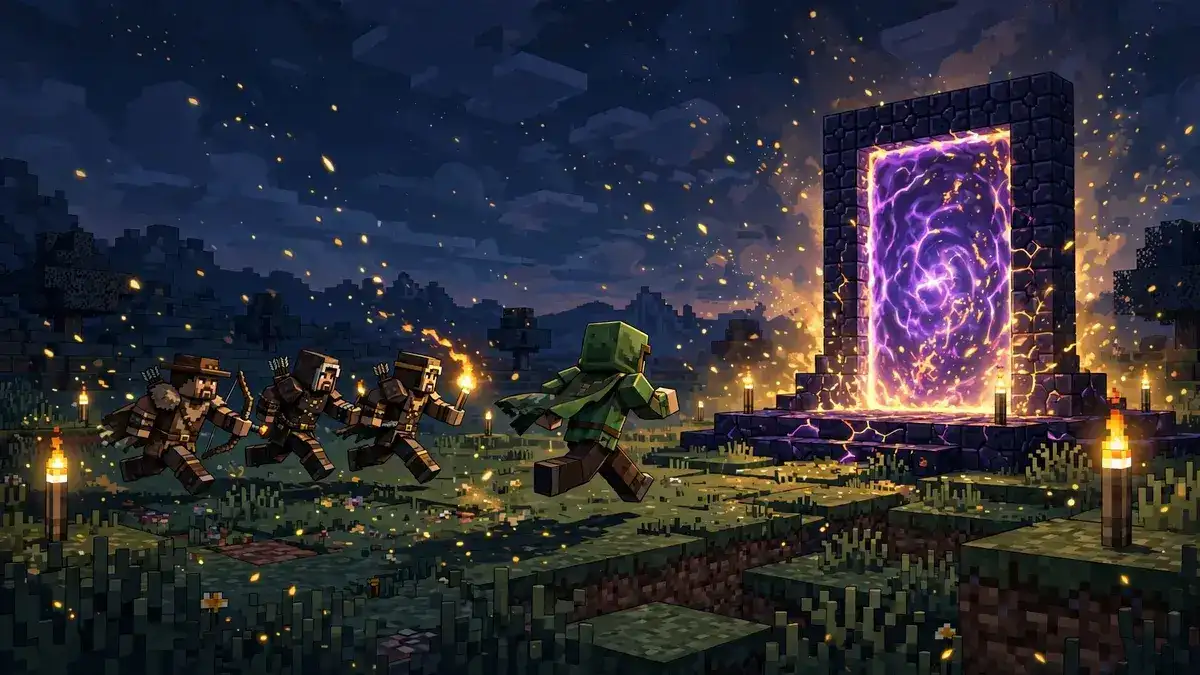
Then came the format that made him a star. In December 2019 Dream uploaded the first episode of Minecraft Manhunt, a series built on a simple idea: he tries to beat Minecraft while his friends hunt him down and try to kill him first. The hunters start with nothing and chase him across the world. Dream starts with nothing too, and has to gather gear, reach the Nether, kill the Ender Dragon and win — while being hunted the whole time. Every episode is a chase, a puzzle and a piece of theatre at once, and the audience gets to root for the runner and the hunters at the same time.
Manhunt worked because it turned Minecraft into a sport. The rules were clear, the stakes were visible, and the ending was never certain. One early episode, posted in August 2020, featured Dream against three hunters and became his first video to pass 50 million views. The most-viewed episode in the series has 135 million views as of April 2025, per Wikipedia. The series ran until February 26, 2022, when the final episode of the original run was published — and then, four years later, Dream brought it back.
Minecraft Manhunt: The Format That Made Him
Manhunt is the single most important thing Dream ever made. It is the series that took him from a fast-growing Minecraft channel to a cultural event. The format is simple enough to explain in one sentence, and deep enough to fill dozens of episodes. Dream speedruns Minecraft. His friends — usually GeorgeNotFound, Sapnap and BadBoyHalo — try to stop him. The hunters get a compass that points at Dream. Dream gets nothing but his own skill.
The episodes built a language of their own. Fans learned the jargon: the Nether portal trap, the TNT trick, the pearl clutch, the moment Dream turns a chase into an ambush. Each episode raised the stakes. More hunters. Harder rules. New twists — Dream versus five hunters, Dream versus a hunter with a head start, Dream trying to beat the game while the hunters get better gear. The series became appointment viewing for millions of teenagers, and the comment sections turned into strategy debates that ran for thousands of posts.
The format also made Dream’s friends into stars. GeorgeNotFound and Sapnap were hunters before they were household names in the Minecraft community, and their chemistry with Dream — the teasing, the panic, the genuine friendship underneath the competition — is what kept viewers coming back after the novelty of the chase wore off. Manhunt was never only about Minecraft. It was about three friends trying to outsmart each other in front of 30 million people.
The Dream SMP: Three Years Running the Internet
In April 2020, shortly after Minecraft snapshot 20w17a, Dream and GeorgeNotFound created the Dream SMP — a private survival multiplayer server where a group of creators played Minecraft together and built a shared story through roleplay. The server launched on April 25, 2020, and within months it was the centre of the Minecraft internet. More than 30 creators eventually joined, including TommyInnit, Technoblade, Wilbur Soot, Quackity, Sapnap and Karl Jacobs. The server had wars, factions, betrayals, elections and funerals. It had a plot that ran for years, written live by the people playing it.
The numbers were unlike anything Minecraft had seen. In January 2021, over a million people tuned into Dream SMP livestreams at the same time. The server’s storylines trended on Twitter for days at a stretch. Fan art, fan fiction and fan theories piled up by the thousand — in 2021, a fanfic about a fictional romance between Dream and GeorgeNotFound became the highest-rated story on the fan-fiction platform Archive of Our Own. The Dream SMP was not a server. It was a television show that happened to be played inside a video game, and its cast was the most-watched group of creators on the internet.
The server’s most active era ended in late 2021, as members drifted toward their own projects. Dream said in March 2023 that a second season was unlikely, with members busy and the loss of Technoblade — who died in June 2022 — weighing on the group. The server itself never formally closed. On November 12, 2024, Dream released a copy of the Dream SMP world map for anyone to download. On July 9, 2025, he logged back onto the server during a stream, spawned in a plains biome, died, respawned in a stronghold, and was told to leave by the server operator. He logged off. The moment lasted minutes, and fans clipped it for weeks.
The Dream Team: GeorgeNotFound, Sapnap and the Podcast
Dream did not build his channel alone. The Dream Team — Dream, GeorgeNotFound and Sapnap — became one of the most recognisable trios in gaming, and the friendship at its centre is the reason the channel worked. GeorgeNotFound, a British creator, was Dream’s first collaborator and the co-founder of the Dream SMP. Sapnap, from Texas, was the third hunter, the loudest voice in the group, and the friend who pushed Dream into the boxing training that would later break his wrist. The three lived together in Orlando at one point, streamed together constantly, and built a shared audience that followed all three channels at once.
The trio also host the Dream Team podcast, where the Minecraft personas drop away and the three talk about their lives, their work and the strange business of being famous without ever having applied for it. The podcast matters because it is the one place Dream sounds like a person rather than a brand. He talks about the pressure of the mask, the weight of the audience, and the oddness of being recognised by voice alone. Listeners who only know the Manhunt runner meet someone quieter, funnier and more tired than the legend suggests.
The friendship has survived the things that usually end creator groups: money, fame, controversy and distance. GeorgeNotFound moved to the United States in part so the three could make content together in person — the same move that pushed Dream toward the face reveal in 2022. Sapnap’s boxing training in 2025, the training that broke Dream’s wrist, was a friend helping a friend prepare for a fight. The Dream Team is a business partnership, but it reads like a friendship first, and that is why the audience stayed.
The Speedrun Controversy, Told Straight
Every biography of Dream has to deal with the cheating scandal, and most of them deal with it badly — either by skipping it or by treating it as a punchline. Here is what happened, with the dates and the sources attached.
In December 2020, the moderation team at speedrun.com published a 14-minute video and a research paper summarising a two-month investigation into Dream’s Minecraft speedruns. The paper showed that the drop rates for certain items in his runs were so unlikely that they could not be explained by luck. The moderators concluded the runs had been played with modifications that changed the game’s odds. Dream’s records were removed. Dream denied the allegations, and the argument ran for months — Dream against the moderators, the moderators against Dream, and the Minecraft community split down the middle. Matt Parker, the mathematician behind the YouTube channel Stand-up Maths, examined the numbers and said Dream was either cheating or the luckiest person who had ever lived.
In May and June 2021, Dream changed his position. He said he had realised a modified client — a recording mod — had been active during the runs, and that it had affected the drop rates without his knowledge at the time. He apologised to the moderators and to his audience. Ars Technica reported the admission on June 2, 2021. The records stayed removed. Dream has never claimed the runs were clean since, and he has also said he handled the first response badly — in a June 2021 interview with Anthony Padilla he put it plainly: “I handled the situation horribly. When it originally came out, my response was, You guys are idiots, blah blah blah.”
The story did not end there. In October 2026, a new round of claims arrived from independent YouTube investigators. On October 10, 2026, Dart Spark posted a video titled “Dream’s ‘UNCUT’ Manhunts Are a Lie”, alleging that hidden cuts had been made in Manhunt episodes presented as uncut. On October 29, 2026, Karl Jobst — who had defended Dream in public for five years — posted a private message in which Dream allegedly said he had used aimbot software after his wrist surgery. In the same month, Eliotex and MrMangoHands published investigations into Dream’s world records. These are claims by independent creators, not findings by any official body, and no confirmation from Dream was established in this research. They are reported here because a biography written in November 2026 that ignored them would be out of date — and because the reader deserves to know the difference between a verified finding, like the 2020 speedrun report, and an unproven claim, like the October 2026 videos.
One more controversy belongs in this section, briefly. In October 2022, an anonymous account posted allegations of grooming against Dream. More followed over the next year. Dream denied the allegations, and in December 2023 he posted a nearly 90-minute video addressing them in detail. No legal charges have ever been filed. The allegations and the denial are both on the public record; the charges are not. This article states that plainly and leaves it there.
The Face Reveal and the Mask Coming Back
For three years, the mask was the brand. A white smiley face, a green hood, no face at all — and it worked better than any face could have. Fans drew it, wore it, tattooed it. The mask let Dream be famous without being recognised, and it let the audience project whatever they wanted onto the voice behind it. It was also, by Dream’s own account, an accident. He has said the mask was never a calculated move. It started as a way to stay anonymous, and the audience turned it into an icon before he had time to think about it.
On October 2, 2022, he took it off. The video was called “hi, I’m Dream”, and it did numbers that matched the occasion: more than 25 million views in the first 24 hours, 1.5 million concurrent viewers at its peak. Dream said he was revealing his face because he wanted to meet his friends in person, film content with his face in it, and live a normal life — GeorgeNotFound was moving to the United States, and the three of them wanted to make videos together without hiding. The reaction was not what anyone hoped for. Dream was mocked for his looks across social media in the days after the reveal, and the pile-on was ugly enough that other creators spoke out against it.
Eight months later, the mask came back. In June 2023, Dream announced that he would wear the mask again, and the face-reveal video was taken down. He did not frame it as a retreat. He framed it as a return to the thing that had worked — the mask was the brand, the face was a distraction, and the audience had shown him which one they preferred. The mask has stayed on since. It is on the merch, on the channel art, and on the thumbnail of every video. The face reveal is now a piece of history: a 23-year-old showed his face to 30 million people, learned what the internet does with a face, and put the mask back on.
Music, Merch and the Business Beyond YouTube
Dream’s second business is music, and it started the same way the channel did: quietly, then all at once. In 2021 he released three singles — “Mask” in February, “Roadtrip” with PmBata, and “Change My Clothes” with Alec Benjamin in August. The songs were not a joke or a side project. They were released through major-label distribution — his labels are listed as Dream, Mercury and Republic — and they charted on the strength of an audience that already numbered in the tens of millions. “Mask” was the statement of intent: a song about hiding behind a face that was not yours, from a man whose whole career was built on exactly that. Later singles followed, and the music became a real revenue stream rather than a merch table afterthought.
The third business is the merch store at dream.shop, and it is the one that explains the gap between the ad-only trackers and the whole-business trackers. The smiley-face mask is not a piece of clothing. It is a symbol that millions of teenagers recognise instantly, and the store sells it on hoodies, shirts, plush toys and accessories. No sales figures are public — Dream has never disclosed them — but the scale of the audience makes the scale of the store easy to understand. A creator with 34.8 million subscribers does not need a high conversion rate to move a large volume of merch. One per cent of the audience buying one item a year is 348,000 orders.
The fourth stream is sponsorships, and it is the quietest of the four. Dream has never been a creator who reads ad copy on camera, and his sponsorships have mostly run through the Dream SMP era, when brands wanted access to the biggest Minecraft audience on the platform. None of the deals carried a published dollar figure, so this article does not invent one. What the brand interest proves is marketability: Dream was not only a YouTuber with a big audience, he was a YouTuber other companies wanted to be associated with. That is the difference between a channel and a business.

Where the Money Comes From: The Income Breakdown
Dream’s fortune has four legs, and they are not equal. YouTube advertising is the only one with a published estimate: NetWorthSpot puts it at about $1.1 million a year, based on the channel’s view counts. That is the floor of the business. Everything else sits on top of it, and the table below labels each figure honestly — reported where a source exists, estimated where it does not.
| Income Stream | Estimated Annual Value | What We Know |
|---|---|---|
| YouTube advertising | ~$1.1 million (NetWorthSpot, Oct 2026) | 34.8M subscribers, 4.5B lifetime views; 6 long-form videos + 42 Shorts in the Mar–Oct 2026 window |
| Merchandise (dream.shop) | $1–3 million (estimated) | Smiley-face mask branding on apparel and accessories; no sales figures published; scale implied by audience size |
| Music royalties | $200,000–$500,000 (estimated) | Three 2021 singles plus later releases; distribution through Dream, Mercury and Republic labels |
| Sponsorships and brand deals | $500,000–$1 million (estimated) | Peak during the Dream SMP era; no deal values published |
| Twitch and streaming | Under $200,000 (estimated) | Streaming is secondary to YouTube; no published figures |
Add the ranges together and the business plausibly generates $3 million to $5.8 million a year in gross revenue at its current pace — less than the Dream SMP peak, when the merch and sponsorship lines were running at full speed, and more than the ad-only figure the cheapest trackers print. The net-worth math follows from there. Dream has been earning at this level since 2020, with the biggest years in 2020 and 2021, and he has had six years to accumulate. A $10 million fortune after six years of multi-million-dollar gross revenue, minus taxes, management, production costs and living expenses, is the figure the evidence supports. The table is also the reason the $4.4 million estimates look thin: a creator with four income streams cannot be priced on one of them.
One more detail sharpens the picture. Dream’s output slowed after 2022, and the revenue slowed with it. The channel published 6 long-form videos in the eight months from March to October 2026, against 42 Shorts — and Shorts pay a fraction of what long-form videos pay. The 2026 Manhunt revival pushed the numbers back up: the March rematch drew 17 million views and the October finale drew 14 million. The business is not dead. It is lumpy, tied to the big videos, and dependent on Dream’s wrist holding up long enough to make them.
Dream Against the Creator Giants
Context turns a number into a story. The table below compares Dream with seven other creators, using Guide Net Worth’s own published estimates for each of them. The gap between Dream and the top of the list is the story of output: MrBeast built a $2.6 billion empire by uploading relentlessly and reinvesting everything. Dream built $10 million by uploading rarely and letting a handful of giant videos do the work.
| Creator | Net Worth (Guide Net Worth estimate) | Why the Figure Differs |
|---|---|---|
| MrBeast | $2.6 billion | A business empire — Feastables, Beast Philanthropy, a media company — on top of the biggest channel on Earth |
| KSI | $100 million | Prime Hydration and boxing paydays on top of a decade of YouTube |
| Ninja | $50 million | Fortnite-era streaming deals, including the reported Mixer contract, at peak streaming rates |
| Markiplier | $45 million | A decade of daily uploads, film projects and a merch empire built on consistency |
| IShowSpeed | $40 million | Relentless live streaming and global tours at a pace Dream never attempted |
| DanTDM | $35 million | The other Minecraft giant — a decade of family-friendly uploads with no gaps in output |
| Dream | $10 million | A handful of giant videos, a merch line and a music career — built on scarcity, not volume |
| Ludwig | — | The streamer-turned-mogul peer: subathons, Mogul Moves and a business built on live hours |
Two comparisons carry the real lesson. DanTDM sits at $35 million — the other Minecraft giant, and the proof of what Dream’s channel might have been worth with a decade of steady uploads instead of long gaps. Markiplier sits at $45 million on the same logic: consistency compounds. Dream’s $10 million is the price of scarcity. He made fewer videos than any creator in his weight class, and each one had to carry more of the business. The celebrity net worth archive carries the full set of these profiles for readers who want to compare the whole creator economy.
Personal Life: Family, Patches and the Wrist Injury
Dream has kept his private life private to a degree that is rare even among masked creators. He has never confirmed a public relationship, and this article does not invent one. What is known comes from his own words and from the people around him: three siblings, a cat, a house in Orlando, and a wrist that changed everything.
The siblings are part of the story. His younger sister, who streams as Drista, has appeared in his content and built her own audience from it. His older sister and younger brother stay out of the spotlight. The family thread runs through the channel in small ways — Drista’s appearances, the jokes about growing up together, the sense that the Dream Team house in Orlando was an extension of a family home rather than a content house. Dream’s height is another small fact that fans have measured for years: our Dream height profile settles it at 6 feet 2 inches, with listings running from 6 feet flat to 6 feet 4 inches, and no verified measurement ever published.
Patches, the cat, was a fixture of the early channel — mentioned in videos, photographed with the mask, and mourned by fans when he was no longer around. It is a small detail, and it is the kind of detail that tells you more about a creator than a subscriber count does. Dream’s audience did not only watch the Manhunts. They watched the life around them.
Then came the wrist. On November 4, 2025, Dream released a video on his main channel in which he said he had broken his scaphoid bone — a small bone in the wrist — about six months earlier, while helping Sapnap train for an upcoming boxing match. The break had not healed properly. He had undergone surgery and a bone graft to try to fix it, and he was still in a cast at the time of the upload. He said the injury might affect his ability to make the skill-intensive Minecraft challenge videos that built his channel, and he admitted that his recent uploads had been pre-recorded before the surgery — filmed while the injury was already affecting his gaming. It was the most honest video he had made in years, and it put his whole 2026 in doubt.
Dream in 2026: Shorts, Six Hunters and the Second Act
The doubt did not last. Dream’s 2026 started with a return to the format that made him. On March 30, 2026, he published “Minecraft Speedrunner VS 6 Hunters REMATCH” — six hunters, one runner, 52 minutes of chase — and it drew 17 million views. On August 9, 2026, came “Minecraft Speedrunner Swap VS 3 Hunters”, with 7 million views. On October 20, 2026, the “FINALE” of the six-hunter run landed with 14 million views. The Manhunt was back, and the audience was back with it.
The shape of the channel has changed, though. Between March 14 and October 29, 2026, Dream published 48 videos — but only 6 of them were long-form. The other 42 were Shorts: quick Minecraft explainers, jokes and challenges, most under a minute long. “The YouTube Algorithm Explained In Minecraft” (April 18, 2026) and “Traffic Jams Explained In Minecraft” (May 3, 2026) each drew millions of views in under a minute of footage. Shorts keep the channel alive between the big videos, but they pay a fraction of what a 50-minute Manhunt pays. The business model has shifted from event videos to a steady drip, with the events doing the heavy lifting.
The wrist is the open question. Dream’s November 2025 video said the injury might limit the skill-intensive videos, and the 2026 slate — six long-form videos in eight months — is consistent with a creator managing a physical limit rather than a creative one. The six-hunter rematch proves he can still make the videos that matter. The Shorts prove he has found a way to stay visible when he cannot. What happens next depends on the bone, not the brand — and that is the honest place to end a biography of a creator whose whole career has been a negotiation between what his body can do and what his audience wants to see.
Frequently Asked Questions
What is Dream’s real name?
Dream’s real first name is Clay. His full surname has never been confirmed. Kotaku reported Clayton Huff, other profiles say Clayton Ray Huff, and Polygon noted at the time of the face reveal that his last name was unknown. This article prints only “Clay” as confirmed and treats every reported surname as unconfirmed.
How old is Dream?
Dream is 27 years old in 2026. He was born on August 12, 1999, in Florida, and he turned 27 on August 12, 2026. He started his YouTube channel at 14, broke out at 20, revealed his face at 23, and put the mask back on before he turned 24.
What is Dream’s net worth in 2026?
Dream’s net worth in 2026 is estimated at $10 million, inside a range of $6 million to $15 million. StreamScheme gives the range as $6–15 million (January 2026) and uniforumtz gives $8–12 million (March 2026). NetWorthSpot, counting YouTube ads alone, puts him at $4.4 million (October 2026). One outlet claims $35–40 million without sourcing it; this article treats that as the outlier it is.
Did Dream cheat in his Minecraft speedruns?
In December 2020 the speedrun.com moderation team published an investigation concluding that Dream’s speedrun drop rates were too unlikely to be luck, and his records were removed. Dream denied it at first, then in May and June 2021 admitted a modified client had been active during the runs and apologised. New claims surfaced in October 2026 from independent YouTube investigators, including Dart Spark and Karl Jobst, but those are unverified claims, not findings by any official body.
Why did Dream put his mask back on?
Dream revealed his face on October 2, 2022, in the video “hi, I’m Dream”, and was mocked for his looks in the days that followed. In June 2023 he announced the mask was returning and the face-reveal video was taken down. He framed it as a return to the brand that worked — the mask was the icon, and the face had become a distraction.
Is Dream still making videos in 2026?
Yes. Dream published 48 videos between March 14 and October 29, 2026 — 6 long-form videos and 42 Shorts, per vidIQ. The biggest were the Manhunt revival: “Minecraft Speedrunner VS 6 Hunters REMATCH” (March 30, 2026, 17 million views) and the “FINALE” (October 20, 2026, 14 million views). His channel stood at 34.8 million subscribers on November 11, 2026.
How tall is Dream?
Dream is 6 feet 2 inches tall (188 cm), per Guide Net Worth’s adjudication in our Dream height profile, with an honest range of 6 feet 2 inches to 6 feet 3 inches. Listings elsewhere run from 6 feet flat to 6 feet 4 inches, and no verified measurement has ever been published.
What happened to Dream’s wrist?
In a video on November 4, 2025, Dream said he had broken his scaphoid bone about six months earlier while helping Sapnap train for a boxing match. The break was struggling to heal, he had undergone surgery and a bone graft, and he was still in a cast. He said the injury might affect his ability to make skill-intensive Minecraft challenge videos, and that his recent uploads had been pre-recorded before the surgery.
Sources & Reporting
This article was reported from live sources in November 2026. Net-worth figures come from StreamScheme (January 2026, $6–15 million), NetWorthSpot (updated October 1, 2026, $4.4 million ad-only, up to $6.2 million all-revenue, ~$1.1 million a year), uniforumtz (March 14, 2026, $8–12 million), richradarz ($10–20 million), worthypedia (May 2026, $12 million), zyntharo (July 2026, $5–10 million), and Press Farm ($35–40 million, treated as an unsourced outlier). Biographical facts come from Wikipedia’s Dream (YouTuber) page (updated November 3, 2026: born August 12, 1999; channel created February 8, 2014; most-viewed Manhunt 135 million views; music labels Dream, Mercury, Republic; November 4, 2025 wrist-injury video), Polygon’s face-reveal explainer (October 4, 2022), NME’s face-reveal coverage (October 4, 2022), Ars Technica’s speedrun admission report (June 2, 2021), thefamouspeople.com (32.7 million subscribers; family details), and chi-nese.com (updated October 22, 2026). 2026 upload data and subscriber counts come from vidIQ (November 11, 2026: 34.8 million subscribers, 4.5 billion views). The October 2026 claims are attributed to Dart Spark (October 10, 2026), Karl Jobst (October 29, 2026), Eliotex and MrMangoHands, and are reported as unverified claims by independent investigators. Peer net-worth figures in the comparison table are Guide Net Worth’s own published estimates, verified live on this site in November 2026. Reporting window: November 19, 2026.
All net-worth figures are estimates based on publicly reported information. No audited financial statements exist for Dream, and no figure in this article should be read as a confirmed bank balance. If you spot an error, contact us through the corrections line on our About page and we will fix it.
References & Sources
This article has been fact-checked and verified against multiple public sources, financial disclosures, SEC filings, Forbes reports, Celebrity Net Worth databases, and official records. All net worth estimates are based on publicly available information and financial analysis.