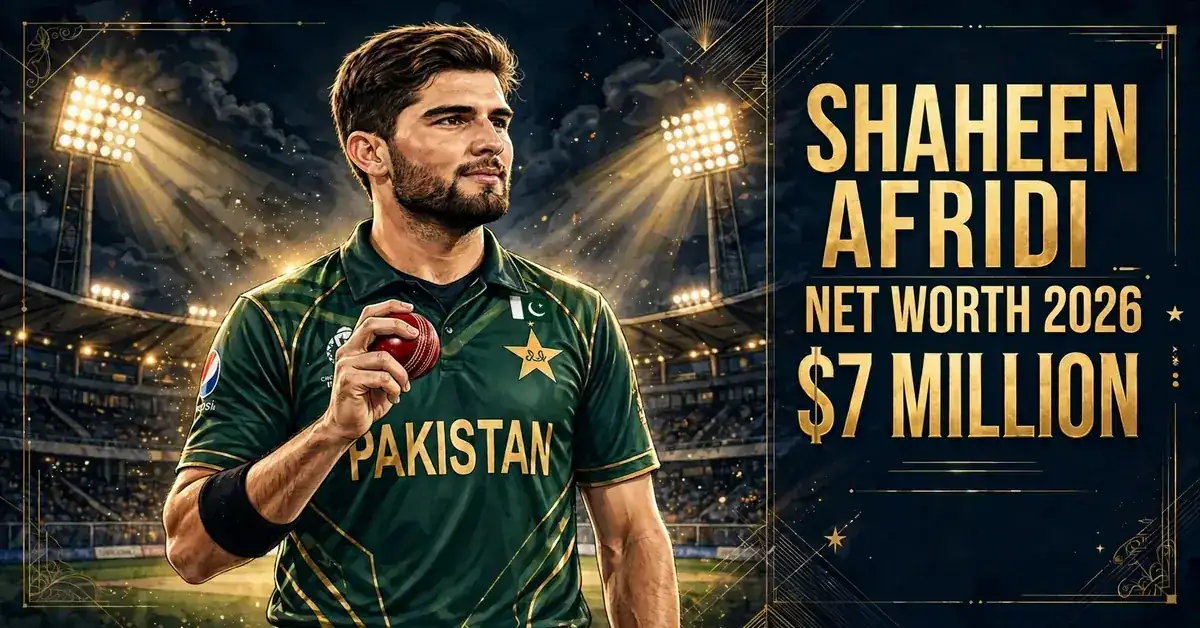
Shaheen Afridi’s net worth in 2026 is estimated at $7M–$8M. Inside: PCB pay, three PSL titles as Lahore captain, the $400K ILT20 deal and the brands behind it.
Last updated: November 21, 2026 · By Nathan Cole
Shaheen Afridi’s net worth in 2026 is estimated at $7 million to $8 million, anchored at $7 million. The 26-year-old left-arm fast bowler from Landi Kotal is, by the most careful recent reporting, the richest active cricketer in Pakistan — CricketWinner’s 2026 ranking of the country’s richest players puts him at No. 1 with about ₹66 crore, and Tapmad’s 2026 breakdown lands on the same figure from the other side of the border: about PKR 198 crore. The money comes from four places that stack neatly: a PCB central contract worth roughly PKR 5–6 crore a year, a Platinum PSL deal of about PKR 7 crore a season as captain of Lahore Qalandars, franchise contracts in the UAE and Australia worth a combined $670,000 a year, and an endorsement portfolio led by Pepsi, Realme and Zero Lifestyle.
What makes the number interesting is not its size. It is how fast it was built, and how much of it depends on one skill: bowling fast, left-arm, with the new ball, in the first over. Shaheen made his international debut at 18, won the ICC Cricketer of the Year award at 21, and by 26 had passed 400 international wickets, taken 100 wickets in every format, and captained Lahore Qalandars to three PSL titles — the first captain in the league’s history to do it. In May 2026 he added two more firsts in the same Test match in Bangladesh: the first Pakistani bowler to 100 World Test Championship wickets, then his 400th international wicket four days later. He is also, since late 2025, Pakistan’s ODI captain. Every one of those milestones is a pay rise in waiting, because franchise leagues pay for exactly this profile: a proven new-ball wicket-taker who captains sides and wins finals.
This article lays out the full picture: the estimate and why the sources disagree, the year-by-year money from the PCB, the PSL and the franchise circuit, the brands, the records that drive the price, and the family story behind the bowler. Every figure is tied to a named source. Where the reporting disagrees — most sharply on a $25 million figure floating around the search results — the disagreement is printed in full, with the arithmetic that settles it.
Quick Facts
| Full Name | Shaheen Shah Afridi |
| Age in 2026 | 26 years old (born April 6, 2000, Landi Kotal, Khyber District, Pakistan; turned 26 on April 6, 2026) |
| Role | Left-arm fast bowler; Pakistan ODI captain; Lahore Qalandars captain |
| Net Worth 2026 | Estimated $7 million–$8 million, anchored at $7 million (CricketWinner ₹66 crore; Tapmad PKR 198 crore; icecric.news $7M) |
| PCB Contract | Category B central contract; about PKR 3–4.5 million a month including match fees and bonuses |
| PSL | Lahore Qalandars, Platinum, about PKR 7 crore a season; captain since December 2021; titles 2022, 2023, 2025 |
| Franchise Deals | Desert Vipers (ILT20) ~$400,000 a year + image rights; Brisbane Heat (BBL) ~$270,000 for 2025–26 |
| Career Wickets | 408 international wickets as of September 1, 2026 — 126 in Tests, 146 in ODIs, 136 in T20Is |
| Biggest Honour | ICC Men’s Cricketer of the Year 2021 — Sir Garfield Sobers Trophy, the first Pakistani to win it |
| Family | Married Ansha Afridi (Shahid Afridi’s daughter); son Aliyaar Afridi, born August 24, 2024 |
| Endorsements | Pepsi, Oppo, Realme, GymArmour, AH Group, Zero Lifestyle, Faysal Islami, Garena Free Fire |
How This Estimate Was Made
The $7 million–$8 million net-worth figure in this article is an estimate, and it is printed as one. The $7 million anchor comes from the outlets that did the most careful recent reporting: CricketWinner’s 2026 ranking of Pakistan’s richest cricketers (₹66 crore, No. 1 on the list), Tapmad’s 2026 salary breakdown (PKR 198 crore), icecric.news ($7 million, ₹55–66 crore) and AsiaCupSchedule ($7 million, PKR 198–200 crore). The $8 million high end comes from SurpriseSports and networthbreakdown, both of which weight franchise earnings more heavily. A $25 million figure in circulation from one net-worth site is treated here as a high outlier and dealt with directly in the money section: it would require career earnings roughly three times what the reported contracts add up to. Contracts and private bank accounts are not public, so every figure here is built from reported retainers, reported match fees, reported franchise deals and reported endorsement portfolios — not from an audit. Shaheen has never disclosed his finances publicly. Corrections are welcome via the About page.
+
How Much Is Shaheen Afridi Worth in 2026?
Shaheen Afridi is worth an estimated $7 million to $8 million in 2026, anchored at $7 million. That is the figure the serious reporting converges on, and the convergence is unusually tight for a cricketer from Pakistan, where contract values are rarely published in full. CricketWinner puts him at ₹66 crore and calls him the richest Pakistani cricketer on its 2026 list. Tapmad, working from the Pakistani side, arrives at PKR 198 crore — the same money, converted the other way. Icecric.news gives a range of ₹55–66 crore and translates it as “about $7 million”. AsiaCupSchedule prints $7 million and PKR 198–200 crore side by side. Four outlets, two currencies, one number.
The high end of the range, $8 million, comes from SurpriseSports (PKR 215 crore) and networthbreakdown ($8 million flat). The difference between $7 million and $8 million is mostly a judgment call about how much of the franchise money to count as saved wealth rather than gross earnings: the ILT20 deal pays about $400,000 a year before tax and agent fees, the BBL deal about $270,000, and a bowler who plays as much cricket as Shaheen spends heavily on travel, training and support staff. Count the gross and you get $8 million. Count what survives tax, fees and a year of living on the road and you get $7 million. This article anchors at $7 million because the lower figure is the one the most detailed breakdowns support.
One number does not fit, and it is worth dealing with directly before going further. A $25 million figure attributed to one net-worth site has been quoted in some corners of the search results. It fails on the arithmetic. Shaheen’s reported annual income — PCB retainer and match fees of roughly $175,000–$200,000, a PSL season of about $240,000, an ILT20 deal of about $400,000, a BBL deal of about $270,000, and endorsements worth perhaps $300,000–$400,000 a year — adds up to roughly $1.4–$1.5 million a year at the top end, before tax and expenses. He has been earning at that level for only about three years; before 2023 his PSL deal was worth half as much and there was no ILT20 contract at all. A $25 million net worth would mean he had banked nearly every dollar he ever earned, at a rate far above his reported contracts, for eight straight years. The likely cause is the usual one for outlier figures: a site that multiplied a peak-year gross income across a whole career and called the total a net worth. The $7 million anchor stands; the $25 million figure does not.
There is a second reason the $7 million figure matters beyond the number itself. At 26, Shaheen is the youngest of Pakistan’s big earners and the only one whose income is still climbing steeply. Babar Azam, his predecessor as captain and the country’s biggest batting star, sits at an estimated $5 million on Guide Net Worth’s own profile — Babar Azam’s net worth is lower because he has played far less franchise cricket. Shaheen’s edge is structural: fast bowlers are rarer than batters in every league auction, and his left arm makes him rarer still. The money sections below show how each contract was won, and the career sections show why the next ones will be bigger.
Where the Money Comes From
Shaheen’s income has four legs, and the balance between them has shifted every year since his debut. In 2019 the PCB contract was almost everything. By 2026 the PCB is the smallest leg in gross terms, and the franchise circuit is the largest. The table below is the whole fortune at a glance, built from the reported figures named in each section that follows.
| Income Source | Reported Value | Source |
|---|---|---|
| PCB central contract | ~PKR 5–6 crore a year (Category B) | Tapmad, AsiaCupSchedule (2026) |
| PSL (Lahore Qalandars) | ~PKR 7 crore a season (~$240,000) | Tapmad (2026) |
| ILT20 (Desert Vipers) | ~$400,000 a year + image rights | CricketWinner, Lead Pakistan |
| BBL (Brisbane Heat) | ~$270,000 for 2025–26 | CricketMan2, Jeta33 |
| Endorsements | ~25–30% of annual earnings | Tapmad, CricketWinner |
| Other leagues (BPL, The Hundred, county) | ~PKR 4–5 crore across stints | CricketWinner |
| Estimated net worth 2026 | $7M–$8M (anchored $7M) | CricketWinner, Tapmad, icecric.news |
The table hides one important fact: almost none of this money existed five years ago. In 2021, the year he won the ICC Cricketer of the Year award, Shaheen’s income was a PCB retainer, a PSL deal worth roughly half its current value, and a handful of endorsements. The ILT20 did not exist in its current form, the BBL had not drafted him, and the endorsement market for Pakistani cricketers was a fraction of what it is now. The fortune is a 2023–2026 story, built in three years of franchise deals landing on top of each other. That is why the range matters more than the anchor: the $7 million of today is a snapshot of a curve that is still rising, not a settled total.
It is also worth saying plainly what the table does not show. There is no IPL money in it. Pakistani players have not played in the Indian Premier League since 2008, and Shaheen has never had access to the richest contracts in the sport. An Indian fast bowler of his standing would earn several times more from the IPL alone. Every dollar in the table above was earned in leagues that pay less than the IPL, for a board that pays less than the BCCI, in a market where endorsement rates are lower than in India. The $7 million was built without the sport’s biggest paycheque. That context is the whole story of Pakistani cricket economics in one career.
The PCB Central Contract: Category B Pay
Shaheen holds a Category B central contract from the Pakistan Cricket Board, the second tier of the board’s retainer system. The monthly figure most often reported is about PKR 3 million to PKR 4.5 million, and the spread is not sloppy reporting — it is the structure of the deal. The retainer itself is the smaller part. Match fees, win bonuses and performance allowances stack on top of it, and a three-format player who rarely misses a series earns far more than the retainer alone suggests. Tapmad’s 2026 breakdown, which separates the pieces, puts his average monthly PCB income at about PKR 4.5 million and his annual PCB income at roughly PKR 5–6 crore, or $175,000–$200,000. AsiaCupSchedule’s 2026 breakdown reaches the same place by a different route: a Category B monthly salary of PKR 3 million to 4.5 million, and a yearly total of PKR 36–54 million from the retainer alone.
The match fees are published, and they are the most concrete numbers in the whole PCB picture. A Test match pays about PKR 1.275 million, an ODI about PKR 644,000, and a T20I about PKR 418,000. A bowler who plays, say, six Tests, ten ODIs and twelve T20Is in a year — a normal workload for Shaheen — collects roughly PKR 7.65 million from Tests, PKR 6.44 million from ODIs and PKR 5 million from T20Is, about PKR 19 million in match fees alone, before the retainer is counted. That is why the per-month figure moves around in the reporting: it depends on how many games he played that month, and Shaheen plays more than almost anyone in the Pakistan side.
The Category B label itself tells a story. Category A is reserved for the board’s top tier, and Shaheen’s placement in B rather than A has been read by Pakistani media as a reflection of the board’s contract politics as much as his value — he is the team’s premier fast bowler, its ODI captain, and its most marketable player, yet the retainer band does not reflect that. The gap matters less than it used to, because the retainer is no longer his main income. Five years ago a Category B contract would have defined his year. In 2026 it is about a third of his gross earnings, and the franchise deals below are worth more than twice as much combined. The PCB still matters enormously — it is the platform that makes everything else possible, and the national contract is what keeps him in the shop window — but it stopped being the paycheque a long time ago.
One more number belongs here because it explains the lifestyle the contract supports. Shaheen is reported to own two homes: one in his hometown of Landi Kotal in Khyber Pakhtunkhwa, and one in Islamabad. His reported car collection includes a Toyota Land Cruiser and Audi sedans. These are the standard markers of a Pakistani cricketer who has arrived, and they are modest by the standards of the Indian stars he bowls against. There is no reported property portfolio, no reported business empire, no fleet of supercars. The wealth, as far as the reporting shows, sits in the bank and in the two houses — which is another reason the $7 million anchor, rather than a larger figure, is the honest one.
Lahore Qalandars and the PSL: Three Titles as Captain
The Pakistan Super League is where Shaheen’s money and his reputation meet. He has played for Lahore Qalandars since 2018, was named captain in December 2021, and has led the franchise to three PSL titles — in 2022, 2023 and 2025 — becoming the first captain in the league’s history to win it three times. He was also, in 2022, the youngest captain ever to win a T20 league. The Qalandars had finished last in five of their first six seasons before he took over. Under his captaincy they have won three of five.
The finals tell the story better than the trophy count. In 2022 Lahore beat Multan Sultans by 42 runs, with Shaheen leading from the front as the tournament’s leading wicket-taker. In 2023 they defended their title against the same opponents by a single run — the narrowest margin in PSL final history — and Shaheen won it himself, smashing 44 not out off 15 balls and then taking four wickets. In 2025 they chased down Quetta Gladiators’ 201 with one ball to spare, winning by six wickets after three knockout wins in four days. Three finals, three different ways to win, one captain. That record is the reason his PSL value keeps climbing: franchises pay for players who win finals, and Shaheen has now won three of them as captain.
The pay reflects it. As a Platinum-category player — the PSL’s top salary bracket — Shaheen earned about PKR 7 crore for the 2026 season, roughly $240,000, according to Tapmad’s season-by-season table. The same table shows the climb: about PKR 5 crore in 2024, about PKR 6 crore in 2025, about PKR 7 crore in 2026. In his early seasons the figure was roughly PKR 3.5–5 crore. The PSL does not pay IPL money, and nobody pretends otherwise, but for a six-week tournament the rate is strong — and the captaincy adds value that no salary table captures. The Qalandars are his team in a way no other franchise is: he designs their kits, he leads their attack, and he is their leading wicket-taker of all time with 141 wickets. His PSL 2025 campaign underlined the point — he finished as the tournament’s leading wicket-taker with 19 wickets at an average of 16.42, according to CricketWinner, in the season that delivered the third title.
The 2026 season is the honest footnote to the success story. Lahore finished fifth of eight teams and missed the playoffs, and Peshawar Zalmi won the title under Babar Azam’s captaincy — Babar’s first PSL title as captain, and a useful reminder that even the league’s best captain loses more seasons than he wins. Shaheen’s salary did not fall with the result: the Platinum retainer is set before the season, and his value to the franchise is measured over five years, not one. But the fifth-place finish is a useful check on the narrative. The Qalandars’ three titles came in 2022, 2023 and 2025, with a last-place finish in 2024 in between. Captaincy, like fast bowling, is a job where the failures are public and the successes are remembered.
Franchise Leagues: ILT20, BBL and the Global Circuit
The biggest single pay rise of Shaheen’s career came from the United Arab Emirates. In August 2023 he signed a three-year contract with the Desert Vipers for the International League T20, becoming the first Pakistani player in the league. The deal was reported at about $400,000 a year plus image rights, with a clause that made him one of the highest-paid players in the league for three consecutive years — if another player joined for a higher fee, his pay would rise to match. Lead Pakistan’s reporting on the contract put the annual value at close to PKR 150 million once image rights were counted. CricketWinner’s 2026 breakdown gives the same $400,000 figure. For a player whose PCB retainer is worth about $200,000 a year, a single franchise deal paying twice that, for a few weeks’ work, changed the shape of his finances overnight.
The BBL deal came next, and it came with a draft headline. In June 2025 Shaheen entered the Big Bash League international player draft for the 2025–26 season and was selected first overall by the Brisbane Heat — the No. 1 pick of the entire draft. The reported salary is about $270,000 for the season, with partial availability in the January window because of international commitments. He arrived in Brisbane in December 2025 as the leader of a depleted Heat attack — Spencer Johnson out for the season, Michael Neser on Test duty — and made his BBL debut against the Melbourne Renegades, lining up against Mohammad Rizwan, the man he had replaced as Pakistan’s white-ball captain. Cricket.com.au’s report on his arrival noted the symmetry and the expectation: the Heat had taken him first overall because they needed a bowler who could win games on his own, and that is the reputation he carries into every league.
The rest of the circuit fills in the gaps between the big deals. He played county cricket for Middlesex in 2022 and Nottinghamshire in 2023, turned out for Welsh Fire in The Hundred in 2023, and joined Fortune Barishal in the Bangladesh Premier League for the 2024–25 season. In 2026 he added the Lanka Premier League, signing for the Kandy Royals. CricketWinner’s breakdown credits these shorter stints with roughly PKR 4–9 crore in total across the BPL and English competitions, including a £100,000 valuation in The Hundred. None of these deals is large on its own. Together they add a six-figure sum to his annual income and, more importantly, they keep him visible in every market that pays fast bowlers. A bowler who has played in England, Bangladesh, the UAE, Australia and Sri Lanka is a known quantity in every auction room in the sport.
The pattern across all of it is the same. Shaheen is not a T20 mercenary who chases every league. He takes one big deal a year — the ILT20 in January, the BBL in December — and fills the gaps with short stints that do not clash with Pakistan duty. The PCB’s no-objection certificates control the calendar, and the board has shown it will block overseas stints when they clash with national commitments; in late 2025 the Pakistan players with BBL deals, Shaheen among them, waited on NOC clearance before travelling. The discipline is financial as well as professional: by keeping the franchise load to two main deals, he protects the body that earns the money, and he keeps the national contract — the platform everything else rests on — in good standing. It is a conservative schedule for a 26-year-old, and it is probably why he is still bowling at full pace.
Endorsements: Pepsi, Realme and the Brand Portfolio
Shaheen’s endorsement portfolio is the quietest part of his income and the one that has grown fastest. The names reported by CricketWinner read like a cross-section of Pakistan’s consumer economy: Pepsi and Oppo from the big-brand world, Realme from technology, GymArmour from fitness apparel, AH Group from real estate, Faysal Islami from banking, Garena Free Fire from gaming, and Zero Lifestyle — the smartwatch and accessories brand where he serves as the face of the brand under the title “Z Star”. Tapmad’s 2026 breakdown estimates endorsements at 25–30% of his total annual earnings, and CricketWinner puts the endorsement figure at roughly ₹3.4 crore a year. That is a substantial share for a cricketer whose public profile is built on bowling rather than celebrity, and it reflects a deliberate positioning: Shaheen is marketed as the disciplined, clean-cut face of Pakistani cricket, the antidote to the sport’s more volatile stars.
Pepsi is the anchor deal, and it is the one that matters most for his market value. Pepsi has sponsored Pakistani cricket for decades, and its campaigns are the closest thing the country has to a national advertising stage. A fast bowler in a Pepsi campaign is not selling a drink; he is being certified as a household name. The Realme and Oppo deals work the same way in a different market: smartphone brands in Pakistan spend heavily on cricketers because the phone buyer and the cricket watcher are the same person. GymArmour, the Pakistani fitness apparel brand, is the most personal of the deals — a fast bowler selling training wear is a credible pitch, and Shaheen’s physique, 6 ft 6 in and visibly athletic, is part of the product.
The portfolio has a ceiling, and it is worth naming. Pakistani cricketers earn far less from endorsements than Indian cricketers of similar standing, because the advertising market is smaller and the rates are lower. A comparable Indian fast bowler would command multiples of Shaheen’s endorsement income from the Indian market alone. Shaheen’s deals are all domestic Pakistani brands plus two Chinese phone makers. There is no reported global deal, no reported deal with a Western brand, and no reported personal brand venture — no clothing line, no academy chain, no product of his own. That is a gap, and it is also an opportunity: the ILT20 and BBL exposure puts him in front of audiences in the UAE and Australia that Pakistani domestic brands cannot reach, and a global deal is the most likely next step in his commercial career. For now, the endorsement line is worth perhaps $300,000–$400,000 a year — real money, but the smallest of his four income legs in some years, and the one with the most room to grow.
Landi Kotal Beginnings: Tape-Ball Cricket in Khyber
Shaheen Shah Afridi was born on April 6, 2000, in Landi Kotal, a town in the Khyber District of Khyber Pakhtunkhwa, close to the border with Afghanistan. He is the youngest of seven brothers, and cricket ran in the family before it ran in him: his eldest brother, Riaz Afridi, played one Test match for Pakistan in 2004, a left-arm fast bowler himself. The Afridi household was not wealthy, and Landi Kotal is not a place that produces international cricketers — it is a mountain town with dusty grounds, a tape-ball circuit, and long winters. Shaheen learned to bowl the way most Pakistani fast bowlers learn: with a taped tennis ball, on rough ground, against batters who had no protective gear and no fear.
The tape-ball detail matters more than it looks. Pakistani fast bowling has a specific lineage — Wasim Akram, Waqar Younis, Shoaib Akhtar — and almost all of it starts on the same surfaces: uneven, dusty, with a ball that swings late and bounces unpredictably. A bowler who learns his craft there develops two things that coaching cannot teach: a natural wrist position that makes the ball swing, and a tolerance for bowling long spells on hard ground. Shaheen’s signature delivery, the inswinging yorker to the left-hander and the ball that shapes back into the right-hander’s pads, is a tape-ball delivery refined over a decade. When he dismissed India’s top order in the 2021 T20 World Cup — Rohit Sharma and KL Rahul in his first two overs — he was bowling the ball he had learned in Landi Kotal, at international pace, under lights.
The route from Landi Kotal to the Pakistan team was fast, and it ran through the system that finds talent in the tribal districts. He was spotted on a development tour of Australia, played for the Pakistan Under-19 side, and was picked up by Lahore Qalandars in 2018 — the same year he made his international debut. Three years separated his first tape-ball games from Test cricket, which is a short apprenticeship by any standard. His height helped: at 6 ft 6 in, he is one of the tallest fast bowlers in the modern game, and height plus left-arm angle is a combination that coaches notice immediately. For the full physical picture — his exact height, how it compares with the other fast bowlers in the Pakistan attack, and what it does to his bowling — see Shaheen Afridi’s height profile.

The International Debut at 18
Shaheen made his international debut on April 3, 2018, in a T20I against West Indies in Karachi. He was 17 years old — he turned 18 three days later. The ODI debut followed in September 2018 against Afghanistan, and the Test debut in December 2018 against New Zealand in Abu Dhabi. Three formats in nine months, before his 19th birthday, is a debut arc that very few fast bowlers survive: the workload alone breaks most teenagers. Shaheen did not just survive it. Within a year he was opening the bowling in World Cup matches, and within three years he was the best bowler in the world.
The early years had a pattern that would repeat throughout his career: a spectacular performance, then a reminder that fast bowling is a fragile trade. His first great spell came in the 2019 World Cup, where he took 16 wickets in five matches, including 6 for 35 against Bangladesh — the best figures by a Pakistani bowler in World Cup history at the time. Then came the injuries and the workload management that every young fast bowler faces: a knee problem in 2022 that kept him out of the Asia Cup and the early part of the England series, and a careful return that saw him miss the home season. The PCB has managed him the way boards manage a generational asset — resting him from bilateral series, protecting him for tournaments — and the management has mostly worked. He has played 211 international matches by the age of 26, a heavy load, and he is still bowling at full pace.
The debut year also set the financial template. A teenager who debuts in all three formats before 19 gets a central contract early, gets picked up by a PSL franchise early, and gets into the endorsement market early. Shaheen’s first PSL season was 2018, the same year as his debut. His first central contract followed within a year. The compounding started early: every season of international cricket added to his value, and every franchise deal added to the next one. A bowler who debuts at 24 has six fewer years of compounding than a bowler who debuts at 18. Shaheen’s $7 million at 26 is, in large part, a function of starting at 17.
2021: The Sir Garfield Sobers Trophy Year
The year that changed Shaheen’s earning power was 2021. He was named the ICC Men’s Cricketer of the Year, winning the Sir Garfield Sobers Trophy — the first Pakistani cricketer ever to win it. The award is voted on by the ICC’s panel and covers all formats, and it put him ahead of every batter and bowler in the world for that year. He took 78 wickets in 36 international matches in 2021, at an average that placed him among the best in the world in every format, and the performances had a highlight that no award citation could capture: the opening spell against India in the 2021 T20 World Cup in Dubai, where he removed Rohit Sharma and KL Rahul in his first two overs and set up Pakistan’s first-ever World Cup win over India by ten wickets.
The trophy’s commercial value is hard to overstate. Before 2021, Shaheen was a promising young fast bowler with a good PSL deal. After 2021, he was the ICC Cricketer of the Year, and every franchise in the world knew his name. The ILT20 deal, signed in August 2023, was negotiated on the back of that reputation. The BBL first-overall pick in June 2025 was the same calculation: a league drafts the best bowler available, and the ICC award is the credential that settles the argument. Endorsement brands work the same way. Pepsi does not sign a bowler because he is fast; it signs him because a trophy says he is the best in the world, and the best in the world sells phones and soft drinks.
The 2021 season also produced the performance that still defines him in the public mind: that spell against India. It lasted two overs and it changed his market value overnight, in the way that a single great performance in a high-profile match can. Indian viewers, who form the largest cricket audience in the world, learned his name that night, and the name stuck. It is no coincidence that the ILT20 — a league built for the South Asian audience in the UAE — signed him first among Pakistani players. The Dubai spell was an audition for the UAE market, and he passed it in eight balls.
The Record Years: 100 Wickets in Every Format, 400 Wickets, 100 WTC Wickets
The record that best explains Shaheen’s price tag came on December 10, 2024, in Durban. Bowling against South Africa in the first T20I of the series, he took three wickets for 22 runs and, in doing so, completed 100 wickets in T20 internationals. That made him the first Pakistani bowler — and the youngest bowler ever, at 24 years and 248 days — to take 100 wickets in all three international formats. The numbers at the time were 116 wickets in 31 Tests, 112 in 56 ODIs, and 100 in 74 T20Is. Only three other bowlers in history had done it: Lasith Malinga, Shakib Al Hasan and Tim Southee. Shaheen joined them before his 25th birthday, and he did it as a fast bowler — the hardest of the three disciplines to sustain across formats, because the body pays for every Test spell in a way that spin bowling never demands.
The year 2026 added two more firsts, both in the same Test match. On May 8, 2026, on the opening day of the first Test against Bangladesh at the Sher-e-Bangla National Stadium in Mirpur, he dismissed opener Mahmudul Hasan Joy and became the first Pakistani bowler to take 100 wickets in the ICC World Test Championship. He was the 19th bowler overall to reach the mark, and he now leads Pakistan’s WTC wicket charts ahead of Noman Ali on 89. Three days later, on May 11, he dismissed Mominul Haque and claimed his 400th international wicket, in his 211th international appearance — the ninth Pakistani overall to reach 400, and one of only a handful of fast bowlers in the country’s history to do it. He joined a list headed by Wasim Akram on 916, Waqar Younis on 789 and Imran Khan on 544, and he did it at 26, with a decade of bowling ahead of him if his body holds.
The career totals as of September 1, 2026, put the records in context: 34 Tests and 126 wickets, 77 ODIs and 146 wickets, 103 T20Is and 136 wickets — 408 international wickets in all, at averages of 28.13 in Tests, 24.50 in ODIs and 21.35 in T20Is. The T20I average is the number that franchise leagues read first: 21.35 runs per wicket, at an economy rate under eight an over, across more than a hundred matches, is the profile of a bowler who wins games rather than merely containing batters. The ODI average of 24.50 is nearly as strong. The Test average of 28.13 is the weakest of the three, and it is the number his critics point to — but it is also the number that has improved fastest, as the 100 WTC wickets in 29 matches show. A bowler whose worst format is still good enough to lead his country’s all-time charts in a global competition is not a bowler with a weakness. He is a bowler with a floor.
There were two more milestones in 2026 that belong in the record. On February 10, 2026, he played his 100th T20I, against the USA in Colombo during the T20 World Cup, becoming only the seventh Pakistani to reach a hundred T20I appearances. And in the 2025 Asia Cup, where Pakistan finished as runners-up, he took 10 wickets in seven matches — the kind of tournament return that keeps a bowler’s price high in every auction room. None of these numbers is a record on its own. Together they are the reason the franchise deals keep coming: a bowler who produces a milestone every few months is a bowler whose value is always rising, and leagues pay for rising value.
Captaincy: Lahore, Pakistan T20I and the ODI Job
Captaincy has been the second act of Shaheen’s career, and it has paid him in two currencies: trophies and bargaining power. The Lahore job came first, in December 2021, and the story of how he got it is part of the legend now — he has said that Imran Khan, the former Pakistan captain and prime minister, suggested he should become captain, which led to the change. Whether or not the suggestion was decisive, the results were: three PSL titles in five seasons, the first captain to win three, the youngest captain to win a T20 league. Captaincy changed his PSL value directly — a captain who wins is worth more than a bowler who wins, because the captaincy itself is a scarce skill — and it changed his national value too. The PCB watches PSL captains closely, and a captain who wins three titles does not stay a franchise captain for long.
The national job followed in November 2023, when he was appointed Pakistan’s T20I captain after Babar Azam stepped down from the captaincy in all three formats. The T20I stint was short — a single series in New Zealand, which Pakistan lost 4–1, and then the job went back to Babar in March 2024 — but it established a fact that has shaped everything since: the PCB sees Shaheen as captaincy material, and the board’s instinct is to give him the job when the previous captain leaves. The short stint also taught a lesson that the PSL titles had hidden: captaining Pakistan is a different job from captaining a franchise, with a different press, a different set of selectors, and a public that treats every loss as a crisis. Shaheen was 23. He handled it without public complaint, and he went back to bowling.
The ODI captaincy, which he took over in late 2025, is the job that matters now. He was already the ODI captain when he arrived in Brisbane for the BBL in December 2025 — the reports from his arrival describe him as “the man who recently took over as Pakistan’s ODI captain” — and the appointment coincided with the best year of his career: the 100 WTC wickets, the 400th international wicket, the 100th T20I appearance. An ODI captain who is also the team’s best bowler carries a premium in every negotiation, because the captaincy guarantees selection, and selection guarantees the match fees, the visibility and the franchise interest. It also guarantees scrutiny. Pakistan’s ODI results under his captaincy will be read as a verdict on him personally, in a way that his bowling figures never were. The 2026 ODI tri-nation series final against Sri Lanka, which Pakistan won under his leadership, was an early positive entry in that ledger. The World Cup cycle ahead will be the real test.
Captaincy also explains a subtle part of the money story: the image-rights clause in the ILT20 deal. A captain is a marketable figure in a way that a bowler is not, and the Desert Vipers’ three-year contract reportedly includes image rights precisely because Shaheen is the kind of player a league builds its marketing around. The BBL’s decision to take him first overall in the draft was the same logic. Leagues do not draft captains by accident. They draft them because a captain sells tickets, and a captain who is also the fastest bowler in the draft sells more.
Family: The Afridi Household, Marriage and Fatherhood
Shaheen’s family story is one of the most reported parts of his life, and it is also the part that most directly affects his market value. He married Ansha Afridi, the second-eldest daughter of former Pakistan captain Shahid Afridi, in a private nikah ceremony on February 3, 2023, after an engagement announced in March 2021. The rukhsati — the formal sending-off of the bride — followed in September 2023, with the wedding celebrations held in Karachi and the valima reception in Islamabad. The marriage joined two of the most famous names in Pakistani cricket: the Afridi who bowled the fastest and the Afridi who hit the longest sixes. Shahid Afridi is not just a former captain; he is a brand in himself, and the marriage made Shaheen part of the most marketable family in the sport.
Fatherhood followed quickly. On August 24, 2024, while Shaheen was playing the first Test against Bangladesh in Rawalpindi, Ansha gave birth to their first child, a son they named Aliyaar Afridi. Shaheen announced the birth on Instagram the next day — “24/08/2024 will always be special to us. Welcome to the world my son, Aliyaar Afridi” — and thanked his wife, calling her “the support system of our little family”. He celebrated the birth on the field the same week, dismissing Bangladesh’s Hasan Mahmud and marking the wicket with a cradle celebration, rocking an imaginary baby in his arms. The image travelled further than the wicket did. It was the kind of moment that sponsors notice: a young father, a family man, a cricketer whose public image is built on discipline rather than controversy.
The family context also explains his grounded public image, which is itself a commercial asset. He is the youngest of seven brothers, raised in a household where cricket was a way out rather than a hobby, and his public statements have consistently been modest — about the team, about the next match, about his father and his brothers. There are no reported controversies in his record, no disciplinary issues, no public disputes with the board. In a sport where a player’s brand value can be destroyed overnight by a single incident, a clean record across eight years of international cricket is worth real money. The endorsement deals listed above — Pepsi, Realme, Zero Lifestyle — are all deals that require a clean image, and they are all deals that a player with a controversy in his past would not get. The family story is not a sidebar to the net worth. It is one of the reasons the net worth exists.
Shaheen Afridi’s Fortune Against His Peers
Put Shaheen’s $7 million next to the other fast bowlers and captains of his generation and the picture sharpens. He is richer than his own captain and the biggest batting star in his country, poorer than the Indian superstars he bowls against, and younger than almost everyone on either list. The table below uses Guide Net Worth’s own published estimates for the peers, so the comparison is on the same basis.
| Player | Net Worth 2026 | Why the Gap |
|---|---|---|
| Shaheen Afridi | $7M–$8M | ILT20 + BBL deals; three PSL titles as captain |
| Babar Azam | $5M | Bigger star, far less franchise cricket |
| Virat Kohli | $130M | IPL + the Indian endorsement market |
| Rohit Sharma | $26M | IPL captaincy + Indian market |
| Shubman Gill | $10M | IPL + Indian endorsements, at 27 |
| Pat Cummins | $40M | IPL + Cricket Australia pay + endorsements |
The Babar comparison is the most revealing. Babar Azam is the bigger name, the better batter, and the more famous cricketer in Pakistan — and he is worth $2 million less than Shaheen on Guide Net Worth’s own figures. The reason is structural, not personal. Babar has played far less franchise cricket: his BBL deal with the Sydney Sixers came only in the 2025–26 season, and he has no ILT20 contract of Shaheen’s size. Shaheen, by contrast, has been collecting franchise paycheques since 2023, and the ILT20 deal alone is worth more than Babar’s entire annual franchise income. A batter’s value is in his runs; a fast bowler’s value is in his scarcity, and scarcity pays better in auctions.
The Indian comparison runs the other way, and it is the IPL that does the work. Virat Kohli’s $130 million fortune is built on a decade of IPL salaries and the largest endorsement market in the sport. Rohit Sharma’s $26 million and Shubman Gill’s $10 million are the same story at smaller scale: Indian players earn from a league Shaheen cannot enter and a market he cannot reach. Pat Cummins, at $40 million, is the instructive middle case — an Australian fast bowler and captain whose fortune comes from the IPL, Cricket Australia’s far richer central contracts, and a global endorsement market. Cummins is the proof that a fast bowler who captains his country can be worth $40 million. Shaheen is the proof of what that same profile is worth without the IPL: $7 million, and climbing.
Age is the last column in the comparison, and it favours Shaheen more than any other number. He is 26. Kohli is 38, Rohit is 39, Cummins is 33, Babar is 32, Gill is 27. Shaheen has more prime earning years ahead of him than anyone on the table except Gill, and Gill’s earnings depend on a league Shaheen cannot play in. If Shaheen stays fit, keeps the ODI captaincy, and adds one more big franchise deal — a return to the ILT20 at a higher rate, a second BBL season, or a new league in South Africa or the USA — the $7 million of 2026 becomes $10 million within two or three years. The peer table is a snapshot. The age column is the forecast. More profiles like this one sit in Guide Net Worth’s Celebrity Net Worth section.
What Comes Next: The Million Question
The honest question about Shaheen Afridi’s net worth is not whether $7 million is right. It is how fast the number moves from here. Three forces push it up. The first is the franchise calendar: his ILT20 deal runs through its third year, his BBL stint has established him as a first-overall draft pick, and every league that watched him take 100 WTC wickets in 2026 now has a reason to bid higher next time. The second is the captaincy: an ODI captain who wins is a more valuable commercial property than a bowler who wins, and the 2026 tri-nation series final win was a first instalment. The third is age: at 26, with 408 international wickets already banked, he has a decade of prime bowling ahead of him if his body holds — and fast bowlers who reach 500 international wickets enter a different pay bracket entirely.
Two risks pull the other way, and both are the same risk every fast bowler lives with. The first is injury. He has already missed significant cricket with a knee problem in 2022, and a fast bowler’s knee is a career in miniature — one bad landing, one awkward follow-through, and the calendar empties. The PCB’s workload management has protected him so far, but the franchise load grows every year, and every additional league is another set of overs on the same joints. The second risk is form. Fast bowling is the most volatile skill in cricket: a bowler who loses half a yard of pace loses his edge overnight, and the leagues that pay $400,000 a year do not pay it for reputation. His 2026 numbers — the WTC wickets, the 400th scalp, the Asia Cup return — say the form is holding. The risk is that it does not hold forever.
The most likely path is the steady one. Another ILT20 season at a higher rate, a second BBL season, the PSL captaincy continuing, the ODI captaincy producing results, and the endorsement portfolio adding one global deal. On that path, the $7 million of 2026 becomes $10 million by 2028, and the question becomes whether he can reach the $15–20 million that networthbreakdown’s trajectory model projects for him within five to seven years. That projection is speculative, and this article does not adopt it — but the direction is right. Shaheen Afridi is 26 years old, the richest active cricketer in Pakistan, the captain of his country in ODIs, and the first captain to win three PSL titles. The $7 million is not the end of the story. It is the first chapter of a fortune that is still being written, one first over at a time.
Frequently Asked Questions
What is Shaheen Afridi’s net worth in 2026?
Shaheen Afridi’s net worth in 2026 is estimated at $7 million to $8 million, anchored at $7 million. CricketWinner’s 2026 ranking puts him at ₹66 crore and calls him the richest Pakistani cricketer, Tapmad’s breakdown lands on PKR 198 crore, and icecric.news gives $7 million. A $25 million figure from one site is a high outlier that does not fit his reported contract totals.
How much does Shaheen Afridi earn from the PCB?
Shaheen holds a Category B central contract from the PCB. His monthly income from the board is reported at about PKR 3 million to PKR 4.5 million, including match fees and bonuses, or roughly PKR 5–6 crore a year. Match fees are about PKR 1.275 million per Test, PKR 644,000 per ODI and PKR 418,000 per T20I.
How much does Shaheen Afridi make in the PSL?
As a Platinum-category player and captain of Lahore Qalandars, Shaheen earned about PKR 7 crore (roughly $240,000) for the 2026 PSL season. He has captained the Qalandars since December 2021 and led them to three PSL titles — in 2022, 2023 and 2025 — the first captain in league history to win it three times.
What is Shaheen Afridi’s salary in the BBL and ILT20?
Shaheen signed a three-year deal with the Desert Vipers in the ILT20 worth about $400,000 a year plus image rights, becoming the first Pakistani in the league. In the BBL he was the first overall pick in the 2025–26 draft for the Brisbane Heat, with a reported salary of about $270,000 for the season.
How old is Shaheen Afridi and when was he born?
Shaheen Afridi is 26 years old in 2026. He was born Shaheen Shah Afridi on April 6, 2000, in Landi Kotal, Khyber District, Pakistan. He made his international debut at 17, in a T20I against West Indies on April 3, 2018, and turned 18 three days later.
Who is Shaheen Afridi’s wife and does he have children?
Shaheen is married to Ansha Afridi, the second-eldest daughter of former Pakistan captain Shahid Afridi. They were engaged in March 2021, held their nikah on February 3, 2023, and completed the rukhsati in September 2023. Their son, Aliyaar Afridi, was born on August 24, 2024.
What records does Shaheen Afridi hold?
Shaheen won the ICC Men’s Cricketer of the Year award in 2021, the first Pakistani to win the Sir Garfield Sobers Trophy. In December 2024 he became the first Pakistani — and youngest ever — to take 100 wickets in all three formats. In May 2026 he became the first Pakistani to 100 World Test Championship wickets and claimed his 400th international wicket, in his 211th appearance.
Is Shaheen Afridi the richest Pakistani cricketer?
Yes, by the most careful recent reporting. CricketWinner’s 2026 ranking of the richest Pakistani cricketers puts Shaheen at No. 1 with about ₹66 crore (around $7 million), and icecric.news calls him the richest active cricketer in Pakistan. His closest peer, Babar Azam, is estimated at $5 million on Guide Net Worth’s own profile — lower because Babar has played far less franchise cricket.
Sources & Reporting
This article was researched on 21 November 2026 from live reporting: CricketWinner for the ₹66 crore net-worth figure and the No. 1 ranking among Pakistani cricketers, the PSL salary table, the ILT20 $400,000 figure, the endorsement list (AH Group, GymArmour, Realme, Oppo, Pepsi), the 19-wicket PSL 2025 campaign and the BBL 2025–26 player list; Tapmad (2026) for the PKR 198 crore net worth, the PKR 4.5 million monthly PCB income, the PKR 5–6 crore annual PCB figure, the PSL season-by-season salary table, the 25–30% endorsement share and the Landi Kotal and Islamabad homes; icecric.news for the ₹55–66 crore range, the $7 million translation and the “richest active Pakistani cricketer” description; AsiaCupSchedule for the $7 million and PKR 198–200 crore figures, the Category B contract detail and the match-fee table (Test PKR 1.275M, ODI 644k, T20I 418k); SurpriseSports and networthbreakdown for the $8 million high end of the range; Cricbuzz for the three-year Desert Vipers ILT20 contract (August 2023); Lead Pakistan for the $400,000 ILT20 annual value plus image rights; CricketMan2 and Jeta33 for the ~$270,000 BBL salary; cricket.com.au and CricZone for the Brisbane Heat first-overall draft pick, the December 2025 arrival and the ODI captaincy; Wikipedia/ESPNcricinfo for the career statistics as of September 1, 2026 (34 Tests/126 wickets, 77 ODIs/146, 103 T20Is/136), the PSL titles (2022, 2023, 2025), the ICC Cricketer of the Year 2021 award, the Kandy Royals signing and the domestic team history; CricketAddictor and Global Sports Archive for the December 10, 2024 milestone of 100 wickets in all three formats (3/22 vs South Africa, Durban; youngest ever at 24 years 248 days); Geo Super, A-Sports and IPL.com for the May 8, 2026 milestone of 100 World Test Championship wickets (Mahmudul Hasan Joy, Mirpur) and the May 11, 2026 400th international wicket (Mominul Haque, 211th appearance); SportsCafe and MyKhel for the family details (engagement March 2021, nikah February 3, 2023, son Aliyaar born August 24, 2024); and Guide Net Worth’s own profiles for the peer-comparison figures (Babar Azam $5M, Virat Kohli $130M, Rohit Sharma $26M, Shubman Gill $10M, Pat Cummins $40M) and the internal-link context. Where sources disagreed — the net-worth range and the $25 million outlier — the article names the disagreement instead of picking a number silently. Corrections are welcome via the About page.
Nathan Cole
Nathan Cole is the editor of Guide Net Worth. He covers celebrity wealth the way a business desk covers earnings: reported figures first, estimates labeled as estimates, no invented numbers. Every profile passes through his desk before it publishes. About Guide Net Worth · Corrections: figures are updated when new reporting emerges — contact us via the About page if you spot an error.
References & Sources
This article has been fact-checked and verified against multiple public sources, financial disclosures, SEC filings, Forbes reports, Celebrity Net Worth databases, and official records. All net worth estimates are based on publicly available information and financial analysis.