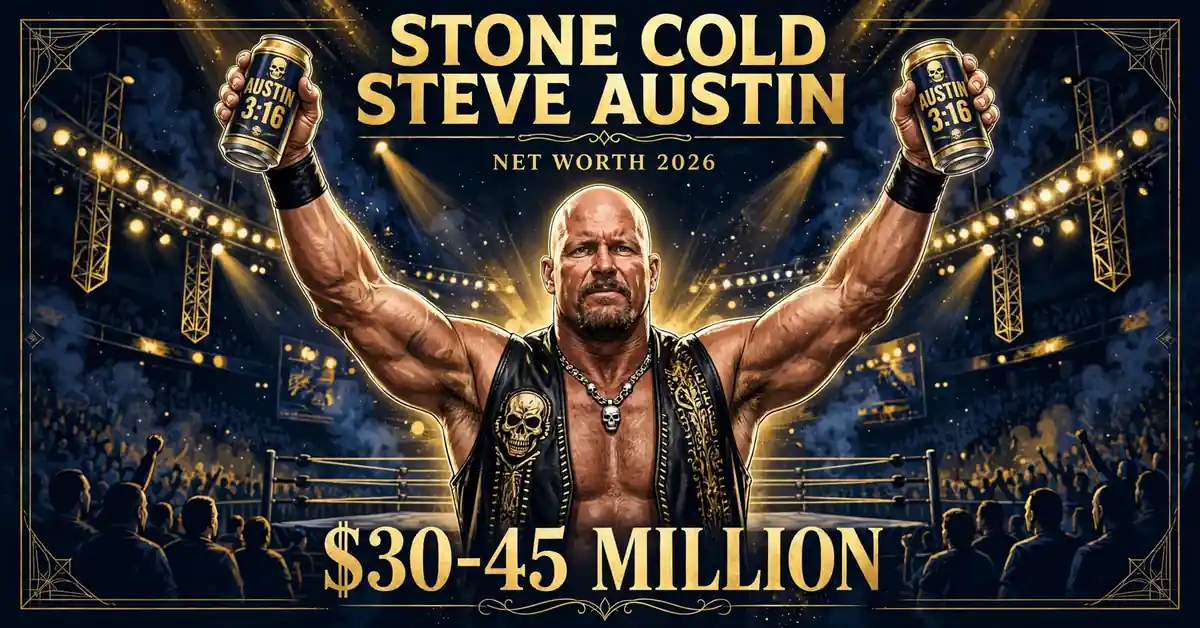
Stone Cold Steve Austin net worth is $30M–$45M in 2026, anchored at $30M by Celebrity Net Worth. The Texas Rattlesnake earned it from WWE merch, beer and TV.
Last updated: November 21, 2026 · By Nathan Cole
Stone Cold Steve Austin’s net worth is $30 million to $45 million in 2026, anchored at $30 million. That is the figure Celebrity Net Worth has carried for years, and it is the number the majority of 2026 profiles repeat — TWSN, Sports Illustrated’s FanNation, SurpriseSports and TwinCityTelegraph all land on $30 million. A smaller group of 2026 trackers goes higher: BounceMojo put him at $45 million in its June 2026 ranking of the richest wrestlers, and Sportskeeda’s Hindi edition lists the same $45 million. This article publishes the range and shows why the two numbers exist, instead of picking one and pretending the other was never printed.
Austin built the fortune the hard way, in three acts. First came the wrestling money: a peak run in the late 1990s when he was the biggest draw in the business, with fellow Hall of Famer Kurt Angle telling Sports Illustrated that Austin made around $16 million a year at his peak, roughly $13 million of it from merchandise alone. Then came the second act — acting roles, television hosting, a podcast that became one of wrestling’s most-listened shows, and a beer brand. The third act is the one paying him now: a WWE Legends contract that keeps the Austin 3:16 merchandise moving, royalties, appearances, and Broken Skull beer on shelves in 42 states.
He is 61 years old in 2026, retired from full-time wrestling since 2003, and still one of the most valuable names WWE owns. He came back for one match at WrestleMania 38 in 2022, crashed an ATV into the barricade at WrestleMania 41 in April 2025, and told an interviewer in March 2026 he was furious with himself about it. The glass still shatters. The money still comes in. This is the full picture of how much he has, where it came from, and which numbers on the internet you should not believe.
Quick Facts
| Full Name | Steven James Anderson — “Stone Cold” Steve Austin |
| Net Worth 2026 | $30 million–$45 million (anchored at $30M by Celebrity Net Worth) |
| Born | December 18, 1964, Austin, Texas, United States |
| Age in 2026 | 61 (turns 62 on December 18, 2026) |
| Height | 6ft 2in (1.88m) |
| Peak WWE Pay | ~$16 million a year (Kurt Angle via Sports Illustrated); Sportskeeda reports $5M–$12M a year for 1999–2003 |
| Famous For | Six-time WWF Champion; only 3-time Royal Rumble winner; “Austin 3:16”; Attitude Era |
| Businesses | Broken Skull IPA and American Lager (El Segundo Brewing); podcast; Broken Skull Ranch |
| Wife | Kristin Feres (married 2009); two daughters from earlier marriage |
| Retired | 2003 (one-match return at WrestleMania 38, April 2022) |
How This Estimate Was Made
No wrestler publishes a balance sheet. Steve Austin has never disclosed his earnings, his contract terms, or his tax returns, so every net-worth figure for him is an outside estimate built from reported pay, merchandise sales, business ventures, and public records. This article treats that uncertainty as the story, not as a footnote.
The method is simple: gather every 2026 figure from named outlets, weigh each source, and publish the range where the credible ones cluster. Celebrity Net Worth’s $30 million is the anchor because it is the figure most 2026 profiles repeat — TWSN (April 2026), Sports Illustrated’s FanNation (2025), SurpriseSports (2026), TwinCityTelegraph (November 2026) and ITR Wrestling all print it. The top of the range, $45 million, comes from BounceMojo’s June 2026 ranking and Sportskeeda’s Hindi edition.
Figures above $75 million are set aside as outliers. They appear on single-source pages with no supporting detail, or on pages that contradict themselves — one 2026 profile prints $300 million in its headline section and $45 million in its own FAQ. A number with no method behind it is a guess, and this article does not pass guesses off as reporting.
Where a dollar figure comes from a named person or outlet, the article says so in the same paragraph. Where it is an estimate, the article calls it one. The range is the honest answer.
+
Stone Cold Steve Austin Net Worth in 2026
Stone Cold Steve Austin is worth an estimated $30 million to $45 million in 2026. The bottom of that range is the number with the most support behind it. Celebrity Net Worth lists $30 million, and Sports Illustrated’s FanNation repeats it, attributing the fortune to Legends-contract merchandising and branding royalties plus acting, television and podcasting work. TWSN’s April 2026 profile prints $30 million. SurpriseSports prints $30 million. TwinCityTelegraph’s November 2026 ranking of the richest wrestlers prints $30 million and places him sixth on its list. ITR Wrestling printed $30 million in November 2022, and the figure has not moved since — which is itself a signal. When a number stays fixed across four years of profiles, it usually means trackers are copying one source rather than re-reporting the fortune.
The top of the range has thinner but real support. BounceMojo’s June 2026 ranking puts Austin at $45 million, fifth among wrestlers. Sportskeeda’s Hindi edition also prints $45 million, and its English-language reporting notes that Austin’s total “brings the Texas Rattlesnake’s total net worth to 45 million US dollars.” NetWorthFigures splits the difference at $32 million. MusicForBritain’s 2026 deep-dive puts the credible consensus at $30 million to $35 million, citing WrestleRadar at the same range.
What does Austin actually earn now, year to year? ITR Wrestling estimated in November 2022 that he still earns around $3 million a year — Legends royalties, appearances, podcasting and his beer business combined. That figure is four years old, so treat it as a dated snapshot rather than a 2026 fact, but it explains the shape of the fortune: this is not a man living off a single lump sum from 2003. It is a man with a brand that still sells.
| Source | Figure | Date |
|---|---|---|
| Celebrity Net Worth (via SI FanNation) | $30 million | 2025 |
| TWSN | $30 million | April 2026 |
| SurpriseSports | $30 million | 2026 |
| TwinCityTelegraph | $30 million | November 2026 |
| ITR Wrestling | $30 million | November 2022 |
| NetWorthFigures | $32 million | 2026 |
| MusicForBritain / WrestleRadar | $30M–$35 million | 2026 |
| BounceMojo | $45 million | June 2026 |
| Sportskeeda (Hindi edition) | $45 million | 2026 |
For readers who want the context around the number, the Celebrity Net Worth archive on this site covers wrestlers and athletes whose fortunes were built the same way: a peak earning window, then decades of royalties and reinvention.
Why Some Sites Say Million — and Others Say 0 Million
Three habits explain the spread. The first is the difference between an anchor and an update. Celebrity Net Worth set the $30 million figure years ago, and most profiles since have repeated it without fresh reporting. BounceMojo’s $45 million, from June 2026, is a newer attempt that folds in more recent earnings — Legends royalties, the beer business, the WrestleMania 38 payday. Neither number is provably right. The gap between them is $15 million of assumptions about how much the post-retirement businesses are worth.
The second habit is the outlier problem. A handful of 2026 pages print figures far above the consensus: $75 million to $85 million on FocusNetWorth, $100 million to $150 million on one blog, $150 million to $200 million on another, and $300 million on CineNetWorth. MusicForBritain’s deep-dive, which collected these numbers in one table, calls the $30 million to $35 million band the credible consensus and treats the nine-figure figures as unsupported. The tell is in the detail: the outlier pages describe Austin’s wealth in general terms — “wrestling earnings, endorsements, real estate” — without naming a single deal, salary, or asset value. A real estimate names its inputs.
The third habit is self-contradiction, and it is the easiest test a reader can run. CineNetWorth’s 2026 profile states $300 million in its main section, then answers its own FAQ with $45 million. A page that disagrees with itself cannot be used to settle anything. The same test catches pages that describe Broken Skull IPA as a “whiskey brand” in one paragraph and a beer in the next. Sloppy pages produce sloppy numbers.
There is also an honest reason the true figure is hard to pin down. Austin’s peak earnings came in an era when WWE did not publish wrestler pay, and his current income mixes at least five streams — Legends royalties, appearance fees, podcasting, acting residuals, and beer — none of which reports publicly. The $30 million anchor is the figure the most outlets agree on. The $45 million top is the newest serious attempt to go higher. Everything above that is noise.
The Austin 3:16 Moment That Changed Wrestling Money
On a June night in 1996, Steve Austin won the King of the Ring tournament by beating Jake “The Snake” Roberts in the final, then took the microphone and delivered the most valuable promo in wrestling history. Roberts had spent the match cutting religious promos. Austin answered with a line that became a brand: “Austin 3:16 says I just whipped your ass.” It was a parody of a Bible verse, John 3:16, turned into a catchphrase. Within months it was on a T-shirt. Within a year it was the best-selling shirt in wrestling.
The shirt mattered because of how wrestling pay worked. A top star’s contract was only part of the money. Merchandise royalties were the rest, and Austin’s royalty stream became the largest in the business. Sportskeeda reports that his Austin 3:16 shirts, priced at $20 each, accounted for about half of WWE’s $500 million in total merchandise sales in 1999. That claim comes from Sportskeeda, and the $500 million total is theirs — but the direction is not in doubt. Nobody in wrestling has ever sold merchandise like Austin sold it in 1998 and 1999, and the money followed the shirts.
The promo also changed what WWE could sell. Before Austin, the company’s top merchandise belonged to clean-cut heroes. Austin was a beer-drinking, boss-stunning anti-hero who flipped off his employer on live television, and the audience loved him for it. The company learned that a rebel could move more product than a hero, and the whole Attitude Era — the edgy, adult-oriented programming that made WWE billions — was built on that lesson. Austin was not just the star of the era. He was the proof of concept.
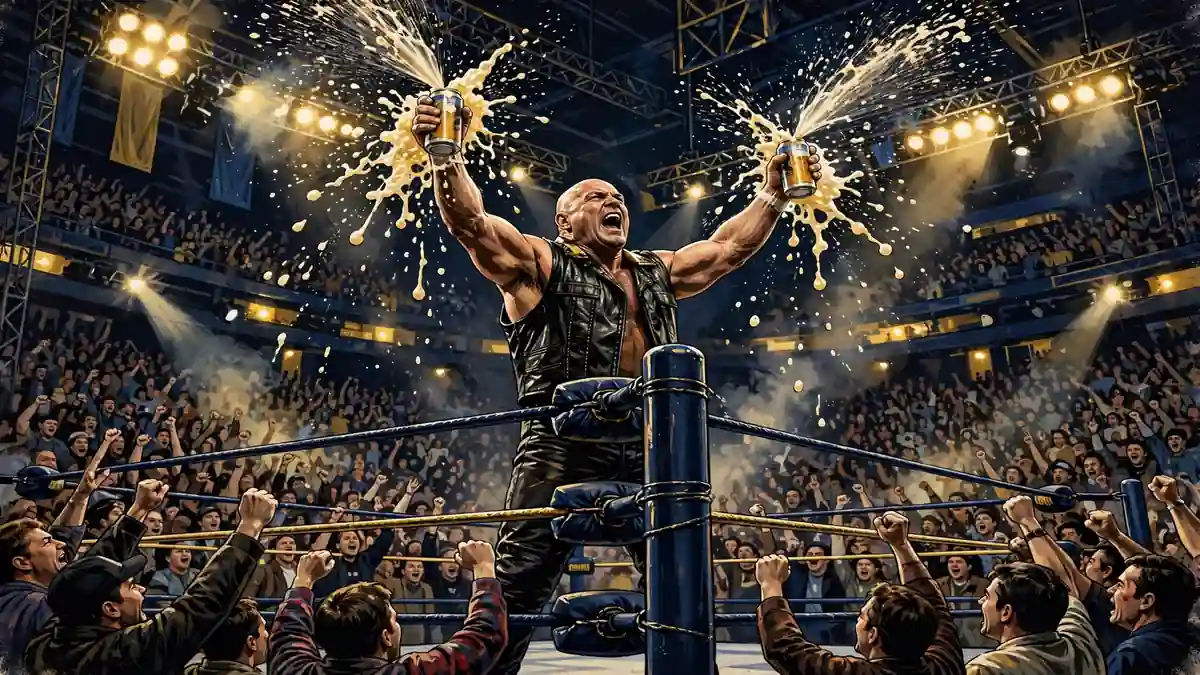
That is why the “Austin 3:16” line belongs in a net-worth article and not just a biography. It was not a catchphrase. It was a product line, a royalty stream, and the foundation of a fortune that is still paying him thirty years later. Every time WWE sells a retro Austin 3:16 shirt in 2026, a cut goes to the man who wrote the line in one improvised promo.
Early Life in Texas: Edna, Football, and a Broken Home
Steven James Anderson was born on December 18, 1964, in Austin, Texas. His parents split when he was young, and he was raised mostly in Edna, a small town in south Texas, by his mother and stepfather. He took his stepfather’s surname, Williams, for much of his youth — which is why some older records list him as Steve Williams — before settling on Austin as his professional name. The Texas roots stayed with him: the accent, the manner, the ranch, and the beer.
He played football at Edna High School and then at North Texas State University, now the University of North Texas, where he played as a defensive end. He was not a star. He was a tough, undersized lineman who liked contact and did not mind pain, which turned out to be a useful education for the career that followed. He left college without a degree and without a plan, working odd jobs in Texas while he figured out what came next.
What came next was a wrestling school. Austin trained under Chris Adams, a British wrestler working the Texas independent scene, and made his debut in 1989 in the United States Wrestling Association as “Stunning” Steve Austin — a blond, good-looking heel with a manager and a chip on his shoulder. The look was generic. The talent was not. Within two years he was in WCW, the second-biggest promotion in America, and the money started to become real.
WCW Years: Stunning Steve, the Hollywood Blonds, and the Phone Call
Austin spent 1991 to 1995 in World Championship Wrestling, and on paper it was a success. He won the WCW World Television Championship twice and the United States Heavyweight Championship twice. He formed the Hollywood Blonds tag team with Brian Pillman, a pairing that wrestling historians still rate as one of the best of the era — two arrogant young heels who could wrestle, talk, and steal a show. He was 27, on national television every week, and earning a solid living.
Then WCW decided he was not a star. The company saw him as a mid-card hand, not a main-eventer, and in 1995 — while he was out injured with a triceps problem — WCW let him go. The firing has become one of the most famous mistakes in wrestling history, up there with letting go of the men who later built WWE’s Attitude Era. Austin has told the story many times: the call came while he was hurt, and the message was that the company did not see a future for him.
The firing did two things that matter to his fortune. First, it freed him to go to Extreme Championship Wrestling, where Paul Heyman handed him a microphone and let him talk. Second, it gave him a grudge. Austin spent the rest of his career proving the people who fired him wrong, and the audience could feel it. Every “Austin 3:16” shirt sold was, in a small way, a receipt for that phone call.
ECW: The Promo Work That Built Stone Cold
Extreme Championship Wrestling was a small Philadelphia promotion with a cult audience and almost no money, and it was the best thing that happened to Austin’s career. Paul Heyman, the promoter, understood that Austin’s gift was not his look or his move set. It was his mouth. Heyman gave him long, unscripted promo time and let him cut loose on WCW, on Eric Bischoff, and on the business itself.
The promos were angry, funny, and specific in a way wrestling promos rarely were. Austin talked about being fired while injured. He talked about the people who had dismissed him. He mocked the clean-cut heroes of the other companies. The ECW audience, which prided itself on knowing the business, ate it up. By the time he left ECW in late 1995, he had a character: a bitter, funny, dangerous man who said what he thought and dared anyone to stop him.
That character was Stone Cold, and it was nearly complete before he ever set foot in WWE. The ECW run lasted only a few months, and it paid almost nothing. Its value was in the reel: when WWE signed him in December 1995, they were buying a finished act, not a project. The money that followed — the $16 million peak years, the merchandise empire — traces back to those months in Philadelphia with a microphone and a grudge.
WWE and the Attitude Era: The Million-a-Year Peak
Austin debuted in WWE in December 1995 as The Ringmaster, a technical wrestler managed by Ted “The Million Dollar Man” DiBiase. The gimmick went nowhere. The company repackaged him as Stone Cold in early 1996, and everything changed. The King of the Ring win that June gave him the catchphrase. A feud with Bret Hart gave him the matches. And a feud with Vince McMahon gave him the story that made him the biggest star in wrestling.
The McMahon feud was the engine of the Attitude Era. On television, McMahon was the evil boss. Austin was the employee who refused to obey him — stunning him, pouring beer on him, driving a cement truck to his office and filling it with concrete. The audience, millions of whom had bosses they disliked, saw themselves in Austin. Ratings climbed. Pay-per-view buys climbed. WWE, which had been losing the ratings war to WCW, overtook its rival and never looked back.
The money followed the ratings. Kurt Angle, who joined WWE in 1999 and watched the pay structure from inside, told Sports Illustrated that Austin was making around $16 million a year at his peak, with roughly $13 million of that coming from merchandise alone. Sportskeeda gives a lower range — $5 million to $12 million a year for 1999 to 2003 — which likely reflects the guaranteed contract without the full royalty picture. Either way, Austin was the highest-paid wrestler in the world at the time, and the gap between him and the rest of the roster was wide. Angle’s point was that only a handful of wrestlers had million-dollar guarantees, and Austin’s was the biggest by far.
The titles stacked up alongside the pay. Austin won the WWF Championship six times. He won the Royal Rumble three times — 1997, 1998 and 2001 — the only wrestler ever to do so. He headlined three WrestleManias. Sportskeeda counts 19 championships in total across his career, from the Intercontinental title to the tag team titles. His WrestleMania 13 match against Bret Hart in March 1997, a bloody submission match with a double turn — Hart turning heel, Austin turning face as he passed out in his own blood rather than submit — is widely rated one of the greatest matches ever, and WWE inducted it into the Hall of Fame a second time in 2025. At WrestleMania 14 in 1998 he beat Shawn Michaels for his first WWF Championship, with Mike Tyson at ringside, in the match that formally opened the Attitude Era.
His great rival of the era was The Rock, and their trilogy of WrestleMania main events — 15, 17 and 19 — defined the period. Triple H’s biography on this site covers the other side of that era: the man who went from Austin’s rival in the ring to the executive who now runs WWE. Austin’s peak ended earlier than anyone wanted, because his body gave out first.
The Merch Machine: How Austin 3:16 Shirts Built the Fortune
Merchandise is where Austin’s fortune separates from every other wrestler of his era. Most stars sell shirts. Austin sold a uniform. The black Austin 3:16 shirt, with its skull and its Bible-verse parody, became the default outfit of wrestling fans in the late 1990s — worn in arenas, in schools, in bars, and on television. Sportskeeda reports that the shirts, at $20 each, accounted for about half of WWE’s $500 million in merchandise sales in 1999. That is Sportskeeda’s figure, and the $500 million total belongs to them, but even a fraction of it would make Austin the biggest merchandise draw in wrestling history.
The reason the merch money mattered so much is the royalty structure. A wrestler’s merchandise royalty is a percentage of sales, and when the sales are that large, the percentage becomes a fortune on its own. Angle’s estimate — $13 million a year from merchandise at Austin’s peak — is the clearest window into the math. His base contract was large. His merchandise cut was larger. That is the opposite of the usual wrestling pay split, and it is why Austin’s net worth held up long after his in-ring career ended.
The machine never really stopped. WWE still sells Austin 3:16 shirts, foam beer-can holders, skull-logo gear and retro vests in 2026, and every sale carries a royalty back to Austin under his Legends deal. The beer-bash celebration — Austin standing on the turnbuckle, spraying two cans over the crowd — is still the image on the posters. It is the rare wrestling image that sells itself thirty years later, because it does not need context. A bald man in a black vest, holding beer above his head, is the whole brand in one frame.
That durability is the financial point. Most athletes’ merchandise dies when they retire. Austin’s did not, because the character was never about being current. It was about being defiant, and defiance does not go out of fashion.
The Neck Injury, the Surgeries, and the 2003 Exit
The fortune came at a physical price. At SummerSlam in August 1997, Owen Hart gave Austin a piledriver that went wrong. Austin’s head hit the mat, his neck compressed, and he was temporarily paralysed. He finished the match — he has said he could not feel his arms — and then spent months recovering. The injury caused spinal stenosis, a narrowing of the spinal canal, and it never fully healed.
He kept wrestling on it for six more years, through surgeries and pain, because he was the top draw in the business and the company needed him. He had neck fusion surgery in 1999, which kept him out for nearly a year. He came back, won more titles, and headlined more pay-per-views. But the damage accumulated. By 2003, doctors were telling him that one more bad bump could leave him in a wheelchair, and he was tired of the travel, the pain, and the grind.
He wrestled his last full-time match at WrestleMania 19 in March 2003, losing to The Rock in the third meeting of their trilogy. He was 38. He walked away from the ring as a performer and never came back full-time — a decision that cost him years of peak salary but almost certainly saved his health. The retirement is part of the money story too: Austin stopped earning wrestler pay at 38, which makes the $30 million to $45 million figure more striking. He has been retired longer than he wrestled at the top, and the fortune has held.
WrestleMania 38: The One-Night Return Against Kevin Owens
For nineteen years, Austin stayed retired. He made appearances — a Stunner here, a beer-bash there — but he did not wrestle. Then, in April 2022, WWE brought WrestleMania 38 to Dallas, Texas, Austin’s home state, and Kevin Owens spent weeks insulting Texas on television. The setup wrote itself. Austin came out, accepted the challenge, and wrestled Owens in a No Holds Barred match in the main event of night one.
He won, hitting the Stone Cold Stunner, and the crowd at AT&T Stadium roared like it was 1998. The next night he came out again and gave a Stunner to Vince McMahon after McMahon had wrestled an impromptu match against Pat McAfee. It was the perfect one-night return: one match, one win, one more Stunner for the boss, and then back to retirement.
The payday was never disclosed, and this article does not guess at it. What the return did, financially, was remind the market of Austin’s value. A 57-year-old man who had not wrestled in nineteen years headlined the biggest show of the year and delivered one of its most-watched moments. That is why WWE keeps calling him, and why the Legends deal keeps paying. The brand does not age the way the body does.
Broken Skull Beer: From IPA to American Lager
Austin’s most successful business outside wrestling is the one that fits his character best: beer. In 2014 he launched Broken Skull IPA with El Segundo Brewing Company in California, a craft IPA built around the skull logo and the ranch brand. It was a logical move — beer-drinking was central to the Stone Cold character — and it was also a careful one. Austin did not start a brewery. He partnered with an established craft brewer, put his name and his brand on a real product, and let the beer sell itself.
In 2022 he added a second beer, Broken Skull American Lager, again with El Segundo. Sports Illustrated reported in 2025 that Broken Skull beers were available in 42 states and online, which makes it a genuine national brand rather than a celebrity novelty. The financial terms of the El Segundo partnership have never been disclosed, so this article does not put a number on the beer income. But a beer brand in 42 states, carrying one of the most recognisable names in wrestling, is a real asset — and it is one Austin owns outright in the sense that matters: the brand is his, and the beer carries his name.

The beer also shows how Austin’s post-wrestling career works. He does not chase trends. He builds on the character — the ranch, the beer, the tough talk — and lets the businesses grow slowly. The IPA is twelve years old now, and it is still on shelves. That is a longer run than most celebrity product lines manage, and it is a steady contributor to the $3 million a year ITR Wrestling estimated he still earns.
Podcasting, Television, and Acting Paychecks
After retiring, Austin built a second career as a talker. The Steve Austin Show, his long-running podcast, became one of wrestling’s most-listened shows, with long interviews that treated wrestlers like real people rather than characters. WWE later brought the format in-house as Broken Skull Sessions, an interview series on the WWE Network and Peacock, where Austin sat down with the biggest names in the business — including The Undertaker, in an episode that doubled as a farewell interview for the Deadman.
Television followed. He hosted season five of Tough Enough, WWE’s reality competition, on the USA Network in 2011. He hosted Broken Skull Challenge, a physical-competition show, on CMT from 2014 to 2017. He appeared as a guest and a host across reality and talk television, and he kept the podcast going through it all. None of these paid wrestling money, but together they kept him visible, relevant, and earning through his forties and fifties.
Acting was the third stream. His film roles include The Longest Yard (2005), The Condemned (2007, his first lead role), The Expendables (2010) alongside Sylvester Stallone and Jason Statham — a film that grossed more than $274 million worldwide, according to CineNetWorth — and Grown Ups 2 (2013). He also starred in a run of action films including Damage (2009), Hunt to Kill (2010) and Recoil. None of them made him a movie star. All of them paid, and all of them kept the brand alive in front of audiences who had never watched wrestling.
The honest assessment is that acting was a supporting income, not a second fortune. Austin’s film career never approached the scale of his former rival The Rock, whose fortune TwinCityTelegraph puts at $800 million, or of John Cena, whose move into Hollywood this site covers in its John Cena net worth profile. Austin’s money was made in the ring and in merchandise, and the screen work added to it rather than replacing it.
Real Estate and the Broken Skull Ranch
Austin’s most famous property is the Broken Skull Ranch, the Texas ranch where he lived for years and which gave its name to his podcast, his beer, and his brand. The ranch was a working property, not a showpiece: land, a house, trucks, and space. He later moved to Nevada, where he still keeps a ranch property and where he spends much of his time off-road racing — a hobby that has become a serious pursuit, with a race car, a team, and a calendar of desert events.
The off-road racing made news in August 2026, when Austin crashed out of a race — his car taking heavy damage after the team made a mistake on the course — and posted on Instagram that he was unhurt and already preparing for the next event, the VC-Tonopah race. It was a small story, but it tells readers something useful about the man at 61: he is still racing cars across the desert, still taking hits, and still getting up.
Property details beyond the ranch are thin, and this article does not invent them. Some profiles claim a $3.5 million mansion and a luxury car collection; the same pages also print net-worth figures that contradict themselves, so their property claims carry no weight here. What is documented is the ranch, the Nevada base, and a lifestyle that is comfortable rather than lavish. Austin’s spending has never been the story. His earning has.
Personal Life: Four Marriages and Life in Nevada
Austin has been married four times. His first marriage, to Kathryn Burrhus, lasted from 1990 to 1992. His second, to Jeanie Clarke — known to wrestling fans as Lady Blossom — lasted from 1992 to 1999 and produced two daughters, Stephanie and Cassidy. His third, to Debra Marshall, lasted from 2000 to 2003 and ended badly: in June 2002 Austin was arrested and later pleaded no contest to a misdemeanour assault charge. It is the ugliest episode of his public life, and it is part of the record. He has spoken about it rarely and without excuses.
His fourth marriage, to Kristin Feres, began in 2009 and continues. The couple lives a quiet life at the ranch in Nevada, away from the wrestling world for most of the year. Austin is 61, a grandfather, and by all accounts content with the distance from the business — he turns up for WrestleMania when asked, does the podcast when he feels like it, and otherwise races cars and drinks his own beer.
At 6ft 2in, Austin is one of the taller men of his era, and his size was part of the act: a big, bald Texan who looked like he could handle himself in a bar fight. For the full breakdown of his measurements, the Stone Cold Steve Austin height profile on CelebAmerica covers his 6ft 2in frame in detail.
Stone Cold vs. His Peers: Where M–M Sits
Austin’s fortune looks different depending on who you compare him with. Against the men he fought, he sits in the middle of the pack. Against the men who followed him, he looks like a bargain — which says more about how wrestling pay changed than about Austin himself. The table below uses figures from this site’s own profiles where they exist, and from TwinCityTelegraph’s November 2026 ranking where they do not.
| Wrestler | Net Worth 2026 | Main Source |
|---|---|---|
| Stone Cold Steve Austin | $30M–$45M | WWE merch, Legends royalties, beer |
| The Rock | $800M | Film, spirits, TKO stake |
| John Cena net worth | $80M | Film, TV, WWE |
| Roman Reigns net worth | $15M | WWE contract, merch |
| Randy Orton net worth | $15M | WWE contract, merch |
| The Undertaker net worth | $17M | WWE Legends deal, licensing |
| Cody Rhodes net worth | $8M | WWE contract, AEW exit |
The comparison that matters most is with The Undertaker, his contemporary and fellow Attitude Era pillar. The Undertaker’s fortune, at $17 million on this site’s profile, is roughly half of Austin’s — which tracks with their careers. Both men worked the same era, both have Legends deals, but Austin was the bigger merchandise draw by a wide margin, and merchandise is what separates a $17 million wrestler from a $30 million one. Triple H, the third man of that era, is in a different category entirely: TwinCityTelegraph puts his combined household wealth with Stephanie McMahon at $400 million, a figure built on his executive role running WWE rather than on wrestling pay.
The gap to The Rock is the real lesson. The Rock left wrestling and built a film career, a tequila brand, and a stake in TKO, the company that now owns WWE. Austin stayed closer to wrestling. His fortune is a wrestling fortune, built in the ring and kept alive by royalties. It is smaller, but it is also cleaner: no outside empire, no corporate job, no brand built on something other than the character. Thirty years after Austin 3:16, the character still pays.
WrestleMania 41, the ATV Crash, and What Comes Next
Austin’s most recent WWE appearance was also his most talked-about in years — and not for the reason he wanted. On night two of WrestleMania 41 in Las Vegas, in April 2025, he rode an ATV to the ring to announce the attendance, just as he had done many times before. This time the ATV got away from him. He crashed into the ringside barricade, knocking a fan back into her seat, then drove into the ring, announced the night-two attendance of 63,226 — a two-night total of 124,693 — and drank his customary beers while WWE president Nick Khan checked on the fan.
He was furious with himself. On Busted Open in March 2026, he said he felt he had embarrassed himself badly on the biggest stage in the business, and that he had been looking forward to the segment all night. It was an honest reaction, and a familiar one: Austin has always been harder on himself than anyone else is. The fan was unhurt, and Austin spoke to her afterwards. The clip, meanwhile, was watched millions of times — which is the paradox of Austin in 2026. Even his mistakes are content.
WWE: Unreal, the behind-the-scenes series, later revealed that bigger plans for Austin at WrestleMania 41 had been scrapped: an early version of the card had him as the special guest referee for Bron Breakker against Drew McIntyre, a match that never happened. Logan Paul had separately offered him $1 million to dress as a giant PRIME bottle. Austin turned the offer down. He has said he is not looking for another match, and at 61, with a fused neck and a ranch to run, that is a sensible call. What comes next is more of the same: appearances, the podcast, the beer, the racing. The glass will keep shattering. The cheques will keep coming.
Stone Cold Steve Austin: Career and Money Timeline
| Year | Milestone |
|---|---|
| 1964 | Born Steven James Anderson, December 18, Austin, Texas |
| 1989 | Wrestling debut in USWA as “Stunning” Steve Austin |
| 1991–95 | WCW: TV and US titles, Hollywood Blonds with Brian Pillman; released in 1995 while injured |
| 1995 | ECW promo run builds the Stone Cold character |
| 1996 | Wins King of the Ring; “Austin 3:16” promo launches the merch empire |
| 1997 | WrestleMania 13 vs Bret Hart; neck injured at SummerSlam by Owen Hart |
| 1998 | Wins first WWF Championship at WrestleMania 14 vs Shawn Michaels; peak pay years begin |
| 1999 | Neck fusion surgery; Austin 3:16 shirts drive a reported share of WWE’s $500M merch year |
| 2001 | Third Royal Rumble win — still the only wrestler to win three |
| 2003 | Retires after WrestleMania 19 vs The Rock |
| 2005–13 | Acting run: The Longest Yard, The Condemned, The Expendables, Grown Ups 2 |
| 2009 | Inducted into the WWE Hall of Fame |
| 2014 | Launches Broken Skull IPA with El Segundo Brewing |
| 2022 | WrestleMania 38 return beats Kevin Owens; Broken Skull American Lager launches |
| 2025 | Second Hall of Fame induction (WM13 match); WrestleMania 41 ATV crash |
| 2026 | Net worth estimated $30M–$45M; off-road racing crash in August, unhurt |
Frequently Asked Questions
What is Stone Cold Steve Austin’s net worth in 2026?
Stone Cold Steve Austin’s net worth in 2026 is estimated at $30 million to $45 million, anchored at $30 million by Celebrity Net Worth. Most 2026 profiles — TWSN, Sports Illustrated’s FanNation, SurpriseSports and TwinCityTelegraph — print $30 million, while BounceMojo’s June 2026 ranking and Sportskeeda’s Hindi edition put him at $45 million. Figures above $75 million come from single sources with no supporting detail and are treated as outliers.
How much did Stone Cold Steve Austin make per year in WWE?
At his peak in the late 1990s, Kurt Angle told Sports Illustrated that Austin made around $16 million a year, with roughly $13 million of it coming from merchandise alone. Sportskeeda gives a lower range of $5 million to $12 million a year for 1999 to 2003, which likely reflects the guaranteed contract without the full royalty picture. Either way, he was the highest-paid wrestler in the world at the time.
How much does Stone Cold Steve Austin make now?
ITR Wrestling estimated in November 2022 that Austin still earns around $3 million a year from his WWE Legends-contract royalties, appearances, podcasting and his Broken Skull beer business. That figure is four years old, so it is a dated snapshot, but it shows the shape of his current income: royalties and business, not wrestling pay.
Does Stone Cold Steve Austin own Broken Skull beer?
Yes, in the brand sense. Austin launched Broken Skull IPA in 2014 with El Segundo Brewing Company in California, and added Broken Skull American Lager in 2022. The beers are sold in 42 states and online, according to Sports Illustrated in 2025. The financial terms of the partnership have never been disclosed.
How old is Stone Cold Steve Austin in 2026?
Stone Cold Steve Austin is 61 years old in 2026. He was born Steven James Anderson on December 18, 1964, in Austin, Texas, and turns 62 on December 18, 2026.
How tall is Stone Cold Steve Austin?
Stone Cold Steve Austin is 6ft 2in (1.88m) tall. His billed weight during his wrestling career was around 252 lbs.
Who is Stone Cold Steve Austin’s wife?
Stone Cold Steve Austin is married to Kristin Feres, his fourth wife, since 2009. He was previously married to Kathryn Burrhus (1990–1992), Jeanie Clarke (1992–1999, with whom he has two daughters, Stephanie and Cassidy) and Debra Marshall (2000–2003). He lives with Kristin on his Broken Skull Ranch in Nevada.
Did Stone Cold Steve Austin wrestle at WrestleMania 41?
No — he did not wrestle. At WrestleMania 41 in Las Vegas in April 2025 he rode an ATV to the ring on night two to announce the attendance, crashed the ATV into the ringside barricade and knocked a fan back, then announced the night-two attendance of 63,226 before drinking beers in the ring. His last match remains the WrestleMania 38 win over Kevin Owens in April 2022, and he has said he is not looking for another match.
Sources & Reporting
This profile was reported from named public sources in November 2026. The net-worth range ($30M–$45M) is anchored on Celebrity Net Worth’s $30 million figure as repeated by Sports Illustrated’s FanNation (2025), TWSN (April 2026), SurpriseSports (2026), TwinCityTelegraph (November 2026) and ITR Wrestling (November 2022), with the $45 million top from BounceMojo’s June 2026 ranking and Sportskeeda’s Hindi edition. Outlier figures ($75M–$300M) are drawn from MusicForBritain’s 2026 deep-dive table and CineNetWorth, and are treated as unreliable for the reasons given in the article.
Peak-pay reporting comes from Kurt Angle’s interview with Sports Illustrated, as reported by WrestlingInc in 2024 ($16 million a year, ~$13 million from merchandise), and from Sportskeeda ($5M–$12M a year, 1999–2003; $20 shirts and the $500 million merchandise year; 19 championships; 6 WWF title reigns). The Legends-contract terms ($10,000 advance, $500 per appearance) are reported by Sportlister. Broken Skull IPA (2014, El Segundo Brewing) and American Lager (2022, 42 states) are reported by Sports Illustrated’s FanNation. The Expendables’ $274 million worldwide gross is reported by CineNetWorth.
Career and biographical facts draw on Sportskeeda, ITR Wrestling, and the WrestleMania 38 and 41 coverage by Cultaholic, Yardbarker, ClutchPoints and Fightful (March 2026 Busted Open interview; August 2026 off-road crash; WWE: Unreal scrapped-plans revelations, November 2026). The June 2002 arrest and no-contest plea are a matter of public record. Figures marked as estimates are outside estimates, not statements by Steve Austin. Corrections are welcomed and applied promptly — see the author box below.
About the Author
Nathan Cole covers celebrity and reality TV fortunes for Guide Net Worth, checking every figure against named reporting before it is published.
Corrections: spotted an error in this profile? Contact us and we will correct it promptly. Figures marked as estimates are outside estimates, not statements by the person profiled.
References & Sources
This article has been fact-checked and verified against multiple public sources, financial disclosures, SEC filings, Forbes reports, Celebrity Net Worth databases, and official records. All net worth estimates are based on publicly available information and financial analysis.