Andy Murray biography 2026: the 39-year-old Scot won 3 Grand Slams, 2 Olympic golds and a £110m fortune — from Dunblane to world No. 1 and life after tennis.
Last updated: November 11, 2026 · By Nathan Cole
Andy Murray is 39 years old, a three-time Grand Slam champion with two Olympic singles gold medals, and the owner of an estimated fortune of about $149 million (£110 million). The number comes from the Sunday Times Rich List, which put his wealth at £110 million in May 2025 and was still reporting the same figure in October 2026. Behind it sits $64.7 million in career prize money, two decades of endorsement deals, a five-star hotel in Scotland and a startup portfolio built through his own management company.
But the fortune is the smallest part of the story. Murray was eight years old and a pupil at Dunblane Primary School when a gunman killed 16 children and a teacher there. He grew into the player who ended a 77-year wait for a British man to win Wimbledon, reached world No. 1 in the most brutal era the men’s game has ever seen, had a hip resurfaced with metal and came back to win again, then retired at the Paris Olympics in August 2024. In 2025 he did the unthinkable and coached his greatest rival, Novak Djokovic. In 2026 he started again with Jack Draper.
This is the full story: the Dunblane childhood, the breakthrough years, the hip, the comeback, the retirement, the money, the family, and what Britain’s greatest modern tennis player is doing now.
Quick Facts
| Net Worth (2026) | $105–165 million, anchored at ~$149 million (£110m) (estimated) |
| Full Name | Sir Andrew Barron Murray |
| Born | May 15, 1987, Glasgow, Scotland (age 39) |
| Height | 6ft 3in (1.91 m) |
| Profession | Former professional tennis player; coach |
| Nationality | British (Scottish) |
| Career Titles | 46 ATP singles titles; 3 Grand Slams; 2 Olympic singles golds |
| Prize Money | $64,687,542 (7th all-time) |
| Spouse | Kim Sears (married 2015); four children |
| Retired | August 1, 2024 (Paris Olympics) |
| Wealth Sources | Prize money, endorsements (Castore, Head, Jaguar), Cromlix hotel, 77 Sports Management, startup equity |
| Last Updated | November 11, 2026 |
How This Estimate Was Made
This figure is an independent estimate — Andy Murray has never disclosed his finances publicly. Our process: gather every credibly reported salary, deal, and asset; cross-check them across reputable outlets; allow for taxes, representation fees, and spending; and publish a range wherever sources disagree, with the reasoning shown in the article. Anything uncertain is labeled as an estimate, not a fact.
+
Dunblane: The Childhood That Shaped Him
Andy Murray was born May 15, 1987, in Glasgow, the younger son of Judy Murray and William Murray. The family lived in Dunblane, a small cathedral town in central Scotland, where Judy — a tennis coach who later captained Britain’s Fed Cup team — put rackets in both her sons’ hands early. His elder brother Jamie, born a year earlier, became a doubles specialist who went on to win seven Grand Slam doubles titles.
The defining event of Murray’s childhood had nothing to do with tennis. In March 1996, when Andy was eight, a gunman walked into Dunblane Primary School — his school — and killed 16 children and a teacher. Murray was in the building that day. He has spoken about it only rarely in the decades since, and this article will not press further than the public record. What can be said plainly is that a child who lived through that morning carried something different onto a tennis court: a hardness, a refusal to fold, that opponents felt for the next 25 years.
His parents split when he was 10. At 15, Murray left Scotland for Barcelona, to train at the Sánchez-Casal Academy — a teenager living away from home in a foreign country because the tennis demanded it. He turned professional in 2005, aged 18, with a game built on defence, court craft and a two-handed backhand that would become one of the best return games the sport has ever seen.
Turning Pro and the First Breakthrough
The climb was fast. Murray won his first ATP title in San Jose in February 2006, beating Lleyton Hewitt in the final at 18 years old. By the end of 2007 he was inside the world’s top 15. In 2008 he reached his first Grand Slam final at the US Open, where Roger Federer beat him in straight sets — a lesson in what the very top of the sport required.
Those early years set the pattern of his career: Murray was the fourth man in a sport owned by three of the greatest players who ever lived. Federer, Rafael Nadal and Novak Djokovic shared 66 Grand Slam titles between them in the years Murray was competing. Breaking into that group was the hardest job in tennis, and it took Murray four years of losing finals to do it.
The Long Wait: Five Australian Open Finals, Five Defeats
No part of Murray’s biography tests a reader’s sympathy quite like Melbourne. He reached the Australian Open final five times — in 2010, 2011, 2013, 2015 and 2016 — and lost every one of them. Federer beat him in 2010; Djokovic beat him in the other four. Three of those defeats came in straight sets.
Most players would have been broken by that record. Murray treated it as a debt to be collected elsewhere. The same years produced his greatest wins on the other surfaces, and the Melbourne losses became part of the story rather than the whole of it: the player who kept walking back into the same room, knowing who was waiting for him, and kept swinging.
2012: Olympic Gold and the US Open Breakthrough
The summer of 2012 changed everything. At Wimbledon in July, Murray reached the final and lost to Federer in four sets — then wept on Centre Court during the trophy presentation, in front of a home crowd that had waited 74 years for a British men’s finalist. Four weeks later, on the same court, he beat Federer in straight sets to win Olympic gold at the London Games. He added a mixed doubles silver alongside Laura Robson at the same Olympics.
Then came New York. At the 2012 US Open, Murray beat Djokovic in a five-set final that ran four hours and 54 minutes — 7-6, 7-5, 2-6, 3-6, 6-2 — to win his first Grand Slam. He was the first British man to win a major singles title since Fred Perry in 1936. The wait, 76 years long, was over.
Wimbledon 2013: Ending 77 Years of Waiting
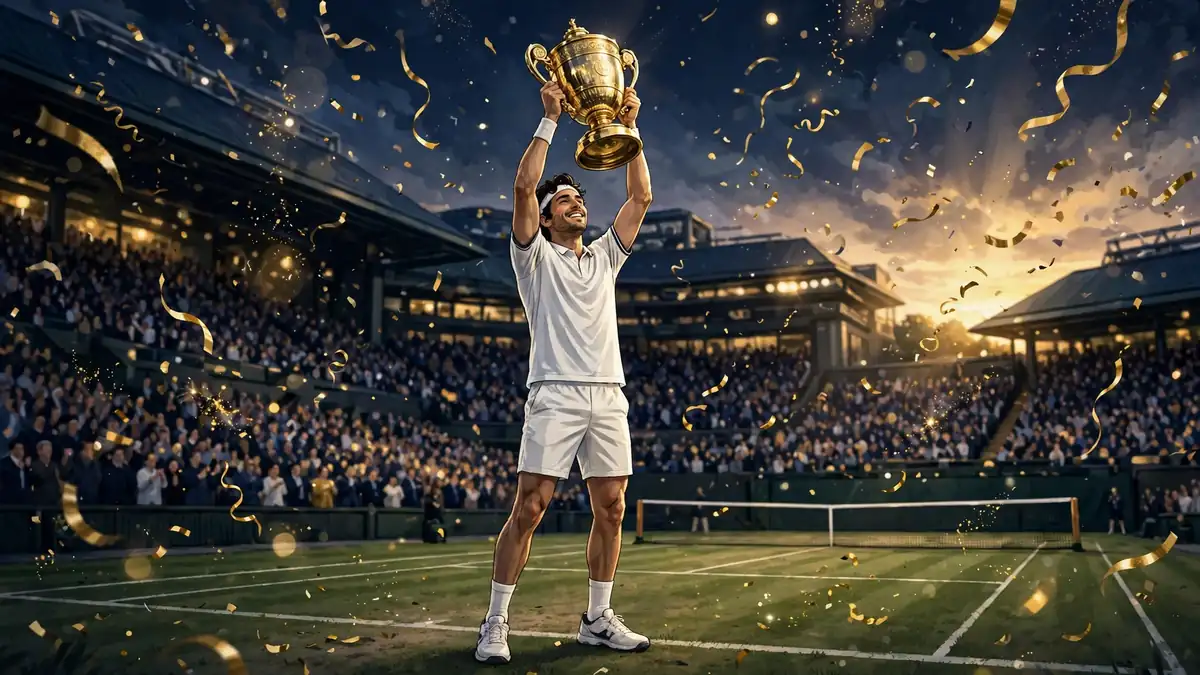
If the US Open broke the drought, Wimbledon 2013 made Murray a national figure. He beat Djokovic in straight sets in the final — 6-4, 7-5, 6-4 — on a July afternoon when Centre Court sounded like a football ground. No British man had won the Wimbledon singles title since Fred Perry in 1936: 77 years. Murray’s mother Judy watched from the players’ box; his brother Jamie was in the crowd. The whole country seemed to exhale at once.
The numbers from that season tell their own story. Murray’s career prize money passed $30 million in 2013, and his endorsement value jumped with it. He was appointed OBE in the 2013 New Year Honours, and the knighthood followed in 2019. But the Wimbledon title also carried a weight that showed in the years after: the expectation that he would do it again, every summer, against the three greatest players in history.
2016: The Year He Owned Tennis
Murray’s best season, by every measure, was 2016. He won his second Wimbledon title, beating Milos Raonic in the final. He defended his Olympic singles gold in Rio, beating Juan Martín del Potro in four sets — the first player ever to defend an Olympic singles title, and still the only man with two Olympic singles golds. He won the ATP Finals in London, beating Djokovic in the final. And in November 2016, he became world No. 1 for the first time, ending Djokovic’s long hold on the top spot.
He finished 2016 as year-end No. 1, with a 78-9 win-loss record and nine titles. It was also his richest year on court: more than $16 million in prize money in a single season, per ATP figures. Across his career he spent 41 weeks ranked world No. 1. The 2016 season is the answer to anyone who asks whether Murray belonged in the same conversation as the other three: for one full year, he was better than all of them.
| Tournament | Titles | Winning Years |
|---|---|---|
| Wimbledon | 2 | 2013, 2016 |
| US Open | 1 | 2012 |
| Olympic singles gold | 2 | London 2012, Rio 2016 |
| ATP Masters 1000 | 14 | 2008–2016 |
| Davis Cup | 1 | 2015 |
The Davis Cup win deserves its own line. In 2015 Murray almost single-handedly carried Britain to the title, winning all eight of the singles rubbers he played and all three doubles rubbers, as Britain beat Belgium in the final in Ghent. It was Britain’s first Davis Cup since 1936 — the same year, Fred Perry, that keeps recurring in Murray’s story.
The Hip That Nearly Ended Everything
The 2016 peak came with a price that showed up fast. Murray’s hip, which had troubled him for years, deteriorated through 2017. He played his last match of that season at Wimbledon in July, losing a quarter-final to Sam Querrey, and did not play again for nearly a year. By January 2019 the pain had become unbearable. At a tearful press conference before the Australian Open, he announced that he might have to retire — that the tournament could be his last.
He lost in the first round in Melbourne, in five sets to Roberto Bautista Agut, and walked off to a standing ovation that felt like a farewell. Days later he underwent hip-resurfacing surgery, in which a metal cap was fitted over the ball of the joint. Plenty of surgeons and pundits said a return to elite singles was unlikely. Murray, who had spent a career being told what he could not do, disagreed.
The Comeback Nobody Expected
The comeback began in doubles. In June 2019, five months after surgery, Murray won the Queen’s Club doubles title alongside Feliciano López. Then, in October 2019, he won a singles title in Antwerp, beating Stan Wawrinka in a three-set final — his first singles title in more than two years, won with a metal hip. It was one of the most improbable wins of his career, and the crowd in Belgium treated it that way.
The years that followed were a long, uneven grind rather than a second peak. Murray kept winning matches against top players — he beat world No. 5 Stefanos Tsitsipas at the 2022 US Open — but the body would no longer hold up across two weeks of a Grand Slam. He played on, chasing one last deep run, until the summer of 2024 gave him the stage to stop.
The Big Four and the Federer–Nadal–Djokovic Rivalry
Murray’s career cannot be understood without the three men who shared his era. Federer, Nadal and Djokovic won 66 Grand Slam singles titles between them; Murray won three. The gap looks wide until you look at who stood in his way: he lost eight Grand Slam finals to those three men, and his three major titles came against Djokovic twice and Raonic once.
At 6ft 3in, Murray was taller than most of his rivals — Federer, for comparison, stands 6ft 1in, as detailed in our piece on Roger Federer’s height — and his game was built to beat them: the best return of serve in the sport, a two-handed backhand he could hit flat down the line, and a willingness to run down balls other players had already given up on. Against Rafael Nadal’s biography reads like a mirror image: clay-court dominance, 22 majors, a career spent winning on his own terms. Murray’s version was different — he won his majors on grass and hard courts, in the teeth of the strongest era the men’s game has produced, and he did it as the fourth man, the one the other three had to beat first.
That is why the tennis world rates him higher than the raw title count suggests. Three Grand Slams in the Federer–Nadal–Djokovic era is a haul that no other player of his generation managed. Only Stan Wawrinka, with three majors of his own, comes close — and Wawrinka never reached world No. 1.
Retirement at Paris 2024
Murray announced in July 2024 that the Paris Olympics would be his last tournament. He played doubles only, alongside Dan Evans, and the pair won two matches — both from match points down — before losing in the quarter-final on August 1, 2024, to the American pair Taylor Fritz and Rajeev Ram. The final point brought the crowd at Roland Garros to its feet and Murray to tears.
He left the court the way he had played: fighting. In his farewell message on social media he wrote that he had not played a single match of tennis since — and, speaking to The Times in 2026, he said he was happy about that. “A lot of people want me to say, ‘I’m really missing it,’ or, ‘I wish I’m still playing,’ but I don’t feel that,” he said. “I’m happy I’ve finished playing tennis.”
Coaching Djokovic: Six Months in the Other Chair
Three months after retiring, Murray did the last thing anyone expected: he joined Novak Djokovic’s coaching team. The announcement came in November 2024, and the partnership ran through the Australian Open in January 2025, where Djokovic reached the semi-final before retiring injured against Alexander Zverev. They reached the Miami Open final together in March. The full story of the man he coached — 24 Grand Slams, 428 weeks at No. 1 — is told in our Novak Djokovic biography, but the coaching chapter belongs here: two former rivals, who had played each other 36 times, trying to solve the same puzzle from the same side of the net.
The partnership ended in May 2025, before the French Open, after back-to-back clay-court defeats. Djokovic won 10 of 14 matches with Murray as coach. In June 2026 Murray dismissed a report that he had earned $100,000 a week for the job, calling it a lie on Instagram. At the Laver Cup in September 2026, appearing on Andy Roddick’s Served podcast, he pushed back at critics who had questioned what he could possibly teach Djokovic. “That really annoys me,” he said — not only about his own case, but about the idea that a player of Djokovic’s standing could not be coached at all.
2026: Coaching Jack Draper and Life After the Tour
Murray’s second coaching job began in May 2026, when Jack Draper — Britain’s leading young player — announced that Murray would work with him through the grass-court season. The pair’s first tournament together was Eastbourne, where Draper reached the semi-finals. Then the injuries that have dogged Draper’s career returned: he withdrew from Wimbledon with a recurring left-arm injury, lost early in Montreal and Cincinnati, and announced he would not play for the rest of the 2026 season. His ranking fell to 155th in the world, after reaching as high as fourth the previous season.
Murray confirmed to Sky Sports in September 2026 that he still plans to help Draper next season, even though the shape of the role is undecided. “There’s still plans to help him,” he said. “I’ve been doing a little bit of coaching, which I’ve enjoyed, but also Jack’s had a few injuries and has been off the tour for quite a while.” He added that he is happy spending time with his children, and that coaching suits him far better than punditry — he has shown no interest in joining the BBC’s Wimbledon coverage, despite pressure on the broadcaster to refresh its team.
The tour Murray left behind is changing fast. The next generation is led by players like Carlos Alcaraz, whose biography already lists seven Grand Slam titles at 23. Murray watches it from the outside now, mostly as a father and a coach, and by his own account he is content there. Golf has filled some of the competitive gap — he took up the game seriously after retiring — and the rest of his time goes to family and to the businesses he built while he was still playing.
The Money: Prize Money, Sponsors and a £110m Fortune
The fortune breaks into three streams. First, the prize money: $64,687,542 across his career, the seventh-highest total in tennis history, per ATP figures. His richest season was 2016, when he banked more than $16 million on court alone. Second, the endorsements, which overtook prize money years ago: Adidas until 2014, then Under Armour from 2015 in a deal reported to be worth £15 million over four years, then Castore from 2019 — a deal that also gave him an equity stake in the British sportswear brand. Head supplied his rackets throughout, and Jaguar, Standard Life and the Royal Bank of Scotland all paid for the association.
Third, the businesses, which are where the fortune keeps growing after retirement. Murray sits among the richest sportspeople in our Celebrity Net Worth archive, and the peer comparison shows why the range matters:
| Player | Estimated Net Worth (2026) | Career Prize Money |
|---|---|---|
| Andy Murray | $105–165M (anchor ~$149M) | $64.7M |
| Novak Djokovic | $240–250M | $194.7M |
| Rafael Nadal | ~$220M | $134.6M |
So why do the published figures for Murray disagree by $60 million? Because the only fully audited number is the prize money. Everything else is an estimate: the value of the Castore stake, the startup portfolio, the hotel, and the property. The Sunday Times Rich List is the most careful single source — it put him at £110 million in May 2025, up £10 million on the year before, and October 2026 reporting still cited £110 million, ranking him joint-10th among the UK’s wealthiest sportspeople alongside England captain Harry Kane. Celebrity Net Worth, updated in May 2026, lands at $140 million. Surprise Sports, updated in October 2026, says $105 million. The honest answer is the range: $105–165 million, anchored at about $149 million — the sterling value of the Rich List figure, converted at roughly 1.35 dollars to the pound.
Business After Tennis: Cromlix, 77 Management and Startups
Murray’s most visible business is the Cromlix, a five-star country-house hotel near Dunblane that he and Kim bought in 2013 for a reported £1.8 million. Their wedding reception was held there in 2015. The couple took over management of the hotel in 2023, with Kim leading the redesign, and the property joined the PoB Hotels collection the same year. Hotels are a hard business, and the accounts show it: the Cromlix lost more than £369,000 in the financial year ending March 2024. A relaunch was reported in May 2026, adding a wellness cottage and two restaurants.
His second business is 77 Sports Management, the company he founded in 2013, which manages athletes and invests in startups — more than 40 of them through the Seedrs platform, according to 2026 reporting. The latest accounts value the company at just under £21.5 million. In May 2025 Murray became an associate partner at Redrice Ventures, a London venture firm. In March 2026 he became a shareholder in Manors, a golf clothing brand, and he also holds a stake in Hylo, a sustainable running-shoe company. The pattern is consistent: Murray invests in sports-adjacent businesses he understands, in small stakes, and lets them compound.
Family Life: Kim, Four Children and Home in Surrey
Murray met his wife Kim Sears at a party during the 2005 US Open. Kim, the daughter of former tennis coach Nigel Sears, was travelling with her father; Murray was 18 and newly professional. They dated for a decade, splitting for about six months in 2008–09 before reconciling, and married on April 11, 2015, at Dunblane Cathedral, with the reception at the Cromlix.
They have four children: Sophia Olivia, born in February 2016; Edie, born in 2017; Teddy Barron, born in 2019; and Lola, born in March 2021. All four were born while Murray was still playing at the top of the sport, which meant a childhood measured in airports and hotel rooms — a fact he has spoken about with unusual honesty since retiring, including the guilt of time missed with Kim and the children during the playing years. The family home is in Surrey, and retirement, by his own account, has meant something simple: being there.
Legacy: What Andy Murray Changed About British Tennis
Murray’s legacy is not a trophy count. It is the fact that British tennis now expects to win. Before him, the last British man to win Wimbledon was Fred Perry in 1936, and the last British Davis Cup team to lift the trophy was also Perry’s, in 1936. Murray ended both waits. He won Olympic singles gold twice — a feat no other man has managed — and reached world No. 1 in an era when three of the five greatest men’s players ever were at their peak.
He also changed the culture around him. Judy Murray’s coaching work, Jamie Murray’s doubles success and Andy’s own career turned Dunblane, a town of fewer than 10,000 people, into the most famous tennis address in Britain. Young British players — Draper among them — grew up watching a Scot win Wimbledon, which is a different thing from reading about Fred Perry in a history book. The 2016 season proved a British player could be the best in the world. The metal hip proved he could come back from the edge of retirement and win again. The coaching years are proving something else: that the same stubbornness works from the other side of the net.
Sources & Reporting
Figures in this profile reflect reporting through November 2026. Key sources: Wikipedia — Andy Murray (career records, prize money, Rich List £110m May 2025, Manors stake March 2026); The Sunday Times Rich List 2025 via Wales Online / The Free Library (May 2025, £110m, joint 35th in the 40 Under 40, up £10m); Airsportt, October 2026 (£110m in 2026, joint-10th sportspeople, 77 Management valued just under £21.5m); Celebrity Net Worth (updated 15 May 2026, $140m); Surprise Sports (updated 29 Oct 2026, $105m); SportsLeo (2026, $105–165m range, Cromlix relaunch, Manors/Hylo stakes); ATP Tour (Draper coaching announcement, 12 May 2026); Tennishead (September 2026, Laver Cup defence, 10–4 coaching record); The Tennis Gazette (28 September 2026, Draper 2027 plans); Tennis Watcher (27 September 2026, Laver Cup); el-balad (23 June 2026, $100,000-a-week denial); Boutique Hotelier (Kim Murray profile, Cromlix £369k loss, children); Hello! magazine (marriage, children, family); The Times via The Free Library (July 2026, BBC punditry). Where outlets disagree, the article explains why and publishes a range rather than picking a side.
Frequently Asked Questions
How old is Andy Murray?
Andy Murray is 39 years old. He was born May 15, 1987, in Glasgow, Scotland, and turned 39 on May 15, 2026. He retired from professional tennis at the Paris Olympics in August 2024.
What is Andy Murray’s net worth in 2026?
Andy Murray’s net worth is estimated at $105–165 million in 2026, anchored at about $149 million (£110 million). The Sunday Times Rich List put his wealth at £110 million in May 2025 and was still reporting the same figure in October 2026; Celebrity Net Worth puts it at $140 million. The fortune is built on $64.7 million in career prize money, endorsements, the Cromlix hotel and his 77 Sports Management business.
How many Grand Slams did Andy Murray win?
Three Grand Slam singles titles: the US Open in 2012 and Wimbledon in 2013 and 2016. He also won two Olympic singles gold medals (London 2012 and Rio 2016), 14 Masters 1000 titles, the 2015 Davis Cup and 46 ATP singles titles in total.
Is Andy Murray retired?
Yes. Murray retired from professional tennis on August 1, 2024, after losing in the men’s doubles quarter-final at the Paris Olympics alongside Dan Evans. He has said he does not miss playing and has not played a match since.
Who is Andy Murray’s wife?
Kim Sears, now Kim Murray. They met at a party during the 2005 US Open and married on April 11, 2015, at Dunblane Cathedral, with the reception at their Cromlix hotel. Kim is an artist and interior designer who led the hotel’s redesign.
How many children does Andy Murray have?
Four: daughters Sophia Olivia (born February 2016), Edie (2017) and Lola (March 2021), and son Teddy Barron (2019). The family lives in Surrey.
What is Andy Murray doing now in 2026?
Coaching and family life. After a six-month stint coaching Novak Djokovic in 2025, Murray joined Jack Draper’s coaching team in May 2026 and confirmed in September 2026 that he plans to keep helping Draper into next season. He also runs his Cromlix hotel and 77 Sports Management business, invests in startups, and spends time with his four children.
Why did Andy Murray retire?
His hip. A long-standing hip injury ended his 2017 season, and in January 2019 he announced he might have to retire before undergoing hip-resurfacing surgery that fitted a metal cap to the joint. He came back and won again, but the body could no longer hold up across a full season, and he chose the Paris Olympics in 2024 as his farewell.
WRITTEN BY
Nathan Cole
Nathan Cole is the editor of Guide Net Worth. He covers celebrity wealth the way a business desk covers earnings: reported figures first, estimates labeled as estimates, and no invented numbers. Every profile on this site passes through his desk before it publishes. About Guide Net Worth · Corrections: figures are updated when new reporting emerges — contact us via the About page if you spot an error.
References & Sources
This article has been fact-checked and verified against multiple public sources, financial disclosures, SEC filings, Forbes reports, Celebrity Net Worth databases, and official records. All net worth estimates are based on publicly available information and financial analysis.