Dave Chappelle is 53 in November 2026 — born 24 August 1973. From the Apollo at 14 to Chappelle’s Show, the $50M walkaway, Netflix millions and two MSG nights.
Last updated: 6 November 2026 | By Nathan Cole
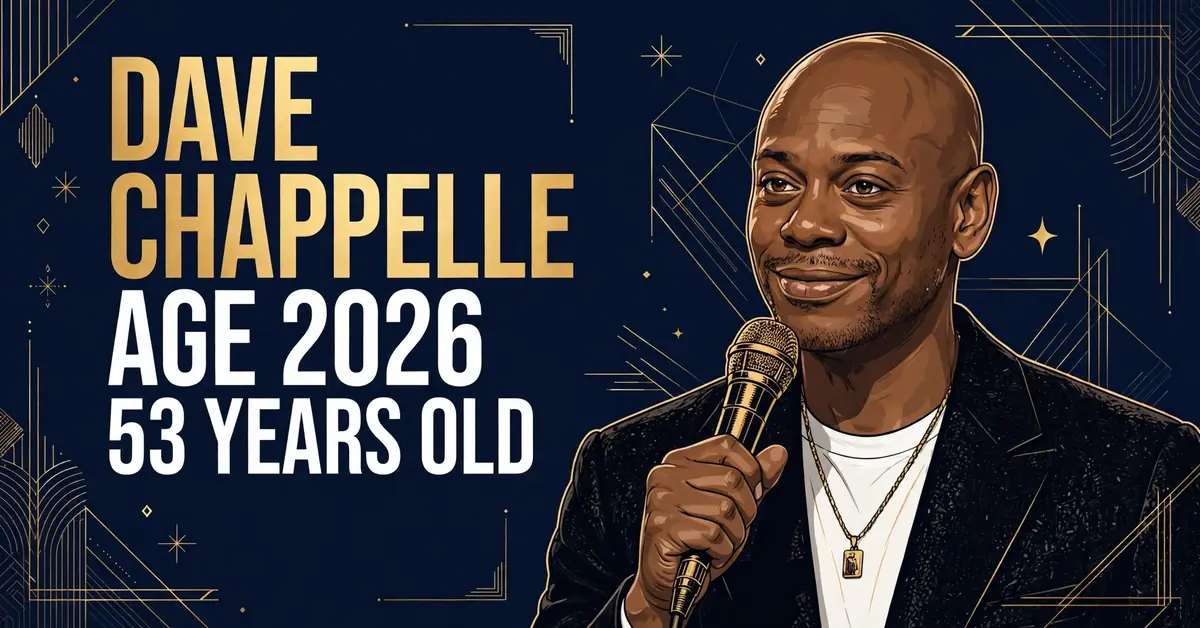
Dave Chappelle is 53 years old in November 2026. His full name is David Khari Webber Chappelle, and he was born on 24 August 1973 in Washington, D.C. He turns 54 on 24 August 2027. If you have seen a profile that still calls him 52, that profile has not been updated since his last birthday: the number flipped in August, and plenty of pages never noticed. Tonight he headlines Madison Square Garden, at 53, as the opening act of the 2026 New York Comedy Festival — a long way from the 14-year-old who got booed off the Apollo stage.
The short version of his life runs like this. A professor’s son from Washington and Yellow Springs, Ohio, started doing stand-up at 14, moved to New York after high school, and spent the 1990s building a film career one supporting role at a time. In 2003 he got his own sketch show on Comedy Central, and within two years it made him the most talked-about comedian in America — then he walked away from a reported $50 million contract in the middle of season three and disappeared to South Africa. The comeback took a decade: a $60 million Netflix deal in 2016, eight specials, six Grammy Awards, five Emmys, the Mark Twain Prize, and a fortune that Celebrity Net Worth now puts at $100 million. He lives on a farm in Ohio with his wife of 25 years and their three children, and he still tours on his own terms.
What makes him worth a full age profile, rather than a stat sheet, is that his age is the frame for the whole story. He was 19 when he stole scenes in Robin Hood: Men in Tights. He was 29 when Chappelle’s Show started. He was 31 when he walked away from the biggest contract in comedy. He was 43 when Netflix handed him $60 million. He is 53 now, and he is playing the Garden tonight. This article puts those ages in order, with dates checked, money estimates labelled as estimates, and the two errors that keep spreading through his coverage — the stale 52 and the wrong Emmy count — corrected with the sources that settle them.
Quick Facts: Dave Chappelle at a Glance
| Full name | David Khari Webber Chappelle |
| Known as | Dave Chappelle |
| Born | 24 August 1973, Washington, D.C., United States |
| Age in November 2026 | 53 (turns 54 on 24 August 2027) |
| Job | Stand-up comedian, actor, writer, producer |
| Height | Listed at 6 ft 0 in (183 cm); no measured figure published |
| Wife | Elaine Erfe, married 2001 |
| Children | Three: Sulayman, Ibrahim, Sanaa |
| Home | Farm near Yellow Springs, Ohio |
| Major awards | Six Grammy Awards for Best Comedy Album; five Primetime Emmy Awards; Mark Twain Prize for American Humor (2019); NAACP President’s Award (2025) |
| Net worth estimate | About $100 million (Celebrity Net Worth), inside a $60–100 million published range; estimate, not an audited figure |
| 2026 highlight | Headlining two nights at Madison Square Garden, 6–7 November 2026, opening the New York Comedy Festival with his Karmageddon tour |
How This Age Was Verified
The birth date, 24 August 1973, is consistent across his major biography profiles and Wikipedia, and the arithmetic is checked against dated milestones: a 1991 high-school graduation, a 1993 film debut at 19, a 2003 sketch show at 29, and a birthday profile published on 24 August 2026 that lists him as 53. Where a secondary profile disagrees — most often by calling him 52 — this article follows the dated record and names the stale pages, rather than averaging two versions. The same rule applies to the awards count: Wikipedia’s awards list and the NAACP’s February 2025 release both say five Emmys, against the six that many profiles copy, so this article uses five and shows the breakdown. Money figures are treated the same way: the publisher is named, the range is shown, and no figure is presented as a bank statement.
+
The Short Answer: 53, and the Stale 52 You Keep Seeing
Dave Chappelle was born on 24 August 1973. Subtract 1973 from 2026 and you get 53, and because his birthday falls in August, he has already had it by November. He will be 53 for the rest of 2026 and turns 54 on 24 August 2027. The date is easy to verify, because the public record lines up at every point: he graduated from the Duke Ellington School of the Arts in 1991, which fits a 1973 birth; his film debut came in 1993, when he was 19; and a birthday profile published on 24 August 2026 lists him, plainly, as 53 years old.
So why do so many pages still say 52? Because age pages are written once and left alone. FamousIntel, updated on 29 May 2026, says he is “52 years old as of 2026” — true on the day it was written, wrong the moment August arrived. Wikibious lists “Age (2026): 52 years”. CelebClan says he “will be 52 years old in 2026”. None of them re-ran the subtraction after his birthday. The error is small, but it is a useful warning about everything else on those pages: a profile that has not noticed a birthday is a profile that has not noticed anything else since, either.
Fresh sources get it right. TVOverMind’s birthday profile, published on 24 August 2026, lists him as 53. Wealthy Gorilla, updated on 5 November 2026, lists his age as 53 and his birth date as 24 August 1973. A live age calculator shows 53 years, 2 months and 8 days as of early November. Three independent checks, all dated, all agreeing — that is the standard this article applies to every number in it, and the stale pages fail it.
The other number that needs correcting is the Emmy count, and it matters for the same reason. Plenty of profiles say Chappelle has won six Emmy Awards. The count is five. Wikipedia’s awards list records five wins from twelve nominations, the NAACP’s February 2025 release says “five Emmy awards, including three for his Netflix comedy specials… and two for hosting Saturday Night Live”, and Ticketmaster’s biography says five. Six is the Grammy count, and somewhere along the line the two numbers got swapped in the copying. This article uses five Emmys and six Grammys, and the awards section below shows the breakdown so readers can check it themselves.
Early Life: Washington, Yellow Springs, and Two Remarkable Parents
David Khari Webber Chappelle was born in Washington, D.C., and grew up between two very different Americas: the capital, where his mother worked, and Yellow Springs, Ohio, a small college town where his father taught. His father, William David Chappelle III, was a professor and dean at Antioch College in Yellow Springs. His mother, Yvonne Seon, was a Unitarian minister and professor who had worked in the Congo for Patrice Lumumba, the first prime minister of the Democratic Republic of Congo. The household was academic, political and religious at once, and the dinner-table conversation in it was not the usual preparation for a stand-up career — unless you count the part where a child learns to hold a room.
His parents separated when he was young, and the split shaped his geography for the rest of his childhood. He spent time in Washington and in Silver Spring, Maryland, with his mother, and in Yellow Springs with his father. Two homes, two towns, two sets of rules. The Yellow Springs side of that split is the one that stuck: the town of about 3,500 people became his adult home, the place he returned to after fame, and the place where he now lives on a farm with his family. A comedian who spent his childhood commuting between a capital city and a college town learned early how to read different rooms, and that skill shows up in everything he has done since.
School gave him the stage before comedy did. He attended the Duke Ellington School of the Arts in Washington, a public arts high school, and graduated in 1991 at 17. Ellington is the kind of school that treats performance as a discipline rather than a hobby, and Chappelle has credited it with teaching him to take the craft seriously. He converted to Islam at 17, a faith he has spoken about sparingly and without performance ever since. By graduation he already knew what he wanted to do: he had been sneaking into comedy clubs since he was 14, and the plan was New York, not college.
Age 14: The Apollo Booing and the New York Club Circuit
Chappelle started doing stand-up at 14, which means he was performing in clubs before he could legally drive to them. The early gigs were the kind every young comic collects: small rooms, indifferent crowds, material that worked one night and died the next. The famous story from this period is the Apollo. He took the stage at Amateur Night at the Apollo Theater in Harlem as a teenager and got booed off — the Apollo crowd is famously unforgiving, and a 14-year-old with five minutes of material was never going to survive it. He has told the story himself, more than once, and he tells it as a beginning rather than a trauma: the night he learned what a hostile room feels like, at an age when most kids are learning algebra.
After graduating from Ellington in 1991, he moved to New York and worked the club circuit in earnest. The early 1990s New York scene was a hard school. Comics did five or six spots a night, riding the subway between clubs, testing the same five minutes in front of a different crowd each time. Chappelle was 18, broke, and funny enough to keep getting booked. The work paid in stage time rather than money, and the stage time compounded: by 1992, at 18 going on 19, he was on Def Comedy Jam, HBO’s showcase for Black stand-up, and the industry started to know his name.
That apprenticeship matters to the age question in a plain way. When Chappelle’s Show arrived in 2003, he was 29, but he had already been doing stand-up for 15 years — more than half his life. The show looked like an overnight success and was nothing of the kind. It was the product of a teenager who had been booed at the Apollo, kept going, and spent a decade and a half learning how to hold a room before television gave him one of his own.
1993–1999: Film Debut, the Bubba Role He Turned Down, and Half Baked
Chappelle’s film debut came in 1993, when he was 19, as Ahchoo in Mel Brooks’s Robin Hood: Men in Tights. It was a small role — a few scenes, a few jokes — but it put a teenager on a studio film set with one of the great comedy directors, and it opened the door to a decade of supporting parts. The same year he was offered the role of Bubba in Forrest Gump and turned it down, a decision that has followed him ever since. Bubba went to Mykelti Williamson and became one of the most quoted supporting turns of the decade. Chappelle has said he did not think the part was funny, and he has never sounded like he regrets the call. At 19, he was already choosing material on his own terms.
The rest of the 1990s filled out his filmography one supporting role at a time. He played a small part in The Nutty Professor in 1996, appeared in Con Air in 1997, and showed up in You’ve Got Mail in 1998. None of these roles made him a movie star, and none of them was supposed to. They paid the rent, kept him visible, and taught him how a film set works — useful knowledge for a man who would later run his own show. The pattern of the decade was a comic who was too funny to ignore and too unwilling to play the game to be cast as a lead.
The exception came in 1998, when he co-wrote and starred in Half Baked, a stoner comedy about a man who sells marijuana to bail his friend out of jail. Chappelle was 24, and it was his first lead role and his first writing credit on a feature. The film was a modest box-office performer that became a cult favourite on video, and it showed what he could do with his own material: the jokes were his, the voice was his, and the film’s fans quoted it for years. Blue Streak followed in 1999, and Undercover Brother in 2002, by which time the film career had done its job — it had kept him working while stand-up made him undeniable.
Killin’ Them Softly and the Road to Chappelle’s Show
The turning point of Chappelle’s career before television was a one-hour HBO special, Killin’ Them Softly, recorded in 2000 when he was 26. It was his first hour, and it is still the special his fans cite first: an hour of material about race, drugs, policing and everyday life, delivered with the loose, conversational timing that became his signature. The special did not make him famous overnight, but it made him the comedian other comedians watched. Comedy Central noticed, and the conversation that became Chappelle’s Show started soon after.
By 2003, at 29, he had spent 15 years in stand-up and a decade in film. That is the context the show needs: it was not a young comic’s lucky break, it was a veteran’s first real platform. The show’s format — sketches, musical guests, Chappelle himself introducing each piece from the street — gave him a freedom no film role had offered. The sketches were his, the point of view was his, and the audience that found it was young, mixed and enormous. Within two seasons it was Comedy Central’s biggest show, and Chappelle was the most talked-about comedian in America.
The show’s signature bits entered the language fast. The Rick James sketch, with Charlie Murphy telling the story and Chappelle playing James, became a catchphrase machine. The Wayne Brady sketch, the reparations sketch, the blind white supremacist sketch — each one took a subject other comics avoided and made it funny without softening it. The show ran for two full seasons and part of a third, and its ratings and cultural reach were the kind of thing networks dream about. At 30, Chappelle had the biggest show on cable and a contract offer that would have made him rich for life. Then he left it.
Chappelle’s Show (2003–2006): The Peak, the Million Offer, and the Walkaway
Chappelle’s Show ran on Comedy Central from 2003 to 2006, and its peak came fast. Season two, in 2004, was a ratings hit and a cultural event: the DVD sets sold in huge numbers, the sketches were quoted in schoolyards and offices, and Chappelle’s face was everywhere. Comedy Central responded the way networks do when a show works — with money. The reported offer for two more seasons was $50 million. Chappelle himself has used the $50 million figure when telling the story; some accounts put it at $55 million. Either way, it was the biggest contract in comedy at the time, and it was sitting on the table in front of a 31-year-old who had spent half his life trying to get exactly that kind of offer.
He walked away in May 2005, in the middle of production on season three, and flew to South Africa. The reasons he gave later, most fully in a 2006 interview with Oprah Winfrey, were burnout and a loss of creative control: the show had become a machine, the sketches were being shaped by the demands of the schedule rather than by his judgement, and a moment on set — a white crew member laughing at a sketch in a way that made him feel the joke was landing on the wrong side — crystallised the feeling that the show was no longer his. He was 31, rich beyond anything he had imagined, and miserable enough to leave it all behind.
The walkaway became the defining story of his career, and it is still misunderstood. It was not a breakdown, and it was not a negotiating tactic. It was a man deciding that the price of the money was the work itself, and refusing to pay it. The cost was real: he gave up the $50 million, the show was cancelled, and for a few years the industry treated him as a cautionary tale. The payoff took longer to see. When he came back, he came back on his own terms, and the terms he set — no network notes, no schedule he did not choose, no material he did not believe in — have held ever since. The $50 million he left on the table in 2005 is the reason the $60 million Netflix paid him in 2016 came with no strings he would not accept.
The Missing Years: South Africa, Oprah, and the Slow Return
The years between the walkaway and the comeback are the part of Chappelle’s story that gets told least, because there is less to report. After South Africa, he returned to the United States and went back to the only thing that had never failed him: stand-up. He toured clubs and theatres, sometimes unannounced, sometimes for small crowds, working new material in rooms where nobody could tell him what to say. He was 32, 33, 34 — the years when a television star is supposed to be consolidating fame — and he was doing the same work he had done at 18, one room at a time.
The Oprah interview in February 2006 was the first full public account of what had happened, and it is still the best source on the walkaway. Chappelle told Winfrey he had not been well, that the pressure of the show had made him doubt his own judgement, and that South Africa had given him the distance to think clearly. He was calm, funny and lucid throughout, which did as much as anything to kill the rumours that he had lost his mind. The interview did not bring the show back — Comedy Central aired the remaining season-three sketches in 2006 without him — but it reset the public story from “comedian goes crazy” to “comedian makes a choice”.
The slow return took the rest of the decade. He kept touring, he kept his name out of the tabloids, and he let the work speak. In 2019 he regained licensing rights to Chappelle’s Show, a quiet piece of business that mattered more than most headlines: the show that had nearly broken him was now, in part, his to control. By the time Netflix called in 2016, he was 43, he had been back on stage for a decade, and he was in no hurry. The missing years were not a gap in his career. They were the part where he decided what the career was for.
The Netflix Era: Million, Million a Special, and Eight Specials
In November 2016, Netflix announced a deal for three Chappelle stand-up specials, reported by Page Six at $60 million — $20 million per special. Chappelle was 43. The deal made him one of the highest-paid comedians in the world, and it did something else: it put him back on screen in a format he controlled, with no network notes and no weekly schedule. The first batch arrived in March 2017 — four specials, not three, because two came from his personal archive: The Age of Spin and Deep in the Heart of Texas, both recorded years earlier, alongside the new Equanimity and The Bird Revelation. Four specials in one day, after a decade away from the format, and the audience was still there.
The specials kept coming at the reported $20 million rate. Sticks & Stones arrived in August 2019, The Closer in October 2021, What’s in a Name? in September 2022, and The Dreamer in December 2023 — eight Netflix specials in all, spanning six years and taking him from 43 to 50. Internal Netflix figures reported in 2021 put the company’s spending on Sticks & Stones at $23.6 million and on The Closer at $24.1 million; those are production costs, not his pay, but they show the scale Netflix was working at. Forbes reported that he earned $47 million between June 2016 and June 2017, and that the Netflix contract brought him $82 million across 2016 to 2018. The $20 million per special figure has never been confirmed by Netflix — the company does not comment on deal terms — but it has been reported consistently enough, and by enough outlets, to be the working number.
The specials also brought the awards, and the arguments. Sticks & Stones and The Closer drew criticism for material about transgender people, and Chappelle answered the criticism on stage rather than apologising for it — a stance that cost him some goodwill and cost Netflix some headlines, but never cost him the audience. In April 2026, Variety reported that he had re-teamed with Netflix for three more shows, with terms undisclosed. Ten years after the first deal, at 52 turning 53, he was still the comedian Netflix called when it wanted a special that people would actually talk about.
The Trophy Shelf: Six Grammys, Five Emmys, the Mark Twain Prize
The awards record is the cleanest way to measure the Netflix era, because it is counted by institutions rather than estimated by trackers. Chappelle has won six Grammy Awards for Best Comedy Album, one for each of his Netflix specials’ album releases: The Age of Spin (2018 ceremony), Equanimity & The Bird Revelation (2019), Sticks & Stones (2020), The Closer (2022), What’s in a Name? (2023), and The Dreamer (2025). Six specials, six Grammys — a record no other comedian has matched in the category, and a run that turns the $20 million per special figure into a bargain in retrospect.
The Emmy count is five, not six, and the breakdown is worth spelling out because so many profiles get it wrong. He won twice for hosting Saturday Night Live — the 2016 broadcast (Emmy ceremony 2017) and the 2020 broadcast (ceremony 2021) — and three times for his Netflix specials, including Equanimity and Sticks & Stones in the Outstanding Variety Special (Pre-Recorded) category. The two SNL wins are the ones that show his range: a stand-up comic walking into live television’s hardest job, twice, and winning the industry’s top prize for it both times. His most recent SNL hosting, in January 2025, featured a 17-minute monologue reported as the longest in the show’s history.
The honour that sits above the rest is the Mark Twain Prize for American Humor, presented by the John F. Kennedy Center for the Performing Arts and awarded at a gala on 27 October 2019, when Chappelle was 46. The prize is widely described as America’s highest comedy honour, and its past recipients are the names Chappelle grew up admiring. Rolling Stone had already placed him at No. 9 on its 2017 list of the 50 Best Stand-Up Comics of All Time. In February 2025, at 51, he received the NAACP President’s Award at the 56th NAACP Image Awards — an honour that recognises a career’s public standing as much as its art. The trophy shelf, taken together, is the record of a comedian who walked away from television at 31 and came back to collect every prize the industry has.
Money in Context: The 0 Million Estimate and Why Trackers Disagree
Dave Chappelle’s net worth in 2026 is estimated at about $100 million by Celebrity Net Worth, inside a published range that runs from roughly $60 million to $100 million. Wealthy Gorilla, updated on 5 November 2026, still lists $60 million. Net Worth Radar, modelling the figure in October 2026, lands at $95 million with a likely range of $73 million to $121 million. This article anchors on $100 million per Celebrity Net Worth inside the $60–100 million range and labels it for what it is: an estimate. No audited balance sheet exists, no tax return is public, and the fees for his later Netflix specials were never disclosed, which means nobody outside his accountants can price his wealth with precision. Any single number quoted without that range is hiding the uncertainty, not resolving it.
The range is wide for reasons that are easy to name. The Netflix money is the biggest known quantity — $60 million for the first three specials, a reported $20 million per special after that, and Forbes’s $82 million figure for the contract’s first two years — but a fee is not a balance. Agents, managers, lawyers and tax take their share before anything reaches an account. Touring is the second stream, and the only hard number for it is a gross: Pollstar reported $44.2 million in ticket sales from 30 shows, which is the money the box office took in before venues, promoters, production, travel, staff and tax. A tracker that counts the gross as income lands near $100 million; a tracker that counts only what survives the haircut lands near $60 million. The spread is a methods gap, not a disagreement about a fact.
There is one more correction worth making, and it is on this site. Guide Net Worth’s own Dave Chappelle net worth post, last updated in July 2026, reported $60–70 million. That figure reflected Celebrity Net Worth’s estimate at the time. Since then the estimate has moved to $100 million, and the trackers that model the touring years have moved with it. The July number is not wrong for July; it is stale for November, and this article says so rather than quietly overwriting it. Property is the third stream, and the numbers there are the most concrete: county records put his Yellow Springs holdings, more than 20 properties including an old firehouse bought for a comedy venue, at an appraised value of about $10.9 million in 2026. Appraisal is not sale value and not net equity, but it is a real number from a public record, and it anchors the Ohio side of the fortune in a way no tracker estimate can.
Put together, the money story at 53 is simple: a man who walked away from $50 million at 31, signed for $60 million at 43, and built a fortune that the best available estimates now place around $100 million — earned mostly from specials and touring, held partly in Ohio property, and spent, by his own account, on the town he lives in rather than on the life he left behind.
Personal Life: Elaine, Three Children, and the Yellow Springs Farm
Chappelle has been married to Elaine Erfe since 2001, when he was 27. Elaine, who is of Filipino descent, has stayed almost entirely out of the public eye for the whole of their 25-year marriage — no interviews, no red carpets, no social media presence to speak of. The couple have three children: Sulayman, Ibrahim and Sanaa. Chappelle has spoken about his family rarely and briefly, usually to make the point that they are the reason he lives where he lives and works the way he works. The children were part of the walkaway story too: in the Oprah interview he talked about wanting to be present for them in a way the show’s schedule did not allow.
Home is a farm near Yellow Springs, Ohio, the town where his father taught and where he spent part of his childhood. The choice is deliberate and it is the most consistent fact in his biography: he could live anywhere, and he lives in a town of about 3,500 people, on a farm, in the state where his father worked. The property portfolio around the farm has grown over the years — more than 20 properties in Greene County, including the old firehouse he bought to turn into a comedy venue — and the summer outdoor show series he hosts in Yellow Springs reached its sixth edition in 2026. He has put his money into the town as visibly as he has put his name on it, and the town has kept him.
His height is listed at 6 ft 0 in (183 cm) in profiles. No measured figure has been published, so that number is a listing, not a measurement, and it is labelled that way here for the same reason the net worth figure carries its range: a repeated listing is not a verified fact. The restraint in this section is deliberate. Chappelle’s private life is not his product, even though his public life has been on television for twenty years, and the line between the two is one he has drawn himself by keeping his family off stage. A biography earns trust by respecting that line where the subject drew it, and by saying “not publicly confirmed” rather than filling a gap with a rumour that search results will then repeat as fact.
2026: Karmageddon, Madison Square Garden, and Age 53 on the Biggest Stage
At 53, Chappelle is not slowing down. His 2026 fall tour, Karmageddon, runs seven dates across the United States and Canada: Nashville on 20 October, Charlotte on 21 October, Toronto on 23 October, Louisville on 24 October, Austin on 26 October, Houston on 28 October, and then the close — two nights at Madison Square Garden, Friday 6 November and Saturday 7 November, at 7:30 PM, as the opening of the 22nd New York Comedy Festival, presented with Live Nation. The shows are phone-free, with Yondr pouches at the door, a rule he has enforced for years: no recordings, no clips, no phones in the room. What happens in the Garden stays in the Garden, at least until he decides otherwise.
The Garden dates are the right place to end an age profile, because they close a circle that started at the Apollo. At 14 he was booed off a Harlem stage. At 53 he headlines the biggest room in New York, twice in two nights, on a tour named for the end of the world. The distance between those two stages is 39 years, and it is the whole story: the teenager who kept going, the star who walked away, the comic who came back on his own terms, and the 53-year-old who still sells out the Garden without a phone in the room.
The year around the tour has been busy in the quiet way his years are busy. In August 2026 he hosted the Diaspora Calling! festival in London. In September he returned to Washington for a benefit performance for the Duke Ellington School of the Arts at DAR Constitution Hall — the school that taught him the craft, thirty-five years after he graduated from it. He turned up in tributes to Mel Brooks, the man who gave him his first film role, and to Eddie Murphy at the AFI Life Achievement Award in 2026. And in April, Variety reported the new three-show Netflix team-up. At 53, the biography pages that stopped in 2005 missed most of that. This one does not.
Sources & Reporting
Reporting window: November 2026, with facts checked against the dated milestones in his career: the 1991 Duke Ellington graduation, the 1993 film debut, the 1998 Half Baked release, the 2000 Killin’ Them Softly special, the 2003–2006 Chappelle’s Show run, the May 2005 walkaway, the February 2006 Oprah interview, the November 2016 Netflix deal, the eight specials from 2017 to 2023, the 27 October 2019 Mark Twain Prize gala, the February 2025 NAACP President’s Award, and the 6–7 November 2026 Madison Square Garden dates. Birth date and family background are drawn from his major biography profiles and Wikipedia; age confirmed by TVOverMind (24 August 2026) and Wealthy Gorilla (5 November 2026); the stale-52 error documented from FamousIntel, Wikibious and CelebClan; awards from Wikipedia’s awards list and the NAACP’s February 2025 release; Netflix figures from Celebrity Net Worth (2016 deal, $60 million, $20 million per special) and Forbes (2016–2017 earnings); tour gross from Pollstar; MSG dates from Madison Square Garden and Ticketmaster; money figures from Celebrity Net Worth (about $100 million, inside a $60–100 million published range) and Net Worth Radar (modelled $95 million, October 2026). Where trackers disagree, the range is published and the method difference is named. No figure in this article comes from Chappelle’s private financial records, which are not public. Corrections: figures are updated when new reporting emerges — contact us via the About page if you spot an error.
Frequently Asked Questions
How old is Dave Chappelle in 2026?
Dave Chappelle is 53 years old in November 2026. He was born on 24 August 1973 in Washington, D.C., and he turns 54 on 24 August 2027. Some profiles still say 52 — that number was correct before his birthday in August 2026 and is stale now.
When is Dave Chappelle’s birthday?
Dave Chappelle’s birthday is 24 August. He was born on 24 August 1973, turned 53 on 24 August 2026, and turns 54 on 24 August 2027.
What is Dave Chappelle’s net worth in 2026?
Dave Chappelle’s net worth in 2026 is estimated at about $100 million by Celebrity Net Worth, inside a roughly $60 million to $100 million range across published trackers. No audited balance sheet exists, and the fees for his later Netflix specials were never disclosed, so the figure is an estimate, not a confirmed account.
Is Dave Chappelle married?
Yes. Dave Chappelle has been married to Elaine Erfe since 2001. They have three children — Sulayman, Ibrahim and Sanaa — and live on a farm near Yellow Springs, Ohio.
How tall is Dave Chappelle?
Dave Chappelle is listed at 6 ft 0 in (183 cm) in profiles. No measured figure has been published, so that number is a listing, not a confirmed measurement.
Why did Dave Chappelle leave Chappelle’s Show?
Chappelle walked away in May 2005, in the middle of season three, giving up a reported $50 million contract. He later told Oprah Winfrey in 2006 that he was burned out and felt he had lost creative control of the show, and he flew to South Africa to get distance from it. The show was cancelled, and he spent the next decade rebuilding his career on his own terms.
How many Netflix specials does Dave Chappelle have?
Dave Chappelle has eight Netflix specials: The Age of Spin, Deep in the Heart of Texas, Equanimity and The Bird Revelation (all 2017), Sticks & Stones (2019), The Closer (2021), What’s in a Name? (2022) and The Dreamer (2023). His first Netflix deal, signed in November 2016, was reported at $60 million for three specials, about $20 million each. Variety reported in April 2026 that he had re-teamed with Netflix for three more shows.
How many Grammys and Emmys has Dave Chappelle won?
Dave Chappelle has won six Grammy Awards for Best Comedy Album — one for each of his Netflix specials’ album releases — and five Primetime Emmy Awards: two for hosting Saturday Night Live and three for his Netflix specials. He also received the Mark Twain Prize for American Humor in 2019 and the NAACP President’s Award in February 2025.
WRITTEN BY
Nathan Cole
Nathan Cole is the editor of Guide Net Worth. He covers celebrity wealth the way a business desk covers earnings: reported figures first, estimates labeled as estimates, and no invented numbers. Every profile on this site passes through his desk before it publishes. About Guide Net Worth · Corrections: figures are updated when new reporting emerges — contact us via the About page if you spot an error.
References & Sources
This article has been fact-checked and verified against multiple public sources, financial disclosures, SEC filings, Forbes reports, Celebrity Net Worth databases, and official records. All net worth estimates are based on publicly available information and financial analysis.