Deepika Padukone biography: from Copenhagen-born badminton player to Bollywood’s highest-paid star — her $40M-$65M fortune, films, family and 2026 comeback.
Last updated: November 19, 2026 · By Nathan Cole
Deepika Padukone is 40 years old in 2026, one of the highest-paid actresses in India, and the star of a career that runs from a badminton court in Bangalore to the Cannes jury, the Oscars stage, and a skincare brand of her own. She was born on January 5, 1986, in Copenhagen, Denmark, the daughter of badminton great Prakash Padukone, and she played the sport at national level before modelling pulled her in a different direction. Her Bollywood debut, Om Shanti Om (2007), made her a star overnight. Nineteen years later she has three Filmfare Awards, a place on the TIME 100 list, a production company, a mental-health foundation, and a fortune that published estimates put at $40 million to $65 million — a spread this page explains rather than hides.
The year 2026 has been the most argued-over of her career. She walked away from two major films — Spirit and the Kalki 2898 AD sequel — in a public row over working hours that turned into a debate about how Bollywood treats its leading women. She answered it in her own words, on camera, and then went back to work: King, her sixth film with Shah Rukh Khan, reaches cinemas on December 24, 2026. In the same year she became a mother for the second time. Her second daughter, Devi, was born in September 2026, per Celebrity Net Worth (updated November 16, 2026) and Britannica, which now records that she and Ranveer Singh have two daughters.
This page tells the whole story in order: the Copenhagen birth and the Bangalore childhood, the modelling years, the debut, the blockbuster run, the Hollywood years, the 2025 exits and what they were really about, the marriage and the two daughters, the foundation that changed how India talks about mental health, and the business empire — 82°E, KA Productions, startup stakes, and a Kroll brand value of $89.2 million. Every figure carries the name of the outlet that reported it. Where the outlets disagree, the disagreement is printed in full.
Quick Facts
| Full Name | Deepika Prakash Padukone |
| Born | January 5, 1986, Copenhagen, Denmark |
| Age in 2026 | 40 (turned 40 on January 5, 2026) |
| Height | 5 ft 7.5 in (1.71 m), per IMDb |
| Parents | Prakash Padukone (former badminton champion) and Ujjala Padukone (travel agent) |
| Sibling | Anisha Padukone, younger sister |
| Husband | Ranveer Singh, married November 2018 (Italy) |
| Children | Dua (born September 2024); Devi (born September 2026) |
| Debut | Aishwarya (Kannada, 2006); Bollywood debut Om Shanti Om (2007) |
| Awards | Three Filmfare Awards; TIME 100 (2018); Time100 Impact Award (2022); Crystal Award (2018) |
| Net Worth 2026 | Estimated $40M–$65M (Celebrity Net Worth $40M; Alux $48M; Indian media ~$60M; GNW $65M) |
| Brand Value | $89.2M (Kroll 2025 celebrity brand valuation, 7th among Indian celebrities) |
| Businesses | 82°E skincare (2022); KA Productions (2018); The Live Love Laugh Foundation (2015) |
| Next Film | King, with Shah Rukh Khan — releasing December 24, 2026 |
How This Biography Was Researched
A biography is only as good as its sources, and this one is built from the outlets that keep the primary record: Wikipedia and Encyclopaedia Britannica for the life facts, IMDb for the filmography and measurements, Filmfare for the awards record, Celebrity Net Worth and Alux for the money figures (both dated November 2026), Kroll for the brand valuation, and Bollywood Hungama plus CNBC-TV18 for the 2025–2026 reporting on the film exits and her own words about them. The net-worth figure is published as a range because the sources disagree by $25 million, and the reasons for the gap are laid out in the money section. The second daughter, Devi, is included only because two independent sources — Celebrity Net Worth and Britannica — now confirm it. One rumor, a reported “Kaali Productions” launch carried by a single low-quality site, was left out because no major outlet corroborated it. Nothing here is invented, and no sentence is copied from a competitor.
+
Who Is Deepika Padukone?
Deepika Padukone is an Indian actress who works mostly in Hindi films, and she has been one of the biggest names in Bollywood for almost twenty years. She is the daughter of Prakash Padukone, the badminton player who put India on the sport’s international map, and she grew up in Bangalore after being born in Copenhagen. She played badminton at national level as a teenager, then left the sport for modelling, then left modelling for films. The debut came in 2007, and the career since then has covered every kind of Hindi cinema: romance, comedy, period epic, action, and drama.
Three numbers describe the scale of her standing. She has won three Filmfare Awards, including two for Best Actress. TIME named her one of the 100 most influential people in the world in 2018 and gave her the Time100 Impact Award in 2022. Kroll’s 2025 celebrity brand valuation put her brand at $89.2 million, seventh among Indian celebrities — a measure of what her name is worth to advertisers, not of her bank balance, and this page keeps the two separate.
She is also one of the few Indian film stars whose public identity extends past the screen. She disclosed her depression in 2015, at the peak of her career, and built The Live Love Laugh Foundation into one of India’s best-known mental-health organisations. In 2025 the Union Ministry of Health and Family Welfare appointed her India’s first Mental Health Ambassador. She runs a skincare brand, 82°E, and a production company, KA Productions. She is married to actor Ranveer Singh, and she is the mother of two daughters. The sections below take each part of that life in turn, with the dates and the sources attached.
Early Life: Copenhagen, Bangalore and Badminton
Deepika Prakash Padukone was born on January 5, 1986, in Copenhagen, Denmark, to Konkani-speaking Indian parents. Her father, Prakash Padukone, was in Denmark for badminton — he was a professional player at the height of his career, and in 1980 he had become the first Indian to win the All England Open Badminton Championships. Her mother, Ujjala, worked as a travel agent. The family moved to Bangalore while Deepika was still a baby, and Bangalore is where she grew up: Sophia High School, then Mount Carmel College for her pre-university education, and later a sociology degree at IGNOU that she left unfinished when modelling took over.
The house she grew up in ran on sport. Her father trained in the mornings, and Deepika followed him onto the court. She played badminton at state level until her Class 10 board exams, and at national level as a teenager, before the sport gave way to something else. Her younger sister Anisha took a different path in sport — Britannica notes that Anisha was one of the top ten amateur golfers in India in her teens — and the two sisters grew up in a household where discipline was normal and public attention was not. Prakash Padukone’s fame was the sporting kind: respected, not chased. Deepika’s would be different.
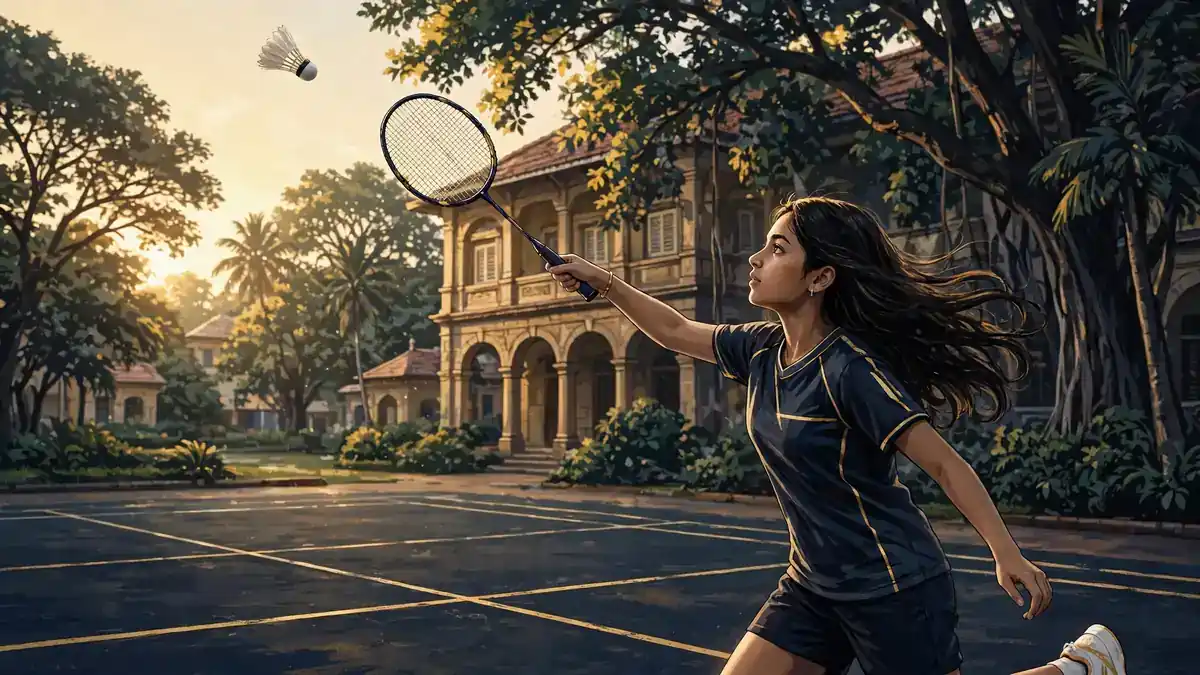
The badminton years matter to the rest of the story for a practical reason: they gave her the body and the discipline that modelling and then film work would demand. She has said in interviews over the years that the sport taught her to show up, to train, and to lose without falling apart — lessons that carried into a film career where rejection is routine and a flop is public. The sport also gave her height and posture. She is listed at 5 ft 7.5 in (1.71 m) by IMDb, tall for a Hindi film heroine of her generation, and the modelling scouts noticed her for it before the film directors did. Readers who want the full measurement story can read Deepika Padukone’s height profile on this site, which covers her height in detail while this page covers the life.
There is one more detail from the childhood that explains the adult. Deepika has spoken about being shy as a girl, and about the gap between the private person and the public one. The shyness never quite left — she still describes herself as an introvert — but the discipline from the badminton court gave her a way to work through it. She learned to perform. First on the court, then on the runway, then on screen. The through-line is not talent alone. It is the habit of showing up and doing the work, learned before she was fifteen.
The Modelling Years: Lakme, Kingfisher and Maybelline
Deepika’s modelling career began the way most do: someone saw her and asked. She made her runway debut at Lakme India Fashion Week in 2005, walking for designer Suneet Varma, and the work came fast after that. She appeared in print and television advertising for Liril, Close-Up toothpaste and Limca, and she became the brand ambassador for Jewels of India, an annual jewellery exhibition. At the fifth annual Kingfisher Fashion Awards she was named Model of the Year. Then came the break that took her past the Indian market: Maybelline made her its new international cover girl, putting her face in front of audiences that had never seen a Bollywood film.
Modelling gave her two things that film school could not. The first was camera sense — how to hold a frame, how to move in front of a lens, how to make a still image carry feeling. The second was money and independence at a young age, which meant she could choose her film debut rather than take the first offer. She was nineteen when the runway work began in earnest, and by twenty she was being offered film roles. She turned some down. The one she took, a Kannada film called Aishwarya (2006), was a home-state production directed by Indrajit Lankesh, and it let her learn the craft in a smaller pond before the Bollywood ocean.
The modelling years also explain the endorsement career that still pays her today. She learned the business of being a brand early: the contracts, the exclusivity clauses, the way a face becomes an asset. By 2025 that asset was worth $89.2 million in brand value according to Kroll, and the brands on her roster included Louis Vuitton and Cartier, both of which made her their ambassador — Indian media reported her as the first Indian ambassador for both houses. The runway was not a detour from the film career. It was the first half of it, and the commercial sense she picked up there is still visible in the way she runs her businesses now.
Om Shanti Om: The Debut That Changed Everything
Deepika’s Bollywood debut arrived in 2007, and it arrived at full volume. Om Shanti Om, directed by Farah Khan and produced by Shah Rukh Khan’s Red Chillies Entertainment, cast her in a dual role opposite Shah Rukh Khan himself — the biggest star in Hindi cinema, playing opposite a twenty-one-year-old who had never done a Hindi film. She played Shantipriya, a 1970s film star, and Sandy, her lookalike in the present day. The film was a reincarnation romance wrapped in a love letter to old Bollywood, and it became the top-grossing Bollywood film of 2007.
The debut won her the Filmfare Award for Best Female Debut, and it did something rarer: it made her a star on day one, without the years of small roles that most actors serve. That kind of launch carries a cost. A debut opposite Shah Rukh Khan sets a bar that every later film is measured against, and the next few years were uneven. Bachna Ae Haseeno (2008) and Love Aaj Kal (2009) did business. Chandni Chowk to China (2009) did not, and the reviews were harsh. She has said since that the early criticism stung, and that she took acting lessons and worked on her Hindi diction — her mother tongue is Konkani, and Hindi was a language she had to master for the screen, not one she grew up speaking at home.
The partnership with Shah Rukh Khan that began on that set has now lasted nineteen years. Om Shanti Om was the first of their films together; Chennai Express (2013), Happy New Year (2014), Pathaan (2023) and Jawan (2023) followed, and King (2026) will be the sixth. Readers who want the full story of the man she debuted opposite can read Shah Rukh Khan’s biography on this site, which covers his life from the biography angle while this page covers hers. The two careers have run side by side for nearly two decades, and the debut is where they first crossed.
One fact about the debut is often missed: she was paid little for it by the standards of what she earns now, and the film’s success belonged mostly to its star and its director. What she took from it was not money. It was proof that she could hold a screen opposite the biggest name in the business, and a Filmfare trophy that opened every door in Mumbai. The next phase of her career — the one that made her the highest-paid actress in India — started the day that trophy was handed to her.
The Breakthrough Run: Cocktail, Ram-Leela and 2013
The turning point came in 2012, five years after the debut. Cocktail, directed by Homi Adajania, cast Deepika as Veronica, a free-spirited woman in London whose life unravels in public. The role was the opposite of the polished heroine she had played before, and it worked. The critics who had dismissed her as a model who acted began to write about her as an actor, and the film made money. It was the first sign that the second act of her career would be bigger than the first.
Then came 2013, the year that settled the argument for good. She had four releases, and three of them were major successes. Yeh Jawaani Hai Deewani, opposite Ranbir Kapoor, became one of the highest-grossing Hindi films of the year. Chennai Express, opposite Shah Rukh Khan, did the same. And Goliyon Ki Raasleela Ram-Leela, Sanjay Leela Bhansali’s retelling of Romeo and Juliet, gave her the role that won her first Filmfare Award for Best Actress — Leela, a headstrong woman from a feuding clan, played with a ferocity nobody had seen from her before. The fourth film, Race 2, was a commercial action sequel. Four films, one year, and by December there was no longer any debate about whether she belonged at the top.
The Ram-Leela win matters because it changed how directors used her. Bhansali, who had built his reputation on visually lavish period films, saw in her a performer who could carry both the spectacle and the emotion. He would cast her twice more, in Bajirao Mastani (2015) and Padmaavat (2018), and both films became landmarks. The 2013 run also changed her market position: she was now the actress producers called first for the biggest films, and her fee — reported by Indian outlets at Rs 15 crore per film in later years, with some reports putting it as high as Rs 30 crore — began to climb toward the top of the industry. The money story is covered in full in the net-worth section below, and in Deepika Padukone’s net worth profile on this site, which covers the fortune from the money angle while this page covers the life.
There is a personal thread running through 2013 as well. She had begun dating Ranveer Singh in August 2012, during the making of Ram-Leela, where he played her Romeo. The film that made her a serious actor also introduced her to the man she would marry. The two kept the relationship quiet for years, and the films they made together — Ram-Leela, Bajirao Mastani, Padmaavat, 83 — became a running thread in both careers. The marriage section below picks that thread up.
Piku, Bajirao Mastani and Padmaavat: The Bhansali Era
If 2013 made Deepika a star, 2015 made her an actor nobody could dismiss. Piku, directed by Shoojit Sircar, cast her as a headstrong daughter caring for her ageing father, played by Amitabh Bachchan. The film was small, funny, and built on conversation rather than spectacle, and it won her the second Filmfare Award for Best Actress. The pairing with Bachchan — the biggest name in Hindi cinema, playing her father — showed a different register: she could hold a scene with a legend and not disappear. Readers who want the full story of her co-star can read Amitabh Bachchan’s age profile on this site, which covers the veteran’s remarkable longevity while this page covers Deepika’s rise.
The same year brought Bajirao Mastani, her second film with Bhansali, in which she played Mastani, the warrior-princess second wife of the Maratha general Bajirao. The film was a visual epic, and her performance — a woman fighting for her place in a court that did not want her — earned her another round of award nominations. The film also marked the third on-screen pairing with Ranveer Singh, who played Bajirao. By now the pattern was clear: the biggest directors in Hindi cinema wanted her for their biggest films, and the films kept making money.
Padmaavat (2018) was the peak of the Bhansali run, and the hardest of the three to make. The film, in which she played Queen Padmavati, faced protests before release, threats against its cast, and a delayed opening. It still became one of the highest-grossing Hindi films of all time, and her performance — restrained, regal, and built on stillness rather than speech — was widely praised. The film also marked a pause: after Padmaavat she stepped back, took time off, and in 2018 formed her own production company, KA Productions. The next chapter would be hers to write as well as to star in.
The three films together — Piku, Bajirao Mastani, Padmaavat — are the core of her claim to be taken seriously as a performer rather than a star. One is a small family comedy. One is a historical romance. One is a period epic made under threat. She is the centre of all three, and the range between them is the answer to anyone who still thinks of her as the model who got lucky in 2007.
Hollywood, Cannes and the Global Stage
Deepika’s move past Bollywood began in 2017, when she made her Hollywood debut in xXx: Return of Xander Cage, opposite Vin Diesel. The film was a global action franchise, and her role — Serena Unger, a sharp, funny operative — introduced her to audiences who had never seen a Hindi film. She turned down a part in Furious 7 years earlier because of scheduling conflicts with her Bollywood commitments, per IMDb, so the Hollywood debut was a choice she made on her own terms, not a door she walked through because Bollywood had closed one.
The global recognition kept building. In 2022 she served on the jury of the Cannes Film Festival, one of the most visible seats in world cinema. In December 2022 she unveiled the FIFA World Cup trophy in Qatar ahead of the final, a ceremony watched by hundreds of millions. In March 2023 she presented at the Academy Awards in Los Angeles, introducing the performance of “Naatu Naatu” from RRR — the song that went on to win the Oscar for Best Original Song. Each appearance put an Indian film star in front of a global audience that was still learning how big Indian cinema had become.

The brand work followed the same path. Louis Vuitton and Cartier both made her their ambassador, and Indian media reported her as the first Indian ambassador for both houses — a signal that the luxury world saw her as a global face, not a regional one. She has walked the Cannes red carpet, the Met Gala, and the Oscars, and each appearance has been covered as a fashion event in its own right. The clothes matter to the money story too: the endorsement fees reported by Indian outlets run at Rs 7 to 10 crore per campaign, and the global brands pay at the top of that range.
What the global stage did not do is pull her away from Hindi cinema. She has never moved to Hollywood, and her film choices since 2017 have stayed rooted in Mumbai. The global work runs alongside the Indian work, not instead of it. That is the point that separates her from earlier Indian stars who tried Hollywood and faded: she used the global stage to raise her value at home, and the films that followed — Pathaan, Jawan, Kalki 2898 AD — were Indian blockbusters with global grosses, not Hollywood films with an Indian face in them.
The Blockbuster Comeback: Pathaan, Jawan, Fighter, Kalki
After the producing years — Chhapaak (2020), in which she played acid-attack survivor Laxmi Agarwal, and 83 (2021), the cricket epic opposite Ranveer Singh — Deepika returned to the big commercial film with a run that few stars of any generation have matched. Pathaan (2023), opposite Shah Rukh Khan, became one of the highest-grossing Hindi films ever made, and her role as Rubina, a Pakistani agent with her own agenda, gave her an action part with real weight. Jawan (2023), again with Shah Rukh Khan, followed the same year and did the same kind of business.
Fighter (2024), opposite Hrithik Roshan, put her in a fighter-pilot’s uniform in India’s first aerial-action blockbuster, and Kalki 2898 AD (2024), the science-fiction epic opposite Prabhas, became one of the biggest Indian films of the year — a mythological future epic in which her character, SUM-80, carried the unborn child believed to be the final avatar of Lord Vishnu. Four films, two years, and each one a different kind of spectacle: spy thriller, vigilante action, aerial combat, science-fiction mythology. The run proved that a forty-year-old actress could still open the biggest films in the country, and it set up the 2025–2026 story that follows.
The comeback run also reset her market position. The films were global releases, and the grosses were reported in hundreds of crores. Her fee, reported at Rs 15 crore per film and higher for the big franchise titles, reflected that she was now a star whose presence moved the opening weekend. The producing work continued alongside it — KA Productions, the banner she formed in 2018, had its first release in Chhapaak (2020) and backed 83 (2021) — but the acting was the engine, and the engine was running at full speed when 2025 brought the exits.
2025–2026: The Exits, the 8-Hour Day and King
The most talked-about stretch of Deepika’s career began in 2025, when she exited two major projects in quick succession. The first was Spirit, director Sandeep Reddy Vanga’s film starring Prabhas. The second was the sequel to Kalki 2898 AD. Reports linked both exits to her request for fixed eight-hour working shifts, a profit share, and — in the case of Spirit — not delivering dialogues in Telugu. Triptii Dimri was later cast in her place in Spirit. In September 2025, Vyjayanthi Movies, the production house behind Kalki, announced officially that she would not be part of the sequel, saying: “Despite the long journey of making the first film, we were unable to find a partnership. And a film like Kalki 2898 AD deserves that commitment and much more.”
The exits became a public argument about working conditions in Hindi cinema, and about whether a leading actress asking for an eight-hour day was being professional or difficult. Deepika broke her silence in an interview with CNBC-TV18, addressing the double standards she said women face in the industry. “By virtue of being a woman, if that’s coming across as pushy or whatever, then so be it,” she said. She spoke about the same subject again in November 2026, during a visit to Madhya Pradesh for World Mental Health Day, where she marked ten years of her foundation. The same month, IMDb’s “25 Years of Indian Cinema” report placed her fourth among actors with the most popular titles of the past quarter-century — a reminder, in the middle of the argument, of what the career actually contains.
She did not stay away from work. She began shooting King, directed by Siddharth Anand, with Shah Rukh Khan, Suhana Khan, Abhishek Bachchan, Rani Mukerji and Jackie Shroff, and the film is set to release on December 24, 2026. It is her sixth film with Shah Rukh Khan, after Om Shanti Om, Chennai Express, Happy New Year, Pathaan and Jawan, and she announced the start of shooting with an Instagram post recalling a lesson he taught her on the set of her debut, eighteen years earlier: “The very first lesson he taught me almost 18 years ago while filming Om Shanti Om was that the experience of making a movie, and the people you make it with, matter far more than its success.” She returned to shooting 37 days after giving birth, per a Tupaki report from October 2026, filming a song with Shah Rukh Khan in Mumbai from October 26. She is also reported to be working on Atlee’s film with Allu Arjun, known as AA22xA6, per Bollywood Hungama — a pan-Indian action film that would pair her with one of Telugu cinema’s biggest stars.
What the exits really show is a star who can afford to say no. An actress who could not walk away from a major franchise would not have walked away from two of them in one year. Deepika could, because the career behind her — nineteen years, three Filmfare Awards, a global brand — does not depend on any single film. The eight-hour day she asked for is now part of the industry’s conversation, and whether or not other stars get it, the fact that she asked for it in public changed the terms of the debate. The work that follows will tell whether the stand cost her anything. King, on Christmas Eve 2026, is the first answer.
Marriage to Ranveer Singh and Motherhood
Deepika Padukone married actor Ranveer Singh in November 2018, in Italy, in two ceremonies — one Konkani, one Sikh — that reflected both families’ traditions. The wedding was private, held at Lake Como, and the photographs were released by the couple themselves rather than sold to a magazine. They had been dating since August 2012, when they met during the making of Ram-Leela, and they had kept the relationship out of the press for most of those six years. The marriage brought together two of the biggest stars in Hindi cinema, and the combined fortune is part of the money story: Celebrity Net Worth puts Ranveer’s own net worth at $30 million and the couple’s combined fortune at $70 million.
The couple’s first child, a daughter named Dua, was born in September 2024. Deepika stepped back from work for the birth and the months after it, and the 2025 exits happened as she was returning — which is the context for the eight-hour day she asked for. A second daughter, Devi, was born in September 2026, per Celebrity Net Worth (updated November 16, 2026), which names the child as Devi Padukone Singh. Britannica now records that the couple have two daughters, and Indian outlets reported her return to the King set 37 days after the birth. Readers who want the full story of her husband can read Ranveer Singh’s age profile on this site, and Ranveer Singh’s net worth profile, which cover the other half of the household’s story. Readers who want the year-by-year age timeline can read Deepika Padukone’s age profile on this site, which covers the age angle while this page covers the life.
The family story is also a professional one, because Deepika and Ranveer have made four films together — Ram-Leela, Bajirao Mastani, Padmaavat and 83 — and each one was a major release. The partnership on screen and off it is one of the most durable in Hindi cinema, and it has survived the kind of public attention that breaks most celebrity marriages. They do not sell their private life. The wedding photographs were theirs. The children’s names were announced on their terms. The second birth was confirmed by the outlets that track these things, not by a press release. That restraint is part of the public image, and it is one reason the foundation work below carries as much weight as it does: when she speaks about something personal, people listen, because she does not speak about everything.
Mental Health: The Live Love Laugh Foundation
The part of Deepika Padukone’s life that has changed the most lives has nothing to do with film. In 2015, at the peak of her career — the year of Piku and Bajirao Mastani — she disclosed publicly that she had been living with depression and anxiety. She described waking up one morning in February 2014 feeling hollow, and the months that followed. The disclosure was unusual for a Hindi film star, and it was deliberate: she talked about it in interviews, in her own words, at a time when mental illness was barely discussed in Indian public life, and when an actress admitting to it risked being written off as unstable.
On October 10, 2015 — World Mental Health Day — she founded The Live Love Laugh Foundation, with her counsellor, her psychiatrist, and a board of trustees that included biotech pioneer Kiran Mazumdar-Shaw. The foundation works on awareness, on training doctors and teachers, and on community programmes in rural India. In April 2026 it announced a three-year partnership with Bisleri International to scale rural community mental-health programmes in the Chhindwara district of Madhya Pradesh. In November 2026 she marked the foundation’s tenth anniversary in Madhya Pradesh, on World Mental Health Day, in the same week she was addressing the row over her film exits — the two stories, the professional stand and the foundation work, landing in the same news cycle.
The recognition for this work is as substantial as the film awards. She received the World Economic Forum’s Crystal Award in 2018 for the foundation’s work. TIME named her one of the 100 most influential people in the world in 2018, and gave her the Time100 Impact Award in 2022. In 2025 the Union Ministry of Health and Family Welfare appointed her India’s first Mental Health Ambassador — a government title, and the first of its kind. The foundation is the reason her biography is read differently from other film stars’ biographies: the career is the headline, but the mental-health work is the part that other people cite when they explain why she matters. A film star who talks about depression in public, in India, in 2015, changed what other people felt able to say. That is a matter of record, not of praise.
Business: 82°E, KA Productions and Brand Value
Deepika Padukone’s business career is built on the same instinct as her acting career: own the work, don’t just rent your face to it. In 2018 she formed KA Productions, her own production company. Its first release was Chhapaak (2020), the Meghna Gulzar drama in which she starred as acid-attack survivor Laxmi Agarwal, and the banner also backed 83 (2021), the cricket epic in which she played Romi Dev opposite Ranveer’s Kapil Dev. Producing gave her control over the stories she wanted to tell, and Chhapaak — a film about a survivor, made by a woman, produced by its star — is the clearest example of what she chose to do with that control.
In 2022 she launched 82°E, a premium skincare and self-care brand, built around her own name and her own routine. The brand is the centre of her business portfolio, and Alux’s November 2026 estimate of her fortune notes that the brand is still loss-making — a fact worth stating plainly, because a new consumer brand takes years to turn a profit, and the value sits in the brand equity rather than the current accounts. Alongside the brand, her family office, KA Enterprises, holds startup stakes, including the yoghurt maker Epigamia and the furniture-rental company Furlenco, per Alux. She was among the first Indian film stars to invest seriously in startups, and the portfolio is part of why her fortune is harder to pin down than a simple salary count.
The brand value is the cleanest number in the money story, because it comes from a single named study. Kroll’s 2025 celebrity brand valuation report put her brand value at $89.2 million, seventh among Indian celebrities, and she held that position in the 2025 ranking published in August 2026. Brand value is a measure of what her name is worth to advertisers — the market value of the celebrity brand, not her personal wealth, as Celebrity Net Worth itself notes. The distinction matters, and this page keeps it: $89.2 million is what the name is worth to a brand. $40 million to $65 million is what the person is estimated to be worth. The two numbers describe different things, and confusing them is the most common error in the coverage of her money.
Net Worth 2026: Why Estimates Run M–M
Deepika Padukone’s net worth in 2026 is estimated at $40 million to $65 million. The range is wide — $25 million wide — and the width is the story. No single number is right, because the outlets that publish these figures use different methods, different exchange rates, and different ideas about what counts. This section prints each estimate with its source and its date, and then explains why they differ.
| Source | Estimate | Date / Method |
| Celebrity Net Worth | $40 million | Updated Nov 16, 2026; counts realised money, after tax |
| Alux | $48 million | Nov 2026; built from fees, savings growth, startups, 82°E |
| Indian media | ~$60 million | 2026; Rs 500–600 crore converted at older rates |
| Guide Net Worth (own estimate) | $65 million | Our earlier profile; top of the published range |
Celebrity Net Worth’s $40 million is the cautious reading. The site counts the money that has actually arrived, takes a large share of it for tax, and lands low. Alux’s $48 million is a build-up: film fees since 2007, growth on the savings, the startup portfolio, and 82°E, which Alux notes is still loss-making. The Indian media figure, around $60 million, starts from Rs 500 crore — a round number that Indian outlets have carried for years — and converts it at exchange rates that have moved since the figure was first set. At Rs 94 to the dollar, Rs 500 crore is about $53 million; at older rates it was $62.5 million. The same rupee figure produces different dollar figures depending on when you convert it, and that is half the disagreement right there. The other half is method: realised cash after tax versus the value of everything she owns, including a brand that loses money today and might be worth far more tomorrow.
The income behind the fortune comes from three streams. Film fees are the first: Indian outlets report Rs 15 crore per film, with some reports putting the top franchise fees as high as Rs 30 crore. Endorsements are the second: Rs 7 to 10 crore per campaign, per Indian outlets, with the global luxury houses at the top of that range. The businesses are the third: 82°E, KA Productions, and the startup stakes held through KA Enterprises. None of these figures is audited, and the fees are reported ranges rather than confirmed contracts, so this page labels them as reported. What is certain is the direction: a nineteen-year career at the top of the biggest film industry in the world, with a global endorsement roster and a brand of her own, produces a fortune in the tens of millions. The honest statement is the range, and the range is $40 million to $65 million. Readers who want the full money breakdown can read Deepika Padukone’s net worth profile on this site, and the Celebrity Net Worth archive carries every profile in the series.
Awards and Recognition
Deepika Padukone has won three Filmfare Awards: Best Female Debut for Om Shanti Om (2007), Best Actress for Goliyon Ki Raasleela Ram-Leela (2013), and Best Actress for Piku (2015). The three trophies map the career: the debut, the breakthrough, and the performance that proved the range. She has been nominated many more times, and the Filmfare record is only part of the honours list. The full list, per Wikipedia, runs across IIFA Awards, Screen Awards, Zee Cine Awards and Producers Guild honours, and this page does not repeat it in full — the three Filmfare wins are the ones that define the career, and the rest are a matter of public record.
The recognition past film is just as substantial. TIME named her one of the 100 most influential people in the world in 2018, and awarded her the Time100 Impact Award in 2022. The World Economic Forum gave her the Crystal Award in 2018 for the mental-health foundation. In 2025 the Union Ministry of Health and Family Welfare appointed her India’s first Mental Health Ambassador. In November 2026, IMDb’s “25 Years of Indian Cinema” report placed her fourth among actors with the most popular titles of the past quarter-century — a data-driven honour, built from twenty-five years of audience behaviour rather than a jury vote, and a fitting one for a career that has lasted nineteen of those twenty-five years.
The honours tell a single story when they are read together. The Filmfare Awards say she can act. The TIME and World Economic Forum honours say she matters past the screen. The government appointment says the state takes her seriously on the subject she chose to speak about. And the IMDb ranking says the audience has stayed with her for nearly two decades. Few film stars collect all four kinds of recognition. She has, and the collection is still growing: King opens on December 24, 2026, and the next chapter of the career — the one after the exits, after the second child, after the stand over working hours — starts that night.
Frequently Asked Questions
How old is Deepika Padukone in 2026?
Deepika Padukone is 40 years old in 2026. She was born on January 5, 1986, in Copenhagen, Denmark, and turned 40 on January 5, 2026. She is one of the few leading actresses in Hindi cinema still headlining major blockbusters at forty.
Who is Deepika Padukone’s husband?
Deepika Padukone is married to actor Ranveer Singh. They began dating in August 2012 during the making of Ram-Leela and married in November 2018 in Italy, in two ceremonies — one Konkani and one Sikh. They have made four films together: Ram-Leela, Bajirao Mastani, Padmaavat and 83.
What are Deepika Padukone’s children’s names?
Deepika Padukone has two daughters. Her first daughter, Dua, was born in September 2024. Her second daughter, Devi Padukone Singh, was born in September 2026, per Celebrity Net Worth (updated November 16, 2026); Britannica also records that she and Ranveer Singh have two daughters.
What is Deepika Padukone’s net worth in 2026?
Deepika Padukone’s net worth in 2026 is estimated at $40 million to $65 million. Celebrity Net Worth puts it at $40 million (updated November 16, 2026), Alux puts it at $48 million (November 2026), and Indian media report around Rs 500 crore (about $60 million). The range reflects different methods: realised money after tax versus the value of fees, startup stakes and her 82°E brand. Her Kroll brand value of $89.2 million is a separate figure — the value of her name to advertisers, not her personal wealth.
What was Deepika Padukone’s first movie?
Deepika Padukone’s first film was the Kannada movie Aishwarya (2006). Her Bollywood debut was Om Shanti Om (2007), opposite Shah Rukh Khan, in which she played a dual role. The film was the top-grossing Bollywood film of 2007 and won her the Filmfare Award for Best Female Debut.
Why did Deepika Padukone leave Spirit and Kalki 2?
Deepika Padukone exited Spirit (directed by Sandeep Reddy Vanga) and the Kalki 2898 AD sequel in 2025. Reports linked both exits to her request for fixed eight-hour working shifts and a profit share. Vyjayanthi Movies, the Kalki producers, announced in September 2025 that they were “unable to find a partnership” with her. She later told CNBC-TV18: “By virtue of being a woman, if that’s coming across as pushy or whatever, then so be it.”
What is Deepika Padukone’s next movie?
Deepika Padukone’s next movie is King, directed by Siddharth Anand and co-starring Shah Rukh Khan, Suhana Khan, Abhishek Bachchan, Rani Mukerji and Jackie Shroff. It releases on December 24, 2026, and is her sixth film with Shah Rukh Khan. She is also reported to be working on Atlee’s film with Allu Arjun, known as AA22xA6.
What is The Live Love Laugh Foundation?
The Live Love Laugh Foundation is the mental-health organisation Deepika Padukone founded on October 10, 2015 (World Mental Health Day), after disclosing her own depression and anxiety. It works on awareness, training and community programmes in India, including a three-year Bisleri partnership announced in April 2026 for rural programmes in Madhya Pradesh. The foundation earned her the World Economic Forum’s Crystal Award in 2018, and in 2025 she was appointed India’s first Mental Health Ambassador.
Sources & Reporting
Wikipedia, Deepika Padukone (born January 5, 1986, Copenhagen; three Filmfare Awards; TIME 100 2018; Time100 Impact Award 2022; Crystal Award 2018; KA Productions formed 2018; Chhapaak 2020; Pathaan, Fighter and Kalki 2898 AD 2023–2024; filmography and awards). Encyclopaedia Britannica, Deepika Padukone (born January 5, 1986; known for Om Shanti Om, Yeh Jawaani Hai Deewani, Chennai Express, Padmaavat, Pathaan; exited Spirit and the Kalki 2898 AD sequel in 2025; married Ranveer Singh in 2018 and they have two daughters; sister Anisha a top-10 amateur golfer; Lakme India Fashion Week 2005 debut). IMDb, Deepika Padukone biography (height 5 ft 7.5 in; state-level badminton until Class 10; Kingfisher Model of the Year; Maybelline international cover girl; Furious 7 offer declined; two children). Celebrity Net Worth, Deepika Padukone Net Worth (updated November 16, 2026; $40 million; Kroll 2025 brand value $89.2 million, 7th among Indian celebrities; 82°E launched 2022; second daughter Devi Padukone Singh born September 2026; Ranveer Singh $30 million; couple combined $70 million). Alux, Top 10 Richest Bollywood Actresses (November 2026; $48 million; KA Enterprises stakes in Epigamia and Furlenco; 82°E still loss-making). Bollywood Hungama (November 2026; Vyjayanthi Movies September 2025 statement on the Kalki sequel exit; Spirit exit reports, 8-hour shift and profit-share demands, Triptii Dimri replacement; CNBC-TV18 “pushy” quote; King cast and December 24, 2026 release; IMDb 25 Years of Indian Cinema report, 4th among actors; AA22xA6 with Allu Arjun and Atlee). PopcornReview (Lakme 2005 debut for Suneet Varma; Sophia High School, Mount Carmel College, IGNOU sociology; February 2014 depression disclosure; Live Love Laugh Foundation founded October 10, 2015; Mental Health Ambassador 2025; Bisleri partnership April 2026). Hauterrfly (August 5, 2026; Kroll Celebrity Brand Valuation Report 2025, Deepika 7th at $89.2 million). TechnoSports (2026; Rs 500 crore / $62.5 million; per-film fee Rs 15 crore; endorsements Rs 7–10 crore per campaign). CareerMasti (November 10, 2026; second daughter Devi born 2026; King due December 24, 2026). Tupaki (October 25, 2026; return to King shoot 37 days after giving birth; song shoot from October 26). Filmfare (May 14, 2019; KA Productions and 83). Guide Net Worth internal: Deepika Padukone net worth, Deepika Padukone age, Deepika Padukone height, Shah Rukh Khan biography, Ranveer Singh age, Ranveer Singh net worth, Amitabh Bachchan age, Celebrity Net Worth archive. Figures are estimates built from reported fees and public estimates, not audited statements. Where outlets disagreed — on the net worth, the per-film fee, and the 83 co-producer credit — this article prints the range and the reason for it. If new reporting emerges, this article will be updated and the change noted here.
Nathan Cole
Nathan Cole is the editor of Guide Net Worth. He covers celebrity wealth the way a business desk covers earnings: reported figures first, estimates labeled as estimates, and no invented numbers. Every profile on this site passes through his desk before it publishes. About Guide Net Worth · Corrections: figures are updated when new reporting emerges — contact us via the About page if you spot an error.
References & Sources
This article has been fact-checked and verified against multiple public sources, financial disclosures, SEC filings, Forbes reports, Celebrity Net Worth databases, and official records. All net worth estimates are based on publicly available information and financial analysis.