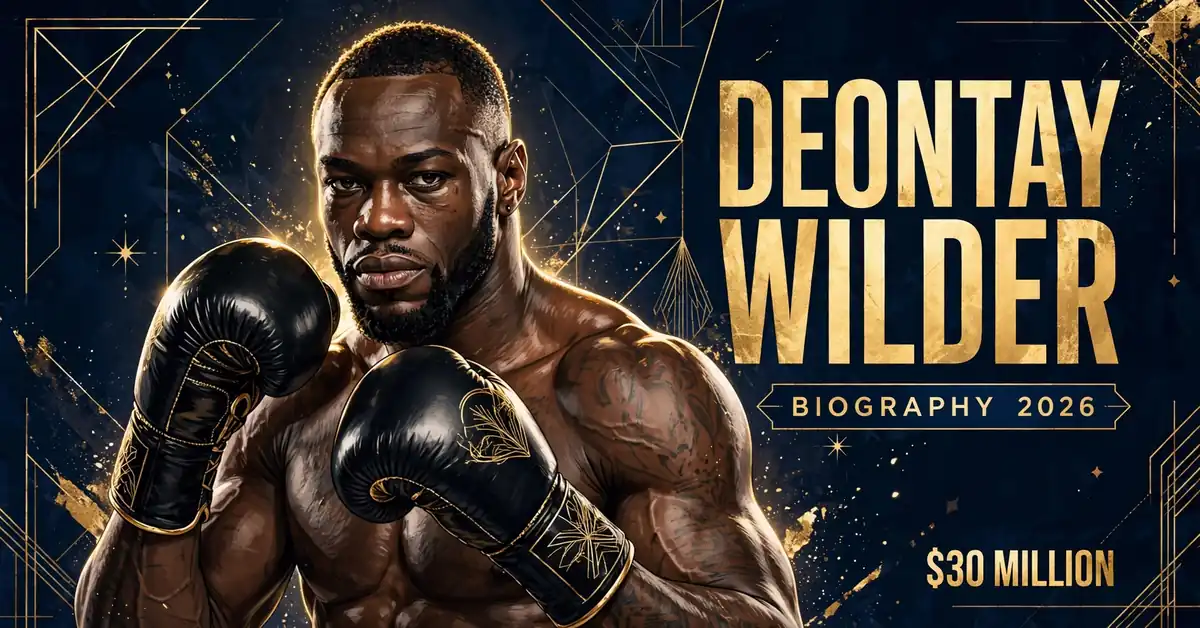
Deontay Wilder biography 2026: age 41, 45-4-1 with 43 knockouts, Olympic bronze, five years as WBC champion and a $30M net worth — the full Bronze Bomber story.
Last updated: November 8, 2026 · By Nathan Cole
Deontay Wilder is 41 years old, a former WBC heavyweight champion with 43 knockouts in 45 wins, and five weeks away from the biggest test of his late career. On December 11, 2026, he meets undefeated cruiserweight champion Jai Opetaia at Cardiff’s Principality Stadium, on the undercard of Tyson Fury vs Anthony Joshua, live on Netflix. The booking, announced on November 4, 2026, caps a comeback year that already includes a hard-earned split-decision win over Derek Chisora in London.
Wilder’s story is the strangest in modern heavyweight boxing. He did not lace up a glove until he was 20, won an Olympic bronze medal with barely two dozen amateur fights, and then spent five years as the most feared puncher on the planet — 40 straight wins, 39 by knockout, before his first defeat. The record now reads 45 wins, 4 defeats, 1 draw, 43 knockouts, and the fortune built on those fights is estimated at $30 million by the 2026 outlets that track him most closely. This biography follows the whole arc: the Tuscaloosa childhood that pushed him into the gym, the Olympic run, the five-year title reign, the Fury trilogy, the slide, and the 2026 revival.
It is current through November 8, 2026 — after the Opetaia fight was confirmed, and after Wilder’s camp confirmed a new trainer for the bout.
Quick Facts
| Full Name | Deontay Leshun Wilder — “The Bronze Bomber” |
| Born | October 22, 1985, Tuscaloosa, Alabama, USA (age 41 in 2026) |
| Height / Reach | 6 ft 7 in (201 cm) · reach 83–84 in |
| Record | 45 wins, 4 defeats, 1 draw — 43 wins by knockout (95.6% KO-to-win ratio) |
| Titles Held | WBC heavyweight champion (2015–2020), 10 defences · 2008 Olympic bronze medallist |
| Net Worth (est.) | $30 million (2026 consensus); range $30M–$50M across outlets |
| Wife / Partner | Ex-wife Jessica Scales (married 2009–2017); ex-fiancée Telli Swift (split 2024); no current partner publicly confirmed |
| Children | Eight — Naieya (born 2005), four with Jessica Scales, Kaorii Lee (born 2018), and two whose mothers are not publicly identified |
| Next Fight | vs Jai Opetaia, December 11, 2026, Principality Stadium, Cardiff, on Netflix |
| 2026 Fights | Beat Derek Chisora (SD, April 4, O2 Arena, London) |
| Trainer | Jay Deas (2005–present); Don House (2026–); Malik Scott (2020–2025) |
| Hometown | Tuscaloosa, Alabama |
How This Biography Was Put Together
No single source covers Wilder’s whole story, so this profile works from the record and the reporting that surrounds it: Wikipedia (updated November 2026) and the Encyclopedia of Alabama for dates, places, and the amateur career; BoxRec for the fight record, the trainer history, and the punch statistics; the BBC, FightMag, and Bad Left Hook for the April 4, 2026 Chisora fight; DAZN, Boxing Insider, and Netflix’s own card announcement (November 4, 2026) for the December 11 Opetaia booking; and SurpriseSports (updated October 11, 2026), PlayersBio, and RivonHome for the fortune figures.
Where outlets disagree — most visibly on the fortune, where 2026 estimates run from $30 million to $80 million, and on the reach, listed at 83 or 84 inches — this profile names the disagreement and says which figure it trusts and why, rather than picking one silently. Fight purses are reported figures, not Wilder’s own disclosures, and they are labeled as such throughout.
+
The Short Answer: 41, Still Fighting, and Booked for December 11
Deontay Wilder’s biography divides into acts, and the current one is the least expected. He is 41, a former world champion five years removed from his title, and the holder of a 45-4-1 record whose four defeats came against three men: Tyson Fury twice, Joseph Parker, and Zhilei Zhang. He lost three of four fights between February 2020 and June 2024, and most observers wrote him off. Then he won twice in 2025 and 2026, and on December 11 he fights on the biggest card of the year.
The Opetaia fight is a gamble in both directions. Opetaia, 31, is unbeaten in 31 fights with 24 knockouts, a two-time IBF cruiserweight champion moving up to heavyweight for the first time. Wilder is ten years older, coming off a split decision that many ringside observers scored the other way, and fighting a man widely ranked among the best pound-for-pound boxers alive. If Wilder’s right hand still lands the way it used to, none of that matters. That single punch has carried his entire career.
None of it was predictable from where Wilder started: a 20-year-old working two jobs in Tuscaloosa, Alabama, who walked into a boxing gym because his baby daughter needed medical care he could not afford.
Tuscaloosa Beginnings: Football Dreams and a Daughter’s Diagnosis
Deontay Leshun Wilder was born on October 22, 1985, in Tuscaloosa, Alabama, to Rev. Gary Wilder and Deborah Wilder. He grew up in a city with a deep boxing history — Joe Louis, the greatest heavyweight of them all, was an Alabama native too, born in Chambers County — but Wilder’s own sporting dreams pointed elsewhere. At Tuscaloosa Central High School, where he graduated in 2004, he was a multi-sport athlete, excelling in football, basketball, baseball, and track. He dreamed of playing wide receiver or forward for his hometown Alabama Crimson Tide.
Two things rerouted him. The first was his daughter Naieya, born in 2005 with spina bifida, a condition in which the spine and spinal cord do not develop properly in the womb. Wilder has said plainly, in interviews across his career, that her care was the reason he needed a way to earn real money, and that it was the reason he eventually walked into a gym. The second was his grades, which were not strong enough for a football scholarship. He enrolled at nearby Shelton State Community College instead, and worked two jobs to support his daughter.
That is the detail that explains everything that followed. Wilder did not come to boxing as a child prodigy or a gym rat. He came to it as a 20-year-old father who needed a paycheque, and the sport rewarded him with a speed of progress that still looks implausible on paper.
A Late Start: Boxing at Twenty
Wilder started boxing in October 2005, when he entered Skyy Boxing Gym in Northport, Alabama, and began training under Jay Deas. He was 20 years old. Most future world champions have a decade of amateur boxing behind them by that age; Wilder had none. Deas, who remains his trainer and manager more than two decades later, saw a 6 ft 7 in athlete with natural power and taught him from scratch.
The learning curve was steep, and it was fast. Within 18 months Wilder was winning national-level amateur bouts against fighters who had boxed since childhood. His right hand did the heavy lifting — a punch so hard that it papered over the technical gaps in his game, then and for years after. The pattern of his whole career was set in those first months: raw, late, and dangerous from the opening bell.
Golden Gloves, National Title, and the Road to Beijing
The amateur breakthrough came in 2007, when Wilder — with only about 14 bouts to his name — won both the National Golden Gloves and the U.S. Championships at heavyweight (201 lbs). At the Golden Gloves he beat the highly touted cadet world champion Isiah Thomas of Detroit and David Thompson of Brooklyn in the final. He had, in the words of BoxRec’s contemporary account, seemingly come out of nowhere.
He kept winning. At the Olympic Trials he beat Graves twice more and won the Trials with only 21 total amateur bouts. He qualified for Beijing by beating Deivis Julio, Jorge Quinones of Ecuador on a double countback, and Rafael Lima of Brazil, all by narrow 6-5 margins. Three years after his first day in a gym, Wilder was an Olympian.
Beijing 2008: The Bronze That Made the Nickname
At the 2008 Summer Olympics in Beijing, Wilder won two bouts — beating Abdelaziz Toulbini of Algeria 10-4 on his way through the draw — before losing his semi-final to Clemente Russo of Italy. The defeat earned him the bronze medal, and the medal earned him his nickname: “The Bronze Bomber,” a deliberate homage to Joe Louis, the “Brown Bomber,” Alabama’s first great heavyweight champion.
The medal carried extra weight because Wilder was the only American boxer to win one at those Games. The United States team, once the dominant force in Olympic boxing, went home with a single bronze. Wilder, the late starter with 30-odd amateur fights, was the man who saved it from a shutout.

Turning Pro: The Knockout Streak Begins
Wilder turned professional on November 15, 2008, at the Vanderbilt University Memorial Gymnasium in Nashville, Tennessee, stopping Ethan Cox in the second round. He was 23. Golden Boy Promotions, run by Oscar De La Hoya, signed him, and the early years of his professional career followed a single script: opponent, knockout, repeat.
He won his first 30 professional fights inside the distance. Not one of them went to the scorecards. The streak was the longest run of consecutive knockouts to start a heavyweight career in the modern era, and it built him into a television attraction before he had fought anyone of real note. Critics called the opposition soft, and they were right — but the power was not a trick of matchmaking. Opponents kept falling in the first round. By the time he stepped up, nearly half of his knockouts had come inside the opening three minutes.
The Climb: First Titles and the Stiverne Breakthrough
The first belt came on December 15, 2012, when Wilder knocked out Kelvin Price in the third round to win the WBC Continental Americas heavyweight title. The step up in class continued through 2013 and 2014, with stoppage wins over former title challengers and fringe contenders, until the WBC ordered him to face its champion.
Bermane Stiverne, a Haitian-Canadian who had won the vacant WBC title in 2014, was a legitimate test: durable, experienced, and heavy-handed. On January 17, 2015, at the MGM Grand in Las Vegas, Wilder beat him by unanimous decision over 12 rounds — the first time in his career a fight had gone the distance, and the first time anyone had seen him box rather than simply punch. The purse was a reported $1 million, per the Encyclopedia of Alabama, and the result made him the first American world heavyweight champion since 2007, ending the longest gap in boxing history without an American holding the division’s crown.
WBC Champion: Five Years at the Top
Wilder held the WBC heavyweight title from January 2015 to February 2020, defending it ten times. The defences tell the story of his reign: a first-round knockout of Eric Molina in June 2015; a ninth-round stoppage of Johann Duhaupas that September; a ninth-round knockout of Artur Szpilka in January 2016, a punch so clean that Szpilka lay motionless on the canvas for several minutes; a stoppage of Chris Arreola in July 2016, in a fight Wilder fought most of with a broken right hand and a torn biceps; and a first-round demolition of Bermane Stiverne in their November 2017 rematch that took 2 minutes and 59 seconds.
The reign also had its scares. Against Luis Ortiz in March 2018, Wilder was badly hurt in the seventh round, wobbling on unsteady legs as the Cuban poured on punches. He survived the round, recovered between rounds, and stopped Ortiz in the tenth. The rematch, in November 2019, followed the same shape: Ortiz outboxed him for six rounds, then Wilder landed one right hand in the seventh and the fight was over. That punch — thrown from nowhere, against the run of play — became the signature image of his championship years. It was also the argument his supporters made whenever critics called him a one-punch fighter: one punch was enough.
By the end of 2019 Wilder was 42-0-1 with 41 knockouts, and the division’s three-belt unification picture was finally coming into focus. The only man standing between him and it was Tyson Fury.

The Fury Trilogy: Draw, Defeat, and a Classic
The first Fury fight, on December 1, 2018, at the Staples Center in Los Angeles, was one of the most dramatic heavyweight bouts of the decade. Fury outboxed Wilder for most of the night, then Wilder knocked him down in the ninth round — and again, heavily, in the twelfth. Fury rose at the count of nine, an image that became the fight’s defining moment, and the bout was scored a split-decision draw. Most ringside observers thought Fury had won. The controversy guaranteed a rematch, and the rematch changed both careers.
For the February 22, 2020 return, Fury changed trainers, linking up with SugarHill Steward of Detroit’s Kronk Gym, and changed tactics completely. Instead of boxing on the back foot, he walked Wilder down from the opening bell, using his size to lean on the champion and sap his legs. Wilder’s corner stopped the fight in the seventh round. The title was gone, the unbeaten record was gone, and Wilder’s excuses in the aftermath — that his ring-walk costume, a 40 lb tribute to Black History Month, had weakened his legs — became a story of their own.
The third fight, on October 9, 2021, in Las Vegas, was better still. Fury was knocked down twice in the fourth round, Wilder was knocked down in the third, seventh, and tenth, and Fury finished it with an emphatic knockout in the eleventh. It closed one of the great heavyweight trilogies — a draw, a stoppage win, a knockout win — and left Wilder at 42-2-1, with both defeats to the same man.
The Slide: Parker, Zhang, and the Questions
Wilder returned a year later, in October 2022, with a first-round knockout of Robert Helenius in Brooklyn — the right hand doing what it had always done. The win set up a December 2023 date with Joseph Parker in Riyadh, Saudi Arabia, on the “Day of Reckoning” card. Parker, the former WBO champion, boxed a disciplined fight, stayed out of range of the right hand, and won a wide unanimous decision. Wilder landed almost nothing of note across 12 rounds, and the performance raised the first serious questions about whether the power — and the reflexes behind it — had gone.
The answer, six months later, was worse. On June 1, 2024, also in Riyadh, Zhilei Zhang, the 6 ft 6 in Chinese southpaw, stopped Wilder in the fifth round. It was Wilder’s third defeat in four fights, and his second stoppage loss in a row. He was 38 years old, a former champion with a 43-4-1 record, and the boxing world largely assumed he was finished. He did not announce a retirement. He simply went quiet.
The Comeback Trail: Herndon and Chisora
The return came in June 2025, in Wichita, Kansas, where Wilder stopped Tyrrell Herndon in the seventh round. It was a comeback win against modest opposition, the kind of fight a former champion takes to find out whether anything is left. The answer was encouraging enough to book something far harder: Derek Chisora, the veteran British heavyweight, at the O2 Arena in London on April 4, 2026.
It was the 50th professional fight for both men, and it was a mess in the best sense — scrappy, exhausting, and dramatic. Chisora, 42, was dropped in the eighth round and sent through the ropes, and again in the eleventh. Wilder was deducted a point in the eighth for pushing, and was stunned by a Chisora overhand right in the fifth. The judges scored it 115-111 and 115-113 for Wilder, with one card 115-112 for Chisora: a split decision win. CompuBox counted Chisora landing 143 of 385 punches to Wilder’s 125 of 341. The BBC’s ringside report called it a wild heavyweight contest and noted that Chisora had expected it to be his final professional bout. Wilder, for his part, had won two in a row for the first time since 2019, and his record stood at 45-4-1 with 43 knockouts.
December 11, 2026: Wilder vs Opetaia in Cardiff
On November 4, 2026, the next step was announced: Wilder will face Jai Opetaia on December 11 at the Principality Stadium in Cardiff, Wales, as the co-feature of the Tyson Fury vs Anthony Joshua card, streaming live on Netflix. Turki Alalshikh announced the bout, and Netflix confirmed it in its official card release the same day.
Opetaia, 31, is the unbeaten cruiserweight champion — 31-0 with 24 knockouts, a two-time IBF titleholder who beat Brandon Glanton on points in March 2026 and stopped Norair Mikaeljan inside nine rounds in September. He is moving up to heavyweight for the first time, giving away around five inches in height and seven inches in reach. Wilder, at 41, is ten years older than his opponent, and his own promoter’s camp has changed trainers for the bout: BoxRec lists Don House as Wilder’s trainer from 2026, succeeding Malik Scott (2020–2025), with Jay Deas still in the corner as he has been since 2005.
The stakes are plain. A win over an unbeaten champion puts Wilder back in the title conversation at 41. A loss, against a smaller man moving up in weight, would be very hard to come back from. Tyson Fury, who fights in the main event on the same card, has already weighed in publicly, saying Wilder should never have fought again after their last meeting — a verdict Wilder will get the chance to answer in the ring, five weeks before the year ends.
The Money: A Thirty-Million-Dollar Fortune, Explained
Deontay Wilder’s net worth in 2026 is estimated at $30 million. That figure is the consensus across the outlets that track him most closely: SurpriseSports, updated October 11, 2026, puts it at $30 million; PlayersBio, updated November 2026, agrees; RivonHome (May 2026) and DrWebSEO (January 2026) land on the same number. This profile uses $30 million–$50 million as the honest range, because a handful of lower-quality aggregator pages publish $50 million, $70 million, and even $80 million, without naming a source or a method. None of those higher figures survives a look at the underlying earnings.
The shape of the money is clearer than the total. Wilder’s career gross earnings exceed $100 million, per SportsLeo’s 2026 breakdown, and the Fury trilogy is the bulk of it: more than $50 million combined across the three fights, with the February 2020 rematch alone reported at around $28 million for Wilder. Forbes counted $46.5 million in Wilder earnings across 2019 and 2020, the two years in which the trilogy paid out. Against that, the usual haircut applies, and it is heavier in boxing than in most sports: trainers, promoters, managers, and taxes routinely take 30 to 40 percent of a gross purse before the fighter sees a cent, and Wilder fought his biggest fights under Al Haymon’s Premier Boxing Champions banner, where those costs are real. A $100 million-plus gross career landing at a $30 million net figure is not a contradiction. It is the arithmetic of the sport.
Outside the ring, the money is quieter. Endorsement income has centred on Everlast, his long-time equipment partner, rather than the lifestyle brands that pay footballers and basketball players. His property holdings, as reported by RivonHome in May 2026, include a Tuscaloosa estate valued at around $1.2 million and a California home worth about $1.78 million. He has spoken about investing in a gym and in his children’s future, and his will — discussed in British tabloid coverage of his family life — reportedly provides for all eight of his children. No audited net worth exists, and no outlet has seen his accounts. The $30 million figure is an estimate, labeled as one, and the range above is the honest way to carry it.
| Money event | Reported figure | Source |
|---|---|---|
| Stiverne title win (Jan 2015) | $1 million purse | Encyclopedia of Alabama |
| Fury trilogy, combined | $50 million+ | SportsLeo / RivonHome, 2026 |
| Fury rematch (Feb 2020) | ~$28 million | Urban Splatter, Oct 2026 |
| Earnings, 2019–2020 | $46.5 million | Forbes, via Urban Splatter |
| Career gross earnings | $100 million+ | SportsLeo, 2026 |
| Tuscaloosa estate / California home | $1.2 million / $1.78 million | RivonHome, May 2026 |
Family: Eight Children and a Public Split
Wilder is a father of eight, a fact he discusses openly and with evident pride, though the details of every relationship are not all in the public record. His eldest daughter, Naieya, was born in 2005 to Helen Duncan, and her spina bifida is the reason Wilder gives for starting to box at all. He was married to Jessica Scales from 2009 to 2017, and they had four children together — Ava, Deontay Jr., and Dereon are the three named publicly. His daughter Kaorii Lee Wilder was born on March 7, 2018, to his then-fiancée Telli Swift. The mothers of his remaining two children have not been publicly identified.
Swift, a television personality and entrepreneur who appeared on WAGS Atlanta, met Wilder at Los Angeles Airport in 2015. They got engaged in February 2018, at the gender reveal for Kaorii, and the relationship lasted about a decade before ending in August 2024. Reporting in 2026 describes Wilder as rebuilding his life after the separation, and a custody dispute over Kaorii was still reported as ongoing in early 2026. No current partner has been publicly confirmed. Wilder has also played a role in the upbringing of Swift’s son Kerron, from her earlier marriage.
The family story has a quieter footnote: his younger brother Marsellos Wilder is also a professional boxer, and in July 2014 the author Tony Bowers published a children’s book, Deontay, the Future World Champ, inspired by Wilder’s life and aimed at healthy living and determination. The book’s premise — a boy from Tuscaloosa who became a champion because his daughter needed him to — is, unusually for a children’s book about a boxer, the true one.
Outside the Ring: Business, Books, and the Bronze Bomber Brand
Wilder’s public profile outside the ring has always been smaller than his profile inside it. He won the Premier Boxing Champions Knockout of the Year award in 2016, 2017, and 2019 — a measure of how often his fights ended with a single punch that made the highlight reels. His ring entrances, particularly the elaborate costumes and masks of the Fury rematch, became events in themselves, and his “Bomb Squad” catchphrase — “Bomb Squad!” shouted at the crowd before every fight — turned his fanbase into a named unit.
He has kept his business interests close to boxing: talk of opening his own gym in Alabama, the Everlast partnership, and a promotional itch that has never quite become a company. What he has not done is build the kind of off-ring empire that fighters like Floyd Mayweather or Canelo Alvarez built. His wealth is fight money, almost entirely, and that is why the December 11 bout matters beyond the record: at 41, with a $30 million fortune and eight children to provide for, another big payday is not a luxury. It is the business model.
He is also, by the measure that matters most to heavyweight history, a genuine outlier. His knockout-to-win ratio of 95.6 percent — 43 knockouts in 45 wins — is the highest in heavyweight championship history, per Wikipedia’s count of the record books. Twenty of those knockouts came in the first round. No heavyweight champion has ever finished fights the way Wilder does, and no heavyweight has ever started boxing as late as he did and reached the top. Both facts will still be true whatever happens in Cardiff on December 11.
Frequently Asked Questions
How old is Deontay Wilder in 2026?
Deontay Wilder is 41 years old in 2026. He was born on October 22, 1985, in Tuscaloosa, Alabama, and he turned 41 on October 22, 2026.
What is Deontay Wilder’s net worth in 2026?
Deontay Wilder’s net worth in 2026 is estimated at $30 million, the consensus across the outlets that track him most closely (SurpriseSports, updated October 11, 2026; PlayersBio; RivonHome). The honest range is $30 million to $50 million, because a few aggregator pages publish $50 million to $80 million without naming a source. No audited figure exists, and purses are reported gross, before tax and team costs.
What is Deontay Wilder’s boxing record?
Deontay Wilder’s professional boxing record is 45 wins, 4 defeats, and 1 draw, with 43 wins by knockout. That is a 95.6% knockout-to-win ratio, the highest in heavyweight championship history. His most recent win came against Derek Chisora by split decision on April 4, 2026, at the O2 Arena in London.
Who has beaten Deontay Wilder?
Three men have beaten Deontay Wilder as a professional: Tyson Fury twice (a seventh-round stoppage in February 2020 and an eleventh-round knockout in October 2021), Joseph Parker by unanimous decision in December 2023, and Zhilei Zhang by fifth-round knockout in June 2024. His only draw came against Fury in December 2018.
Why is Deontay Wilder called the Bronze Bomber?
Deontay Wilder is called “The Bronze Bomber” because he won a bronze medal in the heavyweight division at the 2008 Beijing Olympics, and because the nickname is a deliberate homage to Joe Louis, the “Brown Bomber” — Alabama’s first great heavyweight champion. Wilder was the only American boxer to win a medal at the Beijing Games.
How tall is Deontay Wilder?
Deontay Wilder is 6 ft 7 in (201 cm) tall, per Wikipedia and the Encyclopedia of Alabama. His reach is listed at 83 to 84 inches depending on the source, and he weighed 226 lbs for his April 2026 fight against Derek Chisora.
Who is Deontay Wilder’s wife?
Deontay Wilder is not currently married. His ex-wife is Jessica Scales, whom he married in 2009 and divorced in 2017; they had four children together. His ex-fiancee is Telli Swift, whom he met in 2015 and split from in August 2024; they have a daughter, Kaorii Lee, born in 2018. No current partner has been publicly confirmed.
When is Deontay Wilder’s next fight?
Deontay Wilder’s next fight is against Jai Opetaia on December 11, 2026, at the Principality Stadium in Cardiff, Wales. It is the co-feature of the Tyson Fury vs Anthony Joshua card, streaming live on Netflix. Opetaia is the unbeaten cruiserweight champion, 31-0 with 24 knockouts, moving up to heavyweight for the first time.
Sources & Reporting
This profile was researched on November 8, 2026, from live search results and the outlets named throughout: Wikipedia (updated November 2026) and the Encyclopedia of Alabama for the October 22, 1985 birth date, the Tuscaloosa birthplace, the 6 ft 7 in height, the parents, the amateur career, and the $1 million Stiverne purse; BoxRec for the fight record, the 10 WBC defences, the trainer history (Jay Deas, Mark Breland, Malik Scott, Don House), the Chisora punch statistics, and the 226 lb weigh-in; SurpriseSports (updated October 11, 2026) for the $30 million net worth figure; PlayersBio (updated November 2026) for the age, the $30 million figure, the eight children, and the PBC Knockout of the Year awards; the BBC (April 5, 2026), FightMag, and Bad Left Hook for the April 4, 2026 Chisora split-decision result and scorecards; DAZN News (November 4–5, 2026), Boxing Insider, The Fighting Feed, and Netflix’s official card announcement for the December 11, 2026 Opetaia booking, the Principality Stadium venue, and the Fury–Joshua undercard; RivonHome (May 2026) for the Tuscaloosa and California home values and the Fury-trilogy earnings; Urban Splatter (October 2026) for the $28 million Fury-rematch figure and the $46.5 million Forbes 2019–2020 earnings figure; SportsLeo (November 2026) for the $100 million-plus career gross; and family reporting from Celeb-Family, DailyWikiBio, and the Mirror-derived coverage for the eight children, the Jessica Scales marriage (2009–2017), the Telli Swift relationship and August 2024 split, and the Kaorii custody dispute. Where outlets disagree — most visibly $30 million versus $50 million–$80 million for the fortune, and 83 versus 84 inches for the reach — this profile names the disagreement and attributes each version to its outlet instead of picking one silently. Corrections policy: figures are updated when new reporting emerges — contact us via the About page if you spot an error.
WRITTEN BY
Nathan Cole
Nathan Cole is the editor of Guide Net Worth. He covers celebrity wealth the way a business desk covers earnings: reported figures first, estimates labeled as estimates, and no invented numbers. Every profile on this site passes through his desk before it publishes. About Guide Net Worth · Corrections: figures are updated when new reporting emerges — contact us via the About page if you spot an error.
References & Sources
This article has been fact-checked and verified against multiple public sources, financial disclosures, SEC filings, Forbes reports, Celebrity Net Worth databases, and official records. All net worth estimates are based on publicly available information and financial analysis.