Free Dog Age Calculator — Accurate Breed-Specific Results
Every dog ages differently, and the process is not linear. Our scientifically-backed Dog Age Calculator uses breed-specific lifespan data and precise epigenetic aging curves to show you the real science behind your dog’s age in human years.
Unlike the simple “multiply by 7” myth, our calculator offers three calculation modes: Simple, Advanced (AKC), and Scientific (Epigenetic) — giving you the most accurate dog-to-human age conversion available online.
Dog Age Calculator
Discover your dog's real age using breed-specific lifespan data & scientific aging curves
Classic 7:1 ratio — quick and easy estimate.
Dog Birthday Calendar
Generate a calendar with your dog's birthday milestones in human years. Download as .ics file for Google Calendar, Apple Calendar, or Outlook.
| Breed | Size | Avg Lifespan |
|---|
Dog Years to Human Years — Complete Conversion Guide
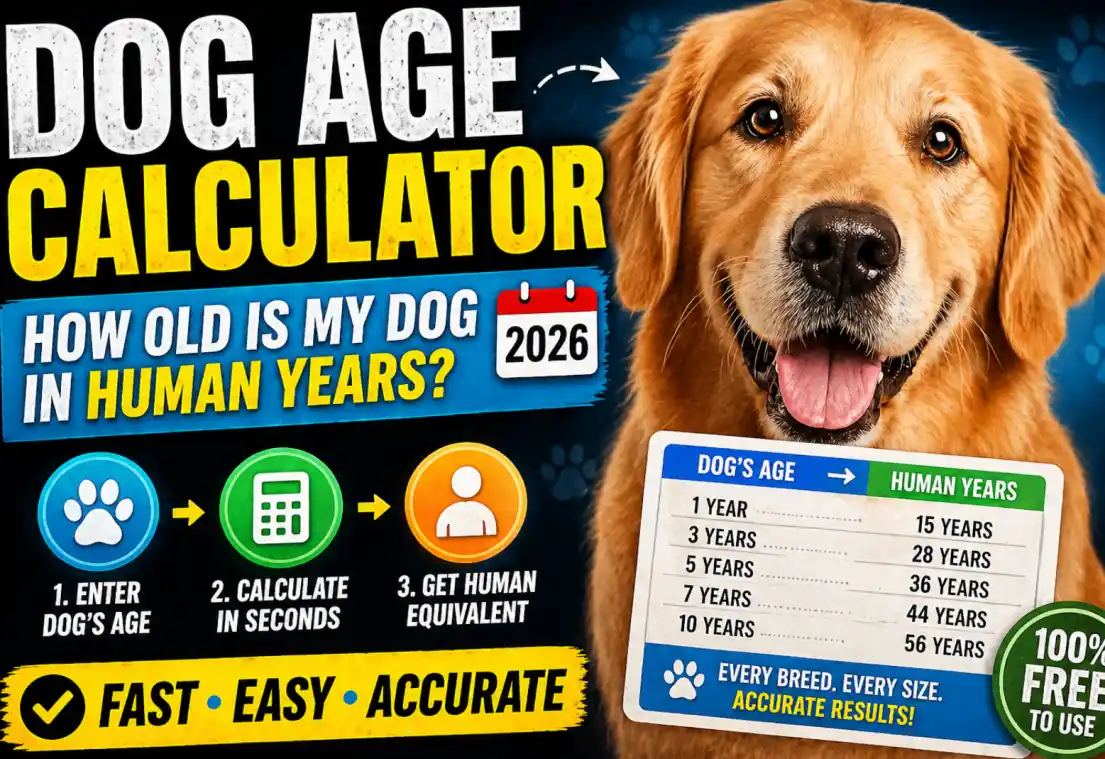
The question “how many human years is one dog year?” doesn’t have a simple answer. Dogs age rapidly in their first two years, then slow down. Below is a complete dog to human years conversion chart based on breed size, using the AKC-recommended non-linear aging model.
Dog Age Chart — All Sizes
| Dog Age | Small Breed (Under 20 lbs) |
Medium Breed (20-50 lbs) |
Large Breed (50-90 lbs) |
Giant Breed (90+ lbs) |
|---|---|---|---|---|
| 1 year | 15 | 15 | 15 | 12 |
| 2 years | 24 | 24 | 24 | 22 |
| 3 years | 28 | 28 | 28 | 31 |
| 4 years | 32 | 32 | 32 | 38 |
| 5 years | 36 | 36 | 36 | 45 |
| 6 years | 40 | 42 | 45 | 49 |
| 7 years | 44 | 47 | 50 | 56 |
| 8 years | 48 | 51 | 55 | 64 |
| 9 years | 52 | 56 | 61 | 71 |
| 10 years | 56 | 60 | 66 | 79 |
| 12 years | 64 | 69 | 77 | 93 |
| 14 years | 72 | 78 | 88 | 100+ |
| 15 years | 76 | 83 | 93 | — |
| 16 years | 80 | 87 | 99 | — |
| 18 years | 88 | 96 | — | — |
How Old Is 1 Year in Dog Years?
A 1-year-old dog is approximately 15 human years old — not 7 as the old myth suggests. During their first year, dogs undergo incredible physical and mental development. They reach sexual maturity, grow to near-adult size, and develop permanent teeth. This is why a 1 year old dog in human years is equivalent to a teenager, not a 7-year-old child.
How Old Is a 2 Year Old Dog in Human Years?
At 2 years old, a dog is approximately 24 human years. By this point, most dogs are fully grown adults. The second year adds about 9 human years (not 7), because dogs still age faster than humans during this developmental phase. After age 2, the aging rate slows to roughly 4-5 human years per dog year, depending on breed size.
How Old Is a 3 Year Old Dog in Human Years?
A 3-year-old dog is approximately 28 human years old for small and medium breeds, but can be up to 31 human years for giant breeds. At this age, your dog is a young adult — fully mature physically and mentally. This is typically when dogs have the most energy and are in peak physical condition.
4 Years in Dog Years
A 4-year-old dog equals roughly 32 human years for small/medium breeds and up to 38 human years for giant breeds like Great Danes and Mastiffs. Your dog is now a fully established adult. Regular vet checkups, dental care, and a balanced diet are essential to maintain health during the prime adult years.
5 Years in Dog Years
At 5 years old, your dog is approximately 36 human years (small/medium) or up to 45 human years (giant breeds). This is the midpoint of life for most breeds. Large and giant breed dogs may begin showing early signs of aging, while small breeds are still in their prime. A 5-year-old dog in human years is comparable to a person in their mid-30s to mid-40s.
6 Years in Dog Years
What is 6 years in dog years? A 6-year-old dog is approximately 40-49 human years, depending on size. Small dogs (40 human years) are still relatively young, while giant breeds (49 human years) are entering their mature years. This is a good age to begin senior wellness screening for larger breeds.
7 Years in Dog Years
The popular saying “dog years 7” comes from the old 7:1 ratio, making 7 dog years = 49 human years. But in reality, a 7-year-old dog is closer to 44-56 human years depending on breed size. Small breeds (44) are middle-aged, while giant breeds (56) are entering their senior years. Many veterinarians consider 7 years old the threshold for “senior” status in large breeds.
8 Years in Dog Years
An 8-year-old dog is approximately 48-64 human years. For small breeds (48), life is still going strong. For giant breeds (64), this is solidly senior territory. At 8 years, dogs benefit from twice-yearly vet visits, joint supplements like glucosamine, and age-appropriate nutrition with higher protein and lower calories.
9 Years in Dog Years
A 9-year-old dog equals approximately 52-71 human years. Medium and large breeds are now seniors, and even small breeds are entering mature territory. Watch for signs of cognitive decline, decreased activity, and vision or hearing changes. Regular blood work can catch health issues early.
10 Years in Dog Years
How old is a 10-year-old dog in human years? Approximately 56-79 human years, depending on breed size. A 10-year-old small dog (56 human years) still has several good years ahead. A 10-year-old giant breed (79 human years) is in advanced senior status. At this age, comfort and quality of life become the top priorities.
12 Years in Dog Years
How old is 12 in dog years? A 12-year-old dog is approximately 64-93 human years. Small breeds (64) are seniors but often still active. Giant breeds rarely reach 12, making this exceptional longevity for large dogs. At 12, dogs need senior-formula food, gentle exercise, orthopedic bedding, and increased veterinary monitoring.
14 Years in Dog Years — How Old Is 14 in Dog Years?
A 14-year-old dog is approximately 72-100+ human years. Reaching 14 is remarkable for any dog, especially medium and large breeds. At this age, dogs may experience significant mobility issues, cognitive decline, and organ-related health challenges. Focus on comfort, pain management, and maintaining quality of life.
15 Dog Years to Human Years
At 15 years old, a small dog is approximately 76 human years, while a medium dog is around 83 human years. Few large or giant breeds reach this age. A 15-year-old dog has lived an exceptionally long and full life. Celebrate every day and focus on gentle care, warmth, and love.
16 Years in Dog Years
A 16-year-old dog is approximately 80-87 human years for small and medium breeds. This is extremely advanced age, equivalent to a human centenarian in some cases. Dogs reaching 16+ are typically small breeds like Chihuahuas, Dachshunds, and Yorkshire Terriers. Proper nutrition and veterinary care throughout life are key to reaching this milestone.
18 in Dog Years
An 18-year-old dog is approximately 88-96 human years. Only the smallest and healthiest breeds reach this extraordinary age. The current verified record for the oldest dog is over 30 years. At 18, a dog has lived the equivalent of nearly a century — a testament to genetics, excellent care, and a bit of luck.
How Old Is My Dog? Understanding Dog Ages
Determining how old your dog is in human years requires knowing their breed (or size category) and using a non-linear conversion model. The key insight is that dogs age fastest in their first two years, then slow down considerably. Small dogs live longer and age more slowly than large dogs.
Use our calculator above for precise results, or refer to the small dog age chart and size-specific tables for quick reference.
Small Dog Years to Human Years
Small breeds (under 20 lbs) like Chihuahuas, Pomeranians, and Yorkshire Terriers age the slowest. A 10-year-old small dog is only about 56 human years — still relatively middle-aged. Small dogs commonly live 14-16 years, with some reaching 18-20.
How Many Dog Years Is One Human Year?
The reverse calculation: 1 human year equals approximately 7 dog years in the simple model, but this varies. In the first year, 1 human year = 15 dog years. In the second year, 1 human year = 9 dog years. After that, each human year equals about 4-5 dog years for small breeds and 6-8 for giant breeds.
Why Small Dogs Live Longer Than Large Dogs
It may seem counterintuitive, but research published in The American Naturalist confirms that large dogs age faster because their rapid growth increases cellular damage and cancer risk. Giant breeds like Great Danes and Irish Wolfhounds average only 7-8 years, while small breeds like Chihuahuas and Toy Poodles routinely reach 15-16 years.
Dog Life Stages Explained
Puppy (0-15 Human Years Equivalent)
Rapid growth phase. Focus on vaccinations, socialization, puppy nutrition, and basic training.
Adolescent (15-30 Human Years Equivalent)
The teenage phase. Consistent training, regular exercise, and patience with behavioral challenges.
Adult (30-50 Human Years Equivalent)
Peak condition. Annual vet checkups, dental cleanings, and maintaining a healthy weight are priorities.
Mature (50-75 Human Years Equivalent)
Early aging signs appear. Joint supplements, adjusted exercise, and semi-annual vet visits recommended.
Senior (75+ Human Years Equivalent)
Focus on comfort, specialized diets, pain management, and frequent veterinary monitoring.
Frequently Asked Questions
8 ANSWERSNo. The 7:1 ratio is a common misconception. Dogs age much faster in their first two years, then slow down significantly. A 1-year-old dog is roughly equivalent to a 15-year-old human, not 7. Our Advanced and Scientific modes use peer-reviewed research to provide far more accurate results based on your dog’s actual breed and size.
Yes — and the difference is dramatic. Small breeds like Chihuahuas and Yorkshire Terriers typically live 14-16 years, while giant breeds like Great Danes average only 7-8 years. Scientists believe this is because larger dogs’ accelerated growth leads to faster cellular aging and higher cancer risk. Our calculator factors in 4 size categories (small, medium, large, giant) for accurate results.
The Scientific (Epigenetic) mode in our calculator uses the most recent research based on DNA methylation patterns. Published in 2019 by UC San Diego researchers in the journal Cell Systems, this model analyzes how chemical modifications to DNA change with age — providing the most biologically accurate conversion between dog years and human years available today.
It depends on breed size. Using the Advanced (AKC) model: a 10-year-old small dog ≈ 56 human years, a medium dog ≈ 60, a large dog ≈ 66, and a giant breed ≈ 79 human years. Use our calculator above to get your specific breed’s exact conversion.
Dogs are generally considered senior when they reach 75+ human years equivalent. The actual dog age varies by size: small breeds become seniors around 10-12 dog years, large breeds at 6-7 dog years, and giant breeds can be considered senior as early as 5-6 years old. Senior dogs benefit from more frequent vet visits, joint supplements, and adjusted nutrition.
Research suggests that spayed and neutered dogs tend to live 1-3 years longer than intact dogs, on average. This is partly due to reduced risk of reproductive cancers (mammary, testicular, ovarian) and decreased roaming behavior that can lead to accidents. However, timing matters — consult your veterinarian about the optimal age for your specific breed.
The epigenetic model is considered the most scientifically accurate method available. Based on a landmark 2019 study published in Cell Systems by UC San Diego researchers, it uses the formula Human Age = 16 × ln(dog age) + 31. This logarithmic model captures the biological reality that dogs mature rapidly in their first 1-2 years, then age more gradually — unlike the linear 7:1 myth.
Small breeds (under 20 lbs): 14-16 years. Medium breeds (20-50 lbs): 12-14 years. Large breeds (50-90 lbs): 10-13 years. Giant breeds (90+ lbs): 7-10 years. However, individual breed genetics, diet, exercise, and veterinary care all play significant roles in actual lifespan.