Georges St-Pierre’s biography: from a bullied kid in Saint-Isidore to a two-division UFC champion with a 26-2 record, nine defences and a $20M-$30M fortune.
Last updated: November 23, 2026 · By Nathan Cole
Georges St-Pierre is 45 years old in 2026, a retired two-division UFC champion with a professional record of 26-2, and the fighter most often named when the sport argues about its greatest ever. He was born in Saint-Isidore, a farming town in Quebec, on May 19, 1981, and he grew up getting bullied at school. His father put him in karate at seven so he could defend himself. By twelve he held a black belt. By 25 he held the UFC welterweight title. By 32 he had defended it nine times in a row — still a division record — and walked away from the sport as champion.
Then he came back. After four years away, St-Pierre moved up a weight class in November 2017 and choked out Michael Bisping to win the middleweight title, becoming only the fourth fighter in UFC history to hold belts in two divisions. He retired for good in February 2019, was inducted into the UFC Hall of Fame in 2020, and has spent the years since acting, coaching, and running his anti-bullying foundation. His net worth sits at an estimated $20 million to $30 million in 2026, with Celebrity Net Worth reporting $20 million in an update dated November 20, 2026, and Sports Brief and Players Bio both reporting $30 million. This biography follows the whole arc — the bullying, the nightclub doors, the two losses that shaped him, the record reign, the comeback, and the money.
+
Quick Facts: Georges St-Pierre
| Full name | Georges St-Pierre |
| Nickname | Rush (GSP) |
| Born | May 19, 1981, Saint-Isidore, Quebec, Canada |
| Age in 2026 | 45 |
| Height | 5 ft 10 in (1.78 m) |
| Weight class | Welterweight (2002–2013); middleweight (2017) |
| MMA record | 26-2 (8 knockouts, 6 submissions, 12 decisions) |
| UFC titles | Welterweight (three-time champion); middleweight (2017) |
| Title defences | 9 consecutive welterweight defences — division record |
| Retired | February 2019 |
| Hall of Fame | UFC Hall of Fame (2020); Canada’s Sports Hall of Fame (2023) |
| Net worth (2026) | Estimated $20 million – $30 million |
| Acting | Batroc in Captain America: The Winter Soldier (2014) and The Falcon and the Winter Soldier (2021) |
| Gym / coach | Tristar Gym, Montreal — coach Firas Zahabi |
How This Estimate Was Made
St-Pierre never published his finances, so every net worth figure for him is an estimate built from public reporting. This article uses the range $20 million to $30 million, anchored at $25 million. Celebrity Net Worth lists $20 million in an update dated November 20, 2026. Sports Brief’s 2026 ranking of the richest MMA fighters and Players Bio both report $30 million. BounceMojo reports $25 million. One outlet, Surprise Sports, prints $60 million — no other major source supports that number, and this article treats it as an outlier rather than a fact. The range reflects disclosed fight purses from his 15-year career, long-running endorsement deals, acting pay, and a documented property sale in Quebec. Where a number could not be verified from a named outlet, the article says so instead of printing it.
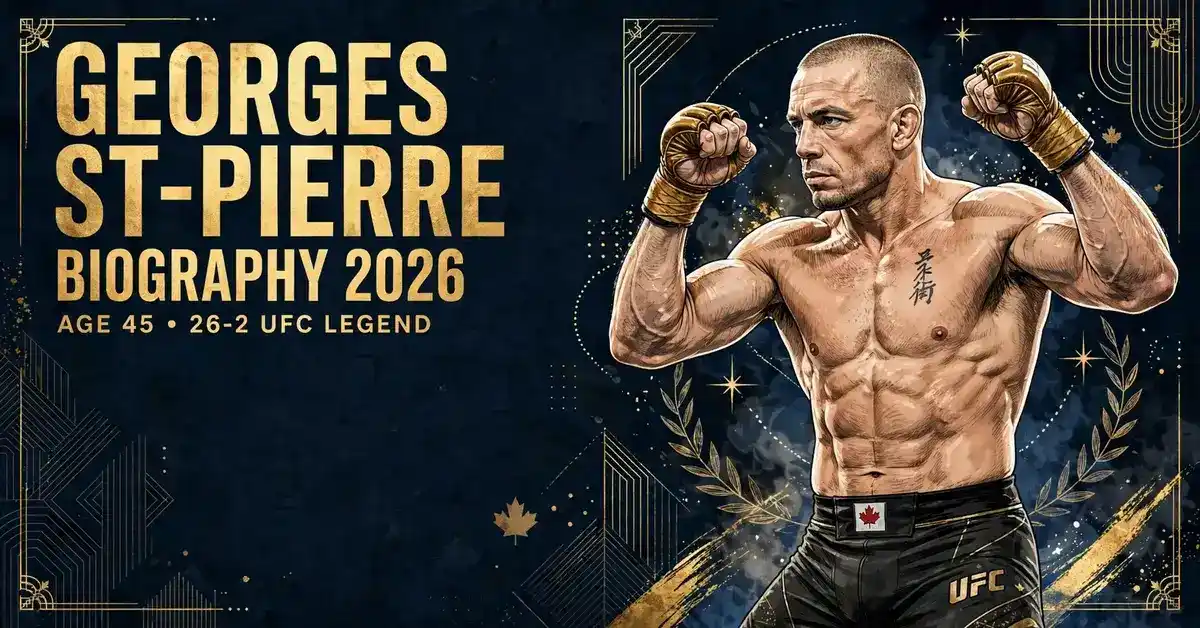
Early Life in Saint-Isidore
Georges St-Pierre was born on May 19, 1981, in Saint-Isidore, a farming community in the Montérégie region of Quebec, to Roland and Pauline St-Pierre. His father installed flooring and carpet. His mother worked at a nursing home. He was the eldest of three children, with two younger sisters, and the family lived a plain working-class life in a town where everybody knew everybody.
School was hard on him. Older boys stole his clothes and his money and threatened him in the hallways. The Canadian Encyclopedia records the bullying plainly: it ranged from teasing and threats to physical abuse and theft. St-Pierre has talked about it often since, and it matters to his story for a simple reason — it is why he started fighting at all. He did not grow up dreaming of the UFC. He grew up trying to walk home without getting hurt.
The town itself shaped him. Saint-Isidore is a small farming community south of Montreal, and St-Pierre has described his childhood there as simple and close-knit — the kind of place where a kid could ride a bike anywhere and everyone knew his parents. The contrast with what came later could hardly be sharper: the boy from a town of a few thousand people would go on to headline pay-per-views in Las Vegas, Toronto and New York, and to draw the largest crowds in Canadian MMA history. He never moved far from home, though. Tristar Gym in Montreal became his base for his entire career, and he still lives in the city.
His father had the answer. Roland St-Pierre had trained in karate himself, and when Georges was seven he enrolled the boy at a local dojo. The lessons were Kyokushin, the full-contact style that treats a hard body shot as a teaching tool. The bullied kid found something he was good at. By the age of twelve he had earned his second-degree black belt in Kyokushin — an age when most kids are still working toward their first. He went on to earn a third-degree black belt in Kyokushin, and later black belts in Shotokan, Shidōkan and Gaidojutsu, plus a first-degree black belt in Brazilian jiu-jitsu under Bruno Fernandes.
Karate, Bullying and the Making of “Rush”
The nickname came later, but the temperament was built in those years. St-Pierre played hockey and skated like other Quebec kids, and at École Pierre-Bédard in Saint-Rémi he set the school record for chin-ups — a small detail that says a lot about the way he trained. He was not the biggest kid in the room. He was the one who kept going after everyone else stopped.
At sixteen he watched a rented video of an early UFC tournament and saw Royce Gracie, a smaller man, beat bigger opponents with technique. The idea lodged. After high school he enrolled in kinesiology at Cégep Édouard-Montpetit, but school fees had to be paid somehow. He worked as a bouncer at a Montreal nightclub called Fuzzy Brossard on the South Shore, and for six months he worked as a garbageman. Both jobs paid for training. The bouncer job also taught him something the dojo never could: how to stay calm when a stranger wants a fight.

He fought his first amateur MMA bout at sixteen and won by submission. The path from there was direct: keep training, keep winning, get noticed. He began wrestling training between the ages of 19 and 20 at the Montreal Wrestling Club under Victor Zilberman, adding the grappling base that would become the most feared weapon in his game. He also started training at Greg Jackson’s gym in New Mexico alongside fighters like Rashad Evans and Donald Cerrone, and at Renzo Gracie’s academy in New York, where he received his Brazilian jiu-jitsu brown belt on July 21, 2006.
The Road to the UFC
St-Pierre turned professional on January 25, 2002, at UCC 7 in the Verdun Auditorium in Montreal, fighting Ivan Menjivar of El Salvador. He won. The Universal Combat Challenge was Quebec’s regional promotion, and it gave him the stage he needed: six professional wins, five of them finishes, in under two years. The last of them, a first-round stoppage of Thomas Denny in November 2003, came two months before the UFC called.
Those early UCC fights are worth a look because they show how complete he already was. Menjivar was a tough, durable veteran. St-Pierre beat him by stoppage, then ran through the local scene with a mix of knockouts and submissions that left no doubt about which discipline he would lean on in a given fight. He was 20 years old, working doors at night and training all day, and he was already fighting like a professional with a plan rather than a kid with a punch.
The call was a test. The UFC offered him a debut against Karo Parisyan, a highly ranked judoka with a reputation for throwing people through the air. St-Pierre took it. He won a unanimous decision at UFC 46 in Las Vegas on January 31, 2004 — 29-28, 30-27, 30-27 on the cards. He was 22 years old, and he had just beaten a top-ten welterweight in his first UFC fight. The sport had a new problem to solve.
UFC Debut and the First Title Run
Two wins followed — a first-round knockout of Jay Hieron at UFC 48 and a second-round stoppage of Dave Strasser at UFC 52 — and by the autumn of 2004 St-Pierre was fighting for the vacant welterweight title against Matt Hughes. Hughes was the division’s dominant champion, a wrestler with a grip like a vice. He caught St-Pierre in an armbar with one second left in the first round at UFC 50 on October 22, 2004. It was St-Pierre’s first professional loss, and it taught him the lesson that shaped the rest of his career: talent without preparation loses to preparation.
He did not lose again for more than two years. He beat Jason Miller, Frank Trigg, Sean Sherk and B.J. Penn in succession, and in November 2006 he got Hughes again at UFC 65. This time he stopped the champion in the second round with a head kick and punches, winning the welterweight title at 25. The rematch told the story of what had changed: St-Pierre had spent the two years between the fights rebuilding his wrestling, his conditioning and his game-planning until there was no hole left to exploit.
The Matt Hughes Rivalry
Hughes was the measuring stick of the welterweight division, and St-Pierre fought him three times — more than any other opponent except B.J. Penn. He lost the first, won the next two, and the trilogy defined both men. The third fight, at UFC 79 in December 2007, was for the interim welterweight title while the division sorted itself out. St-Pierre won by armbar in the second round, the same submission Hughes had used on him three years earlier. It was a deliberate piece of symmetry, and St-Pierre knew it.
The rivalry also set the template for his career: lose, learn, return better. He applied it after every setback, and there were only two setbacks in 28 professional fights. The Hughes loss made him a wrestler. The second loss made him a champion who never took a fight lightly again.
The Matt Serra Upset and the Comeback
Four months after winning the title, St-Pierre lost it in one of the biggest upsets in UFC history. Matt Serra, a heavy underdog, caught him with a right hand behind the ear at UFC 69 on April 7, 2007, and finished him in the first round. St-Pierre has said since that he went into the fight unfocused, distracted by the fame that had arrived with the belt. The loss cost him the title and, briefly, his confidence.
What followed was the most disciplined stretch of his career. He hired a sports psychologist, tightened his camp, and stopped treating training as something he did between distractions. He beat Josh Koscheck at UFC 74, won the interim title from Hughes at UFC 79, and then walked into the Bell Centre in Montreal on April 19, 2008, in front of more than 21,000 hometown fans, and took the undisputed title back from Serra at UFC 83, stopping him in the second round. He never lost the belt again.
The Record Title Reign: Nine Defences
From April 2008 to November 2013, Georges St-Pierre defended the UFC welterweight title nine times in a row — a division record that still stands. He beat Jon Fitch, B.J. Penn, Thiago Alves, Dan Hardy, Josh Koscheck, Jake Shields, Carlos Condit, Nick Diaz and Johny Hendricks. Five of those defences went the full five rounds. Critics called the decisions boring. St-Pierre called them winning.
| Date | Opponent | Event | Result |
|---|---|---|---|
| Aug 9, 2008 | Jon Fitch | UFC 87 | Unanimous decision |
| Jan 31, 2009 | B.J. Penn | UFC 94 | TKO, round 4 |
| Jul 11, 2009 | Thiago Alves | UFC 100 | Unanimous decision |
| Mar 27, 2010 | Dan Hardy | UFC 111 | Unanimous decision |
| Dec 11, 2010 | Josh Koscheck | UFC 124 | Unanimous decision |
| Apr 30, 2011 | Jake Shields | UFC 129 | Unanimous decision |
| Nov 17, 2012 | Carlos Condit | UFC 154 | Unanimous decision |
| Mar 16, 2013 | Nick Diaz | UFC 158 | Unanimous decision |
| Nov 16, 2013 | Johny Hendricks | UFC 167 | Split decision |
The reign’s most talked-about night was the rematch with B.J. Penn at UFC 94 in January 2009. Penn, the lightweight champion moving up, accused St-Pierre’s corner of illegally applying Vaseline to his body between rounds — the “greasing” controversy that dominated MMA discussion for months. The Nevada commission investigated and found no violation, and St-Pierre won by fourth-round stoppage. The episode said something about the champion’s standing: by 2009, beating him had become so difficult that his opponents were looking for explanations outside the cage.
The numbers behind the reign are the ones that fill the UFC record book. St-Pierre holds the record for most wins in title bouts with 13, the most wins by decision with 12, the most takedowns with 90, the most wins in the welterweight division with 19, and the second-longest combined title streak in UFC history at 2,204 days, according to Canada’s Sports Hall of Fame and Wikipedia. He also set the template for the modern champion: a full camp at Tristar Gym in Montreal under coach Firas Zahabi, strength work with Pierre Roy, gymnastics with Patrick Beauchamp, and a game plan built around taking away whatever the opponent did best.
The Hendricks fight, his last defence, was the closest call of the reign. Hendricks hurt him, took him down, and many observers scored the fight for the challenger. St-Pierre won a split decision, then told the crowd he needed time away. He vacated the title in December 2013. He was 32, undefeated in more than six years, and he walked away at the top.
The Hiatus and the Comeback at UFC 217
St-Pierre has been open about why he stepped away in 2013. The pressure of the title, the constant media demands, the weight cuts and the injuries had worn him down, and he has spoken about struggling with his mental health during those years. He took four years off. He trained, he acted, he worked on his foundation, and he waited to see whether the hunger came back.
It came back with a new target. In November 2017 he returned at UFC 217 in New York, moving up to middleweight to challenge champion Michael Bisping. Four years out of the cage, in a heavier division, against a champion who had never been submitted — St-Pierre won by rear-naked choke in the third round. The win made him only the fourth fighter in UFC history to hold titles in two divisions, and it settled the argument about whether the layoff had dulled him. It had not.
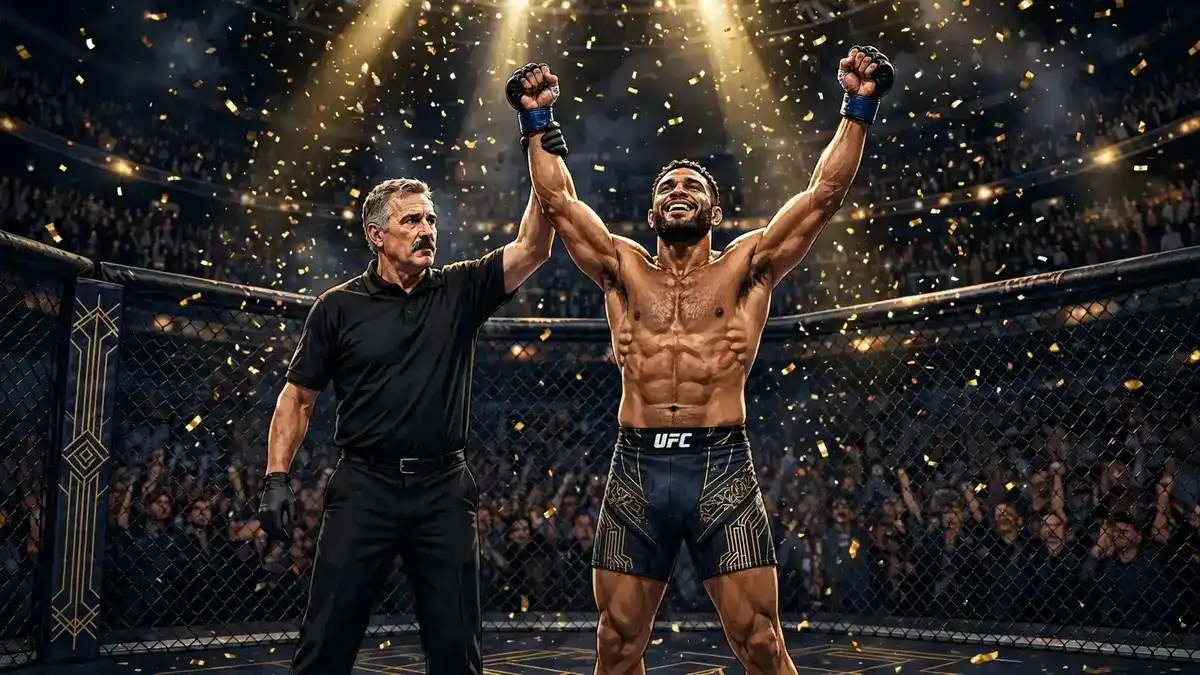
The middleweight reign lasted barely a month. St-Pierre vacated the title in December 2017, citing ulcerative colitis, a condition he said made it impossible to stay at the heavier weight. He never fought again. The Bisping win stands as one of the great comebacks in the sport: a 36-year-old returning after four years to beat a champion in a division he had never fought in.
The comeback also put him in a class of two-division champions that the sport still measures everyone against. Alex Pereira’s net worth story follows a similar arc — a fighter who won belts in two divisions — but Pereira did it in half the time and twice the divisions. St-Pierre’s version took 13 years and two retirements.
There was one more detail that made the comeback remarkable: the weight. St-Pierre had fought his whole career at 170 pounds, and he had to add roughly 15 pounds of muscle to compete at middleweight without losing the speed that defined his game. He worked with a nutrition team for months, and he has said since that the process — eating to a plan, lifting to a plan, carrying the extra weight through a full camp — was harder than the fight itself. The ulcerative colitis that followed, which he has linked to the weight gain, was the price of it.
Retirement and the Hall of Fame
On February 21, 2019, St-Pierre announced his retirement from mixed martial arts at a press conference at the Bell Centre in Montreal, the arena where he had headlined so many of his biggest nights. He was 37, with a record of 26-2, and he left as one of only a handful of champions to retire without ever losing a title fight in the cage after regaining it.
The honours followed quickly. He was inducted into the UFC Hall of Fame in 2020, in the Modern Wing, and into Canada’s Sports Hall of Fame in 2023. He had already been named the Rogers Sportsnet Canadian Athlete of the Year three times — 2008, 2009 and 2010 — the Sports Illustrated Fighter of the Year in 2009, and the World MMA Awards Fighter of the Year in 2009. The Hall of Fame inductions made the verdict official: the sport’s own institutions rank him among its best.
Since retiring he has stayed close to the sport as a coach and analyst, worked with fighters at Tristar, and repeatedly turned down comeback offers, including the long-discussed superfight with Khabib Nurmagomedov that never materialised. He has said the fire for competition is gone, and his record — 26-2, two divisions, nine defences — has not needed defending.
The retirement press conference itself was pure St-Pierre. No tears, no long farewell tour, no promises to return. He thanked his team, his family and his fans, and he left the door open a crack — “never say never” — while making it clear he was done. Seven years on, the door is still open and he has still not walked through it.
Acting Career: Captain America and Beyond
St-Pierre’s acting career started before his fighting career ended. His biggest role came in 2014, when he played Georges Batroc, the French mercenary known as Batroc the Leaper, in Captain America: The Winter Soldier. The fight scene with Chris Evans is one of the film’s best-remembered set pieces, and it worked because St-Pierre did his own stunts — the kicks and the movement were his, not a double’s. He reprised the role in the Disney+ series The Falcon and the Winter Soldier in 2021.
His other film work includes the martial arts film Kickboxer: Vengeance (2016), the action film Cartels (2017), and King of Killers (2023), plus an early appearance in Death Warrior (2009). None of them made him a movie star, and that was never the point. Acting gave him a second career after fighting, a paycheque that did not depend on getting hit, and a public profile that kept his endorsement value alive long after his last fight.
The Batroc role also showed how seriously he took the craft. St-Pierre has said he trained for the fight choreography the way he trained for a bout — rehearsing the movement until it was automatic, then performing it at full speed on camera. Directors kept hiring him for the same reason fight fans kept watching him: he prepared like a professional and delivered under pressure. The Marvel work, in particular, put him in front of an audience far larger than any pay-per-view crowd he ever fought in front of.
Endorsements and Business Ventures
At his peak, St-Pierre was one of the most marketable fighters in the UFC, and the deals reflected it. He held long-running partnerships with Under Armour, the energy drink brand NOS, and the fight-gear company Hayabusa, plus a poker sponsorship with 888poker. The Under Armour deal was the anchor — a global athletic brand putting a Canadian MMA fighter on its roster at a time when the sport was still fighting for mainstream respect.
The endorsement money mattered because his fight purses, by modern standards, were modest. At his peak he earned over a million dollars per fight, according to LowKick MMA, but that was before the era of eight-figure paydays. The difference between St-Pierre’s wealth and the wealth of the fighters who came after him is a matter of timing: he headlined pay-per-views when the sport’s money was smaller, and he never had a rivalry that sold like the ones that made Conor McGregor’s net worth reach an estimated $200 million. St-Pierre built his fortune the slower way — purses, sponsors, acting, and holding on to the money.
He has also invested in fitness and nutrition ventures and worked as a trainer and consultant, and he remains a partner in gym and training projects in Montreal. None of these ventures has a publicly reported valuation, and this article does not guess at one.
One deal deserves a closer look because it shows how St-Pierre thought about money. The Hayabusa partnership was not a logo on a shirt — it was a long-term relationship with a Canadian fight-gear company that grew alongside his career, and it kept paying after he stopped fighting. The 888poker deal worked the same way: a brand that wanted the image of discipline and calculation, and a fighter whose public persona was exactly that. St-Pierre never chased the loudest sponsor. He picked brands that matched the way he carried himself, and the deals lasted because the fit was real.
Georges St-Pierre Net Worth 2026
Georges St-Pierre’s net worth is estimated at $20 million to $30 million in 2026, with $25 million as the anchor point where the most credible sources meet. Celebrity Net Worth reports $20 million in an update dated November 20, 2026. Sports Brief’s 2026 ranking of the richest MMA fighters puts him at $30 million, and Players Bio agrees at $30 million. BounceMojo reports $25 million. The $60 million figure printed by Surprise Sports sits far above every other source and is treated here as an outlier.
For the full breakdown of how that fortune was built — the fight purses, the endorsement deals, the acting work and the property sale — see our sister site’s look at Georges St-Pierre’s net worth on CelebAmerica, which covers the money side of his career in detail.
The money came from four places. Fight purses across 28 professional bouts, including nine title defences and two pay-per-view headlining eras. Endorsements, led by Under Armour, NOS and Hayabusa. Acting, from the Marvel films onward. And property: in October 2023 he listed his home in Saint-Lambert, on Montreal’s South Shore, for $2.239 million, and sold it in 2024 for $1.925 million, roughly 14 percent below the asking price, according to Celebrity Net Worth. That sale is one of the few hard, documented numbers in his financial picture, and it fits the $20 million to $30 million range rather than the outlier.
The range is honest about what is not known. His exact career earnings were never disclosed, his endorsement contracts were private, and his investments are not public. What the sources agree on is the order of magnitude: a fortune in the tens of millions, built over 15 years, and held — St-Pierre has never been linked to the spending problems that have emptied other fighters’ bank accounts.
Personal Life
St-Pierre keeps his private life private, and the public record respects that. He has two younger sisters and remains close to his family in Quebec. He has spoken about his father, Roland, as the man who put him in karate, and about his mother, Pauline, who worked at a nursing home while he trained. He lives in Montreal, trains at Tristar, and has never married publicly or put a relationship in the spotlight.
He has been open about two things that matter more than gossip: his mental health during the title years, and his belief that the discipline of martial arts saved him from the bullying that shaped his childhood. Both themes run through his public appearances now — speaking engagements, coaching, and the foundation work that has become his main project outside the gym.
He has also talked openly about the routines that kept him steady through the pressure years: the same warm-up, the same meals, the same preparation for every fight, win or lose. He has described himself as obsessive about preparation, and he credits that trait — the refusal to leave anything to chance — with the consistency of his reign. It was not superstition, in his telling. It was a system, and the system worked for 13 years.
The GSP Foundation and Giving Back
St-Pierre created the Georges St-Pierre Foundation to help young people, stop bullying and promote physical activity in schools — the three things his own childhood taught him mattered. The foundation runs anti-bullying programmes and supports youth sport in Quebec, and St-Pierre fronts it personally, speaking at schools and community events about the bullying he endured and the role martial arts played in giving him confidence.
It is the part of his post-fighting life that fits him best. The fighter who started karate at seven because he was being bullied now spends his time making sure other seven-year-olds do not have to wait as long as he did for someone to step in.
Legacy: Where He Ranks Among the Greats
The greatest-of-all-time argument in MMA has three names in it, and St-Pierre is always one of them. Jon Jones’s net worth story covers a fighter with more title wins and a far messier career; Jones holds the record for UFC title victories, but his career carries suspensions and controversies St-Pierre never had. Khabib Nurmagomedov’s net worth story covers the only champion to retire undefeated, 29-0, but Khabib defended his title three times to St-Pierre’s nine. Ilia Topuria’s net worth profile follows the newest two-division champion, a fighter whose career is still being written.
St-Pierre’s case rests on completeness. He avenged both of his losses. He held titles in two divisions. He defended a belt nine times in a row. He retired on his own terms, twice, and he left the sport with his health, his reputation and his money intact. No other fighter in UFC history can claim all of that at once. The record book agrees: most wins in title bouts (13), most takedowns (90), most wins in the welterweight division (19) — and a place in the Hall of Fame while still young enough to come back, which he chose not to do.
His influence runs wider than his record. St-Pierre made the UFC a mainstream property in Canada. UFC 129 in Toronto in April 2011 — his defence against Jake Shields — drew 55,724 fans to the Rogers Centre, the largest crowd for a UFC event in North America at the time, and the largest live gate the promotion had ever taken. Canadian fighters who came after him, from Rory MacDonald to the current generation at Tristar, walked through a door he opened. The sport’s growth in Quebec, from the UCC’s small halls to the Bell Centre sellouts, tracks his career almost exactly.
For more profiles of the sport’s biggest earners, see our Celebrity Net Worth section.
Georges St-Pierre Biography: FAQs
How old is Georges St-Pierre in 2026?
Georges St-Pierre is 45 years old in 2026. He was born on May 19, 1981, in Saint-Isidore, Quebec, and turned 45 on May 19, 2026. He won his first UFC title at 25, defended it nine times, and won a second division’s title at 36 before retiring at 37.
What is Georges St-Pierre’s MMA record?
Georges St-Pierre’s professional MMA record is 26-2: 8 wins by knockout, 6 by submission and 12 by decision. His two losses came against Matt Hughes at UFC 50 in October 2004 (armbar, first round) and Matt Serra at UFC 69 in April 2007 (TKO, first round). He avenged both defeats, beating Hughes twice and Serra once to regain the title.
What is Georges St-Pierre’s net worth in 2026?
Georges St-Pierre’s net worth is estimated at $20 million to $30 million in 2026, anchored at $25 million. Celebrity Net Worth reports $20 million (updated November 20, 2026), Sports Brief and Players Bio report $30 million, and BounceMojo reports $25 million. The fortune comes from fight purses, endorsements with Under Armour, NOS and Hayabusa, acting work, and property. One outlet’s $60 million figure is an outlier no other major source supports.
Why did Georges St-Pierre retire?
St-Pierre first stepped away in December 2013, vacating the welterweight title after nine defences, citing the pressure of the championship, injuries and struggles with his mental health. He returned in November 2017, won the middleweight title from Michael Bisping, then vacated it a month later because of ulcerative colitis. He announced his final retirement in February 2019 at the Bell Centre in Montreal, saying he had nothing left to prove.
How many times did Georges St-Pierre defend the welterweight title?
Georges St-Pierre defended the UFC welterweight title nine times in a row between August 2008 and November 2013 — a division record. The nine defences came against Jon Fitch, B.J. Penn, Thiago Alves, Dan Hardy, Josh Koscheck, Jake Shields, Carlos Condit, Nick Diaz and Johny Hendricks. He also holds the UFC record for most wins in title bouts, with 13.
What movies has Georges St-Pierre been in?
Georges St-Pierre played the mercenary Georges Batroc in Captain America: The Winter Soldier (2014) and reprised the role in the Disney+ series The Falcon and the Winter Soldier (2021). His other films include Death Warrior (2009), Kickboxer: Vengeance (2016), Cartels (2017) and King of Killers (2023). He performed his own stunts in the Captain America fight scenes.
How tall is Georges St-Pierre?
Georges St-Pierre is 5 feet 10 inches tall (1.78 m) and fought at 170 pounds (77 kg) at welterweight. For his comeback at UFC 217 in November 2017, he moved up to middleweight (185 pounds) to challenge Michael Bisping, and won the title by submission in the third round.
Is Georges St-Pierre the greatest UFC fighter of all time?
He is one of the three names in every greatest-of-all-time debate, alongside Jon Jones and Khabib Nurmagomedov. His case rests on completeness: two-division champion, nine consecutive welterweight title defences, 13 wins in title bouts (a UFC record), both career losses avenged, and retirement on his own terms. He was inducted into the UFC Hall of Fame in 2020 and Canada’s Sports Hall of Fame in 2023.
Sources & Reporting
This biography was researched from live reporting in November 2026. The career record, dates and title history come from Wikipedia’s Georges St-Pierre page (updated January 16, 2026) and The Canadian Encyclopedia, cross-checked against Canada’s Sports Hall of Fame, which records his 13 title-bout wins, 90 takedowns and 19 welterweight wins. The net worth range of $20 million to $30 million is adjudicated from Celebrity Net Worth ($20 million, updated November 20, 2026), Sports Brief’s 2026 ranking of the richest MMA fighters ($30 million), Players Bio ($30 million) and BounceMojo ($25 million); Surprise Sports’ $60 million figure is flagged as an outlier. The Saint-Lambert home listing ($2.239 million, October 2023) and sale ($1.925 million, 2024) come from Celebrity Net Worth. Peak fight earnings of over $1 million per fight are reported by LowKick MMA. Where sources disagreed — above all the net worth figure — the article names the disagreement and dates each figure. Where the public record is silent — the exact value of his endorsement deals, his private investments, the confirmed value of his acting contracts — the article says so. Corrections are welcome via the About page.
Nathan Cole
Nathan Cole is the editor of Guide Net Worth. He covers celebrity wealth the way a business desk covers earnings: reported figures first, estimates labeled as estimates, no invented numbers. Every profile passes through his desk before it publishes. About Guide Net Worth · Corrections: figures are updated when new reporting emerges — contact us via the About page if you spot an error.
References & Sources
This article has been fact-checked and verified against multiple public sources, financial disclosures, SEC filings, Forbes reports, Celebrity Net Worth databases, and official records. All net worth estimates are based on publicly available information and financial analysis.