Grant Cardone’s net worth is estimated at $500–600 million in 2026 — but the $600M consensus is single-sourced, and his billionaire claim rests on $5.4B in assets he manages, not owns. SEC filings, the Pino class action, and the full money trail, explained.
Last updated: September 30, 2026 · By Nathan Cole
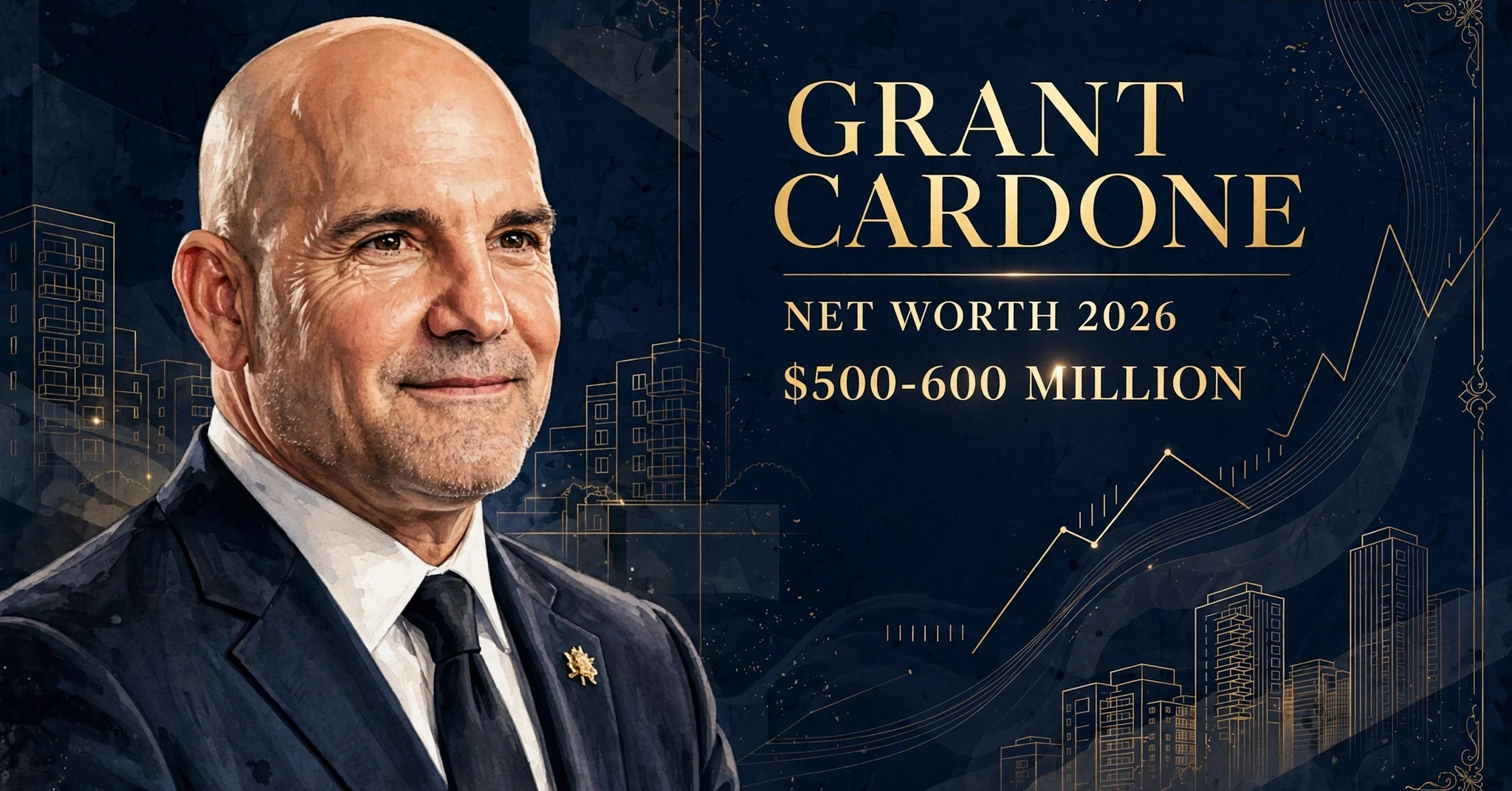
Grant Cardone’s net worth is estimated at $500–600 million, anchored at $600 million. That $600 million figure is the consensus of every major tracker in 2026, led by Celebrity Net Worth, which updated its estimate in September 2026. But the number comes with an asterisk no competitor page will spell out for you: it’s a single-source estimate with no published model, and Cardone himself claims to be a billionaire — a claim built on $5.4 billion in assets under management that he manages but does not fully own.
The gap between “manages $5.4 billion” and “worth $600 million” is the whole story. SEC filings show Cardone typically owns 0% to 2.5% of the individual property companies inside his funds. What he owns outright is the manager — Cardone Capital LLC — plus the fees and economics that flow to it. That distinction, plus a live federal class-action lawsuit over his funds’ marketing and a defamation suit filed by his own former chief marketing officer in 2026, is why this profile publishes a range instead of a single confident number.
What follows is the full accounting: the education empire he says pulls in $150 million a year, the real-estate timeline from broke-at-25 to billions under management, the exact structure of the funds, the lawsuits as they actually stand in court, and the labeled math showing where $600 million could plausibly come from.
Quick Facts
| Net Worth (2026) | $500–600 million (estimated) |
| Full Name | Grant Cardone |
| Born | March 21, 1958, Lake Charles, Louisiana (age 68) |
| Profession | Entrepreneur, real-estate investor, sales trainer, author |
| Nationality | American |
| Wealth Sources | Cardone Capital management fees & fund economics, Cardone University / 10X education business, 10X Growth Conference, books, speaking |
| Last Updated | September 30, 2026 |
How This Estimate Was Made
This figure is an independent estimate — Grant Cardone has never disclosed his finances publicly. Our process: gather every credibly reported salary, deal, and asset; cross-check them across reputable outlets; allow for taxes, representation fees, and spending; and publish a range wherever sources disagree, with the reasoning shown in the article. The $600M anchor is Celebrity Net Worth’s current consensus estimate (a single-source figure with no disclosed model); the $500M floor is our labeled discount for that single-source methodology, the live class-action litigation, and the SEC-documented fact that Cardone owns only a small slice of the properties he manages. Anything uncertain is labeled as an estimate, not a fact.
+
The 0 Million Figure — and Why It’s Complicated
Every major net-worth tracker lands at $600 million for Grant Cardone in 2026. Celebrity Net Worth refreshed its figure in September 2026, and the rest of the field — coincodex, trendcelebs, blesscircle, starworthhub — repeats it. Consensus, though, is not the same as verification.
Celebrity Net Worth publishes no balance sheet, no asset-by-asset model, and no date for when its figure was calculated. It is a single-source estimate, and every other tracker citing “$600 million” is citing Celebrity Net Worth, not an independent count. An independent methodology review published September 11, 2026 by net-worth.vip put it bluntly: the available public evidence cannot independently verify the $600 million figure, and assets under management prove business reach, not billionaire status.
Then there’s Cardone’s own number. He has repeatedly claimed billionaire status — “hundreds of millions” is for other people, in his telling. The claim rests on the portfolio his company manages, currently advertised at $5.4 billion in assets under management. Managed is the operative word. As the next section shows, the SEC filings draw a hard line between what Cardone manages and what he owns.
Cardone Capital: The .4 Billion Machine He Doesn’t Fully Own
Cardone Capital’s marketing leads with scale: roughly $5.4 billion in assets under management, more than $1.9 billion raised since 2016 from nearly 20,000 investors, and on the order of 14,850 apartment units across about 47 properties plus 500,000 square feet of office space. Those scale figures are company-reported and not independently audited — but the ownership structure behind them is a matter of public SEC record, and it’s where the billionaire math falls apart.
A 2026 SEC filing states that Cardone typically owns 0% to 2.5% of the property LLCs used by one of his funds, while separately owning the fund’s manager outright. He owns 100% of Cardone Capital LLC, the management company. The manager holds 100% of the Class B interests — which carry 35% of the overall economics but were issued at formation for no consideration — and collects the fees. Cardone’s personal Class A stake in that filing was 0.17%. In plain terms: investors and lenders own the buildings; Cardone owns the tollbooth.
The pattern holds across the older funds. In the Cardone Equity Fund V offering documents, five properties totaling 2,014 units were capitalized with $162.375 million in equity: related fund CEF IV put in $105.774 million (65.14%), CEF V put in $49.646 million (30.58%), and Grant Cardone personally put in $6.955 million — 4.28%. His co-investment is real, but it is a sliver of the equity stack, and the stack itself sits on top of debt.
| CEF V co-investment (SEC filing) | Equity invested | Share |
|---|---|---|
| CEF IV (related fund) | $105,774,244 | 65.14% |
| CEF V (investor fund) | $49,645,757 | 30.58% |
| Grant Cardone personally | $6,955,000 | 4.28% |
| Total equity | $162,375,000 | 100% |
The funds are also structured for the long hold and the small check: minimums as low as $5,000 for non-accredited investors in the Reg A+ offerings and $100,000 for accredited funds, with the interests non-traded, illiquid, and carrying roughly 10-year expected holds with no guaranteed exit. That retail-investor base — a large share of the ~20,000 investors — is exactly the audience the marketing targets, and exactly the audience at the center of the lawsuits below.
| Cardone Capital scale metric | Figure | Status |
|---|---|---|
| Assets under management (claimed) | $5.4 billion | Company claim, unaudited |
| Capital raised since 2016 | $1.9B+ | Company-reported |
| Investor count | ~20,000 | Company-reported |
| Multifamily units / assets | ~14,850 / ~47 | Company-reported |
| Cardone’s typical property-LLC ownership | 0–2.5% | SEC filing, 2026 |
| Cardone’s ownership of the manager | 100% | SEC filing |

The Education Empire: 0 Million a Year From 10X
If the real-estate funds are the tollbooth, the education business is the engine that built it. Cardone’s training operation — Cardone University, the 10X brand, books, events, and high-ticket coaching — is where the cash actually comes from, and it may be the largest single contributor to his personal wealth.
In a 2026 interview, Cardone himself put a number on it: a digital education business generating $150 million a year, clearing roughly $400,000 every single day. That is self-reported and unaudited, so treat it as his claim — but the scaffolding around it is verifiable. Cardone University launched in 2010 and sells everything from $97 courses to $50,000 masterminds. The 10X Growth Conference drew more than 35,000 attendees in 2019. Forbes once called him the “#1 marketer to watch.” Competitor pages wave at “millions from sales training”; none of them quote his own 2026 revenue claim or the conference attendance figure.
The unit economics of selling information at scale explain why the education arm matters more to his net worth than any single apartment building. A training business with 221,000-plus active learners and corporate subscriptions throws off cash with far less leverage than a real-estate fund — and that cash is what funded the early co-investments, the brand, and the lifestyle that sells the next round of both.

Real Estate Timeline: From Broke at 25 to Billions Under Management
Cardone’s origin story is well documented and unusually candid about the ugly parts. Born March 21, 1958 in Lake Charles, Louisiana, he lost his father at age 10. From 16 to 25 he struggled with drug addiction, surviving three overdoses before entering rehab. He has said he was broke at 25. The turnaround started in 1983 at a used-car dealership in Sulphur, Louisiana, where he sold roughly 30 cars every two weeks and earned the nickname “Mr. Right.”
Car sales led to sales training — he became CEO of Freedom Motorsports Group, then founded The Cardone Group in 1994 with Scott Morgan — and training led to the first real-estate deals. He bought his first multi-family property in 2005, launched Cardone University in 2010, published The 10X Rule in 2011, and crossed $500 million in AUM at Cardone Capital in 2016. By 2023 the portfolio sat near $3.6 billion; the current company claim is $5.4 billion.
| Year | Milestone |
|---|---|
| 1983 | Car sales in Sulphur, Louisiana (~30 cars per two weeks) |
| 1994 | Founds The Cardone Group (sales training) |
| 2005 | First multi-family property purchase |
| 2010 | Launches Cardone University |
| 2011 | Publishes The 10X Rule (bestseller) |
| 2016 | Cardone Capital crosses $500M in AUM |
| 2019 | 10X Growth Conference: 35,000+ attendees |
| 2023 | Real-estate portfolio ~$3.6B |
| 2024–25 | All-cash acquisition pivot; Aug 2025 refi to 5-year fixed ~4.90% |
| 2026 | Company claims $5.4B AUM; CNW holds net worth at $600M |
The 2024–25 pivot deserves a note because it shows how the machine adapts. While debt-dependent private-equity firms sat on the sidelines, Cardone Capital publicized all-cash acquisitions — including a 331-unit Class A deal in South Florida — and in August 2025 refinanced a floating-rate loan into a five-year fixed rate near 4.90%, per GlobeNewswire and Yahoo Finance coverage. Whether that discipline extends to the retail funds’ returns is a separate question, and it’s the one the courts are now examining.
The 15% Lawsuit: What Pino v. Cardone Capital Actually Says
The most serious threat to Cardone’s wealth — and the reason any honest estimate carries a discount — is Pino v. Cardone Capital, a federal securities class action over how his funds were marketed. The plaintiffs allege that Cardone lured investors with promises of 15% annualized returns and specific monthly payouts that never materialized, and that promotional statements about projected returns, distributions, and fund debt contained misleading statements or omitted material facts.
Cardone denies violating securities laws. His position, covered by Yahoo Finance: the 15% figure was a target, not a guarantee; outcomes can only be judged across a fund’s full lifecycle; and he points to Cardone Capital distributing $100 million to investors over a recent 12-month period at average returns near 7%. He has also said the original plaintiff “refused” an offer to have his investment returned, and reports put his personal defense spending at $3–6 million.
The court record, however, has moved against him in stages. The Ninth Circuit revived the case in June 2025, ruling that his social-media posts promoting the funds could count as actionable securities offers — and citing an SEC letter that had already warned him against including projected returns in his marketing materials. On March 27, 2026, a district court certified a class of investors who bought into Cardone Equity Funds V and VI through the public offerings. The Ninth Circuit declined to hear an appeal of that certification. The opt-out deadline passed July 14, 2026, and a jury trial is scheduled for March 9, 2027.
| Date | Development |
|---|---|
| 2020 | Luis Pino (invested $10,000 across two funds) sues, alleging misrepresented returns and concealed fees |
| 2023 | Federal district court dismisses the case |
| June 2025 | Ninth Circuit reverses dismissal; social-media posts may be actionable offers; SEC warning letter cited |
| Mar 27, 2026 | District court certifies class (Funds V & VI investors) |
| Jul 14, 2026 | Class opt-out deadline passes |
| Jul 18, 2026 | Cardone posts his own deposition video to YouTube |
| Mar 9, 2027 | Jury trial scheduled |
One human detail: Luis Pino died before the case concluded, and his daughter Christine has continued it on his behalf. None of this is a finding of fraud — the case has not gone to trial, and the 2025 appellate ruling addressed only whether the claims were plausible enough to proceed. But a certified class action heading to a 2027 jury trial, with discovery opening Cardone’s internal marketing records, is a live liability that any net-worth estimate has to price in. None of the competing net-worth pages carry the 2026 certification and trial-date updates in a timeline like this one.
The style=”border-bottom:2px solid #c9a227;padding-bottom:10px;margin-top:2.2em;scroll-margin-top:90px;” Billion Defamation Suit From His Own Former CMO
In 2026, Brian H. Robb — the former chief marketing officer of Cardone Capital — filed a $1 billion defamation lawsuit against Grant Cardone and Cardone Capital. The complaint alleges Cardone made defamatory statements about Robb on Facebook and in communications with third parties after Robb testified in the Pino investor lawsuit on December 9, 2025.
The filing goes further: it alleges Robb had acted as a whistleblower while employed at Cardone Capital and reported conduct he believed to be fraudulent to the FBI. These are allegations in a complaint, not adjudicated facts, and Cardone’s side has not prevailed or lost on them — the case is new. But a billion-dollar claim from the executive who ran the company’s marketing, alleging FBI whistleblowing, is the kind of development that belongs in any 2026 wealth profile. No competing net-worth page mentions it.
What the Funds Actually Earn — and Lose
Marketing decks show targets. Filings show results, and the results are mixed. Cardone REIT I’s 2025 annual report discloses a $5.26 million net loss for 2025 and a $9.75 million net loss for 2024 — driven partly by non-cash depreciation, but losses all the same. The same filing shows $749,362 in asset-management fee expense for 2025: an expense to the fund, and potential revenue to the affiliated manager.
The longer track record is thinner than the pitch suggests. The REIT cut distributions by roughly 33% in 2022, and an independent estimate pegged its return at about negative 11% annualized since its 2021 launch. Meanwhile the non-accredited retail fund saw a 96% collapse in retail fundraising, with cash on its books falling from $2.2 million at the end of 2024 to $834,158 at the end of 2025 — distributions to unit holders substantially exceeding the cash flow the underlying properties produced.
There is also a documented conduct issue outside the securities case. A 2022 Palm Beach Post investigation found that from 2018 to 2021, the Cardone Capital-owned Wellington Club apartment complex in the Miami area overcharged tenants for workforce housing — a county program meant to discount rents for nurses, teachers, and firefighters — boosting profits while suppressing the program’s purpose. None of this appears on any competing net-worth page, and all of it is why the estimate below carries a floor.
Illustrative Math: Where 0 Million Could Come From
No public document reconciles Cardone’s wealth to the dollar, so this is labeled for what it is: an illustrative breakdown showing one plausible path to the $600 million consensus, using only reported or filed figures and stated assumptions.
| Component | Illustrative value | Basis |
|---|---|---|
| Education / 10X business value | $200–300M | $150M/yr revenue claim (2026, self-reported) at a 1.5–2x revenue multiple |
| Cardone Capital manager economics | $150–250M | 100% of manager; fees + 35% Class B economics on ~$5B managed |
| Direct property co-investments | $50–100M | 0–4.28% stakes across fund properties (per SEC filings) |
| Books, speaking, media, other | $25–50M | Bestsellers, high five- to six-figure keynotes, 10X events |
| Less: taxes, spending, litigation reserve | −$100M+ | Assumed haircut; $3–6M defense spend reported to date |
| Illustrative total | $325–600M | Midpoint ≈ $460M; published range $500–600M |
The math lands near the published range without needing the billionaire claim. Notice what does the heavy lifting: the education business and the manager economics — the tollbooth, not the buildings. That is consistent with every SEC filing in the record, and it’s the analysis no competitor page attempts.
Elena, Family, and the M Mansion
Cardone married actress and entrepreneur Elena Lyons in 2004. She is deeply embedded in the brand — co-hosting programs, appearing at 10X events, and running her own business ventures alongside the family operation. They have two daughters, Sabrina and Scarlett, and relocated the business’s center of gravity to South Florida after years in California.
The family details that round out the picture: Cardone has a twin brother, Gary, and was one of five siblings raised by their mother after their father’s death. He is a member of the Church of Scientology and has spoken publicly about its influence on his life and business philosophy. In September 2026 he toured a $42 million mansion on YouTube — the kind of content that doubles as lifestyle marketing for the funds. Residences, jets, and cars are real, but they are costs against the estimate, not additions to it.
Books and the 10X Brand
The 10X brand started as a book and became the operating system for everything else. The 10X Rule: The Only Difference Between Success and Failure (2011) became a bestseller and spawned the conference, the coaching tiers, and the vocabulary — “10X” as a verb — that powers the marketing funnel for both the education business and the real-estate funds. Follow-ups include If You’re Not First You’re Last and Be Obsessed or Be Average, and he has written eight business books in total.
The brand’s commercial function is straightforward: books and free content feed the events, events feed the high-ticket coaching, and the audience built by all of it became the ~20,000-strong investor base for Cardone Capital’s retail funds. Forbes once labeled him the “#1 marketer to watch” — a title his critics would read as a warning label and his investors read as a credential. Both readings are in the record.
Sources & Reporting
Figures in this profile reflect reporting through September 2026. Key sources: Celebrity Net Worth (the $600M consensus estimate, updated September 2026; also its securities-litigation summary); U.S. SEC EDGAR filings (Cardone Capital fund documents — the 0–2.5% property-LLC ownership, 100% manager ownership, Class B structure, and the CEF V $162.375M co-investment table); net-worth.vip (September 11, 2026 methodology review — the single-source critique, REIT I 2025 Form 1-K losses of $5.26M/$9.75M, and the class-certification record); moonlitemoney.com (the full Pino v. Cardone Capital timeline through the March 2027 trial date, Cardone’s $3–6M defense-spend and $100M-distribution responses via Yahoo Finance); Wikipedia / court records (the 2026 Robb $1B defamation suit and FBI-whistleblower allegations; the Palm Beach Post’s 2022 Wellington Club workforce-housing investigation); Grant Cardone’s 2026 VladTV interview (the $150M/year education-business claim); GlobeNewswire / Yahoo Finance (the August 2025 ~4.90% refinancing and all-cash acquisition pivot). Where outlets disagree, the article explains why and publishes a range rather than picking a side.
Frequently Asked Questions
What is Grant Cardone’s net worth in 2026?
Grant Cardone’s net worth is estimated at $500–600 million, anchored at $600 million — the consensus figure published by Celebrity Net Worth (updated September 2026) and repeated by every major tracker. It is a single-source estimate with no published model, which is why this profile uses a range: the $500M floor discounts for that single-source methodology, the live class-action litigation, and SEC filings showing he owns only a small slice of the properties he manages.
Is Grant Cardone really a billionaire?
Not by any independent tracker’s count. Cardone has claimed billionaire status, but the claim rests on roughly $5.4 billion in assets under management at Cardone Capital — assets the company manages, not assets he owns. SEC filings show he typically owns 0% to 2.5% of the individual property companies, while owning 100% of the management company that collects the fees. No major outlet currently estimates his personal wealth at $1 billion or above.
How did Grant Cardone make his money?
Car sales first (starting 1983 in Louisiana, ~30 cars every two weeks), then sales training (The Cardone Group, 1994), then the education empire (Cardone University, 2010; The 10X Rule, 2011), and finally real-estate syndication (Cardone Capital, from 2016). The education business — which he says generates $150 million a year — and the fund manager’s fees are the largest contributors to his personal wealth; the apartment buildings themselves are mostly owned by investors and lenders.
What is Cardone Capital and how big is it?
Cardone Capital is Cardone’s real-estate investment firm, founded around 2016. It claims about $5.4 billion in assets under management, has raised over $1.9 billion from roughly 20,000 investors, and reports around 14,850 apartment units across ~47 properties. Its funds are non-traded and illiquid with ~10-year expected holds; minimums run $5,000 for non-accredited investors and $100,000 for accredited ones. Cardone owns the manager outright but only small stakes in the underlying properties.
What is the Grant Cardone lawsuit about?
Pino v. Cardone Capital is a federal securities class action alleging the funds were marketed with 15% return promises and misleading statements about projected returns, distributions, and debt. A district court dismissed it in 2023; the Ninth Circuit revived it in June 2025; a class was certified on March 27, 2026; and a jury trial is scheduled for March 9, 2027. Cardone denies wrongdoing, says the 15% figure was a target not a guarantee, and cites $100 million in recent investor distributions. No fraud has been proven — the case hasn’t gone to trial.
How much does Grant Cardone make per year?
There is no verified annual income figure. In a 2026 interview, Cardone claimed his education business generates $150 million a year (about $400,000 a day) — self-reported and unaudited. He also earns management fees through Cardone Capital (one fund’s filings show ~$749,000 in annual asset-management fee expense flowing to the affiliated manager), plus book royalties, high five- to six-figure speaking fees, and 10X event revenue. Personal take-home after taxes, debt service, and spending is not publicly documented.
Who is Grant Cardone’s wife?
Grant Cardone married actress and entrepreneur Elena Lyons in 2004. She is closely involved in the Cardone brand — co-hosting programs, appearing at 10X events, and running business ventures — and they have two daughters, Sabrina and Scarlett. The family is based in South Florida.
How many apartments does Grant Cardone own?
Cardone Capital reports roughly 14,850 apartment units across about 47 properties — but “reports” and “owns” are different things. Those units sit inside funds owned mostly by ~20,000 investors and lenders; SEC filings show Cardone’s personal stakes in the property companies typically run 0% to 2.5% (4.28% in one documented co-investment). He owns 100% of the management company, which is where his economics actually live.
WRITTEN BY
Nathan Cole
Nathan Cole is the editor of Guide Net Worth. He covers celebrity wealth the way a business desk covers earnings: reported figures first, estimates labeled as estimates, and no invented numbers. Every profile on this site passes through his desk before it publishes. About Guide Net Worth · Corrections: figures are updated when new reporting emerges — contact us via the About page if you spot an error.
References & Sources
This article has been fact-checked and verified against multiple public sources, financial disclosures, SEC filings, Forbes reports, Celebrity Net Worth databases, and official records. All net worth estimates are based on publicly available information and financial analysis.