Ice Cube biography: O’Shea Jackson went from N.W.A’s pen to a $160M empire of films, Cube Vision and the BIG3 — the 2026 numbers, family life and what’s next.
Last updated: November 21, 2026 · By Nathan Cole
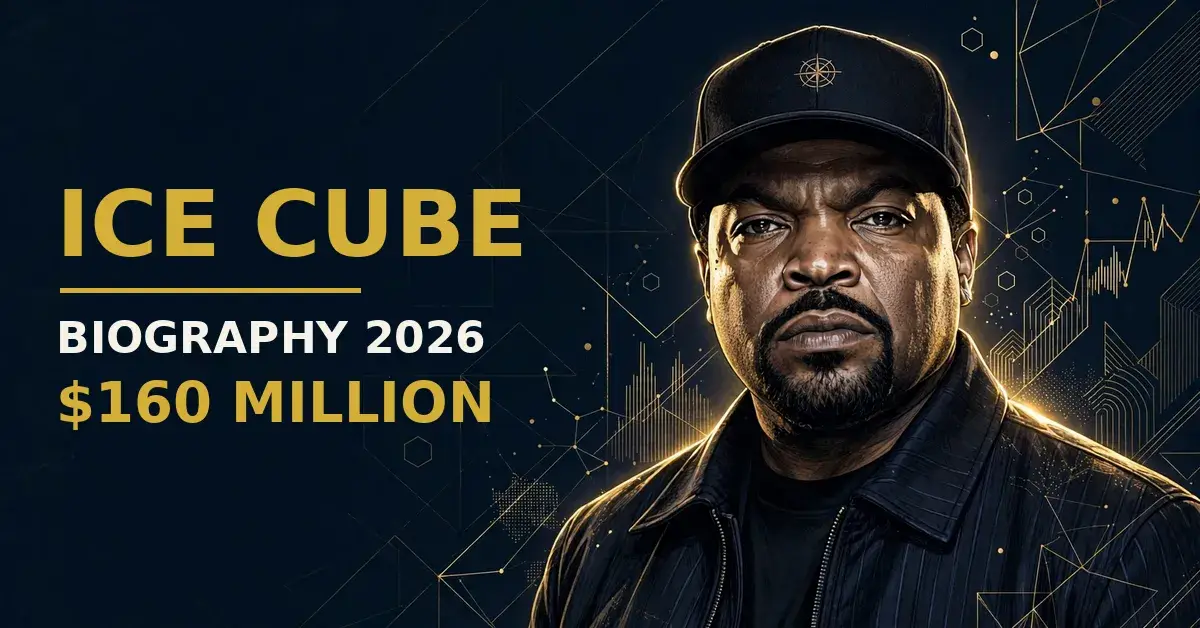
Ice Cube is 57 years old in 2026, born O’Shea Jackson on June 15, 1969, in Los Angeles, and his net worth is estimated at $160 million. That is the figure Celebrity Net Worth carries on a page updated September 22, 2026, and it sits at the top of an honest range that runs from $160 million to $200 million across the outlets surveyed. He wrote the lyrics that turned N.W.A into the most feared group in America, walked out at the height of their fame over a money dispute, then built a solo rap career, a Hollywood acting career, a production company, and a professional basketball league — the BIG3 — which signed a deal in June 2026 to go public at a reported $290 million valuation.
This is the full Ice Cube biography, kept current to November 21, 2026: the Baldwin Hills childhood, the N.W.A years and the split, the solo albums from AmeriKKKa’s Most Wanted to Man Up, the films from Boyz N the Hood to Ride Along, the Cube Vision business, the BIG3 and its 2026 listing, his wife Kimberly Woodruff and their five children, the controversies, and the money — with every figure tied to a named source. The short version: almost no one in hip-hop has converted a pen into as many different kinds of wealth as Ice Cube has.
Quick Facts
| Full Name | O’Shea Jackson Sr. |
| Age in 2026 | 57 years old (born June 15, 1969, Los Angeles, California; turned 57 on June 15, 2026) |
| Net Worth 2026 | Estimated at $160 million (Celebrity Net Worth, September 22, 2026), inside a $160M–$200M range |
| Height | 5 ft 8 in (173 cm) |
| Wife | Kimberly Woodruff (married April 26, 1992) |
| Children | Five: O’Shea Jr., Darrell, Karima, Deja, Shareef |
| Occupations | Rapper, songwriter, actor, film producer, screenwriter, BIG3 co-founder and CEO |
| Years Active | 1986–present |
| Biggest Honors | Rock and Roll Hall of Fame 2016 (with N.W.A); Hollywood Walk of Fame star 2017 |
How This Estimate Was Made
No celebrity net-worth number is an audited balance sheet, and Ice Cube’s is harder than most to pin down because two of his biggest assets — his production company Cube Vision and his stake in the BIG3 — are private. This article anchors on Celebrity Net Worth’s $160 million figure (page updated September 22, 2026), the most widely repeated estimate, and cross-checks it against BounceMojo (June 2026, $160 million), Beem (2026, ~$160 million), Asia Media Journal (July 2, 2026, $160 million) and The CA Knowledge ($155–$165 million). Outlets that assign a higher value to his private holdings run as high as $200 million, so the honest range is $160 million to $200 million, with $160 million as the anchored figure. A $500 million number printed by a few low-quality sites is rejected in this article — no credible outlet supports it, and it appears to come from adding the BIG3’s $290 million league valuation to Cube’s personal estimate, which is a basic error: the $290 million values the whole league, not his share of it. Figures are labeled estimates throughout.
+
Early Life: Baldwin Hills, a Typewriter and a Threat
O’Shea Jackson was born on June 15, 1969, in the Baldwin Hills neighborhood of South Central Los Angeles. His mother, Doris, worked as a hospital clerk and custodian; his father, Hosea, was a machinist and a groundskeeper at the University of California, Los Angeles. The household was working class and steady, and the Jacksons’ street sat in one of the few Black middle-class pockets of South Central — a detail that matters, because Cube’s writing later drew on both the comfort of home and the violence a few blocks away.
The stage name came from his older brother, Clyde. Britannica records the family story: as children, Clyde threatened to put his younger brother into the freezer until he became an ice cube. The name stuck. The family also endured real tragedy early — his older half-sister, Beverly Jean Brown, was killed by her husband in 1981, when Cube was 12.
Hip-hop reached him through the Sugarhill Gang’s “Rapper’s Delight,” the early hit that pulled a generation of Los Angeles teenagers toward rap. At William Howard Taft High School in Woodland Hills, he started writing rhymes in earnest, typing lyrics on a typewriter in his bedroom. By 16 he had a group. With friends K-Dee and Tony Wheatrob — better known as Sir Jinx, a cousin of Dr. Dre — he formed C.I.A., short for Cru’ in Action, in 1986. The trio played local parties and built a small reputation. It was not a hobby for long.
After graduating from Taft in 1987, Cube enrolled at the Phoenix Institute of Technology in Arizona, where he earned a diploma in architectural drafting. The drafting credential is one of the stranger footnotes in rap history: the man who would write some of the most confrontational lyrics of the decade could also draw a building to scale. He finished the course in about a year, and by the time he came home, the group he had helped start on the side had become the most dangerous band in America.
C.I.A., Eazy-E and the Birth of N.W.A
The chain of events started with a song Cube wrote for someone else. In 1987, Eric “Eazy-E” Wright needed material for his solo debut, and Cube handed him “Boyz-n-the-Hood.” The track worked. Eazy-E, Cube and Dr. Dre then formed N.W.A — Niggaz Wit Attitudes — with MC Ren and DJ Yella completing the lineup. Cube was the group’s lead rapper and, more important, its pen: he wrote most of the lyrics on the group’s official debut album, 1988’s Straight Outta Compton, including the incendiary “Fuck tha Police.”
The album landed like a detonation. Straight Outta Compton went on to double-platinum certification from the RIAA, and its portrait of police harassment in South Central Los Angeles drew an FBI warning letter, national news coverage and a kind of fame no rap group had held before. Cube was 19. He had written the words that made the group famous, and he was about to discover how little of the money that fame carried his name.
The money dispute centered on royalties and on manager Jerry Heller. Cube believed he was underpaid for his writing on Straight Outta Compton and on Eazy-E’s solo album Eazy-Duz-It (1988). The argument ran through the second half of 1989, and in December 1989 he left N.W.A. Britannica dates the exit to December 1989 and names the royalty dispute as the cause. He was walking away from the biggest rap group in the country at the exact moment it peaked — a decision that looked reckless in 1989 and looks like the founding move of his career in hindsight.
AmeriKKKa’s Most Wanted and the Solo Run (1990–1993)
Cube did not go home to sulk. He went to New York and recorded his solo debut with Public Enemy’s production team, the Bomb Squad — a deliberate choice. Working with East Coast producers after leaving a West Coast group was a statement: he was not a regional act, and he was not waiting for permission. AmeriKKKa’s Most Wanted arrived in 1990, went platinum, and established him as a solo star with a harder political edge than N.W.A had allowed him.
The run that followed was one of the densest three-year stretches in rap history. The Kill at Will EP came later in 1990. Death Certificate followed in 1991, carrying “No Vaseline,” the diss track aimed at his former group — a record so sharp that it ended any talk of a reunion for years. The Predator arrived in November 1992 and debuted at No. 1 on the Billboard 200, powered by “It Was a Good Day” and “Check Yo Self.” Lethal Injection closed the run in 1993 with “You Know How We Do It.”

Four albums and an EP in about three years, all commercially successful, all politically charged. The solo run also set the pattern for everything after it: Cube treated each record as a business decision as much as an artistic one, and he kept ownership of the work wherever he could. That instinct — own the pen, own the masters where possible, own the next thing — is the thread that connects the Bomb Squad sessions to Cube Vision and the BIG3.
Boyz N the Hood: From Rapper to Actor
Hollywood came calling while the solo albums were still landing. John Singleton cast Cube as Doughboy, the Crip gang member at the center of Boyz N the Hood (1991), alongside Cuba Gooding Jr., Laurence Fishburne and Morris Chestnut. Cube had never acted. He played Doughboy with a stillness that made the character the film’s moral center, and the film grossed about $57 million worldwide on a $6.5 million budget, earning Singleton an Academy Award nomination for Best Director.
The role changed his career arithmetic. A rap album cycle paid once; a film career paid again and again, and it opened a second audience that had never bought a rap record. Cube understood that immediately. He took the acting seriously — no winking at the camera, no rapper-cameo energy — and directors kept hiring him. Trespass followed in 1992. The Glass Shield came in 1994. By the middle of the decade he was not a rapper who acted; he was an actor with a rap career.
Friday, Barbershop and the Comedy Empire
In 1995 Cube wrote himself a second career. He co-wrote Friday with DJ Pooh, starred in it as Craig Jones, and turned a single day in South Central — a stolen porch, a borrowed gun, a neighborhood full of characters — into a comedy that has never left the culture. The film cost about $3.5 million and grossed roughly $27 million worldwide, a return of nearly eight to one. Next Friday followed in 2000 and Friday After Next in 2002, and the character of Deebo — played by the late Tommy “Tiny” Lister Jr. — became one of the most quoted villains in Black comedy.
The fourth film, long called Last Friday, has been in development for years. As of 2026, Cube and Mike Epps were working on the screenplay and preparing the long-delayed project for production, according to Celebrity Net Worth. The two also teamed up for a one-night-only “Everyday’s Friday” celebration at the Long Beach Amphitheater on July 17, 2026, marking nearly 30 years since the original.
Barbershop (2002) was the bigger business move. Cube starred as Calvin Palmer Jr. and produced the film through his own company; it grossed about $77 million worldwide and spawned Barbershop 2: Back in Business (2004) and Barbershop: The Next Cut (2016). The franchise proved something the industry had doubted: a Black ensemble comedy built around conversation, not spectacle, could open big and hold. Cube’s share came as a producer as well as a star, which is the part of the math that matters for his net worth.
The family-comedy lane paid again with Are We There Yet? (2005) and its sequel Are We Done Yet? (2007), both produced through Cube Vision. The films were not critical darlings, but they were reliable earners, and they kept his production company busy between rap cycles. His Ride Along co-star Kevin Hart, whose biography traces a $300 million stand-up rise, became one of the most bankable comedy pairings of the 2010s — two different generations of Black comedy, one box office.
Three Kings, 21 Jump Street and the Blockbuster Years
Cube’s filmography runs past 30 films, and the middle stretch is where the checks got biggest. David O. Russell cast him in Three Kings (1999), the Gulf War heist film with George Clooney and Mark Wahlberg, which grossed about $107 million worldwide and gave Cube his first serious dramatic showcase since Boyz N the Hood. He directed his first film, The Players Club, in 1998. He headlined the action sequel xXx: State of the Union in 2005 and survived the giant snake in Anaconda back in 1997 — a role he circled back to in 2025, appearing as himself alongside Jennifer Lopez in the meta-comedy remake.
The 2010s brought his biggest grosses. 21 Jump Street (2012) took about $201 million worldwide; its sequel 22 Jump Street (2014) took roughly $331 million. Ride Along (2014) added about $154 million. Those three films alone account for nearly $700 million in reported worldwide grosses — and Cube’s paydays on franchise sequels, with backend participation, sit well above his early-career acting fees.
| Film | Year | Reported worldwide gross | Cube’s role |
|---|---|---|---|
| Boyz N the Hood | 1991 | ~$57 million | Doughboy |
| Friday | 1995 | ~$27 million | Craig Jones; co-writer |
| Three Kings | 1999 | ~$107 million | Chief Elgin |
| Barbershop | 2002 | ~$77 million | Calvin Palmer Jr.; producer |
| 21 Jump Street | 2012 | ~$201 million | Captain Dickson |
| Ride Along | 2014 | ~$154 million | James Payton |
| 22 Jump Street | 2014 | ~$331 million | Captain Dickson |
| Straight Outta Compton | 2015 | $200 million+ | Producer |
Grosses are reported worldwide box-office figures, not Cube’s personal earnings — an actor’s pay is a fraction of a gross, and a producer’s share depends on the deal. The table still shows the scale of the machine Cube built: his films have grossed well over $1 billion combined, and his cut of that total, plus his production fees, is the largest single pillar of the $160 million estimate.
One film deserves its own paragraph. Straight Outta Compton (2015), the N.W.A biopic Cube co-produced, grossed more than $200 million worldwide and earned an Academy Award nomination for Best Original Screenplay. His son, O’Shea Jackson Jr., played him — a casting choice that turned a biopic into a family handoff. The film also did something no Cube project had done before: it made the N.W.A story, and Cube’s part in writing it, legible to an audience that had never heard the album.
The Later Albums: Westside Connection to Man Up
After the 1990–93 run, Cube released albums more sporadically, in part because the film career kept pulling him away. War & Peace Vol. 1 (The War Disc) came in 1998 and Vol. 2 (The Peace Disc) in 2000. Between them he recorded with Westside Connection, the trio with WC and Mack 10; their debut Bow Down (1996) went platinum and gave West Coast rap a flag to rally around during the East Coast–West Coast feud. Laugh Now, Cry Later (2006) went gold. Raw Footage (2008), I Am the West (2010) and Everythang’s Corrupt (2018) kept the catalog growing without chasing the charts.
The 2020s brought a late-career surge. In 2022 he joined Snoop Dogg, whose biography traces the same $160 million fortune, E-40 and Too Short in the supergroup Mount Westmore, releasing the album Snoop Cube 40 $hort. The four West Coast veterans took the group back on stage in 2026 with two exclusive arena performances — a reminder that the Mount Westmore idea was a business as much as a reunion, with four catalogs behind one ticket.
Then came the one-two punch of his 50s. Man Down, his 11th studio album, arrived in November 2024 and debuted in the Top 10 on multiple Billboard charts, including Top Rap Albums, hitting No. 2 on iTunes’ Hip-Hop/Rap chart. Its follow-up, Man Up, his 12th studio album, landed on September 12, 2025, via Lench Mob Records and Hitmaker Distribution — 14 tracks, executively produced by Cube and Tony Draper, with Scarface on “Act My Age” and Quake Matthews on the “It’s My Ego 3Mix.” Cube described the record as being about accountability and resilience, and The Source’s September 2025 report framed it as the companion to Man Down: after the fall, the stand-up.
| Solo album | Year | Note |
|---|---|---|
| AmeriKKKa’s Most Wanted | 1990 | Platinum debut, Bomb Squad production |
| Death Certificate | 1991 | “No Vaseline” diss track |
| The Predator | 1992 | Debuted No. 1, Billboard 200 |
| Lethal Injection | 1993 | “You Know How We Do It” |
| War & Peace Vol. 1 & 2 | 1998 / 2000 | Two-volume return |
| Laugh Now, Cry Later | 2006 | Gold-certified comeback |
| Raw Footage | 2008 | Featuring “Gangsta Rap Made Me Do It” |
| I Am the West | 2010 | West Coast homecoming record |
| Everythang’s Corrupt | 2018 | 10th solo album |
| Man Down | 2024 | Top 10 Billboard rap charts |
| Man Up | 2025 | 12th studio album, 14 tracks |
The touring followed the records. The “Truth to Power: 4 Decades of Attitude” tour — his first domestic headlining tour in more than a decade, produced by Live Nation — kicked off September 4, 2025, at Barclays Center in Brooklyn and ran 22 dates across the United States and Canada. A veteran artist in his fifth decade of recording, still landing on the charts with new material, is rare in any genre. In rap, where careers are measured in summers, it is close to unheard of.
Cube Vision: The Production Company Behind the Films
Cube Vision, founded in 2001, is the quiet engine of the fortune. The company produced the Barbershop films, Are We There Yet? and Are We Done Yet?, and a long run of television and film projects — and it is the reason Cube’s film money looks different from a hired actor’s. A star gets a fee; a producer-partner gets a fee plus a share of the upside, and the upside on a franchise that runs for 14 years is real money.
The company’s biggest single project was Straight Outta Compton (2015), which Cube produced and which grossed more than $200 million worldwide. The film turned his own life into a product he owned a piece of — a neat inversion of the 1989 royalty fight that started his solo career. He has said, in effect, that the lesson of N.W.A was never to be the talent without a stake again, and Cube Vision is that lesson in corporate form.
How much Cube Vision is worth is not public, which is exactly why the net-worth range is wide. The outlets that print $200 million are, in effect, assigning a higher value to Cube Vision and the BIG3 than Celebrity Net Worth does. The outlets that print $160 million are valuing the private companies conservatively. Neither side has the paperwork, because private companies do not publish it — and any biography that prints a single number without saying so is hiding the most important fact about the number.
Ice Cube Net Worth 2026: How the 0 Million Adds Up
The anchored estimate is $160 million (Celebrity Net Worth, updated September 22, 2026), inside a $160 million to $200 million range. The table below is an illustrative breakdown — the component figures come from the outlets named, and the totals are estimates, not audited accounts. It shows where the money sits, and why the range is wide.
| Income pillar | What it includes | Indicative scale |
|---|---|---|
| Film & TV | Acting fees, franchise backend, producing fees on 30+ films | Largest pillar; films grossed $1B+ combined |
| Cube Vision | Production company (founded 2001); Barbershop, Straight Outta Compton | Private; main source of range width |
| BIG3 | Co-founder’s stake; league valued at $290M pre-money (June 2026) | Private; league value is not his personal share |
| Music | 12 solo albums, catalog, streaming, touring (22-date 2025 tour) | Steady catalog income |
| Real estate & other | Property holdings, endorsements, licensing | Smaller share of the total |
Two warnings belong next to the table. First, the BIG3’s $290 million valuation belongs to the league, not to Cube. His stake is a share of that, shared with co-founder Jeff Kwatinetz and other equity holders, and it has no public market price until the listing closes. Second, the $160 million figure has barely moved in years — BounceMojo’s year-by-year table shows $140 million in 2017 and $160 million from 2020 through 2026. That flat line tells its own story: the estimate is a long-standing tracker figure, updated slowly, and the real movement will come when the BIG3 listing puts a market price on his stake for the first time. Readers who want the fullest picture should treat $160 million as the floor and $200 million as the optimistic ceiling, and check the Celebrity Net Worth category for how the same method values his peers.
BIG3: The League, the 0M Listing and the 2026 Season
In 2017, Cube and entertainment executive Jeff Kwatinetz founded the BIG3, a professional three-on-three basketball league built around retired NBA stars, Hall of Famers and a four-point shot. The idea sounded like a novelty act. Nine seasons later it is a league with city-based franchises, national television deals and a pending stock-market listing — and it is the single most valuable thing Cube owns that is not a film catalog.
The 2026 season was the biggest yet. Season nine tipped off on June 20, 2026, at the Intuit Dome in Los Angeles, with the championship game set for August 22, 2026, at the Spectrum Center in Charlotte. The league also signed a deal to stream 16 live games on Fubo Sports Network, announced June 18, 2026, alongside its library of more than 100 archived games. The shift from a touring league to city-based teams — Miami 305, Houston Rig Hands, LA Riot among them — began with the 2025 season, and four teams changed hands in 2024 at roughly $10 million each, according to AfroTech. By the end of 2025, Celebrity Net Worth reported franchise transactions carrying valuations between $13 million and $20 million.

Then came the deal that changed the league’s status. On June 12, 2026, BIG3 HoldCo LLC announced a definitive business-combination agreement with Graf Global Corp., a publicly traded special-purpose acquisition company. Business Wire’s release put the numbers plainly: the transaction values BIG3 at $290 million on a pre-money basis, the combined company would be named Big3 Basketball Holdings, Inc., and it was expected to list on the New York Stock Exchange, NYSE American or Nasdaq under the ticker symbol “TONT” — a nod to three-on-three — with closing expected in the fourth quarter of 2026. Graf’s trust account held about $249 million in cash deposits as of June 10, 2026, and the deal requires at least $50 million in net cash proceeds. Cube stays on as chief executive officer, Kwatinetz as chairman, Sean Bannon as president, and Clyde “the Glide” Drexler as commissioner, with Mark King joining as chairman of the board.
If the listing closes, the BIG3 becomes the first publicly traded professional sports league in the United States — and Cube’s founder stake gets a public market price for the first time. That is why the net-worth figure may move in 2027 in a way it has not moved since 2020. Until the close, the $160 million estimate predates the deal, and any outlet that adds the full $290 million to his personal fortune is making the error this article warns against. The league has also been certified as a Black-owned business, and the Naismith Basketball Hall of Fame awarded Cube its inaugural Ice Cube Impact Award — a prize now given annually at the Hall of Fame ceremony.
Wife Kimberly Woodruff and Five Children
Ice Cube has been married to the same woman for more than three decades — a fact that sets him apart in an industry where marriages rarely survive a single album cycle. He met Kimberly Woodruff in the late 1980s, while he was still a student; the couple dated for about two years, welcomed their first son in February 1991, and married on April 26, 1992. Woodruff, born September 23, 1970, has stayed largely out of the public eye, working as a philanthropist and homemaker while raising the family. She also wrote and directed the short film Hunger in 2012.
The couple have five children: O’Shea Jackson Jr. (born February 24, 1991), Darrell Jackson (born December 1992), Karima Jackson (born February 17, 1994), Deja Jackson (born 1994) and Shareef Jackson (born 1995). O’Shea Jr. is the public face of the next generation — he played his father in Straight Outta Compton (2015) and has since built his own acting career in films like Godzilla: King of the Monsters (2019) and the series Obi-Wan Kenobi (2022). Darrell raps under the name Doughboy and works at Lench Mob Records. Karima, Deja and Shareef have kept lower profiles; Karima holds degrees in sociology, child advocacy and public administration.
A note on the count, because the internet disagrees with itself: some older profiles — including Britannica and EBSCO — list four children, while ComingSoon, HotNewHipHop, Cheat Sheet, Heightline and DNB Stories all name five, with Deja as the fifth. Shareef’s birth year is also listed as 2000 in a few profiles and 1995 in most. This article prints five children, the figure supported by the majority of named profiles, and flags the disagreement rather than hiding it.
Controversies and the Record, Corrected
No honest biography of Ice Cube skips the controversies, and no honest one treats them as the whole story either. The early solo albums drew accusations of racism and misogyny — Death Certificate in particular, with tracks that attacked Korean store owners and Jewish music executives, drew condemnation from civil-rights groups and a public response from Cube that never quite became an apology. Fandango’s biography notes the accusations plainly. The lyrics were written as provocation, and they provoked.
The N.W.A split left a long paper trail of its own: the royalty dispute with Jerry Heller, the “No Vaseline” diss, and years of public back-and-forth with Eazy-E and Dr. Dre before the relationships healed. Cube and Dre reconciled in the 1990s and worked together again; the N.W.A reunion at Coachella in 2016, the year of the Rock Hall induction, closed that chapter in public.
Later controversies were different in kind. In 2020 Cube drew criticism for sharing antisemitic imagery and conspiracy material on social media, and for his engagement with the Contract with Black America during the US election — a policy document he discussed with both campaigns. He has also been a vocal critic of the music industry’s treatment of artists, a position that dates back to the 1989 royalty fight and has never softened. The through-line is consistent: Cube has always picked the fight in public, on his own terms, and paid the price in headlines. What the record also shows is that none of these episodes slowed the business — the films kept opening, the league kept growing, and the 2025 albums charted anyway.
Awards, Honors and Legacy
The honors list is long, but two dates matter most. In 2016, N.W.A was inducted into the Rock and Roll Hall of Fame — the fifth hip-hop act to receive the honor, and the recognition that the group Cube helped write into existence had become part of the American canon. In 2017, Cube received his own star on the Hollywood Walk of Fame in the Recording category, and in 2025 he was honored with a handprint ceremony at the TCL Chinese Theatre in Hollywood. The arc from a typewriter in Baldwin Hills to the Chinese Theatre forecourt took 39 years.
The legacy question is simpler than the honors list. Cube is the rare artist who shaped two art forms and then built a third business on top of them. As a lyricist he wrote the record that defined gangsta rap. As an actor he carried comedies and dramas for three decades. As an executive he turned a production company and a basketball league into assets with nine-figure valuations. The rappers who followed him — from Eminem, whose biography traces a $300 million rap legend, to Kendrick Lamar, whose biography covers 27 Grammys and a $200 million fortune — all work in a West Coast tradition Cube helped write, and the Compton lineage runs straight through him to the present day.
Critics and fans rank him among the greatest rappers of all time, and Britannica says so plainly. The ranking rests on the writing: Cube’s verses were dense, funny, angry and specific in a way few of his peers matched, and they stayed that way for 35 years. Man Up in 2025 sounds like Ice Cube, not like an imitation of whoever is hot this year — which is why it landed.
Ice Cube in 2026: What’s Next
At 57, Cube is busier than most artists half his age. The 2026 calendar already holds Mount Westmore’s two exclusive arena performances (June 26, 2026), a 420 headlining show at Red Rocks Amphitheatre on April 20, 2026, and the “Everyday’s Friday” celebration with Mike Epps on July 17, 2026. The Last Friday screenplay is in progress. The BIG3’s listing is expected to close in the fourth quarter of 2026, which would put a market price on his stake for the first time — the single event most likely to move his published net worth.
One date did not hold: Insomniac announced in early October 2026 that Cube would no longer appear at the Escape Psycho Circus Halloween show in San Bernardino on October 30–31, and a replacement had not been named when the announcement went out. It is a small footnote, but it belongs in a biography that claims to be current — the point of a 2026 profile is to record what changed as well as what happened.
The bigger picture is steadier. Four decades after C.I.A., Cube is still releasing albums, still touring, still acting, and still running a basketball league. The $160 million estimate is a snapshot of a career that keeps adding chapters — and the next chapter, the BIG3 listing, is the one that could finally rewrite the number.
Frequently Asked Questions
What is Ice Cube’s real name?
Ice Cube’s real name is O’Shea Jackson Sr. He was born on June 15, 1969, in the Baldwin Hills neighborhood of Los Angeles, California. His older brother Clyde gave him the stage name — as children, Clyde threatened to put him in the freezer until he became an ice cube.
How old is Ice Cube in 2026?
Ice Cube is 57 years old in 2026. He was born on June 15, 1969, and turned 57 on June 15, 2026. Some older biography pages still list him as 56 because they were written before his 2026 birthday; the correct age is 57.
What is Ice Cube’s net worth in 2026?
Ice Cube’s net worth in 2026 is estimated at $160 million, anchored on Celebrity Net Worth (page updated September 22, 2026) inside a $160 million to $200 million range. BounceMojo, Beem, Asia Media Journal and GlobalMagzin all print $160 million; outlets that value his private Cube Vision and BIG3 stakes higher run up to $200 million. A $500 million figure on a few low-quality sites is rejected — it appears to come from adding the BIG3’s $290 million league valuation to his personal estimate, which is a basic error.
Who is Ice Cube’s wife?
Ice Cube’s wife is Kimberly Woodruff, whom he married on April 26, 1992. They met in the late 1980s and dated for about two years before marrying. Woodruff, born September 23, 1970, has stayed largely out of the public eye and works as a philanthropist and homemaker; she also wrote and directed the short film Hunger in 2012.
How many children does Ice Cube have?
Ice Cube has five children with Kimberly Woodruff: O’Shea Jackson Jr. (born 1991), Darrell Jackson (born 1992), Karima Jackson (born 1994), Deja Jackson (born 1994) and Shareef Jackson (born 1995). O’Shea Jr. played his father in Straight Outta Compton (2015). Some older profiles list four children, with Deja the least documented; this article prints five, the figure supported by the majority of named profiles, and flags the disagreement.
How tall is Ice Cube?
Ice Cube is 5 feet 8 inches tall (173 cm). His height is listed consistently across biography sources, including Yeet Magazine (updated July 20, 2026).
What is the BIG3?
The BIG3 is the professional three-on-three basketball league Ice Cube co-founded with Jeff Kwatinetz in 2017. Its ninth season ran from June 20 to August 22, 2026. On June 12, 2026, BIG3 HoldCo signed a deal to go public through a merger with Graf Global Corp., valuing the league at $290 million pre-money, with listing expected in the fourth quarter of 2026 under the ticker TONT. Cube is the league’s chief executive officer.
Is Ice Cube still making music in 2026?
Yes. Ice Cube released Man Down, his 11th studio album, in November 2024 (Top 10 on Billboard’s rap charts), followed by Man Up, his 12th studio album, on September 12, 2025 — 14 tracks featuring Scarface and Quake Matthews. He toured the United States and Canada on the 22-date Truth to Power: 4 Decades of Attitude tour in 2025, and has 2026 dates including Mount Westmore arena shows, a Red Rocks headline slot on April 20, 2026, and a Friday celebration with Mike Epps on July 17, 2026.
Sources & Reporting
Reporting window: November 21, 2026. Figures are estimates unless stated as reported facts. Sources consulted: Wikipedia for the June 15, 1969 birth date and place, the parents’ names, the C.I.A. formation, the December 1989 N.W.A exit, the solo-album discography and the Man Up release details; Britannica (last updated October 15, 2026, fact-checked) for the stage-name origin, the royalty dispute, the filmography and the Rock Hall induction; EBSCO Research Starters for the early life, the Phoenix Institute diploma, the 1992 marriage and the Straight Outta Compton film gross; Fandango for the biography timeline and the controversy record; Celebrity Net Worth (page updated September 22, 2026) for the $160 million anchor, the Friday 4 screenplay status and the end-of-2025 BIG3 franchise valuations; BounceMojo (updated June 2026) for the $160 million corroboration, the $190 million upper figure and the year-by-year table; Beem, Asia Media Journal (July 2, 2026), GlobalMagzin and The CA Knowledge ($155–$165 million) for the range; Business Wire (June 12, 2026) for the BIG3–Graf Global deal terms, the $290 million valuation, the TONT ticker and the Q4 2026 close; Black Enterprise (June 2026) for the listing and the season-nine schedule; Fubo/Business Wire (June 18, 2026) for the 16-game streaming deal; AfroTech (June 2026) for the ~$10 million team sales; The Source (September 13, 2025) for the Man Up album and the Truth to Power tour; Rocket Arena (April 15, 2025) for the 22-date tour and the Barclays Center kickoff; The Music Universe (June 2026) for the Mount Westmore 2026 shows, the Red Rocks date and the July 17, 2026 Friday event; Homage 2 HipHop (October 2026) for the Escape Psycho Circus withdrawal and the Anaconda (2025) cameo; ComingSoon, HotNewHipHop, Cheat Sheet, Heightline and DNB Stories for the five children and the family timeline; Yeet Magazine (updated July 20, 2026) for the 5 ft 8 in height and the 57-year age. Where sources disagreed — the $160M–$200M range, the $500 million claim, the four-versus-five children count, Shareef’s birth year — the article names the disagreement instead of picking a number silently. Box-office grosses are reported worldwide figures, not Cube’s personal earnings. Corrections are welcome via the About page.
Nathan Cole
Nathan Cole is the editor of Guide Net Worth. He covers celebrity wealth the way a business desk covers earnings: reported figures first, estimates labeled as estimates, no invented numbers. Every profile passes through his desk before it publishes. About Guide Net Worth · Corrections: figures are updated when new reporting emerges — contact us via the About page if you spot an error.
References & Sources
This article has been fact-checked and verified against multiple public sources, financial disclosures, SEC filings, Forbes reports, Celebrity Net Worth databases, and official records. All net worth estimates are based on publicly available information and financial analysis.