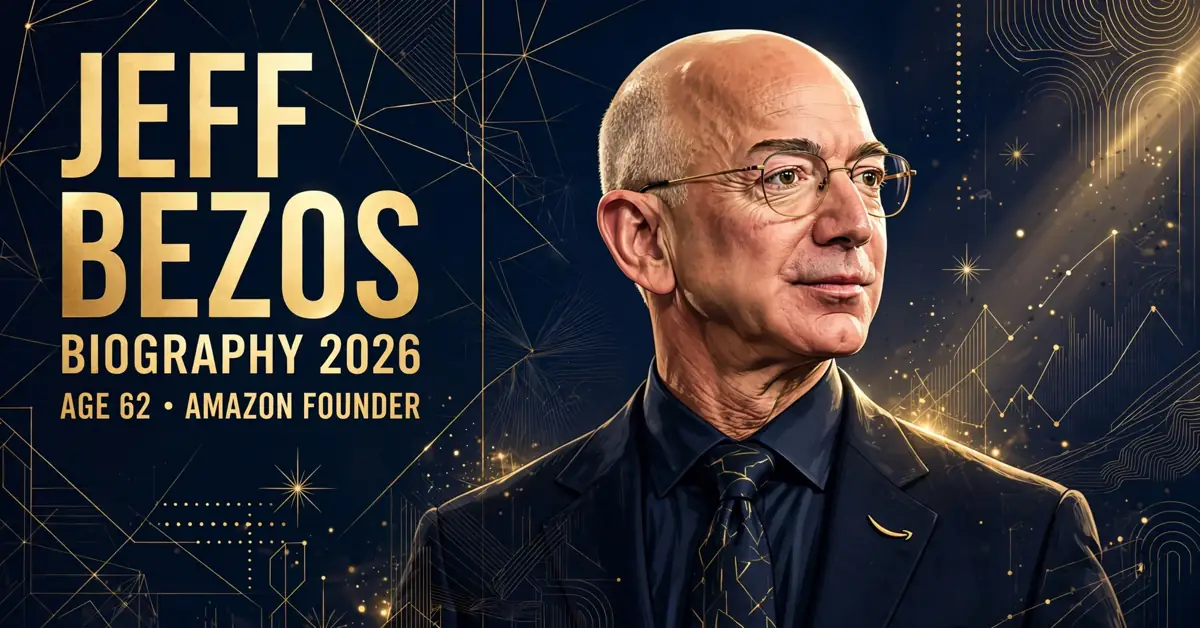
Jeff Bezos biography 2026: age 62, Amazon founder turned space and AI investor — from a Seattle garage bookstore to a $370 billion fortune and Blue Origin.
Last updated: November 1, 2026 · By Nathan Cole
Jeff Bezos is 62 years old in 2026. He was born Jeffrey Preston Jorgensen on 12 January 1964 in Albuquerque, New Mexico, and he turned 62 on 12 January 2026. That date settles the first fact most biography pages fumble, because older profiles still floating around the web list him a year younger, and a few still carry net worth figures from 2025 that the autumn of 2026 has already made obsolete.
The short version of the life is this. A boy whose mother was 17 when he was born, raised by a Cuban immigrant stepfather who adopted him at four, goes from a Texas ranch and a Miami high school to Princeton, then to Wall Street, then — in 1994 — quits a senior job to sell books from a garage in Bellevue, Washington. That garage becomes Amazon, the largest e-commerce and cloud company on earth. He steps down as its chief executive in 2021, marries Lauren Sánchez in Venice in 2025, and in October 2026 is worth an estimated $370 billion by Forbes and $372 billion by Bloomberg — the second-richest person alive, behind only Elon Musk, on the strength of a rocket company that had never taken outside money until weeks earlier.
What follows is the full record, dated at every turn: the childhood, the Wall Street years, the Amazon build, the divorce, the space program, the Washington Post, the Miami move, and the 2026 fortune — including why two respected trackers can disagree by billions about the same man on the same day.
Quick Facts
| Full Name | Jeffrey Preston Bezos, born Jeffrey Preston Jorgensen |
| Born | 12 January 1964, Albuquerque, New Mexico, USA (age 62 in 2026) |
| Occupation | Entrepreneur, investor; founder and executive chairman of Amazon |
| Known For | Founding Amazon (1994), founding Blue Origin (2000), owning The Washington Post (2013) |
| Education | Princeton University — degree in electrical engineering and computer science, 1986 |
| Spouse | Lauren Sánchez Bezos (married 27 June 2025, Venice); previously MacKenzie Scott (1993–2019) |
| Children | Four; their names are kept out of public reporting |
| Residence | Indian Creek Village, near Miami, Florida |
| Estimated Net Worth | About $370 billion (Forbes, 1–2 October 2026); $372 billion (Bloomberg, 9 October 2026 close) |
| Last Updated | November 1, 2026 |
How This Profile Was Put Together
This biography is built from the documented record, not from profile-site copies: Wikipedia’s sourced biography, The Profile’s October 23, 2026 update, EBSCO’s research starter, Built In’s biography, Reuters’ October 7, 2026 report on Blue Origin, and Forbes and Bloomberg billionaire tracking from early October 2026. Where sources disagree — above all on his fortune — the article shows both figures, dates them, and explains the reason for the gap instead of picking one number and hiding the other. No private financial document has ever been published, so every fortune figure here is an estimate, labeled as one.
+
Early Life in Albuquerque, Houston and Miami
Jeffrey Preston Jorgensen was born on 12 January 1964 in Albuquerque, New Mexico, to Jacklyn Gise, who was 17 years old at the time, and Ted Jorgensen. The marriage did not last. Jacklyn left her husband and filed for divorce when Jeff was 17 months old, and she raised the boy with her parents for a time before her life changed a second time.
In April 1968, when Jeff was four, Jacklyn married Miguel “Mike” Bezos, a Cuban immigrant who had arrived in the United States at 15 as part of Operation Pedro Pan during the Cuban Revolution. Mike adopted Jeff shortly after the wedding, and the boy’s surname legally changed from Jorgensen to Bezos. It is the name the world knows, and it came from the stepfather, not the birth father.
When Mike finished his degree at the University of New Mexico, the family moved to Houston, Texas, so he could take an engineering job with Exxon. Jeff attended River Oaks Elementary School in Houston from fourth to sixth grade. His summers were spent on his maternal grandfather’s ranch in Texas. Lawrence Preston Gise had worked for DARPA and later managed the Atomic Energy Commission’s Albuquerque operations office, and the ranch summers — fixing windmills, castrating cattle, long days of practical work — became the most quoted part of Bezos’s childhood, the place he later said taught him resourcefulness.
The family later moved to Miami, Florida, where Bezos attended high school and finished at the top of his class. The pattern of the childhood matters for what came later: a boy moved between cities, raised in a blended family, who learned early that a surname, a home and a plan could all change, and that hard, unglamorous work was simply what a summer was for.
Princeton, Wall Street and the Idea for Amazon
Bezos went to Princeton University and graduated in 1986 with a degree in electrical engineering and computer science. The degree choice was deliberate. He had been a science-obsessed schoolboy — building alarms, tinkering with electronics — and Princeton gave him the formal version of that habit: systems, circuits, and the mathematics underneath them.
After graduation he took a job at Fitel, a high-tech startup, where he built software to track international stock trades. He then moved into finance proper: Bankers Trust, and in 1990 the quantitative hedge fund D. E. Shaw in New York. By 1992 he was the firm’s youngest senior vice president, at 28. It was at D. E. Shaw that he met MacKenzie Tuttle, a novelist working in research; they married in 1993.
At D. E. Shaw, Bezos ran into the statistic that changed his life. Web usage was growing at roughly 2,300 percent a year in the early 1990s. He later described the number as something he could not stop thinking about: a growth rate like that meant whatever business was built on the internet first would have an advantage that no latecomer could easily erase. He drew up a list of products that sold well by mail order and could be sold better online. Books topped it — a catalogue too large for any physical store, a product customers already bought without handling first, and a market with two dominant distributors he believed he could undercut.
He told D. E. Shaw’s founder, David Shaw, that he wanted to leave and start an online bookstore. Shaw reportedly told him it was a good idea, but a better idea for someone who did not already have a good job. Bezos left anyway in 1994.
Founding Amazon: The 1994 Road Trip and the Garage
The founding story is so often repeated that it risks sounding like a fable, but the documented outline holds up. In mid-1994 Bezos and MacKenzie drove from New York City to Seattle while he wrote the business plan in the car. He chose Seattle for practical reasons: it was close to a large book wholesaler, it had a deep pool of technical talent, and Washington state at the time had a smaller population than California or New York, which mattered for sales-tax reasons in the early days of online retail.
Amazon was founded in mid-1994. The first office was the garage of a rented house in Bellevue, Washington, with a pot-bellied stove, doors laid across sawhorses for desks, and an extension cord running to the house. The company was briefly called Cadabra before Bezos settled on Amazon, after the river — the largest river, for what he intended to be the largest bookstore. The website launched in July 1995. In its first month it sold books in all 50 American states and 45 countries, and Bezos and his small team rang a bell each time an order arrived, until the bell had to stop because the orders never stopped.
Amazon went public in May 1997 at $18 a share. The years that followed tested the garage story to its limit: the dot-com crash of 2000–2001 wiped out most of Amazon’s peers, and analysts openly asked whether the company would survive. Bezos kept expanding instead of retreating — into music, video, electronics, and then, decisively, into infrastructure that had nothing to do with selling books.

Building the Everything Store
Three decisions built the modern Amazon, and each looked like a side project at the time. Prime, launched in 2005, charged customers a flat annual fee for fast, free shipping — a bet that loyalty bought in advance would beat per-order margins. Amazon Web Services, launched in 2006, rented out the computing infrastructure Amazon had built for itself, and grew into the company’s profit engine and the backbone of much of the internet. Kindle, launched in 2007, put a bookstore in a pocket and gave Amazon a dominant position in digital reading.
By the 2010s Amazon was no longer a bookstore that had grown up. It was the world’s largest e-commerce and cloud computing company: a marketplace, a logistics network, a studio, a grocery chain after the 2017 purchase of Whole Foods, and a cloud provider whose data centers power companies that compete with it. Bezos’s management doctrine through that period — customer obsession over competitor obsession, a willingness to be misunderstood for long periods, and “two-pizza teams” small enough to move fast — became business-school shorthand, quoted far beyond Seattle.
The cost of that growth was public too. Amazon’s warehouse working conditions, its tax arrangements, and its treatment of third-party sellers drew sustained criticism from regulators, unions and Congress, and Bezos himself was called before a House antitrust subcommittee in 2020 alongside the heads of Apple, Google and Facebook. The biography of a founder this large cannot be told without that counterweight: the same logistics machine that made delivery next-day also made Amazon one of the most scrutinized employers in America.
Stepping Back: Executive Chairman and Andy Jassy
In February 2021 Bezos announced he would step down as Amazon’s chief executive. He did so on 5 July 2021, handing the job to Andy Jassy, who had built AWS. Bezos moved to the role of executive chairman, keeping a major shareholding and a hand in the company’s biggest decisions, while freeing his days for what he called his other passions: Blue Origin, the Earth Fund, the Washington Post, and the Day 1 Fund.
The timing mattered. Amazon in 2021 was at peak pandemic scale, with revenue and headcount swollen by lockdown shopping, and Jassy inherited both the machine and its regulatory fights. Bezos’s own public role shifted with the move. He stopped being the man who ran Amazon day to day and became, in public perception, the man who had built Amazon and was now spending its proceeds — on rockets, on climate, on a very visible personal life.
Blue Origin and the Race Back to Space
Bezos founded Blue Origin in 2000, quietly, and funded it almost entirely himself for a quarter of a century. The stated goal was the opposite of a vanity project in his telling: to lower the cost of access to space so that millions of people could eventually live and work off Earth. For most of its first two decades the company trailed Elon Musk’s SpaceX, founded about 18 months later, which came to dominate commercial launches with its reusable Falcon 9 rockets.
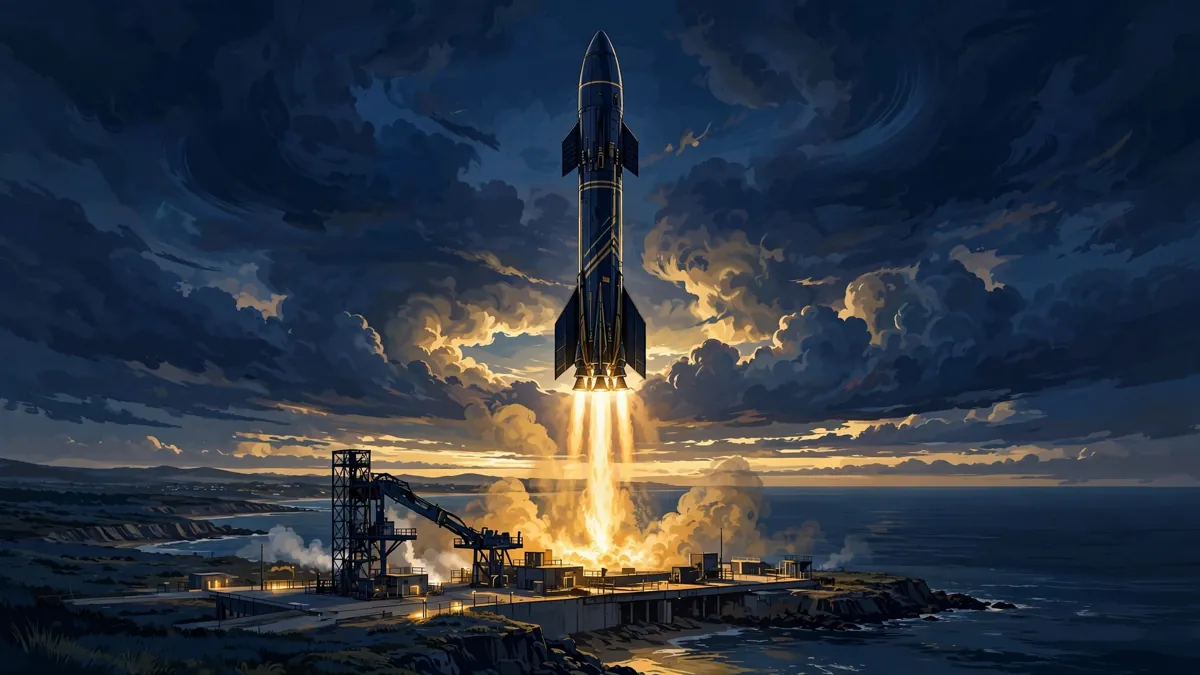
Blue Origin’s New Shepard suborbital vehicle carried Bezos himself to the edge of space on 20 July 2021, weeks after he left the Amazon chief executive job. The orbital rocket, New Glenn — 322 feet tall — made its maiden flight in January 2025 from Cape Canaveral; its booster was lost on descent. The second flight, on 13 November 2025, sent NASA’s Mars-bound ESCAPADE spacecraft into orbit, and eight minutes after launch its booster, nicknamed “Never Tell Me the Odds”, landed on a drone ship in the Atlantic. It was the first time a company other than SpaceX had pulled off that maneuver.
Progress then stalled. A New Glenn rocket exploded during a static-fire test in May 2026, delaying the company’s push into the commercial launch market. Speaking to Fox News on 7 October 2026, Bezos said the company planned to fly New Glenn again in December 2026, and he said something he had never said before in public: that Blue Origin would probably pursue an initial public offering, several years from now, after its first outside funding round. “I think, someday, Blue Origin will have an IPO,” he said. “It would be several years from now. But it probably makes sense for Blue Origin to be a public company at some point.”
The Washington Post and Bezos Expeditions
In October 2013 Bezos bought The Washington Post for $250 million, in a personal purchase separate from Amazon. The paper was losing money and shedding readers; Bezos’s pitch to its newsroom was that the internet, which had broken the newspaper business model, could also rebuild it — through technology, through a wider paying audience, and through patience with losses that a publicly traded owner could not afford.
The Post’s digital audience did grow sharply in the years after the purchase, and its reporting — including on the 2016 and 2020 American elections — won Pulitzers. The ownership also drew a different kind of attention in later years, as Bezos’s public interventions in the paper’s opinion pages, including the decision not to endorse a presidential candidate in 2024, prompted resignations and subscription cancellations. Through Bezos Expeditions, his personal investment vehicle, he has also backed companies outside Amazon and Blue Origin, and he remains the Post’s owner in 2026.
The 0 Billion Fortune — and Why Trackers Disagree
Here is where a biography written in November 2026 has to be careful, because the honest answer to “how much is Jeff Bezos worth?” changed by roughly $90 billion in a single month. Forbes put his fortune at $371.2 billion on 2 October 2026, and at $370 billion on 1 October. Bloomberg’s Billionaires Index put it at $372 billion at the 9 October 2026 close, up $122 billion — 48.7 percent — on a year earlier. Both trackers ranked him second in the world, behind Elon Musk at about $1.02 trillion, and ahead of Alphabet co-founder Larry Page. A year earlier, Forbes had put him above $220 billion (May 2025), and Bloomberg-derived profiles in August 2026 had him at $281 billion. None of those older figures is wrong for its date. All of them are wrong for November.
The jump came from two private companies, not from Amazon’s share price. Blue Origin raised $10 billion in its first outside funding round in September 2026. The Wall Street Journal reported the round valued the company at $140 billion; Forbes counted it at $130 billion pre-money. Because Bezos had owned essentially all of Blue Origin before the round, that valuation flowed almost directly onto his balance sheet. Bloomberg estimates he owns about 93 percent of the company after the round, worth about $123.5 billion after a 5 percent discount for its private status. Forbes, valuing the stake differently, reached a similar total by a different route — which is why the two trackers agree on the headline and disagree on the method.
The second driver was Prometheus, an industrial AI startup Bezos co-founded and co-leads with Vik Bajaj, the former chief scientific officer of Verily. Prometheus closed a $12 billion Series B round in June 2026 at a $41 billion valuation, Axios reported, and Forbes estimates Bezos holds about 20 percent of it — roughly $8.2 billion. Together, Blue Origin and Prometheus account for more than a third of his estimated fortune, a concentration that did not exist a year earlier.
The largest single holding remains Amazon itself. An August 2026 regulatory filing showed Bezos holding 879.3 million Amazon shares directly, worth about $230.8 billion in the Bloomberg-derived breakdown, or about 8.2 percent of the company. Forbes counts his stake at about 8 percent and notes he has sold more than $49 billion of Amazon stock since the company’s initial public offering. The lesson of the October figures is not that Bezos gained $100 billion in cash — he did not — but that a private-company funding round can reprice a fortune overnight, because a company with no share price can only be valued by the price its newest investors are willing to pay.
| Holding (October 2026) | Reported value | Source of the figure |
|---|---|---|
| Amazon stake (~8.2%) | About $230.8 billion | 879.3m shares, Form 4, August 2026 (Bloomberg-derived) |
| Blue Origin (~93%) | About $123.5 billion | $140B round valuation, WSJ, September 2026; Bloomberg estimate |
| Prometheus (~20%) | About $8.2 billion | $41B valuation, June 2026 Series B (Axios); Forbes stake estimate |
| Total, Forbes / Bloomberg | $370 billion / $372 billion | Forbes, 1–2 Oct 2026; Bloomberg, 9 Oct 2026 close |
Prometheus: The 2026 AI Bet
Prometheus is the least known of Bezos’s three companies and, in 2026, the one that says most about where his attention has moved. Co-founded with Vik Bajaj and co-led by the two men as co-chief executives, it aims to use artificial intelligence to automate manufacturing — to take the factory floor, with its shortages of skilled labor and its slow adoption of new tools, and rebuild its processes around AI systems that can design, plan and run production.
The June 2026 Series B — $12 billion raised at a $41 billion valuation — made Prometheus one of the most valuable private AI companies in the world before it had a public product track record to match. Bezos’s estimated 20 percent stake is worth, on paper, more than the entire fortune of most billionaires. Whether Prometheus earns that valuation depends on a question no funding round can answer: whether AI can do for physical manufacturing what it has already done for software and text. In 2026 that question is still open, and Bezos has placed a very large, very public bet on one answer.
Family, Marriages and Life in Miami
Bezos married MacKenzie Tuttle in 1993. They have four children — three sons and a daughter adopted from China — whose names and lives have been kept out of public reporting, a privacy the couple maintained even at the height of Amazon’s fame. On 9 January 2019, Jeff and MacKenzie announced their divorce jointly on social media after 25 years of marriage; it was finalized in April 2019, with MacKenzie receiving a stake in Amazon then worth roughly $35 billion, making her one of the richest women in the world overnight. She has since given away much of it through her own philanthropy.
Bezos was publicly linked to Lauren Sánchez from 2019. Sánchez is an Emmy-winning television journalist, a licensed helicopter pilot, a children’s book author, and vice chair of the Bezos Earth Fund. The couple married on 27 June 2025 in Venice, Italy, in a multi-day celebration that drew celebrity guests and, in Venice itself, protests about overtourism and wealth. Both Bezos and Sánchez have flown to space on Blue Origin’s New Shepard, she on an all-female flight in 2025.
In 2023 Bezos announced he was moving from Seattle to Miami, to be closer to his parents and to Blue Origin’s Florida operations. He acquired three properties on Indian Creek Island — the guarded enclave near Miami Beach known as Billionaire Bunker — between 2023 and 2024, reported at a combined purchase price of about $237 million. He also owns the superyacht Koru, reported to have cost about $500 million, and a support vessel. The Miami move completed a geographic arc that began in Albuquerque, ran through Houston and Miami as a child, spent three decades in Seattle, and returned to Florida as a 59-year-old grandfather of the internet age.
Philanthropy: Earth Fund, Day 1 Fund, Bezos Academy
Bezos’s giving has grown later and faster than his fortune, and it follows the same pattern as his business bets: large, concentrated, and aimed at systems rather than single causes. In 2018 he launched the Day 1 Fund with $2 billion, split between homeless-family shelters and a network of Montessori-inspired preschools in underserved communities, the Bezos Academy. In February 2020 he committed $10 billion to the Bezos Earth Fund, to be granted by 2030, for climate and nature work. Forbes’s 2026 profile notes about $2.4 billion of that pledge had been granted by 2026 — a reminder that a pledge is not the same as money spent.
He has also given $100 million Courage and Civility Awards, announced with fanfare, to figures including Van Jones, José Andrés and Eva Longoria, each free to direct the money to charities of their choice. Critics of his philanthropy note the scale gap: even $10 billion is a small fraction of a $370 billion fortune, and the Earth Fund’s grants, however large in absolute terms, arrive while Amazon’s own carbon footprint remains one of the largest of any American company. Supporters note the opposite: that few living donors have committed $10 billion to a single cause at all. Both observations are true, and a biography that printed only one would be incomplete.
The Record, Corrected
Three errors circulate about Bezos more than any others, and each is worth naming plainly. First, his age: he is 62 in 2026, not 61, because he was born on 12 January 1964. Profiles that still say 61 were written before January 2026 and never updated. Second, his fortune: any article quoting $220 billion or $281 billion without a date is quoting May 2025 or August 2026, and both were superseded in September and October 2026 by the Blue Origin and Prometheus revaluations. Third, his surname: he was born Jorgensen, not Bezos. The name came from his stepfather’s adoption when he was four, and it is the clearest single fact about a childhood that is often smoothed over in hagiography.
What remains genuinely uncertain is also worth stating. No one outside Bezos’s own accountants knows his exact net worth on any given day, because Blue Origin and Prometheus have no public share price. His height is listed in profile databases but has no primary-source confirmation, so this article does not print it as fact. And the future of Blue Origin — IPO or not, December 2026 flight or not — is a plan, stated on television on 7 October 2026, not an accomplished fact.
Sources & Reporting
This profile draws on Wikipedia’s sourced Jeff Bezos biography (birth, family, education, Amazon timeline); The Profile’s “Who Is Jeff Bezos?” (updated 23 October 2026) for the Earth Fund grant total and the 2026 role summary; EBSCO’s research starter for the early career (Fitel, D. E. Shaw, youngest senior vice president 1992); Built In’s biography for the August 2026 Bloomberg fortune figure and the Post purchase price; Reuters, 7 October 2026, for the Blue Origin IPO comments, the $10 billion round, the $28 billion personal investment, and the December 2026 flight plan; TheStreet’s September 2026 report for the Prometheus Series B and the Forbes stake estimate; and Forbes and Bloomberg billionaire tracking from 1–9 October 2026 for the $370 billion / $372 billion fortune figures and the Amazon share count. Reporting window: October–November 2026. Where a figure is an estimate, it is labeled as one. Corrections are welcome via the About page.
Frequently Asked Questions
How old is Jeff Bezos in 2026?
Jeff Bezos is 62 years old in 2026. He was born on 12 January 1964 in Albuquerque, New Mexico, and he turned 62 on 12 January 2026. He turns 63 on 12 January 2027.
Where was Jeff Bezos born?
Jeff Bezos was born in Albuquerque, New Mexico, as Jeffrey Preston Jorgensen. His mother was 17 at his birth. After his parents divorced, his mother married Miguel Bezos, who adopted four-year-old Jeff and gave him the Bezos surname. He was raised in Houston and Miami.
When did Jeff Bezos found Amazon?
Jeff Bezos founded Amazon in mid-1994 after leaving his job at the hedge fund D. E. Shaw. He drove from New York to Seattle writing the business plan, set up in a rented garage in Bellevue, Washington, and launched the website as an online bookstore in July 1995.
Why did Jeff Bezos step down as Amazon CEO?
Bezos stepped down as Amazon CEO on 5 July 2021 to become executive chairman, handing the chief executive job to Andy Jassy, who had built Amazon Web Services. Bezos said the move freed his time for Blue Origin, the Bezos Earth Fund, the Washington Post and the Day 1 Fund, while he kept a major Amazon shareholding.
What is Jeff Bezos’s net worth in 2026?
Jeff Bezos’s net worth was estimated at $370 billion by Forbes on 1–2 October 2026 and $372 billion by Bloomberg at the 9 October 2026 close, making him the second-richest person in the world behind Elon Musk. The gap between the trackers comes from how they value his private company Blue Origin, which raised $10 billion in September 2026 at a reported $140 billion valuation.
Who is Jeff Bezos married to?
Jeff Bezos is married to Lauren Sánchez Bezos, an Emmy-winning journalist, helicopter pilot, children’s book author and vice chair of the Bezos Earth Fund. They married on 27 June 2025 in Venice, Italy. He was previously married to MacKenzie Scott from 1993 until their divorce in 2019.
Where does Jeff Bezos live?
Jeff Bezos lives on Indian Creek Island near Miami, Florida, after announcing a move from Seattle in 2023. He acquired three properties there between 2023 and 2024, reported at a combined price of about $237 million.
What is Blue Origin, and what is Prometheus?
Blue Origin is the space company Bezos founded in 2000; its New Glenn orbital rocket flew for the second time in November 2025 and landed its booster, and Bezos said in October 2026 that it will probably pursue an IPO in several years. Prometheus is an industrial AI startup Bezos co-founded and co-leads with Vik Bajaj, which raised $12 billion in June 2026 at a $41 billion valuation to automate manufacturing.
Nathan Cole
Nathan Cole is the editor of Guide Net Worth. He covers celebrity wealth the way a business desk covers earnings: reported figures first, estimates labeled as estimates, and no invented numbers. Every profile on this site passes through his desk before it publishes. About Guide Net Worth · Corrections: figures are updated when new reporting emerges — contact us via the About page if you spot an error.
References & Sources
This article has been fact-checked and verified against multiple public sources, financial disclosures, SEC filings, Forbes reports, Celebrity Net Worth databases, and official records. All net worth estimates are based on publicly available information and financial analysis.