Julia Child biography 2026: the 6-foot-2 OSS clerk who learned to cook at 36, wrote Mastering the Art and built a $50M legacy; her home just sold for $6.5M.
Last updated: November 12, 2026 · By Nathan Cole
Julia Child was 6 feet 2 inches tall, she did not learn to cook until she was 36, and she died in 2004 worth about $50 million in today’s money. Those three facts, taken together, are the whole of her story: a tall, late-starting, endlessly curious American who went to Paris as a diplomat’s wife, fell in love with a plate of sole meunière, and came home to teach a country that had never heard of a soufflé how to make one. She was born Julia Carolyn McWilliams on August 15, 1912, in Pasadena, California. She died on August 13, 2004, in Montecito, California, of kidney failure, two days short of her 92nd birthday. In between she wrote the most influential cookbook ever published in America, hosted the first television cooking show that mattered, and built a fortune that Celebrity Net Worth puts at $50 million, adjusted for inflation — $38 million in the dollars of the year she died.
Her name is in the news again in 2026 for a reason that has nothing to do with cooking. The house at 103 Irving Street in Cambridge, Massachusetts, where she lived for 40 years and filmed several of her shows, sold on October 29, 2026, for $6.525 million — $50,000 over its asking price, under agreement in five days, twenty-two years after her death. The sale closed the same month the Cambridge City Council’s August vote for a commemorative plaque at the address was still awaiting the new owner’s approval. A woman who has been dead for twenty-two years just sold a house for six and a half million dollars. That is the measure of what she built, and it is why a biography written in 2026 is not a history lesson. It is a current event.
What follows is the full picture: the Pasadena childhood and the Smith College degree, the war years in the OSS where she met her husband, the Paris meal that changed her life, the ten-year writing of Mastering the Art of French Cooking, the 1963 television debut that made her famous at 50, the long shelf of books and shows that followed, the 48-year marriage to Paul Child, the Cambridge house and its 2026 sale, the net-worth figure adjudicated dollar by dollar, and the legacy — a foundation, a film, a television series, and a kitchen in the Smithsonian — that keeps her name current two decades after her death.
Quick Facts
| Full Name | Julia Carolyn Child (née McWilliams) |
| Born | 15 August 1912, Pasadena, California |
| Died | 13 August 2004, Montecito, California (kidney failure), aged 91 |
| Height | 6 ft 2 in (188 cm) |
| Known For | Mastering the Art of French Cooking (1961); The French Chef (1963–1973) |
| Net Worth at Death | About $38 million in 2004 dollars — about $50 million adjusted for inflation |
| Spouse | Paul Cushing Child (m. 1 September 1946 – d. 12 May 1994) |
| Children | None |
| Education | Smith College (BA history, 1934); Le Cordon Bleu, Paris (Diplôme de Cuisine, 1951) |
| Awards | Peabody Award 1965; Emmy 1966; Legion of Honour 2000; Presidential Medal of Freedom 2003 |
How This Estimate Was Made
Julia Child died in 2004, so her net worth is a figure at death, not a live estimate — and the sources disagree about it by a wide margin, which this article adjudicates rather than hides. Celebrity Net Worth puts it at $50 million at the time of her death, adjusted for inflation. MarketRealist and The Richest put it at $38 million at death in 2004 dollars, which is the same figure once inflation is applied — $38 million in 2004 is roughly $50 million in 2026 dollars. Those two numbers agree with each other; they are the same fortune expressed in different years’ money. The outlier is WorthPluse, which gives $3 million — a figure that confuses liquid cash with total estate value and that no other outlet repeats. This article anchors on $50 million inflation-adjusted, with $38 million at death in 2004 dollars stated alongside it, and the $3 million figure is recorded here only to be rejected. Where the record is thin — her exact book royalties, her television fees — the article says so instead of inventing a number.
+
Who Was Julia Child?
Julia Child was the woman who taught America to cook French food, and the first person to prove that a cooking show could be television rather than a demonstration. Before her, American cookbooks were terse and American television chefs were home economists in pearls. She arrived at 50 years old, six feet two inches tall, with a warbling voice and a habit of dropping things on camera and carrying on, and she made French cooking look like something an ordinary American could do on a Tuesday night. Mastering the Art of French Cooking, published in October 1961, sold more than 1.5 million copies. The French Chef, which premiered on Boston’s WGBH on February 11, 1963, ran for more than 200 episodes over ten years and won a Peabody Award in 1965 and an Emmy in 1966. She was not a chef who became famous. She was a famous person who happened to be a chef, and the fame came late enough that she never took it for granted.
The late start is the point of her life, and it is the reason her biography is still read. She was 36 when she ate the meal that changed her life, 37 when she enrolled at Le Cordon Bleu, 49 when her book was published, and 50 when her television show began. She had spent her twenties in advertising and her early thirties in a war, and she had never cooked a serious meal before Paris. The woman who taught America to cook did not learn to cook until she was nearly 40, and she spent the next fifty years making up for lost time. Every chef who came after her — the ones with television shows, book deals and restaurant empires — walks a road she built, and most of them know it.
Her fortune, at about $50 million in today’s money, looks small beside the chefs who followed her. Gordon Ramsay is worth about $220 million. Jamie Oliver about $200 million. Guy Fieri about $130 million. She never owned a restaurant empire, never sold a stake to a cosmetics company, never franchised her name across a hundred products. Her money came from books and television, collected over forty years, and it was enough. The comparison table near the end of this article lays out the gap, and the gap is the story: she built the industry that made the others rich, and she did it for a fraction of what they made from it.
Early Life in Pasadena: The Tall Girl from a Wealthy Family
Julia Carolyn McWilliams was born on August 15, 1912, in Pasadena, California, the eldest of three children in a family that had money and expected its children to behave as if they did. Her father, John McWilliams Jr., was a banker and a landowner, a Princeton man who managed the family’s California holdings. Her mother, Julia Carolyn Weston, was a paper-company heiress from Massachusetts. Her younger siblings were John McWilliams III and Dorothy. The family lived well in Pasadena, and Julia grew up tall — 6 feet 2 inches by adulthood — athletic, and, by her own later account, more interested in sports and jokes than in the kitchen. She did not cook as a girl. She did not need to, and nobody asked her to.
She was educated at the Polytechnic School in Pasadena and then at the Branson School in San Francisco, and in 1930 she went east to Smith College in Northampton, Massachusetts, where she majored in history and graduated in 1934. Smith was a women’s college, and it was there that Julia became the person she would remain: tall, loud, funny, and impossible to miss. She played sports, she wrote, she made friends for life, and she left with a degree in history and no plan at all. Her mother died in 1937, when Julia was 24, and the loss marked her — she was close to her mother, and the death left a space in the family that never quite closed.
After Smith she went to New York, where she worked in advertising for W. & J. Sloane, the furniture store, and wrote for magazines. It was respectable work for a Smith graduate in the 1930s, and it was not what she wanted. She moved back to California, restless, and when the war came she tried to enlist. The Women’s Army Corps turned her down for being too tall — 6 feet 2 inches was over the limit — and so did the WAVES. It was the first time her height had cost her something she wanted, and it would not be the last time it defined her. She joined the Office of Strategic Services instead, the wartime intelligence agency that would later become the CIA, and the OSS sent her where the war needed clerks who could keep secrets. She went to Ceylon, and then to China, and in Ceylon she met the man she would marry.
The OSS Years: War, Ceylon and Paul Child
Julia McWilliams joined the OSS in 1942 as a research assistant, and in 1944 she was posted to Kandy, in Ceylon — now Sri Lanka — where the OSS ran its South-East Asia operations. The work was clerical and secretarial, and it was also, by her own account, the most fun she had ever had. She typed, she filed, she kept the registry, and she lived in a world of young Americans far from home, working hard and playing harder. In 1945, in Kandy, she met Paul Cushing Child, a diplomat and artist ten years her senior, who had been posted to the OSS after a career that already included painting, photography, poetry and a stint in the Foreign Service. Paul was born on January 15, 1902, in New Jersey, and he was, in Julia’s later telling, the most interesting man she had ever met.
The courtship was slow. Paul was posted to China, to Kunming, and Julia followed the OSS to China too, and they wrote to each other across the war’s last months. When the war ended they came home, and on September 1, 1946, they married in Lumberville, Pennsylvania. Paul was 44. Julia was 34 — unusually late to marry for a woman in the 1940s, and a fact the 2026 profiles still note, because it fits the pattern of her life. She did everything late, and she did everything once, and she did it properly. The marriage lasted 48 years, until Paul’s death on May 12, 1994, at 92. They never had children — no biological children, no adopted children — and the question still draws searches in 2026, because a woman famous for feeding America is assumed, wrongly, to have fed a family of her own. She fed the country instead.
The OSS years matter for two reasons. The first is Paul: without the war, without Ceylon, there is no marriage, and without the marriage there is no Paris, and without Paris there is no Julia Child. The second is the height. The WAC and the WAVES had turned her down for being 6 feet 2 inches, and the rejection pushed her into the OSS, which did not care how tall its clerks were. Her height, which had been a social awkwardness in Pasadena and a barrier to enlistment, became, in the OSS and then on television, the thing that made her unmistakable. She was the tallest woman in every room she entered for the rest of her life, and on television that was an advantage: nobody forgot the six-foot-two woman with the warbling voice and the whisk.
Paris 1948: The Meal That Changed Everything
In November 1948, Paul Child was posted to the American Embassy in Paris, to the United States Information Service, and Julia went with him. She was 36 years old, she had never cooked a meal more ambitious than a scrambled egg, and she arrived in France knowing nothing about French food. The first meal she ate in France changed that in a single sitting. Driving from Le Havre to Paris, the Childs stopped for lunch at La Couronne in Rouen, and Julia ordered sole meunière — sole dredged in flour, fried in butter, served with lemon. She wrote about it for the rest of her life. It was, in her telling, the most exciting meal she had ever eaten, and it was the moment she understood that food could be a subject worth a life.
She enrolled at Le Cordon Bleu in 1949, at 37, and graduated in 1951 with a Diplôme de Cuisine. She was the only woman in her class, and the school’s rigid, military kitchen — the shouting, the precision, the insistence that a sauce was either right or wrong — suited her. She was tall, she was strong, she could lift the pots, and she did not mind being told she was doing it wrong. In 1952, with Simone Beck and Louisette Bertholle, two Frenchwomen she had met through the school, she founded a small cooking school of her own, L’École des Trois Gourmandes — the School of the Three Happy Eaters — and began teaching American women in Paris how to cook French food. The school was the rehearsal for everything that followed: the teaching, the patience, the insistence that a home cook could do this.
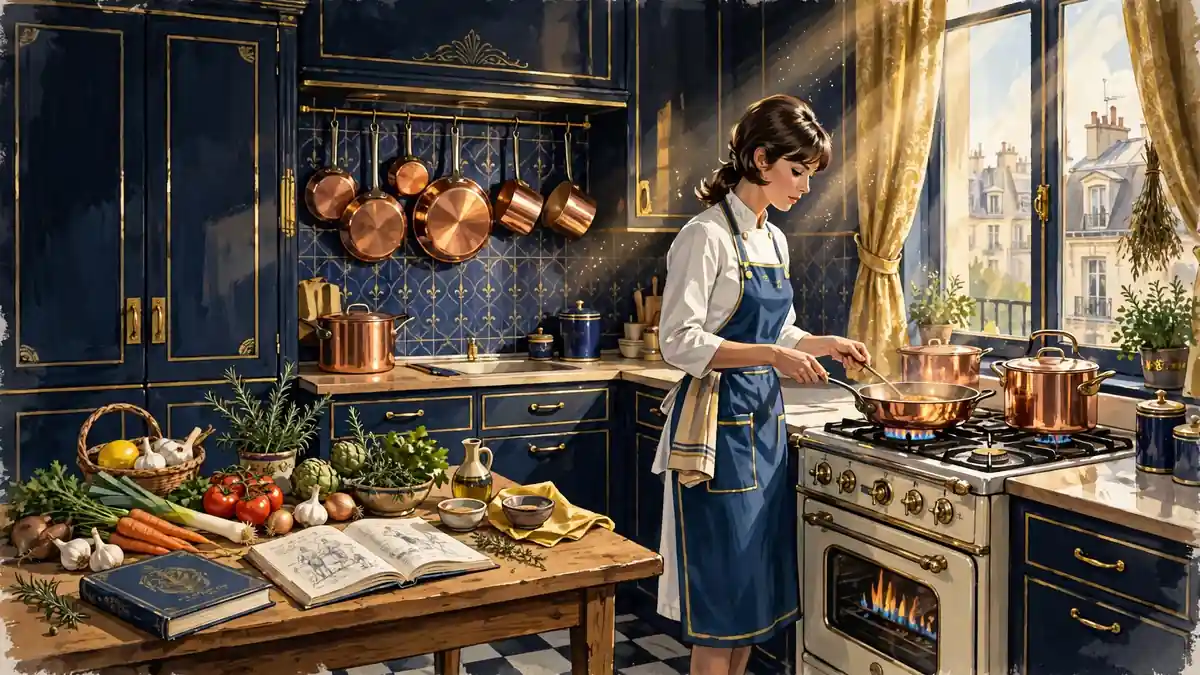
Paris also gave her the book. In 1951, Beck and Bertholle had a manuscript for a French cookbook aimed at American readers, and they invited Julia to join them. The three women spent ten years on it — testing, retesting, rewriting, arguing about whether an American cook could be trusted with a soufflé. The manuscript was rejected by Houghton Mifflin, which thought it too long, and then taken by Alfred A. Knopf, which published it in October 1961 as Mastering the Art of French Cooking. Julia was 49. The book was 524 pages long, it cost $10, and it sold more than 1.5 million copies. It is still in print.
The French Chef: Television’s First Cooking Star
The book made her an author. Television made her famous. In 1962, back in America and living in Cambridge, Julia appeared on a Boston book-review programme on WGBH to talk about Mastering the Art of French Cooking, and instead of talking about it she cooked an omelette on camera. The viewers wrote in. WGBH gave her a show. The French Chef premiered on February 11, 1963, with Julia, at 50, making boeuf bourguignon in a studio kitchen, and it ran for more than 200 episodes over ten years, until 1973.
The show broke every rule of television cooking that existed at the time, mostly because Julia did not know the rules. She dropped food and picked it up. She drank wine while she cooked. She talked to the camera as if it were a friend in the kitchen. She made mistakes on air and laughed at them, and the audience loved her for it, because the mistakes proved that the cooking was real. The show won a Peabody Award in 1965 and an Emmy in 1966 — the first Emmy ever given for an educational television programme — and it made Julia Child, at 50, the most famous cook in America. She was not a chef who had a television show. She was a television show that happened to be about cooking, and the distinction is why she is still watched: the tapes hold up, because the personality holds up.
The show also made her rich, slowly. Television in the 1960s did not pay what it pays now, and public television paid less than commercial television, but the show ran for a decade, the books sold in its wake, and the combination compounded. The French Chef Cookbook followed in 1968. The show’s reruns played for years. The audience that found her in 1963 stayed with her, and it brought its children, and then its grandchildren. By the time she stopped hosting regular series, she had been on American television for forty years, and the money from books, shows, appearances and licensing had accumulated into the fortune this article adjudicates below.
The Later Shows and the Cookbook Shelf
Julia Child did not stop at one show or one book. She worked, steadily and publicly, for another thirty years after The French Chef ended, and the shelf of titles below is the record of a career that refused to narrow. The shows moved with her: from the studio kitchen in Boston to her own kitchen in Cambridge, from French classics to the master chefs she admired, from solo performance to partnership with Jacques Pépin, the French chef who became her closest colleague on screen.
| Year | Show / Book | Note |
| 1961 | Mastering the Art of French Cooking | With Simone Beck and Louisette Bertholle; 1.5M+ copies |
| 1963–1973 | The French Chef | WGBH; 200+ episodes; Peabody 1965, Emmy 1966 |
| 1968 | The French Chef Cookbook | Companion to the series |
| 1970 | Mastering the Art of French Cooking, Vol. 2 | With Simone Beck |
| 1975 | From Julia Child’s Kitchen | Recipes from the television years |
| 1978–1982 | Julia Child & Company / & More Company | Colour television; dinner-party format |
| 1983–1984 | Dinner at Julia’s | Guests cook alongside her |
| 1989 | The Way to Cook / TV series | Her most comprehensive single volume |
| 1993–1995 | Cooking with Master Chefs / In Julia’s Kitchen | Guest chefs; PBS |
| 1996–1998 | Baking with Julia | With guest bakers; companion book 1996 |
| 1999–2000 | Julia & Jacques Cooking at Home | With Jacques Pépin; her last regular series |
| 2000 | Julia’s Kitchen Wisdom | Essential techniques, distilled |
| 2006 | My Life in France (posthumous) | With Alex Prud’homme; memoir of the Paris years |
The honours accumulated alongside the work. The Legion of Honour, France’s highest decoration, came in 2000, when she was 88. The Presidential Medal of Freedom, America’s highest civilian honour, came in 2003, when she was 91, presented by President George W. Bush. She was, by then, the most decorated cook in American history, and she was still working: the Pépin series ran until 2000, and she was 87 when it ended. She retired, finally, to California in 2001, and she died three years later, at 91, having spent fifty-five years in the kitchen she had entered at 36.
Paul Child: The 48-Year Marriage
Paul Cushing Child was ten years older than Julia, a diplomat, an artist, a photographer and a poet, and he was, by every account including Julia’s own, the reason she became Julia Child. He took the Paris posting that put her in France. He supported the cooking school, the ten-year book, the television show, and the career that made his wife more famous than he would ever be, and he did it without resentment — or, if with resentment, without ever letting it show in the record. He photographed her, he designed her book jackets, he managed the household while she worked, and he was, in the words of her biographer Noël Riley Fitch, the person who made the work possible.
They married on September 1, 1946, in Lumberville, Pennsylvania, and they stayed married for 48 years, until Paul’s death on May 12, 1994, at 92. He died in the house in Cambridge, the house this article returns to below, and Julia lived on alone for ten more years. The marriage had no children, and the absence is worth stating plainly, because it is the most searched question about her personal life: Julia and Paul Child had no biological children and adopted none, in a marriage that lasted nearly half a century. A 2026 profile of the question, published three days before this article was researched, confirms it in the same words. The family she built was not children. It was students, readers, viewers, and a foundation that still gives grants in her name.
Paul’s death changed her. She was 81, and she kept working — the Pépin series came five years later — but the Cambridge house was emptier, and the work was lonelier. She moved to Montecito, California, in 2001, to a retirement community called Casa Dorinda, and she donated the Cambridge house to Smith College, her alma mater, the same year. The kitchen — the actual room, with its pegboard walls, its copper pots, its high counters built for a six-foot-two woman — was removed in its entirety and sent to the Smithsonian’s National Museum of American History, where it is on display today. She kept the house’s soul and gave away its body, and then she went to California to die.
The Cambridge House: 103 Irving Street
The house at 103 Irving Street in Cambridge, Massachusetts, is the most famous address in American cooking, and in 2026 it changed hands for the first time in a generation. Julia and Paul bought the 1889 Victorian in 1956 and moved there full-time in 1961, when Paul retired from the Foreign Service. She lived there for 40 years, until 2001, and several of her television programmes were filmed in its kitchen — the kitchen that now sits in the Smithsonian. The house is 6,321 square feet, six bedrooms and six bathrooms across three floors on a quarter-acre plot, on Professor’s Row near Harvard Square, behind the Harvard Law School and the Harvard Divinity School. From the outside it is soft purple. From the inside, for forty years, it was the centre of American food.

The 2026 sale ran like a Julia Child recipe: fast, public, and slightly chaotic. The house was listed on September 24, 2026, at $6.475 million, and the listing page crashed under the traffic the same afternoon. It went under agreement in five days — “in a hot minute”, as the listing agent, Ed Feijo of Gail Roberts, Ed Feijo & Team at Coldwell Banker, put it. The sale closed on October 29, 2026, at $6.525 million, $50,000 over the asking price. The buyer was not named, and Feijo kept the name under wraps. The house had previously sold in 2004, after renovation, for $3,755,000 — which means the 2026 price is nearly double the 2004 price, and the gain is a measure of what twenty-two years of fame does to a house. In August 2026, before the sale, the Cambridge City Council voted in favour of a commemorative plaque recognising Child’s connection to the neighbourhood, though the wording has yet to be finalised and the new owner’s approval will be required before installation. The plaque may or may not go up. The house is sold either way.
There is a second Julia Child house worth recording, because it shows the same pattern on a smaller scale. The Georgetown house in Washington, D.C., where she and Paul lived from 1948 to 1961, was listed in November 2021 for $3.5 million. It did not sell at that price in the headlines the way the Cambridge house did, but the listing is the same story: a house becomes valuable because Julia Child lived in it, and the value keeps rising after she is gone. Her kitchen is in a museum. Her houses are on the market. Her name is on a plaque that has not been installed yet. Twenty-two years after her death, the real estate is still appreciating.
Julia Child’s Net Worth: 38 Million or 50 Million?
The honest answer is both, and the difference is inflation. When Julia Child died on August 13, 2004, her estate was worth about $38 million in the dollars of that year, according to MarketRealist and The Richest. Adjusted for inflation to 2026, that same fortune is about $50 million — the figure Celebrity Net Worth gives, and the figure this article anchors on. The two numbers describe the same money in different years’ prices, and the pages that quote one without the other are not disagreeing. They are rounding to different decades.
The outlier is WorthPluse, which gives $3 million — a figure this article rejects. Three million dollars would not cover the Cambridge house, which sold in 2026 for $6.525 million and was worth a large fraction of that in 2004, let alone forty years of book royalties, television fees, appearances and licensing. The $3 million figure appears to confuse liquid cash with total estate value, and no other outlet repeats it. It is recorded here so that a reader who finds it elsewhere knows why it is wrong.
Where did the $38 million come from? The record is thinner than a reader might expect, because Julia Child’s finances were private and her estate was settled without a public filing. The components are clear in outline, even if the exact splits are not. The books: Mastering the Art of French Cooking sold more than 1.5 million copies, and she published more than a dozen books over forty years, each earning royalties for decades. The television: more than 200 episodes of The French Chef, plus seven more series, plus reruns, plus the licensing of her name and image. The appearances: she was a working public figure into her late eighties, and she was paid for it. The property: the Cambridge house, the Georgetown house, and the Montecito retirement home. And the restraint: she never owned a restaurant, never franchised, never sold a stake in herself to a corporation. The $38 million was accumulated the slow way, over fifty years, by a woman who started at 36 and never stopped.
| Source | Estimate | Basis |
| Celebrity Net Worth | $50 million | At death, adjusted for inflation |
| MarketRealist | $38 million at death; $50M+ today | 2004 dollars, inflation-adjusted |
| The Richest | $38 million at death | 2004 dollars |
| WealthyPeeps / BiographyHost | $50 million | At death, inflation-adjusted |
| WorthPluse (rejected) | $3 million | Confuses cash with estate; not repeated elsewhere |
The Legacy: Foundation, Film and the New Julia
Julia Child’s legacy is managed, in the most literal sense, by the Julia Child Foundation for Gastronomy and the Culinary Arts, which she established in 1995 and which has awarded more than $3 million in grants. The foundation funds culinary education, research and writing, and it is the institutional form of the thing she spent her life doing: teaching people to cook, and paying for other people to teach them. It is also the reason her name appears on grants, scholarships and programmes she never saw. A foundation is a kind of afterlife, and hers is a working one.
The screen has kept her alive in a different way. Julie & Julia, the 2009 film in which Meryl Streep played Julia and Amy Adams played Julie Powell — the blogger who cooked her way through Mastering the Art of French Cooking in a year — grossed about $129 million worldwide and introduced Julia to an audience that had never seen The French Chef. Streep’s performance, all warble and whisk, is the Julia most people under 40 know, and it is a faithful one: the film’s Julia is the woman this article describes, tall, funny, and late to everything except the kitchen. HBO Max’s Julia, with Sarah Lancashire in the title role and David Hyde Pierce as Paul, ran for two seasons in 2022 and 2023 before it was cancelled, and it told the story this article tells — the Paris years, the book, the show — with the care of a drama that knew its subject mattered.
The most visited piece of her legacy is a room. Her Cambridge kitchen — the pegboard, the copper pots, the high counters built for a woman six feet two inches tall — sits in the Smithsonian’s National Museum of American History in Washington, D.C., where it has been on display since 2001. It is one of the most visited exhibits in the museum, and it is the only kitchen in America that people travel to see. The house it came from just sold for $6.525 million. The kitchen itself is priceless, which is to say it is not for sale, and it is the best answer to the question of what Julia Child was worth. The money was $38 million, or $50 million in today’s dollars. The kitchen is in the Smithsonian. The house is in Cambridge, with a new owner and a plaque still to come. The books are still in print. That is the fortune.
Julia Child vs the Chefs Who Followed
Every television chef who came after Julia Child owes her a debt, and the table below shows the size of the industry she created — and the size of the fortunes it now produces. The chefs who followed her built restaurant empires, sold stakes, franchised their names, and earned, in most cases, four or five times what she did. She built the road. They built the toll booths.
| Chef | Net Worth 2026 | How the Money Was Made |
| Julia Child | $50M (inflation-adjusted) | Books + television, 40 years, no restaurants |
| Gordon Ramsay | About $220 million | Restaurant empire + television |
| Jamie Oliver | About $200 million | Books + television + restaurant group |
| Bobby Flay | About $60 million | Restaurants + Food Network |
| Ina Garten | About $60 million | Books + Barefoot Contessa television |
The gap is not a judgment on Julia Child. It is a judgment on the industry. Ramsay and Oliver work in a world where a chef’s name is a brand that can be franchised across continents, and Julia Child worked in a world where a chef’s name was a byline on a cookbook. She earned her $50 million the slow way, and the slow way is the reason it lasted: books do not go out of business, reruns do not close, and a kitchen in the Smithsonian does not lose value. The chefs in the table above are richer than she was. None of them is more famous. None of them changed a country’s cooking the way she did.
For readers who want the same treatment for the chefs in the comparison table, the Celebrity Net Worth archive carries biography, net-worth, age and height profiles for Ramsay, Oliver, Flay and Garten, each researched the same way as this one — reported figures first, estimates labeled as estimates, and the disagreements left visible.
Frequently Asked Questions
Who was Julia Child?
Julia Child (1912–2004) was an American chef, author and television personality who taught America French cooking. Her cookbook Mastering the Art of French Cooking (1961) sold more than 1.5 million copies, and her show The French Chef (1963–1973) was the first television cooking programme that mattered. She did not learn to cook until she was 36.
What was Julia Child’s net worth when she died?
Julia Child’s net worth at her death in 2004 was about $38 million in 2004 dollars, which is about $50 million adjusted for inflation to 2026. Celebrity Net Worth gives the $50 million inflation-adjusted figure; MarketRealist and The Richest give $38 million at death. A $3 million figure from one outlet is rejected in this article — it confuses liquid cash with total estate value.
How tall was Julia Child?
Julia Child was 6 feet 2 inches tall (188 cm). Her height kept her out of the Women’s Army Corps and the WAVES in World War II — both rejected her for being too tall — which pushed her into the OSS, where she met her husband Paul. Her kitchen counters at 103 Irving Street were built high to fit her, and the kitchen now sits in the Smithsonian.
Did Julia Child have children?
No. Julia Child and her husband Paul Cushing Child had no children — no biological children and no adopted children — in a marriage that lasted 48 years, from 1946 until Paul’s death in 1994. A profile published in November 2026 confirms it in the same words. The family she built was her students, readers, viewers, and the Julia Child Foundation, which has awarded more than $3 million in grants.
Who was Julia Child’s husband?
Julia Child’s husband was Paul Cushing Child (1902–1994), a diplomat, artist, photographer and poet. They met in 1945 while both worked for the OSS in Kandy, Ceylon, and married on September 1, 1946, in Lumberville, Pennsylvania. Paul was ten years older than Julia. His posting to the American Embassy in Paris in 1948 put Julia in France, where she learned to cook.
When and how did Julia Child die?
Julia Child died on August 13, 2004, in Montecito, California, of kidney failure, at a retirement community called Casa Dorinda. She was 91 years old — two days short of her 92nd birthday. She had moved to California in 2001, the same year she donated her Cambridge house to Smith College and her kitchen to the Smithsonian.
How much did Julia Child’s Cambridge house sell for?
Julia Child’s former home at 103 Irving Street, Cambridge, Massachusetts, sold on October 29, 2026, for $6.525 million — $50,000 over its $6.475 million asking price. It was listed on September 24, 2026, went under agreement in five days, and closed a month later. The buyer was not named. She lived there for 40 years, from 1961 to 2001, and the house is 6,321 square feet on a quarter-acre plot near Harvard Square.
What is Julia Child famous for?
Julia Child is famous for Mastering the Art of French Cooking (1961), the cookbook she wrote over ten years with Simone Beck and Louisette Bertholle, and for The French Chef (1963–1973), the WGBH television show that made her the first true star of cooking television. She won a Peabody Award in 1965 and an Emmy in 1966, received the Legion of Honour in 2000 and the Presidential Medal of Freedom in 2003, and her Cambridge kitchen is on display at the Smithsonian’s National Museum of American History.
Sources & Reporting
This article was researched on 12 November 2026 from live reporting: Celebrity Net Worth (Julia Child net worth) for the $50 million inflation-adjusted figure; MarketRealist (March 2022) for the $38 million at-death figure and the $50 million inflation-adjusted figure; The Richest for the $38 million at-death figure; WorthPluse (December 2025) for the $3 million outlier, recorded here to be rejected; WealthyPeeps and BiographyHost for the $50 million figure, the 15 August 1912 birth date, the 13 August 2004 death date, the Paul Child marriage dates and the 1.5-million-copy figure; MEAWW (May 2022) for the 1.5-million-copy figure, the 1963–1973 run of The French Chef, the Emmy, and the Georgetown house listing at $3.5 million in November 2021; DiningAndCooking (November 2026) for the no-children confirmation, the Julia Child Foundation’s $3 million+ in grants, the $6.525 million Cambridge sale price, and the five-day agreement (“in a hot minute”); Homes of Celebs (October 2026) for the $6.525 million sale, the $50,000 over-asking figure, the 1956 purchase and 1961 full-time move, and the 6,321-square-foot, six-bedroom details; Trip Jaunt (2 November 2026) for the $6.52 million closing weeks after listing; Faultline Journal (November 2026, reporting drawn from the Times of India and Mansion Global) for the $6.525 million sale, the 1889 build date, the quarter-acre plot, the August 2026 Cambridge City Council plaque vote and the unconfirmed buyer and terms; EntertainmentNow (October 2026) for the $6.475 million listing price and the six-bedroom, 6,231-square-foot details; BuildLikeNew (October 2026) for the September 24, 2026 listing date, the crashed listing page, the 2004 sale at $3,755,000 and the August 2026 plaque vote; Centers and Squares for the 1961 move-in, the 2001 kitchen removal to the Smithsonian and the 2004 sale; and Guide Net Worth’s own chef profiles for the peer comparison table (Gordon Ramsay about $220 million, Jamie Oliver about $200 million, Bobby Flay about $60 million, Ina Garten about $60 million). The biographical record — Smith College 1930–1934, the OSS service in Ceylon and China, the 1945 meeting with Paul Child, the September 1, 1946 marriage, the November 1948 sole meunière at La Couronne in Rouen, Le Cordon Bleu 1949–1951, L’École des Trois Gourmandes 1952, the 1961 Knopf publication, the February 11, 1963 premiere of The French Chef, the 1965 Peabody and 1966 Emmy, the 2000 Legion of Honour, the 2003 Presidential Medal of Freedom, the 2001 Smithsonian kitchen donation and Smith College house donation, and the 2009 Julie & Julia film at about $129 million worldwide — is drawn from the standard biographical record as carried by Wikipedia, the Smithsonian and the Julia Child Foundation. Where sources disagreed — the $38 million versus $50 million net worth, the $3 million outlier — the article names the disagreement instead of picking a number silently. Corrections are welcome via the About page.
Nathan Cole
Nathan Cole is the editor of Guide Net Worth. He covers celebrity wealth the way a business desk covers earnings: reported figures first, estimates labeled as estimates, no invented numbers. Every profile passes through his desk before it publishes. About Guide Net Worth · Corrections: figures are updated when new reporting emerges — contact us via the About page if you spot an error.
References & Sources
This article has been fact-checked and verified against multiple public sources, financial disclosures, SEC filings, Forbes reports, Celebrity Net Worth databases, and official records. All net worth estimates are based on publicly available information and financial analysis.