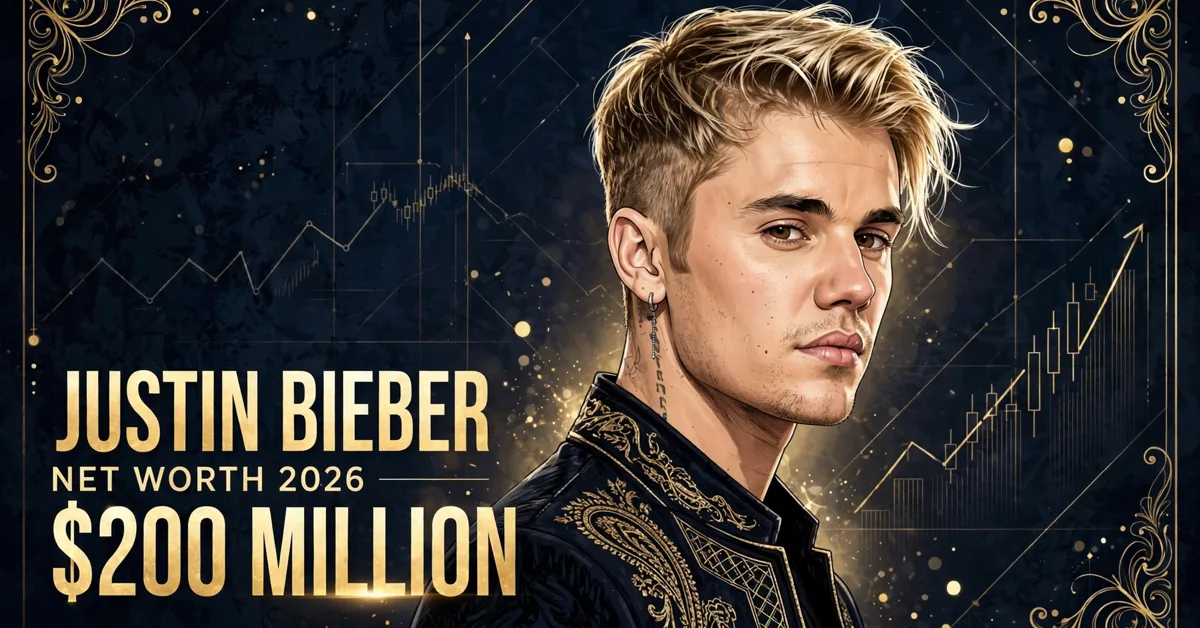
Justin Bieber net worth in 2026 is $200 million, per Celebrity Net Worth, in a $200–$300M range — from stadium tours, a $200M catalog sale and Coachella.
Last updated: 3 November 2026 | By Nathan Cole
Justin Bieber’s net worth in 2026 is $200 million, according to Celebrity Net Worth, the figure Parade repeated in its 2026 update and MoneyDigest cited in August 2026. Other trackers push higher, to $300 million, which is why this article anchors at $200 million inside a $200 million to $300 million range rather than printing one number as settled fact. Nobody outside Bieber’s own accountants has seen a balance sheet. Every published figure is an estimate built from public deals, tour grosses, property records and reported settlements.
The number carries a puzzle that most short profiles skip past. Bieber was already reported at $200 million back in 2014, when he was 20. Twelve years, a $257 million tour, a $200 million catalog sale and a reported $10 million festival fee later, the headline figure is the same. That flat line is the real story of his fortune: gross earnings on an enormous scale, set against taxes, management and touring costs, a cancelled tour that left reported debts, and a catalog sale that converted future royalties into a single check. The money came in waves. The net worth stayed put.
This article follows each wave with dates and named sources, separates Justin Bieber’s money from his wife Hailey Bieber’s separate Rhode fortune, and says plainly where reporting stops and guessing starts. The settlement figures, the Coachella fee and the catalog price are all reported figures, attributed to the outlets that published them. Where outlets disagree, the disagreement is in the text, not smoothed over.
Quick Facts: Justin Bieber at a Glance
| Full name | Justin Drew Bieber |
| Net worth (2026) | $200 million anchored (Celebrity Net Worth via Parade, 2026); $200 million–$300 million range across trackers; estimate, not an audited figure |
| Born | 1 March 1994, London, Ontario, Canada; raised in Stratford, Ontario |
| Age in November 2026 | 32 (turned 32 on 1 March 2026) |
| Job | Singer, songwriter; 150 million-plus records sold worldwide |
| Height | Listed at 5 ft 9 in (175 cm); no verified measurement published |
| Biggest single deal | $200 million-plus catalog sale to Hipgnosis Songs Capital, January 2023 (291 songs released before 31 December 2021) |
| Biggest tour | Purpose World Tour, 2016–2017: $257 million gross per Pollstar (gross, not personal income) |
| Wife | Hailey Bieber (married 2018); son Jack Blues Bieber, born August 2024 |
| 2026 headline | Coachella headliner, April 2026; reported fee north of $10 million for two weekends (Rolling Stone) |
How This Estimate Was Made
No audited net worth figure for Justin Bieber exists in the public record. This article anchors on Celebrity Net Worth’s $200 million because Parade, MoneyDigest and Next Magazine all carried that figure in 2026 updates, and because it is the most repeated estimate in current reporting. The top of the range, $300 million, comes from trackers such as SurpriseSports and Plisio that have carried $300 million since 2024. Tour grosses are business grosses before venue, crew, production, management and tax costs; they are never counted here as personal income. The catalog price, the Coachella fee and the Braun settlement are reported figures attributed to their outlets, and each is labeled as reported where no primary document confirms it. Hailey Bieber’s Rhode proceeds are excluded from Justin Bieber’s figure entirely: her ownership stake was never disclosed, so no share of the e.l.f. deal can honestly be assigned to him.
+
The 0 Million Answer, and Why It Has Not Moved
Parade’s 2026 profile puts the figure plainly: Justin Bieber’s estimated net worth is $200 million in 2026, with a warning attached that the number should be treated as an unofficial estimate. MoneyDigest, updating in August 2026, reached the same $200 million and added the context that makes it interesting: Bieber has reportedly generated roughly $600 million in gross earnings and deal proceeds across his career. Gross earnings and wealth are different things. A $257 million tour gross does not put $257 million in a singer’s bank account. A $200 million catalog check arrives before tax, before debts are settled and before a management split is resolved.
The flat line has a second explanation, and it is a simpler one. Bieber hit $200 million unusually early. Parade notes that he was at $500,000 at 16 in 2010, and at $200 million by 2014, just before Purpose. A teenager who reaches that level has already banked the kind of money most artists spend a career chasing. Everything after 2014 — the Purpose tour, the Justice tour, the catalog sale — had to refill a fortune that was already large, while also paying for a life priced at that level: private aviation, security, staff, and a property portfolio bought at reported prices above $55 million. Standing still at $200 million after that kind of spending is itself a financial result, not a failure of one.
Trackers that print $300 million are not necessarily wrong in a way that can be proven. They weight the catalog sale, the touring history and the property portfolio differently, and they may credit Bieber with a larger share of post-2023 income. The honest presentation is the range. A reader who sees only $200 million misses the higher estimates; a reader who sees only $300 million misses the fact that the most repeated current figure, carried by Parade and MoneyDigest in 2026, is $200 million. This article uses $200 million as the anchor and $200 million to $300 million as the range, and every section below shows its working.
| Year | Reported figure | What it actually was |
|---|---|---|
| 2010 | $500,000 | Estimated net worth at 16, per Parade |
| 2014 | $200 million | Estimated net worth reached before Purpose |
| 2016–2017 | $257 million | Purpose World Tour gross, per Pollstar — gross, not income |
| January 2023 | $200 million-plus | Catalog sale to Hipgnosis, reported price — gross, before tax and debts |
| April 2026 | $10 million-plus | Coachella headline fee, reported by Rolling Stone — fee, before production costs and tax |
From Stratford Bedrooms to a YouTube Discovery
Justin Drew Bieber was born on 1 March 1994 at St. Joseph’s Hospital in London, Ontario, and raised in Stratford, about 40 kilometres away. His parents, Pattie Mallette and Jeremy Bieber, were both 18 when he was born and never married. Britannica’s 2026 fact file still lists the same essentials: born 1 March 1994 in London, Canada, son of Jeremy Bieber and Pattie Mallette, married to Hailey Bieber since 2018. The Stratford childhood matters to the money story because it was cheap, local and self-taught. Bieber learned drums, piano, guitar and trumpet as a boy in a small Ontario town, and his mother posted home videos of him singing to family. Those videos were the business plan, even though nobody called them that at the time.
Scooter Braun found the videos in 2007 and flew Bieber to Atlanta. Usher joined the picture, and in 2008 Bieber signed with RBMG Records, the joint venture between Braun and Usher, alongside Island Def Jam. The structure of that early deal shaped the next fifteen years: a teenage artist, a manager who became a business partner, and a label system that took its share before Bieber saw his. When the Braun relationship ended in the mid-2020s, the settlement that followed — reported at $31.5 million — closed a loop that had opened in a Stratford bedroom. The discovery story is usually told as luck. The financial version is a contract signed at 14 that governed the most valuable years of a pop career.
My World, Baby and the Teen-Idol Years
The debut EP My World arrived in 2009, and the first studio album My World 2.0 followed in 2010 with “Baby,” the single that turned a YouTube singer into a global teen idol. My World 2.0 debuted atop the US Billboard 200, making Bieber the youngest solo male act to top the chart in 47 years. The concert film Justin Bieber: Never Say Never, released in February 2011, grossed about $73 million in the United States and set a domestic box-office record for a concert film at the time. Parade’s timeline puts his net worth at $500,000 in 2010 and $200 million by 2014, a jump that tracks the touring and merchandising machine that grew up around those early records rather than record sales alone.
Under the Mistletoe came in 2011 and Believe in 2012, the album that moved Bieber from teen pop toward a more adult R&B sound. The Believe Tour ran through 2012 and 2013 and kept the grosses climbing, but the years 2013 and 2014 also brought the controversies and legal issues that damaged his public image and, by extension, his endorsement value. Brands pay for a clean story. Bieber’s story in those years was not clean, and the endorsement income that other pop stars banked in their peak years never became a headline number for him. No single endorsement deal value for Bieber was ever credibly reported at the scale of a tour gross or a catalog sale, and this article does not invent one. Endorsements were real income across his career — Calvin Klein and Adidas are the names most often cited — but they were the side income, not the main event.
Believe, Purpose and the Peak Touring Machine
Purpose, released in November 2015, was the commercial peak of Bieber’s recording career and the engine of his largest tour. The album debuted at No. 1 on the Billboard 200 and produced three US No. 1 singles — “What Do You Mean?”, “Sorry” and “Love Yourself” — with Bieber becoming the first artist to occupy the entire top three of the UK Singles Chart at the same time. The Purpose World Tour opened in Seattle on 9 March 2016 and ran into 2017. Pollstar put the final numbers at $257 million in gross and 2.8 million in attendance across 162 shows, making it one of the highest-grossing tours of both 2016 and 2017. Bieber cancelled the remaining dates in July 2017, citing unforeseen circumstances, which cut the tour short of its full schedule.

That $257 million figure is the most misread number in Bieber’s financial story. Readers see it and add it to the catalog sale and arrive at $457 million, then wonder where the money went. The answer is that a tour gross is shared. The promoter takes a cut, venues take rent, a touring crew of dozens is paid weekly, staging and transport are billed, management takes a percentage, and tax applies to what remains. Bieber’s personal share of the Purpose gross was a fraction of $257 million, and no reliable source has published that fraction. The tour mattered to his net worth because it was large, sustained and global — not because $257 million landed in one account.
Changes followed in February 2020 and Justice in March 2021, with “Peaches” becoming one of his defining later hits. The Justice World Tour was supposed to be the next machine on the Purpose scale. It became the opposite: the tour that cost him money instead of making it.
The Justice Tour Collapse: Ramsay Hunt and the Bill That Followed
In June 2022 Bieber announced he had been diagnosed with Ramsay Hunt syndrome, a rare neurological disorder that caused facial paralysis, and postponed the remaining Justice tour dates. He returned to the stage a month later, then cut the late-summer South American run short in September 2022, citing exhaustion and the need to prioritise his health. The cancellation left a financial crater that reporting has only partly mapped. MoneyDigest, drawing on Pollstar, reports that the tour’s first 36 shows averaged 12,592 tickets and $1.88 million in revenue per show — a pace that suggests a completed tour would have grossed well past $100 million. TMZ’s reporting, cited in the same coverage, claimed Bieber would have made $90 million had he finished the tour.
The debt side is where the reporting splits. The Hollywood Reporter alleged in 2025 that Bieber was left millions of dollars in debt from the cancellation. Bieber’s representatives rejected that account in strong terms, telling People the story was based on unnamed and ill-informed sources. MoneyDigest’s 2026 accounting separates the pieces: Bieber reportedly owed $26 million connected to an advance from AEG Presents, which Scooter Braun’s company HYBE covered, and then agreed to repay that amount as part of a 2025 settlement. The reported settlement total was $31.5 million, with the extra $5.5 million covering unpaid commissions rather than tour losses. MoneyDigest’s own estimate is that the cancellation left Bieber’s 2026 net worth about $25 million to $50 million lower than it otherwise would have been, once returned advances, missed profits and avoided expenses are taken together. The $31.5 million settlement figure is reported, not confirmed by a primary document, and this article keeps it labeled as such.
What is not in dispute is the sequence: a health crisis in June 2022, a cancelled tour in September 2022, a catalog sale announced in December 2022 and completed in January 2023, and a management settlement in 2025. Whether the sale was caused by the debts or merely timed alongside them is the question the next section takes up, because the two sides of that argument give very different pictures of Bieber’s finances.
The 0 Million Catalog Sale, Explained
In January 2023 Bieber sold his share of the rights to his 291-song catalog to Hipgnosis Songs Capital for a reported $200 million. The deal covered all of his music released before 31 December 2021, up to and including Justice, and included his writer’s share plus his stake in the master recordings, with Universal Music continuing to administer the masters. Variety and Billboard, reporting via NME and the BBC, called it Hipgnosis’s biggest acquisition to date and among the largest catalog deals ever for an artist under 70. Bieber was 28. Most artists sell a catalog late, cashing out a lifetime of work near the end of a career. Bieber cashed out early, and the timing is what fuels every argument about the deal.
Hipgnosis’s logic was straightforward: a catalog of proven hits — “Baby,” “Sorry,” “Love Yourself,” “Peaches” — generates streaming, radio, television and film income for decades, and a fund backed by Blackstone could pay a large sum now for that long tail. Bieber’s camp never gave a public reason for selling. The TMZ documentary TMZ Investigates: What Happened to Justin Bieber?, which aired in 2025, claimed the sale happened because Bieber was on the verge of “financial collapse” after the Justice tour cancellation, with executive producer Harvey Levin alleging that Bieber’s own side acknowledged that position in 2022 and that Bieber insisted on selling in December rather than waiting until January for a tax advantage. Bieber’s representatives denied the distress narrative, and People reported that a Bieber representative had no comment on the documentary’s specific claims while his team had previously rejected the debt reporting outright.
Both versions can be partly true, and the honest reading holds them together. A catalog sale at 28 is unusual, and a cancelled tour with a reported eight-figure advance liability is a plausible reason to want a large, immediate payment. A $200 million check also makes sense as estate-style planning for an artist who had already earned at the top level for fifteen years and wanted to convert future royalty income into present capital. What the sale unambiguously did was change the shape of Bieber’s fortune: after January 2023, the pre-2022 songs no longer generate royalty income for him in the way they did before. Hipgnosis collects when “Sorry” plays. Bieber’s future music income depends on new work — which is why SWAG, released two and a half years later, mattered more financially than a typical comeback album.
Was He Broke? What the Claims Get Right and Wrong
The “Bieber is broke” narrative peaked with the TMZ documentary in 2025 and has been repeated in weaker forms ever since. It gets three things right and one large thing wrong. It gets right that the Justice cancellation created real liabilities, that Bieber’s spending — private jets, a large staff, multiple homes — ran at a level priced for a fortune larger than $200 million, and that the catalog sale arrived at a moment of visible financial pressure. It gets wrong the conclusion. A man who sells an asset for $200 million, settles a reported $31.5 million dispute, and then headlines Coachella for a reported $10 million fee is not broke in any ordinary sense of the word. He is less liquid than his gross earnings suggest, and his wealth is concentrated in property and new music rather than cash. Those are different conditions, and only one of them makes a headline.
Parade’s 2026 profile makes the same distinction in plainer language: Bieber’s net worth stays in the black, and the superstar locks down his hard-earned fortune, even while his financial situation in recent years has been described as troubling in parts of the reporting. MoneyDigest’s August 2026 update lands in the same place, holding the $200 million estimate while noting that gross earnings are not wealth. The 2026 evidence cuts against the doom story on its own terms: a reported $10 million Coachella fee, two albums in 2025, and Spotify monthly listeners reported at a personal record of around 140 million. A broke artist does not command that fee. An artist rebuilding his income streams does.
Readers should also discount one recurring piece of gossip arithmetic: the claim that Bieber earned $500 million to $1 billion across his career, cited in the TMZ documentary via Harvey Levin. That is a gross-earnings claim spanning fifteen years, before tax, costs and settlements, and it cannot be checked against any public filing. It is useful as a scale marker — Bieber’s career grossed an enormous amount — and useless as a net worth figure. This article does not use it as one.
SWAG, SWAG II and the 2025 Comeback
Bieber returned in July 2025 with SWAG, which debuted at No. 2 on the Billboard 200, and followed it in September 2025 with SWAG II. The two albums were later merged into an extended release, a rollout choice that created confusion among fans about whether SWAG II was a deluxe edition or a separate album, but kept Bieber’s name on the charts through the autumn of 2025. Sources close to the project told reporters that Bieber had full creative freedom on SWAG and that he and his team drove both rollouts. The commercial point matters more than the chart trivia: after selling his pre-2022 catalog, new recordings are the only recordings Bieber fully owns for future income. SWAG was his first major statement as an artist whose old hits belong to someone else.
No reliable annual salary figure for Bieber exists for 2025 or 2026, and this article does not print one. Streaming income from two new albums, plus the Coachella fee and any touring or appearance income, would form the bulk of his current earnings, but streaming rates, label splits and production costs make any single “per year” number a guess dressed as a fact. Competitors that print a clean annual salary for Bieber are printing an estimate without showing its parts. The parts that are public — a reported $10 million festival fee, two charting albums, record monthly listeners — point to a strong earning year in 2026 without supporting a precise salary claim.
The comeback also included a public break with the past. Bieber stepped away from Drew House in April 2025, the clothing brand he had launched in January 2019 around a yellow smiley-face logo. He has since teased a new lifestyle venture under the name SKLR (also reported as Skylrk). No revenue figure for Drew House or SKLR has been credibly reported, so neither brand is counted as a numbered asset in this article. The brand story matters for a different reason: it shows Bieber moving from a manager-led business structure to one he controls directly, the same shift visible in the Coachella negotiation.
Coachella 2026: The Reported Million Headline Fee
Coachella announced Bieber as a 2026 headliner in September 2025, alongside Sabrina Carpenter, Karol G and Anyma, for the weekends of 10–12 April and 17–19 April 2026 in Indio, California. Rolling Stone reported that Bieber negotiated directly with promoter Goldenvoice, without an agent, and that an insider put his fee at north of $10 million for the two weekends, or $5 million per weekend. Billboard Canada repeated the report and added that Bieber was forfeiting an agency commission in the process. Grey Journal’s October 2026 review of Coachella pay reporting calls Bieber’s figure the best-sourced 2026 figure available, while stressing that Coachella and Goldenvoice have not published artist fees and that the number remains a report, not a confirmed contract term.

The reported fee would surpass the $8 million figure cited for Beyoncé’s 2018 headline performance, making Bieber the festival’s highest-paid headliner on reported figures. Two cautions belong with that record claim. The Beyoncé figure is itself a reported number, so the record rests on two reports, not two contracts. And the fee is not take-home pay: production costs for a headline festival set, crew, staging, rehearsals and travel come out of the artist’s side in various arrangements, and none of the sources reviewed establish what Bieber kept after those costs. What the fee does establish is market value. A promoter does not pay a reported $10 million to an artist whose drawing power has collapsed. It pays it to an artist it expects to sell the weekend.
The performance was also Bieber’s first major live performance in the United States since the Justice World Tour ended in 2022. That gap — nearly four years without a major US stage — is the context for the fee’s size. Coachella was buying a return, not a routine booking, and Bieber was selling it on his own terms, without an agent taking a percentage. The direct negotiation is a small detail with a large financial meaning: on a $10 million fee, a standard agency commission would run into six figures. Keeping it is part of the new Bieber business model.
Drew House, SKLR and the Business After Music
Drew House, launched in January 2019, was Bieber’s most visible business outside music: a streetwear line built around a simple smiley-face logo with “drew” written across it, trademarked in February 2018. It sold well enough to become a recognisable brand, but its finances were never published in a form that allows a valuation. Bieber’s exit in April 2025 ended his association with the label, and his teased SKLR venture has not yet produced reported revenue. The honest accounting for both brands is that they are real businesses with unknown values, and any article that assigns them a dollar figure is guessing.
The same discipline applies to endorsements. Bieber’s career includes major brand associations, and his early Calvin Klein campaign is one of the most photographed endorsement deals of the 2010s. Yet no single deal value was ever credibly reported at a scale that would move a $200 million net worth estimate. That absence is itself informative: when a deal is large enough to matter to a net worth total, it usually leaks. Bieber’s endorsement income was spread across many deals over many years, each contributing without any one of them defining the fortune. The fortune was defined by tours and the catalog sale. Everything else filled in around those two pillars.
Houses: Beverly Park, La Quinta and the Ontario Lake Estate
Property is the most visible part of Bieber’s wealth and the easiest to overstate, because purchase prices are public while mortgages are not. The Biebers’ primary residence is the Beverly Park mansion in Los Angeles, bought in August 2020 for $25.8 million. The house measures 11,145 square feet on 2.5 acres inside a guard-gated enclave, and TMZ, Variety, E! News and Elle Décor all put the price at $25.8 million. A first Beverly Hills home, a 1930s Monterey Colonial of 6,132 square feet, was bought in March 2019 for $8.5 million and sold in February 2021 for about $7.96 million — a loss on paper before costs, and a reminder that celebrity homes do not always appreciate.
| Property | Reported price | Status |
|---|---|---|
| Beverly Park mansion, Los Angeles | $25.8 million (August 2020) | Primary residence |
| La Quinta estate, Madison Club | $16.6 million (2023) | Active |
| Ontario lake estate, Puslinch Lake | About $5 million (July 2018) | Active; 101 acres |
| First Beverly Hills home | $8.5 million bought; $7.96 million sold (2021) | Sold |
Roundups that total the portfolio at $47 million to $60 million are adding reported purchase prices across homes owned jointly with Hailey Bieber. Those totals describe a couple’s property footprint, not Justin Bieber’s personal equity, and they ignore any mortgage debt. A $25.8 million purchase price is not $25.8 million of wealth unless the house was bought outright and has held its value. Bieber’s property wealth is real — Beverly Park alone is a substantial asset — but the purchase-price total is a ceiling, not a balance.
Hailey, Rhode and the Combined-Wealth Trap
The most common error in Bieber net worth coverage is also the easiest to spot once it is named: adding Hailey Bieber’s money to Justin Bieber’s total. Hailey Bieber launched Rhode in June 2022 with co-founders Lauren Ratner and Michael Ratner. On 28 May 2025, e.l.f. Beauty agreed to acquire Rhode in a deal valued at up to $1 billion: $600 million in cash, $200 million in stock, and up to $200 million in performance-based earnout over three years. The deal closed in August 2025 with roughly $800 million in cash and stock paid upfront. Rhode had generated $212 million in net sales in the twelve months to March 2025, and about $390 million in fiscal 2026 net sales, up roughly 80 percent year over year.
None of that is Justin Bieber’s money. Hailey Bieber’s ownership stake in Rhode before the sale was never made public, and the deal proceeds were shared among the founders and early backers. Her personal net worth is estimated by various outlets at around $300 million, but that figure is itself an estimate built on an undisclosed stake. Headlines that put the couple’s combined wealth at $500 million to $600 million are adding two estimates together — Justin’s $200 million and Hailey’s roughly $300 million — and presenting the sum as if it were a household balance sheet. It is a useful illustration of the couple’s scale and a poor measure of either person’s fortune. This article keeps the two fortunes separate, as the underlying reporting requires.
The couple married in 2018 — a courthouse wedding in September 2018 followed by a formal ceremony in South Carolina in September 2019 — and welcomed their son Jack Blues Bieber in August 2024. Hailey Bieber stayed on as Rhode’s chief creative officer and became a strategic adviser to e.l.f. Beauty after the sale. Her business success changes the household’s financial picture, and it changes the public conversation about who is the wealthier Bieber. It does not change Justin Bieber’s net worth figure, which is the subject of this article.
How Justin Bieber Makes Money Now
In 2026 Bieber’s income comes from a smaller set of streams than at his peak, and each one is easier to describe than to price. New music income from SWAG and SWAG II, including streaming and sales, replaces the pre-2022 royalty stream he sold to Hipgnosis. Live income, led by the reported Coachella fee, replaces the tour grosses that defined his peak years. Brand and venture income from SKLR and any future endorsements sits in a third bucket with no reported figures yet. There is no current stadium tour announced that would restore tour-scale income, and no new catalog deal to repeat the 2023 payment. That is why the net worth figure is flat rather than rising: the big one-off payments are in the past, and the current income is steady rather than spectacular.
The tax and cost picture explains the rest. A $200 million catalog payment in the United States is taxed as income or capital gain depending on its structure, and no public filing shows Bieber’s tax treatment of the deal. A $10 million festival fee is taxed the same way, after production costs. Property carries running costs — tax, insurance, staff, maintenance — that scale with the purchase price. None of these deductions appear in tracker headlines, which is why tracker headlines consistently run higher than a careful estimate. The $200 million anchor already reflects those deductions in the judgment of the outlets that publish it. It is a post-cost, post-tax estimate, not a sum of gross deals.
What Could Move the Number Next
Three things could move Bieber’s net worth materially from here. A full stadium tour on the Purpose scale would be the largest, restoring tour grosses in the hundreds of millions and personal income in the tens of millions, even after the cost structure described above. A second catalog-style deal — for example, a sale of post-2021 rights once that catalog has grown — would be another one-off payment, though no such deal has been reported. A successful SKLR launch at Drew House scale would be the third, turning a brand venture into a valued asset rather than a teased name. None of these is counted in the current $200 million figure, and none should be until reporting confirms it.
The downside risks are narrower than the doom headlines suggest but real. Another health-forced cancellation would repeat the Justice pattern of sunk costs and refunded dates. A property downturn in Los Angeles would cut the paper value of the Beverly Park and La Quinta homes. A weak SKLR launch would leave the brand bucket empty. Against those risks stands the 2026 evidence: a headline festival fee, two charting albums, record streaming listeners, and a settled management dispute. The balance of that evidence supports a flat $200 million estimate with room to rise — not a collapse, and not a billionaire trajectory.
Frequently Asked Questions
What is Justin Bieber’s net worth in 2026?
Justin Bieber’s net worth is estimated at $200 million in 2026 by Celebrity Net Worth, as carried by Parade and MoneyDigest in 2026 updates. Other trackers print up to $300 million, so the honest range is $200 million to $300 million. The figure is an estimate, not an audited balance sheet.
How much did Justin Bieber sell his music catalog for?
Justin Bieber sold his 291-song catalog, covering music released before 31 December 2021, to Hipgnosis Songs Capital in January 2023 for a reported $200 million-plus. The deal included his writer’s share and his stake in the master recordings, with Universal Music continuing to administer the masters.
Was Justin Bieber broke?
No, in the ordinary sense. A 2025 TMZ documentary claimed Bieber was near “financial collapse” after the Justice tour cancellation, a claim his representatives denied. The reported facts — a $200 million catalog sale, a reported $31.5 million management settlement and a reported $10 million Coachella fee — describe an artist with liquidity pressure and large assets, not an artist without money.
How much did Justin Bieber make at Coachella 2026?
Rolling Stone reported that Justin Bieber’s Coachella 2026 headline fee was north of $10 million for the two weekends, or $5 million per weekend, negotiated directly with promoter Goldenvoice without an agent. The fee is reported, not confirmed by a published contract, and production costs and tax would come out of it.
How much does Justin Bieber make per year?
No reliable annual salary figure for Justin Bieber exists for 2025 or 2026. His current income comes from new music streaming and sales from SWAG and SWAG II, live fees led by the reported Coachella payment, and brand ventures. Any single per-year number printed without showing its parts is a guess, so this article does not print one.
What is Justin Bieber’s wife Hailey Bieber’s net worth?
Hailey Bieber’s net worth is estimated by various outlets at around $300 million, but her ownership stake in Rhode before its sale to e.l.f. Beauty was never disclosed, so that figure is an estimate. The Rhode deal was valued at up to $1 billion in total, shared among founders and backers. Her fortune is separate from Justin Bieber’s $200 million and is not added to it in this article.
Where does Justin Bieber live?
Justin Bieber and Hailey Bieber’s primary residence is a Beverly Park mansion in Los Angeles, bought in August 2020 for a reported $25.8 million. The couple also own a La Quinta estate bought in 2023 for a reported $16.6 million and an Ontario lake estate bought in 2018 for about $5 million.
How old is Justin Bieber in 2026?
Justin Bieber is 32 years old in November 2026. He was born on 1 March 1994 in London, Ontario, Canada, and turned 32 on 1 March 2026.
Sources & Reporting
This profile was compiled from live reporting available in November 2026. The $200 million anchor comes from Celebrity Net Worth as carried by Parade’s 2026 profile and MoneyDigest’s August 2026 update; the $300 million top of the range comes from trackers including SurpriseSports and Plisio. The catalog sale price and structure come from Variety and Billboard reporting via NME and the BBC; the Justice tour figures come from Pollstar via MoneyDigest and Wikipedia’s tour summary; the Ramsay Hunt diagnosis and cancellation timeline come from contemporary 2022 reporting; the TMZ documentary claims and the Bieber team’s denials come from People and Hollywood Reporter coverage; the reported $31.5 million settlement split ($26 million AEG advance plus $5.5 million commissions) comes from MoneyDigest’s 2026 accounting and is labeled reported throughout; the Coachella fee comes from Rolling Stone via Billboard Canada and Grey Journal’s October 2026 pay review; the Rhode deal structure comes from e.l.f. Beauty’s 28 May 2025 announcement as reported by Reality Tea and AInvest; property prices come from TMZ, Variety, E! News and Elle Décor via the Velvet Ropes and Rich Report roundups; birth and early-life facts come from Britannica’s October 2026 fact file. Reporting window: October–November 2026. Where sources disagreed — most visibly on the $200 million versus $300 million net worth figure and on the reasons for the catalog sale — both positions are reported and the anchor is explained rather than asserted.
WRITTEN BY
Nathan Cole
Nathan Cole is the editor of Guide Net Worth. He covers celebrity wealth the way a business desk covers earnings: reported figures first, estimates labeled as estimates, and no invented numbers. Every profile on this site passes through his desk before it publishes. About Guide Net Worth · Corrections: figures are updated when new reporting emerges — contact us via the About page if you spot an error.
References & Sources
This article has been fact-checked and verified against multiple public sources, financial disclosures, SEC filings, Forbes reports, Celebrity Net Worth databases, and official records. All net worth estimates are based on publicly available information and financial analysis.