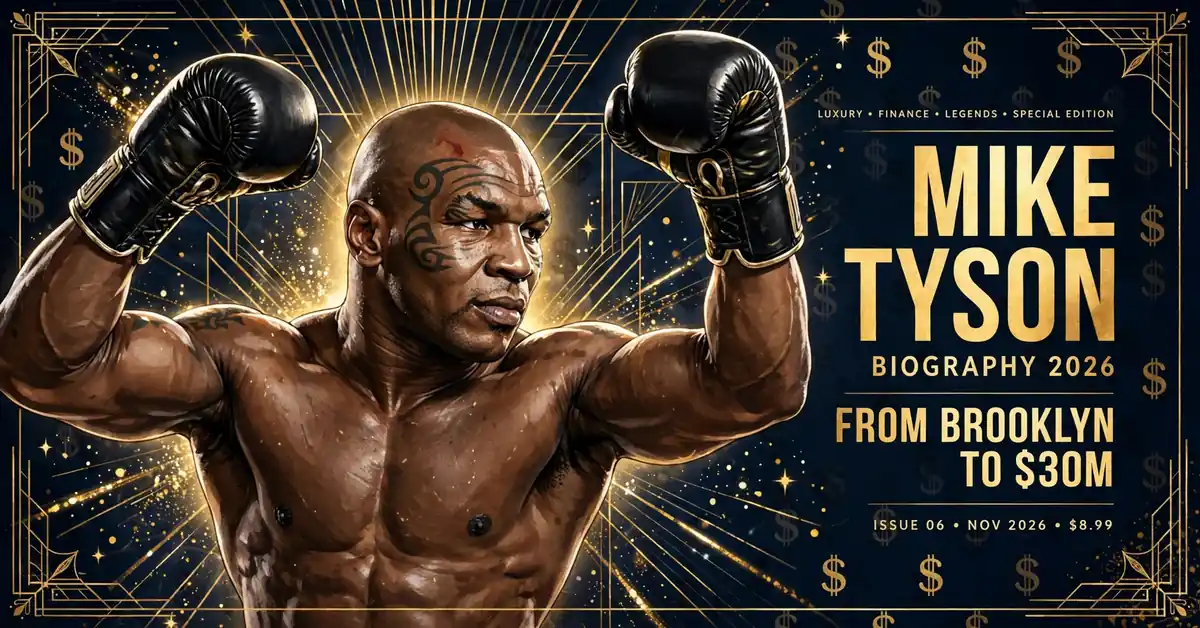
Mike Tyson biography 2026: born 30 June 1966 in Brooklyn, 60, worth about $30M — from youngest heavyweight champion to bankruptcy and the Jake Paul comeback.
Last updated: 10 November 2026 | By Nathan Cole
Mike Tyson is 60 years old in November 2026, born Michael Gerard Tyson on 30 June 1966 in Brooklyn, New York, and worth an estimated $30 million per Celebrity Net Worth. The biography behind that number runs from a Fort Greene childhood shaped by 38 arrests before his 13th birthday to the youngest heavyweight championship in history, a $400 million fortune earned and lost, three years in prison, and — in 2024 — a return to the ring at 58 against a YouTuber 31 years his junior. No boxer of his generation lived a louder life, and none fell further or climbed back more publicly.
The short version of the life: a teenager from Brooklyn taken in by the legendary trainer Cus D’Amato, a wrecking machine who won his first 19 professional fights by knockout, the undisputed heavyweight champion of the world at 21, then a convicted felon, a bankrupt, a movie cameo, a cannabis entrepreneur, and finally a 60-year-old businessman whose name still sells out stadiums. The long version is where the biography gets interesting, because Tyson’s career has never followed a straight line: every peak was followed by a collapse, and every collapse by a reinvention nobody saw coming.
This profile covers the whole arc — the Brooklyn childhood, the Catskill gym, the championship years, the prison sentence, the money and the bankruptcy, the family, and what he is doing in 2026, including the Floyd Mayweather exhibition and the Netflix documentary that left out his biggest recent fight. Every figure is attributed to the outlet that reported it, and where sources disagree, this article says so.
Quick Facts: Mike Tyson at a Glance
| Full name | Michael Gerard Tyson |
| Born | 30 June 1966, Brooklyn, New York, USA |
| Age in November 2026 | 60 |
| Height | 5 ft 10 in (178 cm) |
| Net worth estimate (2026) | $30 million (Celebrity Net Worth; range $25–35 million) |
| Professional record | 50 wins (44 KOs), 7 losses, 2 no contests |
| Career earnings | About $400 million in purses; peak net worth ~$300 million |
| Titles | Undisputed heavyweight champion 1987–1990 (WBC, WBA, IBF) |
| Spouse | Lakiha “Kiki” Spicer (married 2009) |
| Children | Seven |
| Hall of Fame | International Boxing Hall of Fame, 2011 |
| Last updated | 10 November 2026 |
How This Estimate Was Made
Mike Tyson has never published his finances, so every net-worth figure is an estimate built from reported purses, court filings and tracker models. The anchor is Celebrity Net Worth’s $30 million (snapshot 4 November 2026), carried by Parade in January 2026; TheStreet phrases the same figure as a range, $20–30 million. This article uses a $25–35 million range around that anchor and explains the one number that moves it: the Jake Paul fight payday, reported at $20 million but shown as a $2 million guaranteed purse in leaked bout contracts published in May 2026. Career-earnings totals differ by source — Celebrity Net Worth’s fight-by-fight reconstruction totals $370 million, while other trackers put it above $440 million — because exhibition fees, PPV shares and taxes were never fully disclosed. Where the sources part ways, the article names both.
+
Who Is Mike Tyson?
Mike Tyson is an American former professional boxer who competed from 1985 to 2024 and is widely regarded as one of the greatest heavyweight fighters of all time. Born Michael Gerard Tyson in Brooklyn, New York, he became the youngest boxer ever to win a heavyweight world title when he stopped Trevor Berbick on 22 November 1986, aged 20 years and four months. He held the WBC, WBA and IBF belts at the same time, reigned as undisputed champion from 1987 to 1990, and finished with a professional record of 50 wins (44 by knockout), 7 losses and 2 no contests.
Tyson’s fame never stayed inside the ring. He was the most feared fighter on the planet before his 24th birthday, then the most famous fallen athlete in America: a rape conviction in 1992, a three-year prison sentence, the ear-biting disqualification against Evander Holyfield in 1997, and a 2003 bankruptcy filing that listed about $23 million in debts. His second act — acting cameos, a one-man Broadway show, a memoir, a podcast and a cannabis company — made him a different kind of celebrity: a man who talks openly about the damage he did and the money he burned through.
At 5 ft 10 in, Tyson was short for a heavyweight, and that is part of why he was so terrifying. He fought out of the peek-a-boo style his trainer Cus D’Amato taught him: hands high, head moving, closing distance in a crouch and unloading combinations before bigger men could set their feet. Opponents knew what was coming. It rarely helped them.
Early Life in Brooklyn
Tyson was born on 30 June 1966 at Cumberland Hospital in Fort Greene, Brooklyn, to Lorna Smith Tyson and Jimmy Kirkpatrick. His father left the family early, and his mother struggled to hold the household together. By the time he was 13, Tyson had been arrested 38 times, according to EBSCO’s research profile — mostly for petty theft and street fights. He was sent to the Tryon School for Boys in upstate New York, a reform school where his size and temper first drew the attention of adults who saw a fighter rather than a delinquent.
At Tryon, Tyson met Bobby Stewart, a former boxer working as a counsellor, who introduced him to Cus D’Amato. D’Amato, then in his seventies, had trained Floyd Patterson and José Torres, and he took one look at the 13-year-old and told people the boy would be heavyweight champion of the world. It was not a guess. D’Amato had spent decades studying what made Patterson the youngest heavyweight champion in history, and he believed he could build a faster, harder-hitting version.
Tyson’s mother died in 1982, when he was 16. D’Amato became his legal guardian. The arrangement gave Tyson the first stable home of his life, and it gave D’Amato a final project: a fighter he could shape from the ground up, with no bad habits to undo.
Cus D’Amato and the Catskill Years
D’Amato’s gym in Catskill, New York, was a converted police station with a ring upstairs and a strict code downstairs. Tyson lived there, trained there and studied film of old fighters there. D’Amato drilled the peek-a-boo defence into him for hours a day: slip, bob, weave, step inside, throw in combination, get out. He also drilled something less visible — the idea that fear was a tool. “Fear is like fire,” D’Amato told him. “If you control it, it warms you. If it controls you, it burns you.”

The amateur results came fast. Tyson won Junior Olympic titles in 1981 and 1982 and the national Golden Gloves heavyweight championship in 1984. He missed the 1984 Los Angeles Olympics after losing twice to Henry Tillman in the trials, and D’Amato decided there was nothing left for him as an amateur. He turned professional on 6 March 1985 in Albany, New York, stopping Hector Mercedes in the first round. He was 18.
D’Amato died of pneumonia in November 1985, eight months after Tyson’s debut. Tyson was 19, undefeated in 11 fights, and suddenly without the only father figure he had ever known. His manager Jimmy Jacobs and trainer Kevin Rooney carried the plan forward, but everyone close to Tyson agrees the loss changed him. The discipline D’Amato enforced had been external. Without him, it started to slip.
The Youngest Heavyweight Champion in History
Tyson’s rise through 1985 and 1986 remains the fastest in heavyweight history. He fought 15 times in his first year as a professional and won them all by knockout. By the summer of 1986 he was 22–0 with 21 knockouts, and the title shot arrived on 22 November 1986 against WBC champion Trevor Berbick in Las Vegas. Tyson stopped him in the second round. At 20 years and four months, he broke Floyd Patterson’s record as the youngest heavyweight champion ever — a record that still stands.
The Berbick win also answered the question people had been asking about Tyson’s height. At 5 ft 10 in he gave away inches to nearly every opponent, including Berbick, yet he reached them first. His speed was the point: he closed six feet of ring in a blink, threw four punches where other heavyweights threw one, and left before the return came. For readers who want the full breakdown of his measurements, our profile of Mike Tyson’s height covers the listed figures, the disputed ones, and how he fought taller men.
Within nine months of the Berbick fight, Tyson held all three major belts. He beat James “Bonecrusher” Smith for the WBA title on 7 March 1987 and Tony Tucker for the IBF title on 1 August 1987, becoming the first heavyweight to unify the WBC, WBA and IBF championships. He was 21 years old.
Undisputed: The 1987–1990 Reign
The undisputed years were the peak of the Tyson legend. He defended the titles ten times, and the defences became events in themselves: 91 seconds against Michael Spinks on 27 June 1988 in Atlantic City, a fight billed as the richest in boxing history to that point, ended with Spinks flat on the canvas and Tyson’s aura complete. Spinks had never lost. He never fought again.
Outside the ring, the cracks were already showing. Tyson married actress Robin Givens in February 1988; the marriage collapsed within a year amid public accusations of abuse, and they divorced in 1989. His management changed hands, with promoter Don King taking control after Jimmy Jacobs died in March 1988. The team around him fractured into competing camps, and the training discipline that had defined the Catskill years began to loosen. Kevin Rooney, his trainer since the D’Amato days, was dismissed in late 1988.
The end came in Tokyo on 11 February 1990. James “Buster” Douglas, a 42-to-1 underdog, knocked Tyson out in the tenth round at the Tokyo Dome in one of the biggest upsets in sports history. Tyson had barely trained for the fight and had been knocked down in sparring in the weeks before it. The loss stripped him of the titles and, in the eyes of many, of the invincibility that had been his real weapon. He won his next four fights, but the aura never fully came back.
The Fall: Prison and the Lost Years
In July 1991, Tyson was arrested in Indianapolis and charged with raping 18-year-old Desiree Washington, a Miss Black America pageant contestant. On 10 February 1992, an Indiana jury convicted him. He was sentenced to six years in prison and served just under three, released on parole on 25 March 1995. He was 28 years old and had spent his physical prime behind bars.
The conviction remains the most contested chapter of Tyson’s life, and this article states the facts as the courts recorded them: a jury convicted him, he served the sentence, and he has always maintained his innocence. What is not in dispute is the cost. The three years away ended his undisputed reign, cost him tens of millions in purses, and made his return a spectacle rather than a sporting event.
He came back in August 1995 with a first-round knockout of Peter McNeeley, then regained the WBC title from Frank Bruno in March 1996 and the WBA title from Bruce Seldon that September. The comeback set up the fight the public wanted: Evander Holyfield, the former champion who had never lost to a man Tyson had beaten. On 9 November 1996, Holyfield stopped Tyson in the 11th round.
The Comeback and the Holyfield Fights
The rematch on 28 June 1997 is the fight everyone remembers, and not for the boxing. In the third round, Tyson bit Holyfield’s ear — twice — and was disqualified. The Nevada State Athletic Commission fined him $3 million and revoked his licence for over a year. The image of Holyfield’s torn ear became the defining picture of Tyson’s career, and for years it crowded out everything he had done before it.
Tyson fought on, but the championship years were over. His last great payday came on 8 June 2002 against Lennox Lewis in Memphis, a fight that earned him a reported $30 million purse and ended with an eighth-round knockout defeat. His final professional win came in February 2003 — a 49-second first-round knockout of Clifford Etienne. Two more losses followed, and in June 2005, after quitting on his stool against Kevin McBride in Washington, D.C., Tyson announced his retirement. He was 38.
The Holyfield rematch also marked the point where Tyson’s public image split in two. To boxing purists he was a cautionary tale; to a wider public he was becoming something else — a flawed, funny, self-aware figure who showed up in films and talked about his mistakes without excuses. The 2006 cameo in Rocky Balboa and the 2009 turn in The Hangover, where he played a version of himself, introduced him to audiences who had never watched a fight.
The Money: 0 Million Earned, Million in Debt
Tyson’s finances are the most dramatic rise-and-fall in sports history, and the numbers are worth laying out plainly. He earned roughly $400 million in purses across his career — Celebrity Net Worth’s fight-by-fight reconstruction totals $370 million, while other trackers put the figure at $443.6 million, the gap coming from undisclosed PPV shares and exhibition fees. At his peak in the late 1980s, his net worth was estimated at about $300 million. In August 2003 he filed for bankruptcy, listing about $23 million in debts.
| Period | What happened | Money |
|---|---|---|
| 1985–1990 | Rise to undisputed champion; Spinks, Bruno, title defences | ~$100M+ earned; peak net worth ~$300M |
| 1991–1995 | Conviction and prison; no fights for three years | Tens of millions in lost purses |
| 1996–2002 | Holyfield fights, Lewis fight ($30M purse) | ~$150M+ in purses; $3M Holyfield fine |
| August 2003 | Bankruptcy filing | ~$23M in debts |
| 2010s | Acting, stage show, memoir, podcast | Rebuild from near zero |
| 2021–2024 | Tyson 2.0 cannabis; Jake Paul fight | Reported $20M Paul payday |
| 2026 | Estimated net worth | $25–35M, anchored at $30M |
Where did it all go? The bankruptcy filing told the story: lavish spending — houses, cars, jewellery, a reported $71,000 on pet tigers — plus divorce settlements, legal bills, taxes and management disputes, including a long-running conflict with Don King that ended in a settlement. Tyson himself has said he never understood the money while he was earning it. He was 20 years old with tens of millions of dollars and no one left who could tell him no.
For the full breakdown of the current figure — the range, the sources behind it, and the Paul-fight purse dispute — see our profile of Mike Tyson’s net worth in 2026. The short version: the $30 million estimate is roughly triple what he was worth before the Paul fight, and the single biggest uncertainty in it is how much of that fight’s money was actually his.
Bankruptcy and the Long Rebuild
The years after the 2003 bankruptcy were the quietest of Tyson’s life. The big purses were gone, the endorsements had dried up, and he was a former champion in his late thirties with debts and a reputation for chaos. What rebuilt him was not boxing but performance. In 2012 he took a one-man stage show, Mike Tyson: Undisputed Truth, to Broadway — directed by Spike Lee, written with his third wife — and toured it nationally. The show, and the 2013 memoir of the same name, let him tell his own story in his own words, including the parts that made him look bad.
The film cameos kept coming, and so did the smaller paydays: appearances, speaking engagements, and in 2019 the launch of his podcast, Hotboxin’ with Mike Tyson, where his unfiltered conversations with fighters, actors and musicians found a large audience. The podcast mattered because it changed how people heard him. The man who had been the most feared voice in boxing turned out to be a thoughtful, funny and strikingly honest interviewer.
The real financial rebuild, though, came from cannabis. Tyson 2.0, launched in 2021 with Columbia Care, grew into Carma HoldCo, the company behind the brand. The company reportedly cleared $50 million in revenue in 2024, with a $75 million projection for 2025, and Forbes has reported Carma HoldCo’s yearly revenue at about $200 million — though Tyson’s exact ownership stake has never been disclosed, which is why no net-worth tracker can put a firm number on it.
The Jake Paul Fight and the Million Question
On 15 November 2024, Tyson returned to a sanctioned professional ring for the first time in nearly 20 years, fighting Jake Paul at AT&T Stadium in Arlington, Texas. He was 58. Paul was 27. The fight, streamed on Netflix, drew 108 million viewers worldwide, and Tyson lost an eight-round unanimous decision. He looked every bit his age in the later rounds, and he said afterwards that he had no regrets — he had proved to himself he could still do it.
The money from that night is the most argued-over figure in Tyson’s finances. The widely reported purse was $20 million for Tyson, $40 million for Paul. But in May 2026, signed bout contracts listed for auction by Goldin Auctions — verified agreements filed with the Texas Department of Licensing and Regulation — showed a guaranteed purse of just $2 million for each man. The gap is not a contradiction: the guaranteed purse is the floor, and the real money in a Netflix event sits in revenue participation, sponsorships and backend shares that never appear on a commission filing. What the leaked contracts prove is that the $20 million figure was never the guaranteed cheque. What they do not prove is what Tyson actually banked.
The fight had been postponed from its original date of 20 July 2024 after Tyson suffered an ulcer flare-up. He later said he had feared he might die during the episode. It was a reminder, if one were needed, that the 2024 comeback carried real risk for a man approaching 60.
Tyson 2.0, the Mayweather Exhibition and 2026
In 2026, Tyson is 60, and his public life is busier than it has been in years. The biggest story is the exhibition bout with Floyd Mayweather, announced in 2025. In July 2026, Bloody Elbow reported that new legal filings pointed to the fight taking place later in the year in the United States. No confirmed date or venue had been announced at the time of writing, and the details have shifted more than once — but the event, if it happens, would pair the two biggest boxing names of the last forty years, both long retired, in front of a global audience. For the other half of that pairing, see our profile of Floyd Mayweather’s net worth, which breaks down the $300 million fortune he built from the same era of the sport.
October 2026 brought two very different headlines. Netflix released a four-part documentary series on Tyson’s life — and viewers quickly noticed it skipped the Jake Paul fight entirely, leaving out the event that had most recently changed his finances and returned him to the mainstream. The omission drew public criticism and a round of coverage asking why the series stopped where it did. The same month, Tyson and his company Tyrannic LLC were sued for £1.5 million in London’s High Court by Medier Ltd, the operator of the Rabona gambling brand, over an alleged breach of a sponsorship agreement signed in January 2024. Medier claims Tyson withdrew from promotional commitments after agreeing to the more lucrative Paul fight; Tyson and Tyrannic deny breaching the contract, and the hearing was still running in October 2026. Tyson was reported to have received almost £145,000 under the agreement before the relationship broke down.
Through it all, the business keeps running. Tyson 2.0 and Carma HoldCo remain his main commercial engine, the podcast continues, and in January 2025 he paid a reported $13 million for a waterfront estate in Delray Beach, Florida — a purchase made, by most accounts, with money from the Paul fight. It is a long way from the bankruptcy filing of 2003, and Tyson knows it. He talks about the Delray house the way he talks about everything now: as proof that the second act worked.
Personal Life and Family
Tyson has been married three times. His first marriage, to actress Robin Givens in 1988, lasted barely a year and ended in a divorce that played out in public. His second, to Monica Turner from 1997 to 2003, produced two children and ended during the bankruptcy years. In 2009 he married Lakiha “Kiki” Spicer, who remains his wife and runs Tyrannic LLC, the family company at the centre of the Rabona lawsuit.
Tyson has seven children. The family’s hardest loss came in May 2009, when his four-year-old daughter Exodus died in a treadmill accident at the family home in Phoenix. Tyson has spoken about the tragedy rarely and briefly, and it is the one subject he has consistently refused to turn into content. His other children include Mikey Lorna, Rayna, Amir, Miguel, Milan and Morocco. Milan, born in 2008, has drawn attention as a junior tennis player.
He lives in Florida now, trains most days, and still watches boxing closely — including the current heavyweight division, where his name comes up whenever a new champion is measured against the old ones. He has said the modern heavyweights are bigger and more careful than his generation, and that he doubts any of them would have survived the era he fought in. Whether that is true is a debate for boxing fans. What is not in doubt is that Tyson’s shadow still falls across the division.
Mike Tyson’s Legacy
Tyson’s legacy is two legacies, and they do not sit comfortably together. The first is sporting: the youngest heavyweight champion in history, the first man to hold all three major belts, 44 knockouts in 50 wins, and a peak — roughly 1986 to 1988 — when no heavyweight alive could stay in the ring with him for long. He was inducted into the International Boxing Hall of Fame in 2011, and his place among the great heavyweights is secure.
The second legacy is cultural: the most famous boxer of his generation became, by stages, a cautionary tale, a punchline, and then a kind of folk figure — a man who lost everything in public and rebuilt himself in public, without pretending the losses had not happened. The fighters who came after him studied his style; the public studied his life. Both are still being argued over.
The current heavyweight division measures itself against him, sometimes explicitly. Anthony Joshua, who rebuilt his own career after defeat, and Tyson Fury, who named himself after him and fought his way back from his own collapse, both owe something to the Tyson story — the fall as much as the rise. For their full stories, see our biographies of Anthony Joshua and Tyson Fury.
At 60, Tyson’s biography is still being written. A Mayweather exhibition, a cannabis company, a podcast, a lawsuit, a documentary that skipped his biggest recent fight — the contradictions that defined his twenties are still there in his sixties, only now he is the one telling the story. The numbers in this article will change. The arc probably will not: a kid from Brooklyn who became the most feared man in the world, lost it all, and spent the next twenty years earning it back on his own terms.
Sources & Reporting
This biography was researched from live reporting and reference sources in November 2026. Wikipedia for the career record (50–7–2, 44 knockouts), birth date and title history; Britannica (updated 17 October 2026) for the career narrative, the 1992 conviction and the 2024 Jake Paul fight; EBSCO Research Starters for the early-life record, including the 38 arrests by age 13; heavyweightboxing.com (updated October 2026) for the Catskill years and the championship timeline; Celebrity Net Worth (snapshot 4 November 2026) for the $30 million estimate and the $370 million fight-by-fight earnings total; Parade (January 2026) and TheStreet for the $20–30 million range; Bloody Elbow (15 May and 10 July 2026) for the leaked $2 million guaranteed purses and the Mayweather exhibition legal filings; Yardbarker (15 May 2026) for the Goldin Auctions contracts and the 108 million Netflix viewers; BBC Sport for the ulcer postponement; the Palm Beach Post via trade reporting for the $13 million Delray Beach purchase; bbherald (30 October 2026) for the Netflix documentary omission; and focusgn (15 October 2026) for the Rabona lawsuit. Net worth figures are estimates: Mike Tyson has never disclosed his personal finances. Where sources disagree, this article publishes the range and names the outlet behind each figure. Corrections: figures are updated when new reporting emerges — contact us via the About page if you spot an error.
Nathan Cole
Nathan Cole is the editor of Guide Net Worth. He covers celebrity wealth the way a business desk covers earnings: reported figures first, estimates labeled as estimates, and no invented numbers. Every profile on this site passes through his desk before it publishes. About Guide Net Worth · Corrections: figures are updated when new reporting emerges — contact us via the About page if you spot an error.
Frequently Asked Questions About Mike Tyson
How old is Mike Tyson in 2026?
Mike Tyson is 60 years old in November 2026. He was born Michael Gerard Tyson on 30 June 1966 in Brooklyn, New York, and turned 60 on 30 June 2026.
What is Mike Tyson’s net worth in 2026?
Mike Tyson’s net worth in 2026 is estimated at $30 million, per Celebrity Net Worth (snapshot 4 November 2026), inside a published range of about $25–35 million. TheStreet phrases it as $20–30 million. Before the Jake Paul fight, the estimate was about $10 million. No figure is confirmed — Tyson has never published his finances.
What is Mike Tyson’s professional boxing record?
Mike Tyson’s professional record is 50 wins (44 by knockout), 7 losses and 2 no contests across 59 fights. He won his first 19 fights by knockout, 12 of them in the first round, and became the youngest heavyweight champion in history at 20 years and four months.
Why did Mike Tyson go to prison?
On 10 February 1992, an Indiana jury convicted Tyson of raping Desiree Washington, an 18-year-old pageant contestant. He was sentenced to six years in prison and released on parole on 25 March 1995 after serving just under three years. Tyson has always maintained his innocence.
How much did Mike Tyson earn against Jake Paul?
The widely reported purse was $20 million for Tyson, but signed bout contracts published in May 2026 (Goldin Auctions, filed with the Texas Department of Licensing and Regulation) showed a guaranteed purse of just $2 million. The guaranteed purse is the floor — the real money in a Netflix event sits in revenue participation and sponsorships that never appear on a commission filing, so the full amount Tyson banked is not public.
Is Mike Tyson fighting Floyd Mayweather in 2026?
An exhibition bout between Mike Tyson and Floyd Mayweather was announced in 2025, and in July 2026 Bloody Elbow reported that new legal filings pointed to the fight taking place later in the year in the United States. No confirmed date or venue had been announced at the time of writing, and the details have shifted more than once.
Who is Mike Tyson married to?
Mike Tyson is married to Lakiha “Kiki” Spicer, his third wife, since 2009. She runs Tyrannic LLC, the family company. His earlier marriages were to actress Robin Givens (1988–1989) and Monica Turner (1997–2003).
How many children does Mike Tyson have?
Mike Tyson has seven children. His daughter Exodus died in May 2009, aged four, in a treadmill accident at the family home in Phoenix. His other children include Mikey Lorna, Rayna, Amir, Miguel, Milan and Morocco.
References & Sources
This article has been fact-checked and verified against multiple public sources, financial disclosures, SEC filings, Forbes reports, Celebrity Net Worth databases, and official records. All net worth estimates are based on publicly available information and financial analysis.