Mitchell Starc is 196 cm tall (6 ft 5 in) — Australia’s tallest quick. His 2025-26 Ashes heroics, 460 Test wickets and $20–30M net worth, verified for 2026.
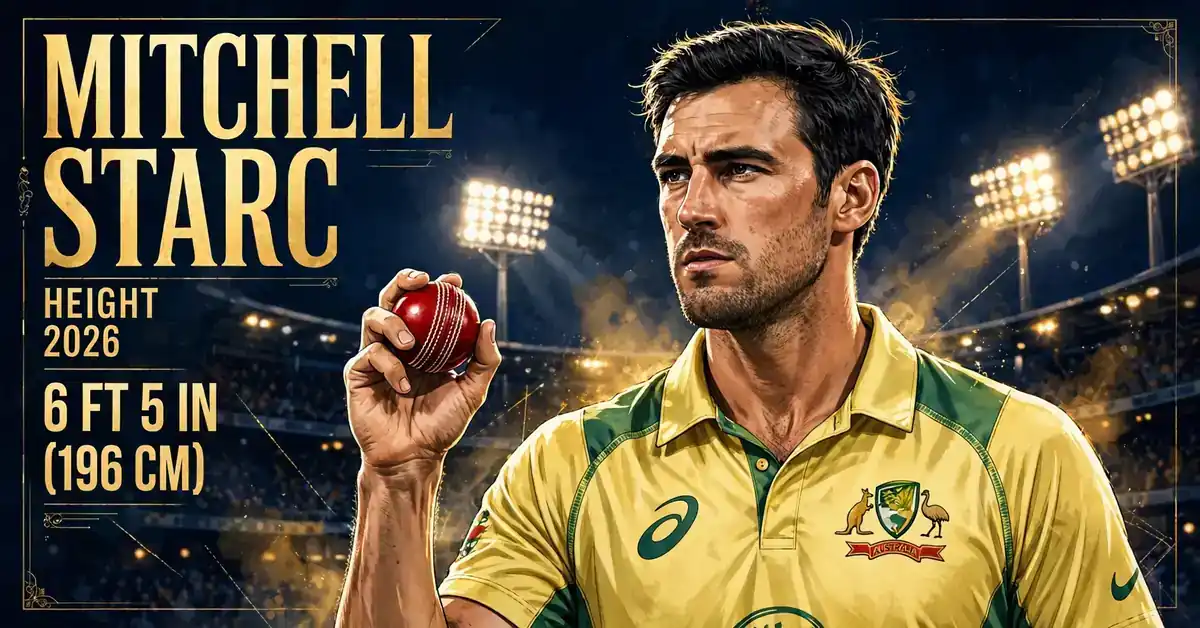
Mitchell Starc is 196 cm tall — 6 feet 5 inches. That is the figure on his Wikipedia profile, on ESPNcricinfo, on Cricket Australia’s player page and on the IPL’s official player profile, and it has not moved in years. A handful of outlets list 197 cm (6 ft 6 in) instead, so the honest range is 196–197 cm, with 196 cm as the anchored figure.
Height is not a trivia stat for Starc. It is the physical fact his whole bowling method is built on. A 196 cm left-armer releases the ball from higher than almost every batter he faces, which turns a full delivery into a toe-crushing yorker and a good-length ball into one that climbs toward the gloves. The swing he gets with the new ball and the steep bounce he gets with the old one are the same skill seen from two ends of a spell — and both start with the extra centimetres.
This page settles the number with named sources, converts it into every unit fans search for, stacks Starc against his fellow Australian quicks and the tallest bowlers in the game’s history, and explains what those extra centimetres do to a cricket ball. It also covers the 2026 story around the height: the 2025-26 Ashes series in which he took 31 wickets and won the Compton-Miller Medal, the 460 Test wickets, the return to No. 1 in the ICC Test bowling rankings in November 2026, and the money — a net worth estimated at $20–30 million.
| Full name | Mitchell Aaron Starc |
| Height | 196 cm (6 ft 5 in) — some sources list 197 cm, giving a 196–197 cm range |
| Weight | ~92 kg (203 lbs) |
| Born | January 30, 1990, Baulkham Hills, New South Wales, Australia |
| Age in 2026 | 36 (turned 36 on January 30, 2026) |
| Role | Left-arm fast bowler; lower-order left-handed batter |
| Teams | Australia, New South Wales, Delhi Capitals (IPL) |
| Test wickets | 460 (as of the ICC rankings update, November 4, 2026) |
| Estimated net worth (2026) | $20–30 million (range across 2026 estimates) |
| Wife | Alyssa Healy (married 2016); no children |
How This Estimate Was Made
The height figure comes from the reference sources that agree with each other: Wikipedia’s personal-information box (“196 cm (6 ft 5 in)”, sourced to ESPNcricinfo), ESPNcricinfo, Cricket Australia’s player profile and the IPL’s official player page all list 196 cm. Outlets that print 197 cm (6 ft 6 in) are rounding the same measurement up — 196 cm converts to 6 feet 5.2 inches, and some profiles round to a clean 6 ft 6 in and convert back to 197 cm. The measurement is the same. The rounding is different. The net-worth range of $20–30 million is the spread across 2026 estimates from SportsDunia ($25 million), CricBites ($25–30 million), IPLSalary (₹180–220 crore, about $20–24 million) and SportPreferred ($20–21 million). A $40 million figure still circulating from SurpriseSports is treated as a high outlier and is not used as the anchor. No figure in this article is invented, and every estimate is labelled as an estimate.
+
Mitchell Starc Height: The Exact Figure
Mitchell Starc is 196 cm tall. In imperial units that is 6 feet 5 inches. Wikipedia lists his height as “196 cm (6 ft 5 in)” in the personal information box of his profile, citing ESPNcricinfo as the source, and the figure has stayed unchanged across years of profile updates. ESPNcricinfo, the sport’s reference database, carries the same number. Cricket Australia’s player page lists 196 cm as well, and the IPL’s official player profile prints “6 ft 5 (196 cm)”.
Why do some pages say 197 cm? Because 196 cm converts to 6 feet 5.2 inches, and some outlets round up to a clean 6 ft 6 in, then convert back to 197 cm. The measurement is the same. The rounding is different. A few profile sites print “6 ft 6 in (196 cm)” in the same breath — a conversion slip that gives the game away, since 6 ft 6 in is 198 cm, not 196. The honest way to show it is the range: 196–197 cm, anchored at 196 cm.
The one thing no reference source supports is a figure below 196 cm. Every major profile — Wikipedia, ESPNcricinfo, Cricket Australia, the IPL — agrees on 196 cm as the floor. If a page tells you Starc is 6 ft 4 in or shorter, it is working from an aggregator, not from the reference profiles.
Mitchell Starc Height in Feet, Inches and Centimetres
Fans search the same height in half a dozen formats. Here they are, all from the anchored 196 cm figure:
| Unit | Value |
|---|---|
| Centimetres | 196 cm (197 cm with rounding) |
| Metres | 1.96 m |
| Feet and inches | 6 ft 5 in |
| Inches (total) | 77 inches |
| Millimetres | 1,960 mm |
For a quick mental check: 196 cm is 16 cm taller than the average Australian man (about 180 cm) and 21 cm taller than the average man worldwide. He is taller than most of the batters he bowls at, and that gap is visible on television every time he stands next to a wicketkeeper at the top of his mark. At 92 kg (203 lbs) he carries the frame of a fast bowler built for pace, not bulk — long levers, a high arm, and a front foot that lands hard.
How His Height Compares to Other Fast Bowlers
Starc is tall. He is not the tallest fast bowler in the game, and the gap between him and the very tallest is instructive — it shows that height helps, but it is not the whole story.
| Bowler | Height | Note |
|---|---|---|
| Mohammad Irfan (Pakistan) | 216 cm (7 ft 1 in) | Tallest international cricketer ever |
| Joel Garner (West Indies) | 203 cm (6 ft 8 in) | “Big Bird” — the classic tall-bowler template |
| Curtly Ambrose (West Indies) | 201 cm (6 ft 7 in) | 414 Test wickets from that height |
| Jason Holder (West Indies) | 201 cm (6 ft 7 in) | Tallest current West Indies quick |
| Morne Morkel (South Africa) | 198 cm (6 ft 6 in) | 309 Test wickets |
| Cameron Green (Australia) | 198 cm (6 ft 6 in) | All-rounder, taller than the quicks |
| Mitchell Starc (Australia) | 196 cm (6 ft 5 in) | 460 Test wickets and counting |
| Josh Hazlewood (Australia) | 196 cm (6 ft 5 in) | Same height as Starc, different method |
| Pat Cummins (Australia) | 192 cm (6 ft 4 in) | 4 cm shorter — and the captain |
| Jasprit Bumrah (India) | 175 cm (5 ft 9 in) | 21 cm shorter — and just as dangerous |
Two things stand out in that table. First, Starc shares his height exactly with his new-ball partner Hazlewood, yet the two bowl nothing alike: Hazlewood seams it off a metronomic length, Starc swings it at pace and hunts the stumps. Second, Jasprit Bumrah’s height of 175 cm makes him 21 cm shorter than Starc, and he is one of the best bowlers alive. Height is an advantage. It is not a ranking.
The 201-cm mark is where the comparison gets interesting. Curtly Ambrose took 405 Test wickets from 201 cm, and Wasim Akram — the left-arm benchmark Starc passed in the 2025-26 Ashes — took 414 from 191 cm, five centimetres shorter than Starc. Starc passing Akram’s tally in Brisbane in November 2025 made him the leading left-arm wicket-taker in Test history. The record did not fall to the tallest left-armer. It fell to the one who kept running in for fifteen years.
Why 196 cm Matters With the Ball
A fast bowler’s release point is roughly his height plus his arm extension at the top of the delivery stride. For Starc that puts the ball in the air at well over two metres, coming down at the batter from a steeper angle than a 180 cm bowler can produce from the same length. The practical result is twofold. With the new ball, the height adds carry and late swing: the ball stays in the air longer, moves later, and arrives at the stumps. With the old ball, the height adds bounce: a length delivery climbs toward the splice of the bat instead of sitting up to be driven.
The yorker is where the height pays off most visibly. Starc’s signature delivery — full, fast, swinging late at the base of the stumps — is the hardest ball in cricket to play, and it is hardest from a tall left-armer because the angle comes across the right-handed batter. The ball starts wide of off stump from over the wicket and ends at the toes. Batters know it is coming. They still miss it. His 2015 World Cup final spell and his 2019 World Cup haul of 27 wickets, the most in the tournament, were built on that delivery more than any other.
Height also shapes his one-day and T20 bowling. In white-ball cricket the short ball is a wicket-taking delivery, and a 196 cm bowler can bowl it from a fuller length without losing the steepness. His IPL value rests on the same physics — Kolkata Knight Riders paid ₹24.75 crore for it in 2024, the highest price in auction history at the time, and Delhi Capitals paid ₹11.75 crore for it a year later.
The trade-off is real, and it has shaped Starc’s career in a different way than it shaped Cummins’. A tall fast bowler’s body absorbs more load at landing, and Starc’s career has been a long negotiation with that load: ankle and foot injuries, a broken foot in India in 2017, a calf strain here, a finger there. He missed Tests in clusters through his twenties. What changed in his thirties was management — shorter spells, smarter scheduling, and the decision in September 2025 to retire from T20 internationals so the body could keep doing the two formats that matter most to him. The height gives him the yorker. The management keeps him bowling it.

Early Life: Baulkham Hills and the Sporting Family
Mitchell Aaron Starc was born on January 30, 1990, in Baulkham Hills, a suburb in Sydney’s Hills District in New South Wales. He went to Homebush Boys High School, where he played first-grade cricket, and came through the New South Wales pathway — the same system that produced a long line of Australian quicks. He played junior cricket in Sydney’s west and was bowling genuinely fast by his late teens, though the raw pace arrived before the control did.
Sport ran in the family. His younger brother Brandon Starc became an Olympic high jumper, representing Australia at the Tokyo and Paris Games — a detail that makes sense once you see the two brothers side by side, both tall, both built for explosive single-effort events. Brandon jumps over a bar. Mitchell bowls a ball at 150 km/h. The family gene pool did not do subtle.
Starc was a wicketkeeper as a junior before he switched to fast bowling, a change that still shows in his game: he fields sharply, takes sharp return catches, and bats with a wicketkeeper’s eye for the ball. His highest Test score, 99 against India at Mohali in 2013, fell one run short of a century — the kind of near-miss that follows a lower-order batter around for a career.
The Debuts: ODI in 2010, Test in 2011
Starc’s one-day international debut came on October 20, 2010, against India in Visakhapatnam. He was 20 years old, tall, quick, and raw. His Test debut followed on December 1, 2011, against New Zealand at the Gabba in Brisbane. He took two wickets in the match — a quiet start that gave no hint of what was coming.
The early years were a stop-start education. He was in and out of the side, quick enough to be picked and erratic enough to be dropped. The 2013 Ashes series in England was the first time the cricket world saw the full package: pace, swing, and a yorker that dismantled England’s lower order. By the 2015 World Cup, played at home, he was no longer a prospect. He was the tournament’s best bowler.
What the debuts established, and what has never really changed, is the role: Starc is the strike bowler, the one who takes the new ball and is asked to take wickets, not contain runs. His career economy rate in Tests, 3.44, is the price of that job. His strike rate, 46.2 balls per wicket, is the reward. He has never been the bowler you pick to dry up an end. He is the bowler you pick to end an innings.
The World Cup Bowler: 2015, 2019, 2021, 2023
No bowler of the modern era has owned World Cups the way Starc has. In 2015, on home soil, he took 22 wickets and was named Player of the Tournament as Australia won the final against New Zealand at the MCG. His yorker to Brendon McCullum in the final — first ball of New Zealand’s chase, middle stump — is one of the iconic deliveries of the decade.
In 2019, in England, he went further: 27 wickets, the most by any bowler in a single World Cup, including a hat-trick against Sri Lanka and a five-wicket haul against New Zealand. Australia lost the semi-final to England, but Starc left the tournament as its leading wicket-taker for the second time running.
The T20 World Cup followed in 2021, when Australia won the title in the UAE, and the ODI World Cup in India in 2023, when Australia beat the hosts in the final at Ahmedabad. That 2023 win matters to the height story for a specific reason: Virat Kohli’s height of 175 cm made him the tournament’s leading run-scorer and the player of the tournament, while Starc, 21 cm taller, took the wickets that decided the final. The two men are the same generation, the same era, and opposite physical types — and both were the best in the world at what they do.
Starc also won the 2023 World Test Championship final against India at The Oval, completing a set of global titles no other Australian fast bowler of his generation can match: two ODI World Cups, one T20 World Cup, one World Test Championship. He reached 200 ODI wickets faster than any bowler in history, in 102 matches.
The 2025-26 Ashes: 31 Wickets and the Compton-Miller Medal
Starc was 35 when the 2025-26 Ashes began, and the series became the best of his career. He took 31 wickets across the five Tests and won the Compton-Miller Medal as Player of the Series — the most prolific Ashes series he has ever had, on the eve of his 36th birthday. With Pat Cummins’ height of 192 cm keeping the captain out of the first two Tests with a back injury and Steve Smith’s height of 176 cm putting him in charge instead, Starc carried the attack. He averaged 13.50 against England’s left-handers — Ben Stokes, Ben Duckett and Jacob Bethell — while the rest of Australia’s pace attack averaged 29.63 against them.
The record fell in the second Test in Brisbane, on a pink ball under lights. His dismissal of Harry Brook took his Test tally to 415, passing Wasim Akram’s 414 and making Starc the leading left-arm wicket-taker in Test history. He called Akram “the pinnacle left-armer” afterwards, and meant it — the record had stood for more than two decades.
By the time the series ended 4-1 to Australia, Starc had taken more Test wickets since the start of the 2023 Ashes cycle than any bowler in the world — 118 of them. Cricket Australia’s own reporting called him “irreplaceable”, and put a number on why: without him, Australia lose 430 Test wickets and the one bowler in the attack no batter wants to face with the new ball. He was 35, playing his seventh Ashes series, and bowling as fast as he ever had.
The 100th Test, 400 Wickets and the No. 1 Ranking
Starc played his 100th Test in July 2025, against West Indies at Sabina Park in Kingston — only the second Australian fast bowler after Glenn McGrath to reach the mark. He took his 400th Test wicket in that match, and his second-innings figures of 6 for 9 were the best of his career in a single innings. West Indies were bowled out for 27, the second-lowest total in Test history, and Starc owned the morning.
Two months later, in September 2025, he retired from T20 internationals. The decision was framed plainly: at 35, with a body that had already carried him through 100 Tests, he wanted to keep bowling in Tests and one-day internationals, and the shortest format was the price. It was the same calculation Cummins made about the 2026 T20 World Cup, made a year earlier and from the same position — a tall fast bowler choosing the formats his body can still do well.
The ranking followed the results. On November 4, 2026, Starc returned to No. 1 in the ICC Test bowling rankings for the first time, with 460 Test wickets from 110 Tests. He had taken 32 wickets in six Tests in 2026, including match figures of 10 for 51 against Bangladesh, and five wickets in the Sydney Test against England to start the year. At 36, he was the best Test bowler in the world by the ICC’s own measure — and the tallest bowler ever to hold the ranking.
IPL Money: The ₹24.75 Crore Auction and the Delhi Capitals Deal
Starc’s IPL story is a lesson in how a player’s value can multiply. He first played the league for Royal Challengers Bengaluru in 2014 and 2015, then stayed away from the auction for years, choosing rest and national duty over the money. When he finally returned to the auction in 2024, Kolkata Knight Riders paid ₹24.75 crore for him — about $2.98 million — the highest price in IPL auction history at the time.
KKR got their money’s worth. Starc took 17 wickets in 14 matches, was named Player of the Match in both the Qualifier and the Final, and KKR won their third IPL title. The record price, which had looked like a gamble in December, looked like a bargain by May.
Delhi Capitals bought him for ₹11.75 crore for the 2025 season, and he took 14 wickets in 11 matches, including a best of 5 for 35. The franchise retained him at the same ₹11.75 crore for 2026. Across his IPL career his earnings from the league alone run past ₹77 crore, according to CricTrends’ tally — and the 2024 KKR deal remains the single biggest IPL contract of his career.

Mitchell Starc Net Worth in 2026
Mitchell Starc’s net worth in 2026 is estimated at $20–30 million. The estimates cluster tightly: SportsDunia puts the figure at $25 million (about ₹208 crore, updated March 16, 2026), CricBites at $25–30 million, IPLSalary at ₹180–220 crore (about $20–24 million) and SportPreferred at $20–21 million. The anchored figure is $25 million, and the honest range is $20–30 million. Readers who follow the Celebrity Net Worth category on this site will recognise the pattern: the range is the story, not the single number.
One outlier needs flagging. SurpriseSports lists Starc at $40 million. That figure sits well above every other 2026 estimate and above the total his reported contracts support, so it is treated here as a high outlier and is not used as the anchor. An older figure of $13.8 million still circulating on one profile site is years out of date — it predates the ₹24.75 crore IPL deal — and is not used either.
| Income source | Estimated value | Notes |
|---|---|---|
| Cricket Australia contract | ~₹12–14 crore per year | Retainer plus match fees across formats (SportsYaari) |
| IPL (Delhi Capitals) | ₹11.75 crore per season (2025–26) | ₹24.75 crore at the 2024 KKR auction; retained by DC for 2026 |
| IPL career earnings | ~₹77.65 crore total | Across all seasons, per CricTrends |
| Endorsements | ~₹4 crore per year | Brand deals reported by SportsYaari and SportsDunia |
| Property | ~₹138 crore (A$24 million) | House value reported by SportsDunia |
Annual income estimates disagree more than the net-worth estimates do, and the gap is a methodology story. SurpriseSports puts his annual salary at $700,000 and says he earned over $2 million from cricket alone in 2022 — a figure that counts the national contract and match fees but predates the big IPL deals. SportsDunia’s 2026 breakdown counts the Cricket Australia contract at about ₹14 crore a year, the IPL at ₹11.75 crore, and endorsements at about ₹4 crore, which adds up to roughly ₹30 crore a year before tax. The honest answer is that the number depends on what you count, and on whether the year in question included an IPL auction.
Family: Alyssa Healy, Brandon Starc and Cricket’s First Couple
Starc married Alyssa Healy in 2016. Healy captained the Australian women’s team and is one of the great wicketkeeper-batters of the women’s game, which makes the Starc-Healy household the closest thing cricket has to a first couple: two international cricketers, both at the top of their game, both understanding exactly what the other’s job costs. Reports note the couple do not have children together.
The marriage is also a cricket story in its own right. Healy’s career has run on the same calendar as Starc’s — World Cups, Ashes series, IPL seasons — and the two have spoken publicly about the reality of a household where both partners tour. Starc keeps his family life largely private, and the public record goes about as far as the wedding and the shared career. That privacy is a choice, and it is worth respecting in a profile that exists to answer a height question.
His brother Brandon’s Olympic career adds a second thread to the family story. Brandon Starc competed in the high jump at the Tokyo and Paris Olympics, and the brothers’ shared height — Brandon stands 1.97 m — is the most visible evidence of the family’s genetics. One brother jumps over a bar set above two metres. The other releases a cricket ball from above two metres. The family does not do low ceilings.
Mitchell Starc Height vs the Rest of the Australian Team
Starc is tall, but he does not stand out in an Australian dressing room the way a 196 cm cricketer would in most other teams. Australia’s current side is one of the tallest in world cricket, and the comparison puts his height in context.
| Player | Height | Role |
|---|---|---|
| Cameron Green | 198 cm (6 ft 6 in) | All-rounder |
| Mitchell Starc | 196 cm (6 ft 5 in) | Left-arm fast bowler |
| Josh Hazlewood | 196 cm (6 ft 5 in) | Right-arm fast bowler |
| Pat Cummins | 192 cm (6 ft 4 in) | Fast bowler, captain |
| Travis Head | 190 cm (6 ft 3 in) | Batter |
| Alex Carey | 184 cm (6 ft 0 in) | Wicketkeeper |
| Marnus Labuschagne | 180 cm (5 ft 11 in) | Batter |
| Steve Smith | 176 cm (5 ft 9 in) | Batter |
Cameron Green, at 198 cm, is the tallest player in the side — taller than all three frontline quicks. Among the bowlers, Starc and Hazlewood share the top spot at 196 cm, and it has never held either of them back that they bowl so differently from the same height. If anything, the attack works because the three heights produce three different angles: Starc swings it from 196 cm, Hazlewood seams it from 196 cm, and Cummins hits the deck hard from 192 cm with a higher arm and a fuller length. Batters facing Australia do not get one problem three times. They get three different problems.
The height of the team also explains the fielding. A tall side takes catches in the slips that a shorter side would watch fly over its head, and Australia’s slip cordon — built around Smith at first slip and Labuschagne behind him — has been one of the best in the world for a decade. Starc’s own catching in the gully and at mid-off benefits from the same reach.
What Comes Next: 2027 and Beyond
Starc turned 36 in January 2026. For a fast bowler that is the age when careers are measured in series rather than years, and his recent history makes the point: a T20 international retirement in 2025, a carefully managed Test workload, and a No. 1 ranking that arrived at 36 rather than 26. The body is the governor on everything now.
What he has left to chase is specific. Forty more Test wickets take him to 500 — a mark only six fast bowlers in history have reached, and one that would put him past Dennis Lillee’s 355 long ago and alongside the game’s greats. A 2027 Ashes series in England — the place where he retained the urn with Australia in 2023 — would be the natural stage for it, if the body allows it.
The one-day game still has something for him too. Australia’s next ODI World Cup cycle runs to 2027, and Starc has never hidden that the 50-over format is the one he loves most. Two World Cup titles, two Player of the Tournament-level campaigns, and the fastest 200 ODI wickets in history say the feeling is mutual. At 196 cm, the yorker that made him will keep coming for as long as he can run in. The body decides the rest.
Sources & Reporting
This article was reported from live sources in November 2026. The height figure — 196 cm (6 ft 5 in) — comes from Wikipedia’s personal-information box (sourced to ESPNcricinfo), ESPNcricinfo, Cricket Australia’s player profile and the IPL’s official player page; the 197 cm rounding is covered in the text with its source named. Career dates, the 2025-26 Ashes sequence (31 wickets, Compton-Miller Medal, passing Wasim Akram’s 414 in Brisbane, the 4-1 series result) and the 118 Test wickets since the 2023 Ashes cycle come from reporting in January and October 2026, including Cricket Australia (January 5, 2026), ZapCricket (updated October 7, 2026) and the BBC’s Ashes coverage. The 100th Test and 400th wicket (Kingston, July 2025, 6/9), the September 2025 T20I retirement, the 247 ODI wickets and the IPL figures (₹24.75 crore KKR 2024, ₹11.75 crore DC 2025 and 2026, 17 wickets in 14 matches for KKR, 14 in 11 for DC) come from the IPL’s official player profile, CricTrends (updated March 31, 2026) and CricBites. The return to No. 1 in the ICC Test bowling rankings (460 wickets, 110 Tests, November 4, 2026) and the 10/51 against Bangladesh come from the November 2026 rankings reporting. The net-worth range comes from SportsDunia ($25 million, updated March 16, 2026), CricBites ($25–30 million), IPLSalary (₹180–220 crore) and SportPreferred ($20–21 million), with the $40 million SurpriseSports figure flagged as a high outlier; the contract, endorsement and property numbers come from those same 2026 roundups. Where sources disagree, this article publishes the range and names the disagreement. Figures that could not be verified from a named source were left out. Corrections can be sent via the contact page, and this article will be updated if new reporting changes any figure.
Mitchell Starc Height: Frequently Asked Questions
How tall is Mitchell Starc?
Mitchell Starc is 196 cm tall, which is 6 feet 5 inches. Wikipedia, ESPNcricinfo, Cricket Australia and the IPL’s official player profile all list the same figure. A few outlets round it to 197 cm, so the honest range is 196–197 cm, with 196 cm as the anchored figure.
How tall is Mitchell Starc in feet?
Mitchell Starc is 6 feet 5 inches tall. That is 77 inches in total, or 1.96 metres. He is about 16 cm taller than the average Australian man.
Is Mitchell Starc the tallest Australian bowler?
He shares the title. Starc and Josh Hazlewood are both listed at 196 cm, making them the tallest bowlers in the Australian side. Pat Cummins, at 192 cm, is 4 cm shorter. Cameron Green, at 198 cm, is the tallest player in the team overall.
How old is Mitchell Starc?
Mitchell Starc is 36 years old in November 2026. He was born on January 30, 1990, in Baulkham Hills, New South Wales, and he turned 36 on January 30, 2026.
What is Mitchell Starc’s net worth in 2026?
Mitchell Starc’s net worth in 2026 is estimated at $20–30 million. SportsDunia puts the figure at $25 million, CricBites at $25–30 million, IPLSalary at about $20–24 million and SportPreferred at $20–21 million. His income comes from his Cricket Australia contract, his IPL deal with Delhi Capitals (₹11.75 crore for 2026), endorsements and property.
How many Test wickets does Mitchell Starc have?
Mitchell Starc has 460 Test wickets from 110 Tests, as of the ICC rankings update on November 4, 2026, when he returned to No. 1 in the ICC Test bowling rankings. He took his 400th Test wicket in his 100th Test, against West Indies at Kingston in July 2025, and passed Wasim Akram’s 414 in the 2025-26 Ashes to become the leading left-arm wicket-taker in Test history.
How many wickets did Mitchell Starc take in the 2025-26 Ashes?
Mitchell Starc took 31 wickets in the 2025-26 Ashes and won the Compton-Miller Medal as Player of the Series. It was the most prolific Ashes series of his career. Australia won the series 4-1.
Who is Mitchell Starc’s wife?
Mitchell Starc is married to Alyssa Healy, who captained the Australian women’s cricket team. The couple married in 2016 and do not have children together. His younger brother Brandon Starc is an Olympic high jumper who represented Australia at the Tokyo and Paris Games.
References & Sources
This article has been fact-checked and verified against multiple public sources, financial disclosures, SEC filings, Forbes reports, Celebrity Net Worth databases, and official records. All net worth estimates are based on publicly available information and financial analysis.