Mondo Duplantis is 27 in 2026 — born November 10, 1999, in Lafayette, Louisiana. His age-by-age rise to a 6.31m world record, the 2026 season and marriage.
Last updated: November 26, 2026 · By Nathan Cole
Mondo Duplantis is 27 years old in 2026. The Swedish-American pole vaulter, born Armand Gustav Duplantis on November 10, 1999, in Lafayette, Louisiana, turned 27 on November 10, 2026 — eight months after raising his own pole vault world record to 6.31 metres at the Mondo Classic in Uppsala, Sweden. He is the youngest man ever to hold the pole vault world record, and he has now held some version of it for more than six years.
The age question follows him because his career reads like a countdown nobody else has matched. World youth champion at 15. European champion at 18. First world record at 20. Olympic champion at 21. Fifteen world records by 26, each one a single centimetre higher than the last. This article settles the age with the birth record and the arithmetic, explains why some profiles still list him as 24 or 26, sorts out the conflicting world-record figures floating around the web, and then walks through the career year by year — from a four-year-old vaulting in his family’s Louisiana backyard to a 27-year-old married man chasing 6.40 metres.
Quick Facts
| Full Name | Armand Gustav Duplantis, known as Mondo Duplantis |
| Age | 27 years old (born November 10, 1999; turned 27 on November 10, 2026) |
| Born | Lafayette, Louisiana, USA |
| Height | 1.81 m (5 ft 11 in) |
| Sport | Pole vault, representing Sweden |
| World Record | 6.31 m, set March 12, 2026, Uppsala, Sweden (15th world record) |
| Olympic Golds | Tokyo 2020 and Paris 2024 |
| World Titles | 3 outdoor (2022, 2023, 2025), 4 indoor (2022, 2024, 2025, 2026), 1 World Ultimate (2026) |
| Spouse | Desiré Inglander — married March 2026, Stockholm City Hall |
| Net Worth 2026 | $5–10 million estimated range; no official figure published |
| 2026 Honours | Laureus World Sportsman of the Year 2025; Time 100 most influential people in sports, June 2026 |
How This Age Was Verified
The birth date is not in dispute: Wikipedia’s Armand Duplantis entry (crawled November 20, 2026) and NBC Olympics both list November 10, 1999, in Lafayette, Louisiana, and the date appears identically in World Athletics’ own records. The arithmetic is simple — November 10, 2026, minus November 10, 1999, is 27 years — and the confusion in search results comes from publication dates, not from the date itself. NBC Olympics’ profile still says 24 because it was last updated before his 25th birthday; a track-and-field profile updated in September 2026 says 26 because it was written before November 10. This article uses the live date, November 26, 2026, so 27 is the correct figure today. The same staleness problem affects the world-record figure: profiles written before March 12, 2026, list 6.30 metres or lower. The current record, 6.31 metres, is confirmed by World Athletics’ all-time list, Guinness World Records, and the Associated Press report of March 13, 2026, and the section below lays out the full progression so readers can see exactly where each older figure came from.

+
The Answer in Full: 27 Years Old
Mondo Duplantis was born on November 10, 1999. He turned 27 on November 10, 2026, sixteen days before this article was published. He will turn 28 on November 10, 2027. There is no rounding question here, no competing claim from a credible source, and no self-reported figure that contradicts the record — every major outlet that lists his birth date agrees on it, and the only wrong numbers online are the ones on pages that have not been updated since his last birthday.
What makes 27 worth a full article is the distance he has already travelled by that age. Most pole vaulters reach their peak in their late twenties; Duplantis reached his at 20, when he cleared 6.17 metres in Toruń, Poland, on February 8, 2020, to break Renaud Lavillenie’s six-year-old world record. He has spent the six years since then raising the bar one centimetre at a time, fifteen times, from 6.17 to 6.31 metres. Sergey Bubka, the previous standard-bearer, needed a decade to raise the record fourteen times; Duplantis passed Bubka’s tally of consecutive records in March 2026, when he cleared 6.31 metres at the Mondo Classic and Athletics Weekly noted he had bettered Bubka’s fourteen straight records from 1984 to 1994.
The age also frames the two questions that now define him. The first is how long the dominance lasts: as of September 2026 he had cleared six metres or higher in 91 competitions across nine straight seasons, a run that began when he cleared 6.05 metres at the 2018 European Championships in Berlin, and he accounts for 42 of the 56 competitions in history where the winning vaulter cleared 6.10 metres or more. The second is what is left to chase: he is targeting 6.40 metres with new poles, according to the Sweden Herald’s October 2026 report, and he has said the record is a project he intends to keep raising for years. At 27, he is both the youngest world-record holder in the event’s history and a veteran of eleven years of senior competition.
The World-Record Dispute, Settled: 6.31 Metres
Search for Duplantis’s world record and three different numbers come back: 6.27, 6.30, and 6.31 metres. All three were correct on the day they were published. None of them is wrong in the way a false figure is wrong — they are snapshots of a record that moves every few months, on pages that stopped updating. The current figure is 6.31 metres, set on March 12, 2026, at the Mondo Classic in Uppsala, Sweden, and confirmed by World Athletics’ all-time list, which shows 6.31 metres at the IFU Arena in Uppsala on March 12, 2026, at the top of the men’s pole vault rankings.
The 6.30-metre figure was the record for six months. Duplantis set it on September 15, 2025, winning his third world title at the World Championships in Tokyo — his fourteenth world record, and the one that closed a 2025 season in which he won all sixteen of his competitions. The 6.27-metre figure is older still: he cleared it on February 28, 2025, in Clermont-Ferrand, France. And the 6.25-metre figure that still appears on profiles written in 2024 was the Paris Olympics mark of August 5, 2024. Each number is a real record from a real date; the error is only in treating an old snapshot as the current one.
There is one more distinction worth making, because it explains a second source of confusion. The 6.31-metre jump was indoors, at the Mondo Classic, a World Athletics Indoor Tour meeting held at his adopted home base in Uppsala. His outdoor best is 6.30 metres, the Tokyo mark. World Athletics treats the overall world record as a single mark regardless of venue, so 6.31 metres is the world record, full stop — but a reader who sees “outdoor record 6.30m” on one page and “world record 6.31m” on another is looking at two different categories, not a disagreement. Guinness World Records lists the 6.31-metre clearance as the highest outdoor pole vault in its record book, published August 18, 2026, which is the one place the categories blur; the date and the height are the same in every source.
The full progression, as published by Sky Sports in March 2026, shows the method: fifteen records, every one exactly one centimetre higher than the last, starting at 6.17 metres in Toruń on February 8, 2020, and running through Glasgow, Belgrade (twice), Eugene (twice), Clermont-Ferrand (twice), Xiamen, Paris, Chorzów, Stockholm, Budapest, Tokyo, and finally Uppsala. He has never raised the bar by two centimetres. NBC Sports noted in March 2026 that he has increased the record by the minimum one centimetre on all fifteen successful attempts — a deliberate strategy that stretches one career’s worth of records across as many meets, and as many bonuses, as possible.
A Childhood Built Around a Pole
Armand Gustav Duplantis was born into a family where pole vaulting was the family business. His father, Greg Duplantis, is a former pole vaulter with a personal best of 5.80 metres; his mother, Helena, née Hedlund, is a former heptathlete and volleyball player from Sweden. Both parents coach him to this day. He is of Cajun ancestry through his father, grew up speaking English first and Swedish second, and spent his summers with his Swedish grandparents — the two halves of his identity that would later decide which country he represented.
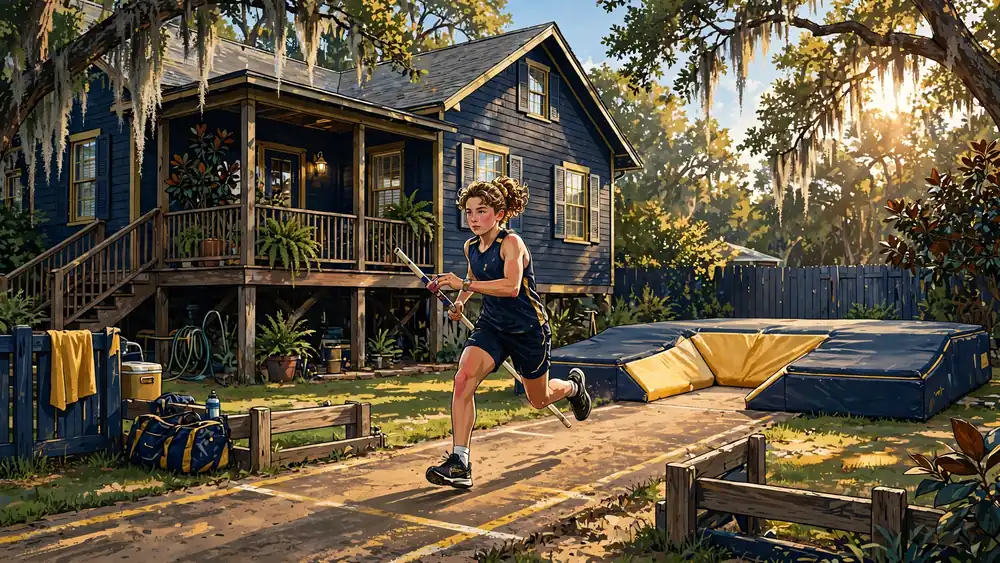
He first tried pole vaulting at four years old, in the family’s backyard in Lafayette, Louisiana, where his father had built a runway and a landing pit. He took to it fast enough that the records started almost immediately: he set his first age-group world best at seven, and his jump of 3.86 metres as a ten-year-old passed the previous world bests for ages eleven and twelve as well. As of July 2015 he held the world best in every age group from seven to twelve. The backyard in Lafayette was not a metaphor for his childhood; it was the training ground, and the mat and runway in the family garden were where the technique that now clears 6.31 metres was built.
The nickname came just as early. “Mondo” was given to him as a small child by his father’s best friend, an Italian from Sicily — “mondo” means “world” in Italian — and he was first called “Mondo Man” before it shortened to Mondo. It stuck, and it now reads like a prediction: the boy called “world” grew into the man who owns the world record. His siblings took up sport too. Older brother Andreas represented Sweden as a pole vaulter at the 2009 World Youth Championships and the 2012 World Junior Championships; older brother Antoine dropped pole vault for baseball in high school, went to Louisiana State University, and became the team’s career hits leader in 2019; younger sister Johanna competes professionally in pole vaulting for Sweden. The Duplantis household produced four athletes, and the youngest of the vaulters became the greatest of them.
Teenage Breakthrough: World Youth Gold at 15, Records at 17
Duplantis announced himself internationally at fifteen. In June 2015 he declared he would compete for Sweden — he holds both citizenships, and the Swedish federation had invited his father to join the national team as a coach, while his older brother’s youth-team experiences and his own childhood summers in Sweden made the choice easy, as he has said since. A month later, at the 2015 World Youth Championships in Cali, Colombia, he won gold on countback with a first-attempt clearance of 5.30 metres, improving his personal best by two centimetres and setting a championship record. He was fifteen years and eight months old. The same year he was named Gatorade Louisiana Boys Track and Field Athlete of the Year, after setting national freshman records indoors and outdoors at Lafayette High School.
The next two years were a run of age records. On February 6, 2016, he cleared 5.49 metres at a high school meet in Baton Rouge, setting a new age-16 world best and becoming the first high school athlete to vault eighteen feet indoors. That summer he took bronze at the World Under-20 Championships in Bydgoszcz, Poland. In 2017, at seventeen, the records came in a rush: 5.75 metres at the Millrose Games on February 11 for the world indoor junior record, then 5.90 metres at the Texas Relays on April 1 for the world under-20 record — a ten-centimetre jump on a mark that had stood since 1989 — and then gold at the European Under-20 Championships in Grosseto, Italy, in July, with a championship record of 5.65 metres. He was still a schoolboy. He had already broken a record older than he was.
He is one of very few athletes in history to win world championship titles at youth, junior, and senior level, a distinction Wikipedia’s entry flags explicitly. The teenage years explain why: he was not a late developer who found the event at eighteen. He was a child prodigy who had been vaulting for thirteen years by the time he won his first senior title, and the senior titles that followed were the continuation of a curve that had been rising since he was seven.
Age 18: European Champion and the First Six Metres
Duplantis turned eighteen in November 2017 and spent 2018 becoming a senior champion. He opened the year with an indoor personal best of 5.83 metres at the Pole Vault Summit in Reno in January, then cleared 5.88 metres in Clermont-Ferrand in February for the world under-20 indoor record. In the summer he won the World Under-20 title in Tampere, Finland, and then, in August, the senior European title in Berlin — clearing 6.05 metres, his first jump over six metres, to win gold at eighteen and set the current world under-20 record in the process.
Six metres is the line that separates the good from the great in pole vaulting. Before Duplantis, only a handful of men had ever cleared it, and none had done so as a teenager. He did it at his first senior European Championships, in his first season out of school, and he has now cleared six metres or higher in 91 competitions across nine straight seasons — a streak that began with that Berlin jump and, as of September 2026, had not been broken in a single season since. The 2018 season also earned him the European and World Athletics Male Rising Star of the Year awards, the first of many times the sport’s governing bodies would name him its best young athlete and then, two years later, its best athlete outright.
He graduated from Lafayette High School in 2018 and enrolled at Louisiana State University, following his parents and brothers. He left after his first year, in 2019, to turn professional — a decision that looks obvious now and was a gamble then, taken at nineteen with one senior title and no world record to his name. The same year he took silver at the World Championships in Doha, his first senior world medal, finishing behind the man whose record he would break five months later.
Age 20: The First World Record
On February 8, 2020, in Toruń, Poland, Duplantis cleared 6.17 metres and broke the world record. He was twenty years and three months old — the youngest man ever to hold the pole vault world record. Renaud Lavillenie of France had held the mark at 6.16 metres since 2014, and before him Sergey Bubka had owned it for two decades. Duplantis took it in his first full season as a professional, and he took it again a week later, clearing 6.18 metres in Glasgow on February 15. Two world records in eight days, at twenty, and the sport had a new owner.
The timing mattered. The Tokyo Olympics were postponed that spring as the pandemic shut down sport, so the twenty-year-old world-record holder had to wait a year for the Olympic stage. He spent 2020 as the world number one in the event and the overall world number one in athletics, and at the end of the year he was voted World Male Athlete of the Year — the first of four such awards, with the others following in 2022, 2023, and 2025. He was also, by then, the man every other vaulter measured himself against: the record was his, the ranking was his, and the only title missing was the Olympic one.
He collected the missing pieces in 2021. He won the European Indoor title in Toruń in March, and then, at twenty-one, he won Olympic gold in Tokyo. The full story of that gold belongs in the next section; what matters here is the shape of the career at twenty. In three years he had gone from European champion at eighteen to world-record holder at twenty to Olympic champion at twenty-one — a climb with no plateau, no injury break, and no season in which he failed to improve on the last.
Age 21: Olympic Gold in Tokyo
Duplantis won his first Olympic gold medal at the Tokyo Games in August 2021, clearing 6.02 metres to take the title at twenty-one. He won it cleanly, without a failure at the winning height, and then took three attempts at a world record of 6.19 metres that stayed out of reach on the night. The gold made him the Olympic champion, the world-record holder, and the world number one all at once — the complete set, at an age when most vaulters are still trying to make their first Olympic team.
Tokyo also set the pattern for the years that followed: Duplantis winning the biggest meets, and then using the victory lap to chase the record. He did not break it in Tokyo, but he broke it twice the following spring — 6.19 metres in Belgrade on March 7, 2022, and 6.20 metres in the same city thirteen days later, winning his first world indoor title — and then again at the World Championships in Eugene in July 2022, clearing 6.21 metres to win his first outdoor world title. Three world records in 2022, two global titles, a European title in Munich, and a Diamond League title: the season ended with him voted World Male Athlete of the Year for the second time and European Male Athlete of the Year as well.
The Olympic-champion years also show how his age compares with his peers. Gymnast Simone Biles, who was 27 when she won gold in Paris in 2024, reached her fourth Olympic Games at an age when Duplantis was winning his second. The comparison is not about who is better — different sports, different clocks — but about how early Duplantis arrived. He won his first Olympic gold at twenty-one; most Olympic champions in track and field win their first in their mid-to-late twenties.
Age 24: Paris Gold and a Record at the Olympics
By 2024 Duplantis had added two more world records and two more global titles: 6.22 metres in Clermont-Ferrand in February 2023, 6.23 metres in Eugene in September 2023 to win his second world title, and a world indoor title in Glasgow in March 2024. He arrived in Paris for the 2024 Olympics as the defending champion, the world-record holder, and the favourite — and he delivered the defining performance of his career so far. On August 5, 2024, at twenty-four, he cleared 6.25 metres to win his second Olympic gold and break the world record at the Olympic Games, the first man to do both on the same night since the event’s modern era began. He added a third record three weeks later, 6.26 metres in Chorzów, Poland, and closed the year with his fourth Diamond League title.
Paris 2024 was also the Games where the record-breaking habit spread across the sport. Sydney McLaughlin-Levrone broke her own 400-metre hurdles world record in Paris, running 50.37 seconds, and the two of them — the vaulter and the hurdler — became the twin faces of a Games defined by athletes who won and moved the outer limit of their event on the biggest stage. Duplantis’s 6.25 metres was the ninth world record of his career and the third he had set at a championship rather than a specialist meet, which is the harder way to do it: the bar goes up once, in front of eighty thousand people, with no second chance.
He was twenty-four in Paris, and the number matters because of what usually happens next in pole vaulting. The event rewards patience and punishes impatience; the great vaulters — Bubka, Lavillenie — peaked in their late twenties and held their records into their thirties. Duplantis had already held the record for four years at twenty-four, and he had set it nine times. The question after Paris was not whether he would keep winning. It was whether anyone would ever catch him.
Age 25: Four Records and a Third World Title in Tokyo
Duplantis turned twenty-five in November 2024 and produced the best season of his life in 2025. He set four world records in a single year — 6.27 metres in Clermont-Ferrand in February, 6.28 metres in Stockholm in June, 6.29 metres in Budapest in August, and 6.30 metres in Tokyo in September — and he won all sixteen of his competitions, a perfect season. The last of the four records came at the World Championships in Tokyo on September 15, 2025, where he cleared 6.30 metres to win his third consecutive outdoor world title. Sky Sports, reporting the 6.31-metre jump six months later, noted that he had set four new world records in 2025 along with winning every competition he entered.
The Tokyo win also settled the one gap in his medal collection. He had a world silver from Doha in 2019; after Tokyo 2025 he had three outdoor world golds to go with it, plus the indoor titles, the Olympic golds, and the European titles. He closed 2025 with his fifth successive Diamond League title in Zurich, and on November 30, 2025, World Athletics announced him as the Men’s World Athlete of the Year for the fourth time. The Laureus World Sportsman of the Year award followed in 2025, the first time a pole vaulter had been named the world’s best sportsman by the Laureus academy.
He was twenty-five, and the sport had run out of superlatives that did not sound stale. Athletics Weekly, covering the 6.31-metre jump in March 2026, put it plainly: he had raised the global mark from 6.17 to 6.31 metres in just six years, and he had now bettered another of Bubka’s records, going one better than the Ukrainian’s tally of fourteen consecutive world records. The only honest way to describe a twenty-five-year-old with fifteen records on the horizon was to say that the history books were being rewritten in real time, and that the man doing the rewriting was not yet halfway through his twenties.
Age 26: The 2026 Season — 6.31, the First Defeat, and Karalis
Duplantis turned twenty-six on November 10, 2025, and opened his 2026 season the way he had opened every season since 2020: by breaking the world record. On March 12, 2026, at the Mondo Classic in Uppsala — the indoor meeting named after him, held at his adopted home base — he cleared 6.31 metres on his first attempt, his fifteenth world record, in front of a home crowd that showered him with golden confetti from a cannon the organisers had installed in anticipation. He had opened with 5.65 metres, then 5.90 and 6.08 metres, all first-attempt clearances, before asking for the bar to be raised to the record height. The Associated Press reported it as his 38th straight pole-vault victory, a streak dating to August 2023. He added a fourth straight world indoor title in Toruń later in March, and a fourth European title in Birmingham in the summer, clearing 6.15 metres at the first attempt to improve his own championship record.
Then, in June 2026, something happened that had not happened in three years: he lost. At the Stockholm Diamond League, in front of his home fans, he finished second with 5.80 metres as Australia’s Kurtis Marschall claimed victory, ending a winning streak of forty competitions. European Athletics, profiling his 2026 season ahead of the Golden Tracks awards, called it his first defeat since July 2023. The loss was not a collapse — 5.80 metres is a height most vaulters never reach — but it was a crack in the aura, and it arrived just as a genuine rival was emerging. Emmanouil Karalis of Greece, the Olympic bronze medallist from Paris, improved his best from 6.08 metres to 6.17 metres indoors in February 2026, and then pushed Duplantis deep into two of the summer’s best competitions: in Lausanne on August 20, both men cleared 6.16 metres before Duplantis won with 6.21 metres at the first attempt, and in Zurich on August 27, Karalis cleared 6.20 metres — a Greek record, and the second-highest vault in history — before Duplantis answered with 6.25 metres. Both men then failed three times at 6.32 metres, a centimetre above the world record, and the record stayed at 6.31.
The season’s final act was complicated. Duplantis withdrew from the Diamond League Final with an injury problem, allowing Karalis to claim the title — the one major prize of 2026 that did not go to the Swede. The Diamond League circuit he competes on is the same one where sprint star Noah Lyles headlines the 100 metres, and the two of them are the tour’s biggest draws — the fastest man and the highest vaulter, sharing the same Saturday-night billing from Lausanne to Zurich. But he closed the year by winning the inaugural World Athletics Ultimate Championship in Budapest on September 11, 2026, clearing 6.20 metres in a straight final to take the new event’s first pole vault title and its winner’s share of a ten-million-dollar prize pot. The 2026 season, in full, was a fifteenth world record, a fourth world indoor title, a fourth European title, a first defeat in forty meets, a rival who can now clear 6.20 metres, and a new championship won. It was, by his standards, an ordinary year — which says everything about the standard.

Age 27: Marriage, Honours, and the 6.40 Target
Duplantis turned twenty-seven on November 10, 2026, in a year that changed his life off the runway as much as on it. In March 2026 he married Desiré Inglander, the Swedish model he had been with for years, at Stockholm City Hall — the same month he set the 6.31-metre world record. The wedding was confirmed that month, and the two milestones now sit side by side in every 2026 profile of him: a world record and a marriage, three weeks apart, in the city he now calls home.
The honours kept coming at twenty-six and twenty-seven. He was named Laureus World Sportsman of the Year for 2025, and in June 2026 he was included in Time’s list of the 100 most influential people in sports — a list that measures reach beyond the track, and a sign that his fame has outgrown athletics. He is also, by now, a crossover figure in Sweden in a way few track athletes ever become: the Mondo Classic, the meeting named after him, sells out in Uppsala, and his face is on billboards for Puma and Red Bull across the country. The next target is the one he has named himself. According to the Sweden Herald’s October 2026 report, he is targeting 6.40 metres with new poles and skipping the indoor season to prepare for the outdoor return — nine centimetres above his current record, and a height no human has ever cleared.
Whether he gets there is the open question of the next three years, and the honest answer is that nobody knows — not even him. What the record shows is a man who has raised the bar fifteen times without once failing to raise it when he chose to try, and who has done it while winning every championship that matters. At twenty-seven, he has ten senior global titles, fifteen world records, two Olympic golds, and a marriage. The 6.40-metre project is the next chapter, and it starts with a vaulter who has never yet found a height he could not clear.
Height and Physical Profile: 1.81 Metres
Duplantis stands 1.81 metres tall — 5 feet 11 inches — according to Wikipedia’s profile of him, and he is listed at the same height in World Athletics’ athlete records. For a pole vaulter, that is a useful height rather than an extreme one: tall enough to carry speed down the runway and plant the pole high, compact enough to invert quickly over the bar. The great vaulters cluster around the same range — Lavillenie is 1.76 metres, Bubka was 1.83 — and Duplantis sits in the middle of it. His other measurable advantage is speed: he ran 10.37 seconds for 100 metres in Zurich in 2024, a time that would be respectable for a sprinter and is extraordinary for a man who spends his working life upside down over a bar.
For the full breakdown of his height — how it compares with other vaulters and with the gymnasts and swimmers who share his Olympic stage — see Armand Duplantis’s height in 2026 on this site, our different-angle profile of the same athlete. The comparison with gymnasts is the sharpest one: Suni Lee, the Olympic gymnast, stands far shorter, and the two sports reward opposite builds — the gymnast’s compact power against the vaulter’s long, fast frame. Duplantis’s height has never been the question readers ask most; the age and the record are. But it is the physical fact that makes the record possible, and it has not changed since he stopped growing.
Net Worth at 27: What the Money Looks Like
An age article still has to answer the money question, because it is the second thing every reader searches — and with Duplantis the honest answer starts with a warning. No official net worth figure for him has ever been published. There are no tax filings, no audited disclosures, and no confirmed reporting from a business outlet. What exists is a cluster of media estimates, and they point to a $5–10 million range. William Hill puts him between $4 million and $10 million; Essentially Sports and Urban Journal both land on $5–10 million; SportsBigNews gives the same $5–10 million figure; PopGolden puts it at $5 million and reports his annual income at $1–2 million from prize money and endorsements. Celebrity Net Worth lists $1 million, a figure so far below every other estimate — and so stale, given the four world records and sixteen wins of 2025 — that this article treats it as an outlier and prints the range instead.
The income streams behind the range are public enough to name. Prize money is the first: he earned £74,000 for the world record at the World Championships, according to the Apex Sports breakdown, and £37,000 when he breaks the record at a Diamond League meeting, with his sponsor Puma paying a bonus on top for every record. The Ultimate Championship win in Budapest in September 2026 carried a winner’s prize of $150,000 from a ten-million-dollar prize pot, according to Essentially Sports. Endorsements are the second stream: Puma supplies his spikes and signature gear, Red Bull produces features on his training, and Polestar, Omega, and Eton Shirts back his international appearances. Swedish experts quoted by the Times of India in October 2025 put his overall valuation near 100 million Swedish kronor — roughly $9–10 million — as his brand value climbs with each record.
For the full money story, with the income streams broken down and the estimates compared outlet by outlet, see Armand Duplantis’s net worth in 2026 on CelebAmerica, our sister site’s different-angle profile, which puts his fortune at $5 million. More profiles of athletes at the same level sit in our Celebrity Net Worth category, where the same reporting standard — ranges on conflict, named sources, no invented figures — applies to every name.
Personal Life: Family, Partner, and Life in Sweden
Duplantis keeps his private life low-key in the way Swedish athletes tend to, but the facts that are public tell a coherent story. He lives in Sweden now — Uppsala is his training base, Stockholm the city where he married — and he trains under his parents, Greg and Helena, who have coached him since the backyard days in Lafayette. He still feels a strong bond to Louisiana, as he has said in interviews, and he returns there; but his professional life, his meeting, and his marriage are Swedish. He grew up speaking English and learned Swedish as a second language, and he spent his childhood summers with his Swedish grandparents in Avesta, the town whose club, IK Stål, he first represented in Sweden before switching to his mother’s former club, Upsala IF, in 2016.
His partner is Desiré Inglander, a Swedish model, and the two married in March 2026 at Stockholm City Hall, as reported by BiographyHive in September 2026 and by Apex Sports. The wedding came the same month as the 6.31-metre world record, and the two events are now permanently linked in his story: the record in Uppsala, the marriage in Stockholm, three weeks apart, at twenty-six. His siblings remain close to the sport — Andreas and Johanna both vaulted for Sweden, Antoine played baseball at LSU — and the family shows up at his meets the way it always has, from the backyard in Lafayette to the stadium in Tokyo.
Off the runway he has a second public identity that surprises people who only know the vault. He is a singer: he has released music under his nickname Mondo, including a song written with Emil Berg and Rasmus Wahlberg, and he has performed it publicly. It is a footnote next to fifteen world records, but it is the kind of footnote that explains the nickname and the showmanship — the vaulter who named his own meeting, who plays to the crowd before he runs, and who treats the record attempts as theatre. The singing is not a career. It is a reminder that the man clearing 6.31 metres is twenty-seven, and still young enough to have a second act in mind.
Age at Every Milestone: The Timeline
| Date | Age | Milestone |
| November 10, 1999 | 0 | Born Armand Gustav Duplantis in Lafayette, Louisiana, USA |
| 2003–2004 | 4–5 | First vaults in the family backyard; nickname “Mondo” given |
| 2006–2011 | 7–12 | Age-group world bests every year; 3.86 m at age 10 |
| July 2015 | 15 | World Youth champion, Cali — 5.30 m, championship record |
| February 2016 | 16 | 5.49 m age-16 world best; first high-schooler over 18 ft indoors |
| 2017 | 17 | World indoor junior record 5.75 m; world U20 record 5.90 m; European U20 gold |
| August 2018 | 18 | European champion, Berlin — 6.05 m, first jump over six metres |
| October 2019 | 19 | World silver, Doha; leaves LSU to turn professional |
| February 8, 2020 | 20 | First world record — 6.17 m, Toruń; second record 6.18 m a week later |
| August 2021 | 21 | Olympic gold, Tokyo — 6.02 m |
| 2022 | 22 | World indoor + outdoor gold; three world records (6.19, 6.20, 6.21 m) |
| 2023 | 23 | Second world title, Budapest; records 6.22 and 6.23 m |
| August 5, 2024 | 24 | Second Olympic gold, Paris — world record 6.25 m |
| September 15, 2025 | 25 | Third world title, Tokyo — 6.30 m; four records and 16 wins in 2025 |
| March 12, 2026 | 26 | 15th world record — 6.31 m, Mondo Classic, Uppsala; married Desiré Inglander the same month |
| June–September 2026 | 26 | First defeat in 40 meets (Stockholm); European gold Birmingham; Ultimate champion Budapest |
| November 10, 2026 | 27 | Turns 27; targeting 6.40 m with new poles, skipping the indoor season |
The next number to watch is not an age — 27 will become 28 on November 10, 2027, without anyone needing to write about it — but a height. The 6.40-metre project is the story of his late twenties, and if he clears it, the age article will need a new first line: the youngest world-record holder in history, still raising the bar at twenty-eight.
Sources & Reporting
Birth date, family, career and titles: Wikipedia’s Armand Duplantis entry (crawled November 20, 2026 — born November 10, 1999, Lafayette; parents Greg and Helena; siblings Andreas, Antoine, Johanna; first vaulted at four; age-group bests; nickname origin; Sweden choice June 2015; 2015 World Youth gold 5.30 m; 2016 5.49 m; 2017 records 5.75 and 5.90 m; 2018 European title 6.05 m; 2019 World silver; 2020 first world record 6.17 m; Olympic golds Tokyo 2020 and Paris 2024; world titles Eugene 2022, Budapest 2023, Tokyo 2025; world indoor titles 2022, 2024, 2025, 2026; World Ultimate champion Budapest 2026; European titles 2018, 2022, 2024, 2026; 91 competitions over six metres; 100 m best 10.37 seconds, Zurich 2024; height 1.81 m). World record: World Athletics report “Duplantis breaks world pole vault record in Uppsala” and all-time top list (6.31 m, IFU Arena, Uppsala, March 12, 2026); Guinness World Records (6.31 m, published August 18, 2026); NBC Sports (March 2026, 15th record, one-centimetre increments); ESPN/Associated Press (March 13, 2026, 38th straight win); Sky Sports (March 2026, full 15-record progression 6.17–6.31 m; four records in 2025, all 16 competitions won); Athletics Weekly (March 12, 2026, Bubka comparison). 2026 season: European Athletics Golden Tracks profile (Stockholm defeat, 40-meet streak ended, Marschall win, Karalis rivalry, Birmingham 6.15 m championship record, Lausanne 6.21 m, Diamond League Final withdrawal, Karalis title); World Athletics Weltklasse Zürich results (August 27, 2026, 6.25 m win); EuropeSays and Yardbarker (Zurich 6.25 m, Karalis 6.20 m Greek record, both failed at 6.32 m). Honours and future: World Athletics London Diamond League article (World Athlete of the Year 2025, announced November 30, 2025; fifth Diamond League title); Laureus (World Sportsman of the Year 2025); Sweden Herald (October 2026, 6.40 m target, skipping indoor season). Marriage: BiographyHive (published September 30, 2026, married March 2026); Apex Sports (Stockholm City Hall, March 2026; Time 100, June 2026; prize money £74,000 and £37,000; Puma record bonuses). Net worth: William Hill ($4–10 million); Essentially Sports ($5–10 million; Ultimate Championship $150,000 winner’s prize); Urban Journal ($5–10 million, 2025 estimate); SportsBigNews ($5–10 million); PopGolden ($5 million; $1–2 million annual income); Celebrity Net Worth ($1 million, treated as a stale outlier); Times of India via NewsPoint (October 2025, SEK 100 million valuation). Age staleness: NBC Olympics profile (says 24, last updated ~887 days ago); trackandfieldapp (says 26, September 2026, pre-birthday). Where outlets disagreed — the 6.27, 6.30 and 6.31 metre figures, and the $1–10 million net-worth spread — this article prints the dated progression and the range rather than the rounder number. If new reporting emerges, this article will be updated and the change noted here.
Nathan Cole
Nathan Cole is the editor of Guide Net Worth. He covers celebrity wealth the way a business desk covers earnings: reported figures first, estimates labeled as estimates, and no invented numbers. Every profile on this site passes through his desk before it publishes. About Guide Net Worth · Corrections: figures are updated when new reporting emerges — contact us via the About page if you spot an error.
Frequently Asked Questions
How old is Mondo Duplantis in 2026?
Mondo Duplantis is 27 years old in 2026. He was born Armand Gustav Duplantis on November 10, 1999, in Lafayette, Louisiana, and turned 27 on November 10, 2026.
When was Mondo Duplantis born?
Mondo Duplantis was born on November 10, 1999, in Lafayette, Louisiana, USA. His full name is Armand Gustav Duplantis, and his nickname “Mondo” — Italian for “world” — was given to him as a small child by his father’s Sicilian friend.
What is Mondo Duplantis’s pole vault world record?
The current world record is 6.31 metres, set on March 12, 2026, at the Mondo Classic in Uppsala, Sweden — his 15th world record. The 6.30-metre figure seen on older pages was the Tokyo World Championships mark of September 15, 2025, and 6.27 metres was the Clermont-Ferrand mark of February 28, 2025. Every one of his 15 records raised the bar by exactly one centimetre.
How many world records has Mondo Duplantis broken?
Duplantis has broken the pole vault world record 15 times, raising it from 6.17 metres in February 2020 to 6.31 metres in March 2026. He passed Sergey Bubka’s tally of 14 consecutive world records with the 6.31-metre clearance.
How tall is Mondo Duplantis?
Mondo Duplantis is 1.81 metres tall (5 ft 11 in), according to Wikipedia and World Athletics. He also ran 10.37 seconds for 100 metres in Zurich in 2024.
Is Mondo Duplantis married?
Yes. Duplantis married Swedish model Desiré Inglander in March 2026 at Stockholm City Hall, the same month he set the 6.31-metre world record.
What is Mondo Duplantis’s net worth in 2026?
Duplantis’s net worth is estimated at $5–10 million in 2026, with no official figure ever published. William Hill puts him at $4–10 million, while Essentially Sports, Urban Journal and SportsBigNews all land on $5–10 million. His income comes from prize money, world-record bonuses and endorsements with Puma, Red Bull, Polestar, Omega and Eton Shirts.
What did Mondo Duplantis do in 2026?
At 26, Duplantis set his 15th world record (6.31 m) at the Mondo Classic in Uppsala on March 12, 2026, won a fourth world indoor title in Toruń and a fourth European title in Birmingham (6.15 m), suffered his first defeat in 40 competitions in Stockholm in June, won the Diamond League meetings in Lausanne and Zurich, withdrew injured from the Diamond League Final, won the inaugural World Athletics Ultimate Championship in Budapest in September, married Desiré Inglander in March, and was named to Time’s 100 most influential people in sports in June. He turned 27 on November 10, 2026.
References & Sources
This article has been fact-checked and verified against multiple public sources, financial disclosures, SEC filings, Forbes reports, Celebrity Net Worth databases, and official records. All net worth estimates are based on publicly available information and financial analysis.