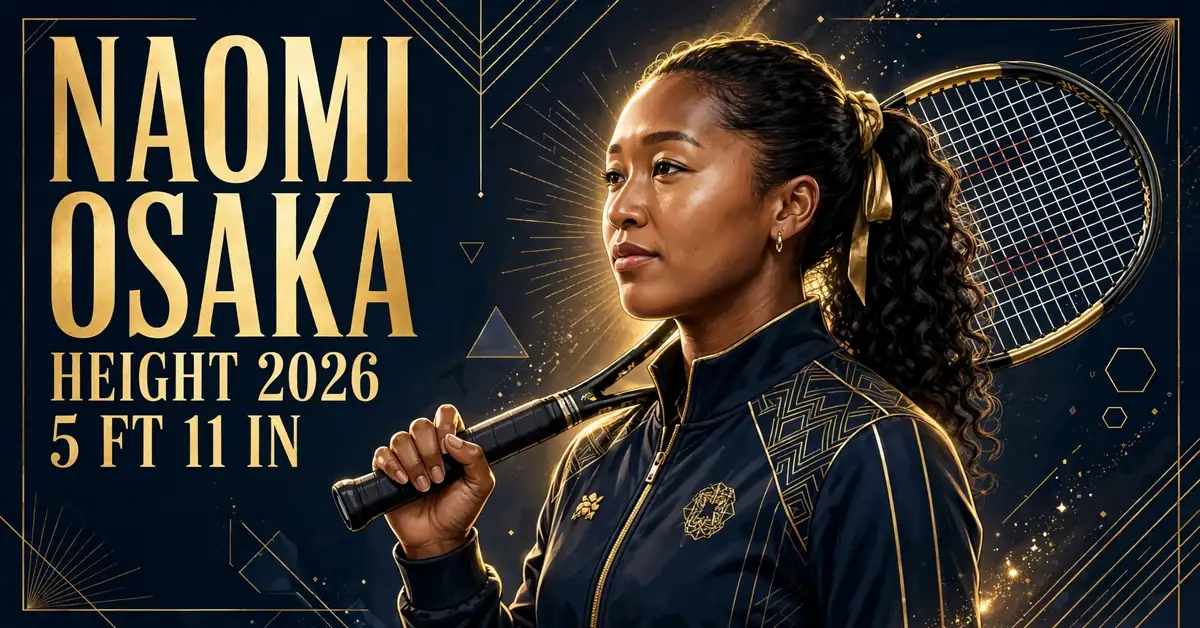
Naomi Osaka height 2026: the four-time Grand Slam champion stands 5 ft 11 in (1.80 m). How her height powers her serve, her 2026 comeback and a $120M fortune.
Last updated: November 14, 2026 · By Nathan Cole
Naomi Osaka is 5 feet 11 inches tall (1.80 m / 180 cm) — a figure every major authority agrees on, from the WTA’s official player page to the US Open and Wikipedia. At 29, the four-time Grand Slam champion and former world No. 1 stands two inches taller than Serena Williams and Coco Gauff, level with Karolina Muchová, and one inch shorter than Aryna Sabalenka. Her height is not a trivia answer. It is the physical foundation of the most feared serve in the women’s game, a weapon that carried her to four major titles before her 24th birthday and is still winning her matches in a 2026 comeback season that has taken her back to world No. 17.
This profile answers the height question properly: the number and the sources that confirm it, how it compares with the rest of the women’s tour, what it does for her serve and her movement, and the career it sits inside — the Osaka childhood, the Serena final that changed tennis, the mental-health stand, motherhood, and the 2026 season that has her beating a world No. 1 again. Her net worth in 2026 sits in a published range of $45–120 million, anchored by Celebrity Net Worth’s $120 million, built on $25.7 million in official career prize money and an endorsement portfolio that once made her the highest-paid female athlete on the planet.
Quick Facts
| Full Name | Naomi Osaka |
| Born | October 16, 1997, Chūō-ku, Osaka, Japan |
| Age (2026) | 29 years old — turned 29 on October 16, 2026 |
| Height | 5 ft 11 in (1.80 m / 180 cm) |
| Plays | Right-handed, two-handed backhand |
| Coach | Tomasz Wiktorowski (since July 2025) |
| Ranking | World No. 17 (November 2026); career high No. 1 (January 2019); 2026 peak No. 14 |
| Grand Slams | 4 — US Open 2018, 2020; Australian Open 2019, 2021 |
| Career Prize Money | $25,724,612 (WTA official, June 29, 2026) — 17th all-time |
| Estimated Net Worth | $45–120 million (Celebrity Net Worth anchor $120M, see adjudication below) |
| Family | Daughter Shai, born July 2023; parents Leonard François and Tamaki Osaka; sister Mari Osaka |
| Last Updated | November 14, 2026 |
How This Height Was Verified
The height figure in this profile needs no range, because the sources do not disagree. The WTA’s official player page lists Naomi Osaka at 5 ft 11 in (1.80 m). Wikipedia’s infobox gives 1.80 m (5 ft 11 in), updated July 6, 2026. The US Open’s official player profile gives “5 ft. 11 in. (1.8 meters)”. Tennis.com lists 5’11” (180 cm), Sportradar lists 180 cm, and The Sport Review lists 180cm / 5ft 11ins. Six independent sources, one number. Where sources do disagree in this profile — the net worth — the article publishes the full range and names the outlets on each side rather than picking one. Height, by contrast, is settled: 5 ft 11 in, 180 cm.
+
How Tall Is Naomi Osaka? The Answer, Sourced
Naomi Osaka is 5 feet 11 inches tall — 1.80 metres, 180 centimetres. The number is confirmed across every authority that publishes player measurements: the WTA, the US Open, Tennis.com, Sportradar and Wikipedia all carry the same figure, and none of them has ever carried a different one. There is no competing measurement in circulation, no “5 ft 10 in” variant, no metric-imperial conversion error. For a question that usually produces a spread of answers, Osaka’s height is unusually clean.
The reason the question gets asked so often is that Osaka looks taller on court than the number suggests. At 5 ft 11 in she is already among the taller players on the WTA Tour, but her serve motion — a full, high toss and a long reach up to the ball — makes her play bigger than her listed height. Opponents have said for years that her ball comes down from a height most players never see. The 180 cm frame is the reason: at contact, her racket meets the ball higher than a 5 ft 9 in player can reach, and the angle she can hit down into the service box is steeper. The rest of this profile explains what that height has done for her game, and the career it has carried.
Early Life: Osaka, Haiti, Japan and the Move to Florida
Naomi Osaka was born on October 16, 1997, in Chūō-ku, Osaka, Japan, to a Haitian father, Leonard François, and a Japanese mother, Tamaki Osaka. Her older sister Mari, who also became a professional tennis player, was born a year earlier. The family moved to the United States when Naomi was three years old, first to Long Island, New York, and then to Florida, where the warm weather and the year-round courts made a tennis childhood possible. She grew up speaking Japanese at home and English everywhere else, and she has represented Japan in competition since her early teens — a choice her father made deliberately, and one that made her a national figure in Japan long before she won a major.
Leonard François had a plan for his daughters that he has never hidden: he modelled it on Richard Williams and the path he built for Venus and Serena. He saw the Williams sisters on television at the 1999 French Open and decided his own daughters would play tennis. The training started early and stayed serious. Naomi and Mari hit together for hours a day in Florida, and their father coached them himself for years. The height came later — Osaka grew into her 5 ft 11 in frame during her teens, and the power in her game grew with it. By the time she turned professional in 2013, at 15, she was already a tall, hard-hitting teenager with a serve that outpaced players years older than her.
The Williams Sisters Blueprint
The Williams comparison followed Osaka from her first seasons on tour, and it was more than a lazy parallel. Her father had studied how Richard Williams built two champions outside the tennis establishment — homeschooled, family-coached, protected from the junior treadmill — and he applied the same shape to his own daughters. Osaka played a limited junior schedule, skipped the usual academy route, and learned the game hitting with her sister under her father’s eye. The approach produced a player with a distinctive style: huge groundstrokes, a flat first serve, and a calm that looked, even at 16, like someone who had been taught to treat the court as her own space.
The blueprint reached its full circle in September 2018, when Osaka beat Serena Williams herself in the US Open final — the player her father had used as the model, in the final her family had imagined for years. Osaka was 20 years old, ranked 19th in the world, and playing her first Grand Slam final. The match ended 6-2, 6-4, and it made her the first Japanese player, male or female, to win a Grand Slam singles title. The moment was overshadowed by the controversy around Serena’s code violations and the crowd’s reaction, and Osaka cried through the trophy ceremony. She apologised to the crowd for winning. It was the first sign that the player her father had built for the court would have to learn to carry the weight of everything around it, too.
Turning Pro and the First Breakthrough at Indian Wells
Osaka turned professional in 2013 and spent four years climbing the rankings the hard way — through ITF events, qualifying draws and first-round losses to players she would later beat routinely. Her first real signal came at the 2016 Pan Pacific Open in Tokyo, where she reached the final as a teenager and lost to Caroline Wozniacki. The result moved her into the top 50 for the first time. She finished 2016 ranked No. 40, and the tour knew her name. What the tour did not yet know was how fast the next step would come.
It came at Indian Wells in March 2018. Osaka entered the tournament ranked 44th and beat five seeded players in a row, including world No. 1 Simona Halep in the semi-final and Daria Kasatkina in the final, to win her first WTA title. She did not drop a set in the last three rounds. The serve that would define her was already there — flat, heavy, and hard to read — and the 5 ft 11 in frame behind it gave her a contact point that shorter returners could not reach. Six months later she was a Grand Slam champion. The gap between first title and first major was the shortest of any player of her generation, and it announced a career that would move at a different speed from everyone else’s.
World No. 1 and the Australian Open Titles
The 2019 Australian Open turned Osaka from a one-major wonder into the best player in the world. She beat Petra Kvitova in a three-set final, 7-6, 5-7, 6-4, to win her second consecutive Grand Slam, and the ranking points took her to world No. 1 on January 28, 2019. She was 21 years old, and she was the first Asian player — man or woman — ever to hold the top ranking in singles. The achievement landed in Japan as national news. Her face was on magazine covers, her matches were broadcast live in the middle of the night, and her endorsement value doubled almost overnight.
She added a second Australian Open title in 2021, beating Jennifer Brady 6-4, 6-3 in the final, and a second US Open in 2020, beating Victoria Azarenka in three sets. Four Grand Slam finals, four wins — Osaka has never lost a major final, a record no active player with more than two major titles can match. Her seven WTA singles titles include the 2019 Pan Pacific Open in Osaka and the 2019 China Open in Beijing, where she beat Ashleigh Barty in the final. The 2020 and 2021 seasons also brought the honours that sit outside tennis: Sports Illustrated’s Sportsperson of the Year in 2020, a place on the TIME 100 in 2021, and the Laureus Breakthrough of the Year award. At 23, she had won everything the sport offers except a French Open and Wimbledon, and she was the highest-paid female athlete in the world.
The Serve: How 5 ft 11 in Shapes Her Game
Osaka’s serve is the shot her height built. At 5 ft 11 in, her ball toss peaks high enough that she strikes the ball at a height most returners never have to handle, and the downward angle she generates into the service box is steeper than a shorter player’s. The result is a first serve that regularly clocks above 115 mph and a second serve with enough kick to push returners behind the baseline. Coaches who have worked with her describe the serve as the shot that does the most damage per rally — not because it is the fastest on tour, but because the height and the disguise make it the hardest to read. The toss looks the same whether the ball is going wide, down the middle or into the body, and the returner has to guess.
The height helps everywhere else, too. Her wingspan gives her reach on the stretch, so balls that would be winners against a shorter player come back. Her groundstrokes, hit flat and early, travel through the court at a pace that shorter players struggle to match. The trade-off is the one every tall player knows: movement. At 180 cm, Osaka has to work harder than a 5 ft 7 in player to change direction, and her career has been a study in managing that cost — the footwork drills, the conditioning blocks, the decision, after her return from maternity leave, to rebuild her movement first and let the power follow. Her coach Tomasz Wiktorowski, who guided Iga Swiatek to four Grand Slam titles, has said the work since July 2025 has been about exactly that: keeping the serve and the power while making the 5 ft 11 in frame move like a smaller player’s.

Mental Health, the 2021 French Open Withdrawal and Activism
The 2021 French Open changed how the sport talks about its players, and Osaka was the one who forced the change. Before the tournament she announced she would not do press conferences, saying they damaged her mental health. The Grand Slam organisers fined her $15,000 after her first-round win and warned her about further sanctions. The next day she withdrew from the tournament entirely, writing that she had suffered long bouts of depression since the 2018 US Open and that she needed to step away. The reaction split the tennis world — some officials called it a breach of duty, most players and much of the public backed her — and within weeks the tours were rewriting their media rules and adding mental-health support. Osaka had done something no player had done before: she had said no to the machinery around the sport, in public, at a major, and the sport moved.
She had already used her platform once before, at the 2020 US Open, where she wore a different face mask for each of her seven matches, each one carrying the name of a Black person killed by police violence in the United States — Breonna Taylor, Elijah McClain, Ahmaud Arbery, Trayvon Martin, George Floyd, Philando Castile and Tamir Rice. She won the tournament, and every mask was photographed around the world. The gesture cost her nothing in prize money and earned her a reputation that no endorsement deal could buy: a player who would use the biggest stage in her sport to say something that mattered to her. The two moments together — the masks and the withdrawal — are the reason Osaka’s name carries weight far beyond tennis, and the reason her sponsors stayed with her through the seasons when she barely played.
Motherhood: Daughter Shai and the 15-Month Break
In January 2023, Osaka announced she was pregnant and would miss the season. Her daughter, Shai, was born in July 2023. Osaka has spoken openly about the birth being difficult — she has described it in interviews as the hardest experience of her life — and about the months after it, when she had to rebuild a body that had carried a child and a career that had been paused for fifteen months. She returned to the tour in January 2024 at the Brisbane International, ranked outside the top 800, with a ranking that had to be rebuilt from scratch and a game that had to be rebuilt with it.
The return was slow by design. Osaka won 20 matches in 2024 and none of them came easily; she reached the quarter-final in Doha and the fourth round of the French Open, where she held a match point against Swiatek and lost it. In January 2025 she announced her split from the rapper Cordae, Shai’s father, saying the two would remain good parents together. The personal reset and the professional one ran in parallel through 2025: a first final since 2022 at Auckland (retired with an abdominal injury), a WTA 125 title at Saint-Malo, a run to the Canadian Open final in Montreal, and a US Open semi-final where she beat Coco Gauff and Karolina Muchová before losing to Amanda Anisimova. She finished 2025 ranked No. 16, her best year-end ranking since 2021, and the comeback had a shape to it at last.
The Comeback: 2024–2025 Rebuild
The two seasons after maternity leave were a rebuild in the open, and the numbers show how gradual it was. Osaka won 20 matches in 2024, then 25 in 2025, then 31 in the first ten months of 2026 — a steady climb that mirrors the ranking’s return from outside the top 800 to No. 17. The coaching change in mid-2025 was the hinge. After splitting with Patrick Mouratoglou, Osaka brought in Tomasz Wiktorowski on a trial basis at the Canadian Open in July 2025. Wiktorowski had coached Swiatek through her rise to No. 1 and four Grand Slam titles, and he knew the shape of the job: a tall, powerful player whose movement and consistency needed rebuilding after a long break. Osaka reached the final in Montreal, the partnership was extended, and the results followed — the US Open semi-final six weeks later was her first Grand Slam semi-final in more than four years.
What changed under Wiktorowski was not the power. The serve and the forehand were always there. What changed was the shape of the rallies: shorter points, earlier ball-striking, less running for its own sake, and a willingness to finish points at the net that Osaka had rarely shown before. The 2025 US Open run proved the model worked — she beat Gauff in straight sets in the fourth round, a match that ended 6-3, 6-2, and Muchová in the quarter-final before the semi-final loss. She finished the year inside the top 20 for the first time since 2021, and the 2026 season began with a player who looked, finally, like the one who had won four majors.
2026 Season: Wimbledon Quarter-Final and a Return to the Top 20
The 2026 season has been Osaka’s best since her return, and the best argument that the comeback is real. She went 31–13 across the season, a 70% win rate, and reached the fourth round or better at three of the four Grand Slams — the first time she has done that in a single season. The French Open brought her best-ever run at Roland Garros, a fourth-round finish ended by Sabalenka. Then came the grass season, her weakest surface for most of her career, and the two results that defined her year: a first grass-court final at Bad Homburg, where she retired against Muchová with a foot injury, and a first Wimbledon quarter-final, where she beat world No. 1 Aryna Sabalenka in the round of 16 — her first win over a top-10 player in 2026 — before losing to Muchová again.
The hard-court summer kept the run going: a semi-final in Washington, a quarter-final in Toronto where Elena Rybakina ended her run, and a fourth-round finish at the US Open, where Rybakina beat her 6-1, 6-4 on Louis Armstrong Stadium. The season closed in Tokyo at the Pan Pacific Open, where she lost in the round of 16 to Mia Pohankova on October 29, 2026. She peaked at No. 14 in the world in June, her highest ranking since 2021, and sits at No. 17 as the season ends. The title is still missing — she has not won a tournament since the 2021 Australian Open — but the ranking, the win rate and the three deep Grand Slam runs say the same thing: the player who won four majors is back in the draw, and the rest of the tour is treating her that way again.

Height Compared: Osaka Against the Rest of the Tour
At 5 ft 11 in, Osaka is taller than most of the players she faces, and the comparison table shows how she sits against the names her career is measured against. She is two inches taller than Serena Williams and Coco Gauff, who both stand 5 ft 9 in, and two inches taller than Iga Swiatek, also 5 ft 9 in. She is level with Karolina Muchová at 5 ft 11 in, one inch shorter than Aryna Sabalenka at 6 ft, and two inches shorter than Elena Rybakina at 6 ft. The pattern is visible in the results: the three players who have beaten her most often in 2026 — Sabalenka, Muchová and Rybakina — are all 5 ft 11 in or taller. On the modern women’s tour, height has become a weapon, and Osaka was one of the first to prove it.
The comparison also explains why the serve has become the tour’s most important shot. A taller player strikes the ball higher and hits down into the box at a steeper angle, and the returner has less time to react. Osaka’s height puts her in the group of players — Sabalenka, Rybakina, Muchová — whose serves decide matches. The shorter champions of the last decade, Swiatek and Gauff, win with movement and defence instead. There is no single right height in tennis, but there is a clear split in how the game is played, and Osaka sits firmly on the power side of it. Her profile of Serena Williams’ height shows the player she was measured against as a teenager; the Coco Gauff height profile covers the rival she beat at the 2025 US Open; and the Iga Swiatek height profile covers the 5 ft 9 in world No. 1 whose movement Osaka’s power has to solve.
| Player | Height | vs Osaka | Source |
|---|---|---|---|
| Naomi Osaka | 5 ft 11 in (180 cm) | — | WTA, US Open, Wikipedia |
| Serena Williams | 5 ft 9 in (175 cm) | 2 in shorter | WTA, Wikipedia |
| Coco Gauff | 5 ft 9 in (175 cm) | 2 in shorter | WTA, Sportradar |
| Iga Swiatek | 5 ft 9 in (176 cm) | 2 in shorter | WTA, Wikipedia |
| Karolina Muchová | 5 ft 11 in (180 cm) | Level | Tennis.com |
| Aryna Sabalenka | 6 ft (182 cm) | 1 in taller | WTA, Wikipedia |
| Elena Rybakina | 6 ft (184 cm) | 2 in taller | WTA, Wikipedia |
Net Worth 2026: The Wide Range Explained
Naomi Osaka’s net worth in 2026 is estimated at 120 million dollars by Celebrity Net Worth, inside a published range of 45–120 million dollars. The range is unusually wide, and the reason is honest: her fortune is built on endorsements and private business values that no outlet can audit, not on prize money that anyone can count. The one figure that is fully verifiable is her tennis earnings. The WTA’s official career prize-money list, updated June 29, 2026, records Osaka at $25,724,612 — 17th in the history of women’s tennis. EssentiallySports lists a slightly higher $26.6 million. Either way, prize money is a small slice of the total: between 2019 and 2025 she earned more than $230 million in total income, and only about 10 percent of it came from tournament cheques.
The sources split into two camps. Celebrity Net Worth’s $120 million (2026) is the anchor, and it is the figure most outlets cite. EssentiallySports’ $45 million (July 3, 2026) sits at the bottom, with most of its cluster in the $40–50 million range. SureBets’ editorial range of $45–120 million (July 28, 2026) is the most defensible single summary, because it names the disagreement instead of hiding it. The gap comes from what each source counts: the $120 million figure rests on gross career earnings of roughly $230 million plus the value of her businesses, while the $45 million figure appears to count a smaller slice of endorsement income and to discount the private companies. Neither side publishes its model, so this profile does not pick one. The full breakdown of her fortune — endorsements, prize money and the business empire — is covered in our Naomi Osaka net worth profile, and the same story from our sister site is told in Naomi Osaka’s net worth on NetWorthCraft. Forbes’ reporting gives the scale of the peak: $57.3 million of income in 2021 alone, which made her the highest-paid female athlete in the world that year.
| Source | Date | Figure | What It Rests On |
|---|---|---|---|
| Celebrity Net Worth | 2026 | $120M | ~$230M gross income 2019–2025; businesses included |
| EssentiallySports | Jul 3, 2026 | $45M | $40–50M cluster; prize money $22M+ cited |
| EssentiallySports | Sep 3, 2026 | $120M | CNW figure; $26.6M career prize money |
| SureBets | Jul 28, 2026 | $45–120M | Editorial range; WTA prize money $25.72M anchor |
| SportsLeo | 2026 | $120M | Endorsements 85%+ of wealth; $40–50M peak annual |
| SurpriseSports | Nov 5, 2026 | $120M | $24.6M career prize money; Nike anchor deal |
| WTA (official) | Jun 29, 2026 | $25.72M | Career prize money, auditable; 17th all-time |
| Forbes | 2021 | $57.3M | Single-year income 2021; highest-paid female athlete |
Endorsements and Businesses: Nike, Louis Vuitton, KINLÒ, Hana Kuma, Evolve
Endorsements are the engine of Osaka’s fortune, and the portfolio is one of the widest in women’s sport. The anchor is Nike, which signed her in 2019 when she left Adidas and which Forbes valued at more than $10 million a year in 2020 — a deal that later grew into her own signature apparel line. Yonex has supplied her racquets since 2008, a partnership that predates her professional career. The luxury names arrived in early 2021, when Louis Vuitton made her a global ambassador and TAG Heuer signed her as a watch ambassador. Around them sit Nissan (since 2018), Mastercard, Nissin Foods, Panasonic, Beats by Dre, Workday, BodyArmor, Sweetgreen, Levi’s, Maybelline New York and Zico. At her commercial peak, Forbes reported she had signed more than a dozen brand partners, and in 2020 and 2021 she earned more from endorsements in a single year — over $50 million — than any female athlete before her.
The businesses she built herself are the second half of the story. In September 2021 she launched KINLÒ, a skincare brand built for melanated skin, after years of struggling to find sun protection that worked for her. In May 2022 she co-founded Evolve, a sports agency, with her longtime agent Stuart Duguid — a move that made her one of the few athletes to own the agency that represents her. She also launched Hana Kuma, a media and production company, in partnership with LeBron James and Maverick Carter’s SpringHill Company. And she owns a minority stake in the North Carolina Courage, the women’s soccer team in the NWSL. None of these companies publishes its value, which is exactly why the net-worth range is so wide — the public can see the deals, but it cannot see the balance sheets. What the public can see is the direction: Osaka has spent her twenties turning endorsement income into ownership, and the businesses are the part of her fortune most likely to keep growing after her playing career ends.
Personal Life: Family, Cordae and Life in Florida
Osaka lives in Florida, where she has trained since childhood, and her public life off the court is built around family. Her parents, Leonard and Tamaki, remain close to her career — her father coached her through her teens, and her mother has been a steady presence at her matches. Her sister Mari retired from professional tennis in 2021 and has worked in fashion and design since. Osaka’s daughter Shai, born in July 2023, travels with her when the schedule allows, and Osaka has spoken about how motherhood changed the way she sees the sport: the losses hurt less, the wins feel different, and the pressure that once crushed her now looks smaller beside a child.
Her relationship with the rapper Cordae, Shai’s father, ended in early 2025, when Osaka announced the split and said the two would remain good parents together. She does not parade her private life, and this profile does not fill the gaps with rumor. What is public is the shape of it: a family that moved across the world for tennis, a sister who shared the journey, a daughter born at the height of her fame, and a player who came back from maternity leave and rebuilt her career from outside the top 800. The personal story and the professional one are the same story — a woman who walked away from the sport at the top, started a family, and then decided she wanted the sport back.
Records and Honours at 29
The record book at 29 is already the kind most players never touch. Four Grand Slam titles, four finals, four wins — never beaten in a major final. The first Asian player to reach world No. 1, in January 2019. The first Japanese player to win a Grand Slam singles title. Seven WTA singles titles, including Indian Wells, the Pan Pacific Open and the China Open. A career prize-money total of $25.7 million, 17th in the history of women’s tennis. A 2026 season that took her to a career-best French Open fourth round, a first Wimbledon quarter-final, a first grass-court final, and a win over the world No. 1.
The honours outside tennis are just as long: Sports Illustrated Sportsperson of the Year in 2020, the Laureus World Breakthrough of the Year, a place on the TIME 100 in 2021, and the 2020 AP Female Athlete of the Year. The 2026 season added the numbers that matter most for what comes next: 31 wins against 13 losses, a peak ranking of No. 14, and a place back in the top 20 for the first time since 2021. A fifth Grand Slam is the one gap left in the career, and the 2026 season — the deepest runs, the win over Sabalenka, the ranking climb — is the first time since 2021 that it has looked like a realistic target rather than a memory.
| Year | Milestone | Detail |
|---|---|---|
| 2013 | Turned professional | Age 15 |
| 2018 | First WTA title + first Grand Slam | Indian Wells; US Open (beat Serena Williams 6-2, 6-4) |
| 2019 | World No. 1; Australian Open | First Asian player to hold No. 1 (Jan 28, 2019) |
| 2020 | Second US Open; SI Sportsperson of the Year | Mask protest across seven matches |
| 2021 | Second Australian Open; TIME 100 | French Open withdrawal; $57.3M income (Forbes) |
| 2023 | Daughter Shai born | July 2023; 15-month break from the tour |
| 2025 | US Open semi-final; year-end No. 16 | Coach Wiktorowski from July; beat Gauff, Muchová |
| 2026 | Wimbledon QF; French Open 4R; US Open 4R | 31–13 record; beat No. 1 Sabalenka; peak No. 14 |
Sources & Reporting
Figures in this profile reflect reporting through November 14, 2026. Key sources: WTA (official player page — height 5’11” / 1.80 m, birthday Oct 16, 1997, career prize money $25,724,612 as of Jun 29, 2026, 17th all-time); Wikipedia (biography, height 1.80 m, ranking No. 17 Oct 5, 2026, coach Tomasz Wiktorowski, updated Jul 6, 2026); US Open official (player profile — height 5 ft. 11 in., rank 17); Tennis.com (player profile — height 5’11” / 180 cm; match head-to-heads); Sportradar (bio — height 180 cm, DOB); The Sport Review (biography — 180cm / 5ft 11ins); EssentiallySports (Sep 3, 2026 — net worth $120M, $26.6M prize money, KINLÒ / Hana Kuma / Evolve / NC Courage; Jul 3, 2026 — net worth $45M, $40–50M cluster; Jul 7, 2026 — Osaka vs Muchová comparison, $25,724,612 prize money); SureBets (Jul 28, 2026 — editorial range $45–120M, Forbes $57.3M 2021 income, Nike $10M+/yr); SurpriseSports (updated Nov 5, 2026 — net worth $120M, 2026 prize money $1,121,280 YTD, Wiktorowski trial Jul 2025, ranking No. 14); LiveTennis (2026 season — No. 17, Roland Garros 4R, Wimbledon QF beating Sabalenka, US Open 4R); Tennis Up To Date (2026 season review — 31–13, Bad Homburg final, Toronto QF, US Open 4R); Predictionist (Nov 10, 2026 — No. 17, Pan Pacific R16 loss to Pohankova Oct 29, 2026); KickServe (Nov 13, 2026 — No. 17, Elo No. 10, 2026 record 31–13). Where outlets disagree — net worth — the article publishes the range and names the sources on each side rather than picking one. More profiles in the Celebrity Net Worth archive.
Frequently Asked Questions
How tall is Naomi Osaka?
Naomi Osaka is 5 feet 11 inches tall (1.80 m / 180 cm). The figure is confirmed by the WTA, the US Open, Tennis.com, Sportradar and Wikipedia — every major authority lists the same number.
How tall is Naomi Osaka in cm?
Naomi Osaka is 180 cm tall. That is 1.80 metres, or 5 feet 11 inches — the same figure the WTA lists on her official player page.
Is Naomi Osaka taller than Serena Williams?
Yes. Naomi Osaka is 5 ft 11 in (180 cm), two inches taller than Serena Williams, who stands 5 ft 9 in (175 cm). Osaka beat Serena in the 2018 US Open final, the match that won her first Grand Slam title.
How old is Naomi Osaka in 2026?
Naomi Osaka is 29 years old in 2026. She was born on October 16, 1997, in Chūō-ku, Osaka, Japan, and turned 29 on October 16, 2026.
What is Naomi Osaka’s net worth in 2026?
Naomi Osaka’s net worth in 2026 is estimated in a range of $45–120 million. Celebrity Net Worth anchors the range at $120 million, while EssentiallySports puts it at $45 million; the gap comes from how each source values her endorsements and private businesses. Her official career prize money is $25.7 million (WTA, June 2026).
How much prize money has Naomi Osaka won?
Naomi Osaka has won $25,724,612 in official career prize money, according to the WTA’s career list updated June 29, 2026 — 17th in the history of women’s tennis. EssentiallySports lists a slightly higher $26.6 million. Prize money is only about 10 percent of her total income since 2019; endorsements make up the rest.
Who is Naomi Osaka’s coach in 2026?
Naomi Osaka is coached by Tomasz Wiktorowski, the Polish coach who previously guided Iga Swiatek to four Grand Slam titles. He joined on a trial basis at the Canadian Open in July 2025, after Osaka’s split from Patrick Mouratoglou, and the partnership was extended after she reached the final there.
Does Naomi Osaka have a child?
Yes. Naomi Osaka’s daughter, Shai, was born in July 2023. Osaka announced her pregnancy in January 2023, took a 15-month break from tennis, and returned to the tour in January 2024. She announced her split from Shai’s father, rapper Cordae, in January 2025.
WRITTEN BY
Nathan Cole
Nathan Cole is the editor of Guide Net Worth. He covers celebrity wealth the way a business desk covers earnings: reported figures first, estimates labeled as estimates, and no invented numbers. Every profile on this site passes through his desk before it publishes. About Guide Net Worth · Corrections: figures are updated when new reporting emerges — contact us via the About page if you spot an error.
References & Sources
This article has been fact-checked and verified against multiple public sources, financial disclosures, SEC filings, Forbes reports, Celebrity Net Worth databases, and official records. All net worth estimates are based on publicly available information and financial analysis.