Saquon Barkley height is 6 ft 0 in (183 cm), combine-measured in 2018. Why some listings say 5 ft 11 in, his 2026 Eagles season, and his $30–32M net worth.
Last updated: November 13, 2026 · By Nathan Cole
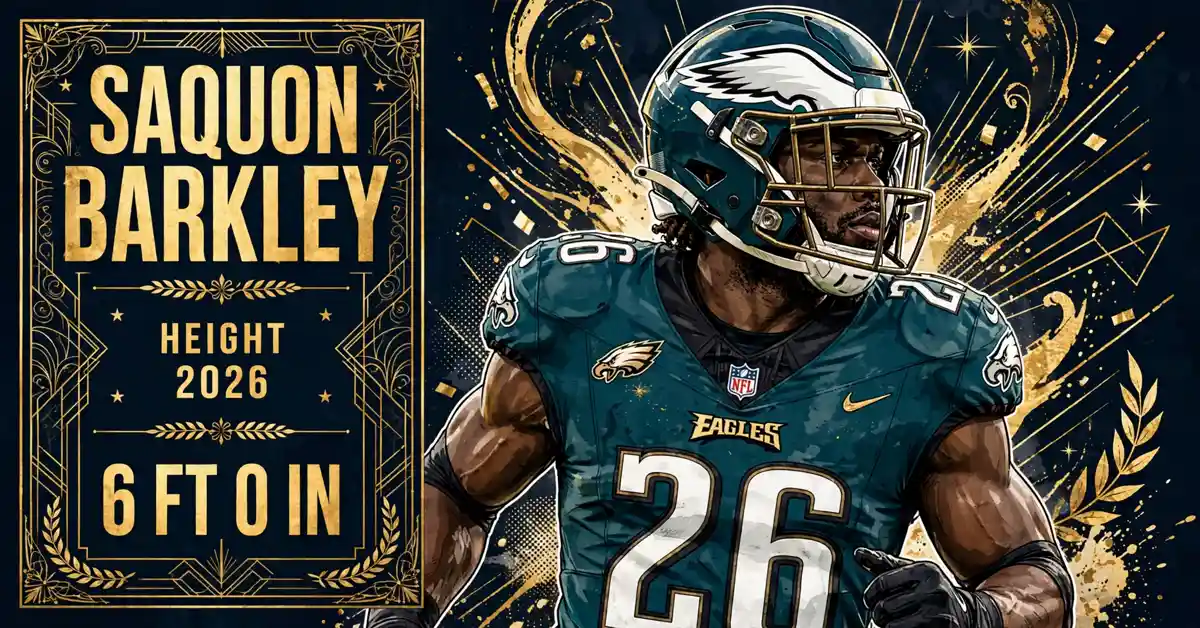
Saquon Barkley is 6 feet 0 inches tall (183 cm). That is the figure the NFL recorded when it measured him at the 2018 Scouting Combine in Indianapolis, and it is the figure the Philadelphia Eagles still print on his roster page. He weighed 233 pounds at that same combine, ran the 40-yard dash in 4.40 seconds, and jumped 41 inches off the floor — a set of numbers that turned a very good Penn State running back into the No. 2 overall pick in the 2018 NFL Draft.
If you have seen 5 feet 11 inches attached to his name, you are looking at an older number. His high-school recruiting listing put him at 5’11”, and a few databases never updated it. The combine measurement settles the question: Barkley is six feet tall, and he has been listed that way by his team, the league, and the record books ever since. This profile works through the proof, the reason the two numbers still circulate, and the career that made the measurement matter — a 2,005-yard season in 2024, a Super Bowl win on his 28th birthday, the richest running back contract in league history, and a 2026 season that has tested him with injuries and a 2-5 Eagles start.
Every figure below is attributed to the outlet that reported it. Nothing here is invented, and nothing is copied from a competitor’s telling of the same life.
Quick Facts: Saquon Barkley at a Glance
| Full name | Saquon Rasul Quevis Barkley |
| Height | 6 ft 0 in (183 cm) — combine-measured, 2018 |
| Weight | 233 lb at the combine; 232 lb on the Eagles roster |
| Born | February 9, 1997, Bronx, New York (age 29 in 2026) |
| Position / team | Running back, Philadelphia Eagles (No. 26) |
| College | Penn State, 2015–2017 |
| Draft | No. 2 overall, 2018 NFL Draft (New York Giants) |
| 40-yard dash | 4.40 seconds (2018 NFL Combine) |
| Vertical jump | 41 inches (2018 NFL Combine) |
| Current contract | Two-year, $41.2 million extension, March 2025 — $20.6 million per year, the highest average ever for a running back |
| Net worth (2026) | Estimated $30 million to $32 million, anchored at $32 million |
| Partner / children | Anna Congdon; daughter Jada and son Saquon Jr. |
How This Height Was Verified
The NFL Scouting Combine measures players barefoot, in socks, against a stadiometer, with league officials recording the result. Barkley measured 6 feet 0 inches at the 2018 combine in Indianapolis, and that number appears in the league’s own pre-draft measurables table, in the Eagles’ media guide, and on his Wikipedia infobox. It is the only measurement in his record taken under controlled conditions by a neutral party.
The 5-foot-11 figure comes from his recruiting profile. When Barkley committed to Penn State in February 2014, the recruiting services listed him at 5 ft 11 in and 233 pounds with a 4.66-second 40-yard dash. Teenagers grow, and recruiting listings are self-reported by high schools — they are not measurements. A few databases, including Pro Football Archives and Sportradar (which lists 180 cm), still carry the old figure. Treat those as stale entries, not as a second opinion. The combine number is the one his team uses, the one the league uses, and the one this article uses.
+
Early Life: From the Bronx to Coplay, Pennsylvania
Saquon Rasul Quevis Barkley was born on February 9, 1997, in the Bronx, New York. His family moved to Pennsylvania while he was still young, and he grew up in Coplay, a small borough in the Lehigh Valley, where he attended Whitehall High School. The move shaped everything that followed: Whitehall is where the recruiting services first noticed him, and it is where the 5-foot-11 listing that still haunts his height pages was born.
At Whitehall, Barkley ran track as well as playing football, and the track numbers tell their own story about the athlete he was becoming. He set personal bests of 46 feet 2.5 inches in the shot put and 6 feet 0 inches in the high jump — the high jump mark matching, to the inch, the height the NFL would later measure at the combine. He was a four-star recruit in the 2015 class, ranked the No. 13 running back in the country by the 247Sports Composite, and he committed to Penn State in February 2014 after initially committing to Rutgers.
The recruiting profile from that February listed him at 5 ft 11 in and 233 pounds, with a 4.66-second 40-yard dash. Those numbers were already out of date by the time he reached college — he was still growing, and the 4.66 forty belonged to a 17-year-old who had not yet spent three years in a college strength program. The full story of his path from the Bronx to Penn State to the NFL is told in our Saquon Barkley biography, which covers the family background and the recruiting decision in detail.
Penn State: Three Seasons That Built a Star
Barkley played three seasons at Penn State, from 2015 to 2017, and left as the most decorated running back in program history. In 38 games he rushed for 3,843 yards at 5.7 yards per carry with 43 rushing touchdowns, and added 1,195 receiving yards and eight more scores through the air. No Penn State player has produced more rushing touchdowns or more total touchdowns (53) than Barkley, and his 1,496-yard sophomore season set the program’s single-season record for a second-year back.
The honours stacked up in his final two seasons. He was named Big Ten Offensive Player of the Year in both 2016 and 2017, Big Ten Running Back of the Year in both seasons, and won the Paul Hornung Award in 2017 as college football’s most versatile player. He finished fourth in Heisman Trophy voting in 2017 and earned consensus All-American honours. Penn State’s own announcement when he signed with the Eagles in March 2024 called him the only player in school history — and only the fourth in Big Ten history — to gain 3,000 rushing yards and 1,000 receiving yards in a career.
The physical development across those three seasons is the bridge between the recruiting listing and the combine measurement. Barkley arrived in Happy Valley listed at 5’11” and left it measured at 6’0″. The strength program built the lower body that became his trademark — the quads that drew gasps in training videos and the power that let a 233-pound back run through arm tackles. By the time he declared for the draft on December 31, 2017, mock drafts had him as high as the second overall pick, the highest projection for a running back since Reggie Bush in 2006.
The 2018 NFL Combine: Every Number on the Board
The 2018 NFL Scouting Combine in Indianapolis is where Barkley’s height became an official fact. He measured 6 feet 0 inches and 233 pounds on the first day, then produced a workout that scouts still talk about eight years later. The numbers, all from the NFL Combine’s official record, are set out below.
| Measurement | Result | What it means |
|---|---|---|
| Height | 6 ft 0 in (1.83 m) | Official combine measurement; the authoritative figure |
| Weight | 233 lb (106 kg) | Eagles roster now lists 232 lb |
| 40-yard dash | 4.40 seconds | Second-fastest among running backs at the combine |
| 10-yard split | 1.54 seconds | Faster than wide receiver DeSean Jackson’s split |
| 20-yard split | 2.57 seconds | Explosive first-step speed for a 233-pound back |
| 20-yard shuttle | 4.24 seconds | Change-of-direction quickness |
| Vertical jump | 41 inches (1.04 m) | Tied for fifth overall at the combine |
| Bench press | 29 reps at 225 lb | Tied for the most by a running back; more than Joe Thomas managed |
| Arm length | 31 3/8 inches (0.80 m) | Helps him stiff-arm and catch away from his body |
| Hand span | 9 1/2 inches (0.24 m) | Secure hands for a receiving back |
| Wingspan | 6 ft 2 1/4 inches (1.89 m) | Longer than he is tall — useful in pass protection |
The workout comparisons wrote themselves. Barkley ran a faster 10-yard split than DeSean Jackson, a faster 40 than return man Devin Hester, benched more than Hall of Fame tackle Joe Thomas, and jumped higher than receiver Julio Jones. Bleacher Report called it one of the best combine performances in recent memory, and Barkley skipped athletic testing at Penn State’s pro day three weeks later because, as the report put it, he had nothing left to prove. Yahoo Sports’ Charles Robinson wrote that Barkley checked in with just about every prototypical measurement a scout could want, and the draft stock followed: mock drafts that had him as a top-ten pick in January had him as high as the second selection by late February, the highest projection for a running back since Reggie Bush in 2006. The Giants took him second overall on April 26, 2018.
New York Giants: Rookie of the Year and the Injury Years
Barkley’s rookie season remains one of the best debut years a running back has ever produced. He rushed for 1,307 yards and 11 touchdowns on 261 carries, caught 91 passes for 721 yards and four more scores, and led the entire NFL with 2,028 yards from scrimmage. He set Giants rookie records for rushing yards, rushing touchdowns, and total touchdowns (15), won the AP Offensive Rookie of the Year award, and made the Pro Bowl. Only two other rookies in league history had ever passed 2,000 yards from scrimmage, and none had ever caught more passes as a running back.
The next three seasons tested him. A torn ACL in Week 2 of the 2020 season cost him almost the whole year, and injuries held him to 1,630 rushing yards combined across 2019, 2020, and 2021. He returned to form in 2022 with a career-high 1,312 rushing yards and 10 touchdowns, made his second Pro Bowl, and carried the Giants to their first playoff appearance since 2016. His final Giants season, 2023, produced 962 rushing yards and six touchdowns in 14 games.
Across six seasons in New York, Barkley played 74 games and rushed 1,201 times for 5,211 yards and 35 touchdowns. The Giants chose not to sign him to a long-term deal, and when free agency opened in March 2024 he crossed the NFC East divide to the franchise’s fiercest rival. The Eagles announced the signing on March 13, 2024: a three-year contract worth $37.75 million, with $26 million guaranteed.
The Move to Philadelphia and the Record Extension
Barkley signed with the Eagles on a three-year, $37.75 million deal in March 2024, with $26 million guaranteed. The move put a 27-year-old back with heavy mileage behind the best offensive line in football, in an offence built around the tush push and a quarterback who demands defensive attention on every snap. What followed was the greatest season by a running back in Eagles history — and the greatest debut season by any free agent in Philadelphia sports history, in the words of Sportsnet’s Super Bowl coverage.
The Eagles did not wait for the contract to play out. Less than a month after the Super Bowl, in March 2025, they gave Barkley a two-year extension worth $41.2 million, with $36 million fully guaranteed at signing and up to $15 million more in incentives. The deal made him the highest-paid running back in NFL history and the first running back ever to average more than $20 million per year — $20.6 million, to be exact. ESPN’s Adam Schefter broke the news on March 4, 2025, and Pro Football Talk’s Mike Florio added that the full guarantees covered the 2025 and 2026 seasons. The extension keeps Barkley under contract through the 2028 season, though the structure matters: only $2.5 million of his 2027 salary is guaranteed, and his cap number jumps to about $13.06 million that year. His 2026 cash compensation is $16.75 million, including a $15.45 million option bonus and a $1.3 million base salary.
The contract math is why the 2026 season carried so much weight. Sports Illustrated framed it as a make-or-break year: with the bulk of his guarantees ending after this season, 2026 could be Barkley’s last in Philadelphia if he could not return to form. The Eagles’ answer to trade speculation in November 2026 was firm — they told other teams before the November 10 deadline that Barkley was not available, with general manager Howie Roseman surveying the market for other players instead. ESPN’s Tim McManus reported on November 2 that Barkley had received assurances from the front office that he would stay.
The Historic 2024 Season: 2,005 Rushing Yards
Barkley’s first season in midnight green rewrote the record books. He carried the ball 345 times for 2,005 rushing yards and 13 touchdowns, added 278 receiving yards, and finished with 15 total touchdowns. He became the ninth player in NFL history to rush for 2,000 yards in a regular season, and he did it while threatening Eric Dickerson’s single-season record of 2,105 yards — a mark that stood for 40 years. Seven of his touchdown runs covered 60 yards or more.
The awards followed the yardage. Barkley was named the AP NFL Offensive Player of the Year, earned first-team All-Pro honours, and finished the regular season as the league’s rushing champion. The Eagles rested him in Week 18 with the record in sight — a decision that cost him a shot at Dickerson but left him fresh for the playoffs, where the yardage kept coming. By the time the confetti fell in New Orleans, his combined regular-season and postseason rushing total stood at 2,504 yards, an NFL single-season record.
Super Bowl LIX: A Birthday Championship
Super Bowl LIX was played on February 9, 2025 — Barkley’s 28th birthday — at the Caesars Superdome in New Orleans. The Eagles beat the Kansas City Chiefs 40-22 to win the second Super Bowl in franchise history and deny the Chiefs a third straight title. Barkley’s own numbers on the night were modest by his standards: 25 carries for 57 yards and six catches for 40 yards, with the Chiefs stacking the box and daring Jalen Hurts to beat them through the air. Hurts did, throwing for 221 yards and two touchdowns, rushing for 72 yards and a score, and taking home Super Bowl MVP honours.
The quiet box score hid the history. Barkley’s first carry of the game made him the NFL’s single-season scrimmage-yards leader, regular season plus playoffs, and a two-yard run on the final play of the first half pushed him past Terrell Davis’s 1998 mark of 2,476 combined rushing yards. He finished the season with 2,504 rushing yards and 2,857 scrimmage yards including the playoffs — both records, both previously held by Davis for 26 years. The Eagles led 24-0 at halftime behind two interceptions, including Cooper DeJean’s 38-yard pick-six on his own 22nd birthday, and never let Kansas City closer than 16 points.

The 2026 Season So Far: A Slower Start
The 2026 season has been a hard one, for Barkley and for the Eagles. Through Week 9 — the last game before the Week 10 bye — he had played seven games and carried the ball 69 times for 296 rushing yards and three touchdowns, averaging 4.3 yards per carry, with seven receptions for 41 yards. That is 337 yards from scrimmage in seven games, a long way from the 2,005-yard pace of 2024. The Eagles sat at 2-5, and the offence that had looked unstoppable a year earlier had gone quiet.
The game log shows where the yards went missing. Week 1 against Washington brought 15 carries for 83 yards in a 24-22 win. Week 7 against Dallas produced his best day of the year — seven carries for 62 yards and a touchdown, at 8.9 yards a carry, in a 21-38 loss. Then came two grinding weeks: 13 carries for 30 yards and a touchdown at Washington on November 1, and 13 carries for 22 yards and a touchdown against his old team, the Giants, on November 8. He has scored Philadelphia’s only touchdowns in each of the last two games, but he has managed just 2.0 yards per carry across them.
Injuries explain part of the slide. Barkley has played through hamstring and back problems, and his snap share fell to 32 percent in the Washington game as he split the backfield with Elijah Mitchell. Rotowire’s November 8 report noted he had no injury designation for the Giants game, but the workload tells its own story — 13 touches a game is a long way from the 20-plus he carried through the 2024 playoff run. The bye week arrived at the right time. His next game is Week 11 against the Pittsburgh Steelers on November 22, and the Eagles need their highest-paid player healthy for the stretch run.
The context around the numbers matters as much as the numbers themselves. Philadelphia’s 2-5 record has put the whole offence under scrutiny, and the running game has drawn more of it than the passing game, because the 2024 identity was built on Barkley. New offensive coordinator Sean Mannion’s scheme has leaned on a passing attack that has not clicked, and the running lanes that opened behind the league’s best line a year ago have been tighter. Barkley’s own 2025 season — 280 carries for 1,140 yards — already showed the first step down from the historic year, and 2026 has continued the trend. None of that changes the height question this profile answers, but it is the reason the height question now sits inside a bigger one: whether the back who ran for 2,005 yards two seasons ago can still do it at 29 with a sore hamstring and a 2-5 team around him.
Saquon Barkley Height vs Other NFL Running Backs
At six feet tall, Barkley stands one inch above the average NFL running back. The top 20 backs in the league in 2018 averaged 5 feet 11 inches and 220.7 pounds — Barkley is an inch taller and about 12 pounds heavier than that average, and the gap shows up on film every week. He is not the tallest back in the league, and he is not the shortest. He sits in the sweet spot: tall enough to see over the line and run with power, short enough to hide behind his blockers and change direction without a long lever working against him.
| Player | Height | Weight | Note |
|---|---|---|---|
| Saquon Barkley (Eagles) | 6 ft 0 in (183 cm) | 233 lb | Combine-measured, 2018 |
| Derrick Henry (Ravens) | 6 ft 3 in (191 cm) | 247 lb | Tallest active running back; combine-measured |
| Leonard Fournette | 6 ft 0 in (183 cm) | — | Same height as Barkley |
| Christian McCaffrey (49ers) | 5 ft 11 in (180 cm) | 205 lb | One inch shorter, 28 lb lighter |
| Marshawn Lynch | 5 ft 11 in (180 cm) | — | Combine-measured at 5’11” |
| Tyreek Hill (Dolphins, WR) | 5 ft 10 in (178 cm) | — | Two inches shorter; speed over size |
The quarterback comparison puts his height in a wider frame. The two quarterbacks who define the modern NFL tower over him: Josh Allen stands 6 feet 5 inches, and Patrick Mahomes stands 6 feet 2 inches. Barkley gives away two inches to Mahomes and five to Allen, and it does not matter — he plays a position where the ball arrives at waist height and the work is done below the pads. History backs the point: Barry Sanders ran for 15,269 career yards at 5 feet 8 inches, and Emmitt Smith, the league’s all-time rushing leader, stood 5 feet 9 inches. Height helps a running back. It has never decided one.
So does height matter at all for a running back? The honest answer is that it matters at the margins, and Barkley’s career shows both margins. Six feet gives him the stride length to eat ground in the open field and the frame to carry 233 pounds without losing speed — the reason his seven 60-plus-yard touchdown runs in 2024 looked effortless. The cost is visibility and pad level: a taller back presents a bigger target, and the low running posture that lets a 5-foot-8 back disappear behind his guards is harder to hold for six feet of running back. Coaches live with the trade because the rest of the package — the 4.40 speed, the 41-inch jump, the hands — is rare at any height. The position’s history is full of great backs between 5-foot-8 and 6-foot-3, and Barkley sits almost exactly in the middle of that range.
How His Height Shapes His Running Style
Barkley’s game is built on the combination his measurements describe: a six-foot frame carrying 233 pounds, with the burst of a much smaller back. The 1.54-second 10-yard split from the combine is the number that matters most — it is the first-step explosion that lets him hit a hole before it closes, and it is why defensive coordinators game-plan for him as a home-run threat on every snap. The 41-inch vertical jump is the same quality turned upward: the leaping ability behind the hurdle, his signature move, in which he clears a diving defender in full stride.

Height cuts both ways for a back, and Barkley’s style shows both edges. At six feet he runs with a higher pad level than a 5-foot-8 back like Barry Sanders, which gives defenders a bigger target and makes him easier to square up in the open field. The counterweight is his lower-body power and his balance: the same legs that produced 29 bench-press reps of upper-body strength and a 41-inch jump let him run through arm tackles and keep his feet after contact. His wingspan — 6 feet 2 1/4 inches, longer than he is tall — helps in pass protection, where he can meet a blitzing linebacker with extended arms, and as a receiver, where he has caught 91 passes in a season.
The 2024 season showed the full package at its peak. Seven touchdown runs of 60 yards or more is not a power-back stat or a speed-back stat — it is both, and it is the product of a back who can break a tackle at the line, outrun a safety in the open field, and hurdle the last man standing. The 2026 dip is a reminder that the package depends on health: hamstring and back trouble have cut his snap share and his burst, and the 2.0 yards per carry across the last two games is what a great back looks like when his legs are not right.
Personal Life: Anna Congdon, Family and Faith
Barkley’s partner is Anna Congdon, his girlfriend since their Penn State days. The couple have two children: a daughter, Jada, and a son, Saquon Jr. Congdon has built her own following as a social-media influencer and model, with brand partnerships including Savage X Fenty, and the family keeps a low profile away from the football calendar. Barkley has spoken publicly about his faith, including in the days after the Super Bowl LIX win, which fell on his 28th birthday.
The family made unwanted headlines in July 2026, when an attempted burglary targeted their home. Barkley and his family were unharmed, according to the Tredyffrin Township Police Department, and the incident became part of a wider run of home invasions aimed at high-profile athletes that summer. The episode stayed a police matter rather than a public one — Barkley said little about it, and the coverage moved on within days.
Off the field, Barkley’s training habits are part of his public image. The squat and workout clips from his Penn State years still circulate, and the combine numbers remain the documented proof behind the reputation: 29 bench-press reps and a 41-inch vertical at 233 pounds is not a gym story, it is a league record. He has also put money into business ventures beyond football, including investments in startups — a thread the net-worth picture below picks up.
Saquon Barkley Net Worth in 2026
Barkley’s net worth in 2026 is estimated at $30 million to $32 million, anchored at $32 million. The range comes from the most recent 2026 trackers: SurpriseSports put the figure at $32 million in an update on October 18, 2026, Pro Football Network lands at about the same number, and Parade reported around $30 million in September 2026. The full breakdown of his contracts, endorsements, and investments is covered in our sister site’s Saquon Barkley net worth profile, which reaches the same $30 million to $32 million range.
The number is built on roughly $80 million in career NFL earnings — about $79.94 million in salary across his career, per a June 2026 tally — plus endorsement income estimated at around $10 million a year. Sports marketing analyst Bob Dorfman gave that endorsement figure to Front Office Sports in early 2025, and the brand list runs through Nike, Pepsi, Toyota, Visa, Dunkin’, Bose, and Old Spice. One report put his investment portfolio at $13.2 million across the S&P 500 and more than ten startups, though that figure comes from a single source and should be read as indicative rather than settled.
One tracker disagrees loudly, and the disagreement is worth explaining. Celebrity Net Worth updated its Barkley page on October 28, 2026, and now lists him at $100 million — more than triple every other 2026 source. The gap is a method problem, not a fact problem: the $100 million figure counts his cumulative cash earnings through the full 2026 season (about $96.7 million) and future contract years as if they were wealth already held, and it leans on peak valuations of private investments, notably the fintech company Ramp, which reached a $60 billion valuation in October 2026. Barkley told Front Office Sports that same month he had been required to divest a prediction-market investment because NFL rules bar players from investing in or promoting prediction-market companies. A net-worth estimate that counts money not yet received is a career-earnings total wearing the wrong label. The $30 million to $32 million range — after taxes, agent fees, and living costs on roughly $80 million banked — is the figure the evidence supports. For more profiles in this series, see the Celebrity Net Worth archive.
Frequently Asked Questions About Saquon Barkley Height
How tall is Saquon Barkley?
Saquon Barkley is 6 feet 0 inches tall (183 cm). The figure comes from his official measurement at the 2018 NFL Scouting Combine, and it matches the height the Philadelphia Eagles print on his roster page and the figure on his Wikipedia infobox.
How much does Saquon Barkley weigh?
Barkley weighed 233 pounds at the 2018 NFL Combine. The Eagles’ media guide lists him at 232 pounds, and current roster pages show 232 to 233 pounds depending on the season — a one-pound difference that reflects normal playing-weight fluctuation, not a new measurement.
What was Saquon Barkley’s 40-yard dash time?
Barkley ran the 40-yard dash in 4.40 seconds at the 2018 NFL Combine, the second-fastest time among running backs that year. His 10-yard split of 1.54 seconds was faster than wide receiver DeSean Jackson’s, and he also recorded a 41-inch vertical jump and 29 bench-press reps at 225 pounds.
Why do some sites list Saquon Barkley at 5 ft 11 in?
The 5-foot-11 figure comes from Barkley’s high-school recruiting profile, which listed him at 5 ft 11 in and 233 pounds when he committed to Penn State in February 2014. A few databases, including Pro Football Archives and Sportradar, never updated the listing. The combine measurement of 6 feet 0 inches, taken barefoot by league officials in 2018, supersedes it.
Is Saquon Barkley taller than Christian McCaffrey?
Yes — by one inch. Barkley is 6 feet 0 inches and McCaffrey is 5 feet 11 inches, both combine-measured. Barkley is also considerably heavier: 233 pounds against McCaffrey’s 205 pounds. Derrick Henry, at 6 feet 3 inches, is the tallest active running back in the league.
How old is Saquon Barkley in 2026?
Barkley was born on February 9, 1997, in the Bronx, New York, which makes him 29 years old in 2026. He won Super Bowl LIX with the Eagles on his 28th birthday, February 9, 2025, and he is in his ninth NFL season.
What is Saquon Barkley’s net worth in 2026?
Saquon Barkley’s net worth in 2026 is estimated at $30 million to $32 million, anchored at $32 million by the most recent trackers, including SurpriseSports (updated October 18, 2026) and Pro Football Network. Celebrity Net Worth lists $100 million after an October 2026 update, but that figure counts future contract years and peak investment valuations as wealth already held, so this profile treats it as an outlier.
How is Saquon Barkley doing in the 2026 season?
Through Week 9 (November 8, 2026), Barkley has played seven games with 69 carries for 296 rushing yards and three touchdowns, averaging 4.3 yards per carry, with seven receptions for 41 yards. The Eagles are 2-5, and Barkley has played through hamstring and back injuries with a reduced snap share. The team confirmed before the November 10 trade deadline that he would not be traded, and his next game is Week 11 against the Pittsburgh Steelers on November 22.
Sources and Reporting
This profile was reported from live sources in November 2026. Height and combine measurements come from the NFL Scouting Combine’s official record as reported by Bleacher Report (March 2018), 247Sports, GiveMeSport, and Wikipedia’s pre-draft measurables table, with the Eagles’ 2025 media guide confirming the 6-foot-0 roster listing. Career statistics come from Pro-Football-Reference (2026 game log, updated November 12, 2026) and the Philadelphia Eagles’ own signing announcement (March 13, 2024). Contract details come from ESPN’s Adam Schefter via Pro Football Rumors (March 2025) and Pro Football Talk’s Mike Florio. The 2024 season and Super Bowl LIX record totals come from Sportsnet and Deadspin (February 2025) and the Pro-Football-Reference box score. The 2025 season figures come from Sports Illustrated (2026). The 2026 season, injury, and trade-deadline reporting comes from Rotowire via CBS Sports (November 2026), NFL Network (November 1, 2026), and ESPN’s Tim McManus (November 2, 2026). Net-worth figures come from SurpriseSports (updated October 18, 2026), Pro Football Network, Parade (September 9, 2026), and Celebrity Net Worth (updated October 28, 2026), with endorsement figures attributed to sports marketing analyst Bob Dorfman via Front Office Sports. The home-invasion report comes from Heavy (July 19, 2026), citing ESPN and the Tredyffrin Township Police Department. Reporting window: November 2026. Figures are estimates where labelled as such; contract values are reported totals, not cash received.
About the Author
Nathan Cole covers celebrity net worth and biography for Guide Net Worth, reporting from public records, league data, and named outlets. Read more about the site’s methods on the About Us page.
Corrections: spot an error in a figure or a date? Email the newsroom and we will check it against the source and correct it, with a note on the page.
References & Sources
This article has been fact-checked and verified against multiple public sources, financial disclosures, SEC filings, Forbes reports, Celebrity Net Worth databases, and official records. All net worth estimates are based on publicly available information and financial analysis.