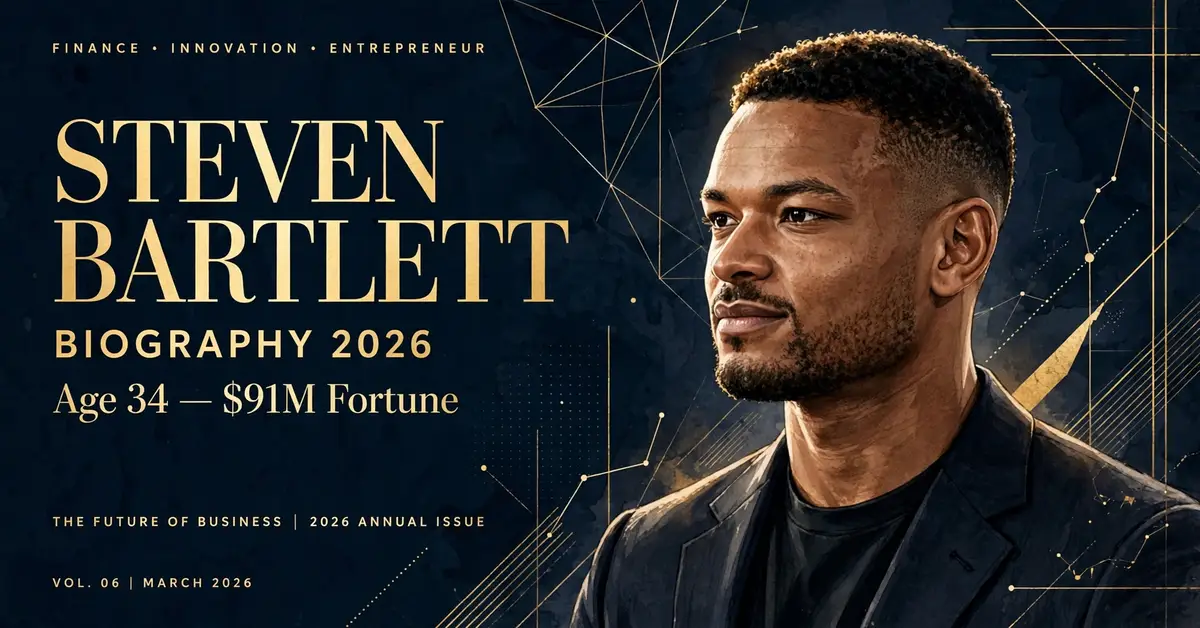
Steven Bartlett biography 2026: born 26 August 1992 in Botswana, the Social Chain founder and Diary of a CEO host is 34, with a fortune near $91 million.
Steven Bartlett is 34 years old. Born on 26 August 1992 in Gaborone, Botswana, and raised in Plymouth, England, he went from an expelled schoolboy who quit university after a single lecture to one of the most recognisable business faces in Britain. He co-founded the social media agency Social Chain at 21, built The Diary of a CEO into one of the biggest podcasts on the planet, and became the youngest investor in Dragons’ Den history.
The money followed the fame, but pinning it down takes care. Real Business put his net worth at around £71 million (about $91 million) in 2026, while other published estimates run from £29 million to more than £100 million. The gap is not sloppy reporting. Most of his wealth sits in a private holding company, Steven.com, valued at $425 million in October 2025, and Bartlett owns more than 90 percent of it. That stake is worth hundreds of millions on paper and far less in cash he can spend. This biography tells the full story in order, separates the paper wealth from the spendable kind, and names the source behind every big number.
Freshness matters here because Bartlett’s story moved fast in 2026. Forbes ranked him third on its 2026 Top Creators list in June 2026, crediting him with $52 million in estimated gross earnings between March 2025 and March 2026. He was the highest-placed European on the list and the highest-placed podcaster. Everything below is checked against reporting from 2025 and 2026, with older claims flagged where they come from.
Quick Facts: Steven Bartlett
| Full name | Steven Cliff Bartlett |
| Born | 26 August 1992, Gaborone, Botswana |
| Age | 34 (as of November 2026) |
| Nationality | British |
| Raised | Plymouth, Devon, England (moved there aged 2) |
| Education | Plymstock School (expelled in sixth form); Manchester Metropolitan University (dropped out after one lecture) |
| Known for | Co-founder of Social Chain; host of The Diary of a CEO; investor on BBC’s Dragons’ Den |
| Companies | Social Chain (2014), Flight Story (2023), Thirdweb (2021), Steven.com (holding company) |
| Books | Happy Sexy Millionaire (2021); The Diary of a CEO: The 33 Laws of Business and Life (2023) |
| Net worth (2026) | Estimated £71 million (about $91 million); published range $50 million–$115 million |
| Forbes Top Creators 2026 | Ranked #3; $52 million estimated gross earnings, March 2025–March 2026 |
| Partner | Melanie Vaz Lopez (reported engaged since 2025) |
| Height | Reported 5ft 11in (180cm) |
How This Estimate Was Made
There is no audited figure for Steven Bartlett’s personal wealth, and no single number in this article should be read as one. Real Business estimated around £71 million (about $91 million) in 2026, and that is the anchor used here because it is the most recent full estimate from a UK business outlet and it sits near the middle of the credible range. Elites Mindset put him at £75–85 million in September 2026. Internewscast reported £68 million the same month. At the low end, MoneyWeek’s 2025 figure, attributed to Forbes, was £29 million, and StoriesToday estimated his liquid wealth — cash and assets he could actually use — at £36–54 million ($50–75 million) in January 2026.
The high-end figures come from a different kind of math. Steven.com was valued at $425 million in October 2025, and Bartlett owns more than 90 percent of it, which puts his paper stake above $380 million. That is a valuation, not money in the bank. It only turns into cash if he sells shares or the company lists, and private valuations can fall as fast as they rise. Forbes’ $52 million from the 2026 Top Creators list is gross earnings across one year, not net worth. This article keeps those three things apart: earnings, paper value, and spendable wealth.
+
Steven Bartlett’s Early Life in Botswana and Plymouth
Steven Cliff Bartlett was born on 26 August 1992 in Gaborone, the capital of Botswana. His father is English and works as a structural engineer. His mother is Nigerian. The family moved to England when Steven was two years old, settling in Plymouth, a port city on the south-west coast. That move shaped almost everything that followed. Plymouth in the 1990s and 2000s was overwhelmingly white and middle class in the areas where the family lived, and Bartlett has spoken about growing up as one of the only Black children around him.
He told the Guardian that he grew up in a home with a lot of love but always felt different. “I was one of the only Black people in an all-white, middle-class area of Plymouth,” he said. The Standard, retelling his rise in 2025, put it the same way: a first-generation immigrant of British-Nigerian descent whose success was far from guaranteed. His mother had left school at seven and never learned to read or write. His father spent five days a week working in London, which left a ten-year-old Steven with more independence than most children his age. Money was tight. Bartlett has recalled that the family did not have a huge amount of money and did not take fancy holidays.
That background is the first thing most short biographies skip past, and it is the key to the rest of his story. He did not arrive at business from a comfortable home with connections. He arrived from a household where reading was not something his mother could do, where his father was away most of the week, and where standing out was a daily fact of life rather than a choice. The outsider feeling he describes from those years shows up again and again in his later work — in the podcast questions he asks about belonging, in the books he writes about self-worth, and in the way he talks about building companies as a way of building a place where he fit.
School, Expulsion and the One-Lecture University Exit
Bartlett attended Plymstock School in Plymouth. School did not suit him. His attention wandered, homework went undone, and classes went unattended. He was expelled in the sixth form for failing to hand in homework or turn up to class. The expulsion could have been the end of the education story. In Bartlett’s telling, it was closer to a release. He had already started his first small business at around 16, organising school trips and parties and taking an agreed cut of the profits. He was learning a different curriculum: how to get people to show up, how to price something, how to keep a share of the money that moved through his hands.
He did try the conventional route once more. He enrolled at Manchester Metropolitan University to study Business Management. He lasted one lecture. He looked around the room, decided it would not take him where he wanted to go, and walked out. He never went back. The one-lecture dropout has become the most repeated line in his biography, and it is worth pausing on what it actually means. He was 18, with no degree, no job, and no family money. Walking out of university was not a bold bet backed by a safety net. It was a teenager deciding that the room he was sitting in was the wrong place to learn the thing he wanted to learn.
In 2023, Bartlett was diagnosed with ADHD after a brain scan, a fact recorded on his Wikipedia page and repeated by The Standard. He has described himself as having “overfocused ADHD” — strong focus on things that engage him, poor focus on things that do not. Read against the school record, the diagnosis fills in a gap that the expulsion story leaves open. The boy who could not sit through homework could spend hours building something online. The difference was never effort. It was interest, and the internet gave him places where his interest counted.
Wallpark: The First Business That Failed
After leaving university, Bartlett built Wallpark in 2013, an online messaging board where students could connect, swap ideas, and organise events and services. It was his first proper venture, and it failed to gain traction. Short biographies often skip Wallpark entirely or mention it in a single clause. That misses its role. Wallpark taught him the two lessons that made Social Chain possible: online communities grow around what people already care about, and a platform with no audience is a room with no one in it.
He was 21, living in Manchester, and starting again from nothing. The failure did not slow him down. Within a year he had taken the community idea in a different direction. Instead of building his own audience from scratch, he would help brands reach the audiences that already existed on social media. That pivot — from owning the community to renting attention inside other people’s communities — became Social Chain.
Social Chain: Building a Social Media Agency From a Bedroom
In 2014, Bartlett and Dominic McGregor co-founded Social Chain in Manchester. They started it from a bedroom in a shared house, with almost nothing behind them. Bartlett was 22. The idea was simple and, in 2014, still new enough to be an edge: brands did not know how to talk to young people on social media, and the people who ran social media pages with millions of followers did not know how to sell that attention. Social Chain sat in the middle, running campaigns and influencer marketing for brands that wanted reach among younger audiences.
The client list grew into names that still get quoted in every profile of the company: Apple, McDonald’s, Amazon, TikTok, and KFC, according to the London Stock Exchange announcement for the later Brave Bison deal and UniFresher’s 2026 profile. Social Chain was part of the first wave of social media marketing, helping international brands work out the grammar of viral content at a moment when most of them were still treating social media as a place to paste television adverts. Bartlett’s age was part of the pitch, even if nobody said so out loud. He was the audience the brands wanted to reach, and he was selling them a map of his own generation’s attention.
Growth was fast. By 2019, the company had become part of a much bigger group, and Bartlett, still only 27, was sitting on the board of a publicly listed company. The bedroom startup had turned into a serious business in five years. The speed is the part of the story that gets told most often. The part that gets told less often is how much of that growth depended on timing. Social Chain arrived at the exact moment brands realised social media was not a side channel. Five years earlier, the market would not have been ready. Five years later, the big agencies would already have owned it.
The Social Chain AG Listing and the 2019 Merger
In 2019, Social Chain merged with Lumaland, a German online retailer, and the combined group became The Social Chain AG, listed on stock exchanges in Germany. Toolshero’s biography notes that Bartlett, at 27, became one of the youngest board members of a publicly traded company in Europe. The merger changed what Social Chain was. It had started as an agency selling attention. It was now part of a listed group that had acquired more than 30 companies by 2019 — at least five marketing agencies and around twenty e-commerce businesses, according to Bartlett’s own account reported by Tech Funding News.
The listing is often told as the climax of the Social Chain story. In some ways it was. A 27-year-old who had started a company in his bedroom five years earlier was now on the board of a public company. But the merger also planted the question that would follow Bartlett for years afterwards: how much of the group’s value came from the agency he built, and how much came from the retail businesses bolted on beside it? The Times ran an investigation in 2023 arguing that much of the group’s value came from the retail side rather than Bartlett’s agency. That challenge is covered in full later in this article, because it matters to any honest account of his fortune. For now, the plain fact is that the listing made Bartlett a public-company director before his 28th birthday, and it gave him a platform — and a reputation — far bigger than the agency alone could have provided.
He did not stay to run it. In December 2020, Bartlett stepped down as chief executive of Social Chain. He was 28. The decision looks strange only if you assume the agency was the destination. For Bartlett, it was the first act. He had already started the project that would define the next decade of his career, and it had begun three years earlier in a spare room with almost no listeners.
Stepping Down as CEO and the Brave Bison Sale
The final chapter of the Social Chain story arrived in February 2023, and it is the most misunderstood part of Bartlett’s biography. Brave Bison, a London-listed social and digital media group, agreed to buy the Social Chain agency. The initial consideration was £7.7 million, according to the company’s announcement to the London Stock Exchange on 3 February 2023. Tech Funding News and Business Live reported the deal the same week. Some later coverage described the price as £17 million, which appears to reflect a fuller accounting of the transaction; the £7.7 million figure is the initial consideration named in the formal announcement.
Here is the detail most profiles leave out: Bartlett did not get that money. Business Live reported that he and Dominic McGregor had not retained a stake in the company and would not financially benefit from the sale. The agency being sold was a non-core division of The Social Chain AG, and by 2023 Bartlett had been gone from the chief executive’s chair for more than two years. He wrote on LinkedIn at the time that the group was selling the first and original agency business they had started in Manchester almost ten years earlier, a business he believed was generating £15 million in sales in 2022. He said he was happy the brand was in talented hands, wished the group’s new chief executive well, and noted that he had submitted a bid to buy one of the group’s other agencies from its portfolio.
The sale matters to this biography for two reasons. First, it corrects a lazy version of the story in which Bartlett “sold Social Chain for £7.7 million” and pocketed the cash. He did not. Second, it shows what he had already understood by 2020: the agency was a vehicle, not the destination. The money that made him rich came from what he built next, and from the audience he had been gathering while the agency grew.
The Diary of a CEO: From Spare Room to a Billion Listens
Bartlett launched The Diary of a CEO in 2017, while he was still running Social Chain. The first episode dropped on 29 September 2017 and was recorded in a spare room. It began as a personal project — Bartlett sharing his own thoughts and lessons — and grew into long-form interviews with entrepreneurs, investors, athletes, scientists, and authors. UrbanGeekz reported in July 2026 that the show had passed 18 million YouTube subscribers and averaged around 60 million monthly views and downloads. Business Stories reported that the show passed one billion views and listens across Apple, Spotify, and YouTube in 2024.
Those numbers put it among the biggest business podcasts on the planet, and the format explains why. Bartlett interviews people other business shows cannot get, and he asks the questions other hosts avoid — about failure, fear, childhood, and the parts of success that do not photograph well. His guests have included Matthew McConaughey, Maisie Williams, Louis Tomlinson, Jimmy Fallon, and Thierry Henry, according to The Standard. The show’s tone is closer to therapy than to a boardroom, and that is the point. Bartlett’s own story — the expulsion, the dropout, the outsider childhood — gives him permission to ask personal questions, and his guests answer them.
The podcast is also the engine of his current wealth. It is not a side project with a sponsor read at the top. It is the centre of a media business that sells advertising, books, live events, and partnerships with brands such as Spotify, LinkedIn, and Adobe, according to Forbes’ 2026 reporting. The audience is the asset. Every episode adds listeners who can be sold books, tickets, and products, and every famous guest brings their own audience with them. That loop — guests bring listeners, listeners bring sponsors, sponsors fund bigger guests — is the machine that turned a spare-room recording into a holding company worth hundreds of millions on paper.

Dragons’ Den: The Youngest Dragon in the Show’s History
In May 2021, the BBC announced that Bartlett would join Dragons’ Den as an investor for Series 19. He was 28, and he was the youngest Dragon in the show’s history. Real Business and UrbanGeekz both record the milestone, and Wikipedia notes that he was the youngest person to appear on the show as an investor. The series aired in early 2022, which is why some profiles date his debut to 2022; the announcement and the appointment came in 2021.
The casting was a deliberate change of direction for the programme. The existing Dragons were seasoned, older, and mostly from traditional industries. Bartlett brought a younger, social-media-native view of business, and a different kind of credibility with founders who had grown up online. On screen he plays a calm investor, leaning forward with quiet intensity while founders pitch, as ABC Money described him in 2026. Off screen, the show gave him something the podcast could not: a weekly television audience of millions who had never heard of Social Chain and did not listen to business podcasts.
The Den also became a real investment channel. Bartlett has put his own money into companies he met on the show, and he has spoken publicly about what happens after the cameras stop — the due diligence, the paperwork, and the deals that fall apart once the excitement fades. In September 2026, Internewscast reported him explaining that process on his YouTube channel, Behind The Diary, including the detail that the first step after a deal is agreed is for everyone to leave the Den. One of his reported investments, a natural energy drink company, grew its monthly revenue from £9,000 in March 2022 to £400,000, according to his LinkedIn post quoted in that report. He has also said he put £150,000 of his own money into CheeseGig, a technology company delivering cheese. Not every Den deal completes, and Bartlett is open about that. The television version is a pitch. The real version is months of checks, and some of them fail.
He remains on the panel in 2026, and the role has become part of his public identity in a way the agency never was. Ask a stranger in Britain who Steven Bartlett is and the answer is as likely to be “the young one on Dragons’ Den” as “the podcast guy”. Both are true, and both feed each other. The television audience finds the podcast. The podcast audience watches the television show.

Happy Sexy Millionaire and The 33 Laws: Bartlett the Author
Bartlett has written two books, and both did far better than a podcaster’s side project usually does. The first, Happy Sexy Millionaire, came out in 2021. It is a short, plain-spoken book about ambition, self-worth, and the gap between getting rich and feeling happy. It drew directly on his own life: the Plymouth childhood, the expulsion, the dropout years, and the realisation that the money he had chased did not fix the feeling of not being enough.
The second book is the bigger one. The Diary of a CEO: The 33 Laws of Business and Life was published by Penguin on 29 August 2023. It compresses thousands of podcast conversations into 33 principles, arranged in four pillars: The Self, The Story, The Philosophy, and The Team. The Standard reported that it became the fastest-selling personal development book since records began, and it became a Sunday Times bestseller. That is not a modest achievement for a book built from podcast interviews. It means the audience was large enough, and loyal enough, to buy the same ideas twice — once as audio, once as print.
The books matter to the biography because they show how Bartlett turns attention into income. A podcast episode earns advertising money once. A book earns royalties for years, gets stocked in shops, and puts his name in front of people who never listen to podcasts. The 33 Laws also gave him a second identity: not just a host who asks questions, but an author with a system. Whether the system holds up is a matter of taste. The sales figures are a matter of record, and they are large.
Thirdweb and the Web3 Bet
In 2021, the same year he joined Dragons’ Den, Bartlett co-founded Thirdweb, an open-source Web3 development platform that gives developers tools to build blockchain applications without writing the underlying code from scratch. The company raised $24 million in a Series A round at a $160 million valuation, according to UrbanGeekz and Tech Funding News. The timing was the peak of the crypto boom, and the bet was that Web3 would need the same kind of simple tooling that the early web had needed.
Thirdweb is the least covered of Bartlett’s big ventures, and the most useful for understanding how he invests. He does not buy into a trend after it is safe. He buys into the tools that a trend needs to grow. Social Chain sold the tools brands needed to reach audiences on social media. Thirdweb sold the tools developers needed to build on blockchains. The pattern is the same: find the new platform early, then sell shovels to the people rushing to dig. Whether Web3 grows into the market its backers promised is still an open question, and Thirdweb’s $160 million valuation dates from a very different market than the one in 2026. The venture shows his instinct clearly, even if the final value is still to be decided.
Flight Story, Flight Fund and Steven.com: The Holding Company
In 2023, Bartlett launched Flight Story, a media and investment group, and the Flight Story Fund — also called the Flight Fund — a fund backing European founders. Tech Funding News reported the fund as a $100 million vehicle, while some 2026 reporting describes it as £100 million, about $134 million. Face2Face Africa reported that the fund planned to invest between $1 million and $10 million in early-stage European startups each year, with a focus on female-founded ventures. The fund is the clearest expression of what Bartlett wants his second act to be: not just a creator with a podcast, but an investor with a portfolio.
In the autumn of 2025, he pulled the pieces together under one name. FlightStory, the Flight Fund, and FlightCast were unified into Steven.com, a holding company that owns his media assets and creator ventures. In October 2025, Steven.com closed an eight-figure investment round at a $425 million valuation, led by Slow Ventures and Apeiron Investment Group, with Bartlett keeping more than 90 percent ownership. UrbanGeekz, Real Business, and Forbes’ 2026 coverage all report the same figures. The round matters because it is the first time the market put a public price on the whole Bartlett operation — podcast, books, live events, fund, and all — rather than on one company inside it.
Forbes’ 2026 reporting adds detail on what Steven.com does with that money. The holding company buys up other creator-led brands, runs a media studio and podcast technology arm, and operates Founded.com, which gained a million followers on Instagram in ten months, according to Creators Hub’s account of the Forbes list. Bartlett has also backed technology companies including Replit and Lovable, per the same Forbes coverage. The shape of the business is now clear: the podcast brings the audience, the holding company turns the audience into businesses, and the fund sends capital back into European startups. He is, as Forbes’ coverage put it, a businessman who makes content rather than a content creator who stumbled into business.
Steven Bartlett’s Net Worth in 2026: The Full Breakdown
With the story told, the money can be laid out plainly. Real Business estimated Bartlett’s net worth at around £71 million (about $91 million) in 2026. That is the anchor figure for this article. Around it sits a spread of published estimates that shows how uncertain private wealth really is.
| Source | Estimate | Date | What it counts |
|---|---|---|---|
| Real Business | £71m (~$91m) | 2026 | Overall personal net worth — anchor figure |
| Elites Mindset | £75–85m | September 2026 | Deployable capital and verified asset base |
| Internewscast | £68m | September 2026 | Overall personal fortune |
| StoriesToday | £36–54m liquid ($50–75m) | January 2026 | Cash and usable assets only; paper stake ~£240m |
| MoneyWeek / Forbes | £29m | 2025 | Older estimate, before the Steven.com round |
| London Lifestyle Blog | $90–110m | March 2026 | Overall estimate from secondary sources |
The honest range, using the credible 2025–26 estimates, is $50 million to $115 million. The bottom of that range is the liquid-wealth view: what he could actually spend. The top is the generous view, counting the full value of private holdings at their most recent valuations. The £29 million figure from 2025 is now out of date — it predates the October 2025 Steven.com round — and the £100–150 million figures on fan sites such as diaryofceo.online have no named reporting behind them and should be treated with care. The $115 million figure still quoted on some celebrity sites dates from 2023 and has not been refreshed.
The reason the numbers disagree is structural, and it is worth understanding because it explains almost every celebrity net worth argument. Bartlett’s wealth has three layers. The first is cash and liquid assets: podcast advertising, book royalties, speaking fees, and investment returns he has already banked. The second is his stake in Steven.com, worth more than $380 million on paper at the October 2025 valuation. The third is his fund and startup portfolio — Thirdweb, Replit, Lovable, and the Dragons’ Den investments — whose value depends on future exits that have not happened yet. Add the paper value of layer two to the cash of layer one and he looks like a near-billionaire. Count only layer one and he looks like a wealthy podcaster. Both counts use real numbers. Neither is the whole truth. The £71 million anchor sits between them because it discounts the paper value for illiquidity while still crediting the businesses he owns.
How Much Does Steven Bartlett Earn? The Forbes 2026 Numbers
The freshest hard number on Bartlett’s income comes from Forbes. Its 2026 Top Creators list, published in June 2026, ranked him third, with $52 million in estimated gross earnings between March 2025 and March 2026. Only MrBeast, at $300 million, and Dhar Mann, at $65 million, earned more. The top 50 creators on the list collectively earned $1.02 billion, the first time the group has passed a billion dollars, up 20 percent on the previous year. Bartlett was the highest-placed European and the highest-placed podcaster on the list, with 38.7 million followers across platforms.
Two things about that figure need to be said clearly. First, it is gross earnings, not profit and not net worth. It counts the money that reached his businesses before production costs, staff, and tax. A podcast with a studio, editors, producers, and a live events arm costs real money to run, and the $52 million is before those costs. Second, Forbes explicitly excluded equity held in public and private companies from the earnings figure. The $425 million Steven.com valuation does not enter the table at all. That is why the $52 million and the £71 million net worth can both be true at the same time: one is a single year’s gross income, the other is the accumulated value of everything he owns after costs and discounts.
Where does the $52 million come from? Forbes’ coverage and the reporting around it point to four streams: podcast advertising and sponsorships, partnerships with Spotify, LinkedIn, and Adobe, book royalties and live events, and the media businesses inside Steven.com. The show’s scale makes the advertising math work: 18 million YouTube subscribers and around 60 million monthly views and downloads give sponsors an audience that most television shows would envy, at a fraction of television’s production cost. That low overhead is exactly what the Forbes coverage highlighted — interview and studio formats that need a small team relative to the revenue they bring in.
Personal Life, ADHD and Life Away From the Cameras
Bartlett keeps his private life quieter than his business life, but the outlines are public. His partner is Melanie Vaz Lopez, a French influencer and podcast host. Toolshero’s biography names her as his girlfriend, and reports in 2026 described the pair as engaged since 2025. He does not parade the relationship, and this article will not go further than what has been reported. The couple appear in public together occasionally, and she has her own audience and her own show.
His ADHD diagnosis in 2023, after a brain scan, is something he has spoken about openly, and it reframes the school story that opens this biography. The boy who was expelled for not handing in homework was not lazy. He was, in his own description, overfocused — able to pour hours into things that engaged him and almost unable to engage with things that did not. That is a useful lens for the whole career. Social Chain, the podcast, the books, and the fund all reward the same trait: deep, sustained attention to one project at a time, switched between projects rather than spread thin.
He is also, by several accounts, a disciplined operator off camera. The podcast schedule alone — long-form interviews, recorded weekly, with the research each guest requires — is a heavy workload on top of running a holding company and sitting on a television panel. The public image is calm and measured. The work behind it is volume: hundreds of episodes, two books, a fund, a holding company, and a television show, all built in under a decade.
What Steven Bartlett Is Doing in 2026
As of November 2026, Bartlett’s year has been defined by the Forbes ranking and by the consolidation of Steven.com. The June 2026 Top Creators list put him third in the world among creators by earnings, ahead of every other European and every other podcaster. The October 2025 valuation of Steven.com at $425 million is the number every profile now has to reckon with, and it has changed the conversation about him. He is no longer described only as a podcaster or a Dragon. He is described as the owner of a media holding company, and the podcast is treated as one asset inside it.
He also continues to expand his television profile. He remains on the Dragons’ Den panel, and ProfileAge reported him as a guest investor for Season 18 of the American Shark Tank, bringing his Den experience to the US series. That move, if confirmed on screen, would put him in front of the largest television investment audience in the world. Behind the scenes, the Flight Fund keeps deploying capital into European startups, and Steven.com keeps buying creator-led brands. The direction of travel is consistent: less time as the face in front of the camera, more time as the owner of the businesses behind it.
| Year | Milestone |
|---|---|
| 1992 | Born 26 August in Gaborone, Botswana |
| 1994 | Family moves to Plymouth, England |
| 2008–09 | Expelled from Plymstock School in sixth form |
| 2010 | Drops out of Manchester Metropolitan University after one lecture |
| 2013 | Founds Wallpark; the venture fails to gain traction |
| 2014 | Co-founds Social Chain with Dominic McGregor |
| 2017 | Launches The Diary of a CEO (first episode 29 September) |
| 2019 | Social Chain merges with Lumaland to form The Social Chain AG, listed in Germany |
| 2020 | Steps down as Social Chain CEO (December) |
| 2021 | Joins Dragons’ Den (announced May, youngest Dragon, aged 28); publishes Happy Sexy Millionaire; co-founds Thirdweb |
| 2023 | Publishes The 33 Laws of Business and Life (29 August); launches Flight Story and the Flight Fund; Brave Bison buys the Social Chain agency for £7.7m initial consideration; ADHD diagnosis |
| 2024 | The Diary of a CEO passes one billion views and listens |
| 2025 | Steven.com valued at $425m in October funding round; Bartlett retains 90%+ ownership |
| 2026 | Forbes Top Creators: ranked #3 with $52m gross earnings (March 2025–March 2026); net worth estimated at ~£71m (~$91m) |
The Criticism and the Questions Around the Numbers
No honest biography of Bartlett can skip the criticism, because it goes to the heart of the fortune this article is estimating. In 2023, The Times ran an investigation into his business claims, arguing that much of the Social Chain group’s value came from the retail businesses acquired alongside the agency, not from the agency Bartlett built. Business Stories’ 2026 profile records the investigation and its argument. The point is a fair one. The Social Chain AG that listed in 2019 was a group of more than 30 companies, most of them e-commerce businesses. The agency was one part of it. Crediting Bartlett with the whole group’s value would overstate his contribution, and the £7.7 million Brave Bison paid for the agency arm in 2023 — for a business doing around £15 million in sales — is a useful reality check on what the agency itself was worth.
There is a second, broader question that applies to every figure in this article. Private company valuations are opinions, not prices. Steven.com was valued at $425 million because investors in October 2025 agreed to pay a price that implied that value. If the next round values it lower, Bartlett’s paper wealth falls with it, and no cash changes hands either way. The £71 million anchor used here already discounts for that uncertainty. Readers who see a headline claiming he is worth $400 million should know what that headline is counting: almost all of it is the paper value of shares he has not sold, in a company that has not listed.
None of that takes away from what he has actually built. A podcast with 18 million YouTube subscribers, a book that became the fastest-selling personal development title since records began, a seat on Britain’s best-known investment show, and a fund writing cheques to European founders are real achievements with real revenue behind them. The criticism does not say he built nothing. It says the numbers need care. This article agrees, and that is why it gives a range, names its sources, and separates paper wealth from cash.
Frequently Asked Questions About Steven Bartlett
How old is Steven Bartlett?
Steven Bartlett is 34 years old as of November 2026. He was born on 26 August 1992 in Gaborone, Botswana, and turned 34 on 26 August 2026. He moved to Plymouth, England, with his family when he was two years old.
What is Steven Bartlett’s net worth in 2026?
Steven Bartlett’s net worth is estimated at around £71 million (about $91 million) in 2026, according to Real Business. Published estimates vary widely, from £29 million to more than £100 million, because most of his wealth is tied up in his private holding company Steven.com, valued at $425 million in October 2025. The honest range across credible 2025–26 estimates is $50 million to $115 million.
How did Steven Bartlett make his money?
He made his first money co-founding the social media agency Social Chain in 2014 with Dominic McGregor, then built his fortune through The Diary of a CEO podcast (launched 2017), two bestselling books, his Dragons’ Den investments, the Web3 company Thirdweb, and his holding company Steven.com, which owns his media businesses and the Flight Fund. Forbes estimated his gross earnings at $52 million between March 2025 and March 2026.
How tall is Steven Bartlett?
Steven Bartlett is reported to be 5 feet 11 inches tall (180cm). The figure comes from celebrity biography sites rather than an official measurement, so it should be treated as reported rather than confirmed.
Who is Steven Bartlett’s girlfriend?
Steven Bartlett’s partner is Melanie Vaz Lopez, a French influencer and podcast host. Reports in 2026 described the pair as engaged since 2025. Bartlett keeps his private life largely out of public view, and the engagement has been reported rather than formally announced by the couple.
Why did Steven Bartlett leave Social Chain?
Bartlett stepped down as chief executive of Social Chain in December 2020 to focus on new projects, above all The Diary of a CEO podcast. The Social Chain agency itself was later sold to Brave Bison in February 2023 for an initial consideration of £7.7 million. Bartlett and his co-founder Dominic McGregor held no stake in the company by then and did not financially benefit from that sale, according to Business Live.
What books has Steven Bartlett written?
He has written two books: Happy Sexy Millionaire (2021) and The Diary of a CEO: The 33 Laws of Business and Life (Penguin, 29 August 2023). The second book became a Sunday Times bestseller and, according to The Standard, the fastest-selling personal development book since records began.
Is Steven Bartlett still on Dragons’ Den in 2026?
Yes. Bartlett joined Dragons’ Den in 2021, announced in May of that year as the youngest Dragon in the show’s history at 28, and he remains on the panel in 2026. He has also been reported as a guest investor for Season 18 of the American show Shark Tank.
Sources & Reporting
This biography was researched in November 2026 from live reporting and reference sources. The birth date, family background, and career timeline are drawn from Wikipedia’s Steven Bartlett (businessman) entry, last updated in August 2026, and cross-checked against Toolshero’s biography (updated November 2025) and The Standard’s 2025 profile of his rise. The Social Chain history, the Brave Bison sale, and the statement that Bartlett held no stake in the sale come from the London Stock Exchange announcement of 3 February 2023, Business Live’s reporting of February and August 2023, and Tech Funding News (February 2023). Podcast audience figures come from UrbanGeekz (July 2026) and Business Stories (2026). The Steven.com valuation and ownership come from UrbanGeekz, Real Business (2026), and Forbes’ 2026 Top Creators coverage via Visual Capitalist, DesignTAXI, and Qoshe. The net-worth anchor of £71 million comes from Real Business (2026), with the range built from Elites Mindset (September 2026), Internewscast (September 2026), StoriesToday (January 2026), and MoneyWeek’s 2025 figure. The Times’ 2023 investigation is cited via Business Stories’ 2026 profile. Figures for height, the engagement, and the Shark Tank guest role come from lower-authority celebrity sites and are labelled as reported in the text. Where sources disagree, this article gives the range and explains why rather than picking the biggest number. Corrections can be sent to the site’s contact page and will be reviewed under the corrections policy.
References & Sources
This article has been fact-checked and verified against multiple public sources, financial disclosures, SEC filings, Forbes reports, Celebrity Net Worth databases, and official records. All net worth estimates are based on publicly available information and financial analysis.