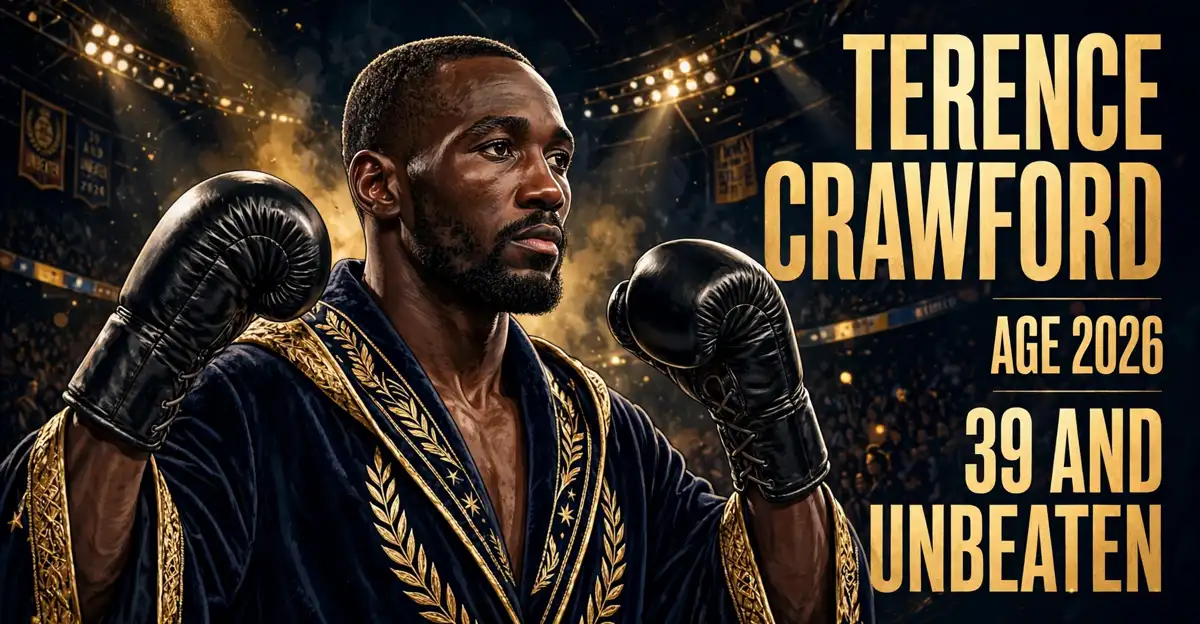
Terence Crawford is 39 years old in 2026, born September 28, 1987 in Omaha. The 42-0 three-division undisputed champion retired unbeaten after beating Canelo.
Last updated: November 19, 2026 · By Nathan Cole
Terence Crawford is 39 years old in November 2026. He was born on September 28, 1987, in Omaha, Nebraska, which means he turned 39 two months ago — and he did it as a retired fighter. Crawford announced his retirement on December 16, 2025, three months after the biggest win of his career: a unanimous-decision victory over Canelo Alvarez that made him the first male boxer in the four-belt era to become undisputed champion in three weight divisions. He walked away at 42-0, with 31 knockouts, and nothing left to prove.
Age was the story of that final fight. Crawford was 37 when he stepped in against Canelo, two weeks short of his 38th birthday, moving up two weight classes to face a younger man at super middleweight. He won every meaningful round. Then, in his own words, he explained the retirement that followed: “I’m 38. 38 is old in boxing. I’ve been boxing since I was seven. I have nothing else to prove.” This article answers the age question in full — the date, the career it frames, and what 39 looks like for a fighter who has already done everything.
Quick Facts
| Full Name | Terence Allan Crawford |
| Born | September 28, 1987, Omaha, Nebraska, USA |
| Age | 39 years old |
| Nickname | “Bud” |
| Height / Reach | Listed 5 ft 8 in (173 cm); 74 in reach (listings vary) |
| Record | 42–0, 31 KOs |
| Career | 2008–2025; retired December 16, 2025 |
| Titles | World champion in 5 divisions; undisputed in 3 |
| Final Fight | Beat Canelo Alvarez (UD), September 13, 2025, Las Vegas |
| Net Worth (2026) | Estimated $50 million (range $30M–$50M) |
| Family | Long-term partner Alindra Person; seven children |
How This Estimate Was Made
The age in this profile is arithmetic, not estimation: born September 28, 1987, Crawford turned 39 on September 28, 2026. The money figures are estimates, and this article treats them as such. Celebrity Net Worth puts his net worth at $50 million, inside a published range of $30 million to $50 million, and reports lifetime ring earnings above $100 million, including about $25 million for the Spence fight and about $50 million in total compensation for the Canelo fight. Crawford himself said on a podcast that he received $10 million for the Canelo fight, so the $50 million figure is a reported total, not a disclosed contract. One outlet, Alux, estimates $80 million — higher than the consensus — and this article notes it as an outlier rather than adopting it. No tax return or bank statement has ever been published.
+
Early Life in Omaha
Terence Allan Crawford was born and raised in Omaha, Nebraska, the only son of Debbie and Terry Crawford, with two sisters, Latisha and Shawntay. His father was a US Naval veteran who travelled often, and the boy who would become the best pound-for-pound fighter of his generation grew up in north Omaha, a neighbourhood he has never left. He still lives there. His mother, his grandmother and his sister live on Terence “Bud” Crawford street, in the heart of the area that raised him.
He started boxing at seven. The coach who recruited him was Carl Washington, who ran the Carl Washington Boxing Gym and had trained Crawford’s father years earlier. Washington had to work to connect with a seven-year-old who had been taught not to talk to strangers; once his mother gave her blessing, the boy tried it and fell in love with the sport. He had to wait until his eighth birthday for his first fight, and he lost it. The loss did not put him off. With his father away in the Navy, he found a father figure in trainer Midge Minor, and a family in the gym team that stayed with him for his entire career.

Omaha shaped the fighter in a specific way. Crawford has described himself as a self-described knucklehead from north Omaha, and the city gave him both the chip on his shoulder and the discipline to carry it. He was not a blue-chip prospect with a famous amateur pedigree. He was a local kid in a local gym, and the people around him were the same people who would be in his corner 17 years later, when he fought Canelo Alvarez in front of 70,000 people in Las Vegas.
The Amateur Years
Crawford fought 70 amateur bouts and lost 12 of them, a record of 58-12 that tells a truer story than the unbeaten professional record that followed. As an amateur he beat both Danny Garcia and Mikey Garcia — two men who went on to become world champions themselves — and he won gold at the National PAL Championships at 132 pounds in 2006. He was ranked the top lightweight in the United States after winning three amateur tournaments.
The amateur years taught him the two skills that defined his professional career: switching stances and solving problems. Crawford fights comfortably from both orthodox and southpaw, and he changes stance mid-round, mid-exchange, sometimes mid-combination. It is a rare gift — most fighters have one stance and a lifetime of habits built around it — and it came from years of amateur work where he had to adjust to a new opponent every weekend. By the time he turned professional in 2008, at 20, he was already a complete boxer. The power and the record would come later; the craft was there from the start.
Turning Professional: 2008–2014
Crawford turned professional in 2008 and spent the first years of his career the way most fighters do: on undercards, in small halls, fighting for purses in the low seven figures at best — as recently as 2015 he was still fighting for that kind of money. The record grew quietly: win after win, no losses, no noise. His big break came on three days’ notice, when he stepped in to whitewash Breidis Prescott, the former Amir Khan conqueror, over ten rounds. The performance put his name in front of the people who matter.
Those early years also built the reputation that followed him: a fighter who would take a bout on short notice, travel to the other man’s backyard, and win clearly. He fought in Scotland for his first title, in front of a hostile crowd, and never looked troubled. Promoters learned that Crawford did not need home advantage. What he needed was an opponent, a ring, and twelve rounds — and the rest took care of itself.
The Switch-Hitter: How Crawford Fights
The technical fact that explains Crawford’s career is his stance. He fights comfortably from both orthodox and southpaw, and he switches between them in the middle of exchanges — sometimes in the middle of a combination. Most fighters have one stance and a lifetime of habits built around it. Crawford has two, and he uses the switch as a weapon: a southpaw jab from an angle the opponent has not prepared for, then a step back to orthodox before the reply arrives.
It is the skill that made the Spence fight look one-sided. Spence is a pressure fighter who walks opponents down behind a jab; against a switch-hitter, the jab lands from a different angle every time, and the pressure has nowhere to settle. Crawford dropped Spence three times before stopping him in the ninth. Against Canelo, two years later, the same skill kept the bigger man off balance for twelve rounds: Canelo could never set his feet, because the target in front of him kept changing shape.
The rest of the game is built around that switch. Crawford is a patient fighter who reads opponents for rounds before committing, and his knockout rate — 31 stoppages in 42 wins — comes late in fights, when the reading is done and the openings are clear. He has stopped men in the ninth, tenth and eleventh rounds after losing early rounds on the cards. The patience is the point: he would rather win the twelfth round than the first, and the record says the approach works. His defence is built on the same patience — head movement and footwork rather than a high guard — and it kept him from ever being stopped, or even seriously hurt, in 42 professional fights.
Trainers who study him point to one more detail: the jab. Crawford’s jab is not a range-finder but a scoring punch, thrown from either stance, doubled and tripled, and it sets up everything else. Against Madrimov, a awkward and durable opponent, the jab was the punch that kept the fight under control when the power shots were not landing cleanly. Against Canelo, it was the punch that won rounds. It is the least glamorous weapon in boxing, and Crawford made it the foundation of a career that ended unbeaten.
The first world title arrived on March 1, 2014, against Ricky Burns in Glasgow, for the WBO lightweight championship. Crawford won clearly, on the road, against a 30-year-old champion in his own backyard. He was 26, and he had his first belt. The lightweight division did not hold him long. He moved up, and the titles followed him: world championships in five weight classes, from lightweight to super middleweight, and 18 major world championships in total.
Undisputed at Light Welterweight: 2017
In 2017, Crawford became the undisputed light welterweight champion by beating Julius Indongo — the first undisputed champion in the division since Kostya Tszyu in 2004, and the first boxer in any weight class to hold all four major world titles at the same time since Jermain Taylor in 2005. He was 29. The achievement put him on the pound-for-pound lists for good, and it set the pattern for the rest of his career: move up, collect every belt, move up again.
The full story of that climb, fight by fight, is told in Terence Crawford’s biography on this site. What matters here is the age curve. Crawford won his first undisputed title at 29, an age when many fighters are already past their best. He was not. He was getting better — sharper, more patient, more willing to wait for the opening rather than force it. The best years were still ahead of him, and they would come at welterweight.
Welterweight and the Spence Fight: 2018–2023
Crawford moved to welterweight in 2018 and won the WBO title against Jeff Horn. Over the next five years he defended it seven times, beating Amir Khan, Kell Brook, Shawn Porter and David Avanesyan along the way. But the fight everyone wanted was Errol Spence Jr., the other unbeaten welterweight champion, and it took years to make. When it finally happened, on July 29, 2023, Crawford was 35 — and he produced the finest performance of his career.
He stopped Spence in the ninth round to become the undisputed welterweight champion, the first since Zab Judah in 2006, and the first male boxer of the four-belt era to win undisputed titles in two divisions. The fight drew about 700,000 pay-per-view buys and more than $59 million in revenue. Crawford’s purse was reported at about $25 million. He was 35 years old, fighting the best opponent of his life, and he made it look one-sided. After the fight, the argument about the best pound-for-pound fighter in the world was, for most observers, over.
Four Divisions: Madrimov, 2024
In August 2024, Crawford moved up again, to light middleweight, and beat Israil Madrimov to become a four-division world champion. He was 36, fighting for the first time in more than a year, and the fight was closer than the Spence win — a competitive decision rather than a statement. The event drew about 200,000 pay-per-view buys and $16 million in revenue. It also set up the question that would define his final year: was there anything left? He had won titles in four divisions and been undisputed in two. The answer, it turned out, was one more division — and the biggest name in the sport.
The Canelo Fight: 37 Years Old, Two Divisions Up
On September 13, 2025, Crawford jumped two weight classes to challenge Saul “Canelo” Alvarez for the undisputed super middleweight championship at Allegiant Stadium in Las Vegas. He was 37 years old — two weeks short of his 38th birthday — fighting a man who had held that division for years, in front of an announced crowd of 70,482, with more than 41 million people watching on Netflix. The live gate was about $47.2 million. Crawford won by unanimous decision.
The win made him the first male boxer in the four-belt era to become undisputed champion in three weight divisions, and one of only six male boxers in history to win world titles in five divisions. It also made him, at 37, the oldest man to do anything of the kind. The prefight talk had been about size: Canelo was the naturally bigger man, and Crawford was giving away two divisions. In the ring, the size never mattered. Crawford’s footwork kept him out of trouble, his jab controlled the distance, and his switch-hitting kept Canelo guessing for twelve rounds.

The money matched the moment. Crawford said on a podcast that he received $10 million for the fight; post-fight reporting put his total compensation at about $50 million, and Forbes reported that his career boxing earnings had moved above $100 million. The gap between the two figures is a reminder that purse numbers in boxing are usually unconfirmed reports, not disclosed contracts — and this article reports the range rather than picking one end of it. Whatever the exact figure, the Canelo fight was the biggest payday of his career, and it arrived in his 37th year.
For the age angle, the comparison is instructive: Canelo Alvarez’s age in 2026 puts the Mexican star in his mid-thirties too, but Crawford was the older man by three years and the smaller man by two divisions — and he won clearly. Age, in that fight, was a number the younger champion could not use.
Retirement at 38 — and the Comeback Talk
Crawford announced his retirement on December 16, 2025, three months after the Canelo fight. He was 38. The announcement was short and final in tone: he had nothing left to prove, and he had been boxing since he was seven. He retired as the number one pound-for-pound boxer in the world, undisputed super middleweight champion, and the first man to become undisputed in three weight divisions.
Retirement in boxing is rarely final, and the talk started almost immediately. Promoter Eddie Hearn said in November 2026 that he believes Crawford would end his retirement for the chance to become a four-division undisputed champion — the one record still available to him. Crawford himself has pushed back. On November 14, 2026, he showed up at the Jaron “Boots” Ennis vs Josh Kelly kickoff press conference in Carson, California, picked Ennis to stop Kelly within seven rounds, and said he is done — again. Days earlier he had dismissed speculation about a comeback after social-media exchanges involving Ryan Garcia and Floyd Mayweather, saying plainly that his career is finished.
He is 39 now, and the question is whether “I’m done” at 39 means the same thing it meant at 38. History says to take the word of a retired fighter with care: the sport has a long record of comebacks. But Crawford’s case is different from most. He retired unbeaten, undisputed, and wealthy, with no defeat to avenge and no belt to reclaim. The only thing a return could add is a fourth undisputed title — and the only thing it could cost is the zero on his record. That is a calculation a 39-year-old makes differently from a 29-year-old.
What 39 Means in Boxing
Thirty-eight is old in boxing — Crawford said so himself — and 39 is older. The sport is young by design: reflexes slow, recovery stretches, and the punch you used to walk through starts to move you. The greats who fought past 38 did it by changing their game. Crawford already had: he was never a fighter who relied on speed alone. His game is timing, distance, and the ability to fight from both stances, and those age better than raw athleticism. That is why he could win the biggest fight of his life at 37, when most fighters his age are already in decline.
The comparison with his peers is instructive. Tyson Fury’s age in 2026 is 38, and the heavyweight division’s other dominant champion of recent years, Oleksandr Usyk’s age profile covers a fighter from the same generation who also stayed unbeaten deep into his late thirties. The three of them — Crawford, Fury, Usyk — are the last of a generation of champions who held their divisions through their thirties. Crawford is the oldest of the group, and the only one who retired unbeaten.
There is a second age that matters: ring age. Crawford has been boxing since he was seven, which means 32 years in the sport by the time he retired, and 17 years as a professional. That is a long career in a sport where the average professional lasts a fraction of it. He fought 42 times as a pro and won all 42, with 31 knockouts — a 74 percent knockout rate. The body of work, measured in years rather than fights, is what makes the retirement at 38 feel right: he did not leave early, and he did not stay too long.
The usual shape of a boxing career is a steep climb, a short peak, and a long decline that everyone can see except the fighter. Crawford’s shape was different: a slow climb, a peak that arrived at 35 and lasted through 37, and then a clean stop. No comeback tour, no farewell fight against a hand-picked opponent, no slow fade into journeyman status. He beat the biggest name in the sport, announced his retirement three months later, and spent the next year saying no to everyone who asked him back. For a 39-year-old former champion, that discipline is the rarest achievement of all — harder, in its way, than winning the fights.
Crawford by the Numbers
The career fits on one table, and the table is the argument for his place in history. Seventeen years as a professional, 42 fights, no defeats, titles in five divisions, undisputed in three. No other fighter of his generation put together that combination, and the numbers hold up against any era.
| Measure | Figure |
|---|---|
| Professional record | 42–0, 31 KOs (74% KO rate) |
| Amateur record | 58–12 (70 bouts) |
| World titles | 18 major titles in 5 divisions |
| Undisputed titles | 3 (140 lbs 2017, 147 lbs 2023, 168 lbs 2025) |
| Career span | 2008–2025 (17 years); boxing since age 7 |
| Biggest purses (reported) | Spence ~$25M; Canelo ~$50M total compensation |
| Career earnings (reported) | Above $100M (Forbes) |
| Net worth (2026) | $50M anchored (CNW); range $30M–$50M |
The number that best captures the career is not 42-0 but 17: the years between his professional debut and his retirement, during which he never lost, never ducked an opponent, and moved up through five divisions without ever being stopped. Unbeaten records are rare in boxing; unbeaten records built across five weight classes, against the best opponents of the era, are rarer still.
Personal Life and Family
Crawford has been in a relationship with Alindra Person since the early 2000s, after meeting in their hometown of Omaha. They have six children together — Terence Jr., Miya, T. Bud, Tyrese, Talaya “Lay Lay”, and Trinity Michele — and Crawford is a father of seven in total. The family lives in Omaha, where he runs the B&B Sports Academy, the gym that carries the name of his own boxing education. He spends his time now fishing, travelling to his children’s wrestling tournaments, and working with the young fighters at the academy.
They were never legally married, and a recent social-media post from Crawford suggested the relationship with Person may have ended — a detail this article notes because it has been reported, not because it changes the story of his career. What has not changed is Omaha. His mother, grandmother and sister live on the street named after him in north Omaha, and the former mayor once gifted him land in the city. He is, by every account, the most famous person in Nebraska, and he acts like someone who never wanted to be anywhere else.
The Omaha Connection: Why He Never Left
Most fighters who reach Crawford’s level leave home. They move to Las Vegas, or Los Angeles, or Miami, where the gyms are bigger and the sparring is better. Crawford never did. He trained in Omaha, lived in Omaha, and fought for Omaha, and the city returned the loyalty in kind: a street named after him, land gifted by a former mayor, and a crowd at every fight that travelled from Nebraska to wherever he was fighting.
The decision was practical as much as sentimental. His team — the same people from the Carl Washington gym, led by trainer Brian “BoMac” McIntyre — was in Omaha, and the gym culture that produced him was not something he wanted to rebuild somewhere else. The B&B Sports Academy, which he runs, is the same idea carried forward: a gym in north Omaha where local kids get the start he got, from the coaches who gave it to him. His father was trained by Carl Washington; Crawford was trained by Washington; the academy’s young fighters are now trained by Crawford’s team. Three generations, one gym.
It also kept him grounded in a way the sport rarely allows. Crawford’s public image has always been low-key — no entourage theatre, no manufactured feuds, no noise outside the ring — and Omaha is part of the reason. He fishes, he goes to his children’s wrestling tournaments, and he is home for dinner. The money changed his bank balance, not his address. At 39, with a promotion to run and a gym to keep open, the city that made him is also the place where his second career is happening.
Net Worth and Life After Boxing
Crawford’s net worth is estimated at $50 million in 2026, anchored on Celebrity Net Worth’s current figure, inside a published range of $30 million to $50 million. His lifetime ring earnings are reported at more than $100 million, including about $25 million for the Spence fight and about $50 million in total compensation for the Canelo fight. A fuller breakdown of the fortune — including the property portfolio of nearly 80 residential and commercial buildings across Omaha, Kansas City and Colorado Springs — is covered in Bud Crawford’s net worth profile on our sister site NetWorthCraft.
Retirement has not meant stillness. In May 2026 he co-founded a US-Japan boxing promotion, signed on May 14, 2026, and he runs the B&B Sports Academy in Omaha. The property portfolio, built quietly over the later years of his career, now sits at nearly 80 buildings. The pattern is familiar from other fighters who kept their money: the ring made the fortune, and the discipline that made the fighter is now managing it. At 39, Crawford’s second career is promotion and property, not prizefighting — and the early signs are that he is as patient with business as he was in the ring.
Legacy: Where Crawford Ranks
Crawford retired with a record no other fighter of his era can match: 42-0, world titles in five divisions, undisputed in three, and the number-one pound-for-pound ranking at the end. The comparisons made during his career — to Floyd Mayweather and Manny Pacquiao — were about style and achievement rather than personality. Like Mayweather he retired unbeaten; like Pacquiao he won titles across five divisions. Unlike either, he was undisputed in three of them, a feat no man had achieved in the four-belt era before him.
The age question will follow him into retirement, because it is the question that frames the whole career. He came from nothing, built slowly, peaked late, and finished at the top. He won his first world title at 26, his first undisputed title at 29, his second at 35, and his third at 37. Most fighters have one prime; Crawford had three, each in a different division, each further from home. At 39, the number that matters is not his age but his record: 42 wins, no losses, and a retirement he chose rather than one that chose him.
The Hall of Fame case is already settled in the eyes of most observers, and the only question is timing: under the International Boxing Hall of Fame’s five-year rule, he becomes eligible in 2031. First-ballot induction is the expectation, not the hope — unbeaten fighters who won titles in five divisions and were undisputed in three do not wait. When the call comes, he will be 43, and the speech will presumably be short. Crawford has never been a man of many words. The record does the talking, and at 42-0, it does not need much help.
Sources & Reporting
This profile was reported from live sources in November 2026. Age and record: Wikipedia (updated October 2026 — born September 28, 1987, Omaha; 42-0, 31 KOs; 18 major world championships; undisputed in three divisions); Round Zero (age 39, born September 28, 1987; retired February 2026 listed — this article uses the December 16, 2025 announcement date confirmed by Boxing News, CNN and his own bio sheet); The Ring (September 11, 2025 — age 37 before the Canelo fight). Career: Wikipedia career summary; The Ring (Madrimov fight picks — seven WBO welterweight defences); boxercontest.com (Spence TKO 9, 700,000 PPV buys context); thecityceleb.com (amateur record, family details). Canelo fight: Alux (October 2026 — 70,482 attendance, $47.2 million gate, 41.4 million viewers); Celebrity Net Worth (Canelo ~$50 million total compensation, career earnings above $100 million); theinfohatch.com (Forbes reporting — $50 million Canelo payday, $100 million-plus career earnings). Net worth: Celebrity Net Worth ($50 million current figure); GNW’s own Terence Crawford biography (November 2, 2026 — $50 million anchored, $30 million–$50 million range, 80 properties, US-Japan promotion signed May 14, 2026, B&B Sports Academy); Alux (October 2026 — $80 million estimate, noted as an outlier); celebsamerica.com (October 2026 — $50 million, Salary Sport $81.9 million recorded purses). Retirement and comeback talk: Boxing News Online (November 13, 2026 — Hearn on a four-division undisputed return); FightBanter (November 14, 2026 — Ennis press conference, “I’m done”); Dave Sport (November 2026 — retirement announced December 16, 2025); Boxing Wire (November 14, 2026 — rules out return after Garcia and Mayweather call-outs); SPRT News (November 14, 2026 — retired last December after Canelo win). Personal life: Wikipedia (Alindra Person since early 2000s, six children together, a seventh child); thecityceleb.com (children’s names, not legally married); his official bio sheet via Constant Contact (B&B Sports Academy, seven children, Omaha street, retirement December 16, 2025). Where sources disagreed — his listed height and reach, the $10 million versus $50 million Canelo purse, and the $30 million to $80 million net-worth spread — this article names the spread rather than filling it in. Corrections are welcome via the About page.
Frequently Asked Questions
How old is Terence Crawford?
Terence Crawford is 39 years old. He was born on September 28, 1987, in Omaha, Nebraska, and turned 39 on September 28, 2026.
When did Terence Crawford retire?
Crawford announced his retirement on December 16, 2025, three months after beating Canelo Alvarez. He was 38 at the time. He retired unbeaten at 42-0 with 31 knockouts, as the undisputed super middleweight champion.
How old was Terence Crawford when he beat Canelo?
He was 37 years old. The fight was on September 13, 2025, two weeks before his 38th birthday. He won by unanimous decision, moving up two weight classes to take Canelo’s undisputed super middleweight title.
What is Terence Crawford’s boxing record?
42 wins, no losses, with 31 knockouts — a 74 percent knockout rate. He won 18 major world championships in five weight classes, from lightweight to super middleweight, and was undisputed champion in three divisions.
Is Terence Crawford coming back to boxing?
He says no. In November 2026 he told reporters at the Jaron Ennis press conference that he is done, and dismissed comeback talk after social-media exchanges with Ryan Garcia and Floyd Mayweather. Promoter Eddie Hearn believes he could return for a shot at a fourth undisputed title, but Crawford has not agreed to anything.
What is Terence Crawford’s net worth in 2026?
His net worth is estimated at $50 million in 2026, per Celebrity Net Worth, inside a published range of $30 million to $50 million. His lifetime ring earnings are reported at more than $100 million, including about $50 million in total compensation for the Canelo fight.
Who is Terence Crawford’s wife?
Crawford has been in a long-term relationship with Alindra Person since the early 2000s. They were never legally married, and they have six children together. Crawford is a father of seven children in total, and the family lives in Omaha, Nebraska.
How tall is Terence Crawford?
He is listed at 5 ft 8 in (173 cm), with a 74-inch reach. Listings vary slightly between sources, so this article uses the standard listed figure. He fought from lightweight (135 lbs) up to super middleweight (168 lbs) in his career.
Nathan Cole
Nathan Cole is the editor of Guide Net Worth. He covers celebrity wealth the way a business desk covers earnings: reported figures first, estimates labeled as estimates, and no invented numbers. Every profile on this site passes through his desk before it publishes. About Guide Net Worth · Corrections: figures are updated when new reporting emerges — contact us via the About page if you spot an error.
References & Sources
This article has been fact-checked and verified against multiple public sources, financial disclosures, SEC filings, Forbes reports, Celebrity Net Worth databases, and official records. All net worth estimates are based on publicly available information and financial analysis.