Wolfgang Puck net worth in 2026 is an estimated $120 million, built from Spago, CUT and 100+ restaurants — but how much of that empire does he actually own?
Wolfgang Puck’s net worth in 2026 is an estimated $120 million. That is the figure Celebrity Net Worth carries after its August 2025 update, and it is the same number Parade puts on him in its 2026 profile, updated in August 2026. One ranking, Alux’s November 2026 list of the richest celebrity chefs, goes higher at $150 million — which is why the honest answer is a range of $120 million to $150 million, anchored at $120 million, where the two most careful sources agree.
Puck did not get rich the way a television chef gets rich. He got rich the way a founder gets rich. One restaurant, Spago, opened on the Sunset Strip in 1982, became a brand. The brand became three companies. Those three companies now cover fine dining, catering, airport counters, grocery shelves, cookbooks, and television — more than 100 venues carrying his name. He has catered the Academy Awards Governors Ball every year since 1995. At 77, he is still opening restaurants, and his eldest son Byron took over as president of the fine-dining group in June 2025.
This profile works through the whole picture: where the $120 million comes from, why some outlets print $150 million, the restaurants and deals behind it, the real estate, the family, and how Puck’s fortune stacks up against the other chefs who turned cooking into big business.
Quick Facts: Wolfgang Puck
| Full Name | Wolfgang Johannes Topfschnig (later Wolfgang Johannes Puck) |
| Born | July 8, 1949, Sankt Veit an der Glan, Austria |
| Age in 2026 | 77 |
| Estimated Net Worth | $120 million (range $120M–$150M, as of November 2026) |
| Primary Income Sources | Fine-dining restaurants, catering, brand licensing, consumer products, cookbooks, television |
| Key Ventures | Spago, CUT, Chinois, Wolfgang Puck Fine Dining Group, Wolfgang Puck Catering, Wolfgang Puck Worldwide Inc. |
| Restaurants | 21 fine-dining restaurants; 80+ Express locations; 100+ venues total |
| Signature Role | Official chef of the Academy Awards Governors Ball since 1995 |
| Spouse | Gelila Assefa Puck (married 2007) |
| Children | Four sons: Byron, Cameron, Oliver, Alexander |
| Nationality | Austrian-American (U.S. citizen since 1999) |
How This Estimate Was Made
No celebrity net worth is an audited fact. Puck’s companies are private, he has never published a balance sheet, and no tax return is public. Every number in this article is an estimate built from public reporting, and the method matters more than the number itself.
We started with the two most current, most careful trackers — Celebrity Net Worth ($120 million, updated August 21, 2025) and Parade ($120 million, published January 2026, updated August 7, 2026) — and treated their agreement as the anchor. We then checked the outlier: Alux’s November 2026 ranking at $150 million. Alux’s own text admits published pages range from $100 million to $300 million without sources, so $150 million sets the top of the range, not the anchor. We cross-checked the business behind the figure against the company structure (three companies, 21 fine-dining restaurants, 80-plus Express outlets) and the one hard property record (the $14 million Los Angeles home bought in 2013). Where outlets disagree, this article names the disagreement instead of picking a winner silently.

+
How Much Is Wolfgang Puck Worth in 2026?
The short answer is $120 million. The longer answer is that the number has been steady for years, and the steady part is what makes it believable.
Celebrity Net Worth lists Puck at $120 million with an update dated August 21, 2025. Parade’s 2026 profile, published in January 2026 and updated August 7, 2026, gives the same figure in plain words: “Wolfgang Puck’s net worth in 2026 is estimated at a scrumptious $120 million.” Alux, ranking the richest celebrity chefs in November 2026, places him fifth at $120 million in its table — then argues $150 million in its text. Brands Owned By, in a September 2026 analysis of his companies, also lands on $120 million. Four separate outlets, four separate dates, one number.
That agreement is worth something because the underlying business is private. Nobody outside Puck’s companies has seen a balance sheet. The $120 million is a synthesis: restaurant interests, licensing, property, and four decades of earnings, weighed by people who track this for a living. It is not an audited fact, and this article will not pretend otherwise.
It helps to understand what $120 million means for a restaurant owner. It does not mean $120 million in a bank account. It means ownership stakes in three companies, a share of the restaurants, the licensing contracts, and a $14 million house — minus whatever debt the companies carry, which is not public. A restaurant group is valued on its earnings, not its revenue, and fine-dining earnings are thin. That is why the range matters: $120 million assumes the companies earn what their scale suggests; $150 million assumes they earn more. The difference between the two numbers is a disagreement about profit margins, not about whether the empire exists.
Why the Estimates Disagree — and Why 0M Is the Anchor
If you search “Wolfgang Puck net worth” you will see numbers from $100 million to $300 million. Most of that spread is noise. Alux’s own November 2026 article admits that celebrity-wealth pages range from about $100 million to $300 million “without sources” — and then publishes $150 million anyway, without explaining how it got there.
That is the pattern to watch for. A tracker that updates its figure on a schedule and names its method (Celebrity Net Worth, August 2025) carries more weight than a listicle that picks a bigger number for a bigger headline. Parade’s 2026 profile is the freshest dated reporting available, and it cross-checks the restaurant count (21 fine-dining restaurants) and the company structure against Puck’s own operation. When the freshest source and the standard tracker agree, the anchor is set.
| Source | Figure | Date | How much weight we give it |
|---|---|---|---|
| Celebrity Net Worth | $120 million | Updated Aug 21, 2025 | High — the standard tracker, regularly updated |
| Parade | $120 million | Published Jan 2026, updated Aug 7, 2026 | High — current, dated, checks the business |
| Brands Owned By | $120 million | Sep 2026 | Medium — careful company analysis |
| Alux | $150 million | Oct/Nov 2026 | Medium — outlier; its own text admits the $100M–$300M spread is unsourced |
| Social Life Magazine | $120 million | 2025 | Low-medium — repeats Celebrity Net Worth |
Strip out the stale and the sloppy, and the honest range is $120 million to $150 million, anchored at $120 million because that is where the two most current, most careful sources agree. The $90 million figure that still floats around older pages has no live source behind it at all — nothing published in 2025 or 2026 supports it, and it should be treated as outdated.
From Sankt Veit to Sunset Strip: The Early Years
Wolfgang Puck was born Wolfgang Johannes Topfschnig on July 8, 1949, in Sankt Veit an der Glan, a small town in Austria. His mother was a pastry chef, and the kitchen was the first classroom he ever had. He left home young and trained the hard way, working his way through kitchens in Provence, Paris, and Monte Carlo before he was out of his teens.
He arrived in the United States in 1973 and spent two years at La Tour, a restaurant in Indianapolis. Then he moved to Los Angeles and became executive chef and part-owner of Ma Maison, a French restaurant on Melrose Avenue that quickly became the place Hollywood ate. Ma Maison is where Puck learned the lesson that built his fortune: in Los Angeles, a chef could be a star, not a servant. The full arc — the Austrian childhood, the French training, the Ma Maison years, and the move to America — is covered in detail in our Wolfgang Puck biography, which follows the same timeline this profile draws on for the money story.
The road from Sankt Veit to Los Angeles ran through other people’s kitchens, and Puck has never hidden how hard those years were. He set off on his own after middle school, worked his way up through French kitchens, and arrived in America with technique, ambition, and no money to speak of. That matters to the net-worth story because it sets the starting point: zero. Everything in this profile — the $120 million, the hundred venues, the house — was built from a standing start in 1973, in a country whose language he was still learning. The fifty-three years between La Tour and the 2026 Governors Ball are the whole fortune, compressed into a single career.
Ma Maison also gave him his first book. In 1981 he published “Modern French Cooking for the American Kitchen,” built on the recipes he was cooking there. A year later he walked out and opened his own place. That decision, more than any single dish, is the hinge of his wealth. An employee chef earns a salary. An owner-chef owns the brand.
The French years deserve a closer look, because they explain the food. Puck did not learn cooking from a school. He learned it standing on a stool in his mother’s kitchen, then in professional kitchens in Provence, Paris, and Monte Carlo, where the discipline was classical French and the hours were brutal. By the time he reached Los Angeles, he could cook the French canon in his sleep — which is exactly why he felt free to break it. The smoked salmon pizza, the Asian touches at Chinois, the California produce on a French plate: all of it was a classically trained chef deciding the rules were his to rewrite.
Ma Maison taught him the other half of the trade. As part-owner, he saw the books as well as the stove. He watched what a full dining room was worth, what a famous table was worth, and what a chef’s name on the door was worth. When he left to open Spago, he was not gambling on a restaurant. He was cashing in four years of watching how the money worked — and his business partner in that education, Barbara Lazaroff, had already talked him into quadrupling his salary as a chef before they married. The partnership that built the empire started as a salary negotiation.
Spago 1982: The Restaurant That Changed American Dining
Spago opened on the Sunset Strip in 1982, and it broke nearly every rule of fine dining at the time. The kitchen was open, so diners could watch the cooking. The menu mixed French technique with California produce and Asian flavors. And the pizza — smoked salmon pizza, created for Joan Collins — put a casual dish on a fine-dining menu and made it the most famous pizza in America.
Spago became the hardest table in Los Angeles within a year. Hollywood ate there because Hollywood could be seen eating there, and Puck understood that visibility was an asset. He kept the restaurant, and the name, for himself. In 1997, after fifteen years on the Strip, he moved Spago to Beverly Hills, to 176 North Canon Drive, where it remains the flagship. The original Sunset location closed in 2001.
The open kitchen was the most copied idea of the three. Before Spago, the kitchen was hidden and the chef was invisible. Puck put the cooking where the customers could watch it, and the customers loved the show. Within a decade, open kitchens were everywhere — in fine dining, in casual chains, in food courts. The idea is so common now that it is hard to remember it was ever new. It was new in 1982, and the man who made it new collected the royalties in reputation for the next forty years. Every open kitchen in America is, in a small way, a Spago franchise that never paid him.
What Spago really sold was a template. Open kitchen. California ingredients. Asian touches. A chef whose face the public knew. Every celebrity-chef restaurant that followed — and there are hundreds now — runs on some version of that template. Puck invented the category, then spent forty years franchising the invention.
Today Spago has seven locations, from Beverly Hills to Budapest, Maui, and Saudi Arabia, according to Tasting Table’s count of the group. The flagship still carries the name that started everything, and Puck still owns it.
The smoked salmon pizza deserves its own line in the money story. Puck created it for Joan Collins, and it became the dish that proved a point: a pizza could sit on a fine-dining menu without embarrassing the restaurant, if the ingredients were right. That single dish did more for Spago’s brand than any review. It was photographed, imitated, and ordered by people who had never eaten smoked salmon before. It turned a restaurant into a story, and the story into a reservation list that never shortened.
There is a second lesson in Spago’s economics. A celebrity dining room is a room full of people paying for dinner, and a room full of people whose presence is itself the marketing. Spago’s tables filled with actors, producers, and agents who told other actors, producers, and agents to go. Puck never had to buy the kind of advertising a new restaurant normally needs, because the dining room was the advertisement. That is why the restaurant survived the move from the Sunset Strip to Beverly Hills in 1997 without losing its pull — the customers followed the name, not the address.
CUT, Chinois and the Fine-Dining Group
Spago was the first restaurant. It was not the last by a long way. A year after Spago, in 1983, Puck opened Chinois on Main in Santa Monica — an Asian-fusion restaurant that, like Spago, mixed traditions nobody had mixed in a fine-dining room before. Postrio followed in San Francisco in 1989, Granita in Malibu in 1991, and his first Las Vegas restaurant, Spago at Caesars Palace, in 1992.
CUT, the high-end steakhouse, opened in 2006 at the Beverly Wilshire hotel and became the second flagship. It earned a Michelin star in 2007. The Singapore CUT earned one in 2016. Spago Beverly Hills held two Michelin stars from 2009 until it later lost them, according to Chowhound’s reporting cited by Parade. Three stars across the group, at the peak, is a serious credential — and it is the credential that lets a Puck restaurant charge what it charges.
Parade’s 2026 profile counts 21 fine-dining restaurants in the group, including Spago, CUT, Chinois, and Merois, the rooftop restaurant at the Pendry in West Hollywood. Tasting Table, counting the core restaurants in 2023, arrived at 20, spread from New York to Singapore, with Spago and CUT in multiple cities and Wolfgang Puck Bar & Grill in Las Vegas and Orlando. The exact count moves as locations open and close. The shape does not: a tight group of high-priced flagships in the world’s richest cities, all carrying the same name.
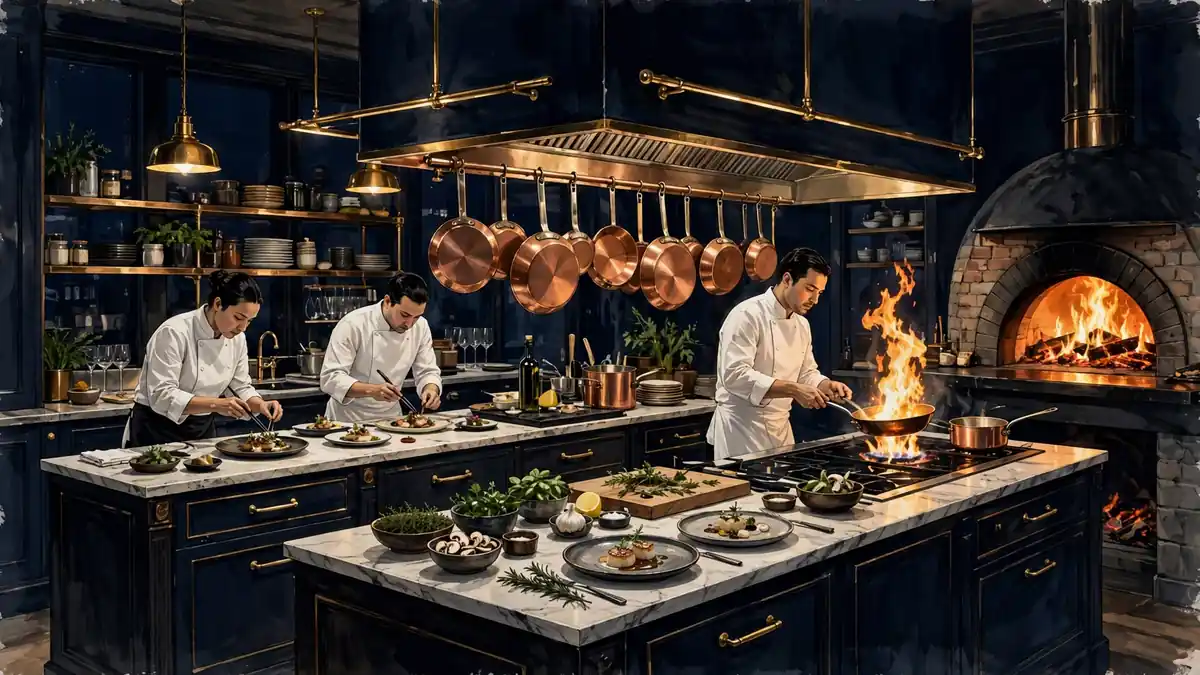
Fine dining is the most visible part of the fortune and, in pure cash terms, probably not the largest. A flagship restaurant is expensive to run, and margins in fine dining are thin. What the flagships do is different: they keep the name valuable. The name is what the rest of the business sells.
Las Vegas shows how the model travels. Puck opened his first Las Vegas restaurant in 1992, Spago at Caesars Palace, and kept going: Postrio Bar & Grill at The Venetian and Trattoria del Lupo at Mandalay Bay in 1999, Wolfgang Puck Bar & Grill at MGM Grand in 2004, CUT at The Palazzo in 2008, and Cucina by Wolfgang Puck at The Shops at Crystals in 2010. Las Vegas is the perfect market for his model — high foot traffic, high spenders, and hotels that want a famous name on the door. The hotel pays for the room and the foot traffic; Puck supplies the name and the kitchen. It is the same licensing logic as the Express outlets, dressed up in white tablecloths.
CUT itself is the clearest example of the second-flagship strategy. A steakhouse is a simpler machine than a Spago: a shorter menu, a higher average check, and a clientele that orders the most expensive thing on the page. CUT Beverly Hills, CUT London, CUT New York, CUT Singapore — the same room, the same menu, the same star, repeated in every city where rich people eat steak. Repetition is the whole point. One great restaurant is a job. Four copies of one great restaurant is a business.
The Three Companies Behind the Fortune
This is the section most net-worth profiles skip, and it is the one that explains the number. Puck does not own “more than 100 restaurants” in the way a landlord owns houses. He owns three companies, and the companies own, operate, or license the venues.
| Company | What it does | Role in the fortune |
|---|---|---|
| Wolfgang Puck Fine Dining Group | Owns and runs the flagships: Spago, CUT, Chinois, Merois | The asset itself — the restaurants are the wealth |
| Wolfgang Puck Catering | Events and contract dining, including the Oscars Governors Ball since 1995 | High-ticket event fees and a steady corporate book |
| Wolfgang Puck Worldwide, Inc. | Casual dining, Express outlets, consumer products, licensing, media | The scale — 80-plus Express locations and supermarket products |
That structure is the difference between a chef and a company. A chef sells his time. A company sells its name, over and over, in places the founder never visits. The Express outlets — more than 80 of them, in airports, hotels, and shopping centers — are the volume business. The fine-dining group is the prestige business. Catering is the cash business: a single Governors Ball or corporate event bills at a level no restaurant dinner can match.
The venue counts from different outlets look contradictory until you sort them by company. Twenty or twenty-one is the fine-dining group — the flagships. Eighty-plus is the Express count. A hundred-plus is the total across all three companies, including catering venues and licensed counters. Marketplace, quoting Puck’s own operation in 2015, put it at 27 fine-dining restaurants and more than 80 Express locations. Parade’s 2026 count of 21 fine-dining restaurants is lower, which is what you would expect after a decade of openings and closings in a group that refreshes its portfolio. None of the counts is wrong. They are counts of different things, taken in different years — and the article that adds them together without saying so is the one that invents a number.
How much of it Puck personally owns is not public. Brands Owned By, in its September 2026 analysis, warns explicitly against adding up systemwide sales and calling the total his wealth — much of that turnover belongs to operating partners, and the private cap table has never been published. Puck himself said in 2017 that his businesses generated more than $500 million in annual gross sales. That is enterprise turnover across divisions and partners, not personal income and not liquid wealth. Any profile that quotes the $500 million as his money is making a basic error, and this one will not.
The honest way to read the structure: three companies, one name, and a founder who kept control of the name. That control is what the $120 million is really pricing.
The Express outlets show the logic at full stretch. More than 80 of them sit in airports, hotels, and shopping centers — places where the customer did not plan to eat at a Wolfgang Puck restaurant and does not need to know who Wolfgang Puck is. The food is simpler, the prices are lower, and the volume is enormous. An airport outlet can serve more covers in a day than Spago serves in a week. The margin per meal is smaller, but the margin per day is not, and the founder never has to be in the room.
There is also a quieter line of business inside the same structure: management agreements with hotels. WealthyPeeps reports Puck has negotiated management deals with hotels and holds rooms at the Four Seasons in Bahrain — a claim without a named source, but consistent with how his group works. A hotel gets a famous restaurant without hiring a famous chef. Puck gets a fee and a percentage without building a restaurant. It is the same deal as Las Vegas, repeated wherever a hotel wants a name on its dining room.
The Oscars Governors Ball: Thirty Years at Hollywood’s Table
Puck has catered the Academy Awards Governors Ball since 1995. Parade’s 2026 profile notes he celebrated his 30th year in the role in 2025; the March 15, 2026 ball was his 32nd. No other chef has held a contract like it, and no other contract has done as much for a chef’s name.
The menu changes every year, but one dish never leaves it: the chicken pot pie with shaved black truffles, the crowd favorite for Hollywood’s biggest night. Around it, Puck’s team serves a rotating set of small plates to roughly 1,500 guests — the most photographed dinner in the world, cooked by one man, every year, for three decades.
The Ball pays, but its real value is advertising no money can buy. Once a year, every camera in Hollywood points at a Wolfgang Puck kitchen. The catering arm that serves the Ball also serves the Emmys, corporate events, and private parties across the country. It is the part of the business with the best margins and the least public visibility, which is exactly why it matters to the net worth.
Think about what thirty years of the same contract means. The Academy could hire any caterer in the world. It hires the same one, every year, because the risk of changing is higher than the cost of keeping him. That is a moat — a business advantage that competitors cannot copy by spending money. A new chef can open a better restaurant. A new chef cannot buy thirty years of trust from the Academy of Motion Picture Arts and Sciences. The contract is an asset in the same way the Spago name is an asset, and it is priced into the $120 million even though it never appears on a balance sheet.
The food itself is part of the deal. The chicken pot pie with shaved black truffles has become a ritual: stars expect it, photographers wait for it, and Puck has said he would not dare leave it off the menu. Around it, the menu changes every year — small plates, seasonal courses, dishes built for a room where half the guests are being photographed while they eat. Feeding 1,500 people at that standard, in one night, in a room that was a theater the day before, is a logistics operation as much as a cooking one. It is the kind of operation only a catering company with thirty years of practice can run, and it is why the catering arm bills what it bills.

Cookbooks, Television and the MasterClass
Puck has published seven cookbooks, from “Modern French Cooking for the American Kitchen” in 1981 to “Wolfgang Puck Makes It Healthy” in 2014, with “Adventures in the Kitchen” (1991), “Pizza, Pasta, and More” (2000), and “Live, Love, Eat” (2002) in between. In 2003, Tribune Content Agency began syndicating his recipes to newspapers and websites across the country — a quiet deal that put his name in front of readers who had never set foot in Spago.
Television followed the same logic. He hosted “Cooking Class with Wolfgang Puck” on the Food Network, appeared as himself on “Iron Chef America: Battle of the Masters,” played himself on “Frasier” and “Las Vegas,” and turned up in a lighthearted “American Idol” segment introducing strange foods to Kellie Pickler. The 2021 documentary “Wolfgang,” released on Disney+, told the life story to a new generation. His MasterClass series runs to 16 video lessons on cooking and the business of food.
None of this pays like a restaurant group. Cookbooks and television pay in the low millions across a career, not the tens of millions. What they pay in is reach. Every appearance reminds the public that Wolfgang Puck is a person, not a logo — and a person can charge more for a logo than a logo can charge for itself.
The MasterClass deal is the modern version of the cookbook. Sixteen video lessons, filmed once, sold forever, to students who will never eat at Spago. It is the purest form of the licensing model: the name and the knowledge, separated from the kitchen entirely. The cooking school he launched in 2016 works the same way at a smaller scale — students pay to learn from the name, and the name never has to leave the building.
Syndication was the earlier version of the same idea. When Tribune Content Agency began distributing his recipes in 2003, Puck’s name started appearing in newspapers in cities where he had no restaurant. A reader in Ohio who cooked a Puck recipe on a Sunday was a future customer of a Puck product, a Puck cookbook, or a Puck restaurant on a trip to Las Vegas. None of those readers paid him directly. All of them made the name worth more.
Licensing, Cookware and the Supermarket Shelves
The largest part of Puck’s fortune, measured by reach, sits on shelves he never stands behind. Wolfgang Puck Worldwide licenses his name to cookware, panini grills, blenders, cutlery, canned foods, and Estate Grown Organic Coffees. He launched the Wolfgang Puck Cooking School in 2016. The products sell in supermarkets and department stores across the United States, and every sale pays the company without a kitchen, a waiter, or a reservation book.
This is where the net-worth math gets fuzzy — and where most profiles go wrong. One outlet, WealthyPeeps, prints a revenue split claiming Wolfgang Puck Worldwide takes in around $650 million a year, with $200 million from fine dining, $250 million from catering, and $200 million from licensing. Those numbers come with no named source, no filing, and no audit. They are printed as fact by a site that also calls Puck “the world’s sixth-richest celebrity chef” without showing its ranking. We are not repeating them as facts. They are included here only as an example of how soft numbers get laundered into hard ones.
What can be said with confidence: licensing is real, it is large, and it is the part of the business that scales. A restaurant seats a hundred people a night. A licensed coffee line sells to millions. The Express outlets work the same way — the name, not the chef, does the work. That is why the companies are worth nine figures to their owner even though no single restaurant is.
The product list itself tells the story of the brand. Cookware and cutlery for the home cook who wants a piece of the Spago kitchen. Panini grills and blenders for the appliance aisle. Canned foods and Estate Grown Organic Coffees for the supermarket shelf. Each product is a small bet, and the bets add up: a customer who buys the coffee may buy the cookbook, and a customer who buys the cookbook may book a table. The licensing arm is not a side business. It is the funnel that feeds every other part of the company.
There is a risk in licensing that Puck has mostly avoided: a name on too many products stops meaning anything. The guardrail is the fine-dining group. As long as Spago and CUT hold their standard — and the Michelin stars say they do — the name on a supermarket coffee still means something. The day the flagships slip, the licensed products slip with them. That is why the restaurants, thin margins and all, are the most important part of the fortune. They are the proof behind the promise on the package.
Real Estate: Villa Les Violettes and the Beverly Hills Flip
The one hard property record in Puck’s file is Villa Les Violettes, a 12,289-square-foot home in Los Angeles that he and his wife Gelila bought for $14 million in 2013, according to Celebrity Net Worth. The estate has an outdoor kitchen, a swimming pool, a Jacuzzi, a tennis court, and a library. Gelila, a designer by profession, renovated the house in 2017.
There is an earlier flip on the record too. In 2003 Puck paid $3.675 million for a 6,025-square-foot mansion in Beverly Hills and sold it for $8.495 million in 2015, according to Variety’s reporting — a gain of roughly $4.8 million over twelve years, before costs. It is a tidy profit, and it is also a reminder of scale: the gain on one house over twelve years is about 4% of the net worth. Real estate is a store of Puck’s wealth, not the source of it.
Puck lives in Los Angeles with Gelila and their two youngest sons. The house is the family home, not a portfolio. Unlike chefs who collect properties as investments, Puck’s public record shows two homes and one profitable sale — a modest footprint for a $120 million fortune, and a sign that the money stayed in the business.
The $14 million price tag from 2013 also deserves context. Los Angeles luxury property has risen sharply since then, and a 12,289-square-foot estate with a tennis court and an outdoor kitchen would cost considerably more to replace today. But a home is not a liquid asset, and this profile does not count appreciation as income. The house is worth noting because it is the one property transaction with a public price — not because it moves the net worth. If anything, the modesty of the property record is the story: a man worth $120 million, living in one house, bought once, in the city where he made the money.
Family: Gelila Assefa Puck and the Next Generation
Puck has been married three times. His first marriage, to Marie France Trouillot, ran from 1975 to 1980. His second, to Barbara Lazaroff, ran from 1983 to 2003 — and Lazaroff, a celebrated interior designer, remained his business partner long after the divorce, designing the interiors of his restaurants and helping popularize the open-kitchen layout. They have two sons, Byron and Cameron.
His third wife is Gelila Assefa Puck, born in Addis Ababa, Ethiopia. She is a designer, creative director, and philanthropist, and the founder and chairwoman of the Dream for Africa Foundation. They met at a business dinner at Spago — she later worked the door of the restaurant — and married in Capri, Italy, in 2007. She curates the art on the walls of his restaurants and, by her own account to Harper’s Bazaar, buys all his clothes. They have two sons, Oliver and Alexander.
Puck turned 77 in July 2026, and the full breakdown of how old Wolfgang Puck is today sits on our sister site CelebAmerica, which covers his age in detail. The physical facts draw the same curiosity: readers also search constantly for how tall Wolfgang Puck is, and our height profile answers that one directly.
The succession is already underway. In June 2025, Byron Lazaroff-Puck, Puck’s eldest son, was named president of Wolfgang Puck Fine Dining Group — the clearest sign yet that the empire is being handed over inside the family, not sold. Cameron, the second son, is a doctor, and his son Maxwell, born in December 2022, is Puck’s first grandchild. The founder is 77, the son runs the restaurants, and the name stays in the family.
Gelila’s role in the business is easy to miss and worth naming. She curates the art on the walls of his restaurants — a job she describes as giving each room a voice — and she renovated Villa Les Violettes in 2017. The restaurants are kitchens and rooms people pay to sit in, and the art, the design, and the atmosphere are part of what the customer buys. Barbara Lazaroff did the same work in the earlier decades, designing the interiors that made the open kitchen feel like a theater. Two wives, two eras, one lesson: the dining room is a product, and the people who design it are part of the fortune.
What Wolfgang Puck Earns in a Year
Here is the honest answer: nobody knows, because Puck has never disclosed his income and no official salary is public. Any profile that prints a precise annual figure without a source is guessing.
What exists is one soft claim. WealthyPeeps puts his annual income above $15 million and says he made $20 million in 2012, with most of it coming from the restaurants. Neither figure comes with a named source, and the site’s other numbers in the same article are unsourced. Treat both as a rough indication, not a fact: a man with 21 fine-dining restaurants, 80-plus Express outlets, a catering arm, and a licensing business plainly earns millions a year, but the exact number is private.
Illustrative math, labeled as such, shows why the net worth and the income are different things. If a $120 million fortune earned a 5% return, it would throw off $6 million a year without Puck lifting a pan. If his companies distributed $10 million a year to him, the fortune would take twelve years to accumulate from zero — and he has had forty-four years since Spago opened. The point of the arithmetic is not precision. It is that a $120 million fortune built over four decades requires no exotic income to explain. Steady millions, reinvested, do the job.
The longer view makes the point even clearer. Spread $120 million over the forty-four years from Spago’s opening in 1982 to 2026, and the average is about $2.7 million a year kept, after tax, after living costs, after reinvestment in new restaurants. That is a large number for a chef and a modest number for a founder — and it is exactly what a disciplined owner-operator would keep. The fortune was not made in a single deal. It was made in forty-four years of keeping a little more than was spent, and letting the brand do the compounding. Anyone looking for a single payday in this story will not find one. The payday was the career.
Wolfgang Puck in 2026: Still Cooking at 77
Puck turned 77 on July 8, 2026, and nothing about the year suggests retirement. On March 15, 2026, he cooked his 32nd Governors Ball. In June 2025, his eldest son Byron took over as president of the fine-dining group — a handover, not a goodbye. The father still cooks the Ball. The son runs the restaurants. The name covers both.
The succession matters to the net worth because it answers the question every buyer of a founder-led business asks: what happens when the founder stops? In Puck’s case, the answer is already visible. The companies have professional management, the son is in place, and the brand does not depend on one man’s hands. A business that survives its founder is worth more than one that does not, and the market for restaurant groups knows it.
There is also a simpler read on 2026. Puck has now been famous for more than forty years — longer than most of the chefs on the rich list have been alive as professionals. He opened Spago before Gordon Ramsay had a restaurant, before Jamie Oliver had a television show, before Guy Fieri had a driver’s license for the Camaro. The fortune is not a spike. It is a plateau, held for decades, which is rarer than a spike and harder to build. The $120 million has been roughly the same figure for years because the business underneath it has been roughly the same business for years: stable, diversified, and still growing at the edges.
What comes next is expansion, not reinvention. Spago keeps adding locations — Budapest, Maui, Saudi Arabia in the recent count. CUT keeps repeating in new cities. The Express outlets keep multiplying in airports. None of it needs Puck in the kitchen anymore, and that is the point. The empire he built was designed, from the three-company structure down, to outlast the man who built it.
For readers keeping score, the numbers to remember are simple. The fortune is $120 million, anchored by two careful sources and a range up to $150 million. The business is three companies and more than 100 venues. The contract is the Governors Ball, held since 1995. And the chef is 77, still working, with his son running the restaurants and his name on every door.
How Wolfgang Puck Stacks Up Against Other Celebrity Chefs
Puck invented the celebrity-chef business, but he is not the richest chef in it anymore. Television changed the math: a chef with a hit show reaches more people in a week than a restaurant reaches in a year, and the richest chefs today are the ones who turned television into an empire.
| Chef | Net Worth (2026) | How they made it |
|---|---|---|
| Gordon Ramsay | $220 million | 80-plus restaurants, $45M–$60M a year in TV pay, Lion Capital deal |
| Jamie Oliver | $200 million | Television, cookbooks, restaurants — a comeback after the 2019 collapse |
| Guy Fieri | $130 million | Food Network stardom, Flavortown licensing, restaurants |
| Wolfgang Puck | $120 million | Spago, CUT, catering, licensing, 100-plus venues |
| Bobby Flay | $60 million | Iron Chef fame, restaurants, cookbooks |
| José Andrés | $50 million | Restaurants and humanitarian work |
The table flatters television and understates what Puck built. Ramsay’s $220 million rests on a structure Puck designed first: flagships for prestige, television for reach, licensing for scale. Oliver’s $200 million survived a restaurant collapse in 2019 because the brand outlived the balance sheet — the same lesson Puck’s three-company structure was built to teach. Fieri, at $130 million, is the closest parallel: a chef whose name sells more than his kitchens do.
Puck ranks fifth among celebrity chefs in Alux’s November 2026 ranking, and the gap between fifth and first is a television gap, not a cooking gap. He was the first chef to become a brand. The chefs above him are the ones who took his playbook and added a weekly show. The full Celebrity Net Worth archive carries the rest of the chef rankings, and the pattern holds across all of them: the fortune follows the brand, not the stove.
Look closer at the gap and it narrows. Ramsay’s $220 million includes a private-equity deal with Lion Capital and television pay of $45 million to $60 million a year — income streams Puck never chased. Oliver’s $200 million survived a restaurant-group collapse because his television and book brand carried him through. Fieri’s $130 million is almost entirely a television-and-licensing fortune. Puck’s $120 million, by contrast, is built mostly on businesses he owns outright — restaurants, catering contracts, and licenses — rather than on a network’s paycheck. If the television money stopped tomorrow, Ramsay and Fieri would feel it first. Puck’s restaurants would still open for dinner.
That is the real comparison. Puck is not the richest celebrity chef, but he may be the one whose fortune is the least dependent on anyone else’s platform. A television contract can be cancelled. A restaurant group with thirty years of contracts cannot be cancelled by a network executive. The ranking measures size. It does not measure durability — and on durability, the chef who invented the category still leads it.
Sources & Reporting
This profile was reported from live sources in November 2026. Celebrity Net Worth supplied the anchored $120 million figure (updated August 21, 2025) and the biographical spine: the July 8, 1949 birth, the La Tour and Ma Maison years, the restaurant openings, the seven cookbooks, and the $14 million Villa Les Violettes purchase. Parade’s 2026 profile (published January 2026, updated August 7, 2026) supplied the second $120 million figure, the 21-restaurant count, the three-company structure, the 30th Governors Ball year, and the Michelin history. Alux’s November 2026 ranking supplied the $150 million outlier and the admission that published pages range from $100 million to $300 million without sources. Brands Owned By (September 2026) supplied the careful company analysis, including the warning that the $500 million 2017 gross is enterprise turnover, not personal wealth. Tasting Table (2023) supplied the 20-restaurant count and the Spago location list. Marketplace (2015) supplied the 27-restaurant and 80-Express figures from Puck’s own account. Parade’s profile of Gelila Assefa Puck supplied the family detail, including the Harper’s Bazaar interviews. CelebAmerica’s November 12, 2026 profile supplied the 32nd Governors Ball count and the $120 million to $130 million range discussion. Guide Net Worth’s own Wolfgang Puck biography and height profiles, plus the Gordon Ramsay, Jamie Oliver, Guy Fieri, Bobby Flay, and José Andrés profiles, supplied the same-person and peer figures cited in the links.
Where outlets disagree — on the net worth ($120M vs $150M), on the restaurant count (20 vs 21 fine-dining), and on the annual earnings (no disclosed figure vs WealthyPeeps’ $15M-plus claim) — this profile names the disagreement and attributes each figure to its outlet rather than picking a winner silently. One print is named and set aside as context rather than used as a fact: WealthyPeeps’ $650 million annual revenue split, which carries no named source. No figure in this article comes from an anonymous “sources say” claim, and no fact has been added that the cited reporting does not support. Corrections policy: figures are updated when new reporting emerges — contact us via the About page if you spot an error.
Wolfgang Puck Net Worth: Frequently Asked Questions
What is Wolfgang Puck’s net worth in 2026?
Wolfgang Puck’s net worth in 2026 is estimated at $120 million, according to Celebrity Net Worth (updated August 21, 2025) and Parade’s 2026 profile (updated August 7, 2026). Alux’s November 2026 ranking puts him at $150 million, so the honest range is $120 million to $150 million, anchored at $120 million. His companies are private, so no audited figure exists.
How many restaurants does Wolfgang Puck have?
Parade’s 2026 profile counts 21 fine-dining restaurants, including Spago, CUT, Chinois, and Merois. Tasting Table counted 20 core restaurants in 2023. Beyond fine dining, there are more than 80 Wolfgang Puck Express locations, bringing the total across his three companies to more than 100 venues worldwide.
Who is Wolfgang Puck’s wife?
Wolfgang Puck is married to Gelila Assefa Puck, a designer and philanthropist born in Addis Ababa, Ethiopia, and the founder of the Dream for Africa Foundation. They met at Spago and married in Capri, Italy, in 2007. They have two sons, Oliver and Alexander. Puck was previously married to Barbara Lazaroff (1983–2003) and Marie France Trouillot (1975–1980).
How did Wolfgang Puck get rich?
He got rich as a founder, not as an employee. Spago, opened in 1982, became a brand; the brand became three companies — the Fine Dining Group, Catering, and Worldwide Inc. — covering flagships, the Oscars Governors Ball, 80-plus Express outlets, and licensed cookware, coffee, and food products. The name, licensed at scale, is what turned a restaurant career into a $120 million fortune.
How much does Wolfgang Puck make per year?
There is no disclosed salary and no official annual income figure. One outlet, WealthyPeeps, claims he earns more than $15 million a year and made $20 million in 2012, but neither number comes with a named source, so both should be treated as soft. What is certain is that his income comes from restaurant profits, catering fees, licensing, and media — not a salary.
Does Wolfgang Puck still own Spago?
Yes. Puck opened Spago on the Sunset Strip in 1982, moved it to Beverly Hills in 1997, and still owns it. The Beverly Hills flagship at 176 North Canon Drive remains the center of his restaurant group, and Spago now has seven locations worldwide, including Budapest, Maui, and Saudi Arabia.
Where does Wolfgang Puck live?
Wolfgang Puck lives in Los Angeles with his wife Gelila and their two youngest sons. In 2013, he and Gelila paid $14 million for Villa Les Violettes, a 12,289-square-foot home in Los Angeles with an outdoor kitchen, pool, tennis court, and library. He previously owned a Beverly Hills mansion he bought for $3.675 million in 2003 and sold for $8.495 million in 2015.
How many Michelin stars does Wolfgang Puck have?
Puck’s restaurants currently hold two Michelin stars: CUT Beverly Hills earned one in 2007 and CUT Singapore earned one in 2016. Spago Beverly Hills was awarded two Michelin stars in 2009 but later lost them. The stars matter commercially — they are part of why a Puck flagship can charge fine-dining prices.
WRITTEN BY
Nathan Cole
Nathan Cole is the editor of Guide Net Worth. He covers celebrity wealth the way a business desk covers earnings: reported figures first, estimates labeled as estimates, and no invented numbers. Every profile on this site passes through his desk before it publishes. About Guide Net Worth · Corrections: figures are updated when new reporting emerges — contact us via the About page if you spot an error.
References & Sources
This article has been fact-checked and verified against multiple public sources, financial disclosures, SEC filings, Forbes reports, Celebrity Net Worth databases, and official records. All net worth estimates are based on publicly available information and financial analysis.