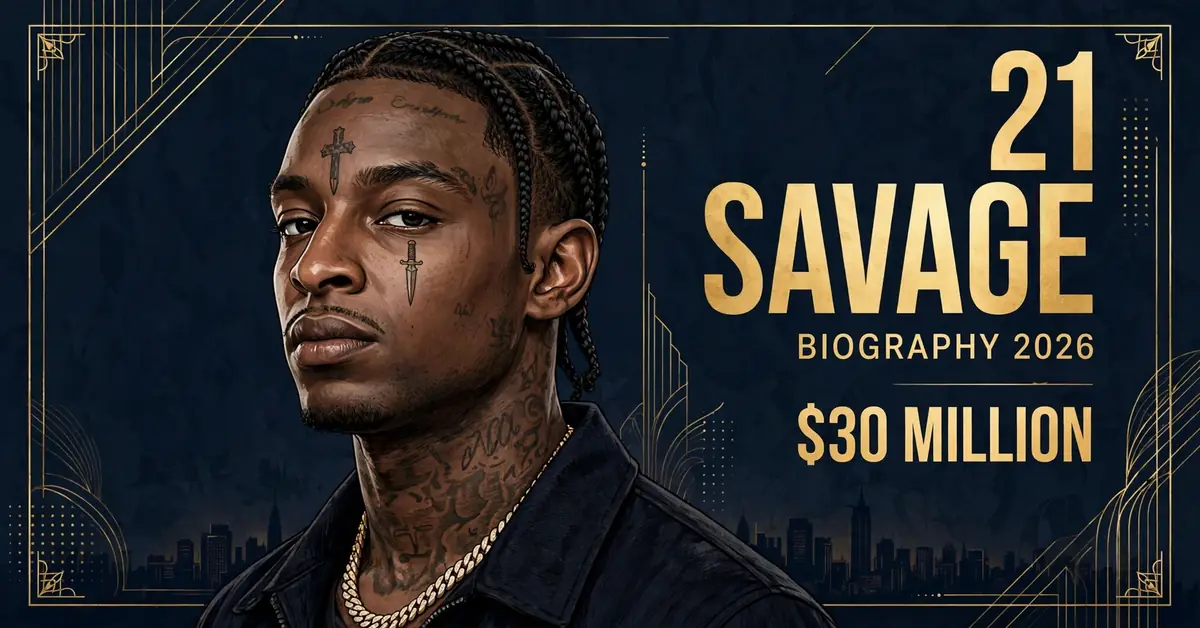
21 Savage biography 2026: born in London, raised in Atlanta, shot six times at 21 — four No. 1 albums, a Grammy, an ICE arrest, green card and a $30M fortune.
Last updated: November 10, 2026 · By Nathan Cole
21 Savage is 34 years old in 2026, a British-born rapper raised in Atlanta, and his net worth is estimated at $30 million. That is the figure Celebrity Net Worth carries in its snapshot dated 5 November 2026, and it sits at the top of a credible range that runs from $16 million to $30 million across the trackers surveyed. He was born Shéyaa Bin Abraham-Joseph in Plaistow, London, on 22 October 1992, moved to Atlanta at seven, and was shot six times on his 21st birthday — the night that gave him his stage name and turned him toward music.
He has since put four albums at No. 1 on the Billboard 200, won a Grammy for “A Lot” with J. Cole, spent more than a decade as the quietest star in Atlanta rap, survived a 2019 ICE arrest that revealed his British citizenship to the world, and became a lawful permanent resident of the United States in 2023. His fourth solo album, What Happened to the Streets?, arrived on 12 December 2025 and debuted at No. 3. This is the full story, kept current to 10 November 2026: the London childhood, the shooting, the Metro Boomin partnership, the Drake albums, the immigration case, the money, and the philanthropy that most biographies skip.
Quick Facts
| Full Name | Shéyaa Bin Abraham-Joseph |
| Age in 2026 | 34 years old (born 22 October 1992, Plaistow, London, England; turned 34 on 22 October 2026) |
| Net Worth 2026 | Estimated at $30 million (Celebrity Net Worth, 5 Nov 2026), inside a $16M–$30M range; credible band $20M–$30M |
| Height | 5 ft 9 in (175 cm) |
| Partner | Latto (2020–present) |
| Children | Three |
| Labels | Slaughter Gang Entertainment / Epic Records |
| Breakout | Savage Mode EP with Metro Boomin, July 2016 |
| No. 1 Albums | Four — I Am > I Was (2018), Savage Mode II (2020), Her Loss with Drake (2022), American Dream (2024) |
| Grammy | Best Rap Song, 2020 — “A Lot” featuring J. Cole |
| Latest Album | What Happened to the Streets? — 12 December 2025, debuted No. 3 on the Billboard 200 |
| Citizenship | British citizen; lawful permanent resident of the United States since 2023 |
How This Estimate Was Made
No audited figure exists for 21 Savage, and no celebrity-finance tracker has access to his bank statements, so the estimate is a range built from the trackers that publish one — and this article shows its work. Celebrity Net Worth gives $30 million (snapshot 5 November 2026). TrendCelebs gives $25–30 million. SuccessTitan gives about $20 million inside a $15–30 million range (updated 28 July 2026). MyFitFoods gives $20–30 million. LitNightzNews gives $16–30 million (24 June 2026). InfoCelebs gives $30 million on one 2026 page and $16 million on another — the same outlet contradicting itself, which is why the $16 million figure is kept as the floor of the range rather than treated as a separate fact. A $6 million figure from an unsourced page was rejected. This article anchors $30 million because it is the most-cited figure and the freshest, inside a $16 million to $30 million range, with the credible band at $20 million to $30 million. Income figures come from the same trackers plus the documented anchors: the 2017–2018 earnings window reported by Celebrity Net Worth, the 133,000 first-week units of American Dream, and the 73,000 first-week units of What Happened to the Streets?. Where sources disagree, the article names the disagreement. Corrections are welcome via the About page.
+
Who Is 21 Savage?
21 Savage is the most understated star in Atlanta rap. He does not chase trends, he does not flood the feed, and he has never had a tabloid era. He records in a flat, deadpan drawl over spare, menacing beats, and he has turned that restraint into a decade-long career: three solo studio albums at No. 1 or No. 2, a collaborative album with Drake that topped the charts in the US and the UK, a Grammy, and a catalog that keeps earning long after release day.
His real name is Shéyaa Bin Abraham-Joseph, born 22 October 1992 at Newham University Hospital in Plaistow, East London. His mother, Heather Carmillia Joseph, is of Dominican descent; his father, Kevin Cornelius Emmons, is of Vincentian descent, and his paternal grandfather was Haitian. The family moved to Atlanta when he was about seven, in July 2005, on a visa that expired the following year — a fact nobody outside his family knew until an ICE arrest in 2019 made it front-page news.
He grew up in East Atlanta, in Zone 6, the neighborhood he still claims in his lyrics. He was expelled from school at thirteen for carrying a weapon, and he finished eighth grade through alternative programs before leaving formal education entirely. By his own account he was dealing drugs by fourteen and involved in robberies as a teenager. He did not start rapping until he was 21, after a shooting on his birthday killed his best friend and nearly killed him. The music career began the following year, in 2014, with a single called “Picky”. Twelve years later he is one of the most durable names in Southern hip-hop, and the shooting that started it all is still the first thing people ask about.
The Net Worth Estimate, Source by Source
21 Savage’s net worth is a spread, not a single number, and the spread is wider than most fans realize. The trackers disagree by $14 million between the low and the high credible figures, and one outlet publishes both ends of the range on different pages. The table below lays out every figure this article found, with its source and its date, so the reader can see why $30 million is the anchor and not a guess.
| Source | Estimate | Date | Status |
|---|---|---|---|
| Celebrity Net Worth | $30 million | 5 Nov 2026 | Anchor |
| TrendCelebs | $25–30 million | 2026 | High band |
| MyFitFoods | $20–30 million | 23 Oct 2026 | Credible band |
| SuccessTitan | ~$20 million ($15–30M range) | 28 Jul 2026 | Mid band |
| LitNightzNews | $16–30 million | 24 Jun 2026 | Full range |
| InfoCelebs | $30 million / $16 million | 2026 | Self-contradictory |
Why does the range run so wide? Because the trackers are modeling different things. Celebrity Net Worth counts a decade of platinum catalog, four No. 1 albums, a diamond-certified feature and a label imprint, and lands at $30 million. SuccessTitan builds from the same catalog but applies heavier haircuts for management fees, touring costs, taxes, publishing splits and label participation, and lands near $20 million. The $16 million low end comes from pages that lean on older salary figures and count only the music, not the label or the brand work. The $6 million figure on one family-gossip page has no method at all and is not in the table.
One more thing the range hides: the $30 million anchor has barely moved in years. Celebrity Net Worth carried $30 million for 21 Savage well before 2026, and the 2026 snapshot repeats it. That stability is the point. He is not an artist whose fortune spikes on one viral moment; he is an artist whose catalog earns steadily, whose touring is selective, and whose spending is private. The estimate has stayed still because the career has stayed steady. A $16 million figure would mean the catalog stopped earning, and a $40 million figure would mean a windfall nobody can document. The truth sits inside the range, and $30 million is the point in it with the most-cited sourcing behind it.
How He Makes His Money
21 Savage’s income rests on four pillars, and the trackers agree on the shape of them even when they disagree on the total. Streaming and music sales come first: a catalog that includes Savage Mode II with more than 4 billion streams, four No. 1 albums, and a diamond-certified feature on Post Malone’s “Rockstar”. The trackers put his streaming income at roughly $3–5 million a year after the label split, and the catalog is the reason the number keeps coming: old 21 Savage songs stream like new ones, because the style has not dated.
Touring comes second, and it is deliberately selective. He toured North America in 2024 behind American Dream, playing arenas with JID and Nardo Wick on the bill, and he has headlined festivals including Dreamville in April 2025. He does not tour every year, and he does not play the small rooms. The 2024 tour was the first full arena run of his career, and it is the single biggest reason the $30 million anchor held through 2025: a touring artist earns in a summer what a streaming artist earns in a year.
| Income stream | Estimated contribution | Notes |
|---|---|---|
| Streaming & music sales | $3–5M a year | Four No. 1 albums; Savage Mode II 4B+ streams; “Rockstar” diamond-certified |
| Touring & festivals | Largest single-year spikes | American Dream arena tour 2024; Dreamville 2025 |
| Features & songwriting | Steady, per-project fees | “Rockstar”, “A Lot”, Her Loss; publishing on his own catalog |
| Label & brand work | Equity, not salary | Slaughter Gang Entertainment imprint under Epic; Mastercard financial-literacy campaign |
The third pillar is features and songwriting. 21 Savage is one of the most in-demand featured rappers of his generation, and the features pay twice: a fee up front and publishing on the recording. “Rockstar” alone, with Post Malone, spent eight weeks at No. 1 on the Hot 100 and went diamond. “A Lot” with J. Cole won the Grammy. The Her Loss album with Drake was a No. 1 in two countries. Those are not side hustles. They are the core of the catalog, and they pay every quarter.
The fourth pillar is the one the low-end trackers miss: the label and the brand work. He owns Slaughter Gang Entertainment, an imprint operating under Epic Records, which means he earns on artists he signs as well as on his own records. He has also done brand work that fits the biography rather than the stereotype — most notably a Mastercard financial-literacy campaign tied to his own foundation’s work teaching young people about bank accounts. That is not a sneaker deal. It is a deal that only makes sense for an artist whose public story is about surviving the streets and learning the system, and it pays like one.
Celebrity Net Worth also notes that he previously earned an estimated $6 million during a single 12-month period between 2017 and 2018, the window that ran from Issa Album through the “Rockstar” peak. That is the only documented annual earnings figure in the public record, and it is the anchor for the whole income picture: a young rapper, one year after his breakout, already earning $6 million in twelve months. Nine years later, with four No. 1 albums behind him, the $30 million total is the accumulation of that kind of year, repeated with gaps, minus the costs of a career lived mostly out of the spotlight.
Early Life: Plaistow to East Atlanta
Shéyaa Bin Abraham-Joseph was born on 22 October 1992 at Newham University Hospital in Plaistow, in the London borough of Newham. His parents separated early in his life. His mother, Heather Carmillia Joseph, brought the family to Atlanta, Georgia, when he was about seven years old — in July 2005, on what began as a temporary visa. He grew up in the Eastside neighborhood of Atlanta, in Zone 6, attending Woodland Hills Academy, alongside multiple siblings. The Caribbean heritage ran through the household: his mother’s family from Dominica, his father’s from Saint Vincent and the Grenadines, his paternal grandfather Haitian.
The Atlanta childhood was rough, and the record of it is consistent across every biography. He was expelled from middle school at thirteen for bringing a gun to school. He finished eighth grade through alternative programs and left formal education after that. By fourteen, by his own account, he was dealing drugs. He was involved in robberies as a teenager. The neighborhood he grew up in — East Atlanta, Zone 6 — is the same neighborhood he still names in his music, and the same one he raps about leaving and returning to on his 2025 album. The early life is not a prelude to the career. It is the subject of the career.
What the early life also explains is the silence. 21 Savage barely speaks in interviews, and when he does, he says little about himself. Part of that is temperament — the deadpan delivery is the persona. Part of it is history: for the first 26 years of his public life, nobody knew he had been born in London at all. The British birth was a secret he kept through the whole rise, from the mixtapes to the Grammy, and it only became public when the government made it public. A childhood that began on a temporary visa, in a new country, with a family that had crossed an ocean, teaches a person to keep their own counsel. He still does.

October 22, 2013: The Night That Named Him
On his 21st birthday — 22 October 2013 — 21 Savage was shot six times in an ambush in Atlanta. His close friend Johnny, known as YNW, was killed in the same attack. Three attackers were involved, by the account in the biographies. He survived. Johnny did not. The shooting is the single most important fact in the biography, because it is the fact that made the biography: the stage name, the career, and the subject matter all trace to that night.
The “21” in his name is the age he was that night. He has said so himself, and every serious biography repeats it. It is not a gang number, not a street code, not a reference to a blackjack hand. It is the birthday on which he was shot six times and his best friend died. The name is a memorial and a marker at once — a reminder of the night he nearly died, worn in public for the rest of his life.
He started rapping the following year, in 2014, with a single called “Picky”, produced by DJ Plugg. The timing is not a coincidence. Before the shooting he had no music career and no public profile. After it, he had a reason to talk and a name to talk under. The early songs were raw and local, and they stayed local for two years: three independent mixtapes, regional acclaim, and a growing reputation in Atlanta. The shooting gave him the story. The music gave him a way to tell it without talking about it.
The Mixtape Years: 2013–2016
The first phase of the career ran from 2013 to 2016, and it was entirely underground. He released three independent mixtapes — The Slaughter Tape in 2015 and Slaughter King later the same year, after the 2014 debut single — and built a regional following in Atlanta on the strength of a delivery nobody else had: flat, slow, almost bored, over beats that sounded like a warning. The deadpan was the point. Other Atlanta rappers shouted. He murmured, and the murmur carried further.
The mixtapes also built the network that would carry the career. The Slaughter Gang name — his crew, his label, his brand — dates to this period. The producers he worked with in Atlanta, including Metro Boomin, were already the most important producers in the city. The local acclaim was real but it was local: the mixtapes charted nowhere, sold little, and stayed inside the region. The breakout needed a record that could travel, and it needed a partner who knew how to make one.
That partner was Metro Boomin, and the record was Savage Mode. The two had been working together since the mixtape years, and by 2016 they were ready to make a project that sounded like a statement rather than a demo. The EP was nine tracks long, it was released in July 2016, and it changed everything in a single month.
Savage Mode and the Metro Boomin Partnership
Savage Mode, the collaborative EP with Metro Boomin released in July 2016, is the record that made 21 Savage a national name. It peaked at No. 23 on the Billboard 200 — modest by the standards of what came later, but a transformation for an artist who had never charted at all. Its singles, “X” featuring Future and “No Heart”, became his first real hits, and the EP was certified gold by the RIAA in 2017. The sound was spare and cold: Metro’s minor-key production under 21’s flat delivery, with almost nothing wasted. It sounded like nothing else on the radio that summer, and it has been copied ever since.
The partnership with Metro Boomin is the most important creative relationship of his career, and it is also the most durable. The two have now made three joint projects across nine years — Savage Mode in 2016, Savage Mode II in 2020, and Metro’s executive production on What Happened to the Streets? in 2025 — and Metro has produced or co-produced the biggest moments of the catalog. The relationship works because the two do different jobs: Metro builds the atmosphere, 21 fills it with the minimum number of words. Neither of them overdoes it, and that restraint is the brand.
Metro’s role also explains why the career has lasted. A rapper with one producer’s sound can go stale in a year. A rapper whose producer keeps evolving — from the trap minimalism of 2016 to the orchestral sweep of Savage Mode II — stays current without changing his own delivery. 21 Savage has never changed his delivery. He has never needed to. The production around him changed, and the voice stayed the same, and that is why a song from 2016 and a song from 2025 sound like the same artist.
Issa Album and “Rockstar”: 2017
His debut studio album, Issa Album, arrived in July 2017 on Epic Records, and it peaked at No. 2 on the Billboard 200. The lead single, “Bank Account”, reached No. 12 on the Hot 100 and became his signature song — a deadpan inventory of money, delivered over a beat that barely moves. The album proved that the Savage Mode sound could carry a full-length record, and it proved that a major label was willing to bet on an artist who refused to smile for the camera.
The same year brought the feature that made him a household name. “Rockstar”, Post Malone’s single featuring 21 Savage, spent eight weeks at No. 1 on the Hot 100, went diamond-certified, and won the Billboard Music Award for Top Rap Song in 2018. It is still the biggest commercial record of his career, and it is a feature — his verse, his voice, on somebody else’s song. That is a pattern that would repeat: the biggest moments of 21 Savage’s career are often collaborations, because his delivery is so distinctive that it makes any song it touches sound like his.
The year also set the earnings pattern that the net-worth trackers still use. Celebrity Net Worth reports that he earned an estimated $6 million in the twelve months between 2017 and 2018 — the Issa Album window, the “Rockstar” peak, the first arena-sized paydays. It remains the only documented annual earnings figure in the public record, and it is the reason the $30 million total is credible: a rapper earning $6 million in a single year, at 25, with a decade of catalog ahead of him, does not stay a $6 million artist.
I Am > I Was and the Grammy: 2018–2020
His second studio album, I Am > I Was, was released in December 2018 and debuted at No. 1 on the Billboard 200 — his first chart-topper as a solo artist. The album’s lead single, “A Lot” featuring J. Cole, became his most decorated record: it won the Grammy Award for Best Rap Song in 2020, his first and so far only Grammy. The song is a quiet masterpiece of the catalog — a slow, confessional track about money, guilt and survival, with a J. Cole verse that matched him bar for bar. It is the song that proved the deadpan could carry emotion, not just menace.
The album also marked a shift in how he was written about. Before I Am > I Was, the coverage was about the shooting and the street past. After it, the coverage was about the craft: the economy of the writing, the control of the delivery, the way a rapper who says so little can say so much. The Grammy sealed the shift. A Grammy for Best Rap Song is a peer award, voted by the industry, and it put him in a category the mixtape years never promised: a serious artist, judged on craft rather than backstory.
Then came the arrest. On 3 February 2019, two months after the album’s release, he was arrested by U.S. Immigration and Customs Enforcement. The full story of that arrest — and the three-year fight that followed — has its own section below, because it is the second defining event of the biography after the shooting. The short version is that the arrest stopped the career cold for a month, revealed the London birth to the world, and turned a private immigration case into a public cause. The album kept selling while he was in detention. The career did not stop. It changed shape.
Savage Mode II and Her Loss: 2020–2022
Savage Mode II, the second collaborative album with Metro Boomin, was released in October 2020 and debuted at No. 1 on the Billboard 200. It was a bigger, darker record than the EP — orchestral, cinematic, with narration from Morgan Freeman — and it proved that the partnership could scale up without losing the minimalism that made it work. The album has since passed 4 billion streams, and it is the commercial backbone of the catalog: the record that earns every quarter, year after year, long after release week.
Two years later came the biggest commercial project of his career. Her Loss, the collaborative album with Drake released in November 2022, debuted at No. 1 on the Billboard 200 in the United States and at No. 1 in the UK as well. It was his third No. 1 album, and it paired him with the biggest star in the genre on equal billing — not a feature, a full album, two names on the cover. The record’s success is part of why the Drake connection matters to the money story: a collaborative album with Drake pays like a Drake album, and 21 Savage’s share of it is the largest single payday of his career. For the numbers behind Drake’s own fortune, see Drake’s net worth on Guide Net Worth.
The two albums together explain the $30 million anchor better than any single figure. Savage Mode II earns forever. Her Loss paid once, and paid big. Between them, the 2020–2022 window was the most lucrative of his career, and it came without a tour, without a scandal, and without a single tabloid headline. He made the records, the records sold, and the money accumulated quietly. That is the whole business model, and it has not changed since.
American Dream: 2024
His third solo studio album, American Dream, was released on 12 January 2024 and debuted at No. 1 on the Billboard 200, with 133,000 album-equivalent units in its first week and 14 songs entering the Hot 100. It was his fourth consecutive chart-topper, counting the collaborative albums, and it was the most personal record he had ever made. The album opens with a narration about his immigration story, and the songs return to it throughout: the British birth, the Atlanta childhood, the visa, the arrest, the green card that was still to come. The title is not a metaphor. It is the legal status he was fighting for.
The album also carried the first full arena tour of his career. The American Dream Tour ran across North America in 2024, with JID and Nardo Wick on the bill, and it was the tour that turned the catalog into cash at scale: arenas, not clubs, for the first time. He had headlined festivals before, including a Dreamville appearance in April 2025, but the 2024 tour was the first time the whole show was his. The trackers that updated in 2026 — Celebrity Net Worth’s November snapshot, TrendCelebs’ $25–30 million band — are counting the tour’s money, and the $30 million anchor held because the tour happened.
He also appeared on Shannon Sharpe’s Club Shay Shay in 2024, in the long-form interview that remains the fullest public account of the immigration story in his own words. He talked about the arrest, the detention, the fear, and the green card process — subjects he had barely discussed in a decade of interviews. The interview is worth noting because it is the exception that proves the rule: 21 Savage does not talk about himself, and when he finally did, it was about the one subject that mattered most.
What Happened to the Streets?: 2025
His fourth solo studio album, What Happened to the Streets?, was released on 12 December 2025 through Slaughter Gang and Epic Records, executive produced by Metro Boomin and Southside. It runs 14 tracks and 47 minutes, and it features Drake, Lil Baby, Young Nudy, Latto, GloRilla, G Herbo, Metro Boomin and Jawan Harris, with production from Metro, Wheezy, Southside, Zaytoven, Turbo and Boi-1da among others. The album debuted at No. 3 on the Billboard 200 with 73,000 album-equivalent units, including 25,000 pure sales.
The record is a lament, not a celebration. The title asks a question the songs never answer, because there is no answer left to give: what happened to the streets is that they collapsed under contradictions nobody could resolve, and the album is the inventory of that collapse from inside. The opening track, “Where You From”, pledges allegiance to East Atlanta’s Zone 6 over a Southside and Wheezy beat. “Stepbrothers” with Young Nudy, “Atlanta Tears” with Lil Baby, “Cup Full”, “Pop It” with Latto, “Mr Recoup” with Drake — the tracklist reads like a roll call of the Atlanta scene, and the theme running through it is survivor’s guilt: the man who got out, looking back at the place he got out of.
The reviews agreed on the shape of it, even when they disagreed on the score. NME, reviewing on 18 December 2025, called it a menacing yet mournful lament on loss and a fractured Atlanta. Rolling Stone India, on 16 December 2025, found it too tough for its own good in places but singled out five strong cuts near the end. The chart performance was softer than American Dream — No. 3 rather than No. 1, 73,000 units rather than 133,000 — and the album’s first weeks were marked by a dispute over Billboard filtering roughly 37,000 units and Spotify removing 25 million streams. The numbers are a footnote. The record is the first album he has made as a lawful permanent resident of the United States, and it sounds like a man who finally has the paperwork to stay and is asking what is left of the place he stayed for.
The ICE Arrest and the Green Card: 2019–2023
On 3 February 2019, 21 Savage was arrested by U.S. Immigration and Customs Enforcement during a traffic stop in Atlanta and held in detention for more than a week. The arrest made international news for a reason nobody in the music industry had expected: officials revealed that he was a British citizen, born in London, who had entered the United States in July 2005 and overstayed an H-4 visa that expired in 2006. He had lived in America for thirteen years, built a career, paid taxes, and never become a citizen or a permanent resident. Almost nobody knew.
He was released on a $100,000 bond on 13 February 2019, after nine days in detention, and the case ran for four years. His lawyers argued that he had applied for a visa in 2017 and that the government had known about his status for years. The public response was immediate and unusually broad: fellow artists, immigration lawyers, members of Congress and the press all took up the case, and the hashtag campaign that followed it made his name a shorthand for the gap between the immigration system and the people it catches. He did not tour during the case. He did not leave the country. He recorded, he waited, and he fought it in court.
In 2023, he became a lawful permanent resident of the United States and received his green card. The announcement was quiet — a line in a legal filing, confirmed in the biographical record — and that quiet is characteristic. The green card is the single most important document of his adult life, and he announced it the way he announces everything: barely at all. The 2024 album, American Dream, is the artistic version of the announcement, and the 2025 album is the first one made by a man who no longer has to worry about being taken from his home. The biography divides into two halves at that date: before the green card, and after it.
Personal Life: Latto, Family, and Leading By Example
21 Savage has been in a relationship with the rapper Latto since 2020, a fact listed in the biographical record and confirmed by both artists in public appearances. The two have collaborated on record — Latto appears on “Pop It” from the 2025 album — and they have kept the relationship mostly out of the press, which is consistent with how he handles everything personal. He is a father of three children, whose names and details he has kept private.
His height is 5 ft 9 in (175 cm), a fact the biography pages all carry and the fans still ask about, and his birthday — 22 October — is the date the whole story turns on. He turned 34 on 22 October 2026. The Libra sign the gossip pages attach to the birthday is trivia; the date itself is the biography.
The part of his life the biographies cover least is the philanthropy, and it deserves more space than it gets. In 2018 he launched the 21 Savage Bank Account campaign with Get Schooled and Juma, a financial-literacy program that gave young people bank accounts, taught them how money works, and placed them in jobs. The campaign grew into the Leading By Example Foundation, which provides scholarships, bank accounts, financial-literacy education and job placement for underserved youth and students. The foundation’s name is the point: an artist whose public story is about surviving the streets and learning the system is teaching young people the system before the streets teach them. The Mastercard financial-literacy campaign he later fronted is the commercial version of the same work, and it is the brand deal that fits the biography rather than contradicting it.
He has also given money directly and quietly: donations to Atlanta schools and youth programs, support for the families of friends lost to street violence, and the kind of local giving that never makes a press release. The foundation is the organized version of it. The habit predates the fame, and it has outlasted every album cycle. A rapper who was expelled from school at thirteen now pays for other children’s schooling. That is not a footnote to the biography. It is the second half of it.
21 Savage vs His Peers: The Rapper Table
21 Savage’s $30 million sits in the middle of the rap peer group — richer than the pure streaming stars, poorer than the crossover names, and right where a decade-long catalog artist should sit. The table below uses Celebrity Net Worth estimates from November 2026, the same source that anchors this article’s estimate.
| Rapper | Net worth 2026 | Note |
|---|---|---|
| Drake | ~$250 million | Celebrity Net Worth — Her Loss collaborator |
| J. Cole | ~$60 million | Celebrity Net Worth — “A Lot” collaborator, Grammy co-winner |
| Post Malone | ~$50 million | Celebrity Net Worth — “Rockstar” collaborator |
| Future | ~$50 million | Celebrity Net Worth — “X” collaborator |
| 21 Savage | $30 million | This article — range $16M–$30M |
| Metro Boomin | ~$45 million | Celebrity Net Worth — producer partner, three joint projects |
The gap between 21 Savage and Drake is the gap between a catalog artist and a global brand: Drake’s $250 million is built on a decade of No. 1 albums, a touring machine and business ventures that run far outside music. The gap between 21 Savage and J. Cole is a single Grammy collaboration and a decade of touring difference. The gap that matters most is the one between 21 Savage and Metro Boomin: the producer is worth more than the rapper, which is the honest shape of modern hip-hop economics, and it is why the partnership has lasted — both of them are earning, and neither of them needs the other to survive.
Frequently Asked Questions
What is 21 Savage’s real name?
21 Savage’s real name is Shéyaa Bin Abraham-Joseph. He was born on October 22, 1992, at Newham University Hospital in Plaistow, London, England, to Heather Carmillia Joseph and Kevin Cornelius Emmons. The “21” in his stage name comes from his 21st birthday, the night he was shot six times and his friend Johnny was killed.
How old is 21 Savage in 2026?
21 Savage is 34 years old in 2026. He was born on October 22, 1992, and turned 34 on October 22, 2026. Some older biography pages still list him as 33 because they were written before his 2026 birthday; the correct age is 34.
What is 21 Savage’s net worth in 2026?
21 Savage’s net worth in 2026 is estimated at $30 million, anchored on Celebrity Net Worth (snapshot November 5, 2026) inside a $16 million to $30 million range. TrendCelebs gives $25–30 million and SuccessTitan about $20 million. The low $16 million figure comes from InfoCelebs, which publishes $30 million on another page. A $6 million figure from an unsourced page was rejected.
How tall is 21 Savage?
21 Savage is 5 feet 9 inches tall (175 cm). His height is listed consistently across biography sources including BoredPanda and TVOverMind, both updated in October 2026.
Why was 21 Savage arrested by ICE?
21 Savage was arrested by U.S. Immigration and Customs Enforcement on February 3, 2019, because he was a British citizen who had overstayed his visa. He entered the United States in July 2005 on an H-4 visa that expired in 2006, and lived in America for 13 years without citizenship or permanent residency. He was detained for nine days and released on a $100,000 bond on February 13, 2019.
Is 21 Savage a US citizen now?
No — 21 Savage is not a US citizen, but he became a lawful permanent resident of the United States in 2023 and received his green card. He remains a British citizen by birth. His 2024 album American Dream tells the immigration story in his own words.
Who is 21 Savage dating?
21 Savage has been in a relationship with the rapper Latto since 2020. Latto appears on “Pop It” from his 2025 album What Happened to the Streets? He is a father of three children, whose names and details he keeps private.
What is 21 Savage’s new album?
21 Savage’s latest album is What Happened to the Streets?, his fourth solo studio album, released on December 12, 2025. Executive produced by Metro Boomin and Southside, it has 14 tracks and features Drake, Lil Baby, Young Nudy, Latto, GloRilla, G Herbo and Metro Boomin. It debuted at No. 3 on the Billboard 200 with 73,000 album-equivalent units.
Sources & Reporting
This article was researched on 10 November 2026 from live reporting: Wikipedia for the 22 October 1992 birth date and place, the parents’ names, the July 2005 entry and 2006 visa expiry, the 3 February 2019 ICE arrest, the 2023 green card, the Latto partnership (2020–present), the Savage Mode No. 23 peak, the Issa Album No. 2 peak, the What Happened to the Streets? tracklist, features and No. 3 debut with 73,000 units; AllMusic for the career timeline, the Savage Mode gold certification, the “Bank Account” No. 12 peak, the American Dream No. 1 debut as his fourth consecutive chart-topper, and the 2013 career start; Celebrity Net Worth (snapshot 5 November 2026) for the $30 million anchor and the $6 million 2017–2018 earnings window; TrendCelebs for the $25–30 million band; SuccessTitan (updated 28 July 2026) for the ~$20 million figure; LitNightzNews (24 June 2026) for the $16–30 million range; InfoCelebs for the self-contradictory $16 million and $30 million pages and the shooting account; BoredPanda and TVOverMind (both October 2026) for the 5 ft 9 in height and the 34-year age; Seatpick for the “Rockstar” chart run, the Grammy, the Leading By Example Foundation and the 2018 Bank Account campaign; NME (18 December 2025) and Rolling Stone India (16 December 2025) for the What Happened to the Streets? reviews and release details; WhatsOnRap for the 12 December 2025 release date, the 14-track 47-minute running time and the Metro Boomin/Southside executive production; PopFiltr for the Caribbean heritage and the Atlanta move at age seven. Where sources disagreed — the net-worth range, the $16 million versus $30 million InfoCelebs pages, the stale 33-year age on older pages — the article names the disagreement instead of picking a number silently. Corrections are welcome via the About page.
Nathan Cole
Nathan Cole is the editor of Guide Net Worth. He covers celebrity wealth the way a business desk covers earnings: reported figures first, estimates labeled as estimates, no invented numbers. Every profile passes through his desk before it publishes. About Guide Net Worth · Corrections: figures are updated when new reporting emerges — contact us via the About page if you spot an error.
References & Sources
This article has been fact-checked and verified against multiple public sources, financial disclosures, SEC filings, Forbes reports, Celebrity Net Worth databases, and official records. All net worth estimates are based on publicly available information and financial analysis.