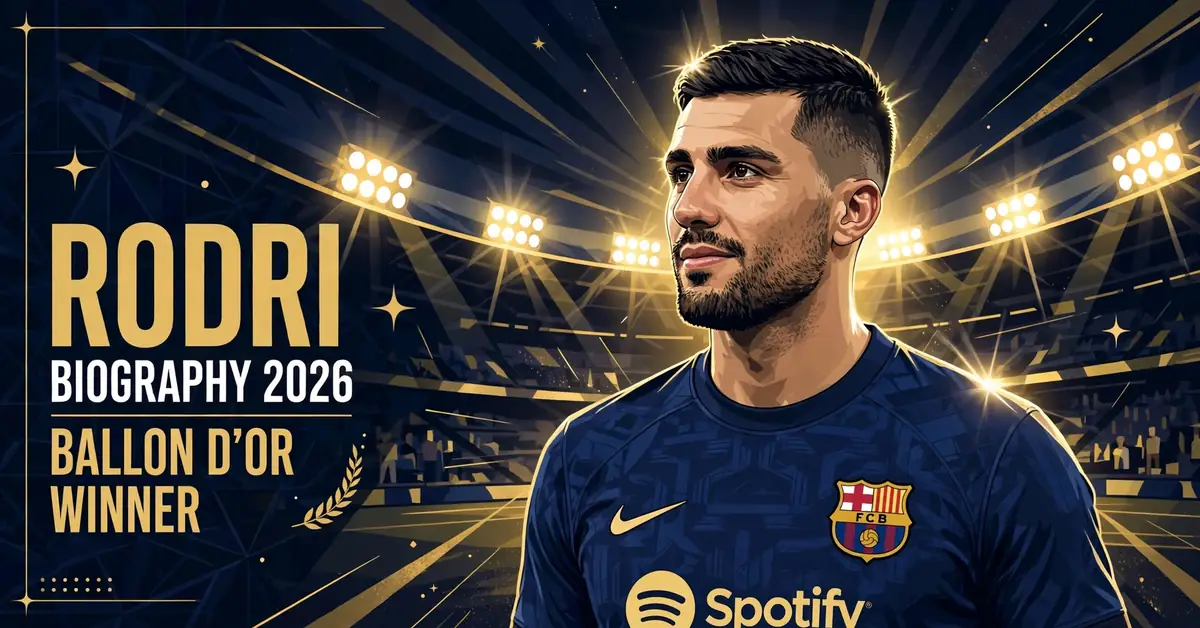
Rodri’s biography in 2026: the Ballon d’Or winner who captained Spain to World Cup glory, then joined Barcelona for £65.4m — ACL comeback and $30–60M fortune.
Last updated November 24, 2026
By Nathan Cole
Rodri — Rodrigo Hernández Cascante, born 22 June 1996 in Madrid — is the defensive midfielder who spent seven years running Pep Guardiola’s Manchester City, won the 2024 Ballon d’Or on crutches, captained Spain to the 2026 World Cup, and then joined FC Barcelona in August 2026 for £65.4 million. He is 30 years old, 1.90 metres tall, holds a university degree in business administration, has no social media accounts, and is, by most serious measures, the best holding midfielder of his generation.
The story reads like a script nobody would buy. Atlético Madrid released him at 17 for being too small. He grew twenty centimetres, earned a degree while playing in La Liga, and returned to the top by the slow route — Villarreal, Atlético again, then Manchester. At City he won four straight Premier League titles, scored the goal that won the 2023 Champions League final, and went 74 games without losing. Then his right knee gave way in September 2024, and five weeks after surgery he collected football’s biggest individual prize on crutches. Two years later he lifted the World Cup as Spain’s captain and won the Golden Ball without scoring a goal.
His net worth in 2026 is estimated at $30–60 million, anchored at $30 million on the Celebrity Net Worth figure, with the spread explained honestly below. His Barcelona salary is reported by Capology at about €27 million a year gross — the highest wage in Hansi Flick’s squad. What follows is the full biography: the rejection, the degree, the trophies, the knee, the Ballon d’Or, the World Cup, and the move home to Spain, with every figure sourced and dated.
Quick Facts
| Full Name | Rodrigo Hernández Cascante |
| Born | June 22, 1996, Madrid, Spain (age 30) |
| Height | 1.90 m (6 ft 3 in) |
| Position | Defensive midfielder (number six) |
| Current Club | FC Barcelona (joined August 18, 2026; contract to June 30, 2030; shirt No. 16) |
| National Team | Spain — captain; World Cup winner 2026, Euro 2024 winner, Nations League 2023 winner |
| Major Honours | Ballon d’Or 2024, World Cup Golden Ball 2026, Euro 2024 Player of the Tournament, Champions League 2023 |
| Education | Degree in Business Administration and Management, Universitat Jaume I, Castellón (graduated 2021) |
| Net Worth (2026) | $30–60 million (estimated, anchored at $30 million) |
| Partner | Long-term girlfriend Laura (met at university); not married |
| Last Updated | November 24, 2026 |
How This Estimate Was Made
This figure is an independent estimate — Rodri has never disclosed his finances publicly. Our process: gather every credibly reported salary, deal, and asset; cross-check them across reputable outlets; allow for taxes, representation fees, and spending; and publish a range wherever sources disagree, with the reasoning shown in the article. The published estimates for Rodri disagree by a factor of two ($30 million to $60 million), so a single number would be dishonest — the range is the honest answer. Anything uncertain is labeled as an estimate, not a fact.
+
The Short Version: Who Rodri Is in 2026
Rodri is a Spanish defensive midfielder for FC Barcelona and the captain of the Spain national team. Born in Madrid on 22 June 1996, he is 30 years old and stands 1.90 metres tall. He spent seven seasons at Manchester City, where he won four consecutive Premier League titles and scored the winning goal in the 2023 Champions League final, then won the Ballon d’Or in October 2024 — the first Spanish man to do so since Luis Suárez in 1960.
His 2026 reads like a career highlight reel compressed into five months. In July he captained Spain to their second World Cup title, beating Argentina 1–0 after extra time in the final at MetLife Stadium, and won the Golden Ball as the tournament’s best player. In August, Barcelona signed him from Manchester City for €76.5 million (£65.4 million) on a four-year contract running to June 2030, after rejecting two lower bids. He now earns a reported €27.08 million a year gross at Barcelona, per Capology — the highest wage in the squad.
What makes him different from almost every other footballer at his level is what he does not do. He has no social media presence at all. He has no tattoos. He completed a full university degree while playing professional football, lived in student halls while playing in La Liga, and drove a second-hand car bought from an elderly woman. The quiet life is not an act. It is the same discipline that shows up on the pitch: he controls games by being in the right place, at the right speed, every single time.
The £65.4 Million Barcelona Move: August 2026
Barcelona announced the signing on Tuesday, 18 August 2026. The statement was short and formal: “FC Barcelona and Manchester City have reached an agreement for the transfer of Rodrigo Hernández Cascante, known in the football world as Rodri, who is committing to the Catalan club until 30 June 2030.” Behind that sentence sat a summer of brinkmanship. Barcelona’s opening offer of £40 million was rejected. A second bid of £55 million was rejected too. The third, agreed over the weekend of 16–17 August, was worth €76.5 million — about £65.4 million, or $88.56 million — and City accepted, with ESPN reporting the agreement in principle on 17 August and the two clubs exchanging paperwork that Sunday.
The fee structure tells its own story about how Barcelona valued a 30-year-old. According to reporting syndicated from BBC Sport, the package was built around a fixed €60 million, plus €10 million in variables tied to the number of matches Rodri plays, plus a further €6 million payable only if easier targets are met. That is a deal designed for a player whose value is measured in control rather than goals: Barcelona were willing to pay top money, but only if he stayed on the pitch.
Rodri had one year left on his Manchester City contract, which had been due to expire in June 2027. Real Madrid had also pursued him, per BWorldOnline’s reporting, and Barcelona beat their rivals to the signature. City’s new boss, Enzo Maresca, admitted he wanted to keep the 2024 Ballon d’Or winner — but the player had made his choice. Rodri flew into Barcelona’s El Prat airport on the Monday, told reporters that “playing for Barcelona is a dream come true for me,” passed his medical on the Tuesday, and was presented before the Joan Gamper Trophy match against Al Ahly. He took shirt number 16 and became the 20th player in the history of the Barça first team to wear the shirt, following names such as Marcos Alonso and Munir.
The move closed a circle that had been open since 2018, when Barcelona first tried to sign him as Sergio Busquets’ successor and Atlético Madrid moved first instead. Eight years later, the successor finally arrived — now a Ballon d’Or winner and a World Cup-winning captain, at a fee that made him one of the biggest deals of the 2026 summer window. By November 2026 he had settled quickly enough to register a goal and an assist in La Liga, per BellyUp Sports’ transfer review.
The World Cup Summer: Spain’s Second Star and the Golden Ball
Spain arrived at the 2026 World Cup as European champions and left as world champions. Rodri, named in Luis de la Fuente’s squad on 25 May 2026, captained the side through eight matches in which Spain conceded a single goal and never once trailed. The semi-final was a 2–0 win over France in Arlington. The final, on Sunday 19 July 2026 at MetLife Stadium in East Rutherford, New Jersey, was decided in extra time by former Manchester City man Ferran Torres, whose goal gave Spain a 1–0 win over Argentina and their second men’s World Cup title — the first since 2010.
Rodri won the Golden Ball as the tournament’s best player, becoming the first Spanish player ever to win the award. The numbers behind the prize are strange and telling: he scored no goals and supplied no assists in eight matches, yet FIFA’s voters picked him ahead of Lionel Messi, who took the Silver Ball, and Kylian Mbappé, who took the Bronze Ball. The Athletic’s Michael Cox, writing after the final, put it plainly — Spain won with teamwork rather than star power, and Rodri’s passing efficiency of nearly 93% was the mechanism that made it work. He was replaced during extra time in the final, but his work was done; he returned to lift the trophy.
Spain swept the individual awards. Unai Simón won the Golden Glove after seven clean sheets and one goal conceded in eight matches. Pau Cubarsí won the Young Player of the Tournament award at 19 years and 178 days, the youngest winner of the prize. The only major award to leave Spain was the Golden Boot, won by Mbappé with 10 goals — the first player to win back-to-back Golden Boots. England, for the record, finished third after beating France 6–4 in a ten-goal playoff in Miami.
For Rodri personally, the Golden Ball completed a collection no midfielder of his generation can match. He had already won the Champions League with Manchester City, the European Championship with Spain, and the Ballon d’Or. The World Cup made him, per Sambad English’s count, only the 11th man in football history to hold all three. Manchester City’s own site noted he became the first City player to captain a side to World Cup glory. His Spain teammate Lamine Yamal, whose net worth we covered here, was 19 and already a star; Rodri, at 30, was the man the whole team was built around.
The Ballon d’Or Night in Paris: October 28, 2024
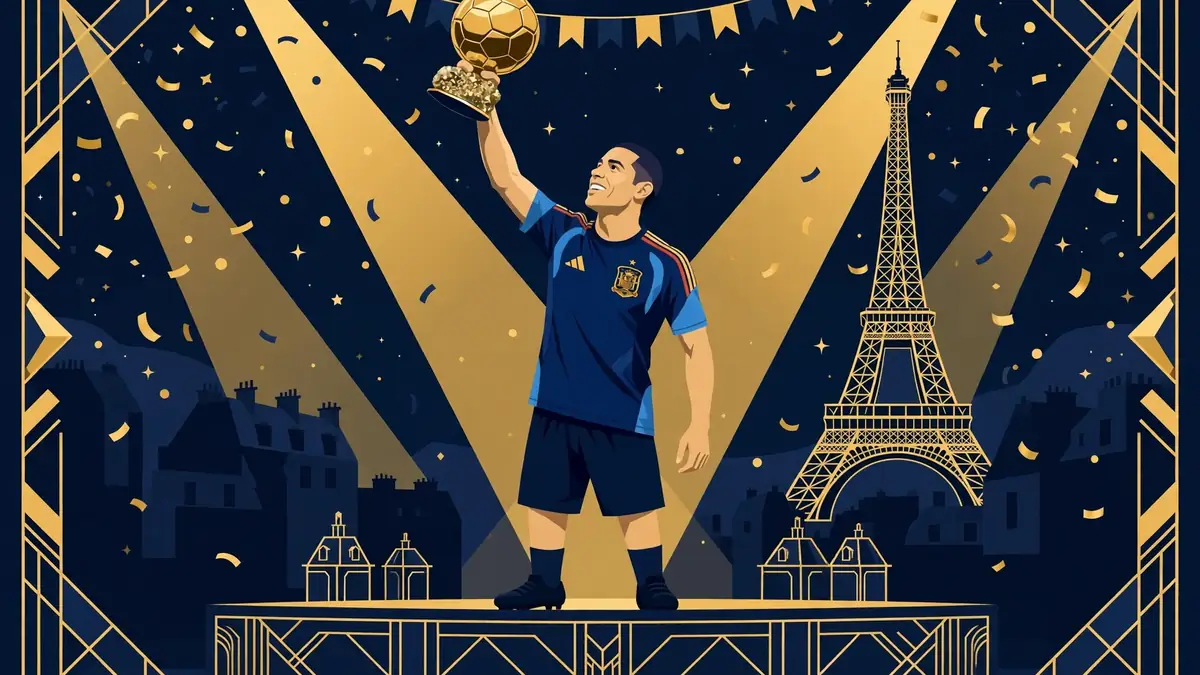
Five weeks after knee surgery, Rodri walked onto the stage at the Théâtre du Châtelet in Paris on crutches. George Weah, the 1995 winner, opened the envelope and announced “Rodrigo Hernández.” On 28 October 2024, Rodri became the 2024 Ballon d’Or winner — the first Manchester City player ever to win it, the first Spaniard since Luis Suárez in 1960, and, per Sky Sports, the first defensive midfielder to win the award since its inception in 1956.
He beat Vinícius Júnior, Dani Carvajal, Jude Bellingham, whose net worth story we tell here, and Erling Haaland to the prize. The vote was close enough, and the outcome surprising enough, that Real Madrid’s entire delegation stayed home in protest — despite Madrid winning the best team award on the same night. Rodri’s speech, delivered in Spanish, was a dedication to the generations of Spanish midfielders who never won it: Xavi Hernández, Andrés Iniesta, and Sergio Busquets. “This is a reward for Spanish football,” he said.
The season that earned it was 2023–24, and the numbers were extraordinary. City did not lose any of the 34 Premier League games in which Rodri featured, winning 27 and drawing seven. Without him they won one of four and lost three. He set new Premier League records for a single season with 3,359 successful passes and 2,122 successful passes in the opposition’s half, records tracked from 2003–04 onward. He scored decisive goals too: an equaliser against Chelsea, and the title-clinching drive against West Ham on the final day as City edged Arsenal.
The unbeaten run behind the award was longer still. Across club and country, Rodri went 74 games and 475 days without experiencing defeat, a run that ended only in the FA Cup final against Manchester United in May 2024. His last Premier League defeat before that had come at Tottenham in February 2023 — and at the time of the Ballon d’Or he was unbeaten in 52 top-flight appearances, 42 wins and 10 draws. No holding midfielder had ever been valued this way by the game’s biggest individual prize. That is what made the night historic rather than merely surprising.
The ACL Rupture and the Eight-Month Comeback
On 22 September 2024, in just his third Premier League appearance of the season, Rodri ruptured the anterior cruciate ligament in his right knee — with a meniscus tear alongside it — during a 2–2 draw with Arsenal at the Etihad Stadium. He underwent surgery and was ruled out for the rest of the season. The timing was brutal: he had just come off the best season of his career, and the injury arrived five weeks before he would win the Ballon d’Or for that very season.
His absence exposed exactly how much City depended on him. The club failed to win a single trophy in 2024–25, the first trophyless season since 2016–17, and the midfield never looked settled without its anchor. The contrast with the previous season — unbeaten in 34 league games with him, one win in four without him — stopped being a statistic and became the story of City’s year. Pep Guardiola’s side, built around a single pivot, discovered what that pivot was worth by losing him.
Rodri returned to the field eight months after the injury, during Manchester City’s league match against AFC Bournemouth in May 2025. The comeback was deliberately slow: hamstring and groin problems in the 2025–26 season — Guardiola’s last at the club — restricted his involvement further, and he managed only a limited role in his final City campaign. That context matters for the Barcelona fee. A club does not pay €76.5 million for a 30-year-old with two injury-hit seasons behind him unless it believes the player in front of it is the one who controlled the World Cup final, not the one who spent eight months in rehab. Barcelona’s bet was on the summer of 2026, not the winter of 2024.
The injury also frames the Ballon d’Or speech. Rodri collected the award on crutches, in a tuxedo, with his partner Laura beside him on the red carpet. He thanked the generations before him and said nothing about the knee. He did not need to. Everybody in the room could see it.
Seven Years at Manchester City: The Treble and Four Straight Titles
Manchester City signed Rodri in July 2019 after paying his £62.6 million release clause — a then club-record fee, with Britannica listing the figure at £62.8 million. He made his debut on 4 August 2019 in the FA Community Shield at Wembley, playing the full 90 minutes as City beat Liverpool on penalties after a 1–1 draw. He had arrived as Fernandinho’s long-term replacement. Within two seasons he was irreplaceable.
The silverware piled up fast. City won the Premier League in 2020–21, 2021–22, 2022–23 and 2023–24 — four consecutive titles, a feat no English club had managed before. The 2022–23 season was the treble: Premier League, FA Cup, and the Champions League, sealed on 10 June 2023 in Istanbul when Rodri scored the only goal of the final against Inter Milan, a 68th-minute strike that made him the Champions League Player of the Season. The FIFA Club World Cup followed in December 2023. His midfield partner for much of that run was Kevin De Bruyne, whose biography we tell here — the creator to Rodri’s controller — and the attack was finished by Erling Haaland, whose net worth story we cover here.
City extended his contract in 2022, tying him down until 2027, and for a while the arrangement looked permanent: the best holding midfielder in the world, in the team built to use him, under the coach who understood him best. Guardiola’s system asks the number six to do everything — receive under pressure, set the tempo, cover the space behind the attack, and arrive late in the box. Rodri did all of it, and the numbers kept proving it: in 2023–24 City averaged 2.6 goals per game with him involved and 1.5 without him, conceding 0.9 per game with him and 1.3 without him.
By the summer of 2026, though, the ground had shifted. Guardiola was preparing his final season, City had a new boss in Enzo Maresca waiting in the wings, Rodri’s contract had one year left, and Barcelona had come back with real money. Seven years, four league titles, a treble, a Club World Cup, and one Champions League final winner later, the chapter closed with a £65.4 million fee — slightly more than City had paid for him, and a fair price for a player who had given them the best years of his career.
The Rejection That Made Him: Atlético, Villarreal and the Growth Spurt
Rodri was born in Madrid and raised in Villanueva de la Cañada, a commuter town of just under 23,000 people to the west of the capital, alongside two younger brothers. His father Antonio is an engineer; his mother Elena works in marketing. He began organised football at CF Rayo Majadahonda at the age of ten, sharing youth pitches with future internationals Lucas and Theo Hernández, and joined Atlético Madrid’s academy in 2007, when he was eleven.
At fourteen, his then-coach Mauricio Elena told ESPN, Rodri already stood out: small, but with vision and intelligence beyond his age, always with his head up, always reading the game a step ahead. “He was a fundamental part of the team. It was a pleasure to watch him.” Not everybody at Atlético agreed. At seventeen, standing barely 1.70 metres tall, he was released by academy coaches who doubted he had the physical strength for senior midfield battles. The official reason, recorded by Wikipedia, was a “lack of physical strength.”
Villarreal took him, and what happened next is the kind of thing that sounds invented. A sudden growth spurt added twenty centimetres to his frame, taking him to 1.90 metres, without costing him his balance or his touch. He made his senior debut for Villarreal B on 7 February 2015, as a late substitute in a 3–1 win at Espanyol B, and his first start came fifteen days later. His first-team debut arrived in December 2015 against Huesca in the Copa del Rey, under Marcelino García Toral, and his La Liga bow followed on 17 April 2016 against Rayo Vallecano. By 2017–18 he was a first-team regular, starting 36 league games.
Atlético came back for him. On 24 May 2018 the club announced his return for a fee in the region of €20 million plus €5 million in variables, on a five-year contract, and he won the UEFA Super Cup in his single season back. One year later Manchester City paid the release clause. The academy that had let him go for being too small had, in the end, paid €20 million to buy him back — and sold him on twelve months later for three times that. The rejection did not break his career. It built it.
The Student Who Became a Midfielder
While rising through Villarreal’s youth and reserve ranks, Rodri enrolled at the Universitat Jaume I in Castellón and began a degree in Business Administration and Management. He lived in student halls of residence even after breaking into La Liga, drank sparkling water while his classmates went out partying, and cycled to training — taking his bike on the train as part of the journey to the ground. His fellow students joked that he had earned them too few points on the fantasy football game Comunio after Villarreal matches.
He kept studying after the money arrived. When he made his Spain debut in March 2018 — coming off the bench in a 1–1 draw with Germany — he was still combining football with his university education. “The student environment helps me a lot,” he told La Razón at the time. He finished the degree while already a Manchester City player, after six years of study, graduating in 2021 according to Britannica — travelling back to Castellón whenever exams required it. At university he met his long-term girlfriend Laura, who was studying medicine. The two have been together ever since; after the 2023 Champions League final, a camera caught her running onto the pitch before Rodri gave her his gold medal.
The rest of his private life follows the same pattern. He has no social media presence — no Twitter, no Instagram — and FC Barcelona’s own welcome piece lists it as one of the ten things to know about him. He has no tattoos. Early in his career he drove a modest second-hand hatchback bought from an elderly woman. None of this is a marketing pose. It is the same temperament that makes him valuable on the pitch: he does not chase attention, he does not rush, and he does not waste energy on anything that does not serve the job in front of him.
How Rodri Plays: The Number Six, Explained
Rodri plays as a defensive midfielder — the number six — and he has spent a decade redefining what the position can be. The old version of the job was destruction: win the ball, give it to someone creative, stay out of the way. Rodri’s version is construction. He receives the ball under pressure, turns, and picks the pass that moves the whole team ten yards up the pitch. He covers the space in front of the defence so completely that his centre-backs rarely have to defend one-on-one. And he scores the goals that decide finals, because he arrives in the box late and unmarked, exactly when the defence has forgotten about him.
The numbers explain why coaches build teams around him rather than merely including him. In 2023–24 he completed 3,359 successful passes in the Premier League — a record for a single season since tracking began in 2003–04 — with 2,122 of them in the opposition’s half. At the 2026 World Cup his passing efficiency ran at nearly 93%. These are not the statistics of a player who plays safe. They are the statistics of a player who takes the ball in the most dangerous areas of the pitch and almost never gives it away.
His game has one visible weakness, and it is also his defining trait: he is not fast. He compensates with positioning so precise that he rarely has to run. Watch him for ten minutes and the pattern is obvious — he is already standing where the ball is about to be, because he read the pass two seconds before it was played. That is why his 74-game unbeaten run was not a fluke, why City collapsed without him in 2024–25, and why Spain conceded one goal in eight World Cup matches with him anchoring the midfield. Speed fades. Reading the game does not.
Net Worth in 2026: –60 Million and Why the Range Is Wide
Rodri’s net worth in 2026 is estimated at $30–60 million, anchored at $30 million on the Celebrity Net Worth figure — the most widely cited number this year. The honest truth is that the published estimates disagree with each other by a factor of two, and any article that prints a single number without saying so is pretending to a precision the public record does not support. Here is what the named sources actually say, with their dates:
| Source | Estimate | Basis |
|---|---|---|
| Celebrity Net Worth (2026) | $30 million | Most widely cited 2026 figure; our anchor |
| FootballPickr (Sept 2026) | $35 million | Wages + endorsements model |
| SoccerNetWorth (2026) | $45 million | Career salary earnings ~$45M since 2019 |
| Alux (Oct 2026) | $60 million (range $40–80M) | Own estimate from reported wages and bonuses |
| Surprise Sports (2026) | $15.6 million | Stale — predates the Ballon d’Or and Barcelona deal |
Why the spread is real: no club has ever published Rodri’s pay, tax and agent costs are private, and the Barcelona contract is only a few months old. SportsLeo puts his total career gross earnings above $85 million, which fits the top of the range once Spanish, German and British taxes, agent fees and ordinary spending are subtracted. The $15.6 million figure, still floating around on some sites, predates both the Ballon d’Or and the Barcelona contract and should be treated as stale. Our anchor stays at $30 million because it is the figure the most trackers agree on — but readers should understand the range, not just the anchor. For context on how football fortunes are tracked, see our Celebrity Net Worth archive.
Endorsements add a smaller, steadier stream. His flagship commercial deal is with Nike — he is a Phantom boot athlete — with Footy Headlines estimating the technical contract at $2–3 million a year. He is not a billboard star in the style of the game’s biggest names, and that is by choice: a man with no social media accounts is never going to be a brand’s loudest ambassador. The money comes from the football, and the football has paid him very well for a very long time.
Salary: What Barcelona Pays Him
Capology’s Barcelona wage data, updated 23 November 2026 and carried by FBref, puts Rodri’s gross salary at €27.08 million a year — €520,769 a week, or about £440,558 a week. That makes him the highest earner in Hansi Flick’s squad and the third-highest-paid player in La Liga. The figure is an estimate, not an official disclosure — neither club has published the contract — but Capology is the salary database the whole football press relies on, and Yardbarker’s November 2026 La Liga salary ranking, sourced from the same data, agrees.
Other reports put the net figure lower. Mykhel reported around €15 million a year, and Yardbarker’s deal reporting at the time of the signing put his contract at a little over €13 million net per season. The gap between €27 million gross and €13–15 million net is Spanish tax, which takes roughly half of a top earner’s pay. Both sets of numbers can be true at once: the gross is what Barcelona pays, the net is what reaches his account.
At Manchester City, his base pay was reported at around £220,000 a week — roughly £11.4 million a year — with some 2026 reports putting the top end of his City earnings at £250,000 a week. The Barcelona deal, on the Capology figures, more than doubles his gross annual pay. That is the market price of a World Cup-winning captain who had just won the Golden Ball: Barcelona paid a €76.5 million fee and a top-three La Liga wage to get him, and they did it knowing he is 30, because the player they bought controls games in a way that does not depend on youth.
Trophies and Honours: The Complete List
Rodri’s trophy cabinet is the argument for his career in one glance. He has won the World Cup, the European Championship, the Champions League, four Premier League titles, and the Ballon d’Or — and he has done it as the player his teams were built around, not as a passenger.
| Honour | Year(s) | Team |
|---|---|---|
| FIFA World Cup | 2026 | Spain (captain; Golden Ball) |
| UEFA European Championship | 2024 | Spain (Player of the Tournament) |
| UEFA Nations League | 2023 | Spain (best player of the finals) |
| UEFA Champions League | 2023 | Manchester City (final winner; Player of the Season) |
| Premier League | 2021, 2022, 2023, 2024 | Manchester City (four consecutive) |
| FA Cup | 2023 | Manchester City (treble season) |
| FIFA Club World Cup | 2023 | Manchester City |
| UEFA Super Cup | 2018 | Atlético Madrid |
| UEFA European Under-19 Championship | 2015 | Spain U19 |
| Ballon d’Or | 2024 | First Spanish man since Luis Suárez (1960) |
| FIFA World Cup Golden Ball | 2026 | First Spanish player to win it |
Two lines in that table carry the weight. He is the first defensive midfielder to win the Ballon d’Or since the award began in 1956, and only the 11th man in history to win the World Cup, the Champions League and the Ballon d’Or. The first fact says something about how football values his position now. The second says something about how rare his career is, full stop.
Rodri vs His Peers: The Midfielders He Beat to the Ballon d’Or
The 2024 Ballon d’Or vote was a referendum on what football values. The favourite for much of the year was Vinícius Júnior, the winger who scores the goals and makes the highlights. Rodri beat him, along with Dani Carvajal, Jude Bellingham and Erling Haaland — three of the four other finalists played for Real Madrid or Manchester City, and all four are attackers or attacking midfielders. A holding midfielder had never won the award before. The voters chose control over chaos.
The comparison that matters most is with the men he was measured against in his own position. Sergio Busquets, the player Barcelona originally wanted Rodri to succeed, never finished higher than third in a Ballon d’Or vote. Xavi Hernández and Andrés Iniesta, the midfielders Rodri thanked in his speech, never won it either. Luka Modrić, the only other pure midfielder to win it in the modern era, did so in 2018 after carrying Croatia to a World Cup final. Rodri’s case was different: he did not carry a team to a final through brilliance. He made two teams — City and Spain — function at a level neither reached without him, and the voters finally rewarded the function itself.
Against his own generation, the gap is just as clear. Bellingham, brilliant as he is, finished behind Rodri in the 2024 vote despite a spectacular first season at Real Madrid. Haaland scores more goals than any striker alive and finished behind him too. The message of that vote, and of the 2026 Golden Ball that followed it, is that the game’s judges have learned to see the player who makes everyone else better — even when he scores no goals and supplies no assists in eight World Cup matches.
What’s Next: Barcelona, the 2026–27 Season and Beyond
Rodri’s Barcelona contract runs to 30 June 2030, when he will be 34. The four-year deal is a statement of intent from both sides: Barcelona believe his game — positioning, passing, reading the play — will age better than a game built on pace, and Rodri believes the club that first tried to sign him in 2018 is the right place to finish his career at the top. He joined the La Liga champions under Hansi Flick, in a squad that already contained his Spain teammates, and took the number 16 shirt.
The short term is straightforward. Barcelona want a Champions League run to match their league title defence, and they bought Rodri to control the games that decide both. His early returns — a goal and an assist in La Liga by November 2026 — suggest the adaptation is going smoothly. The longer question is whether a 30-year-old with an ACL in his history can stay on the pitch enough to justify a €76.5 million fee and a €27 million gross wage. The fee structure, with €16 million of it tied to appearances and targets, shows Barcelona asked themselves the same question.
For Spain, the next landmark is the defence of the European Championship, with Rodri still captain and still the first name on Luis de la Fuente’s team sheet. He has already matched the famous Spain team of 2008–2010 — European champions and world champions in the same cycle — and he did it as the captain. What remains is the part of the story nobody can write yet: whether the quiet midfielder from Villanueva de la Cañada, the one who was too small at seventeen, ends his career as the defining Spanish footballer of his generation. On the evidence of the last three years, it would be a surprise if he did not.
Frequently Asked Questions
How old is Rodri?
Rodri is 30 years old. He was born Rodrigo Hernández Cascante on 22 June 1996 in Madrid, Spain, and he turns 31 in June 2027.
What team does Rodri play for in 2026?
Rodri plays for FC Barcelona. He joined from Manchester City on 18 August 2026 for a reported €76.5 million (£65.4 million), signing a four-year contract to 30 June 2030 and taking shirt number 16. He spent the previous seven seasons at Manchester City.
How much is Rodri worth in 2026?
Rodri’s net worth in 2026 is estimated at $30–60 million, anchored at $30 million on the Celebrity Net Worth figure. Other named estimates include $35 million (FootballPickr), $45 million (SoccerNetWorth) and $60 million (Alux, October 2026). The range reflects real uncertainty: no club has ever published his pay, and the Barcelona contract is only a few months old.
What is Rodri’s salary at Barcelona?
Capology puts Rodri’s Barcelona salary at about €27.08 million a year gross — €520,769 a week — making him the highest earner in the squad and the third-highest-paid player in La Liga. Other reports put the net figure at roughly €13–15 million a year after Spanish tax. At Manchester City he earned a reported £220,000 a week.
Did Rodri win the Ballon d’Or?
Yes. Rodri won the 2024 Ballon d’Or on 28 October 2024 at the Théâtre du Châtelet in Paris, collecting the award on crutches five weeks after knee surgery. He was the first Spanish man to win it since Luis Suárez in 1960, the first Manchester City player to win it, and the first defensive midfielder to win it since the award began in 1956.
What happened to Rodri’s knee?
Rodri ruptured the anterior cruciate ligament in his right knee, with a meniscus tear, on 22 September 2024 during a 2–2 draw with Arsenal. He had surgery and missed the rest of the 2024–25 season, returning eight months later against Bournemouth in May 2025. Hamstring and groin problems restricted him further in 2025–26, but he captained Spain to the World Cup in July 2026.
Is Rodri married? Who is his girlfriend?
Rodri is not married. His long-term girlfriend is Laura, whom he met while studying at the Universitat Jaume I in Castellón — she was studying medicine while he studied business administration. The couple keep their relationship private and rarely appear together in public.
Why does Rodri have no social media?
Rodri has no social media accounts by personal choice. He has never opened an Instagram or Twitter/X account and prefers to keep his personal life offline — a stance FC Barcelona’s own welcome article lists as one of the ten things to know about him. He also has no tattoos and lived in student halls while playing in La Liga.
Sources & Reporting
This biography was researched from live sources in November 2026. The Barcelona transfer was reported by ESPN (17 August 2026), TNT Sports, The Oldham Times (18–19 August 2026), BWorldOnline (19 August 2026) and BBC Sport syndication, with the official announcement from FC Barcelona. The 2026 World Cup final and Golden Ball were reported by ESPN, Manchester City’s official site, OneFootball (19 July 2026), SABC Sport and The Athletic. Biographical detail comes from Britannica, Wikipedia, VAVEL and FC Barcelona’s official site (“10 things about Rodri”, August 2026), with the early-career profile from ESPN (2023). Salary figures are from Capology via FBref (updated 23 November 2026), with net-pay reporting from Mykhel and Yardbarker. Net-worth estimates are from Celebrity Net Worth, Alux (October 2026), SoccerNetWorth, FootballPickr and SportsLeo, as itemised in the table above. Where sources disagree — most notably on net worth and on the Barcelona salary — we published the range and named the sources rather than picking a single figure. No figure in this article is invented; anything uncertain is labeled as an estimate or as reported.
About the author: Nathan Cole is the editor of Guide Net Worth, covering celebrity wealth and biography with named-source reporting. Read more about our editorial standards on the About Us page.
Corrections: spot an error? Email us and we will correct it promptly and note the change. Figures in this article are estimates based on the named sources above and may change as new reporting appears.
References & Sources
This article has been fact-checked and verified against multiple public sources, financial disclosures, SEC filings, Forbes reports, Celebrity Net Worth databases, and official records. All net worth estimates are based on publicly available information and financial analysis.