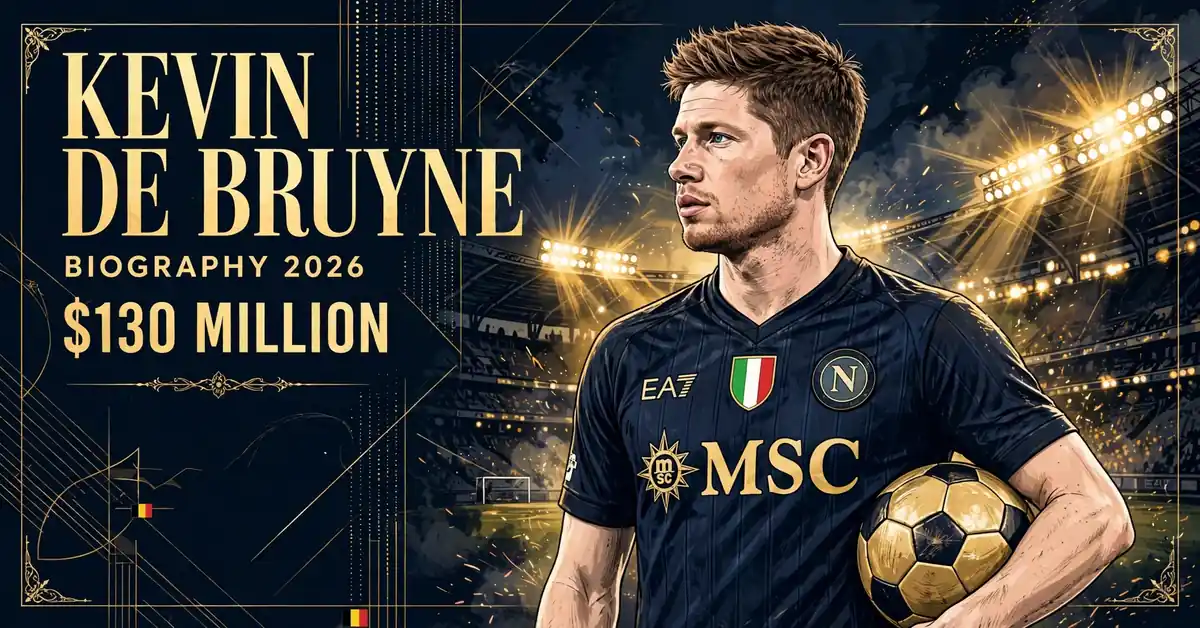
Kevin De Bruyne biography 2026: born in Drongen, 422 City games, six Premier League titles, a $130M fortune — then Napoli at 34 and the last World Cup.
Last updated: November 17, 2026 · By Nathan Cole
Kevin De Bruyne is 35 years old in 2026, a Belgian midfielder who spent a decade running Manchester City, and his net worth is estimated at $130 million. That is the figure Celebrity Net Worth carries in its snapshot dated 5 November 2026, and it sits at the top of a range that runs from $80 million to $130 million across the trackers surveyed. He was born on 28 June 1991 in Drongen, Belgium, made his name at Genk, was written off at Chelsea, rebuilt himself in Germany, and then became the best passer in the Premier League — 422 appearances, 108 goals and 170 assists in ten seasons at City, six league titles and a Champions League.
Then, at 33, he walked away from the richest league in the world and started again. He joined Napoli on a free transfer in the summer of 2025, scored on his Serie A debut season’s opening weeks, lost five months to a hamstring injury, came back in March 2026, and played his last World Cup that summer — turning 35 in the middle of the tournament as Belgium reached the quarter-finals. This is the full story, kept current to 17 November 2026: the Drongen childhood, the Chelsea rejection, the Wolfsburg season that made him undroppable, the City decade, the money, the Napoli gamble, and the family life he has guarded since 2014.
Quick Facts
| Full Name | Kevin De Bruyne |
| Age in 2026 | 35 years old (born 28 June 1991, Drongen, Belgium; turned 35 on 28 June 2026, during the World Cup) |
| Net Worth 2026 | Estimated at $130 million (Celebrity Net Worth, 5 Nov 2026), inside an $80M–$130M range; credible band $85M–$130M |
| Height | 1.81 m (5 ft 11 in) |
| Current Club | SSC Napoli (joined 1 July 2025, free transfer; contract to June 2027, with an option year) |
| Position | Attacking midfielder / central midfielder |
| Manchester City | 2015–2025: 422 appearances, 108 goals, 170 assists; 6 Premier League titles, 1 Champions League (2023 treble) |
| Belgium | Debut 11 August 2010; captain since March 2023; 115 caps and 36 goals (FIFA, March 2026); 120+ caps after the 2026 World Cup |
| Wife | Michèle Lacroix (married 26 June 2017, Sorrento, Italy) |
| Children | Three — Mason Milian (born March 2016), Rome (born October 2018), Suri (born September 2020) |
| Individual Honours | PFA Players’ Player of the Year 2020 and 2021; Premier League Player of the Season 2020 and 2021; Bundesliga Player of the Year 2015 |
| Book | Keep It Simple — autobiography, published October 2014 |
How This Estimate Was Made
No audited figure exists for Kevin De Bruyne, and no celebrity-finance tracker has access to his bank statements, so the estimate is a range built from the trackers that publish one — and this article shows its work. Celebrity Net Worth gives $130 million (snapshot 5 November 2026). SportsLeo gives the same $130 million (August 2026). SureBets gives $80 million to $130 million (28 July 2026), built from Capology’s salary records: $258.4 million in gross career salary and $12.9 million for the current Napoli season. SportsDunia gives €75–88 million, roughly $86–101 million (29 April 2026). SurpriseSports gives $85–100 million (updated 26 October 2026). StrikerReport gives $70–100 million. TheCelebWiki gives $85 million. Bioglance gives $100–120 million (27 June 2026). NetWorthBreakdown and FootballPickr both give $80 million, but both recycle the pre-Napoli contract picture and are kept as the floor of the range rather than treated as current. This article anchors $130 million because it is the freshest figure and the only one two independent 2026 sources agree on, inside an $80 million to $130 million range, with the credible band at $85 million to $130 million. Salary figures come from the same reporting plus the documented anchors: the £400,000-a-week Manchester City peak and the conflicting Napoli reports, which the article presents as a range rather than a single number. Where sources disagree, the article names the disagreement. Corrections are welcome via the About page.
+
Who Is Kevin De Bruyne?
Kevin De Bruyne is the midfielder other midfielders study. For a decade at Manchester City he did the one thing in football that cannot be coached into a player: he saw the pass before the run existed. The numbers are the proof, not the story. He finished his City career with 170 assists in 422 games, 118 of them in the Premier League — the second-highest total in the competition’s history — and his 20 assists in the 2019-20 season tied Thierry Henry’s single-season record. He won the PFA Players’ Player of the Year award twice, in 2020 and 2021, voted by the men he played against.
He was born on 28 June 1991 in Drongen, a quiet sub-municipality of Ghent in the Dutch-speaking Flanders region of Belgium. His father, Herwig, worked in the oil industry; his mother, Anna, was born in Burundi and grew up in London, where her Flemish parents had moved for work. The family settled in Drongen, and Kevin grew up speaking Dutch at home and English, French and German on top of it — four languages before he was a professional, a detail that matters later, because it is why he settled so fast in England, Germany and now Italy. He has a younger sister, Stefanie, and as a boy he supported Liverpool, a loyalty he inherited from his grandfather.
He started playing at four years old for his hometown club, KVV Drongen, in 1997. Two years later he moved to Gent, and in 2005, at fourteen, he joined Genk’s academy — leaving home to live with a host family, learning to be independent before he had finished school. That move is the first decision in a career built on decisions: Genk, Chelsea, Bremen, Wolfsburg, City, Napoli. Every one of them was a bet on himself, and only one of them — Chelsea — ever looked like a mistake. It turned out to be the making of him.
The Net Worth Estimate, Source by Source
Kevin De Bruyne’s net worth is a spread, not a single number, and the spread is $50 million wide. The trackers disagree because they are modeling different things: some count the decade of City wages at face value, some apply heavy haircuts for tax and agents, and some are simply out of date, still pricing him on his old contract. The table below lays out every figure this article found, with its source and its date, so the reader can see why $130 million is the anchor and not a guess.
| Source | Estimate | Date | Status |
|---|---|---|---|
| Celebrity Net Worth | $130 million | 5 Nov 2026 | Anchor |
| SportsLeo | $130 million | Aug 2026 | Supports anchor |
| SureBets | $80–130 million | 28 Jul 2026 | Full range |
| Bioglance | $100–120 million | 27 Jun 2026 | High band |
| SurpriseSports | $85–100 million | 26 Oct 2026 | Credible band |
| SportsDunia | €75–88 million | 29 Apr 2026 | Mid band |
| TheCelebWiki | $85 million | 2026 | Mid band |
| StrikerReport | $70–100 million | 2026 | Mid/low band |
| NetWorthBreakdown | $80 million | 2026 | Stale floor |
| FootballPickr | $80 million | Apr 2026 | Stale floor |
Why does the range run so wide? Because gross career earnings are not net worth, and the trackers handle that gap differently. Capology puts his gross career salary at $258.4 million, and SureBets builds its range from that number, allowing broadly for tax, agents’ fees and private spending. Celebrity Net Worth, which anchors the high end, counts a decade of platinum-level wages plus the endorsement portfolio and the signing bonus Napoli paid precisely because it did not have to pay a transfer fee. The $80 million floor comes from pages that lean on the old City contract and count only the wages, not the commercial income. For the full year-by-year breakdown of that fortune, see Kevin De Bruyne’s net worth on Guide Net Worth.
One more thing the range hides: the $130 million anchor is new. For years the trackers carried $80–100 million for De Bruyne, and the number only moved up after the Napoli deal, when the signing bonus and the Italian tax position entered the picture. That is the honest shape of a footballer’s fortune at 35: the wages are mostly banked, the market value is falling — roughly €10–15 million in 2026, against a peak of €150 million — and the wealth now sits in whatever he kept, invested and did not spend. The range reflects that uncertainty. The anchor reflects the freshest reporting.
How He Makes His Money
De Bruyne’s income rests on four pillars, and the shape of them changed completely in the summer of 2025. For a decade the pillar was the Manchester City wage: a contract renegotiated in 2021 that ran to 2025 and paid a reported £400,000 a week — £20.8 million a year — making him the Premier League’s best-paid player. When that contract expired, the pillar did not disappear. It moved to Naples, and it changed shape: a lower headline wage, a signing bonus in place of a transfer fee, and Italy’s favorable tax treatment for incoming foreign athletes.
The Napoli numbers are the messiest part of this article, and they deserve honesty rather than a clean figure. Celebrity Net Worth puts the Napoli salary at roughly €6 million net a season, with additional signing-bonus money. SurpriseSports reports about €10.1 million net a year plus a reported €9 million signing bonus. SportsLeo reports around €12 million net a year. SportsDunia reports €11.11 million a year. FootyStats lists €13.89 million as the annual salary, and Capology’s gross figure for the season is $12.9 million. These are not five different deals. They are five different ways of reporting one deal — net against gross, salary against total package, with the signing bonus counted in some places and left out in others. The defensible statement is that he earns a reported €6 million net to about €14 million gross a year at Napoli, plus a reported €9 million signing bonus.
| Income stream | Estimated contribution | Notes |
|---|---|---|
| Club wages (career) | $258.4M gross career | Capology via SureBets, Jul 2026; City peak £400k/week; Napoli €6M net–€14M gross reported |
| Napoli signing bonus | ~€9M reported | SurpriseSports, Oct 2026 — paid because no transfer fee was due |
| Endorsements | ~£4M a year at peak | Nike, EA Sports FC, Therabody, Secretlab (SportsLeo, Aug 2026) |
| Book, brand & investments | Private | Keep It Simple (2014); KDB clothing line (2014); property and investments not publicly itemized |
The third pillar is endorsements, and it is smaller than the wages but steadier. SportsLeo’s August 2026 profile names Nike, EA Sports FC, Therabody and Secretlab as the core portfolio, and SurpriseSports puts the endorsement income at around £4 million a year at his City peak. He has never been a billboard athlete in the way some of his peers are. The deals fit the player: boots, a video game, recovery equipment, a gaming chair. No fashion lines, no fragrance, no crypto. The fourth pillar is the quietest: the book, the KDB clothing line launched in 2014, and whatever property and investments sit behind the public numbers. None of it is itemized anywhere public, which is exactly why the net-worth range is $50 million wide.
The career-earnings math, labeled as illustrative, runs like this: $258.4 million in gross career wages (Capology), plus roughly a decade of endorsement income in the low single-digit millions a year, plus the Napoli signing bonus, minus UK and Belgian tax at the top rates for most of that decade, minus agents’ fees, minus the cost of a life lived at the top of the game. What survives that arithmetic is a fortune in the region of $130 million — the anchor this article carries, and the reason the low $80 million figures, which ignore the Napoli money entirely, are kept only as the floor.
Early Life: Drongen, Genk and a Childhood on the Move
Drongen is a quiet place. It sits just outside Ghent, in Flanders, and it is the kind of town where a talented boy gets noticed fast and outgrows the local club faster. Kevin De Bruyne was that boy. He started at KVV Drongen at four, moved to Gent at eight, and at fourteen he left home for Genk’s academy, living with a host family two hours away. His parents made the decision with him: the boy who wanted to be a footballer would have to learn to live like one before he was one. He has said since that the move taught him to look after himself — cooking, cleaning, getting to training on time — and that the independence stayed with him.
The family background explains the languages and the composure. His mother, Anna, was born in Burundi, lived in the Ivory Coast, and grew up in London after her Flemish parents moved to England for work; she only returned to Belgium when she met Herwig, Kevin’s father, who worked in the oil industry. Kevin spent his summers in London visiting his grandparents, which is where the English came from, and he picked up French and German along the way. By the time he was a professional he could give interviews in four languages without thinking about it. It is a small thing, and it is also the reason he has never looked lost in a new country. He has now played professionally in four of them.
The other detail from the childhood that matters is the grandfather. It was his grandfather’s love of Liverpool that made the young De Bruyne a Liverpool supporter — an eleven-year-old Genk academy player telling an interviewer that his favourite club was Liverpool, and that his favourite player was Michael Owen. He never played for Liverpool. The irony is that the club he supported as a boy became the rival he spent a decade trying to beat, and the player he admired became the man whose assist record he tied. The childhood is not a prelude to the career. It is the explanation for the temperament: quiet, self-sufficient, unbothered by noise.
Genk: The Debut and the First Title
De Bruyne was promoted to Genk’s first-team squad in 2008, and he made his senior debut on 9 May 2009, a 3-0 defeat at Charleroi. He was seventeen. The debut was forgettable; the next three seasons were not. He became a regular in the side that won the Belgian Cup in 2008-09 and then, in 2010-11, the Belgian Pro League — Genk’s third league title, and the first of De Bruyne’s career. He finished his Genk career with 97 appearances and 16 goals, and by the winter of 2012 the big clubs were circling. Chelsea moved first, in January 2012, and Genk sold him. He was twenty years old, and he had just won a league title in his home country. The next step was supposed to be the Premier League. It took him three years and two countries to get there properly.
What Genk gave him, beyond the medals, was the position. He arrived as a winger and left as a central midfielder with a passing range nobody in Belgium could match. The coaches at Genk moved him inside because they could see what the raw pace could not hide: he read the game two passes ahead. That is the skill that has defined everything since, and it was learned in Belgium, not bought in England. The fee Chelsea paid was never officially disclosed at the time, but the move itself was the signal: a Belgian club’s academy product, sold to a Champions League club at twenty, was the start of the golden generation’s export trade.
Chelsea, Bremen and the Season That Changed Everything
The Chelsea move is the most famous false start in modern football. De Bruyne signed in January 2012 and was immediately loaned back to Genk for the rest of the season. The following summer he was loaned to Werder Bremen for 2012-13, where he scored 10 goals in 33 Bundesliga appearances and was, by most accounts, the best player in a mid-table side. He returned to Chelsea in the summer of 2013 expecting to play. José Mourinho had other ideas. De Bruyne made nine appearances in the first half of the 2013-14 season, most of them brief, and by January he was gone — sold to Wolfsburg for a reported £18 million.
Mourinho’s judgment is still argued about, and De Bruyne has never hidden what he thought of it. He wrote about the Chelsea period in his autobiography, Keep It Simple, published in October 2014: a young player who had proved himself in Germany, back at a club that would not give him a run of games. The autobiography also covered the personal cost of that year — his then-girlfriend, Caroline Lijnen, left him for his Belgium teammate Thibaut Courtois, who was also at Chelsea. De Bruyne wrote about it plainly and moved on; the two men kept playing together for Belgium for another decade. The Chelsea rejection is the hinge of the biography. Without it, there is no Wolfsburg season, and without the Wolfsburg season, there is no Manchester City.
Wolfsburg was the repair job, and it worked in eighteen months. In the 2014-15 season De Bruyne scored 10 goals and provided 21 assists in the Bundesliga — a league record for assists in a single season — and was named Bundesliga Player of the Year. Wolfsburg finished second, won the DFB-Pokal, and then beat Bayern Munich in the DFL-Supercup in August 2015. He was the best player in Germany, and every big club in Europe knew it. Manchester City paid a reported £54–55 million for him in August 2015, then a club record. He arrived in Manchester as a £54 million midfielder with a point to prove about Chelsea. He spent the next ten years proving it.
Manchester City: A Decade at the Etihad
De Bruyne made his City debut on 12 September 2015, in a defeat at home to West Ham, and scored his first goal a week later against the same opposition in the reverse fixture. The debut season set the pattern: 16 goals in all competitions, a League Cup winners’ medal, and a Champions League semi-final. But the decade that followed is what the history books will carry. He played 422 games for Manchester City, scored 108 goals and made 170 assists, and won 16 major trophies: six Premier League titles (2018, 2019, 2021, 2022, 2023, 2024), two FA Cups, five League Cups, the Champions League in 2023, and the UEFA Super Cup and Club World Cup later that year.
The individual honours match the team ones. He was voted PFA Players’ Player of the Year in 2020 and again in 2021 — the first City player to win it twice — and Premier League Player of the Season in both of those years. He won the Premier League Playmaker of the Season award three times, in 2019-20, 2021-22 and 2022-23. His 20 assists in 2019-20 tied Thierry Henry’s record, and his 118 Premier League assists leave him second on the competition’s all-time list, behind only Ryan Giggs. Those are not the numbers of a good midfielder. They are the numbers of the best passer the Premier League has seen since the competition began, and they were compiled in a team where he was rarely the headline name — that was usually Erling Haaland, whose net worth on Guide Net Worth tells the other half of the City story — but almost always the player the system ran through.

His closest ally in that team was not a striker but another academy product. Phil Foden’s net worth on Guide Net Worth charts the rise of the Stockport boy who grew up in De Bruyne’s shadow and then beside him, and the two of them — the Belgian passer and the English dribbler — were the creative core of the four-in-a-row title run from 2021 to 2024. De Bruyne’s game changed across the decade, too. He arrived as a winger who cut inside, became a No. 10, then dropped deeper into an eight, dictating from his own half. Pep Guardiola trusted him with every version of the role, and the trust was repaid: in the biggest games, the ball went to De Bruyne, and De Bruyne decided what happened next.
The decade was not unbroken success. He missed long stretches through injury — a knee ligament injury in 2018, a hamstring tear at the start of the 2023-24 season that kept him out for five months — and each time he came back, the same question followed him: would the legs still do it? Each time, the answer was yes, and the 2023-24 return was the proof: he came back in January 2024 and produced four assists in his first two games back. The injuries are part of why the City story ended when it did. At 33, with a contract running out and the club planning its next cycle, the two sides agreed to part. He announced in April 2025 that he would leave at the end of the season. His farewell came in May, in front of a crowd that had spent a decade watching him do things no other midfielder in the league could do.
The 2023 Treble and the Peak Years
If the decade has a single season, it is 2022-23. Manchester City won the Premier League, the FA Cup and the Champions League — the treble only Manchester United had managed in England before them — and De Bruyne was at the centre of all three. He made 10 assists in the Champions League that season, the most in the competition, and his performance in the 4-0 demolition of Real Madrid in the semi-final second leg is the game his City career will be remembered by: two assists, a goal disallowed, and a midfield performance that made the European champions look ordinary. He left the final against Inter Milan after 36 minutes with a hamstring injury, and City still won 1-0. He watched the trophy lift from the bench, in tears, and it did not matter. The treble was his as much as anyone’s.
The peak years around the treble were also his best-paid years. The 2021 contract extension, signed when he was 29, ran to 2025 and paid the reported £400,000 a week that made him the Premier League’s top earner — a deal negotiated, unusually, without an agent, by De Bruyne himself with the help of data analysts he hired to argue his case. That detail is worth pausing on, because it is the same mind that reads a pass before the run exists: he walked into a negotiation with the club’s own data, showed them what he was worth in expected assists and chance creation, and got the biggest contract in the league. It is the most De Bruyne story in the whole biography — no noise, no agent theatre, just the numbers, presented cold.
The 2023-24 season, his last full one at City, showed the cost of the peak. The hamstring tear in August kept him out until January, and when he returned, the team was chasing Arsenal and Liverpool in a title race that went to the final day. City won it — a fourth consecutive league title, a record — and De Bruyne’s return was the difference. He finished the season with 10 assists in the league despite missing half of it. The 2024-25 season was quieter, and the farewells began to gather: the announcement in April 2025, the final home game in May, the departure report from the club on 12 June 2025 that put the numbers in print — 422 appearances, 108 goals, 170 assists. Ten years, six league titles, one European Cup. The club called him the greatest midfielder in its history. Nobody argued.
Leaving City: The Free Transfer to Napoli
Napoli announced the signing on 12 June 2025, the same day City published its farewell. De Bruyne officially joined on 1 July 2025, on a free transfer, on a deal running to June 2027 with an option for a further year. The move surprised people who expected him to go to Saudi Arabia or Major League Soccer, where the money would have been bigger and the football easier. He chose Serie A, and he chose the champions — Napoli had won the league in 2024-25 under Antonio Conte — because he wanted to keep playing at the top, in a league he had never played in, in a city that treats its footballers like family. His wife, Michèle, is from Genk, not Naples, but the family moved to Italy together, and by November 2026 they were settled there.
The football reasons were sound. Conte wanted a passer who could run his system, and De Bruyne wanted a coach who would build around him rather than manage his decline. The financial reasons were sound, too: no transfer fee meant Napoli could pay a signing bonus reported at around €9 million, and Italy’s tax rules for incoming foreign athletes meant the net wage went further than the same gross figure would have in England. He scored his first Serie A goal on 23 August 2025, in a 2-0 win at Sassuolo, and the first eight league games brought four goals — a start that suggested the 34-year-old had lost nothing. Then the hamstring went, and the season changed shape.

Napoli 2025-26: A Fast Start, a Long Injury, a Second Place
The injury was a hamstring problem, and it cost him around five months. He played four goals’ worth of football in his first eight Serie A appearances, then disappeared from the team sheet, and Napoli’s title defence wobbled without him. He returned to action in March 2026 and played the run-in, finishing the season with 21 appearances, five goals and four assists in all competitions — nine goal involvements in a season cut in half. He created 40 chances in the league, a total bettered only by his teammate Matteo Politano’s 51. Napoli finished second in Serie A, 11 points behind Inter, who took the Scudetto and the Coppa Italia double. The defence had failed, and the inquest started before the season had finished.
The inquest took a personal turn. Conte left at the end of the campaign, a year after leading Napoli to the title, and De Bruyne did not hide his relief. Speaking to the Belgian newspaper Het Nieuwsblad in May 2026, he said he was glad to see the back of Conte, criticised the coach’s tactics, and said he would have left the club himself if Conte had stayed. It was the bluntest public statement of his career, and it landed badly in Naples — reports in July 2026 said some colleagues were frustrated with him, and he was given an extended break after the World Cup while the new coach, Massimiliano Allegri, took over. Allegri, who had been sacked by AC Milan earlier in the summer, backed him publicly in August 2026, saying he expected De Bruyne to enjoy his second season and that he had been surprised by his fitness after ten days of training. The sporting director, Giovanni Manna, confirmed he remained part of the project. The row has cooled. The second season is the test.
There was silverware in the first season, even so. Napoli won the Supercoppa Italiana on 22 December 2025, beating Bologna 2-0 in the final in Riyadh. And the individual recognition followed: Napoli’s official update on 21 October 2026 named him the club’s Player of the Month for September 2026, voted by the fans in the official-app poll. The 2026-27 season, as of October 2026, had brought six appearances, three goals and one assist — a better start than the first season, and a reminder that the player who finished second in the Premier League’s all-time assist charts had not come to Italy to retire. He has a year left on his contract, and he has said he wants to talk about it. That conversation is the next chapter of this biography.
Belgium: Captain, Third Place and a Last World Cup
De Bruyne made his senior debut for Belgium on 11 August 2010, in a 1-0 friendly defeat to Finland in Turku. He was nineteen, and Belgium were not yet the golden generation — that team was still being built, around him, Eden Hazard, Romelu Lukaku and Thibaut Courtois. He played at the 2014 World Cup, where Belgium lost to Argentina in the quarter-finals, and at Euro 2016, where they lost to Wales at the same stage. The peak came in Russia in 2018: he scored in the 2-1 quarter-final win over Brazil, and Belgium finished third, the country’s best-ever showing at a World Cup. The bronze medal is the closest the golden generation came to a trophy, and it is the result De Bruyne is still judged against.
He became captain on 21 March 2023, after Hazard retired, and the armband changed the way he played for his country. The numbers: FIFA’s feature in March 2026 put him at 115 caps and 36 goals; trackers updated after the World Cup list 120 or more caps, with the goal total reported between 38 and 41 depending on the source. The spread is a dating problem, not a real disagreement — the FIFA figure is from March 2026, and the higher figures count the World Cup games. Either way, he is Belgium’s most-capped outfield player of his generation and the man the team has been built around for a decade.
The 2026 World Cup, played in North America, was his last. He scored in the 5-1 win over New Zealand — a goal and two assists in that game — as Belgium topped Group G and reached the knockout stage. The run ended in the quarter-finals, where Spain beat them 2-1 on 10 July 2026. He turned 35 on 28 June, in the middle of the tournament, and played the quarter-final as a 35-year-old captain in his fourth World Cup. He had also scored six goals and made one assist in six qualifying matches, the highest-scoring midfielder in European qualifying. The golden generation’s story ends without a trophy. De Bruyne’s part in it — the passing, the goals, the captaincy — is the part nobody disputes.
Personal Life: Michèle, Three Children and the Courtois Story
Kevin De Bruyne has been with Michèle Lacroix since 2014. They met through Twitter — she liked one of his tweets while he was playing for Wolfsburg, and a friend pushed him to message her, because he was too nervous to do it himself. He told that story himself in The Players’ Tribune, and he has told it since, in July 2026, with the same self-deprecation: the best passer in the world could not pass a message to a girl he liked. Michèle was born on 8 December 1993 in Genk, studied at the University of Hasselt, and worked for a promotions and events company before the football life took over. She now co-hosts a Dutch podcast, Secret Society, interviewing Belgian and Dutch celebrities.
He proposed in December 2016, beneath the Eiffel Tower in Paris, and they married on 26 June 2017 in Sorrento, Italy, in a three-day celebration. Their first son, Mason Milian, was born on 10 March 2016, before the wedding. Their second son, Rome, was born on 31 October 2018. Their daughter, Suri, was born in September 2020. The family of five moved to Italy in the summer of 2025, and as of November 2026 they live there, where De Bruyne plays for Napoli. Michèle’s Instagram, where she posts the children and the fashion, has close to 600,000 followers. The children themselves are kept out of the press, and their names are the only public detail. That is a deliberate choice, and it has held for a decade.
The Courtois story is the one piece of the personal life that was never private. In 2014, De Bruyne’s then-girlfriend, Caroline Lijnen, left him for his Belgium teammate Thibaut Courtois. He wrote about it in Keep It Simple, plainly and without rancour, saying that although he could not believe what Courtois had done, they would continue to work together professionally. Lijnen later gave her own account in the Belgian press, saying De Bruyne had cheated on her first. The two men played together for Belgium for another twelve years, won a World Cup bronze medal together, and never let it become a public feud. It is the ugliest chapter of the biography, and the most instructive: a 23-year-old who had just been rejected by Chelsea and betrayed by his girlfriend and his teammate wrote a book about it, and then went to Wolfsburg and became the best player in Germany.
The Book, the Brand and the Life Beyond Football
Keep It Simple was published in October 2014 by Borgerhoff & Lamberigts, co-written with Raoul de Groote. De Bruyne was 23, and the book was unusual for a footballer that young: not a ghosted victory lap but a first-person account of a career that had already gone wrong once, at Chelsea, and a personal life that had gone wrong at the same time. It is still the best source for his own voice — dry, direct, allergic to self-pity. He has not written a second book. The first one said what needed saying.
The commercial life beyond football is modest by superstar standards, and that is the point. The KDB clothing line, launched in 2014, put a portion of its proceeds toward the Special Olympics, for whom De Bruyne is an ambassador. He has never chased the fashion or fragrance deals that fill other players’ portfolios. The endorsement list — Nike, EA Sports FC, Therabody, Secretlab — reads like a training ground, not a red carpet. His market value tells the same story in numbers: a peak of €150 million, and roughly €10–15 million in 2026, because he is 35 and the market prices the future, not the past. The fortune is already made. What remains is the playing, and the playing is the reason he is in Naples rather than in Riyadh or Miami.
What the biography pages usually miss is the charity work, and it deserves the space. The Special Olympics ambassadorship is not a photo opportunity. De Bruyne has been involved since 2014, when the clothing line launched, and he has kept the connection through every club move since. It is the one commitment in his public life that has nothing to do with money or football, and it has lasted longer than any of his contracts. A player who has won everything there is to win in club football, and who is still playing at 35 because he loves the game, does not need a second act. He is still in the first one.
Kevin De Bruyne vs His Peers: The Midfielder Table
De Bruyne’s $130 million sits at the top of the midfielder peer group — richer than the younger stars, richer than the forwards he supplied for a decade, and right where a ten-year run at the top of the Premier League’s wage scale should put a player. The table below uses Celebrity Net Worth estimates from November 2026, the same source that anchors this article’s estimate, with the two linked peers carrying their Guide Net Worth figures. More profiles in the same treatment live in the Celebrity Net Worth archive on Guide Net Worth.
| Player | Net worth 2026 | Note |
|---|---|---|
| Kevin De Bruyne | $130 million | This article — range $80M–$130M |
| Robert Lewandowski | ~$105 million | Robert Lewandowski’s net worth on Guide Net Worth |
| Erling Haaland | ~$100 million | Celebrity Net Worth — City teammate, the striker De Bruyne supplied |
| Mohamed Salah | ~$90 million | Mohamed Salah’s net worth on Guide Net Worth |
| Jude Bellingham | ~$50 million | Celebrity Net Worth — the next generation’s midfielder, half De Bruyne’s age |
The gap between De Bruyne and Haaland is the gap between a decade of wages and a career still being built: Haaland, at 26, has the bigger contract ahead of him, and the $30 million difference is really a measure of time served. The gap between De Bruyne and Bellingham is the same measure, doubled — Bellingham has the talent and the years, but not yet the ten seasons at the top of the wage scale. The gap that matters most is the one between De Bruyne and Salah: two players of the same generation, both Premier League legends, separated by $40 million and by the fact that De Bruyne’s peak wage, £400,000 a week, was the highest the league had ever paid a midfielder. The table is a snapshot, not a ranking of greatness. On greatness, the assist numbers speak, and they say De Bruyne is second only to Ryan Giggs.
Frequently Asked Questions
How old is Kevin De Bruyne in 2026?
Kevin De Bruyne is 35 years old in 2026. He was born on June 28, 1991, in Drongen, Belgium, and turned 35 on June 28, 2026 — during the FIFA World Cup, where he captained Belgium. Some older biography pages still list him as 34 because they were written before his 2026 birthday; the correct age is 35.
What is Kevin De Bruyne’s net worth in 2026?
Kevin De Bruyne’s net worth in 2026 is estimated at $130 million, anchored on Celebrity Net Worth (snapshot November 5, 2026) inside an $80 million to $130 million range. SportsLeo also gives $130 million (August 2026), SureBets gives $80–130 million (July 2026), and SurpriseSports gives $85–100 million (updated October 2026). The low $80 million figures come from trackers that still price him on his old Manchester City contract and ignore the Napoli deal.
How tall is Kevin De Bruyne?
Kevin De Bruyne is 1.81 metres tall, which is 5 feet 11 inches. His height is listed consistently across biography sources including Bioglance and FootyStats, both updated in 2026.
Who is Kevin De Bruyne’s wife?
Kevin De Bruyne’s wife is Michèle Lacroix, born December 8, 1993, in Genk, Belgium. They met in 2014 through Twitter, he proposed beneath the Eiffel Tower in Paris in December 2016, and they married on June 26, 2017, in Sorrento, Italy. They have three children: Mason Milian (born March 2016), Rome (born October 2018) and Suri (born September 2020).
What is Kevin De Bruyne’s salary at Napoli?
Reports disagree on Kevin De Bruyne’s Napoli salary because they mix net and gross figures. Celebrity Net Worth reports roughly €6 million net per season plus a signing bonus, SurpriseSports reports about €10.1 million net a year plus a reported €9 million signing bonus, and other trackers report up to about €14 million gross. The honest figure is a reported €6 million net to about €14 million gross a year, plus the signing bonus Napoli paid because no transfer fee was due. At Manchester City his peak wage was a reported £400,000 a week.
Where does Kevin De Bruyne play now?
Kevin De Bruyne plays for SSC Napoli in Serie A. Napoli announced his signing on June 12, 2025, and he officially joined on a free transfer on July 1, 2025, after ten seasons at Manchester City. His contract runs to June 2027, with an option for another year. He scored his first Serie A goal on August 23, 2025, in a 2-0 win at Sassuolo.
Did Kevin De Bruyne play at the 2026 World Cup?
Yes. Kevin De Bruyne captained Belgium at the 2026 FIFA World Cup in North America, his fourth World Cup. He scored in the 5-1 win over New Zealand, with a goal and two assists in that game, as Belgium topped Group G. Belgium were knocked out in the quarter-finals, losing 2-1 to Spain on July 10, 2026. He turned 35 during the tournament, on June 28, 2026.
What happened between Kevin De Bruyne and Thibaut Courtois?
In 2014, Kevin De Bruyne’s then-girlfriend, Caroline Lijnen, left him for his Belgium teammate Thibaut Courtois. De Bruyne wrote about it in his autobiography Keep It Simple, published in October 2014, saying that although he could not believe what Courtois had done, they would continue to work together professionally. The two men went on playing together for Belgium for another twelve years, including the third-place finish at the 2018 World Cup.
Sources & Reporting
This article was researched on 17 November 2026 from live reporting: Wikipedia for the 28 June 1991 birth date and place, the parents’ names and background, the youth career (KVV Drongen 1997–99, Gent 1999–2005, Genk 2005–08), the Genk debut on 9 May 2009, the 97 appearances and 16 goals, the Chelsea loan spells, the Wolfsburg £18 million fee and 2014-15 season, the Keep It Simple publication details (October 2014, co-authored with Raoul de Groote, Borgerhoff & Lamberigts) and the Courtois incident; SportsHub4U (verified 22 October 2026) for the City departure totals (422 appearances, 108 goals, 170 assists, 12 June 2025), the FIFA March 2026 caps figure (115 caps, 36 goals), the Napoli September 2026 Player of the Month award and the KDB clothing line’s Special Olympics proceeds; VAVEL for the Genk Belgian Cup, the six Premier League titles and Champions League, the Napoli announcement (12 June 2025), the first Serie A goal (23 August 2025, Sassuolo), the Supercoppa Italiana (22 December 2025, Bologna 2-0, Riyadh), the Belgium debut (11 August 2010, Finland), the captaincy from 21 March 2023 and the World Cup 2026 run (New Zealand 5-1, Spain 2-1 quarter-final, 10 July 2026); Celebrity Net Worth (snapshot 5 November 2026) for the $130 million anchor and the ~€6 million net Napoli salary; SportsLeo (August 2026) for the $130 million corroboration, the ~€12 million net Napoli salary and the Nike, EA Sports FC, Therabody and Secretlab endorsement list; SureBets (28 July 2026) for the $80–130 million range and Capology’s $258.4 million gross career salary and $12.9 million Napoli season figure; SportsDunia (29 April 2026) for the €75–88 million estimate and the €11.11 million Napoli salary; SurpriseSports (updated 26 October 2026) for the $85–100 million estimate, the £400,000-a-week City peak and the €10.1 million net Napoli salary plus €9 million signing bonus; StrikerReport for the $70–100 million estimate, the 115+ caps and 36+ goals, and the six goals in six World Cup qualifiers; FotMob (30 May 2026) and OneFootball (29 July 2026) for the Conte departure, the Het Nieuwsblad interview, the 21 appearances, five goals and four assists in 2025-26, the 40 chances created, the five-month hamstring injury and the March 2026 return, and Allegri’s August 2026 backing; StatMuse for the 2026-27 season totals (6 appearances, 3 goals, 1 assist, as of October 2026); EssentiallySports, USA Network, OhMyFootball and Athlon (June–November 2026) for Michèle Lacroix’s background, the 2014 meeting, the December 2016 Eiffel Tower proposal, the 26 June 2017 Sorrento wedding and the three children (Mason Milian, March 2016; Rome, October 2018; Suri, September 2020); Bioglance for the 1.81 m height, the $100–120 million estimate, the June 2027 contract with an option year and the injury timeline. Where sources disagreed — the net-worth range, the Napoli salary, the post-World Cup caps total — the article names the disagreement instead of picking a number silently. Corrections are welcome via the About page.
Nathan Cole
Nathan Cole is the editor of Guide Net Worth. He covers celebrity wealth the way a business desk covers earnings: reported figures first, estimates labeled as estimates, no invented numbers. Every profile passes through his desk before it publishes. About Guide Net Worth · Corrections: figures are updated when new reporting emerges — contact us via the About page if you spot an error.
References & Sources
This article has been fact-checked and verified against multiple public sources, financial disclosures, SEC filings, Forbes reports, Celebrity Net Worth databases, and official records. All net worth estimates are based on publicly available information and financial analysis.