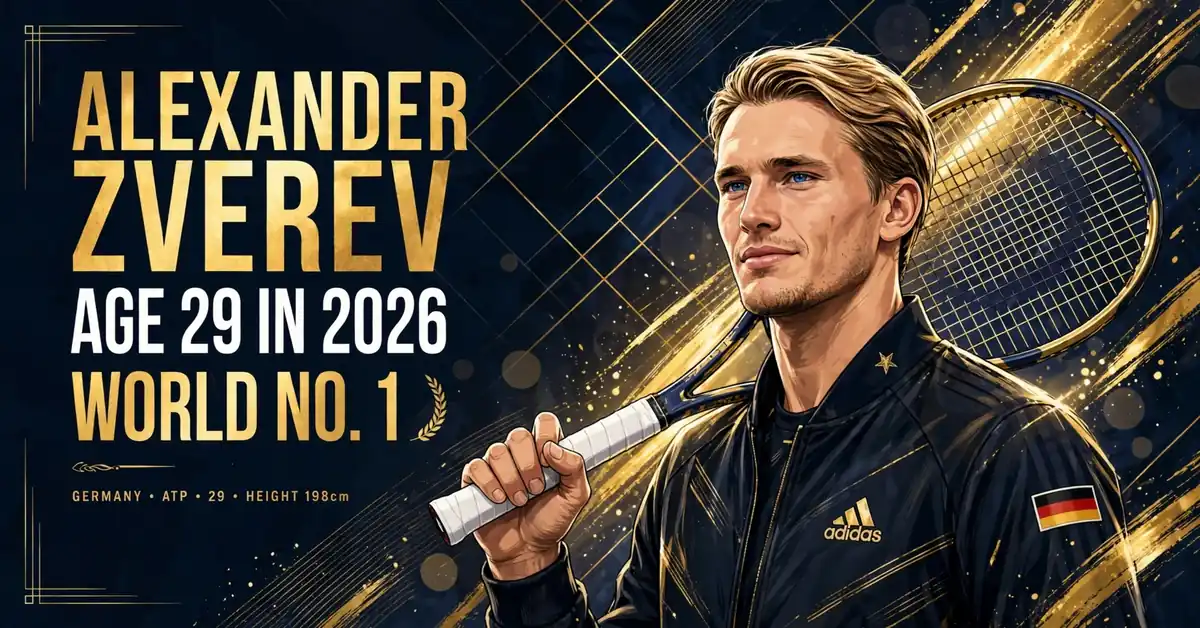
Alexander Zverev is 29 in 2026 — born 20 April 1997 in Hamburg, Germany. At 29 he won the French Open and US Open, then became world No. 1 on 2 November.
Last updated: November 17, 2026 · By Nathan Cole
Alexander Zverev is 29 years old. He was born on 20 April 1997 in Hamburg, Germany, which puts his 30th birthday on 20 April 2027. The number is settled — the ATP lists the same birthdate, Wikipedia prints it, and Sportradar’s athlete bio matches it line for line.
What makes 29 worth a full profile is the year attached to it. At 29, Zverev won his first two Grand Slam titles — the French Open in June and the US Open in September 2026 — then climbed to world No. 1 on 2 November 2026, the first German man to hold the top ranking since Boris Becker in 1991. He did it after three lost major finals, a wheelchair exit from Roland Garros in 2022, and a decade of being filed under “best player never to win a major.”
This profile answers the age question first, then follows the number through his life: the Hamburg childhood, the junior titles, the long climb, the breakthrough season at 29, the family and the diabetes foundation, and the money the career has built. Every figure carries a date and a source. Where outlets disagree, the article says so and gives the range.
Quick Facts
| Age (2026) | 29 years old — born 20 April 1997 |
| Turns 30 | 20 April 2027 |
| Born | Hamburg, Germany |
| Full Name | Alexander “Sascha” Zverev |
| Height | 1.98 m (6 ft 6 in) — officially listed by the ATP |
| Profession | Professional tennis player |
| Current Ranking | World No. 1 (since 2 November 2026) |
| Grand Slam Titles | 2 — 2026 French Open, 2026 US Open |
| Net Worth (2026) | $35–40 million (estimated) |
| Career Prize Money | $74,022,821 (Wikipedia, 1 October 2026) |
| Nationality | German |
| Family | Partner Sophia Thomalla; daughter Mayla (born March 2021) |
| Last Updated | November 17, 2026 |
How This Age Was Verified
The age itself is not an estimate — the ATP Tour’s official player profile, Wikipedia and Sportradar all print the same birthdate, 20 April 1997, and the arithmetic from that date to November 2026 gives 29 years old. One point of confusion is worth naming: Wikipedia’s infobox (last updated 1 October 2026) still listed Zverev’s ranking as world No. 2, dated 24 August 2026. That snapshot predates the ranking change. The ATP Tour, Reuters and ESPN all reported in October and November 2026 that he won the French Open and US Open and reached world No. 1 on 2 November 2026, so this profile follows the November reporting. The money context is different: Zverev has never disclosed his finances publicly, so the net-worth figure is an independent estimate built from reported prize money, named endorsement deals and allowances for taxes and representation fees, with the reasoning shown in the article. Anything uncertain is labeled as an estimate, not a fact.
+
The Direct Answer: 29 Years Old
Alexander Zverev was born on 20 April 1997 in Hamburg, Germany. Count forward from that date and the answer is 29 — he celebrated his 29th birthday on 20 April 2026, in the middle of the clay season, weeks before the French Open campaign that changed his career.
The sources agree without a crack. The ATP’s official player profile lists “Age 29 (1997/04/20)”. Wikipedia’s infobox reads “Born 20 April 1997 (age 29), Hamburg, Germany”. Sportradar’s athlete bio prints the same date of birth. The Laver Cup, profiling him in London in September 2026, put it in plain words: “The 6’6″ German was just 20 that first year. Now, he’s 29.”
His height is part of the same verified record, and it shapes everything the age number means on a tennis court. The ATP lists him at 6 feet 6 inches (198 cm) and 90 kg (198 lbs), right-handed with a two-handed backhand, coached by his father, Alexander Zverev Sr. The full story of that frame — what 1.98 metres does to a serve, a backhand and a pair of knees — is covered in our profile of Alexander Zverev’s height.
When Does Alexander Zverev Turn 30?
Zverev turns 30 on 20 April 2027. That date falls during the spring clay swing, between the Monte Carlo Masters and the Madrid Open — the same stretch of the calendar where, a year earlier, he arrived at Roland Garros as a 29-year-old chasing his first major.
Thirty is not old in the modern men’s game, and the recent record proves it. Novak Djokovic won three Grand Slams after turning 35. Rafael Nadal won Roland Garros at 36. Andy Murray reached world No. 1 for the first time at 29, the same age Zverev was when he got there. The table below pins Zverev’s age to every milestone that matters, so the 29 in the headline sits in its full context.
| Age | Date | Milestone |
|---|---|---|
| 4 | 2001 | Diagnosed with type 1 diabetes |
| 5 | 2002 | Began playing tennis |
| 16 | 2013 | Junior world No. 1; turned professional |
| 16 | Jan 2014 | Australian Open boys’ singles champion |
| 19 | Sep 2016 | First ATP title, St. Petersburg |
| 20 | 2017 | First Masters 1000 titles — Rome and Canada |
| 21 | Nov 2018 | First ATP Finals title |
| 23 | Sep 2020 | First Grand Slam final, US Open (lost to Thiem) |
| 24 | Aug 2021 | Olympic singles gold, Tokyo |
| 25 | Jun 2022 | Ankle injury, Roland Garros semi-final vs Nadal |
| 27 | Jun 2024 | French Open final (lost to Alcaraz) |
| 27 | Jan 2025 | Australian Open final (lost to Sinner) |
| 29 | Jun 2026 | First Grand Slam title, French Open |
| 29 | 13 Sep 2026 | Second Grand Slam title, US Open |
| 29 | 2 Nov 2026 | World No. 1 for the first time (29 years, 196 days) |
| 30 | 20 Apr 2027 | 30th birthday |
The pattern in that table is the story of the article. The prodigy years came early — junior No. 1 at 16, first title at 19, Masters titles at 20. Then the middle of the table stretches out: three lost finals, a ruined ankle, four years of waiting. The last three rows all land at 29. He did not peak early and fade. He peaked late, all at once.
Early Life in Hamburg: A Tennis Family
Alexander Zverev was born in Hamburg to Irina Zvereva and Alexander Zverev Sr., both former professional players for the Soviet Union. His father peaked at No. 175 in the world before the family settled in northern Germany, and tennis became the family trade: his older brother Mischa, a former world No. 25, also played the tour, and the two brothers shared coaches, practice courts and a surname that opponents learned early.
His mother ran his earliest lessons, and he still gives her the credit for the shot that defines his game. “I think I have pretty good technique, which my mum did at a young age, so credit to her for that,” he once said. “My backhand, in particular, is 100 percent down to my mum.” The line, quoted by Sportskeeda, has followed him ever since — and the two-handed backhand it describes is still rated among the finest in the men’s game.
He started playing at five. At four, a year earlier, he had been diagnosed with type 1 diabetes, and doctors warned his parents that a career in high-level sport was unlikely. His mother refused the verdict. “When your 4 year old son gets diagnosed with diabetes, and doctors in the office tell you that life and sports will be very very limited for that child, it takes a very very strong mother to walk out of those offices and say ‘My son will be wherever he wants to be,'” Zverev said after his US Open win in September 2026, dedicating the victory to her. He manages the condition daily with a continuous glucose monitor during matches.
He grew up speaking German, Russian and English, idolized Roger Federer — at 11 he was photographed with Federer at the 2008 Halle Open, a picture that reportedly still hangs above his childhood bed — and was already tall for his age as a junior. The 1.98 m frame was in place long before the trophies were.

Junior Years: World No. 1 at 16
The junior résumé was close to flawless. Zverev reached world No. 1 in the juniors in 2013, the year he turned professional at 16, and won the boys’ singles title at the 2014 Australian Open. He was not a late developer finding his game in his twenties. He was the best junior on the planet before he could legally drive.
That early ranking set expectations that took a decade to cash in. The tour in 2013 and 2014 was still ruled by Federer, Nadal, Djokovic and Murray, and a 16-year-old with a big serve and a famous backhand had to wait his turn behind them. The waiting shaped him: by the time the old guard faded, Zverev had spent ten years learning how to lose finals, rebuild a serve and come back from injury — lessons the juniors never teach.
His first ATP title came in St. Petersburg in September 2016, at 19. Five titles followed in 2017, including the Italian Open in Rome and the Canadian Open in Toronto — his first two Masters 1000 crowns. The Madrid Open and the ATP Finals arrived in 2018, when he was 21. On paper, the path looked like a straight line to the top. The next eight years proved otherwise.
Career Timeline: From Prodigy to Grand Slam Champion
The climb was fast, then it stalled, then it finished in a rush. After the 2018 ATP Finals title at 21, Zverev spent the next three years collecting Masters titles and Davis Cup ties without reaching a major final. The breakthrough at Slam level finally came at the 2020 US Open, played in an empty Arthur Ashe Stadium during the pandemic, where he led Dominic Thiem two sets to love in the final and lost in five. It was the first of three finals he would lose before winning one.
The golden season came in 2021, when he was 24: the Tokyo Olympics singles gold — beating Novak Djokovic in the semi-final, then Karen Khachanov in the final — a second ATP Finals crown, and titles in Madrid, Cincinnati, Acapulco and Vienna. Seven Masters 1000 titles, an Olympic gold, two ATP Finals trophies. The only line missing was the biggest one, and the sport began to ask whether it would ever arrive.
The coaching carousel along the way tells its own story about the wait. Ivan Lendl, the eight-time major winner, coached him through 2018 and 2019. David Ferrer took over for 2020. Sergi Bruguera, a two-time French Open champion, joined in 2022. None of the partnerships lasted long, and the constant through all of them was his father, Alexander Zverev Sr., who remains his coach on the ATP profile today. The churn was not a mystery: a player with Zverev’s weapons kept looking for the voice that could turn them into a major title, and kept finding that the answer was time rather than a new coach.
The full story of those years — the titles, the coaches, the prize money and the $40 million fortune the career built — is told in Alexander Zverev’s biography, which tracks the same career from the money side. What follows here is the age story: how long the wait lasted, and what 29 finally delivered.
The Long Wait: Three Lost Grand Slam Finals
Zverev lost his first three Grand Slam finals across five years, and each defeat taught the tour a different lesson about him. The 2020 US Open final against Thiem exposed his serve under pressure — he double-faulted through the deciding set, and later admitted the delivery could break down at any moment. “That was exactly the time when I had real struggles with my serve and my second serve,” he said in September 2026. “I knew that my serve could break down at any moment. That’s one difference that I do feel now, luckily for me.”
The 2024 French Open final against Carlos Alcaraz, lost in five sets, showed a different gap: the forehand, once his unreliable wing, could not hold up over five sets on clay against the best mover of the new generation. The 2025 Australian Open final against Jannik Sinner, lost 6–3, 7–6, 6–3, was the coldest of the three — Sinner did not drop a set, and Zverev left Melbourne with A$1.9 million for the runner-up cheque and the same question hanging over him.
Between the second and third of those finals sat the worst moment of his career. In the 2022 Roland Garros semi-final against Rafael Nadal, with the second set level at 6–6, Zverev rolled his right ankle and tore all three lateral ligaments. He left Court Philippe-Chatrier in a wheelchair, unsure — in his own later telling — whether he would ever play again. He missed the rest of the 2022 season and spent most of 2023 rebuilding his ranking from outside the top 20.
The rebuild after the ankle injury took the better part of two seasons, and it was steadier than the comeback stories usually allow. He returned in early 2023 ranked outside the top 20, reached the French Open semi-final that June — losing to Casper Ruud — and won his home tournament in Hamburg that summer. Rome brought a sixth Masters title in May 2024, and a month later he was back in a Roland Garros final, losing to Alcaraz in five sets. By the 2025 Australian Open he was the world No. 2 again and a finalist once more. The record of those three years reads like a staircase: semi-final, title, final, final — each step higher than the last, until the staircase finally reached the top floor in Paris in June 2026.
The ledger of his six major finals now reads three defeats and three appearances that ended differently:
| Year | Tournament | Result | Opponent | Score |
|---|---|---|---|---|
| 2020 | US Open | Final | Dominic Thiem | Lost in five sets (led 2–0) |
| 2024 | French Open | Final | Carlos Alcaraz | Lost in five sets |
| 2025 | Australian Open | Final | Jannik Sinner | 6–3, 7–6, 6–3 |
| 2026 | French Open | Won | Flavio Cobolli | 6–1, 4–6, 6–4, 6–7(5), 6–1 |
| 2026 | Wimbledon | Final | Jannik Sinner | Lost |
| 2026 | US Open | Won | Ben Shelton | 6–3, 7–6(2), 5–7, 6–2 |
Three finals, three defeats, then a fourth final that ended the drought. The career ledger now reads 26 ATP singles titles and a 577–237 win-loss record, per Wikipedia’s page updated on 1 October 2026. Boris Becker, watching it unfold, noted Zverev had reached the final of three straight Slams — and could have made all four, having served for the match against Alcaraz in the Australian Open semi-final.
The 2026 Breakthrough Season at 29
Paris first. Defending champion Carlos Alcaraz missed the French Open with a wrist injury; Jannik Sinner went out in the second round, undone by the Paris heat and humidity. Zverev did not waste the opening. He beat Flavio Cobolli 6–1, 4–6, 6–4, 6–7(5), 6–1 in the final — on the same Court Philippe-Chatrier where, four years earlier, he had shredded his right ankle and been wheeled off in a chair. The winner’s cheque was $3.23 million, per EssentiallySports.
Wimbledon brought the comedown: a final, and a straight defeat to Sinner. Then New York. Sinner was out with a knee injury; Alcaraz fell to Ben Shelton in the quarter-finals. Zverev survived two five-set thrillers in the first week — Lorenzo Sonego, then Quentin Halys — and did not drop another set until the final, where he beat Shelton 6–3, 7–6(2), 5–7, 6–2 on 13 September.
The numbers behind the season are strange in the best way. His Grand Slam record for the year stood at 25–2, per Last Word on Sports (27 September 2026). Yet across the whole calendar year he had beaten just two top-10 players: Taylor Fritz in the Wimbledon quarter-finals (6–4, 6–4, 6–2) and Shelton in the US Open final — the lowest top-10 win count of any multi-Slam season in the Open Era, with a 2–8 record against the elite. His overall 2026 mark was 56–14, per tennistonic’s 1 October preview of his Beijing opener. The draw opened; he walked through it. That is not a criticism — every champion needs the door to open, and most never get the chance to walk through.
Zverev himself described the release. “At some point, the self-belief wasn’t quite there anymore. I was struggling to believe that I was ever going to win one,” he told LaverCup.com in London on 26 September. “The pressure for me was in Paris… I feel like I freed myself a little bit in Paris. New York was even better.”

World No. 1 at 29: How It Happened
The ranking followed the trophies. Zverev secured the No. 1 spot on Thursday 29 October 2026, beating Tallon Griekspoor 6–4, 7–5 in the second round of the Vienna Open, which moved him past Jannik Sinner in the live rankings. When the official rankings were published on Monday 2 November, he sat on 9,550 points, 100 ahead of Sinner on 9,450.
The firsts piled up. He is the 30th man to hold the No. 1 ranking since the rankings began in 1973, the first German man to reach the top since Boris Becker in 1991, and — at 29 years and 196 days — the second-oldest man to get there for the first time, behind John Newcombe. He had already clinched the year-end No. 1 on 12 October, per the ATP Tour, becoming the first German ever to finish a season on top and, at 29 years and 217 days on the date the year-end rankings freeze (23 November 2026), the oldest player to do it for the first time — three days older than Andre Agassi was in 1999 (29 years, 214 days) and 20 days older than Andy Murray was in 2016 (29 years, 197 days).
Reuters put the arc in one sentence on 30 October: “Alexander Zverev, who spent years waiting for his moment to reach the summit of his sport only for a new golden generation to surge past him, has claimed the honour that long eluded him by climbing to the top of the world rankings.” ESPN, reporting the official change on 2 November, noted he would play his first tournament as No. 1 at the Paris Masters that week, then head to Turin for the ATP Finals from 15 November with the ranking already settled.
One caution for readers checking older pages: Wikipedia’s infobox still showed “Current ranking No. 2 (24 August 2026)” when its page was last updated on 1 October. That was accurate on its date and stale a month later. The November sources — ATP Tour, Reuters, ESPN — are the ones that count now.
Age vs His Rivals: Sinner, Alcaraz and the New Generation
Zverev is the old man of the new generation — and in 2026, the old man won. He is four years older than Jannik Sinner and six years older than Carlos Alcaraz, the two players who were supposed to own the next decade between them. Instead, at 29, he took two of the four majors and the No. 1 ranking off them. The age gap explains both the wait and the win: Sinner and Alcaraz arrived fully formed at 21 and 22, while Zverev needed until 29 to put his serve, his forehand and his nerve together in the same season.
The numbers make the generation gap plain:
| Player | Born | Age in Nov 2026 | Grand Slam titles | Best ranking |
|---|---|---|---|---|
| Alexander Zverev | 20 Apr 1997 | 29 | 2 (both 2026) | No. 1 (Nov 2026) |
| Jannik Sinner | 16 Aug 2001 | 25 | 5 | No. 1 |
| Carlos Alcaraz | 5 May 2003 | 23 | 6 | No. 1 |
| Daniil Medvedev | 11 Feb 1996 | 30 | 1 (2021 US Open) | No. 1 |
| Novak Djokovic | 22 May 1987 | 39 | 24 | No. 1 |
| Ben Shelton | 14 Oct 2002 | 24 | 0 | Top 10 |
Jannik Sinner’s biography tells the other side of the 2026 story: the 25-year-old Italian arrived in the season with five majors and the No. 1 ranking, then lost it to a man four years his senior after injuries cut his summer short. Carlos Alcaraz’s age — 23 in 2026 — frames the same contrast from the other end: the Spaniard won his first major at 19, an age when Zverev was still waiting for his first ATP title. Daniil Medvedev’s biography covers the closest parallel, a 30-year-old of the same 1.98 m build who won his only major in 2021 and held No. 1 before Zverev got there. And Novak Djokovic’s biography shows what the long game looks like at the far end — 39 years old in 2026, still chasing a 25th major, the player Zverev beat in the Tokyo Olympic semi-final on his way to gold.
There is a second lesson in the table. Zverev’s 2026 season was the first time in the Open Era a player won multiple majors in a season while beating only two top-10 opponents all year. Sinner’s knee, Alcaraz’s wrist and the draw did part of the work. The honest version of the story keeps that in: the titles are real, the ranking is real, and the path was kinder than most champions get. All three facts can be true at once.
What 29 Means in Modern Tennis
Twenty-nine used to be the age when tennis players started fading. The modern game moved the peak later: better fitness, better recovery, slower surfaces rewarding experience, and a generation of thirty-somethings winning majors rewrote the curve. Zverev’s own record fits the new shape. His serve, the shot that deserted him in the 2020 US Open final, became reliable only in his late twenties, after years of work on the toss and the second delivery. His forehand, once his unreliable wing, matured into a rally weapon. The movement that a 6’6″ frame was never supposed to have took a decade to build.
The serve numbers show why the wait was worth it. Sportskeeda reports his biggest deliveries touch 220 km/h (about 137 mph), and a September 2026 technical breakdown credits a pronounced knee bend, an extended trophy position and sharp placement between the T and the wide serve. A 1.98 m contact point opens angles most players cannot copy. Fixing the delivery — the yips, the toss, the second-serve nerve — was the technical project of his late twenties. The 2026 season was the payoff.
Age also changed what his game is for. At 20, Zverev played to prove he belonged. At 29, he plays like a man who knows the window is finite and has stopped apologizing for the time it took. “I feel like I freed myself a little bit in Paris,” he said in London in September. “New York was even better.” Freedom, in his case, arrived the year most players start counting down.
He also rebuilt the game itself at 29, rather than trusting the old one to come good. “This year I also took the step of changing my game a little and rebuilding it, at 29,” he told Reuters in October 2026. The rebuild showed up first in the second serve, the shot that had cost him the 2020 US Open final, and in the forehand, which learned to take the ball earlier and finish points instead of rallying safe. The backhand never needed fixing — his mother had built that one at age five — but the rest of the game caught up to it only when he was nearly 30. Most players rebuild after an injury forces them to. Zverev rebuilt while healthy, because the old version had taken him to three finals and no further.
The comparison that frames it best is the year-end No. 1 record. When the rankings freeze on 23 November 2026, Zverev will be 29 years and 217 days old — the oldest player ever to finish a season at No. 1 for the first time, three days older than Andre Agassi was in 1999. Agassi won five more majors after 29. Murray, the other name on that list, never won another. Which path Zverev follows is the question his thirties will answer.
Personal Life at 29: Family, Daughter and Diabetes
He lives in Monte Carlo, Monaco, speaks German, Russian and English, and keeps his private life mostly out of the press. The outline is public record. He has been in a relationship with German actress, model and television presenter Sophia Thomalla, born 6 October 1989 in East Berlin, since 2020. The couple marked their fifth anniversary around his 29th birthday in April 2026, and share two dogs, Mischka and Buba. Thomalla was in the stands through the 2026 season, including the US Open run in September.
He is also a father. His daughter Mayla was born on 11 March 2021 to his former girlfriend Brenda Patea, a German model he dated in 2019 and 2020. Mayla, now five, has mostly grown up away from the tour spotlight; she made a rare public appearance with him in Acapulco in February 2026, arriving for the Mexican Open. Zverev has said publicly that he takes his responsibilities as a father seriously and that he and Patea share custody.
The diabetes is the part of his life he chose to make public. Diagnosed with type 1 at age four, he now runs the Alexander Zverev Foundation, founded in 2022, which supports children and young adults with the condition and funds medication for patients in developing countries. The foundation’s work in Vanga, in the Democratic Republic of Congo, is done with the Christusträger Bruderschaft organisation. A top athlete competing at the highest level of an endurance sport while managing type 1 diabetes daily is rare; Zverev has turned it into the most visible part of his off-court identity, and told L’Équipe in June 2026 that he wants to play for another ten years.
His brother Mischa, ten years older and a former world No. 25, retired from the tour and now works in commentary. His father still coaches him. The family business that started on the Hamburg indoor courts has now produced a world No. 1, an Olympic champion and a two-time major winner — all before the younger son turned 30.
Hamburg still claims him, even though he lives in Monte Carlo. He was born in the city, learned the game there, and returns for the Hamburg Open most summers — the home tournament where the local crowd treats him as its own. The Monte Carlo base is practical, not sentimental: tax, weather and a cluster of tour players who train on the same courts.
The Harder Paragraph: Allegations and Court Cases
Completeness demands one harder paragraph, and it needs care. Two former partners made domestic-abuse allegations against Zverev, which he has consistently denied. Olga Sharypova made her allegation in 2020. Brenda Patea, the mother of his daughter, made hers in 2023.
The outcomes are a matter of record. A 15-month investigation by the ATP concluded in 2023 that there was insufficient evidence to take action against him. Separately, a German court issued a penalty order in October 2023 assessing a fine of €450,000; Zverev appealed, and the case went to trial in May and June 2024, during that year’s French Open. The proceedings ended before a verdict, after an out-of-court settlement, and the court told the BBC that the decision “is not a verdict and it is not a decision about guilt or innocence.”
The story returned in November 2026, days before the ATP Finals in Turin, when journalist Ben Rothenberg reported that Patea had filed a new civil lawsuit in Berlin on 18 September 2026. The suit concerns statements Zverev made in a June 2026 L’Équipe interview about the resolution of the earlier case, in which he said his “innocence has been proven.” Patea’s filing disputes that characterisation. The case was pending when this profile was written on 17 November 2026. The biography sites in this keyword space skip the subject entirely. This profile records what was alleged, what was decided and what remains open — nothing more, nothing less.
Net Worth and Earnings at 29
The money follows the trophies, and at 29 the trophies finally include the two that pay best. Zverev’s career prize money stands at $74,022,821 — fourth on the all-time men’s list, per Wikipedia’s page updated 1 October 2026. Two Grand Slam titles in 2026 added several million to a ledger that already included seven Masters 1000 titles, two ATP Finals crowns and an Olympic gold.
Readers comparing sources will find two different prize-money totals, and the gap is a date, not a dispute. EssentiallySports, reporting on 13 September 2026, put his career prize money at about $68.5 million per the Australian Open player profile, with 2026 year-to-date earnings of roughly $8.92 million. Wikipedia’s 1 October figure of $74,022,821 came after the US Open title, whose winner’s cheque and the rest of the autumn swing closed the gap. Use the October figure as current; the September figure was right on its own date.
Prize money is gross, pre-tax and pre-fees, which is why published net-worth figures disagree. The spread tells its own story:
| Source | Figure | Date | Basis |
|---|---|---|---|
| Celebrity Net Worth (via EssentiallySports / SurpriseSports) | $40M | Sep–Nov 2026 | Estimate after the 2026 Slam titles |
| EssentiallySports (range) | $35–45M | Jun 2026 | Prize money + endorsements |
| Guide Net Worth | $30–40M (est.) | Oct 2026 | Post-US Open; $74M career prize money less taxes/fees, plus endorsements |
Our read: $74 million in career prize money, minus the heavy haircut of taxes, agent and coaching fees, plus multi-million-dollar endorsements, lands him in the $35–40 million range, anchored at $40 million per Celebrity Net Worth. That is an estimate, labeled as one — Zverev has never opened his books. The Monte Carlo residence and the BMW i8 Roadster reported in earlier profiles are the visible edges of it.
The endorsement portfolio is the second engine. Adidas signed him in 2016 for a head-to-toe apparel and footwear deal. HEAD supplies his Gravity racquet under a contract extended through 2030. Rolex made him a Testimonee in 2021, and Richard Mille has been on his wrist since 2016. The rest of the portfolio runs through Peugeot, the Italian fashion house Zegna, crypto platform Bitpanda — a three-year deal signed in late 2024, with its logo on his match shirts — plus Electronic Arts, Beats by Dre and Jacob & Co., the last of them named by Forbes. EssentiallySports puts his off-court earnings at an estimated $5–8 million a year. At 29, with the No. 1 ranking and two majors on the résumé, the next round of renewals will be negotiated from a stronger chair than any he has sat in before. More profiles in this range sit in our Celebrity Net Worth section.
What Comes Next: 30 and the ATP Finals
Two majors were never going to be the end of it. Zverev heads to Turin for the ATP Finals from 15 November 2026 with the year-end No. 1 already banked — the first German man ever to finish a season on top — and a draw that includes the rivals he spent the autumn passing. He has won the event twice before, in 2018 and 2021, and a third title in his first appearance as world No. 1 would close the best season of his life the way it started: with a trophy that once seemed out of reach.
The longer question is what 30 brings. He told L’Équipe in June 2026 that he wants to play for another ten years. Ten years would take him to 39, Djokovic’s current age, and past every record the late-bloomer path still offers: a third major, a longer stay at No. 1, a career Slam that would need a Wimbledon title and an Australian Open title to complete. The 2026 season proved the serve holds under pressure, the forehand holds over five sets, and the self-belief problem he named in September is solved. What it did not prove is whether a 29-year-old who needed a kind draw to win two majors can beat Sinner and Alcaraz at their best, back to back, when both are healthy.
The first test comes fast. The Australian Open in January 2027 opens the season with Zverev defending finalist points from 2025 — he lost that final to Sinner, and the Melbourne courts are where the Sinner problem is sharpest. He will arrive in Australia still 29, and turn 30 in April, on the road to the clay. If he wins in Melbourne, the late-bloomer story becomes a dynasty story. If he loses to Sinner again, the 2026 season keeps its asterisk in the eyes of the doubters, and the clay swing becomes the next courtroom. Either way, the year that starts with him as world No. 1 is the first year of his career in which he defends a ranking instead of chasing one.
That is the honest place to leave it. At 29, Alexander Zverev is the oldest first-time year-end No. 1 in history, a two-time Grand Slam champion, an Olympic gold medallist, and a father of a five-year-old daughter — a career that took thirteen years to arrive and three months to transform. He turns 30 on 20 April 2027, in the middle of the clay season, on the road back to the court where it all changed.
Sources & Reporting
Figures in this profile reflect reporting through 17 November 2026, with the ATP rankings of 2 November 2026 and the year-end No. 1 clinched on 12 October 2026. Key sources: ATP Tour (the official 20 April 1997 birthdate, 6’6″/198 cm listing, weight, playing style, and the 12 October 2026 year-end No. 1 announcement); Wikipedia (birthdate, career record 577–237, 26 titles, $74,022,821 career prize money — page updated 1 October 2026; note its ranking line was stale at No. 2 from 24 August 2026); Reuters (30 October 2026 — French Open and US Open titles, rise to the summit); ESPN (30 October and 2 November 2026 — No. 1 confirmed for Monday 2 November, 9,550 points vs Sinner’s 9,450, both 2026 final results); LiveTennis (31 October 2026 — No. 1 secured 29 October vs Griekspoor, 30th man to hold No. 1, first German since Becker 1991); AllCourtTennisClub (12 October 2026 — year-end No. 1 maths, US Open final vs Shelton); Laver Cup (26 September 2026 — “Now, he’s 29”, the self-belief quote, the ankle injury); Sportradar (athlete bio, 2026 schedule, ATP Finals Turin from 15 November); EssentiallySports (September 2026 — $40M net worth per Celebrity Net Worth, $68.5M career prize money per AO profile, $8.92M 2026 YTD, $3.23M French Open winner’s prize, $5–8M/yr endorsements, family details); SurpriseSports (updated 5 November 2026 — $40M estimate, $65,845,262 career prize money in June 2026, fourth all-time); Sportskeeda (15 September 2026 — diabetes since age 4, Thomalla relationship, allegations record, ATP “insufficient evidence” finding); Men’s Journal (1 June 2026 — Thomalla relationship, daughter Mayla, ATP bio); Heavy (13 September 2026 — fifth anniversary April 2026, dogs Mischka and Buba, mother’s diabetes quote); IB Times (Thomalla born 6 October 1989, East Berlin; foundation work in Vanga); Ben Rothenberg / Bounces (November 2026 — civil lawsuit filed 18 September 2026 in Berlin; €450,000 penalty order; 2024 trial ended without verdict); Last Word on Sports (27 September 2026 — 25–2 Slam record, two top-10 wins analysis); tennistonic (1 October 2026 — 56–14 season record); Archysport (September 2026 — serve and movement mechanics, 220 km/h serve); Roland Garros (official player profile). Where outlets disagree, the article explains why and publishes a range rather than picking a side.
Frequently Asked Questions
How old is Alexander Zverev?
Alexander Zverev is 29 years old in 2026. He was born on 20 April 1997 in Hamburg, Germany, and he turns 30 on 20 April 2027. The ATP’s official profile, Wikipedia and Sportradar all print the same birthdate.
When was Alexander Zverev born?
Alexander Zverev was born on 20 April 1997 in Hamburg, Germany, to former Soviet professional players Irina Zvereva and Alexander Zverev Sr. His older brother Mischa also played on the ATP Tour, reaching a career-high ranking of world No. 25.
When does Alexander Zverev turn 30?
Zverev turns 30 on 20 April 2027, during the spring clay-court season. At 29 he had already won his first two Grand Slam titles and reached world No. 1, becoming the oldest first-time year-end No. 1 in ATP history at 29 years and 217 days.
How tall is Alexander Zverev?
Alexander Zverev is 6 feet 6 inches tall (1.98 m) and weighs 90 kg (198 lbs), according to the ATP Tour’s official player profile. His height powers one of the biggest serves in tennis, with his fastest deliveries reported at 220 km/h (about 137 mph).
What is Alexander Zverev’s net worth in 2026?
An estimated $35–40 million, anchored at $40 million per Celebrity Net Worth. His career prize money is $74,022,821 (fourth all-time), but that figure is gross and pre-tax; after taxes and fees, plus endorsement income estimated at $5–8 million a year from Adidas, HEAD, Rolex and others, the estimate lands in the $35–40 million range. Zverev has never disclosed his finances, so this is an estimate, not a reported figure.
Who is Alexander Zverev’s girlfriend?
Alexander Zverev’s girlfriend is Sophia Thomalla, a German actress, model and television presenter born 6 October 1989 in East Berlin. The couple have been dating since 2020 and marked their fifth anniversary around his 29th birthday in April 2026. They share two dogs, Mischka and Buba.
Does Alexander Zverev have a child?
Yes, Alexander Zverev has a daughter named Mayla, born on 11 March 2021 to his former girlfriend Brenda Patea, a German model he dated in 2019 and 2020. Mayla is now five years old and has mostly grown up away from the tour spotlight, though she appeared with him in Acapulco in February 2026.
When did Alexander Zverev become world No. 1?
Alexander Zverev became world No. 1 on 2 November 2026, after winning the French Open and the US Open in the same season. He secured the ranking on 29 October by beating Tallon Griekspoor in Vienna, finishing on 9,550 points to Jannik Sinner’s 9,450. He is the 30th man to hold No. 1, the first German man since Boris Becker in 1991, and he clinched the year-end No. 1 on 12 October 2026.
WRITTEN BY
Nathan Cole
Nathan Cole is the editor of Guide Net Worth. He covers celebrity wealth the way a business desk covers earnings: reported figures first, estimates labeled as estimates, and no invented numbers. Every profile on this site passes through his desk before it publishes. About Guide Net Worth · Corrections: figures are updated when new reporting emerges — contact us via the About page if you spot an error.
References & Sources
This article has been fact-checked and verified against multiple public sources, financial disclosures, SEC filings, Forbes reports, Celebrity Net Worth databases, and official records. All net worth estimates are based on publicly available information and financial analysis.