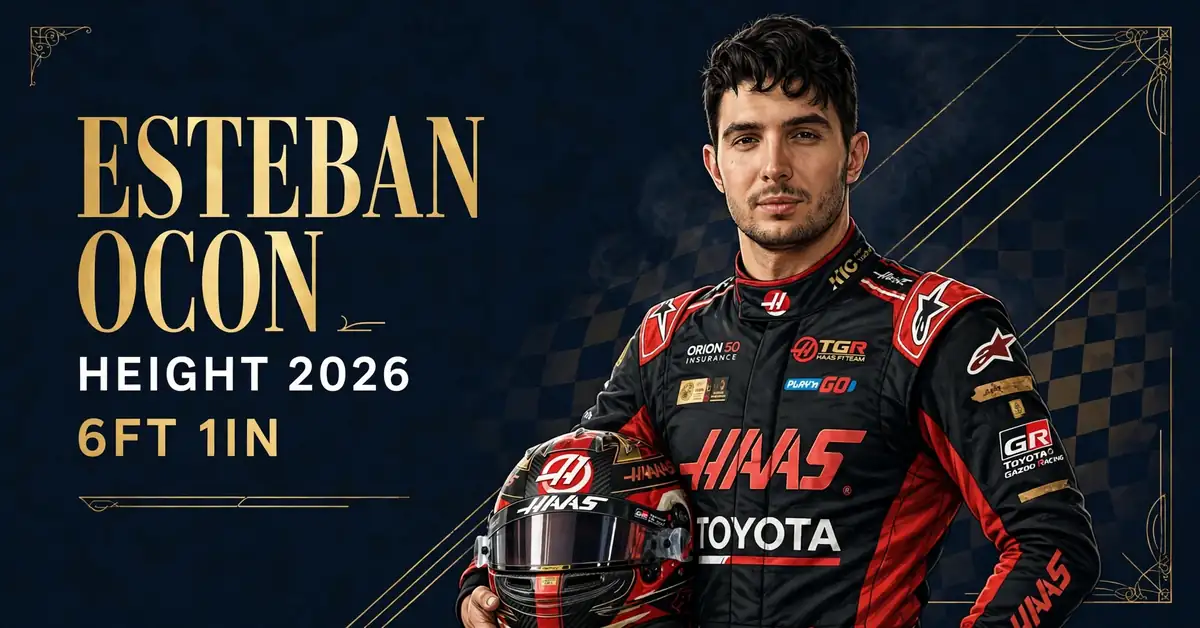
Esteban Ocon height is 1.86m (6ft 1in) — joint-second tallest on the 2026 F1 grid. At 30, the Frenchman stands 7cm above the grid average after his Haas exit.
Last updated: November 24, 2026 · By Nathan Cole
Esteban Ocon is 6 feet 1 inch tall (1.86 m). That is the figure in Autosport’s grid-wide height table, in PlanetF1’s 2026 driver heights rundown, in RacingNews365’s driver profile, and in every independent grid table published since 2023. He stands 186 centimetres tall, 73 inches, and he shares the distinction of joint-second-tallest driver on the 2026 Formula 1 grid with Williams driver Alex Albon. Only his own Haas team-mate, Oliver Bearman, stands taller, at 1.88 m.
The number is one of the most stable facts in Formula 1 reporting. Ocon has been listed at 1.86 m since his Force India days, and the figure has not moved through Manor, Renault, Alpine and Haas. What has moved is everything around it: in November 2026, weeks before this profile was written, Haas dropped Ocon mid-season after a disagreement at the Mexico City Grand Prix, and the 30-year-old Frenchman now faces the winter with no confirmed seat for 2027. His height, though, is settled — and this profile settles it source by source, with the one conversion error named, the weight spread explained, and the cockpit consequences spelled out.
Readers come to this question for the number, and the number is in the first sentence. The rest of the profile answers what the number means: how Ocon compares with every driver on the 2026 grid, why 1.86 m is a genuine engineering problem inside a Formula 1 cockpit, how a tall kid from Évreux climbed from a family caravan to a Grand Prix win, and what his sudden Haas exit means for a career that has already spanned a decade in the sport.
Quick Facts: Esteban Ocon at a Glance
| Full name | Esteban José Jean-Pierre Ocon-Khelfane |
| Born | September 17, 1996, Évreux, Normandy, France |
| Age | 30 (turned 30 on September 17, 2026) |
| Height | 6 ft 1 in (186 cm / 1.86 m / 73 in) |
| Weight | 66–73 kg (146–161 lb) — sources disagree, see below |
| Race number | 31 |
| Role | Formula 1 racing driver |
| Teams | Manor, Force India, Racing Point, Renault, Alpine, Haas |
| Career | F1 debut 2016; 1 Grand Prix win (Hungary 2021); 3 podiums; 180 Grands Prix entered by end of 2025 |
| 2026 status | Dropped by Haas on November 3, 2026, after the Mexico City Grand Prix; no confirmed seat for 2027 |
| Partner | Flavy Barla (since 2023); not married |
| Net worth (2026) | Estimated 16 to 21 million dollars (Celebrity Net Worth 16 million dollars; PlanetF1 21 million dollars) |
How This Height Figure Was Adjudicated
Esteban Ocon’s height is one of the most stable facts in Formula 1 reporting: Autosport’s 2024 grid table, PlanetF1’s 2026 grid heights rundown, F1 Chronicle, RacingNews365, F1-Fansite and FormulaOneHistory all list 1.86 m (6 ft 1 in), and the figure has stayed the same from his Force India years through his Haas seasons. One conversion error exists — PlanetF1’s 2023 grid rundown printed “1.86 metres tall (6’2″)”, which mixes a correct metric figure with a wrong imperial one — and it is named below rather than hidden. His weight is a different story: published figures run from 66 kg to 73 kg depending on the outlet and the season, so this profile publishes the range and names each source. His net worth is estimated at 16 million dollars by Celebrity Net Worth and 21 million dollars by PlanetF1’s 2026 grid rich list; his contracts are private and he has never disclosed his finances, so every money figure is labelled an estimate. Career and Haas-exit facts are from PlanetF1, Autosport, The Race, DAZN, RACER, the Associated Press and RacingNews365 reporting from October and November 2026.
+
The Short Answer: 6 Feet 1 Inch (186 cm)
Esteban Ocon stands 6 feet 1 inch tall, which converts to 1.86 metres and 186 centimetres. In inches alone, that is 73 inches. There is no serious dispute about the number. Every grid-wide height table that lists all twenty drivers puts Ocon at the same figure, and the specialist outlets agree with the general databases.
Autosport’s rundown of the 2024 grid states it plainly: “The tallest F1 drivers on the 2024 grid are Esteban Ocon and Alex Albon who are 1.86 metres tall (6ft 1in).” PlanetF1’s 2026 update keeps the same figure and adds the new context — Haas driver Oliver Bearman is the tallest driver on the 2026 grid at 1.88 metres, “with Williams driver Alex Albon and Bearman’s Haas teammate, Esteban Ocon, next up at 1.86m.” F1 Chronicle, writing in 2026, puts it the same way: Bearman stands “two centimetres above the pairing that shared the tallest-driver distinction before him, Alex Albon and Esteban Ocon, both 186cm (6ft 1in).”
RacingNews365’s driver profile lists “Height, 186cm” alongside his date of birth, September 17, 1996, his birthplace of Évreux, and his race number, 31. F1-Fansite’s career page gives “1.86 meter / 6 feet 1 inch”. FormulaOneHistory’s driver page gives “6 ft 1 in / 1.86m”. F1Oversteer, profiling his life outside the sport, writes: “Measuring in at a height of 1.86m tall, Haas driver Esteban Ocon stands at 6 ft 1 in.”
That kind of agreement across six independent sources, spanning 2023 to 2026, is what a settled fact looks like. Ocon is not a driver whose height gets revised every season. He has been 1.86 m since he arrived in Formula 1 as a 19-year-old with Manor in 2016, and he is 1.86 m now, at 30, after ten seasons in the sport.
The Source-by-Source Height Check
Height figures for racing drivers are not measured by journalists. They come from team media guides, FIA documentation and the driver profiles the sport’s own outlets maintain, and they get repeated from season to season. That repetition is useful: when a figure survives four seasons of grid tables without changing, it has been checked by more editors than any single profile ever gets. The table below shows where Ocon’s 1.86 m comes from.
| Source | Figure given | Date / season |
|---|---|---|
| Autosport | 1.86 m (6 ft 1 in) | 2024 grid heights |
| PlanetF1 | 1.86 m | 2026 grid heights |
| F1 Chronicle | 186 cm (6 ft 1 in) | 2026, tallest-driver rundown |
| RacingNews365 | 186 cm | Driver profile, 2026 season |
| F1-Fansite | 1.86 m / 6 ft 1 in | Career stats, updated November 22, 2026 |
| FormulaOneHistory | 6 ft 1 in / 1.86 m | Driver page, 2026 season |
| F1Oversteer | 1.86 m (6 ft 1 in) | Life-outside-F1 profile |
| PlanetF1 (2023) | 1.86 m, printed as “6’2″” | 2023 grid heights — conversion error, see below |
The one blemish on the record is worth explaining, because it is the source of most of the confusion readers find online. PlanetF1’s 2023 grid rundown wrote: “Two drivers share the honour of being Formula 1’s tallest, with Esteban Ocon and Alex Albon both measuring up at 1.86 metres tall (6’2″).” The metric figure is correct. The imperial figure is not. One metre is 3.28 feet, and 1.86 metres works out at 6 feet 1.24 inches — 6 ft 1 in, rounded down. Six feet two inches is 1.88 m, a different height entirely, and it happens to be the height of Ocon’s 2026 Haas team-mate Oliver Bearman. A reader who saw the 2023 piece and remembered “6’2″” would carry away the wrong number, and a profile page that copied it would repeat the error.
That is the only dissent in the record, and it is a typo rather than a competing measurement. No outlet has ever published a different metric figure for Ocon. He is 1.86 m, and the drivers listed above him or beside him are measured on the same scale: Bearman at 1.88 m, Albon at 1.86 m, George Russell at 1.85 m.
Esteban Ocon Height in Centimetres, Metres and Feet
Searches for a driver’s height come in every unit, so here is the full conversion in one place. Esteban Ocon’s height is 1.86 metres, 186 centimetres, 6 feet 1 inch, and 73 inches. In millimetres, the figure the engineers use, it is 1,860 mm.
The conversions matter because the sport itself mixes units. British outlets quote feet and inches. European team documents quote centimetres. The FIA’s technical paperwork works in millimetres. A fan in France reads 186 cm; a fan in the United States reads 6’1″; a fan in Britain reads 6 ft 1 in. All three describe the same man.
For scale, Ocon stands about 8 centimetres above the 2026 grid average of roughly 1.78 m, according to FormulaOneHistory’s grid survey. He stands about 10 centimetres above the average French man, who measures roughly 1.76 m. And he stands 27 centimetres — nearly 11 inches — above Yuki Tsunoda, the shortest driver on the 2024 grid at 1.59 m, a gap PlanetF1 and Autosport both highlighted when Ocon and Albon shared the tallest-driver title.
One more comparison puts the number in everyday terms. At 6 ft 1 in, Ocon is the same height as the average NBA point guard’s listed height, and taller than most professional footballers. He is two inches taller than Lewis Hamilton, who is listed at 1.74 m, and four inches taller than Lando Norris, listed at 1.70 m. In a sport where the cars are built around drivers who average 5 ft 10 in, Ocon is a big man in a small machine.
How Much Does Esteban Ocon Weigh?
Esteban Ocon’s weight is the one physical figure where the sources do not agree. Published listings run from 66 kg to 73 kg — a spread of 7 kg, or about 15 lb — and the honest answer is the range, not a single number. The spread exists because driver weights move with the season, with training blocks, and with which outlet weighed in when.
PlanetF1’s grid tables list Ocon at 66 kg in both the 2023 and 2024 rundowns, and the 2023 piece makes a point of it: “Esteban Ocon may be tall, but he’s very light, weighing just 66kg.” Autosport’s 2024 grid table lists him at 73 kg. FormulaOneHistory’s 2026 grid table also lists 73 kg. RacingNews365’s driver profile splits the difference at 68 kg.
Three figures, three respectable outlets. The likeliest reading is that Ocon’s weight has moved inside that band over the years — a driver can add or lose several kilos between seasons as training changes — and that different outlets captured him at different points. A 66 kg listing from 2023 and a 73 kg listing from 2024 are not necessarily in conflict; they may simply be two snapshots of the same athlete a year apart.
What the range does establish is the shape of the man: tall and light. At 1.86 m and roughly 66 to 73 kg, Ocon carries very little spare weight for his height. That matters in Formula 1, where every kilo of driver is a kilo the engineers cannot place somewhere else in the car. A tall, light driver is far easier to package than a tall, heavy one, and Ocon’s build is one reason his height has never been the handicap some predicted when he arrived in the sport.
For readers converting the figures: 66 kg is about 146 lb, 68 kg is about 150 lb, and 73 kg is about 161 lb. His body mass index, for those who use it, sits between roughly 19 and 21 depending on which end of the range is used — lean by any standard, and typical of a modern Formula 1 driver.
How Tall Is Esteban Ocon Compared with the 2026 F1 Grid?
On the 2026 grid, Esteban Ocon is the joint-second-tallest driver. The full picture, from PlanetF1’s 2026 heights rundown and F1 Chronicle’s tallest-driver survey, looks like this: Oliver Bearman leads at 1.88 m, then Ocon and Alex Albon tie at 1.86 m, then George Russell follows at 1.85 m. Four drivers, four centimetres apart at the top of the order, and Ocon sits in the middle of that group.
The table below gives the top of the grid and the bottom, so Ocon’s place in the field is clear. Heights for Albon, Russell and Bearman come from the same 2026 grid surveys that list Ocon; the shorter drivers’ figures come from the standard listings those surveys and the driver profiles use.
| Driver | Team (2026) | Height | Gap to Ocon |
|---|---|---|---|
| Oliver Bearman | Haas | 1.88 m (6 ft 2 in) | 2 cm taller |
| Esteban Ocon | Haas | 1.86 m (6 ft 1 in) | — |
| Alex Albon | Williams | 1.86 m (6 ft 1 in) | Same height |
| George Russell | Mercedes | 1.85 m (6 ft 1 in) | 1 cm shorter |
| Max Verstappen | Red Bull | 1.81 m (5 ft 11 in) | 5 cm shorter |
| Charles Leclerc | Ferrari | 1.80 m (5 ft 11 in) | 6 cm shorter |
| Lewis Hamilton | Ferrari | 1.74 m (5 ft 9 in) | 12 cm shorter |
| Lando Norris | McLaren | 1.70 m (5 ft 7 in) | 16 cm shorter |
| Yuki Tsunoda | Red Bull | 1.59 m (5 ft 3 in) | 27 cm shorter |
Two details in that table are worth a second look. The first is the Haas pairing. With Ocon at 1.86 m and Bearman at 1.88 m, Haas fielded the tallest driver pairing on the 2026 grid, with an average height of 1.85 m, according to FormulaOneHistory. No other team came close to that combined height, and it made the Haas garage the place where cockpit packaging mattered most.
The second is the tie with Albon. Ocon and Alex Albon, whose net worth and career we profile separately, have shared the tallest-driver title before: in 2023 and 2024, before Bearman arrived on the grid, the two of them were the tallest drivers in Formula 1, both at 1.86 m. Bearman’s arrival in 2025 pushed them both down to second, but the tie between them has held for four seasons.
George Russell, who turned 28 in February 2026, sits one centimetre behind Ocon at 1.85 m — close enough that the two men are effectively the same height in a photograph, and far enough apart that the official tables still separate them. At the other end of the scale, Isack Hadjar is the shortest driver on the 2026 grid, and the gap between Ocon and the shortest man on the grid is wider than the gap between Ocon and the average fan in the grandstands.
Why Height Matters in a Formula 1 Cockpit
A Formula 1 cockpit is not built for a 6 ft 1 in man. The opening a driver climbs through is roughly the width of a briefcase, the seat is moulded to the driver’s body, and the pedals sit close enough that a tall driver’s knees ride high against the chassis. Every centimetre of a driver’s height has to be negotiated with the car’s designers, and Ocon’s 1.86 m has been a negotiation for his entire career.
The first problem is the seat. Each driver gets a seat moulded to his own body, poured in the factory and fitted in the car, and a taller driver needs a longer seat with more recline. That changes the driver’s eye line, the angle of the steering column and the position of the headrest. Ocon’s engineers at every team he has driven for — Manor, Force India, Renault, Alpine, Haas — have built his seating position around long legs and a long torso, and each new team has had to learn his shape from scratch.
The second problem is weight. Formula 1 sets a minimum combined weight for the driver plus the seat, and teams make up any shortfall with ballast — small weights they can place low in the car, exactly where they want the centre of gravity. A light driver gives the engineers freedom: the ballast goes where it helps the car most. A heavy driver takes that freedom away, because the weight is already in the seat, high up, where it hurts handling. Ocon’s light build, 66 to 73 kg for a 1.86 m man, is the reason his height has cost him less than it might have. He is tall, but he is not heavy, so his teams have kept most of their ballast freedom.
The third problem is the centre of gravity itself. A taller driver’s mass sits higher in the car, and a higher centre of gravity makes a car slower through fast corners. The effect is small — fractions of a second per lap — but Formula 1 is a sport decided by fractions of a second per lap. Over a race distance, a taller driver can cost a team real time, and the engineers claw it back with ballast placement, suspension setup and seat angle.
None of this has stopped Ocon. He won a Grand Prix, stood on the podium three times and held a seat in Formula 1 for ten seasons at a height that puts him near the top of every grid table. The history of the sport backs him up: Justin Wilson, at 1.93 m (6 ft 4 in), remains one of the tallest drivers in modern Formula 1 history, and Alexander Wurz and Alexander Rossi both raced at 1.86 m, Ocon’s exact height. Tall drivers have always found a way to fit, and the teams have always found a way to fit them.
There is also a practical side that fans rarely see. A driver’s helmet must clear the halo, the titanium protection device that sits above the cockpit, and a taller driver sits closer to it. His knees must clear the steering column under braking, when forces of up to 5G push his body forward. His shoulders must fit inside a cockpit barely wider than his frame. Ocon has spent a decade making those millimetres work, and the fact that no team has ever cited his height as a reason to drop him — his Haas exit in November 2026 was about a disagreement with the team, not his size — says everything about how manageable the problem is.
Early Life: The Caravan, the Karting and the Tall Kid from Évreux
Esteban Ocon was born on September 17, 1996, in Évreux, a town in Normandy about 100 kilometres west of Paris. He is the only child of Laurent Ocon, who ran a garage, and Sabrina Khelfane. His father worked on cars for a living; his son would end up driving them faster than anyone in his family had imagined.
The story of Ocon’s childhood is one of the best known in Formula 1, and it is the reason his career still gets described as a caravan-to-F1 story. The family did not have money. To fund their son’s karting, Laurent and Sabrina Ocon sold their house and moved the family into a caravan, travelling to races across France so Esteban could compete. The caravan became the family home, the workshop and the transport, all at once.
That sacrifice is the first thing to understand about Ocon. Most Formula 1 drivers arrive from families that could afford the sport; Ocon arrived from a family that gave up its house for it. PlanetF1’s 2026 rich list makes the point directly, calling him “somewhat of an outlier on the F1 grid in that he did not come from money”. His fortune, whatever figure is put on it, was built from driving contracts and endorsements, not from family wealth.
Karting came early. Ocon was racing karts as a small child, and he was tall for his age from the start — the height that would later make him one of the tallest men on the grid was already visible in the junior categories. In karting, height barely matters: the karts are small, the drivers sit low, and a tall teenager loses nothing to a short one. The height only became a talking point when he moved into single-seaters, where the cockpits are tight and the engineers start measuring.
Évreux itself is an ordinary French town, and Ocon’s roots there are part of his public image. He still speaks about Normandy as home, and his French nationality has always been central to how he is presented — the French driver on the grid, in a sport where France has produced champions from Alain Prost to the present day. He turned 30 on September 17, 2026, an age at which most Formula 1 drivers are in their prime, with their best results either behind them or still to come.
The Junior Years: F3 and GP3 Titles Before Formula 1
Ocon’s path to Formula 1 ran through the two championships that have launched more modern careers than any others: European Formula 3 and GP3. He won them both, back to back, and the double is what put him on the radar of the teams that matter.
In 2014, driving for Prema Racing, Ocon won the FIA Formula 3 European Championship. The series was the proving ground for the generation that would fill the Formula 1 grid — Max Verstappen raced in the same championship that year — and winning it at 17 marked Ocon as a genuine prospect rather than a well-funded hopeful. The title came with the attention of the junior programmes, and Mercedes signed him to its young-driver programme.
In 2015, driving for ART Grand Prix, he won the GP3 Series, the championship that sat directly below Formula 1. A driver who wins F3 and then GP3 in consecutive seasons has done everything the junior ladder asks, and Ocon’s reward was a foot in the Formula 1 door: a reserve role, test outings, and then, in August 2016, a race seat.
There was also a short spell in the DTM, the German touring car championship, with Mercedes in 2016, run alongside his Formula 1 commitments. It was a holding pattern more than a career move — a way to keep a young driver race-sharp while the Formula 1 seat was arranged — and it ended as soon as the Manor call came.
The junior titles matter to this profile for a simple reason: they explain why a driver with no family money got a Formula 1 seat at 19. Teams do not hire 19-year-olds out of sentiment. They hire them because the junior record says the driver can win, and Ocon’s record said exactly that.
Formula 1 Career Timeline: Manor to Force India to Alpine
Esteban Ocon’s Formula 1 career began in August 2016, when Manor Racing called him up to replace Rio Haryanto from the Belgian Grand Prix. He was 19, the season was already half run, and the Manor was the slowest car on the grid. He finished the year without a point, but he finished races, kept the car on the road, and did enough to earn a proper seat for 2017.
Force India gave him that seat, and the two seasons that followed were the making of him. In 2017, alongside Sergio Pérez, Ocon finished eighth in the drivers’ championship with 87 points, scored in 18 of 20 races, and established himself as one of the most consistent midfield drivers in the sport. In 2018, in a season disrupted by the team’s financial collapse and rebirth as Racing Point, he finished 12th with 49 points. The numbers were solid. The relationship with Pérez was not always smooth — the two men collided more than once — but Ocon’s speed was never in doubt.
The 2018 season also produced the moment that defines Ocon’s rivalry with Max Verstappen, whose height we profile separately. At the Brazilian Grand Prix, Ocon, a lap down in his Force India, tried to unlap himself against the race-leading Verstappen. The two cars collided, Verstappen spun, and the win went to Lewis Hamilton. After the race, Verstappen confronted Ocon in the weighing area and shoved him. The incident has followed both men ever since, and it is still raised whenever they race near each other.
At the end of 2018, Ocon lost his seat. Racing Point signed Lance Stroll, whose father had bought the team, and Ocon spent 2019 as Mercedes’ reserve driver — a year on the sidelines, in the simulator, waiting. It was the first real setback of his career, and it lasted a full season.
Renault brought him back in 2020, and the comeback produced his first podium: second place at the Sakhir Grand Prix in Bahrain, behind Sergio Pérez. A year later, now with the team renamed Alpine, came the win. At the Hungarian Grand Prix in August 2021, a first-corner pile-up took out most of the front-runners, Ocon held the lead for 65 laps, and he took the chequered flag for his first — and so far only — Grand Prix victory. He was 24. It remains the high point of his career.
Alpine kept him through 2024, and the years after the win were mixed. A third-place finish at Monaco in 2023 was the other podium of his career. But the team’s competitiveness faded, the relationship frayed — most publicly in a collision with team-mate Pierre Gasly at Monaco in 2024 — and in June 2024 Alpine announced Ocon would leave at the end of the season. He departed before the final race in Abu Dhabi, with Jack Doohan taking the seat, and signed for Haas.
| Season | Team | Championship | Note |
|---|---|---|---|
| 2016 | Manor | 23rd, 0 pts | Debut at Belgium, aged 19 |
| 2017 | Force India | 8th, 87 pts | Points in 18 of 20 races |
| 2018 | Force India / Racing Point | 12th, 49 pts | Brazil collision with Verstappen |
| 2019 | Mercedes (reserve) | — | Year on the sidelines |
| 2020 | Renault | 12th, 62 pts | First podium, Sakhir P2 |
| 2021 | Alpine | 11th, 74 pts | Win at Hungary |
| 2022 | Alpine | 8th, 92 pts | Best championship finish |
| 2023 | Alpine | 12th, 58 pts | Podium at Monaco, P3 |
| 2024 | Alpine | 14th, 23 pts | Left before Abu Dhabi finale |
| 2025 | Haas | 15th, 38 pts | Best result P5, China |
| 2026 | Haas | 17th, 7 pts* | Dropped after Mexico City GP (*through Las Vegas GP) |
By the end of the 2025 season, Ocon had entered 180 Grands Prix and started every one of them, according to F1Oversteer. That is a decade of reliability in a sport that discards drivers quickly. The win, the three podiums and the ten seasons are the record of a driver who was never the fastest man on the grid and never needed to be — he was fast enough, consistent enough and tough enough to stay.
The Hungary 2021 Win: One Victory, One Podium Top Step
Every driver on the grid has one race they would show a stranger first. For Esteban Ocon, it is the Hungarian Grand Prix of August 1, 2021, and it is the only Grand Prix he has ever won.
The race turned in the first corner. On a damp track, Valtteri Bottas braked too late, hit Lando Norris, and set off a chain of collisions that took out five cars, including both Red Bulls of Verstappen and Pérez. When the red flag came out and the race restarted, Ocon was in second. When Lewis Hamilton, the pole-sitter, stayed out on intermediate tyres while the rest of the field pitted for slicks, Ocon inherited the lead.
He held it for 65 laps. Sebastian Vettel, in the Aston Martin, chased him for most of the race and finished less than two seconds behind; Hamilton, fighting back through the field, finished third. Ocon did not put a wheel wrong. He managed his tyres, hit every braking point, and brought the Alpine home for a win that nobody had predicted that morning.
The victory was worth more than the 25 points. It was the first win for the Alpine name in Formula 1, the first win for a French driver with a French team since Olivier Panis won at Monaco in 1996, and the proof that Ocon could deliver when the chance came. He was 24 years old, in his sixth season, and he had just done the thing every driver on the grid is judged by.
The two other podiums of his career frame the win. The first came at the Sakhir Grand Prix in December 2020, when he finished second for Renault behind Pérez — the result that announced his comeback from the reserve-driver year. The third came at Monaco in May 2023, when he finished third for Alpine on the tightest circuit on the calendar, a result that rewarded precision over speed. One win, three podiums, ten seasons: that is the shape of Ocon’s career at the sharp end.
Haas 2025 to 2026: Two Seasons That Ended Early
Ocon joined Haas in July 2024 on a multi-year deal starting in 2025, leaving Alpine for the American team as it rebuilt under team principal Ayao Komatsu. The move made sense on paper: Haas had a Ferrari engine, a Toyota technical partnership, and a vacancy alongside the rookie Oliver Bearman. Ocon brought ten seasons of experience to a team that needed exactly that.
His first season, 2025, was hard. The car was a midfield machine in a midfield fight, and Ocon scored points in nine of the 24 races, with a best result of fifth place in China, on his way to 15th in the drivers’ championship with 38 points — two places and three points behind his rookie team-mate Bearman, according to RacingNews365. It was, by his own standards, his worst full season in Formula 1. The team switched its focus early to the major regulation changes coming for 2026, and Ocon settled in for a second year.
The second year ended suddenly. At the Mexico City Grand Prix weekend of October 30–31, 2026, Ocon argued with his race engineer, Laura Müller, over the radio during Friday practice, over the tyres being used and the run plan he was being asked to complete. On Saturday morning, Haas pulled him from the car. Reserve driver Ryo Hirakawa took over for the rest of the weekend and finished tenth, scoring a point on his debut.
Three days later, on November 3, 2026, Haas confirmed the split. “We have now notified Esteban Ocon that he will not return to a race seat with TGR Haas F1 Team this season,” said Komatsu, in a statement that named Rafael Camara — the 21-year-old Brazilian Formula 2 leader already signed for 2027 — as Ocon’s replacement for the Sao Paulo Grand Prix. The Associated Press reported the same day that Haas had dropped Ocon four days after replacing him in Mexico, and that the team had offered no specific reason. Komatsu described the matter as internal, and said the conversations between the team and Ocon would stay private.
Ocon responded to reports of an altercation by denying he had been violent, while admitting there had been a disagreement with team bosses, according to DAZN. Haas confirmed that illness was not the reason for the driver change, and disclosed nothing further.
The exit had been coming in slow motion. Haas had announced on October 15, 2026, that Camara would replace Ocon for 2027, so the Frenchman already knew his time at the team was ending. What nobody expected was the ending arriving three races early, in the middle of a race weekend, with a reserve driver scoring a point in his car. Camara went on to race in Brazil, Las Vegas, Qatar and Abu Dhabi — RACER confirmed on November 22 that the Brazilian would see out the season, giving up his chance at the Formula 2 title to do it.
As of late November 2026, Ocon has no confirmed seat for 2027. He told reporters in October not to write him off, and said he still wants to be racing in Formula 1, with a reserve role as his fallback. At 30, with ten seasons, a win and 180 Grand Prix starts behind him, he is neither a rookie nor a veteran winding down. The winter will decide whether the Haas exit was a full stop or a comma.
Esteban Ocon Net Worth in 2026: 16 to 21 Million Dollars
Esteban Ocon’s height is settled. His fortune is not, and the range of published estimates says as much about the private nature of Formula 1 contracts as it does about Ocon himself. The two most cited figures put him between 16 million dollars and 21 million dollars, and the full picture — salary, endorsements, career earnings — is laid out in our separate profile of Esteban Ocon’s net worth in 2026, which anchors the estimate at 21 million dollars.
Celebrity Net Worth lists Ocon at 16 million dollars, noting that his decade in Formula 1 has earned him millions in racing salaries but that the sport’s private contracts make his exact cumulative pay difficult to determine. PlanetF1’s 2026 rich list of the grid puts him at 21 million dollars, 13th among the drivers, and reports that he banks about 6 million dollars a season from Haas, with F1Salaries putting his 2026 salary at 7 million dollars. LoveMoney’s 2026 ranking of the richest Formula 1 drivers also lists him at 21 million dollars. Other profile sites give figures between 10 and 15 million dollars, usually by counting only salary and ignoring endorsements.
The sponsors listed on Ocon’s own website include Venum, Globe Air, Meros, Facom and Bianchet, according to PlanetF1, and earlier coverage has linked him with Microsoft and the watchmaker Bell & Ross. He did not come from money — the caravan story is the proof of that — so the fortune, whatever the exact figure, was built lap by lap, contract by contract, across ten seasons and six teams.
Readers who want the full breakdown — the salary history, the endorsement deals, the career earnings and the reasoning behind the 21-million-dollar anchor — will find it in our net worth profile, and in the companion piece on our sister site: Esteban Ocon’s net worth on CelebAmerica, which places the estimate in the same 16-to-21-million-dollar range. The short version is that Ocon is a wealthy man by any measure, and a modestly wealthy one by Formula 1 standards, where the top drivers earn ten times his salary. More driver fortunes are covered in our Celebrity Net Worth section.
Personal Life: Flavy Barla, Family and Life Away from the Track
Esteban Ocon has been in a relationship with Flavy Barla since 2023. Barla is from Nice, studied medicine, and won the Miss Côte d’Azur title in 2022. The couple made their public debut together at the Abu Dhabi Grand Prix in November 2023, and Barla has been a regular presence at races since, joining Ocon at grands prix, on holidays and at public events. They are not married, and no reliable public report shows Ocon has children.
Before Barla, Ocon was in a five-year relationship with Elena Berri, an Italian model. The two split early in 2023, and Ocon’s relationship with Barla began later that year. He has kept the details of his private life mostly out of the press, and the coverage that exists comes from race-weekend appearances rather than interviews about his home life.
His parents remain central to his story. Laurent Ocon ran a garage, Sabrina Khelfane kept the family going through the karting years, and the caravan they lived in to fund their son’s racing is now part of Formula 1 folklore. Ocon has spoken often about his parents’ sacrifices and about his determination to honour them — the kind of debt that does not get repaid with a single win, but with a career.
Away from racing, Ocon’s interests are those of a driver who grew up around cars: he collects watches, works with his sponsors, and maintains the public profile of a French sportsman in his prime. His social media presence is active but measured, and his public statements since the Haas exit have been careful — a driver who knows his next contract depends on how he handles this winter.
Esteban Ocon vs His Peers: Height Comparison Table
Height comparisons are where a number like 1.86 m turns into something a reader can picture. The table below sets Ocon against the drivers he has raced with most closely — his team-mates, his rivals, and the men who defined the grid during his decade in the sport. Figures for Bearman, Albon, Russell and Tsunoda come from the 2024 and 2026 grid surveys cited above; the others are the standard listed heights used across the driver profiles.
| Driver | Height | Ocon is… |
|---|---|---|
| Oliver Bearman | 1.88 m (6 ft 2 in) | 2 cm shorter |
| Esteban Ocon | 1.86 m (6 ft 1 in) | — |
| Alex Albon | 1.86 m (6 ft 1 in) | Exactly the same |
| George Russell | 1.85 m (6 ft 1 in) | 1 cm taller |
| Pierre Gasly | 1.82 m (6 ft 0 in) | 4 cm taller |
| Max Verstappen | 1.81 m (5 ft 11 in) | 5 cm taller |
| Charles Leclerc | 1.80 m (5 ft 11 in) | 6 cm taller |
| Sergio Pérez | 1.73 m (5 ft 8 in) | 13 cm taller |
| Lando Norris | 1.70 m (5 ft 7 in) | 16 cm taller |
| Yuki Tsunoda | 1.59 m (5 ft 3 in) | 27 cm taller |
The comparisons that carry the most history are the ones with his team-mates. Pierre Gasly, Ocon’s Alpine team-mate for two seasons and his junior rival from their karting days, stands 1.82 m — four centimetres shorter, a difference visible in every team photograph. Sergio Pérez, his Force India team-mate in 2017 and 2018, stands 1.73 m, a full 13 centimetres shorter, which made their shared garage a study in contrasts. And Charles Leclerc, whose height we profile separately, stands 1.80 m — six centimetres shorter than Ocon, though the two men have raced each other since their junior days.
Against the champions, Ocon is the taller man almost every time. He stands five centimetres above Verstappen, the four-time world champion he collided with at Brazil in 2018. He stands 12 centimetres above Lewis Hamilton. The grid, taken as a whole, averages about 1.78 m, and Ocon clears it by eight centimetres — enough to notice in a group photograph, and enough to matter in a cockpit.
The gap that surprises most readers is the one at the bottom of the table. Tsunoda, at 1.59 m, is 27 centimetres — nearly 11 inches — shorter than Ocon. When the two men stood on the same grid in 2024, the difference was visible from the grandstands. It is the widest height gap between two drivers on the same grid in years, and it is a reminder of how little Formula 1 cares about a driver’s size: the sport’s smallest driver and one of its tallest raced the same cars, on the same tracks, for the same points.
Sources & Reporting
This profile was researched on November 24, 2026, from live reporting and driver profiles. The height figure — 1.86 m (6 ft 1 in) — comes from Autosport’s 2024 grid heights table, PlanetF1’s 2026 driver heights rundown, F1 Chronicle’s tallest-driver survey, RacingNews365’s driver profile, F1-Fansite’s career statistics (updated November 22, 2026), FormulaOneHistory’s driver page and F1Oversteer’s life-outside-F1 profile. The 66 kg, 68 kg and 73 kg weight figures come from PlanetF1’s 2023 and 2024 tables, RacingNews365 and Autosport’s 2024 table respectively. Grid height context, including Bearman’s 1.88 m and the Haas pairing average of 1.85 m, comes from PlanetF1 and FormulaOneHistory.
Career facts — the 2014 F3 and 2015 GP3 titles, the Manor debut in 2016, the Force India seasons, the 2019 reserve year, the Sakhir 2020 podium, the Hungary 2021 win, the Monaco 2023 podium, the 2025 Haas season (15th, 38 points, best result fifth in China) and the 180 Grands Prix entered by the end of 2025 — come from FormulaOneHistory, F1-Fansite, RacingNews365 and F1Oversteer. The Haas exit — the October 30 radio disagreement with race engineer Laura Müller, the benching at the Mexico City Grand Prix, Hirakawa’s tenth place, the November 3 confirmation, Camara’s debut in Brazil and confirmation for the rest of the season — comes from PlanetF1, The Race, DAZN, the Associated Press via theScore, and RACER’s November 22 report.
Net worth figures come from Celebrity Net Worth (16 million dollars), PlanetF1’s 2026 grid rich list (21 million dollars, about 6 million dollars a season from Haas), LoveMoney (21 million dollars) and F1Salaries (7 million dollars for 2026). Personal-life facts — Flavy Barla since 2023, Miss Côte d’Azur 2022, the Abu Dhabi debut in November 2023, and the earlier relationship with Elena Berri — come from F1Oversteer and Hamariweb’s profile. Birth date, birthplace, full name and race number come from RacingNews365 and Formula Daily.
Figures are reported as their sources report them. Where sources disagree — weight, net worth — the range is published and the disagreement is explained. Where a fact could not be verified from a named source, it is not stated as fact. Corrections: figures are updated when new reporting emerges — contact us via the About page if you spot an error.
Frequently Asked Questions About Esteban Ocon
How tall is Esteban Ocon?
Esteban Ocon is 6 feet 1 inch tall (1.86 m / 186 cm). The figure is agreed across Autosport, PlanetF1, F1 Chronicle, RacingNews365, F1-Fansite and FormulaOneHistory, and it has stayed the same since his Force India days. He is the joint-second-tallest driver on the 2026 Formula 1 grid, tied with Alex Albon.
How tall is Esteban Ocon in centimetres?
Esteban Ocon is 186 centimetres tall. That converts to 1.86 metres, 6 feet 1 inch, and 73 inches. The centimetre figure is the one used in team documents and European profiles, and it is the figure RacingNews365 lists in his driver profile.
How much does Esteban Ocon weigh?
Esteban Ocon’s weight is reported between 66 kg and 73 kg (146–161 lb), depending on the source and the season. PlanetF1 lists 66 kg, RacingNews365 lists 68 kg, and Autosport and FormulaOneHistory list 73 kg. The honest answer is the range: he is a tall, light driver, which helps his teams place ballast low in the car.
Is Esteban Ocon the tallest F1 driver?
No — Esteban Ocon is the joint-second-tallest driver on the 2026 grid. His Haas team-mate Oliver Bearman is the tallest at 1.88 m (6 ft 2 in), two centimetres above Ocon. Ocon shares second place with Williams driver Alex Albon, who is also 1.86 m. Before Bearman arrived, Ocon and Albon shared the tallest-driver title in 2023 and 2024.
How old is Esteban Ocon?
Esteban Ocon is 30 years old. He was born on September 17, 1996, in Évreux, Normandy, France, and turned 30 on September 17, 2026. He made his Formula 1 debut at 19 with Manor in 2016 and has raced in ten seasons.
What is Esteban Ocon’s net worth in 2026?
Esteban Ocon’s net worth in 2026 is estimated between 16 million dollars (Celebrity Net Worth) and 21 million dollars (PlanetF1’s 2026 grid rich list and LoveMoney). His reported salary is about 6 to 7 million dollars a season. The full breakdown is in our separate profile of Esteban Ocon’s net worth in 2026.
Who is Esteban Ocon’s girlfriend?
Esteban Ocon’s girlfriend is Flavy Barla, a medical student from Nice who won Miss Côte d’Azur in 2022. They have been together since 2023 and made their public debut at the Abu Dhabi Grand Prix in November 2023. Ocon was previously in a five-year relationship with Italian model Elena Berri. He is not married and has no children confirmed in public reporting.
Why did Haas drop Esteban Ocon?
Haas dropped Esteban Ocon after a disagreement during Friday practice at the Mexico City Grand Prix on October 30, 2026, when Ocon argued with race engineer Laura Müller over tyres and the run plan. Haas benched him for the rest of the weekend, reserve driver Ryo Hirakawa finishing tenth, and on November 3 confirmed Ocon would not race for the team again in 2026. Haas called the matter internal and gave no further reason; Ocon denied any violence and admitted a disagreement. Rafael Camara, already signed for 2027, took the seat. Ocon has no confirmed seat for 2027.
WRITTEN BY
Nathan Cole
Nathan Cole is the editor of Guide Net Worth. He covers celebrity wealth the way a business desk covers earnings: reported figures first, estimates labeled as estimates, and no invented numbers. Every profile on this site passes through his desk before it publishes. About Guide Net Worth · Corrections: figures are updated when new reporting emerges — contact us via the About page if you spot an error.
References & Sources
This article has been fact-checked and verified against multiple public sources, financial disclosures, SEC filings, Forbes reports, Celebrity Net Worth databases, and official records. All net worth estimates are based on publicly available information and financial analysis.