Charles Leclerc is 1.80 m (5 ft 11 in) tall, per Ferrari’s profile. How he measures up against Verstappen and Hamilton — and why height matters in the cockpit.
Last updated: November 19, 2026 · By Nathan Cole
Charles Leclerc is 1.80 metres tall — 5 feet 11 inches. That is the figure on Ferrari’s own driver profile, and it is the figure RacingNews365, Wikipedia and Formula Daily all carry. He weighs 69 kilograms (152 lbs), stands 1 centimetre shorter than Max Verstappen and 6 centimetres taller than his Ferrari team-mate Lewis Hamilton, and at 29 years old he is in his eighth season with the team from Maranello.
The number looks simple, and the arguments around it are not about the measurement. They are about the rounding. A handful of pages print 5 ft 10 in for the same driver, and both camps cite the same 1.80 m. One rounds up, the other truncates, and the search results carry both answers side by side. This profile settles which one is right, measures Leclerc against every driver he shares a grid with, explains what 1.80 m actually costs — or saves — inside a Formula 1 cockpit, and follows the number through the career it belongs to: nine wins, 27 pole positions, and a 2026 season that delivered Ferrari’s 250th Grand Prix victory.
Quick Facts
| Full Name | Charles Marc Hervé Perceval Leclerc |
| Height | 1.80 m (5 ft 11 in) |
| Weight | 69 kg (152 lbs) |
| Age (2026) | 29 years old |
| Born | October 16, 1997, Monte Carlo, Monaco |
| Team | Scuderia Ferrari (since 2019; 8th season in 2026) |
| Race Number | 16 |
| Career Wins | 9 Grands Prix |
| Pole Positions | 27 (most poles without a World Drivers’ Championship) |
| Podiums | 56 |
| Partner | Alexandra Saint Mleux (since 2023) |
| Net Worth (2026) | $58M–$125M estimated (Celebrity Net Worth $70M, Sept 2026) |
| Last Updated | November 19, 2026 |
How This Measurement Was Made
The height in this profile is a stated measurement, not an estimate: Ferrari lists Leclerc at 1.80 m on its official driver profile, and RacingNews365 and Wikipedia carry the same figure, with Formula Daily agreeing. The only disagreement in circulation is a rounding one — 1.80 m converts to 5 ft 10.87 in, which rounds to 5 ft 11 in; a few outlets truncate the decimal and print 5 ft 10 in for the identical measurement. This profile prints 5 ft 11 in and names the truncation where it appears. The peer heights in the comparison table come from official team profiles and driver databases, and are rounded to the nearest centimetre. The net-worth figure cited here is different — it is an estimate, and this profile treats it as one: published estimates run from $58 million to $125 million, with Celebrity Net Worth’s September 2026 update at $70 million. Leclerc has never disclosed his finances.

+
The Short Answer: 1.80 m, 5 ft 11 in
Charles Leclerc is 1.80 metres tall, which is 5 feet 11 inches. Ferrari prints the metric figure on his official team profile, and the imperial conversion follows from the arithmetic: 180 centimetres is 70.87 inches, and 70.87 inches is 5 feet 10.87 inches. Rounded to the nearest inch, that is 5 ft 11 in. He is 29 years old — born October 16, 1997, in Monte Carlo — and he has carried the same listed height through his whole Formula 1 career, from his Sauber debut in 2018 to his eighth Ferrari season in 2026. Our Charles Leclerc age profile works through the birthdate and the season-by-season ages in full; this profile stays with the measurement.
At 69 kilograms, Leclerc is light for his height, and that pairing — tall frame, low weight — is the one that matters in a Formula 1 car. The regulations set a minimum combined weight for driver plus seat of 82 kilograms, so a 69-kilo driver carries ballast, and ballast placed low in the car is useful weight rather than dead weight. Height on its own tells you almost nothing about a driver’s speed. Height plus weight, and where the team can put the difference, tells you considerably more.
Why Some Pages Say 5 ft 10 in
If you search the question today, you will find both answers. The Ferrari profile, RacingNews365, Wikipedia and Formula Daily say 1.80 m or 5 ft 11 in. F1 Oversteer writes “at 1.80m tall” and then prints 5 ft 10 in in the same sentence, and the Short Box comparison table lists 1.80 metres as 5 ft 10 in. Neither side is measuring a different man. The 1.80 m figure is identical everywhere it appears; the disagreement is a single rounding decision on the last 0.87 of an inch.
Convert carefully and the dispute dissolves. One metre is 39.37 inches, so 1.80 m is 70.87 inches. Seventy inches is 5 ft 10 in, and the remaining 0.87 of an inch pushes the total to 5 ft 10.87 in — closer to 5 ft 11 in than to 5 ft 10 in, by a margin of roughly three-quarters of an inch. Pages that print 5 ft 10 in have dropped the decimal rather than rounding it. The test for any Leclerc height page is simple: if it gives the metric figure, check whether it says 1.80 m. If it does, the imperial figure that follows should be 5 ft 11 in, and a page that prints 5 ft 10 in next to 1.80 m has rounded the wrong way.
How Tall Is Charles Leclerc Compared to Other F1 Drivers?
Leclerc sits just above the middle of the 2026 grid. The average Formula 1 driver stands around 1.77 m, and Leclerc’s 1.80 m puts him 3 centimetres over that line — tall enough to notice in a group photograph, nowhere near the extremes at either end of the pit lane:
| George Russell (Mercedes) | 1.85 m (6 ft 1 in) — the tallest of the group |
| Max Verstappen (Red Bull) | 1.81 m (5 ft 11 in) — 1 cm taller than Leclerc |
| Charles Leclerc (Ferrari) | 1.80 m (5 ft 11 in) |
| Oscar Piastri (McLaren) | 1.78 m (5 ft 10 in) |
| Lewis Hamilton (Ferrari) | 1.74 m (5 ft 9 in) — 6 cm shorter than Leclerc |
| Fernando Alonso (Aston Martin) | 1.71 m (5 ft 7 in) |
| Lando Norris (McLaren) | 1.70 m (5 ft 7 in) |
| Yuki Tsunoda (Red Bull) | 1.59 m (5 ft 3 in) — the shortest on the grid |
The gaps are small enough to vanish in a photograph and large enough to matter in a cockpit. Leclerc is 1 centimetre shorter than Verstappen, his closest rival for the title in 2022, and 6 centimetres taller than Hamilton, the seven-time champion sharing his garage since 2025 — our Lewis Hamilton height profile settles the team-mate’s measurement at 1.74 m. He is 10 centimetres taller than Norris, the driver he has spent the last two seasons fighting through the midfield order, and 5 centimetres taller than Russell, who is himself the tallest man in the comparison at 1.85 m. The spread from Tsunoda to Russell is 26 centimetres — more than a foot — across a grid of twenty drivers who all have to fit into cars built to the same regulations. For the ages behind the measurements, see our Max Verstappen age profile and our George Russell age profile.

Does Height Matter in Formula 1?
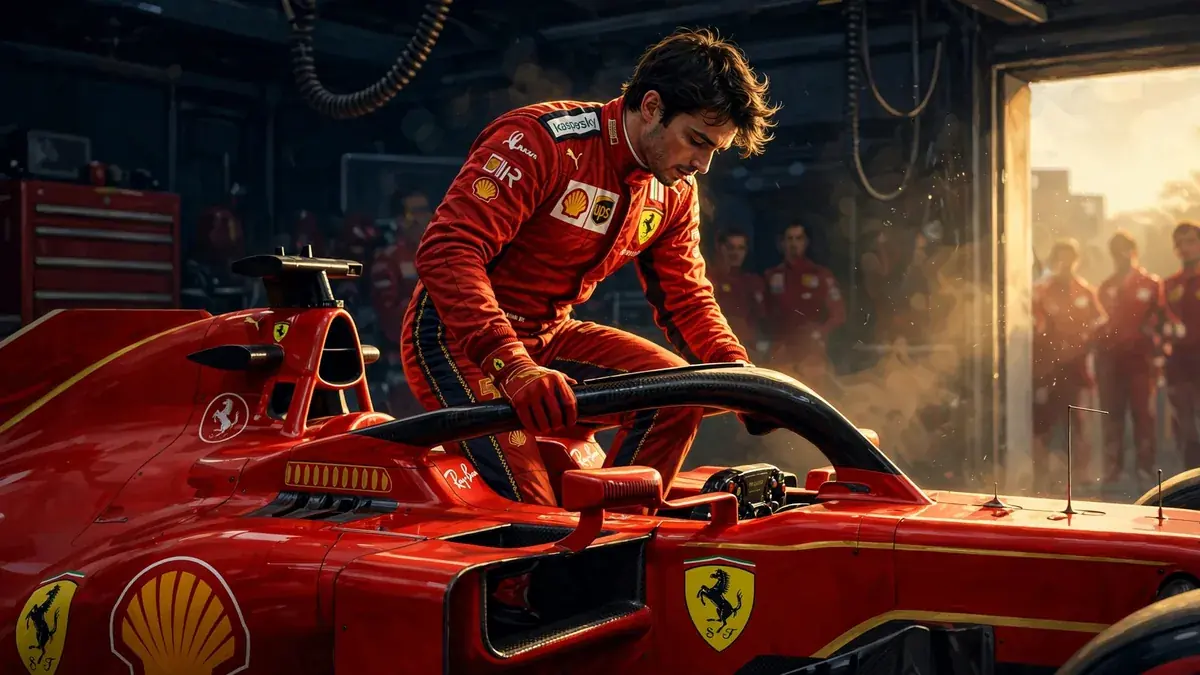
It does, but not the way most fans assume. A Formula 1 cockpit is a carbon-fibre shell moulded around one specific body, and the driver sits with knees bent, elbows tucked and the steering wheel inches from the chest. A taller driver has longer legs to fold into the same space, longer arms to reach the same wheel, and a helmet that sits closer to the top of the survival cell. Teams build the seat around the driver — Leclerc’s is moulded to his frame the way a tailor cuts a suit — so comfort is solvable. What cannot be solved away is weight distribution: a taller driver’s mass sits higher and further back, and in a sport that chases the centre of gravity down to the millimetre, that is a real, if small, engineering problem.
The counterweight is the minimum-weight rule. Since 2019, the regulations have required driver plus seat to weigh at least 82 kilograms, precisely so that lighter drivers cannot carry an advantage over heavier ones. Leclerc, at 69 kilograms, sits 13 kilograms under that line before the seat is counted, which means his car carries ballast — dense metal placed wherever the engineers want it, usually as low as possible. Ballast low in the car lowers the centre of gravity, which is exactly what a taller driver needs. The net effect is that Leclerc’s height costs him almost nothing in lap time and buys him nothing either: the rule was written to make the answer boring. The drivers who feel their height are the outliers — Tsunoda, at 1.59 m, fits anywhere and gives his engineers freedom; Russell, at 1.85 m, is the one whose knees and helmet genuinely fight the packaging. Leclerc, at 1.80 m, is in the sweet spot the Short Box comparison describes: tall enough to look the part on the podium, short enough that the car never has to be built around him.
Leclerc’s Build: 69 kg and the Weight Game
Leclerc’s listed weight is 69 kilograms, and the number has barely moved across his career. At 1.80 m, that gives him a body mass index of about 21.3 — lean by any standard, and deliberately so. Formula 1 drivers train for endurance and neck strength rather than bulk: a race runs close to two hours, cockpit temperatures pass 50°C, and the braking and cornering loads run to five times the driver’s body weight through the neck. The training builds the traps, the forearms and the core, and strips everything else. Leclerc’s frame is the product of that programme — tall, light, and built to survive two hours of sustained g-force without fading.
The weight matters for a second reason, and it is the one that shows up in the timing screens. Every kilogram on the car costs roughly three-hundredths of a second per lap on a typical circuit, which is why the 82-kilogram driver rule exists at all: without it, a 60-kilo driver would carry a free advantage over a 75-kilo rival. With it, the advantage disappears into ballast. Leclerc’s 69 kilos put him on the light side of the rule, which is where most of the grid sits — the heavyweights are the exception, not the norm — and it means Ferrari’s engineers get to choose where his missing kilograms go. In a sport decided by hundredths, that choice is worth more than the height itself.
From Karting Kid to Ferrari: The Career Behind the Number
Leclerc was born in Monte Carlo on October 16, 1997, and started karting in 2005, at seven years old. He won the French PACA karting championship three years running, then climbed the junior ladder the fast way: GP3 champion in 2016, Formula 2 champion in 2017, and a Formula 1 seat with Sauber in 2018, at 20. Ferrari signed him for 2019, and he has driven for the team ever since — eight seasons by 2026, the longest unbroken run of any driver on the current grid with a single team. The full story, from the karting years through the junior titles and the Ferrari promotion, is in our Charles Leclerc biography, and the same story from our sister site’s angle is at Charles Leclerc’s biography on CelebAmerica.
The career has been defined by two things that have nothing to do with height: qualifying speed and near misses. Leclerc’s first win came at Spa in 2019, a week after the death of his friend Anthoine Hubert at the same circuit, and his second came at Monza the following weekend, in front of Ferrari’s home crowd. His home win finally arrived in 2024, when he won the Monaco Grand Prix from pole — the first Monegasque driver to win his home race in the modern era — and added Monza and Austin later that season. The gap between his pole positions and his wins is the stat that follows him: 27 poles, the most any driver has taken without winning a World Drivers’ Championship, against nine wins. He is, by the numbers, the fastest qualifier of his generation and a driver still waiting for a car that can turn Saturdays into Sundays.
The 2026 Season So Far: Silverstone and Ferrari’s 250th Win
The 2026 season has been Leclerc’s steadiest in years. After 20 rounds, through the São Paulo Grand Prix, he sits fifth in the drivers’ championship on 249 points, with one win, six podiums and four fastest laps. The win came at the British Grand Prix at Silverstone, and it was not an ordinary victory: it was Ferrari’s 250th Grand Prix win, a milestone the team had been chasing all season, delivered by the driver who has carried the team since 2019. Three rounds remain — Las Vegas, Qatar and Abu Dhabi — and fifth place is his to defend.
The season is also the second year of the most watched team-mate pairing on the grid. Hamilton joined Ferrari in 2025, and after a first season in which Leclerc outscored him 242 points to Hamilton’s tally, the 2026 fight has been dead level — 10–10 on race results through the São Paulo weekend, by the head-to-head count. Leclerc’s pole drought is the one hole in the year: zero pole positions in 2026, the first season of his career without one, which is a measure of how far the new-regulation Ferrari has slipped from the qualifying weapon it was in 2022, when he took nine poles in a single season.
The 2025 Season: Seven Podiums, No Wins
The year before was a study in consistency without reward. In 2025 Leclerc finished fifth in the championship on 242 points from 24 races, with seven podiums, one pole position — at the Hungarian Grand Prix — and no wins. His best result was second place, which he managed twice, and he finished ahead of Hamilton in the standings by a clear margin. Ferrari finished the year without a win, and Leclerc’s season read like a summary of the team’s problem: a car fast enough to reach the podium seven times, never fast enough to stand on the top step. The 2026 Silverstone win broke a drought that stretched back to Austin in October 2024, and it is the context that makes the 2026 victory matter more than the points it paid.
Career Numbers at 29
Through the São Paulo Grand Prix in November 2026, Leclerc’s career totals are nine wins, 27 pole positions, 56 podiums and 1,921 championship points from 191 Grand Prix starts — fifth on the all-time points list. The season-by-season shape of it is the shape of a driver who arrived fast and stayed fast:
| 2019 (Ferrari) | 2 wins, 7 poles, 264 pts, 4th — first wins at Spa and Monza |
| 2022 (Ferrari) | 3 wins, 9 poles, 308 pts, 2nd — title fight until mid-season |
| 2024 (Ferrari) | 3 wins, 3 poles, 356 pts, 3rd — Monaco, Monza, Austin; best points total |
| 2025 (Ferrari) | 0 wins, 1 pole, 242 pts, 5th — 7 podiums, no victories |
| 2026 (Ferrari)* | 1 win, 0 poles, 249 pts, 5th — Silverstone win, Ferrari’s 250th; 3 rounds left |
The 2024 season remains his best: 356 points, the most he has scored in a year, and the Monaco win that ended a home-race curse stretching back to his karting days. His contract runs until at least the end of 2028, signed as a multi-year extension in January 2024, which means the 29-year-old has at least two more seasons to convert the pole record into the championship the record implies. For the same treatment of his rivals, our Oscar Piastri age profile and Lando Norris age profile cover the McLaren pair he shares the front of the grid with.
Family and Life Off Track
Leclerc’s family story is the hardest part of his biography to write, and the part that explains the most about him. His father Hervé, who drove him to karting races across France as a boy, died in June 2017, days before Leclerc won a Formula 2 race in Baku — a victory he dedicated to his father on the radio. His godfather was Jules Bianchi, the Ferrari junior who died in 2015 from injuries sustained at the 2014 Japanese Grand Prix; Leclerc has carried Bianchi’s memory through his whole career, and the two families remain close. His younger brother Arthur is a racing driver in his own right, part of Ferrari’s development programme, and his older brother Lorenzo manages the family’s affairs.
Off track, Leclerc has been with Alexandra Saint Mleux, an art history graduate and model, since 2023. The pair are a fixture of the Monaco paddock and of the fashion weeks that follow the season, and Saint Mleux’s own profile — art historian, influencer, and, by some estimates, a fortune of around $2 million of her own — has made the couple one of the most covered in the paddock. Leclerc is also a pianist, a hobby he picked up during the 2020 lockdown season and has kept up since, composing pieces he occasionally shares with fans. The piano, the Monaco apartment, and the Ferrari contract are the three fixed points of a life that, at 29, is still built entirely around the next race.
Money at 1.80 m: The M–5M Fortune
Height does not pay the bills, but the career it belongs to does. Published estimates of Leclerc’s net worth run from $58 million to $125 million in 2026: Celebrity Net Worth’s September 2026 update puts him at $70 million, PlanetF1’s August 2026 driver ranking puts him at $125 million, and the spread exists because no two outlets count the same things — the Ferrari salary, the endorsement deals with brands including Richard Mille and Giorgio Armani, and the property portfolio in Monaco are all visible; the exact contract figures are not. Our full breakdown, with every estimate dated and sourced, is in the Charles Leclerc net worth 2026 profile, and the career behind the money is in our Charles Leclerc biography. Browse more profiles in our Celebrity Net Worth section.
The salary is the largest single line. Leclerc signed a multi-year Ferrari extension in January 2024, contracted to at least the end of 2028, and the reported figures for the deal sit in the tens of millions per year — the kind of money that makes a driver the fourth-richest on the grid by PlanetF1’s count, behind only Hamilton, Verstappen and Alonso. The endorsements sit on top: watch deals, fashion deals, and the Ferrari brand itself, which pays its drivers in visibility as much as in cash. At 29, with a contract to 2028 and a team that has just taken its 250th win, the fortune is built on the next three seasons as much as on the last eight.
Sources & Reporting
This profile was reported from live sources in November 2026. Height and weight: Ferrari’s official driver profile (1.80 m), RacingNews365’s driver profile (180 cm, 69 kg), Wikipedia’s Charles Leclerc page (updated November 2026) and Formula Daily. The 5 ft 10 in variant: F1 Oversteer and Short Box, both printing the same 1.80 m figure with the decimal truncated — named here as a rounding difference, not a separate measurement. Peer heights and the 1.77 m grid average: Short Box’s height comparison and official team profiles. Career record: Wikipedia’s season table and the TracingInsights, F1 Report and Formula1Points databases — 2025: 5th, 242 points, 0 wins, 7 podiums, 1 pole; 2026: 5th, 249 points after 20 races, 1 win, 6 podiums, 4 fastest laps, through the São Paulo Grand Prix. The Silverstone win as Ferrari’s 250th: Kozmozracing and the ESWA Sports profile of October 15, 2026. Money: Celebrity Net Worth via Times of India ($70M, September 2026), PlanetF1’s August 2026 driver ranking ($125M) and our own net-worth profile ($58M title figure). Where sources disagreed — the 5 ft 10 in vs 5 ft 11 in rounding, and the $58M–$125M net-worth spread — this article names the outlier and the reason for the call. Corrections are welcome via the About page.
Frequently Asked Questions
How tall is Charles Leclerc?
Charles Leclerc is 1.80 metres tall, which is 5 feet 11 inches. Ferrari lists him at 1.80 m on its official driver profile, and RacingNews365, Wikipedia and Formula Daily all carry the same figure.
How tall is Charles Leclerc in feet and inches?
Charles Leclerc is 5 feet 11 inches tall. The metric figure, 1.80 m, converts to 5 ft 10.87 in, which rounds to 5 ft 11 in. Some pages print 5 ft 10 in for the same measurement because they truncate the decimal instead of rounding it.
Is Charles Leclerc taller than Max Verstappen?
No. Max Verstappen is 1.81 m tall, which makes him 1 centimetre taller than Charles Leclerc’s 1.80 m. Both men are listed at 5 ft 11 in, because the 1 cm difference disappears in the imperial rounding.
Is Charles Leclerc taller than Lewis Hamilton?
Yes. Charles Leclerc is 1.80 m tall and Lewis Hamilton is 1.74 m, so Leclerc is 6 centimetres taller than his Ferrari team-mate. Hamilton is listed at 5 ft 9 in against Leclerc’s 5 ft 11 in.
How much does Charles Leclerc weigh?
Charles Leclerc weighs 69 kilograms (152 lbs), per RacingNews365’s driver profile. Formula 1’s rules require driver plus seat to weigh at least 82 kilograms, so his car carries ballast to make up the difference.
How old is Charles Leclerc?
Charles Leclerc is 29 years old in 2026. He was born October 16, 1997, in Monte Carlo, Monaco, and turned 29 on October 16, 2026.
What is Charles Leclerc’s net worth in 2026?
Published estimates of Charles Leclerc’s net worth in 2026 run from $58 million to $125 million. Celebrity Net Worth’s September 2026 update puts him at $70 million, while PlanetF1’s August 2026 driver ranking puts him at $125 million. The full dated breakdown is in our Charles Leclerc net worth 2026 profile.
Who is Charles Leclerc’s girlfriend?
Charles Leclerc’s girlfriend is Alexandra Saint Mleux, an art history graduate and model. The couple have been together since 2023.
Nathan Cole
Nathan Cole is the editor of Guide Net Worth. He covers celebrity wealth the way a business desk covers earnings: reported figures first, estimates labeled as estimates, and no invented numbers. Every profile on this site passes through his desk before it publishes. About Guide Net Worth · Corrections: figures are updated when new reporting emerges — contact us via the About page if you spot an error.
References & Sources
This article has been fact-checked and verified against multiple public sources, financial disclosures, SEC filings, Forbes reports, Celebrity Net Worth databases, and official records. All net worth estimates are based on publicly available information and financial analysis.