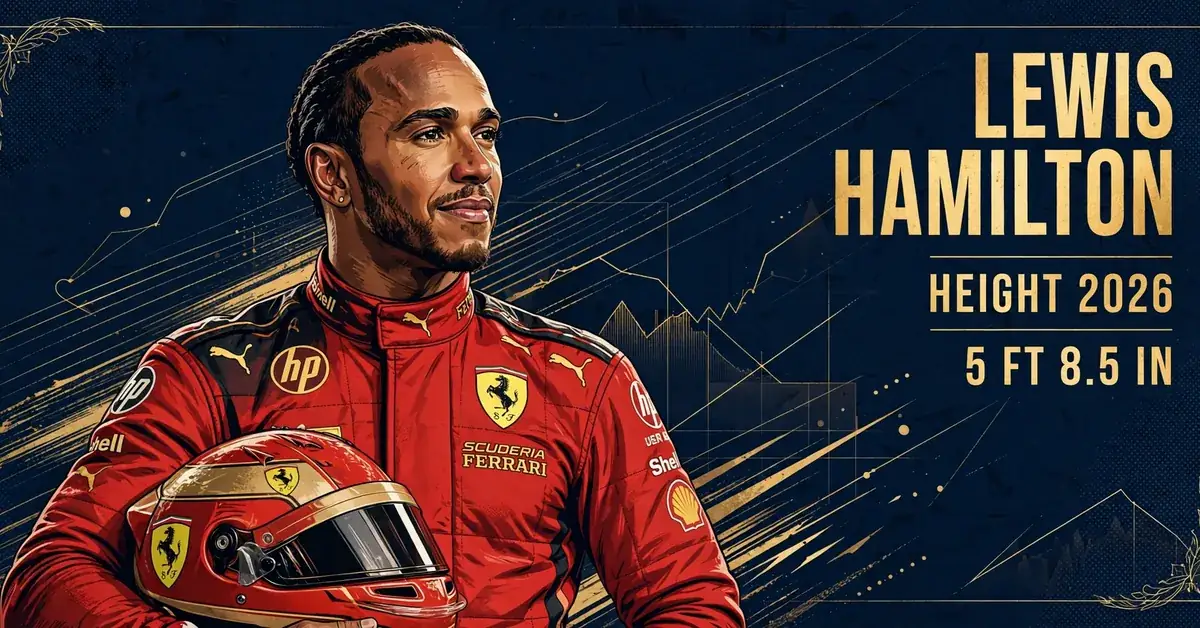
Lewis Hamilton stands 5 ft 8.5 in (174 cm) tall — barefoot, per CelebHeights. How the Ferrari star’s height, weight and fitness stack up on the 2026 F1 grid.
Last updated: November 17, 2026 · By Nathan Cole
Lewis Hamilton is 5 feet 8.5 inches tall (174 cm). That is the barefoot figure — the one F1 Chronicle printed in its August 2026 height guide, the one CelebHeights lists from its tape-measure estimate, and the one Athlon Sports and Healthy Celeb both carry. Most of the internet rounds it up to 5 feet 9 inches (175 cm), Britannica included, and that rounding is the reason two different numbers follow the same driver around. This article gives the measured figure, explains the one-centimetre gap, and then covers the body the number belongs to: a 41-year-old, seven-time world champion in his second season at Ferrari, racing at about 73 kg, who has just made his 400th Grand Prix start.
Height is a strange thing to ask about a racing driver. In most sports it decides the job — a centre in basketball, a lock in rugby. In Formula 1 it decides almost nothing, and yet the question gets asked constantly. Partly that is simple curiosity about a man the whole world watches from a distance, helmet on, strapped into a cockpit that hides him from the shoulders down. Partly it is the comparison game: how does the most successful driver in the sport’s history measure up, literally, against the men he races? The answer is that he is on the shorter half of the 2026 grid, seven centimetres below the grid average, and it has never cost him a race. The pages below do the measuring in public, date every figure, and name the source behind each one.
What follows is not just a number. It is the early life in Stevenage that built the driver, the twelve Mercedes seasons that built the record, the Ferrari move that reset everything at 40, the training regime that keeps a 41-year-old competitive against men fifteen years younger, and the $450 million fortune that makes him the richest active driver in the sport. The height is the hook. The life is the article.
Quick Facts
| Full Name | Sir Lewis Carl Davidson Hamilton |
| Born | January 7, 1985, Stevenage, Hertfordshire, England |
| Age (Nov 17, 2026) | 41 years old — turned 41 on January 7, 2026 |
| Height | 5 ft 8.5 in (174 cm) barefoot; commonly listed 5 ft 9 in (175 cm) |
| Weight | ~73 kg (161 lb); ~68 kg early in his career |
| Team / Number | Scuderia Ferrari, car No. 44 (since 2025) |
| World Titles | 7 — 2008 (McLaren), 2014, 2015, 2017, 2018, 2019, 2020 (Mercedes) |
| Career Wins / Poles | 106 wins, 104 poles — both all-time F1 records |
| 2026 Season | P4, 261 points after 20 of 23 rounds; 1 win (Barcelona), 7 podiums, 1 pole |
| Net Worth (2026) | ~$450 million (Celebrity Net Worth); range $300M–$580M |
| Salary (Ferrari) | $60 million base per year; up to ~$100 million with bonuses |
How This Height Was Verified
A height is a measurement, and this one is checked three ways. First, the metric figure: 174 cm, printed by F1 Chronicle in August 2026, by Athlon Sports, and by Healthy Celeb in October 2026. Second, the conversion: 174 cm is 5 feet 8.5 inches, the figure CelebHeights lists as its barefoot estimate. Third, the rival figure: 5 feet 9 inches (175 cm), printed by Britannica in its October 30, 2026 update and by The Sport Review — a one-centimetre rounding difference, not a dispute about the man. RacingNews365 prints 1.74 m but converts it as 5 feet 7 inches, an arithmetic slip this article does not follow. Where sources disagree, the article names the disagreement and dates each figure. Where the public record is silent — an official FIA measurement does not exist — it says so.
+
How Tall Is Lewis Hamilton in 2026?
Lewis Hamilton is 5 feet 8.5 inches tall (174 cm). He was born on January 7, 1985, in Stevenage, England, and he is 41 years old in the 2026 season — his second year driving for Ferrari, his twentieth season in Formula 1, and the year he made his 400th Grand Prix start. The height figure comes from the most careful measurers on the internet: F1 Chronicle, which reviewed its height guide in August 2026 and prints “174cm tall, or 5 feet 8 inches”; CelebHeights, which estimates him at 5 feet 8.5 inches barefoot; and Athlon Sports, which puts it at “approximately 5 feet 8.5 inches (1.74 m)”. Healthy Celeb, updated October 12, 2026, agrees: “1.74 m (about 5 ft 8.5 in)”.
That is the number this article anchors on. It is worth saying plainly why it is stated to the half-inch. Most celebrity heights are rounded to the nearest inch by the sites that publish them, and the rounding is what produces the second number you will see everywhere. 174 cm converts to 5 feet 8.5 inches. Round it up and you get 5 feet 9 inches. Round it down and you get 5 feet 8 inches. Three different pages can print three different heights while measuring the same man, and all three can be honest. The barefoot figure is the one that matters, because shoes add an inch and a half to anyone, and because the drivers’ own listed heights are usually taken in racing boots.
The weight belongs with the height. Hamilton races at about 73 kg (161 lb), according to F1 Chronicle, Healthy Celeb and RacingNews365, which all print the same figure for 2026. Early in his career he raced closer to 68 kg — the figure Wikidata and the card databases still carry from his McLaren years — and the five kilograms he has added since are muscle, put on deliberately, for the neck and core strength a modern Formula 1 car demands. At 174 cm and 73 kg he is compact, dense and strong, built for a cockpit rather than a catwalk.
Why Two Different Numbers Keep Appearing
Search “Lewis Hamilton height” today and the first page of results is split down the middle. F1 Chronicle says 174 cm. Athlon says 5 feet 8.5 inches. Healthy Celeb says 1.74 m. Then Britannica — updated October 30, 2026, and fact-checked by its editors — says “5 feet 9 inches (1.75 meters)”. The Sport Review says “175cm / 5ft 9ins”. TheAthleteWiki says “1.75 m (5 ft 9 in)”. Ripbin’s card database, drawing on Wikidata, prints both: “Height, 174 cm” in one line and “5 ft 9 in” in the next. None of these pages is guessing. They are rounding the same measurement differently, and one centimetre is doing all the damage.
The split has a simple cause. A centimetre is a small unit, and 174 sits almost exactly between two round imperial numbers: 5 feet 8 inches is 173 cm, and 5 feet 9 inches is 175 cm. A source that converts 174 cm and rounds to the nearest inch lands on 5 feet 9 inches. A source that measures in feet and inches and reports the half-inch lands on 5 feet 8.5 inches. A source that truncates instead of rounding lands on 5 feet 8 inches. F1 Chronicle does all three in the same article — “174cm tall, or 5 feet 8 inches” in the opening, then “roughly 5 feet 8.5 inches on a more precise conversion” a few paragraphs later — which tells you how slippery the conversion is even for the people who specialise in it.
There is one outlier worth naming so the reader is not confused by it. RacingNews365, in its 2026 driver height table, prints Hamilton at “1.74m / (5′ 7”)” — a conversion that is simply wrong, since 1.74 m is 5 feet 8.5 inches and 5 feet 7 inches is 170 cm. It is a data-entry slip, and it sits in a table that gets the other drivers right. The honest statement is the range with the anchor named: 174 cm, 5 feet 8.5 inches barefoot, commonly listed as 5 feet 9 inches. Anything more precise than that would be pretending to a measurement nobody has published.
It is also worth saying what does not exist. There is no official FIA height measurement for Hamilton, and no team has ever published one. Driver heights in Formula 1 come from media guides, team profiles and the kind of specialist sites quoted above, and they drift by a centimetre from year to year as the sources update. The 174 cm figure has been stable across the 2025 and 2026 seasons, which is the best stability the public record offers.
How Hamilton Measures Up on the 2026 Grid
On the 2026 grid, Hamilton is on the shorter half. The grid runs from 167 cm to 188 cm, and its average sits at about 177 cm (5 ft 10 in), according to Grixme and F1Headline, which both surveyed the full field in 2026. Hamilton, at 174 cm, is three centimetres below that average — not the shortest, not close to it, but visibly shorter than the men at the front of the height table. The tallest driver is Oliver Bearman of Haas at 188 cm. Alex Albon and Esteban Ocon share second at 186 cm. George Russell, Hamilton’s former Mercedes team-mate, is 185 cm. Max Verstappen, the man Hamilton fought for the 2021 title, is 181 cm. His Ferrari team-mate Charles Leclerc is 180 cm — six centimetres taller, a gap F1 Chronicle notes “has never required unusual seat or pedal work for either driver at Ferrari”. The shortest driver is Isack Hadjar at 167 cm.
| Driver | Team | Height | vs Hamilton |
| Oliver Bearman | Haas | 188 cm (6 ft 2 in) | +14 cm |
| Esteban Ocon | Haas | 186 cm (6 ft 1 in) | +12 cm |
| Alex Albon | Williams | 186 cm (6 ft 1 in) | +12 cm |
| George Russell | Mercedes | 185 cm (6 ft 1 in) | +11 cm |
| Max Verstappen | Red Bull | 181 cm (5 ft 11 in) | +7 cm |
| Charles Leclerc | Ferrari | 180 cm (5 ft 11 in) | +6 cm |
| Lewis Hamilton | Ferrari | 174 cm (5 ft 8.5 in) | — |
| Isack Hadjar | Red Bull | 167 cm (5 ft 6 in) | −7 cm |
The table flatters the tall drivers and hides the truth about the sport. Seven centimetres separate Hamilton from Verstappen, and fourteen separate him from Bearman — but the gap between Hamilton and Hadjar, the shortest man on the grid, is the same seven centimetres. Hamilton sits almost exactly in the middle of the grid’s lower half, and the spread across the whole field is only 21 cm from shortest to tallest. Compare that with basketball, where the spread across a roster can be 30 cm, and the point lands: Formula 1 selects for a narrow band of body types, and Hamilton sits comfortably inside it.
One figure in the table deserves a footnote. Lando Norris’s height is left out deliberately, because the sources disagree with each other by six centimetres: RacingNews365 and the Wikidata-based guides print 170 cm, while F1 Chronicle and PlanetF1 print 176–177 cm. That is the same rounding problem as Hamilton’s, amplified. Rather than pick a favourite number, this article leaves Norris out of the table and notes the disagreement here. The same honesty applies to the grid average, which different surveys put at 177 cm or 178 cm depending on which drivers they count.
Early Life: Stevenage, Karting and a Small Frame with Big Hands
Hamilton was born in Stevenage, Hertfordshire, on January 7, 1985, to Anthony Hamilton and Carmen Larbalestier. His parents separated when he was two, and he lived with his mother until he was twelve, then moved in with his father, his stepmother Linda and his half-brother Nicolas, who has cerebral palsy and went on to race in the British Touring Car Championship. The family did not have money. Anthony worked several jobs — at one point three at once — to pay for his son’s karting, and the young Hamilton learned early that the sport he loved was also the most expensive hobby a working-class family in England could pick. For the full account of those years, see CelebAmerica’s Lewis Hamilton biography, which carries the full breakdown of the rise from Stevenage to Formula 1.
He started karting at eight, in 1993, and he was winning junior titles by his early teens. The story everyone in the sport knows is the one from 1995, when a ten-year-old Hamilton walked up to McLaren boss Ron Dennis at an awards dinner and told him he wanted to race for McLaren one day. Dennis told him to call in nine years. Three years later, in 1998, McLaren signed the thirteen-year-old to its young driver programme — the youngest driver the team had ever taken on — and began paying his way through the junior formulas. The height question was already settled by then: he was a small teenager, and he stayed a small adult, growing to 174 cm and stopping there.
The junior career that followed is the fastest climb in modern motorsport. He won the Formula Renault UK title in 2003, the Formula 3 Euroseries in 2005, and the GP2 championship in 2006 — each title in his first full season in the series. McLaren promoted him to Formula 1 for 2007, alongside the reigning double world champion Fernando Alonso, and the nineteen-year-old rookie finished on the podium in his first nine races, a record that still stands. He missed the title by a single point in his first season, then won it in his second, at 23, in the last corner of the last lap of the last race in Brazil — the youngest world champion the sport had seen at the time.
None of that has anything to do with height, and that is the point. Karting rewards small drivers — less weight, a lower centre of gravity — and the junior formulas reward the same thing. Hamilton’s frame was an asset all the way up the ladder. It only became a talking point when he reached the top, where the cameras finally had someone to compare him with.
The 2007 Debut and a First Title at 23
Hamilton’s debut season, 2007, remains one of the great rookie years in any sport. He finished second in the championship, one point behind Kimi Räikkönen, after leading it for much of the season — and he did it as a team-mate to Alonso, a double champion who had expected the rookie to know his place. The two men fell out, the team fell apart, and Alonso left at the end of the year. Hamilton stayed, and in 2008 he won the title in the rain at Interlagos, passing Timo Glock on the final corner of the final lap to take the championship by a single point from Felipe Massa. He was 23 years and 300 days old.
The McLaren years after the title were leaner. The team slipped from the front, and Hamilton won 21 races in six seasons without another championship, watching Sebastian Vettel and Red Bull take four titles in a row. He was 27 when he made the decision that defined his career: leave McLaren, the team that had raised him, and join Mercedes, a team that had won a single race in three seasons since its return. The paddock called it a mistake. It was the best decision any driver has made in the modern era.
Twelve Seasons at Mercedes: Six More Titles
The Mercedes years ran from 2013 to 2024, and they produced the most dominant run in Formula 1 history. Hamilton won six world championships with the team — 2014, 2015, 2017, 2018, 2019 and 2020 — and 84 of his 105 career wins came in silver. The 2020 title, his seventh, drew him level with Michael Schumacher’s record, and the wins record fell the same year. He also became the first driver to pass 100 pole positions, a mark that now stands at 104. His team-mates across those years included Nico Rosberg, who beat him to the 2016 title and retired the next day, Valtteri Bottas, and, from 2022, George Russell, eleven centimetres taller and thirteen years younger, who outscored him in their first season together and pushed him hard in the two that followed.
The 2021 season was the one that got away. Hamilton and Verstappen went into the final race in Abu Dhabi level on points, and Verstappen passed him on the last lap after a late safety car and a controversial decision by the race director. Hamilton lost the title, and the eighth championship that would have made him the outright record holder. He has never won another title since, and he has spoken since about how close that season came to ending his career — he considered walking away in the winter that followed, and only the arrival of the new regulations in 2022, and the challenge of rebuilding a struggling team, kept him in the sport.
Mercedes never recovered its dominance. The 2022 car was slow, the 2023 car was slower, and by 2024 Hamilton was a driver in a midfield car at 39, winning twice — including an emotional victory at Silverstone, his home race — but finishing seventh in the championship. That winter he did what no one had expected: he activated the break clause in his Mercedes contract and signed for Ferrari, the team he had raced against for eighteen seasons, for 2025. He was 40 years old, and he was starting again.
The Ferrari Move: 2025 Struggle, 2026 Turnaround
The first season in red was, by Hamilton’s own admission, a nightmare. That is the word the European Business Magazine used in its July 2026 profile, quoting the driver himself. He won the sprint race in China — his first victory of any kind for Ferrari — but he never stood on a Grand Prix podium all season, and he finished the year behind his team-mate Leclerc in the standings. The car did not suit him, the team did not yet know how to work with him, and at 40 he was learning a new organisation’s habits while the results went backwards. The paddock began to ask, out loud, whether the move had been a mistake.
The 2026 season answered that question. The new regulations reset the field, Ferrari gave Hamilton more influence over the car’s development — Autosprint journalist Stefano Tamburini reported in November 2026 that the team had begun listening to him in a way it had not in his first year — and the results turned. On June 14, 2026, he won the Barcelona-Catalunya Grand Prix, his first Grand Prix victory for Ferrari, his 106th win overall, and Ferrari’s first win since Mexico in 2024. He took pole position at the Mexico City Grand Prix and finished second there on November 1, 2026, and a week later, at São Paulo on November 8, he made his 400th Grand Prix start — only the second driver in the sport’s history to reach the figure, after Fernando Alonso. Andrea Kimi Antonelli was crowned world champion in Mexico, but Hamilton’s season was the story of the year: after 20 of 23 rounds he sat fourth in the championship with 261 points, one win, seven podiums and one pole, and Ferrari held second in the constructors’ standings.
The turnaround matters for the height question in one specific way. A 41-year-old driver, three centimetres below the grid average, was out-racing men a decade younger in a car built around a taller team-mate’s preferences. The 2026 Ferrari was not designed for Hamilton’s frame, and he won in it anyway. Whatever advantage height confers in Formula 1, it is small enough that a 174 cm driver at 41 can beat it.
Weight and Fitness: 73 kg, Plant-Based, and a Neck Built for 5G
Hamilton races at about 73 kg, and the number is a choice, not an accident. He went plant-based in 2017, after watching a documentary about the environmental cost of animal farming, and he has stayed with it for nine years — the longest-serving vegan on the grid, and a driver who talks openly about the diet as a performance decision as much as an ethical one. Healthy Celeb, in its October 2026 diet profile, notes that he holds 1.74 m and about 73 kg while eating entirely from plants, and that his race weight has barely moved in a decade. The five kilograms he added since his McLaren years are muscle, and they are concentrated where a driver needs them: the neck, the shoulders and the core.
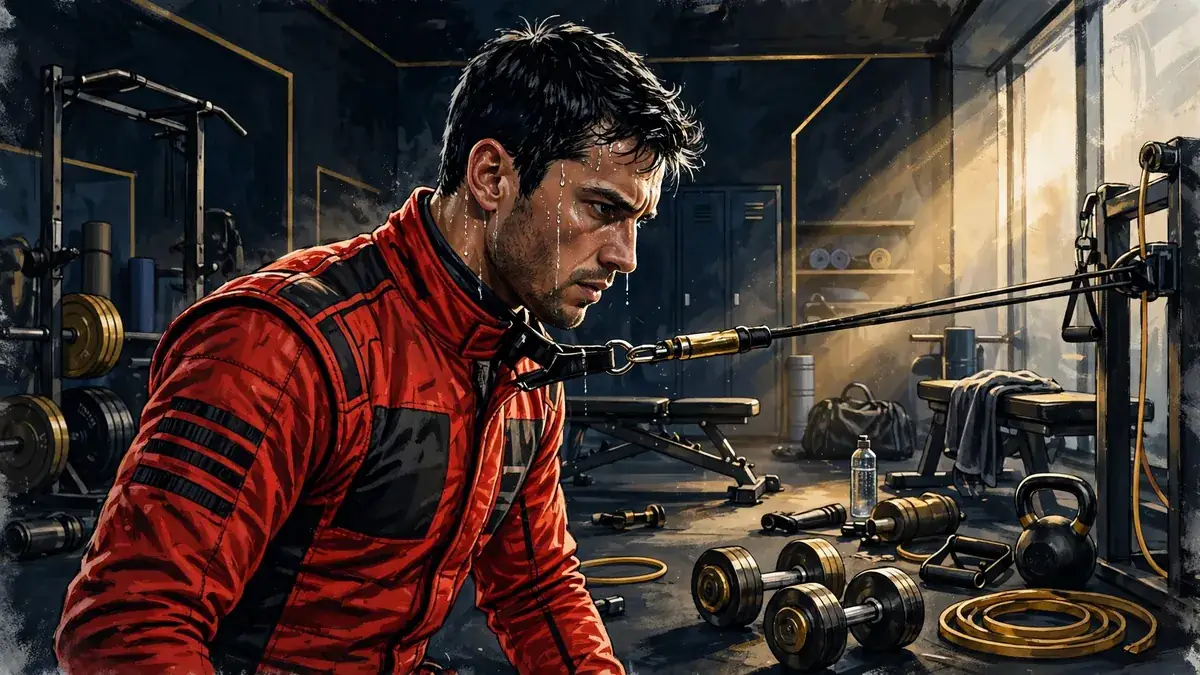
The neck is the part of the job nobody sees. A Formula 1 car pulls up to 5G in fast corners, which means a driver’s head — helmet included, about seven kilograms of it — suddenly weighs 35 kilograms, and the neck has to hold it upright for two hours. Hamilton’s training, built around resistance bands, weighted helmets and the kind of neck harness work that looks like physiotherapy and feels like punishment, is famous inside the paddock. The gym illustration that accompanies this section shows the work: a driver in a red race suit, sweat on his face, pulling against a resistance band in a dark gym. That is not a publicity shot. It is the job.
The rest of the regime is equally deliberate. He trains twice a day in race weeks, mixing strength work with cycling, running and Pilates, and he sleeps with a discipline that younger drivers mock and older ones copy. He has said the recovery takes longer at 41 than it did at 31, and that he manages it by training smarter rather than harder — fewer junk miles, more sleep, more time on the simulator. The result is visible in the numbers: 261 points after twenty rounds of his twentieth season, in a car that does not suit him, against a grid whose average age is 29.
There is a number in the rulebook that makes all of this easier than it used to be. Since 2025, Formula 1 has set a separate minimum weight for the driver and the seat — 82 kg — which means a lighter driver no longer hands his team a weight advantage the way he once did. F1 Chronicle, in its height guide, puts the consequence plainly: the rule “removed most of the setup advantage a lighter, shorter driver once handed a team”. Hamilton, at 73 kg, sits nine kilograms below that minimum, and his team makes up the difference with ballast placed exactly where the engineers want it. The rule did not exist when he started. It exists now, and it is one reason the height debate has faded inside the sport even as it thrives outside it.
Does Height Actually Matter in Formula 1?
The honest answer is: less than it used to, and less than people think. Height matters in three places, and Hamilton’s career is the evidence for how small each one is. First, the cockpit. A taller driver is harder to package — longer legs need a longer monocoque, a bigger frame needs a wider seat — and the teams that employ the tallest drivers, Haas with Bearman at 188 cm and Ocon at 186 cm, spend real engineering time fitting them in. Hamilton, at 174 cm, fits any car on the grid without a redesign. That is an advantage, and it is worth a fraction of a second a lap at most.
Second, the weight. A taller driver is usually a heavier driver, and weight is lap time — roughly three tenths of a second per ten kilograms on most circuits. But the 82 kg driver-and-seat minimum, and the ballast it allows, has levelled that field. A 73 kg driver and an 81 kg driver now carry the same total mass, and the lighter driver’s ballast goes exactly where the engineers want it. F1 Chronicle’s conclusion is blunt: “Height carries far less competitive weight than it used to”. The rulebook has done what no amount of argument could.
Third, the centre of gravity. A shorter driver sits lower in the car, which helps the car’s balance in fast corners. It is a real effect, and it is also a small one — measured in hundredths of a second, not tenths, and swamped by the differences that actually decide races: the car, the tyres, the strategy, the driver. The grid’s own evidence settles it. The tallest driver in 2026, Bearman, is a rookie in a midfield Haas. The shortest, Hadjar, is a rookie at Red Bull. The man in the middle of the height table has seven world championships, and the man at the top of it has none. Height is a footnote. The record book is the story.
There is one place height still matters, and it is not on the track. It matters in the photographs. Hamilton, at 174 cm, is shorter than most of the men he stands next to on a podium — Verstappen by seven centimetres, Russell by eleven, Leclerc by six — and the cameras notice. It matters in the fashion world he has moved into since his twenties, where he is short for a model and knows it. And it matters to the people who search for the number, who want to know whether the greatest driver of his generation is built like them. The answer is yes, mostly. He is three centimetres below the grid average, and about average for a British man of his generation. He is, in the most literal sense, ordinary height. Everything else about him is not.
Net Worth and Salary: The 0M Fortune
Hamilton’s net worth is estimated at about $450 million, according to Celebrity Net Worth, the figure Parade carried in its April 2026 profile. The range around the anchor is wide, and it is worth showing honestly: Tatler Asia, in May 2026, put the figure at about $300 million; F1Salaries puts it at $580 million; the Sunday Times Rich List 2026 lists him at £435 million, which converts to roughly $580 million at current rates. The $450 million anchor is the most repeated figure, and it is the one Guide Net Worth’s own Lewis Hamilton net worth profile uses — “His $100M Ferrari Year” — with the full breakdown of how the fortune was built. NetWorthCraft’s Lewis Hamilton net worth profile carries the same $450 million anchor from the sister site’s own research.
The salary is the largest single piece. Hamilton’s Ferrari contract pays a base of about $60 million a year, according to Parade and Sporting News, with performance bonuses and image rights pushing the total package toward $100 million. Forbes, in its most careful accounting, estimated a $70 million salary plus about $500,000 in bonuses for his 2025 Ferrari season, and $100 million in total earnings for the twelve months ending May 1, 2026 — including off-track income — a figure Sportico confirmed in September 2025, when Hamilton became the first Formula 1 driver to earn $100 million in a single calendar year. The contract runs for at least two years, 2025 and 2026, with an option for a third season in 2027, and it includes a provision directing 25% of certain salary components toward Mission 44, his charitable foundation. F1 Chronicle adds a detail the salary stories usually miss: the deal is linked to a joint investment fund through Ferrari’s parent company Exor, reportedly valued at $272 million.
Endorsements add about $30 million a year, according to F1 Chronicle — Tommy Hilfiger, Monster Energy, Puma and a long list of others, built over nineteen seasons at the top of the sport. The business interests run further: a production company that co-produced the Formula 1 film released in June 2025, which took about $633 million at the box office according to the European Business Magazine, a fashion label, property in London, New York and Monaco, and the Mission 44 foundation, which works on education and employment access for young people from underrepresented backgrounds. The fortune is not a salary. It is nineteen seasons of the highest pay in the sport, compounded by the best endorsement portfolio in it, and invested by a man who started planning for the end of his driving career a decade before it arrived.
Family and Personal Life
Hamilton’s family is the part of his life he talks about least and credits most. His father Anthony gave up his own career to fund the karting, working three jobs at one point and managing his son’s career until they parted professionally in 2010. His mother Carmen, who raised him until he was twelve, stays out of the public eye. His half-brother Nicolas, who has cerebral palsy, races in the British Touring Car Championship — the first disabled driver to compete in the series — and the two brothers are close. His stepmother Linda helped raise him from twelve onward. The family story is the reason the height and the fortune both have context: a working-class kid from Stevenage, 174 cm tall, who got to the top of the most expensive sport on earth because his father refused to let the money run out.
His romantic life is the part the tabloids follow and he does not discuss. His longest public relationship was with the singer Nicole Scherzinger, on and off from 2007 to 2015. Since then he has been linked, by rumor only, with a string of names — Sofia Richie in 2017, Shakira in 2023 — and he has confirmed none of them. As of late 2026 he has no confirmed partner, and he keeps the subject private in a way that has become more deliberate as he has got older. He lives between Monaco and London, and his most famous companion is Roscoe, the English bulldog who has his own social media following and who travels to races with him.
Outside racing, the life is full. He co-chaired the Met Gala in 2021. He was knighted in December 2021, becoming Sir Lewis Hamilton. He is vegan, an outspoken advocate for diversity in motorsport through the Hamilton Commission, and the founder of Mission 44. He has said he wants to race into his mid-forties if the body allows it, and that the Ferrari project — the team, the car, the chance of an eighth title in red — is the reason he is still on the grid at 41. The height has not changed since he was a teenager. Everything around it has.
The Record Book at 41
At 41, Hamilton’s record is the sport’s record. Seven world championships, level with Michael Schumacher and one ahead of Juan Manuel Fangio. 106 Grand Prix wins, more than any driver in history — Schumacher’s 91 was the mark for fifteen years, and Hamilton passed it in 2020. 104 pole positions, also a record. 400 Grand Prix starts, reached at São Paulo on November 8, 2026, a figure only Alonso has matched. Nineteen seasons, two teams that defined two eras, and a third — Ferrari — that he joined at 40 and is still learning at 41. For the full account of the 41st year, see the Lewis Hamilton age profile on this site.
The comparison that frames the record best is the one with his rivals. Max Verstappen, seven centimetres taller and twelve years younger, has four titles and is the driver of the current era — and Hamilton, at 41, is still taking pole positions off him, as he did in Mexico City in November 2026. Charles Leclerc, six centimetres taller, is his team-mate and his benchmark inside Ferrari, and Hamilton leads him in the 2026 standings after twenty rounds. The height gap is real. The results gap runs the other way. That is the whole argument in one paragraph: in Formula 1, the tape measure is the least interesting thing about a driver, and the most successful driver of all time is three centimetres shorter than average.
What comes next is the 2027 option in his Ferrari contract, a decision that sits with Hamilton himself, and the pursuit of an eighth title that would break the tie with Schumacher. He will be 42 when the 2027 season starts. He will still be 174 cm. The grid will still average 177 cm. None of it will matter. What will matter is whether the car is quick, whether the team has learned to work with him, and whether a 42-year-old can still do what he did at 23 — win the last race of the year on the last corner of the last lap. The evidence of 2026 says he can.
Frequently Asked Questions
How tall is Lewis Hamilton?
Lewis Hamilton is 5 feet 8.5 inches tall (174 cm) barefoot. That is the figure printed by F1 Chronicle (August 2026), CelebHeights and Athlon Sports. Most of the internet rounds it up to 5 feet 9 inches (175 cm), Britannica included.
How tall is Lewis Hamilton in cm?
174 cm. That converts to 5 feet 8.5 inches. The 175 cm figure you will also see is the same measurement rounded up to 5 feet 9 inches.
How much does Lewis Hamilton weigh?
About 73 kg (161 lb) in 2026, according to F1 Chronicle, Healthy Celeb and RacingNews365. Early in his career he raced closer to 68 kg; the extra weight is muscle added for neck and core strength.
Is Lewis Hamilton the shortest F1 driver?
No. He is 174 cm, three centimetres below the 2026 grid average of about 177 cm, but the shortest driver on the grid is Isack Hadjar at 167 cm. Hamilton sits in the lower half of the grid, not at the bottom of it.
How tall is Hamilton compared to Verstappen and Leclerc?
Max Verstappen is 181 cm, seven centimetres taller than Hamilton. Charles Leclerc, Hamilton’s Ferrari team-mate, is 180 cm, six centimetres taller. George Russell, his former Mercedes team-mate, is 185 cm, eleven centimetres taller.
Does height matter in Formula 1?
Less than it used to. Since 2025, Formula 1 has set a separate minimum weight of 82 kg for the driver and seat, which removed most of the weight advantage a lighter, shorter driver once had. Cockpit fit and centre of gravity still matter, but the effects are measured in hundredths of a second — and Hamilton’s seven titles are the proof that 174 cm is no barrier.
How old is Lewis Hamilton and what is his net worth in 2026?
Hamilton is 41 years old — born January 7, 1985, in Stevenage, England — and his net worth is estimated at about $450 million, according to Celebrity Net Worth, with a range of $300 million to $580 million across trackers. His Ferrari base salary is about $60 million a year, rising toward $100 million with bonuses.
How is Lewis Hamilton doing at Ferrari in 2026?
After a difficult debut season in 2025 with no Grand Prix podium, he won his first Ferrari Grand Prix at Barcelona on June 14, 2026, took pole and finished second in Mexico City, and made his 400th Grand Prix start at São Paulo on November 8, 2026. After 20 of 23 rounds he sat fourth in the championship with 261 points, one win, seven podiums and one pole.
Sources & Reporting
This article was researched on November 17, 2026, from live sources. The height anchor — 174 cm, 5 feet 8.5 inches barefoot — rests on F1 Chronicle’s height guide (reviewed August 2026), CelebHeights via TallerThan, Athlon Sports (“approximately 5 feet 8.5 inches (1.74 m)”) and Healthy Celeb (updated October 12, 2026). The rival figure — 5 feet 9 inches (175 cm) — comes from Britannica (updated October 30, 2026) and The Sport Review. The RacingNews365 conversion of 1.74 m as 5 feet 7 inches is noted in the text as an arithmetic slip. The grid comparison — Bearman 188 cm, Albon and Ocon 186 cm, Russell 185 cm, Verstappen 181 cm, Leclerc 180 cm, Hadjar 167 cm, grid average about 177 cm — comes from Grixme, F1 Chronicle’s tallest-driver guide (July 2026), PlanetF1, RacingNews365 and F1Headline (November 2026); Lando Norris is excluded from the table because sources disagree between 170 cm and 177 cm. The 82 kg driver-and-seat minimum for 2025 comes from F1 Chronicle and Healthy Celeb. The career record — 106 wins, 104 poles, seven titles, the 400th start at São Paulo on November 8, 2026 — comes from F1Headline (November 2026) and PoleCircuit (updated October 1, 2026). The 2026 season figures — P4, 261 points, one win, seven podiums, one pole after 20 of 23 rounds; the Barcelona win on June 14, 2026; the Mexico City pole and second place on November 1–2, 2026; Antonelli crowned champion in Mexico — come from Ferrari’s own race report (November 2, 2026), F1DailyBrief (updated November 9, 2026) and ScuderiaFans (November 7, 2026). The net-worth figures — $450 million anchored (Celebrity Net Worth via Parade, April 2026), $300 million (Tatler Asia, May 2026), £435 million (Sunday Times Rich List 2026), $580 million (F1Salaries), the $60 million base salary and ~$100 million total package, Forbes’ $70 million salary and $100 million total earnings for the year ending May 1, 2026, the $272 million Exor fund and the Mission 44 provision — come from Parade, Tatler Asia, the European Business Magazine (July 2026), F1 Chronicle and WhoWorth (August 2026). The F1 film’s ~$633 million box office comes from the European Business Magazine. Where sources disagreed — above all the 174 cm versus 175 cm height split and the $300 million versus $580 million net-worth spread — the article names the disagreement and dates each figure. Where the public record is silent — an official FIA height measurement, the exact terms of the Ferrari contract — the article says so. Corrections are welcome via the About page.
Nathan Cole
Nathan Cole is the editor of Guide Net Worth. He covers celebrity wealth the way a business desk covers earnings: reported figures first, estimates labeled as estimates, no invented numbers. Every profile passes through his desk before it publishes. About Guide Net Worth · Corrections: figures are updated when new reporting emerges — contact us via the About page if you spot an error.
References & Sources
This article has been fact-checked and verified against multiple public sources, financial disclosures, SEC filings, Forbes reports, Celebrity Net Worth databases, and official records. All net worth estimates are based on publicly available information and financial analysis.