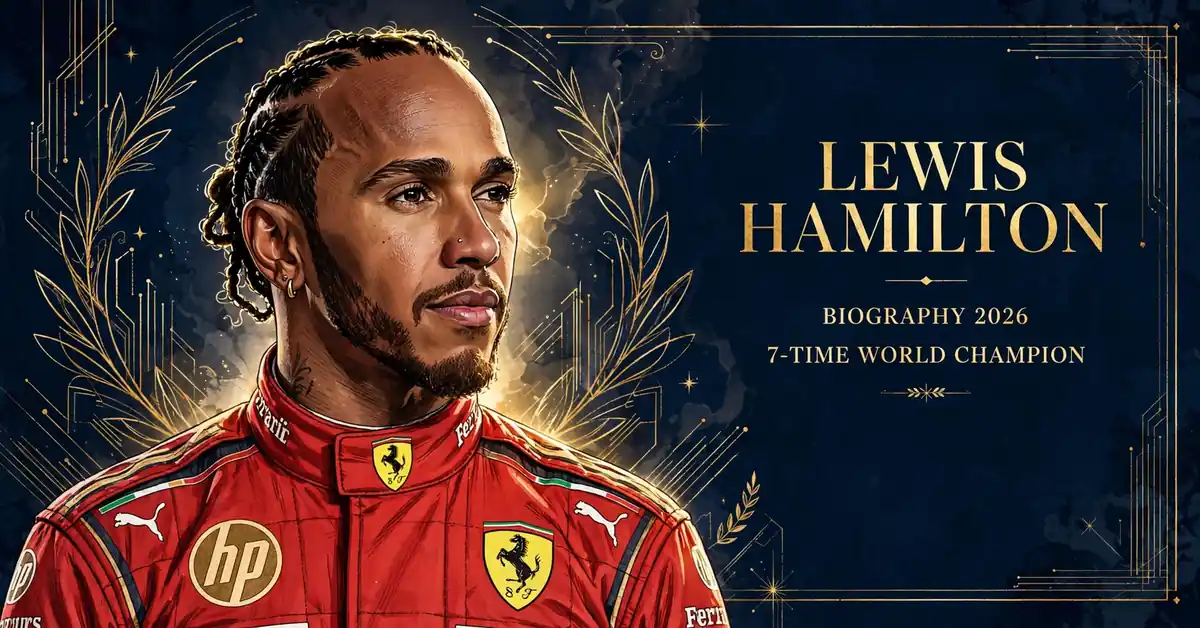
Lewis Hamilton biography 2026: the seven-time F1 champion, born 7 January 1985, is worth an estimated $450 million — from Stevenage karting to Ferrari.
Last updated: November 19, 2026 · By Nathan Cole
Lewis Hamilton is 41 years old, a seven-time Formula 1 world champion, and worth an estimated $450 million in 2026. No driver in the history of the sport has won more races — 106 Grands Prix, after his first Ferrari win at Barcelona on June 14, 2026 — and no driver has taken more pole positions, 104. He started karting at eight in Stevenage, Hertfordshire, talked his way into McLaren’s young-driver programme at 13, won a world title in his second Formula 1 season, then built the most dominant run the sport has ever seen with Mercedes before walking away from it all at 39 to drive for Ferrari.
This is a biography, so the money is part of the story rather than the whole of it. The fortune — a net worth of $400–550 million, anchored at $450 million — comes from a salary ladder that started at $4 million in his rookie year and peaked at $76 million in 2020, a Ferrari deal worth $60–70 million a year, endorsements of roughly $30 million a year, and a business portfolio that runs from a non-alcoholic spirit brand to a minority stake in the Denver Broncos. Forbes reported $100 million in total earnings for the year to May 2026, his first $100 million year.
The career behind those numbers spans three decades and three teams. This profile follows it in order: the Stevenage childhood and the karting years, the junior titles, the McLaren debut that rewrote what a rookie could do, the six Mercedes titles, the Abu Dhabi night in 2021 that still divides the sport, and the Ferrari move that gave a 40-year-old champion a new mountain to climb. It is current through November 19, 2026, and every figure in it carries the outlet that reported it.
Quick Facts
| Full Name | Sir Lewis Carl Davidson Hamilton |
| Born | January 7, 1985, Stevenage, Hertfordshire, England (age 41 in November 2026; turns 42 on January 7, 2027) |
| Net Worth | $400–550 million, anchored at $450 million (Celebrity Net Worth via Parade, May 2026) |
| F1 Titles | 7 — 2008 (McLaren), 2014, 2015, 2017, 2018, 2019, 2020 (Mercedes); tied with Michael Schumacher |
| Career Wins / Poles | 106 wins, 104 poles, 202 podiums (Britannica, updated October 30, 2026) |
| Current Team | Scuderia Ferrari (from 2025; multi-year deal through end of 2027) |
| Ferrari Salary | $60–70 million a year base (Parade $60M; F1 Oversteer £53.2M ≈ $70.5M; SportBible $70M, Jan 2026) |
| Height | 5 ft 9 in (1.75 m) |
| Partner | Never married, no children; long-term relationship with Nicole Scherzinger, 2007–2015 |
| Honours | MBE (2009), knighted in the 2021 New Year Honours; Time 100 (2020) |
How This Estimate Was Made
Lewis Hamilton does not publish a balance sheet, so no outlet can state his net worth as a fact. The range in this profile — $400–550 million, anchored at $450 million — comes from the most recent dated reporting: Celebrity Net Worth, as reported by Parade in May 2026, and Guide Net Worth’s own Lewis Hamilton net-worth profile (October 1, 2026), which uses the same anchor. The Sunday Times Rich List 2026 put his wealth at £435 million, a figure that sits inside the same range once converted. The salary ladder in this article is a compilation from Parade, Spotrac, and Forbes reporting, with the years and the figures named as they are reported. Forbes reported $100 million in total earnings for May 2025–May 2026 — that is one year’s gross earnings, not a net-worth figure, and this profile never treats it as one. Career facts come from Britannica (updated October 30, 2026), which records 106 wins, 104 poles, and 202 podiums after the Barcelona win of June 14, 2026; Wikipedia still listed 105 wins at the time of writing, and this profile follows Britannica and notes the difference. The 2026 season is covered only through the facts named in this profile — no 2026 race result beyond the Barcelona win is claimed.
+
The Short Answer: 41, Seven Titles, 106 Wins, 0 Million
Lewis Hamilton was born on January 7, 1985, which makes him 41 years old in November 2026. He has won seven Formula 1 world championships — one with McLaren in 2008 and six with Mercedes in 2014, 2015, 2017, 2018, 2019, and 2020 — tying the record Michael Schumacher set. He has won 106 Grands Prix, taken 104 pole positions, and stood on the podium 202 times, all records, per Britannica’s update of October 30, 2026.
His net worth in 2026 is estimated at $400–550 million, anchored at $450 million. The anchor comes from Celebrity Net Worth via Parade (May 2026), and it lines up with the Sunday Times Rich List 2026, which put him at £435 million. He is the first Black driver in Formula 1 history, the only driver to win a race in every season he contested from 2007 to 2024, and — since 2025 — a Ferrari driver, the move that defined the second half of his forties.
The number that explains the fortune fastest is the salary. Hamilton’s Ferrari base pay is $60–70 million a year, per Parade ($60 million), F1 Oversteer (£53.2 million, about $70.5 million), and SportBible ($70 million, January 2026). Endorsements add roughly $30 million a year. Forbes put his total earnings for the year to May 2026 at $100 million — his first $100 million year, and enough to place him among the ten highest-paid athletes in the world. The rest of this profile is the career that earned it.
Stevenage: The Boy Who Started Karting at Eight
Sir Lewis Carl Davidson Hamilton was born on January 7, 1985, in Stevenage, Hertfordshire, England. His father, Anthony Hamilton, is of Afro-Grenadian descent; his mother, Carmen Larbalestier (now Lockhart), is white British. His parents separated when he was two, and he was raised largely by his father in Stevenage, attending the John Henry Newman School, a Catholic comprehensive. He was named after the American sprinter Carl Lewis — a detail that reads as prophecy now and was a family choice then.
Anthony Hamilton worked several jobs to fund his son’s karting, at one point holding down three at once, and the family remortgaged their house to keep the kart on track. That is the detail every profile of Hamilton returns to, because it is the detail that explains the rest: this was not a rich kid buying a seat. Karting is expensive at every level, and the Hamiltons paid for it with overtime and debt. Lewis started karting at eight, in 1993, and by ten he had won the British Kart Championship. The speed was obvious early; the sacrifice behind it was just as real.
At ten, at the 1995 Autosport Awards, the boy walked up to McLaren team principal Ron Dennis and told him he wanted to race for McLaren one day. Dennis told him to call in nine years. Three years later, in 1998, Dennis signed the 13-year-old to the McLaren-Mercedes Young Driver Programme — the youngest driver the team had ever taken on. The story is told so often it risks sounding like myth, but the dates check out, and the contract is a matter of record. Hamilton spent the next eight years inside the McLaren system, winning at every level it put him in.

The junior record is worth laying out in full, because it is the part of the biography most profiles compress into a sentence. In 2000, at 15, Hamilton won the Karting World Cup and the European Championship. In 2001 he moved into cars, finishing fifth in the British Formula Renault winter series. In 2003 he won the Formula Renault UK championship. In 2005 he won the Formula 3 Euro Series championship. In 2006 he won the GP2 championship — the feeder series directly below Formula 1 — in his first season. Five championships in six years, each one a step up, each one won rather than bought.
That ladder matters for the money story too. A driver who wins GP2 in his rookie season does not negotiate like a rookie. When McLaren promoted Hamilton to Formula 1 for 2007, his first contract paid a reported $4 million — modest by the standards of what followed, and a fortune by the standards of Stevenage. The full arc of that salary ladder is in Lewis Hamilton’s age profile on this site, which tracks the birth date, the career timeline, and the numbers year by year. What the ladder shows is a career that never had a pay cut: every contract was bigger than the last, right up to the Ferrari deal.
McLaren, 2007: A Rookie Season Like No Other
Hamilton made his Formula 1 debut for McLaren in 2007, alongside the reigning two-time world champion Fernando Alonso. He was the first Black driver in Formula 1 history — a fact the sport noted at the time and has never stopped noting, because the grid had been all-white for 57 years. His salary that year was a reported $4 million, and his teammate was the man he had to beat.
What followed is still the best rookie season the sport has seen. Hamilton finished on the podium in his first nine Grands Prix, a record that stands. He won four races — Canada, the United States, Hungary, and Japan — and took the championship fight to the final race in Brazil, where he finished second in the standings by a single point to Kimi Räikkönen. Kimi Räikkönen, whose net worth is estimated at $250 million, won that title with Ferrari; Hamilton, in his first year, had come within a point of taking it from him.
The season was also a civil war inside McLaren. Hamilton and Alonso, two champions in one garage, fell out over status and strategy, and the team was fined $100 million in the “Spygate” scandal after being found in possession of Ferrari technical information. Alonso left at the end of the year. Hamilton stayed, and the team was rebuilt around him. The rookie who had arrived at $4 million a year was, by 2008, on $5 million — and the sport already knew it was watching its next champion.
The 2007 season set the template for everything that followed: Hamilton was fast immediately, he was fearless in wheel-to-wheel racing, and he was a commercial asset from the first race. Sponsors had never seen a rookie generate that kind of attention. The money followed the attention, and it has never stopped following it.
2008: The Last-Lap Title at Interlagos
Hamilton won his first world championship in 2008, in the most dramatic finish Formula 1 has ever produced. He took five wins that year — Australia, Monaco, Britain, Germany, and China — and arrived at the final race in Brazil needing fifth place to beat Ferrari’s Felipe Massa. Massa won the race, and for 38 seconds his family and his team believed he was world champion. Then Hamilton passed Toyota’s Timo Glock on the final lap, in the rain, on the final corner, to take the fifth place he needed. He won the title by one point, and at 23 he was the youngest world champion the sport had ever seen at the time.
The 2008 title changed his market value overnight. His salary rose through the McLaren years that followed — $14–21 million a year from 2009 to 2012, per the Parade/Spotrac/Forbes compilation in our net-worth profile — and the endorsement portfolio grew with it. He was knighted later, but the MBE came first, in 2009, in recognition of the 2008 title. He was 24.
The Interlagos pass is the single most replayed moment of his career, and it is worth saying plainly why: it was not luck. Hamilton had spent the race managing a car that was slower than the Ferrari in the wet, holding the position he needed, and the Glock pass came because Glock had stayed on dry-weather tyres as the rain fell. The champion read the conditions; the challenger did not. That is the skill, in one corner.
The McLaren Years, 2009–2012: Wins Without Titles
The four seasons after the title were the hardest of Hamilton’s career, and they are the ones that explain the Mercedes move. McLaren won races — Hamilton took 21 wins in total across his six McLaren seasons, from 2007 to 2012 — but the championships went elsewhere. Jenson Button won in 2009 with Brawn, then joined McLaren as Hamilton’s teammate. Sebastian Vettel won four straight titles with Red Bull from 2010 to 2013. Hamilton finished fourth, fifth, fourth, and fourth in the standings in those years.
Those were not wasted years. He won races — at Silverstone, in Monaco, in Canada, in Hungary, in China — and he learned to manage tyres, to race in the wet, to win from the back of the grid. But the car was not a championship car, and by 2012 the frustration was public. His salary by then was $14–21 million a year, and the paddock assumed he would sign a new McLaren deal and stay. He did the opposite.
The 2012 season ended with a win in the United States Grand Prix at Austin, his final race for McLaren. He had spent 14 years inside the McLaren system, from the 13-year-old signed by Ron Dennis to a world champion. Leaving it was the biggest professional risk of his life, and the paddock called it a mistake. The next section is why it was not.
Mercedes, 2013: The Move Everyone Questioned
In September 2012, Hamilton announced he would leave McLaren for Mercedes, a team that had won one race in three seasons since returning to the sport. The reaction was close to unanimous: he was leaving a winning team for a midfield one, for money. His Mercedes salary was reported at $28–31 million a year for 2013–2016, a raise on his McLaren pay — and the raise was the story the critics told. The real story was the 2014 regulation change: Formula 1 was switching to hybrid power units, and Mercedes had built the best one. Hamilton and his father had seen the engine data. The critics had not.
The 2013 season was a transition year: one win, in Hungary, and fourth in the championship. It was the last time Hamilton would finish outside the top two for a decade. The team was building, the engine was the class of the field, and the driver was 28 years old, in his prime, with a car coming to meet him.
The move also remade his finances. Mercedes paid more, and the winning that followed paid more again — bonuses, endorsements, and a salary that rose to $31–57 million a year in 2017–2019 and peaked at $76 million in 2020. The decision that looked like a cash grab in 2012 is now taught as the smartest career move in modern Formula 1. He bet on an engine. The engine delivered.
The Silver Arrows Era: Six Titles in Seven Seasons
From 2014 to 2020, Lewis Hamilton won six world championships in seven seasons and rewrote the record book. The numbers from that run still stop readers cold: 84 wins with Mercedes, across 12 seasons with the team from 2013 to 2024, and a peak year in 2020 in which he won 11 of 17 races, took his seventh title, and tied Michael Schumacher’s record. Michael Schumacher’s net worth is estimated at $600 million, and the comparison between the two seven-time champions is the argument the sport has now: Schumacher built his record with Ferrari over a decade; Hamilton matched it in seven seasons with Mercedes.
The titles came in pairs and clusters. He won in 2014 and 2015, beating his teammate Nico Rosberg both times — the second of those years ending with Rosberg’s retirement, exhausted by the fight. He lost 2016 to Rosberg by five points, the only championship defeat of the Mercedes era, and a loss he has called the hardest of his career. Then came four in a row: 2017 and 2018 against Sebastian Vettel’s Ferrari, 2019 against a rising Max Verstappen, and 2020, the pandemic-shortened season in which he won 11 races and sealed the seventh title in Turkey, in the rain, with a drive that is widely called the best of his career.
By 2020 his salary had reached its peak: $76 million for the year, per the Parade/Spotrac/Forbes compilation. Endorsements added roughly $30 million more. He was, by then, the highest-paid driver in the sport and one of the highest-paid athletes in the world — and the knighthood followed, in the 2021 New Year Honours, making him Sir Lewis Hamilton. He had also become the sport’s conscience: the only driver to take a knee before races in 2020, the loudest voice in the paddock on diversity, and the founder of the Hamilton Commission, which investigated the lack of Black representation in British motorsport.
The Mercedes era also produced the statistic that defines his career: Hamilton won a race in every season from 2007 to 2024, 18 consecutive seasons with at least one victory. No driver before him had done that. The streak ended in 2025, his first Ferrari season — a fact that belongs in the Ferrari section, and a measure of how hard the move has been.
2021 Abu Dhabi: The Title That Got Away
The 2021 season was the best championship fight Formula 1 has had in a generation, and its ending is still argued about. Hamilton and Max Verstappen arrived at the final race in Abu Dhabi level on points, after a season of collisions, penalties, and wheel-to-wheel racing that had the sport gripped. Hamilton led the race comfortably for 57 of its 58 laps. Then Nicholas Latifi crashed, the safety car came out, and race director Michael Masi made a series of decisions about lapped cars that let Verstappen — on fresh soft tyres — line up directly behind Hamilton for a one-lap shootout. Verstappen passed him on the final lap and won his first title. Max Verstappen’s biography on this site tells the other side of that night, from the Dutchman’s first title to the four that followed.
The controversy was immediate and lasting. The FIA’s own investigation found human error in the application of the safety-car rules, Masi was removed from his role, and the rules were rewritten. Hamilton, who had been ten seconds clear with five laps to go, lost a record eighth title on the last lap of the last race of the season. He did not speak publicly for weeks afterward, skipped the FIA prize-giving ceremony, and was widely reported to be considering retirement. He came back — but the 2021 defeat is the wound that runs through everything that followed, including the Ferrari move.
The financial side of 2021 is also worth recording: his salary in 2021–2024 was $35–62 million a year, a step down from the $76 million peak of 2020, reflecting the new cost-cap era and a Mercedes team that was no longer winning. The eighth title would have made him the outright record holder and the most marketable driver in the sport’s history. It was taken from him in circumstances the sport’s own governing body later admitted were wrongly handled. That is the honest account of the night, and it is the one this profile prints.
The Mercedes Decline, 2022–2024: Three Winless Years
Formula 1 changed its rules for 2022, and Mercedes got them wrong. The team’s new car suffered from “porpoising” — a violent bouncing at high speed — and Red Bull, with Verstappen, won everything. Hamilton went winless in 2022, the first winless season of his career, and finished sixth in the championship. He was 37, and the paddock began to ask whether the best was behind him.
He answered in part. In 2023 he finished third in the championship, with six podiums, and signed a two-year extension with Mercedes — a deal that would run to the end of 2025. In 2024 he won twice, at Silverstone and at Spa, his first wins in nearly three years, and the Silverstone win — his ninth at his home race — was the emotional peak of the season. But the team was second best, and the eighth title was not coming. His salary through 2021–2024 was $35–62 million a year, and the wins that had once paid for themselves were now rare.
Behind the scenes, the decision was already made. In February 2024, Hamilton announced he would leave Mercedes at the end of the season to join Ferrari — the move that had been rumoured for a decade and dismissed for just as long. The announcement shocked the sport precisely because the Mercedes marriage had lasted 12 seasons and produced six titles. He was 39 years old, and he was starting again.
Ferrari, 2025–2026: Red at Last
Hamilton joined Scuderia Ferrari for the 2025 season on a multi-year deal reported to run through the end of 2027, with an option for 2027 confirmed by F1 Oversteer in an August 2026 survey of the grid. The salary is $60–70 million a year in base pay — Parade reported $60 million, F1 Oversteer reported £53.2 million (about $70.5 million), and SportBible reported $70 million in January 2026. It is the biggest contract of his career by base salary, and the most romantic move in modern Formula 1: the sport’s most successful driver, in its most famous car, at 40 years old.

The first season was hard. Hamilton finished sixth in the 2025 standings with 109 points and no Grand Prix podium — the first season of his career without one. His first Ferrari win was a sprint win in China in March 2025, a shorter-format race, not a Grand Prix. The car was inconsistent, the team was learning him as he learned it, and his teammate Charles Leclerc, whose biography is on this site, outscored him over the year. The 18-season streak of winning at least one Grand Prix a year, which had run from 2007 to 2024, ended.
Then came Barcelona. On June 14, 2026, Hamilton took his first Ferrari Grand Prix win at the Spanish Grand Prix — his 106th career victory, per Britannica, updated October 30, 2026 — and the record book moved again: 106 wins, 104 poles, 202 podiums. Wikipedia still listed 105 wins at the time of writing, because its count had not yet been updated past the Barcelona result; this profile follows Britannica and flags the difference rather than hiding it. The win did not make the Ferrari years a success on its own. It proved the move could still work.
Why did he leave Mercedes? He has given several answers, and they add up to one: he wanted a new challenge, he wanted the Ferrari red on his CV before he retired, and he believed the team could give him an eighth title. The money was not the reason — Mercedes would have matched the pay. The reason was the mountain. At 41, with seven titles and $450 million, Hamilton chose the hardest job in the sport over the comfortable one. That choice is the biography in a sentence.
The Money: 0 Million, the Salary Ladder, and the 0 Million Year
Hamilton’s net worth in 2026 is estimated at $400–550 million, anchored at $450 million. The full breakdown is in Lewis Hamilton’s net-worth profile on this site; this section is the summary, with the salary ladder that built it.
| Period | Reported salary (per year) |
|---|---|
| 2007 (McLaren, rookie) | $4 million |
| 2008 (McLaren, first title) | $5 million |
| 2009–2012 (McLaren) | $14–21 million |
| 2013–2016 (Mercedes) | $28–31 million |
| 2017–2019 (Mercedes) | $31–57 million |
| 2020 (Mercedes, 7th title) | $76 million (peak) |
| 2021–2024 (Mercedes) | $35–62 million |
| 2025–2026 (Ferrari) | $60–70 million base |
The ladder is a compilation from Parade, Spotrac, and Forbes reporting, and the figures are reported salaries, not confirmed contracts — the teams do not publish them. What the ladder shows is a career with no pay cut and no plateau: $4 million at 22, $76 million at 35, $60–70 million at 41. Endorsements sit on top of the salary at roughly $30 million a year, and Forbes reported $100 million in total earnings for May 2025–May 2026, his first $100 million year and a top-ten finish among the world’s highest-paid athletes.
Two distinctions keep the money honest. The first is earnings versus wealth: the Forbes $100 million is one year’s gross income, before tax, agent fees, and costs, and it is not the net worth. The second is the range: $400–550 million is wide because the contracts are private, the tax position is private, and the business portfolio is valued by outsiders. The Sunday Times Rich List 2026, at £435 million, sits inside the range. The anchor of $450 million is the middle of the published evidence, not the top of it.
The career math is simple to state and hard to argue with: 20 seasons in Formula 1, 106 wins, 104 poles, 202 podiums, seven titles, and a salary that has never gone down. No other driver in the sport’s history has combined that longevity with that pay. The money is the reward for the record, and the record is the reason the money keeps coming at 41.
Business, Fashion, and Mission 44
Hamilton’s business portfolio is wider than most drivers’ — and wider than most athletes’. He founded Almave, a non-alcoholic agave spirit, and X44, an electric rally team that raced in Extreme E. He holds a minority stake in the Denver Broncos, bought as part of the Walton-Penner ownership group, and he runs Lewis Hamilton Ventures, his investment vehicle. A joint investment fund via Ferrari’s parent company, Exor, has been reported at $272 million. The fashion work is just as visible: a Tommy Hilfiger collaboration, a Dior ambassadorship, and a co-chair role at the 2025 Met Gala, where he has been a regular for years.
He also produced Apple’s F1 film — the Brad Pitt racing movie that took $633 million at the box office, per EBM in June 2026 — a credit that puts him on the other side of the camera from the driver he plays on screen. And he was named to the Time 100 in 2020, the year of his seventh title and his most public activism.
The part of the portfolio that matters most to him is Mission 44, the charitable foundation he funds with roughly 25 percent of certain salary components, focused on education and employment access for underrepresented young people. The Hamilton Commission, which he set up in 2020, investigated why so few Black people work in British motorsport and published its findings in 2021. The foundation is the answer to the question the biography keeps raising: what does a driver who has won everything do with the platform? Hamilton’s answer has been consistent — he spends it on the kids who look like the boy from Stevenage and cannot afford a kart.
Personal Life: Monaco, Roscoe, and the Life Off Track
Hamilton has never married and has no children. His longest relationship was with the singer Nicole Scherzinger, from 2007 to 2015, on and off across eight years that covered his first title and the move to Mercedes. He lives in Monaco, the tax home of most Formula 1 drivers, and he is vegan — a choice he has spoken about publicly for years, linking it to his health and to the environment.
His most famous companion is Roscoe, his bulldog, who has his own Instagram following and has travelled the world with him for a decade. The dog is the detail fans ask about almost as often as the titles, and Hamilton has said Roscoe keeps him grounded between races. He is 5 feet 9 inches tall (1.75 m) — the full height breakdown is in Lewis Hamilton’s height profile on this site — and he is one of the most visible drivers in Netflix’s Drive to Survive, the series that brought Formula 1 to a new audience and made Hamilton its most recognisable face.
The private life is, by design, quieter than the public one. Hamilton guards it, and this profile respects that: no speculation about relationships beyond what has been reported, no claims about property or spending that no outlet has sourced. What is public is enough: a 41-year-old who lives in Monaco, races for Ferrari, runs a foundation, produces films, and walks a bulldog through the paddock. The life off track is the reason the career has lasted this long — he built a world outside the car, and the car never consumed him.
Legacy: Where Hamilton Stands Among the Greats
The argument about the greatest Formula 1 driver of all time now has three names in it: Juan Manuel Fangio, Michael Schumacher, and Lewis Hamilton. Fangio won five titles in the 1950s, when the sport killed its drivers. Schumacher won seven and rebuilt Ferrari. Hamilton won seven, took 106 races, 104 poles, and 202 podiums, and did it across three decades, two regulation eras, and three teams. The statistics say he is the most successful driver who has ever lived. The argument against him — that he had the best car for most of his career — is true of every champion, including the other two.
What sets Hamilton apart is not the statistics. It is the breadth. He is the first Black driver in Formula 1 history, and the sport’s grid is more diverse because he is in it. He is the driver who made Formula 1 a fashion and culture story, not just a motorsport one. He is the only champion to take a knee before a race, to set up a commission on diversity, and to fund a foundation with a quarter of his salary. And he is the driver who, at 39, left the team that had given him six titles to join Ferrari — the move that will define how this biography ends.
The eighth title is the one piece missing. If he wins it with Ferrari, he stands alone with eight, ahead of Schumacher, and the argument ends. If he does not, he retires tied at seven, with the records for wins, poles, and podiums, and the Abu Dhabi night of 2021 as the one that got away. Either way, the biography is already written: a boy from Stevenage who started karting at eight, whose father worked three jobs to pay for it, who won seven world championships and $450 million, and who changed what a Formula 1 driver could be. The Ferrari years are the final chapter, and they are still being written.
Lewis Hamilton by the Numbers
| Measure | Figure |
|---|---|
| Net worth | $400–550 million, anchored at $450 million (Celebrity Net Worth via Parade, May 2026) |
| Age | 41 (born January 7, 1985; turns 42 on January 7, 2027) |
| World titles | 7 — 2008, 2014, 2015, 2017, 2018, 2019, 2020 |
| Grand Prix wins | 106 (Britannica, Oct 30, 2026; incl. Barcelona, Jun 14, 2026) |
| Pole positions | 104 (Britannica, Oct 30, 2026) |
| Podiums | 202 (Britannica, Oct 30, 2026) |
| Ferrari salary | $60–70 million a year base (Parade $60M; F1 Oversteer £53.2M ≈ $70.5M) |
| Forbes earnings (May 2025–May 2026) | $100 million — first $100M year, top-10 highest-paid athletes |
| Height | 5 ft 9 in (1.75 m) |
| Honours | MBE (2009), knighted (2021 New Year Honours); Time 100 (2020) |
The table is the article in miniature: a 41-year-old from Stevenage, worth an estimated $450 million, with seven world titles, 106 wins, 104 poles, and 202 podiums — and a Ferrari contract that runs to the end of 2027. The fortune is real, the range is honest, and the career is the reason the question gets asked at all.
Lewis Hamilton Biography: Frequently Asked Questions
How old is Lewis Hamilton in 2026?
Lewis Hamilton is 41 years old in November 2026. He was born on January 7, 1985, in Stevenage, Hertfordshire, England, and he turns 42 on January 7, 2027. He made his Formula 1 debut at 22, won his first title at 23, and joined Ferrari at 40.
How many world titles and Grand Prix wins does Lewis Hamilton have?
Lewis Hamilton has won seven Formula 1 world championships — 2008 with McLaren, and 2014, 2015, 2017, 2018, 2019, and 2020 with Mercedes — tying Michael Schumacher’s record. He has 106 Grand Prix wins, 104 pole positions, and 202 podiums, all records, per Britannica’s update of October 30, 2026. His 106th win came at Barcelona on June 14, 2026, his first Grand Prix win for Ferrari.
What is Lewis Hamilton’s net worth in 2026?
Lewis Hamilton’s net worth in 2026 is estimated at $400–550 million, anchored at $450 million. The anchor comes from Celebrity Net Worth via Parade (May 2026), and it lines up with the Sunday Times Rich List 2026, which put his wealth at £435 million. The full breakdown is in our Lewis Hamilton net-worth profile on this site.
How much does Lewis Hamilton earn at Ferrari?
Lewis Hamilton’s Ferrari base salary is $60–70 million a year: Parade reported $60 million, F1 Oversteer reported £53.2 million (about $70.5 million), and SportBible reported $70 million in January 2026. Endorsements add roughly $30 million a year, and Forbes reported $100 million in total earnings for May 2025–May 2026 — his first $100 million year.
Who is Lewis Hamilton’s wife?
Lewis Hamilton has never married and has no wife. He has no children. His longest relationship was with singer Nicole Scherzinger, from 2007 to 2015, on and off. He lives in Monaco and his best-known companion is his bulldog, Roscoe.
How tall is Lewis Hamilton?
Lewis Hamilton is 5 feet 9 inches (1.75 m) tall. The full height breakdown is in our Lewis Hamilton height profile on this site.
Why did Lewis Hamilton leave Mercedes for Ferrari?
Hamilton left Mercedes after 12 seasons and six titles because he wanted a new challenge and the chance to win an eighth title with Ferrari, the sport’s most famous team. The money was not the reason — Mercedes would have matched the pay. He announced the move in February 2024, joined Ferrari for 2025, and his deal runs through the end of 2027.
Was Lewis Hamilton the first Black driver in Formula 1?
Yes. Lewis Hamilton is the first Black driver in Formula 1 history, making his debut for McLaren in 2007. The grid had been all-white for the sport’s first 57 years. He went on to found the Hamilton Commission in 2020 and Mission 44, his foundation for education and employment access for underrepresented young people.
Sources & Reporting
This profile was researched from live reporting current through November 19, 2026. Net-worth figures: Celebrity Net Worth via Parade (May 2026) for the $400–550 million range and the $450 million anchor; the Sunday Times Rich List 2026 for the £435 million figure; Guide Net Worth’s Lewis Hamilton net-worth profile (October 1, 2026) for the same anchor and the salary ladder compiled from Parade, Spotrac, and Forbes. Salary figures: Parade ($60 million Ferrari base), F1 Oversteer (£53.2 million, about $70.5 million; August 2026 survey confirming the 2027 option), and SportBible ($70 million, January 2026); Forbes for the $100 million total earnings for May 2025–May 2026 and the top-ten highest-paid athletes ranking. Career facts: Britannica (updated October 30, 2026) for 106 wins, 104 poles, and 202 podiums, and for the first Ferrari Grand Prix win at Barcelona on June 14, 2026; the 2025 season record — sixth in the standings, 109 points, no Grand Prix podium, first Ferrari win a sprint win in China in March 2025 — from season reporting. Business facts: EBM (June 2026) for the $633 million box office of Apple’s F1 film; reporting on Almave, X44, the Denver Broncos stake, Lewis Hamilton Ventures, Mission 44, and the Exor investment fund. Comparisons on this site: Michael Schumacher’s net-worth profile ($600 million), Kimi Räikkönen’s net-worth profile ($250 million), Max Verstappen’s biography, Charles Leclerc’s biography, Lewis Hamilton’s age profile, and Lewis Hamilton’s height profile. More profiles in the same series: Celebrity Net Worth.
Where outlets disagree — on the net worth (a $150 million spread, printed here as a $400–550 million range anchored at $450 million), on the Ferrari salary ($60 million to $70.5 million, printed as a range), and on the career win total (Britannica’s 106 after Barcelona versus Wikipedia’s 105, which had not yet been updated) — this profile names the disagreement and attributes each figure to its outlet rather than picking a winner silently. No figure in this article comes from an anonymous “sources say” claim, and no 2026 race result beyond the Barcelona win of June 14, 2026 is claimed. Corrections policy: figures are updated when new reporting emerges — contact us via the About page if you spot an error.
WRITTEN BY
Nathan Cole
Nathan Cole is the editor of Guide Net Worth. He covers celebrity wealth the way a business desk covers earnings: reported figures first, estimates labeled as estimates, and no invented numbers. Every profile on this site passes through his desk before it publishes. About Guide Net Worth · Corrections: figures are updated when new reporting emerges — contact us via the About page if you spot an error.
References & Sources
This article has been fact-checked and verified against multiple public sources, financial disclosures, SEC filings, Forbes reports, Celebrity Net Worth databases, and official records. All net worth estimates are based on publicly available information and financial analysis.