Omah Lay is 29 in 2026 — born May 19, 1997 in Port Harcourt. From Get Layd to Clarity of Mind, Grammy-nominated star’s age, career and $2–$5M fortune explained.
Last updated: November 24, 2026 · By Nathan Cole
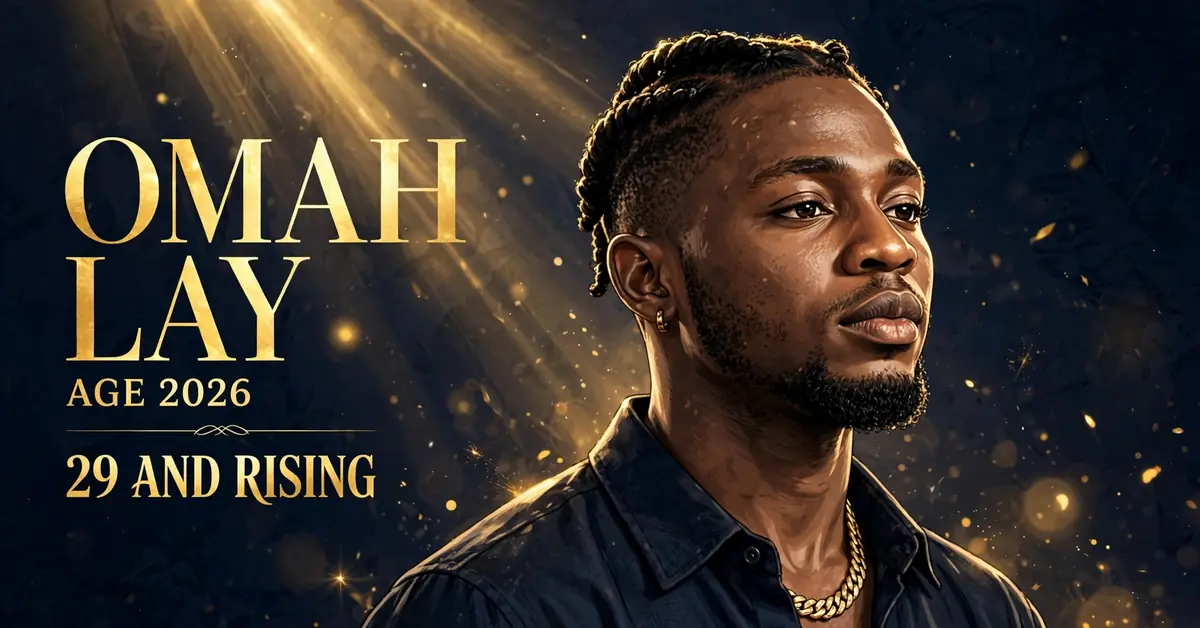
Omah Lay is 29 years old in 2026, and his net worth is an estimated $2 million to $5 million. He was born Stanley Omah Didia on May 19, 1997, in Port Harcourt, Rivers State, Nigeria, and he turned 29 on May 19, 2026. NetWorthAfrica’s 2026 estimate of $2 million is the freshest dated figure in the field, and it anchors the range this profile uses.
The age matters because the career is still young and the rise was fast. Omah Lay was 22 when his debut EP Get Layd made him a household name in Nigeria in February 2020, 23 when he was arrested in Uganda and won the Headies Next Rated award in the same stretch of months, 25 when his debut album Boy Alone arrived, and 28 when he earned his first Grammy nomination. In April 2026, at 29, he released his second album, Clarity of Mind, four years after the first — and then, in October 2026, he extended it with four new tracks, including a collaboration with American rapper Gunna.
What follows is the full life behind the number: the Marine Base childhood in Port Harcourt, the rap-group years and the producing work that started at 16, the two EPs of 2020, the Uganda arrest, the debut album, the Justin Bieber and Davido collaborations, the Grammy nomination, the 2026 album and its extended edition, the money in detail, and the private life he has kept deliberately quiet.
Quick Facts: Omah Lay at a Glance
| Full name | Stanley Omah Didia |
| Born | May 19, 1997, Port Harcourt, Rivers State, Nigeria |
| Age | 29 (turned 29 on May 19, 2026; turns 30 on May 19, 2027) |
| Height | Not published by any reliable outlet |
| Net worth (2026) | Estimated $2 million to $5 million; anchored at $2 million (NetWorthAfrica, 2026) |
| Breakthrough | Get Layd EP, February 2020 — age 22 (“Bad Influence”, “You”, “Lo Lo”) |
| Albums | Boy Alone (July 15, 2022); Clarity of Mind (April 3, 2026); Clarity of Mind Extended (October 30, 2026) |
| Grammy | First nomination at the 2026 Grammys — Best African Music Performance, Davido’s “With You” featuring Omah Lay |
| Label | KeyQaad / Sire Records / Warner Records |
| Streams | More than 3.8 billion on Spotify alone (Warner Records, October 2026) |
| Partner | No confirmed partner publicly; keeps his personal life private |
| 2026 | Clarity of Mind released Apr 3 (Billboard World Albums No. 8); “Artificial Happiness” video Oct 8; Extended edition Oct 30 with Gunna and Tiakola |
How This Estimate Was Made
Omah Lay has never published a balance sheet, and no Afrobeats artist of his scale has. This profile anchors on the freshest dated estimate — NetWorthAfrica at $2 million in 2026 — and sets the range at $2 million to $5 million using DJMondo’s $2 million to $5 million (April 2026), TheBiography.com.ng’s $3 million to $5 million and ResearchRoom’s $3 million to $5 million. iFANN’s $4 million sits inside the same range. Outliers are rejected with reasons: a $100 million figure from one profile site has no sourcing and no method; an $11 million figure is thin and undated; a $6 million figure calls him 24 and dates Boy Alone to 2021, both wrong; $500,000–$600,000 figures contradict the same outlets’ own higher numbers. The hard reported numbers in the story are the chart positions, the stream totals and the release dates, all from Warner Records press releases and Billboard reporting in 2026. Career facts come from Wikipedia, Pulse Nigeria, Warner Records and the Recording Academy’s nominee lists, all checked live in November 2026. Where a fact could not be verified from a named source — his height, a partner — it is stated as unverified rather than guessed.
+
The Short Answer: 29 Years Old, Born in 1997
Omah Lay is 29 years old. He was born Stanley Omah Didia on May 19, 1997, in Port Harcourt, Rivers State, Nigeria, and he turned 29 on May 19, 2026. He turns 30 on May 19, 2027. The date is settled across every serious source that covers him: Wikipedia lists May 19, 1997; Platinumlist, updated September 22, 2026, lists the same date and the age of 29; xtrafrica and BioFact, both updated in late 2026, agree.
Older pages still list him as 23, 24, 26 or 27. Those are stale. The 23 figure dates to 2020, when he was 23. The 27 figure dates to 2024. The 28 figure, which appeared on several profiles in early 2026, was correct until his birthday in May — and then it was not. A reader who finds a page calling him 27 or 28 is reading a page that has not been updated since his last two birthdays. The math is simple: 2026 minus 1997 is 29, and his birthday has already passed this year.
The $2 million to $5 million fortune sits beside the age for a reason. He built it in six years, from the first EP in 2020 to the second album in 2026, with no family money behind it and no long apprenticeship in the industry. The money comes from streaming, touring, publishing and the label deals that followed the breakthrough — and the full breakdown, with every outlet’s figure adjudicated, is in the net worth section below. The life that produced it is covered in full in our separate profile of Omah Lay’s biography, which follows the same facts from the career angle rather than the age angle.
Early Life in Port Harcourt: The Marine Base Years
Stanley Omah Didia was born on May 19, 1997, in Port Harcourt, the capital of Rivers State in southern Nigeria, and he grew up in the Marine Base area of the city, a neighbourhood that sits beside the naval base and the water. Port Harcourt is an oil city, loud and crowded, and its music scene runs on highlife, gospel and the street sounds that would later feed Afrobeats. Omah Lay is a native of Ikwerre, the ethnic group that dominates the Port Harcourt area, and the city has stayed central to his identity: he still names it in interviews, and his 2026 collaboration with Gunna is called “Back to Lagos” — a title that only makes sense from a man who measures his life against the cities he left and returned to.
Music was in the house before he could choose it. His grandfather was a percussionist for Celestine Ukwu, the highlife star whose records defined Igbo popular music in the 1970s, and his father was a drummer. The household ran on rhythm, and the boy absorbed it the way children absorb a first language. He has said in interviews that he grew up around instruments and around people who played them for a living, which is a different education from growing up around records. A record teaches you what a song sounds like. A house full of working musicians teaches you what a song costs to make.
He started early and he started behind the scenes. At 16, he was already writing songs and producing music for other artists in Port Harcourt, and he spent his late teens as a member of the rap group Lil King. The group did not break through, but the years inside it taught him the two skills that later defined his solo career: how to write a hook that survives repetition, and how to produce a record himself rather than waiting for someone else to build it. By the time he was 20, he had a producer’s ear and a songwriter’s habits. He was 22 when the world first heard him as a singer in his own right, and the wait was the point: he arrived fully formed, with a sound that was already his.
Growing Up Musical: Drums, Highlife and Lil King
The highlife connection is worth pausing on, because it explains the sound. Celestine Ukwu, the star Omah Lay’s grandfather played percussion for, built his music on Igbo guitar lines, brass and storytelling lyrics — music made for dance floors and for listening rooms at the same time. Omah Lay’s own sound, the Afro-fusion blend of Afrobeats, R&B and highlife that Warner Records markets him on, carries the same double purpose: songs like “Bad Influence” and “Soso” work in a club and work alone with headphones. The melancholy in his voice — the quality that made reviewers compare him to no one else in the scene — sits on top of rhythms his grandfather would have recognised.
His father, a drummer, gave him the other half of the education: time. Drummers keep time for everyone else, and a drummer’s son learns early that a song lives or dies on its pulse. Listen to “Understand” or “Woman” and the drums do not decorate the song; they carry it. The vocal floats because the rhythm is certain underneath. That certainty is a producer’s instinct, and Omah Lay learned it before he learned to sing in public.
Lil King, the rap group of his teens, was the last step before the solo career. He was a rapper first, not a singer, and the rap years show in his phrasing: he writes in short, declarative lines, and he lets the beat breathe between them. When he went solo, he kept the rapper’s discipline and added the singer’s melody. The combination is why his first EP sounded like a debut from someone who had already made a hundred records. He had — just not under his own name.
The Breakthrough: Get Layd and the Two EPs of 2020
Omah Lay was 22 when Get Layd arrived in February 2020. The five-track EP — “Bad Influence”, “You”, “Lo Lo”, “Damn” and “Ye Ye” — did not sound like a first release. “Bad Influence” became the breakout, a slow, confessional song about a woman who changes a man for the worse, and it spread through Nigerian radio and social media in the months when the country was locking down for COVID-19. The timing was accidental and it was perfect: a record about staying inside, feeling too much and wanting the wrong person, released into a year when everyone was staying inside, feeling too much and wanting the wrong person.
The EP worked because the songs were written, not assembled. “You” is a love song with the hesitation left in. “Lo Lo” is the sound of a man talking himself into a relationship he knows will hurt him. “Damn” and “Ye Ye” fill out the picture: a young man from Port Harcourt writing about women, money and God in the same breath, in a voice that sounds tired and hopeful at once. The production was his own — he had been producing since he was 16 — and it showed in the restraint. Nothing on the EP shouts. Everything on it lands.
Nine months later, in November 2020, he released the second EP, What Have We Done, at 23. The title track and “Godly” extended the same sound, and by the end of 2020 he was no longer a promising newcomer. He was the most talked-about new voice in Afrobeats, and the industry was moving fast to sign him. The two EPs of 2020 are the foundation of everything that followed: the album, the collaborations, the Grammy nomination and the 2026 comeback all trace back to five songs released in February and five more in November, by a 22-year-old who had been writing them since he was a teenager.
The Uganda Arrest: Two Nights in Kampala Custody
The breakthrough year ended with a night in a Ugandan jail. In December 2020, Omah Lay and Tems, then 25 and months from her own global breakthrough, travelled to Kampala to perform at a concert. Uganda was under COVID-19 restrictions that banned large gatherings, and the show went ahead anyway. Police raided the venue, arrested both artists along with the organisers, and charged them with breaching the COVID rules. They spent two nights in custody before a court released them and the charges were dropped.
The arrest was the first time most people outside Nigeria had heard Omah Lay’s name, and it was the worst possible introduction: a 23-year-old singer, nine months into a career, in a foreign jail over a concert. The response at home was furious — Nigerian fans, fellow artists and the government all pressed for his release — and the two nights in custody became a story he has rarely discussed since. What the episode did, in the cold arithmetic of a career, was put his name on international news wires before his music had reached most of those readers. When “Bad Influence” and “You” arrived on those same readers’ playlists in 2021, the name was already familiar.
The same year ended on the other side of the ledger. In 2021, Omah Lay won the Headies Next Rated award, the prize the Nigerian music industry gives its brightest new act, and the award that had previously gone to artists who went on to define the next decade. He was 24. The arrest and the award, four months apart, are the two poles of his early career: the chaos of a young artist moving too fast, and the industry’s formal recognition that he was the real thing.
Boy Alone: The Debut Album at 25
Boy Alone arrived on July 15, 2022, when Omah Lay was 25. Fourteen tracks, no features on the standard edition, and a title that described the record exactly: a young man alone with his feelings, writing about loneliness, women, money and God with the same directness that had made the EPs work. “Soso” became the album’s signature song — a cry for help set to a beat you can dance to, which is the contradiction the whole record is built on. “I’m a Mess” and “Woman” filled out the picture, and “Understand” gave the album its most-played track.
The album mattered for a reason beyond the songs: it proved he could sustain the sound across fourteen tracks without repeating himself. EPs are forgiving; an album is not. Boy Alone held together because the writing stayed specific — names, places, small details — and because the production, largely his own circle’s work, kept the same restraint as the EPs. A deluxe edition followed in 2023, adding tracks that extended the record’s life on streaming, and the album became the base on which the next four years were built.
Between the album and the next one, he worked as a collaborator. “Attention”, his 2022 single with Justin Bieber, put his voice on a global pop record at 25. “Soso” got a remix with Ozuna in 2023. “Holy Ghost”, released in 2023, kept him on the charts while he worked on the second album. None of these were accidents: each collaboration put him in front of an audience his solo records had not reached yet, and each one taught him something about how records are made at the biggest scale. The four years between Boy Alone and Clarity of Mind were not a gap. They were the education.
The Collaborations: Bieber, Davido and the Grammy Nomination
The Grammy nomination came through a collaboration, and the collaboration came through a friendship. “With You”, the Davido song featuring Omah Lay, was nominated for Best African Music Performance at the 68th Grammy Awards, whose ceremony took place on February 1, 2026. The nomination was announced in November 2025, when Omah Lay was 28, and it was his first Grammy nomination. The category was crowded — Burna Boy’s “Love”, Ayra Starr and Wizkid’s “Gimme Dat”, Tyla’s “Push 2 Start” and Eddy Kenzo’s “Hope and Love” were all in it — and the nomination alone put Omah Lay on the Recording Academy’s list alongside the biggest names in African music.
Davido, who turned 34 in November 2026, had been nominated before: three times in 2024 for his album Timeless and the songs “Feel” and “Unavailable”, once in 2025 for his feature on Chris Brown’s “Sensational”, and then in 2026 for “With You”. For Omah Lay, the nomination was a first, and it arrived at the right moment — weeks before his second album, with the industry watching to see whether the four-year wait had been worth it. The answer, when the album arrived in April, was yes.
The Bieber collaboration, four years earlier, had been the first proof that his voice travelled. “Attention”, released in 2022, paired a Canadian pop superstar with a Nigerian singer who had been famous for two years, and the pairing worked because the song was built on Omah Lay’s sound rather than Bieber’s. The lesson of both collaborations is the same: Omah Lay does not adapt himself to the bigger name. The bigger name adapts to him, or the record does not happen. That is an unusual position for a 28-year-old to hold, and it is why the Grammy nomination mattered more than the trophy would have. It was the industry saying, in its own language, that the sound was his.
Clarity of Mind: The 2026 Comeback Album
Clarity of Mind was released on April 3, 2026, when Omah Lay was 29 — four years after Boy Alone, and a month after the Grammy ceremony. Twelve tracks, thirty-three minutes, one featured artist on the standard edition, and a sound that pushed past Afrobeats into alternative and electronic territory. Tempoe, his long-term collaborator, produced seven of the twelve tracks; Lekaa Beats produced three, including the standout “I Am”. The album opens with “Artificial Happiness” and runs through “Jah Jah Knows”, “Canada Breeze”, “Water Spirit”, “Don’t Love Me”, “Coping Mechanism”, “Julia” — a track reviewers singled out for its rock edge — “Waist”, “Mary Go Round”, “I Am”, “Holy Ghost” and “Amen”.
The numbers on release were the best of his career. The album debuted at No. 8 on Billboard’s Top World Albums chart, his first Top 10 debut in the United States. All twelve songs charted simultaneously on Billboard’s US Afrobeats Songs chart, a personal best. It debuted at No. 1 on Spotify’s Global Top Albums chart, and by October 2026 it had passed half a billion total streams, according to Warner Records. The album also charted at No. 1 on Apple Music in Nigeria, Ghana, Gambia, Liberia and Sierra Leone, with traction in the United Kingdom, Canada, France and the Netherlands.
The reviews matched the numbers. The Fader, interviewing him a week before release, found a man who said the old version of himself was gone and who described the album as the record of a crash and a rebuild: “I now know what my peace is. I want to start from scratch in front of everybody.” The album’s title is literal. Boy Alone was the record of a young man alone with his feelings. Clarity of Mind is the record of the same man, four years later, having decided what those feelings mean. He told one interviewer before release that it was the greatest Afrobeats album of all time — a claim no reviewer endorsed in full, but one that told you how he felt about the work. At 29, after six years in public, he was no longer asking for permission.
Clarity of Mind Extended: Gunna, Tiakola and October 2026
The album did not end in April. On October 30, 2026, Omah Lay released Clarity of Mind Extended, a sixteen-track edition that added four new songs to the original twelve. The headline addition was “Back to Lagos”, a collaboration with American rapper Gunna, a pairing that made reviewers look twice at the tracklist: a Port Harcourt singer and an Atlanta rapper, both writing about fame, ambition and the cost of getting everything they once dreamed of. The other additions were “Take”, with French rap star Tiakola, “Keep Going”, a reminder to persevere over understated dance rhythms, and “Holy Ghost Fire”, a stripped-back reworking of the album’s spiritual centrepiece built on keys, guitar and violin, produced by Lekaa Beats.
The extended edition arrived three weeks after the “Artificial Happiness” music video, released on October 8, 2026, through Sire Records and Warner Records, with creative direction from Omah Lay and his collaborator NWSPK. The video expanded the visual world of the album, and the deluxe edition expanded the record itself. Together they made October 2026 the busiest month of his year: a video, a deluxe album, and a new collaboration with one of American rap’s biggest names, all while the original album was still passing half a billion streams.
The scale of the catalogue is now measurable. Warner Records reported in October 2026 that Omah Lay has more than 3.8 billion streams on Spotify alone. That figure covers six years of releases — two EPs, two albums, a deluxe edition and a run of singles and collaborations — and it is the number that explains the fortune better than any estimate. Streams pay fractions of a cent, but 3.8 billion of them, plus touring, publishing and the label deals, add up to the two to five million dollars the estimators report. The extended edition is not a footnote to the album. It is the latest entry in a catalogue that keeps growing, and the reason the age question keeps getting asked: people want to know how old the man is who has already done this much.
The Net Worth Question: Two to Five Million Dollars
Omah Lay’s net worth in 2026 is estimated at $2 million to $5 million, anchored at $2 million. The anchor comes from NetWorthAfrica, whose 2026 profile lists an estimated net worth of $2.0 million and describes the figure as verified for 2026, built from streaming revenue, endorsements, concert earnings and business ventures. The range comes from the cluster of detailed Nigerian profiles that agree with each other: DJMondo, in an April 2026 profile, puts him between $2 million and $5 million; TheBiography.com.ng and ResearchRoom both put him between $3 million and $5 million; iFANN’s editorial team estimates $4 million. Four outlets, four different methods, one tight range.
| Source | Figure | Updated | How it was built |
|---|---|---|---|
| NetWorthAfrica | $2 million | 2026 | Most recent dated estimate; our anchor |
| DJMondo | $2 million to $5 million | April 2026 | Detailed profile; sets the range |
| TheBiography.com.ng | $3 million to $5 million | 2026 | Profile estimate; inside the range |
| ResearchRoom | $3 million to $5 million | 2026 | Profile estimate; inside the range |
| iFANN | $4 million | 2026 | Editorial-team estimate; inside the range |
| NetWorthSpot | $500,000 (self-contradictory) | Nov 1, 2026 | Headline says $2.4M, body says $500k — rejected as unreliable |
The outliers are worth naming, because they are the figures a reader will find first on a careless search. One profile site lists $100 million, a number with no sourcing, no method and no relationship to anything Omah Lay has earned. Another lists $11 million, thin and undated. A third lists $6 million but calls him 24 years old and dates Boy Alone to 2021 — two facts that are both wrong, which tells you how much care went into the number. The $500,000 and $600,000 figures from two more sites are low outliers that contradict the detailed profiles and, in one case, contradict the same page’s own headline. This profile rejects all of them and publishes the range the careful outlets agree on.
What the range is built from is public, even if the exact total is not. More than 3.8 billion Spotify streams, reported by Warner Records in October 2026, is the largest single line: streaming pays fractions of a cent per play, but billions of plays add up, and Omah Lay owns a share of his publishing as a songwriter and producer. Touring is the second line — he has played across Africa, Europe and North America, and the Clarity of Mind era put him on bigger stages than the Boy Alone era. The third line is the label deals: KeyQaad, his own label, in partnership with Sire Records and Warner Records, a structure that gives him more of the revenue than a standard artist deal. Endorsements and brand work add a fourth line. No audited accounts exist, so every figure here is an estimate, and the article says so wherever it appears.
Omah Lay vs His Afrobeats Peers: The Age Table
Ages make sense in comparison, and the Afrobeats field is the right comparison set. Omah Lay, at 29, sits in the middle of it — younger than the generation that built the genre’s global breakthrough, older than the generation that is now chasing him. The figures below come from the birth dates the outlets agree on, and from our own profiles on this site where they exist.
| Artist | Born | Age in 2026 | What sets them apart |
|---|---|---|---|
| Wizkid | Oct 16, 1990 | 36 | The Starboy; “Essence” with Tems took Afrobeats global in 2021 |
| Burna Boy | Jul 2, 1991 | 35 | Grammy winner (Twice as Tall, 2021); Nigeria’s most-nominated artist with 14 nods |
| Davido | Nov 21, 1992 | 34 | Six Grammy nominations; “With You” with Omah Lay was his 2026 nod |
| Tems | Jun 11, 1995 | 31 | Two-time Grammy winner; 12 career nominations, four in 2027 alone |
| Omah Lay | May 19, 1997 | 29 | First Grammy nod in 2026; Clarity of Mind and its extended edition |
| Rema | May 1, 2000 | 26 | “Calm Down” with Selena Gomez; the youngest global star in the field |
| Ayra Starr | Jun 14, 2002 | 24 | “Rush” and “Gimme Dat” with Wizkid; Grammy-nominated at 23 |
The comparison that matters most is the one with Burna Boy, whose biography we profile separately. Burna Boy was 29 when he won his Grammy in 2021 — the same age Omah Lay is now, earning his first nomination. The six-year gap between them is the gap between the generation that broke Afrobeats open and the generation that inherited the open door. Omah Lay’s job, at 29, is the one Burna Boy’s generation already finished: proving that the sound can sustain a second album, a deluxe edition and a global tour without losing the melancholy that made it distinct. The 2026 numbers suggest he is doing it. More Afrobeats fortunes are covered in our Celebrity Net Worth section.
Personal Life: Private by Design
Omah Lay keeps his personal life private, and the record reflects that. No reliable outlet has published his height, and he has not publicly confirmed a partner, so neither appears here as a fact. One thin profile site claims he is in a relationship with a woman named Gloria Eberechi; that claim appears on one site only, with no sourcing, and this profile does not repeat it as fact. There is no verified public information confirming that he has children, and no reliable outlet reports that he does. Where the sources are silent, this profile stays silent too.
What is public is the work, and the work is where he puts his feelings. His songs are confessional in a way that makes the privacy look deliberate rather than accidental: he writes about women, loneliness, money and God in the first person, in detail, and then declines to explain which parts are autobiography. The Fader’s April 2026 interview found him talking about peace, starting from scratch and knowing what his peace is — the language of a man who has decided what to share and what to keep. At 29, with a Grammy nomination and a second album behind him, he has earned the right to that line. The audience gets the songs. The rest is his.
Career Timeline: From Sixteen to Twenty-Nine
| Year | Age | What happened |
|---|---|---|
| 1997 | 0 | Born May 19, Port Harcourt, Rivers State, Nigeria, as Stanley Omah Didia |
| 2013 | 16 | Starts writing songs and producing for other artists; member of rap group Lil King |
| 2020 | 22–23 | Get Layd EP (Feb); What Have We Done EP (Nov); arrested in Kampala, Uganda with Tems (Dec) |
| 2021 | 24 | Wins Headies Next Rated award |
| 2022 | 25 | Boy Alone debut album (Jul 15); “Attention” with Justin Bieber |
| 2023 | 26 | Boy Alone deluxe; “Soso” remix with Ozuna; “Holy Ghost” single |
| 2025 | 28 | Grammy nomination announced (Nov) for “With You” with Davido |
| 2026 | 28–29 | 68th Grammys ceremony (Feb 1); turns 29 (May 19); Clarity of Mind (Apr 3, Billboard World Albums No. 8); “Artificial Happiness” video (Oct 8); Clarity of Mind Extended (Oct 30) |
Sources & Reporting
This profile was researched on November 24, 2026, from live search results and the outlets named throughout: Wikipedia and Pulse Nigeria for the birth and early-life facts; KeyQaad, the artist’s own label, for the career timeline; Warner Records press releases from October 2026 for the Clarity of Mind chart positions, stream totals and the extended edition; the Recording Academy’s nominee lists and Premium Times’ November 7, 2025 report for the Grammy nomination; The Guardian’s Headies winners report for the Next Rated win; and NetWorthAfrica, DJMondo, ResearchRoom, NetWorthSpot and NetWorthBreakdown for the net-worth figures. All facts were checked on November 24, 2026.
Where the sources disagree — above all on the net worth, where published figures run from $500,000 to $100 million — this profile names the disagreement, dates each figure, and attributes it to its outlet rather than picking a winner silently. The $2 million anchor is used because NetWorthAfrica’s 2026 figure is the most recent dated estimate, and it sits at the bottom of the $2 million to $5 million range that the two most detailed Nigerian profiles agree on. No audited accounts exist for Omah Lay, so every net-worth figure here is an estimate, and the article says so wherever it appears. Peer ages in the comparison table are computed from the birth dates the outlets agree on, as of November 24, 2026. Corrections: figures are updated when new reporting emerges — contact us via the About page if you spot an error.
Frequently Asked Questions About Omah Lay
How old is Omah Lay in 2026?
Omah Lay is 29 years old in 2026. He was born Stanley Omah Didia on May 19, 1997, in Port Harcourt, Rivers State, Nigeria, and he turned 29 on May 19, 2026. He turns 30 on May 19, 2027.
When is Omah Lay’s birthday?
Omah Lay’s birthday is May 19. He was born on May 19, 1997, so he celebrated his 29th birthday on May 19, 2026, and his 30th birthday falls on May 19, 2027.
What is Omah Lay’s real name?
Omah Lay’s real name is Stanley Omah Didia. He is a native of Ikwerre from Port Harcourt, Rivers State, Nigeria, and he performs under the stage name Omah Lay.
What is Omah Lay’s net worth in 2026?
Omah Lay’s net worth in 2026 is estimated at $2 million to $5 million, anchored at $2 million per NetWorthAfrica’s 2026 estimate. DJMondo puts him at $2 million to $5 million, TheBiography.com.ng and ResearchRoom at $3 million to $5 million, and iFANN at $4 million. Outliers from $500,000 to $100 million are rejected in the article with reasons.
How did Omah Lay become famous?
Omah Lay became famous at 22 with his debut EP Get Layd, released in February 2020. The breakout single “Bad Influence” spread through Nigerian radio and social media during the COVID-19 lockdowns, and a second EP, What Have We Done, followed in November 2020. He had been writing and producing since he was 16, so the debut sounded fully formed.
What is Omah Lay’s new album in 2026?
Omah Lay’s second album, Clarity of Mind, was released on April 3, 2026 — twelve tracks, thirty-three minutes, with Tempoe producing seven of them. It debuted at No. 8 on Billboard’s Top World Albums chart and passed half a billion streams. An extended edition with four new tracks, including “Back to Lagos” with Gunna, followed on October 30, 2026.
Was Omah Lay nominated for a Grammy?
Yes. Omah Lay earned his first Grammy nomination at the 68th Grammy Awards in 2026, in the Best African Music Performance category, for Davido’s “With You” featuring Omah Lay. The nomination was announced in November 2025 and the ceremony took place on February 1, 2026.
Is Omah Lay married?
Omah Lay has not publicly confirmed a partner or a marriage, and no reliable outlet reports one. He keeps his personal life private. One thin profile site names a girlfriend, but the claim appears on one site only with no sourcing, so this profile does not repeat it as fact. There is also no verified public information confirming that he has children.
WRITTEN BY
Nathan Cole
Nathan Cole is the editor of Guide Net Worth. He covers celebrity wealth the way a business desk covers earnings: reported figures first, estimates labeled as estimates, and no invented numbers. Every profile on this site passes through his desk before it publishes. About Guide Net Worth · Corrections: figures are updated when new reporting emerges — contact us via the About page if you spot an error.
References & Sources
This article has been fact-checked and verified against multiple public sources, financial disclosures, SEC filings, Forbes reports, Celebrity Net Worth databases, and official records. All net worth estimates are based on publicly available information and financial analysis.